Although most climate change forecasts are based on computer simulation, this one has been tested in the real world. The scientists used natural volcanic seeps rich in carbon dioxide to observe the changes to sea floor ecosystems as water chemistry changes with greater levels of dissolved carbon dioxide.
“Carbon emissions might boost plant life in the oceans, but not all plant life will benefit equally,” said Sean Connell, of the Environment Institute at the University of Adelaide.
“Weedy species are quicker to capitalise on nutrients, such as carbon, and can grow faster than their natural predators can consume them.
Weedy turf wins
“Unfortunately, the carbon dioxide that humans are pumping into the atmosphere by burning fossil fuels gets absorbed by the ocean and favours weedy turfs, which replace kelp forests that support higher coastal productivity and biodiversity.”
He and colleagues from Australia, the US, New Zealand, Italy and Hong Kong report in the journal Ecology that they made a series of samples of submarine plant growth at natural volcanic vents in New Zealand’s Bay of Plenty: they looked at rocky reefs on which grew a mosaic of kelp and turf algae, along barren stretches grazed by sea urchins and a native New Zealand mollusc.
They chose the sites because the levels of carbon dioxide – and therefore the measures of acidity – in the water were roughly what climate scientists would predict for the end of this century, if humans go on releasing greenhouse gases.
They found that ecosystems changed with shifts in water chemistry. “While elevated carbon dioxide caused some weeds to be eaten in greater amounts, the dominant sea urchin predator ate these weeds at reduced amounts. This enabled the weeds to escape their natural controls and expand across coasts near the elevated carbon dioxide,” Connell said.
The slow but inexorable changes in ocean acidity will have inevitable consequences for coastal protection offered by natural ecosystems. Kelp forests provide habitat or nourishment for seals, sea otters, sea lions, whales, cormorants, gulls, terns and shore birds as well as fish. There is evidence that warming has already damaged some of Australia’s kelp forests.
Researchers have been issuing such warnings for years: among them Professor Connell and his co-author from Adelaide, Ivan Nagelkerken, who, three years ago, surveyed 632 scientific studies of a huge range of marine habitats to conclude that the overall effect of acidification was to impoverish ocean life.
“Under the level of acidification we will find in the oceans in a few decades, marine life is likely to be dominated by fast-growing and opportunistic species at the expense of longer-lived species with specialist lifestyles, unless we set some change in place,” said Nagelkerken.
“We need to consider how natural enemies might be managed so that those weedy species are kept under control.”
We are delighted to welcome three new expert editors to the Physics World team, each of whom will be working to expand our coverage of a specific research field that benefits from an interdisciplinary approach. Tami Freeman will focus on medical physics and the biosciences, Liz Kalaugher will specialize in environment and energy, and Anna Demming will be covering materials science and technology, particularly at the nanoscale.
From the left: Liz Kalaugher, Tami Freeman and Anna Demming
Tami, Liz and Anna have been writing about their specialist fields for many years, and you can explore their content in detail through our topic pages for medical physics, biophysics and bioengineering, environment and energy, and materials. We are also introducing specialist e-mail newsletters in each of these areas, and we’ll be in touch to let you know how you can sign up to receive these weekly e-mail updates.
In a particularly exciting initiative, our three new editors have also been working with groups of PhD students who have shown a real talent for science communication. Tami, Liz and Anna have provided training and mentorship to more than 50 student contributors over the last year or so, and these students have together have written more than 150 news articles about scientific advances that have piqued their interest.
This initiative has been so successful that we now plan to expand our student network into other fields covered by Physics World. If you are a PhD student who would relish the chance to work alongside our professional science journalists, or you know a student who is a great communicator, find out how to join our network of student contributors.
As ever, we’re keen to know what you think about the Physics World site and our newly expanded content programme. Please contact us at pwld@iop.org to let us know your views.
It is Mental Health Awareness Week, so a good time to pause and think about how things like stress and anxiety affect you, your friends and colleagues. In “Recognizing mental health in the research environment” Jenni Dyer – head of diversity at the Institute of Physics – blogs about her experience at a one-day workshop exploring mental-health issues in the science, engineering, technology and mathematics.
Inspired by Dyer’s blog, physicist Jess Wade of Imperial College has sent us a doodle (see figure) in which she reflects on the myriad pressures bearing down on academics.
And if you missed “My invisible battle” about one physicist’s experience with mental health issues, I highly recommend it.
Scale plays a crucial role physics, and biophysics is no exception. It explains why the world isn’t populated by spiders several metres tall and why an ant can easily carry multiple times its own weight. In his series of Christmas Lectures given in 1968, the physicist Philip Morrison uses Gulliver’s Travels as an embarkation point for exploring the physics of the very small and the very big. The lectures are a tradition of the Royal Institution since 1825, and there are now lectures by 21 speakers and spanning the past 50 years available for your viewing pleasure.
“I was excited enough that the signal appeared in my dreams and I had difficulty sleeping that night.” That is how Japanese astronomer Takuya Hashimoto reacted to the observation of oxygen in a galaxy 13.28 billion light-years away. It’s nice when a scientist gets such joy from their work.
Myopia, or short-sightedness, is almost twice as common in the US and Europe today than it was 50 years ago. It has also become an important problem in some Eastern Asian countries where it affects as much as 70 to 90% of the population. Although glasses and contact lenses are the first choice for many people, permanent vision correction by refractive surgery is becoming more popular, even though the procedure is not without risk. A team of researchers at Columbia University in New York has now developed a new, safe and non-invasive technique that makes use of a femtosecond laser to produce a low-density plasma in the cornea. The plasma generates reactive oxygen species that then react with collagenous tissue in the treated area to form cross-links and alter the refractive power of the eye.
In myopia, incoming light focuses in front of, rather than on the retina. Permanent corrective surgery techniques such as laser-assistedin situ keratomileusis (LASIK) and photorefractive keratectomy (PRK) work by reshaping the curvature of the cornea by laser ablating a portion of corneal tissue. Although they work well, these procedures can weaken the cornea and even lead to post-surgical complications. They are not suitable for patients with a weak cornea either.
New non-invasive approach
Researchers led by Sinisa Vukelic have now developed a new, safer approach in which a low-density plasma produced by a low-power ultrafast laser generates an ionization field within biological issue. Although the laser is powerful enough to produce the plasma inside the set focal volume, it does not have enough energy to damage biological tissue, explains Vukelic.
When applied to collagenous tissue (which is present in the cornea), this plasma ionizes water molecules in the region of interest. This ionization produces reactive oxygen species that then interact with collagen fibrils to form chemical bonds, or cross-links. These change the mechanical properties of the treated tissue, so changing the overall macrostructure (or curvature) of the cornea.
Changing the refractive power of the eye
“If we carefully tailor these changes, we can adjust the corneal curvature and thus change the refractive power of the eye,” Vukelic tells Physics World. “And since the process is photochemical, the induced changes remain stable.”
The researchers tested out their technique on pig eyes in the lab and rabbit eyes in vivo. Pig eyes are frequently used in ophthalmic ex vivo research, explains Vukelic, and rabbits as a model for correcting refractive errors.
The technique could not only be used to treat myopia but also conditions like hyperopia, astigmatism and keratoconus, he adds. “This non-surgical alternative to refractive surgery has fewer side effects and might also be suitable for patients with thin corneas, topographical abnormalities and dry eyes, since it would not disrupt the cornea or cause nerve damage.”
The team, reporting its work in Nature Photonics, says that it is now busy trying to understand how laser-induced cross-links deform the cornea. “We are also looking to bring the technique to the patient and start clinical trials in the near future,” says Vukelic.
Plasma physicists who publish on the arXiv preprint server have the widest range of research interests. That is according to a new analysis carried out by theorist Sabine Hossenfelder at the Frankfurt Institute for Advanced Studies (FIAS) in Germany and Tom Price, who have introduced a new way to quantify a scientist’s “scientific broadness”. The authors of the paper, which is published on arXiv, say that determining broadness could be used alongside other metrics to measure a researcher’s output.
Scientists have long determined their output by using quantities such as the h-index – a measure of the quality of an individual’s research output based on the number of published papers and their citation rates. Yet scientists are also keen to put a figure on woollier concepts such as the broadness of their research. “I began to wonder if there isn’t a way to quantify just what we mean by ‘broad interests’,” explains Hossenfelder.
Science needs both, specialized and broad researchers
Sabine Hossenfelder
To quantify broadness, Price and Hossenfelder identified 40,000 key words in the title and abstract of more than 1.3 million papers on arXiv. They then assigned keywords to the papers and their authors, leaving each author with a list of associated keywords. The more similar an author’s keywords were to the distribution of the keywords of all authors in the arXiv database the greater their scientific broadness. “The concept that we try to capture is how widely distributed the topics a researcher has worked on are over all existing topics,” Hossenfelder told Physics World.
When they looked at authors that had more than 20 papers on arXiv, the researchers found that those primarily associated with the categories plasma physics, numerical analysis and statistical mechanics had the highest author broadness, on average. Authors associated with astrophysics of galaxies, representation theory and algebraic geometry, meanwhile, had the lowest broadness.
Interdisciplinary benefits
According to Hossenfelder, broadness is neither good or bad. “I think science needs both, specialized and broad researchers,” she explains. “Each have their place, but each fulfil different needs. Sometimes digging deep into a problem is the way through, and sometimes you find new inspiration while learning what goes on in other disciplines.” The study also looked at looked at where the authors did the work to establish a “country broadness”. They found that researchers based in Israel, Austria and China carried out the broadest research, with Japan, Iran and South Korea languishing at the bottom.
Lutz Bornmann, a sociologist of science at the Max Planck Society in Munich, Germany, who was not involved in the research, told Physics World that crossing disciplinary boundaries is important, particularly when addressing complex problems such as global warming. He adds that broadness could be useful for evaluating individual researchers, explaining that some methods select researchers based on the number of highly-cited papers within certain disciplines, possibly disadvantaging those that work across fields. “The new broadness metric could be used to empirically study that and to reveal this supposed weakness,” he adds.
A minuscule correction to the calculation of Mercury’s orbital precession has been made using previously unexplored consequences of Albert Einstein’s general theory of relativity. Clifford Will at the University of Florida has derived new equations of motion to describe a shift of one degree every two billion years in the direction of orbit’s perihelion. Although the tiny movement is currently undetectable, the correction could soon be measured when the BepiColombo mission to Mercury is launched later this year.
Every century, the perihelion of Mercury’s elliptical orbit – the point where the planet is nearest to the Sun – rotates (or “advances”) by around 0.16°. The shift can mostly be explained by using Newton’s laws to calculate the pull of other planets in the Solar System, however a discrepancy between observations and calculations became apparent in the 19th century. In 1916, Einstein famously solved the mystery using general relativity. Now, Will has shown that calculations made by Einstein – and then improved on by others – do not tell the entire story.
Writing in Physical Review Letters, Will predicts that Mercury’s orbit is further influenced by relativistic “cross-terms”, which account for the general relativistic influence of the Sun throughout the entire Solar System. The terms are described using relativistic equations of motion for a system of multiple bodies, which all exert a gravitational pull on each other. Will derived equations which account for how the gravitational attraction between the Sun and other planets has an indirect influence on the pull between the Sun and Mercury.
Gravitomagnetic field
The cross-term equations also describe other smaller influences, accounting for the similar relativistic effects arising from the gravitational attraction between other planets and Mercury. Additionally, the “gravitomagnetic field” of the other planets – which, in analogy to the magnetic field, is generated by the “mass currents” of the planets – shifts Mercury’s orbit further. Overall, Will predicts an additional perihelion advance of one degree every two billion years.
Later this year, the joint European-Japanese BepiColombo mission will send two probes to orbit Mercury, allowing for far more accurate measurements of its motion. Will hopes that the measurements will confirm his predictions, which could ultimately help to further advance our understanding of general relativity.
Major changes are taking place in the intricate network that supplies healthcare providers around the world with molybdenum-99 (Mo-99), a key radioisotope for nuclear medicine studies. The question is, can the nuclear medicine community avoid another devastating shutdown like the one that occurred in 2009?
Back then, providers were left scrambling after a perfect storm left sites without supplies of Mo-99, which cannot be stockpiled due to its extremely short half-life. In the years since the 2009 crisis, nuclear reactor operators, nuclear medicine pharmacies and practitioners, radioisotope generator manufacturers, medical societies, and other stakeholders have banded together to ensure that adequate supplies of Mo-99 and its technetium-99m (Tc-99m) byproduct are consistently available.
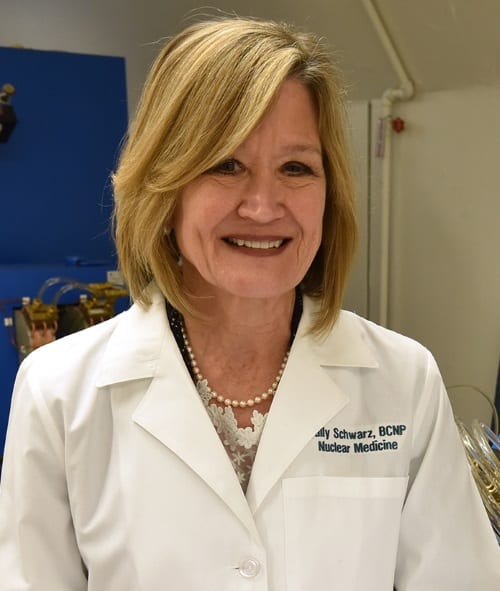
Sally Schwarz from Washington University School of Medicine in St. Louis.
“This whole occurrence of 2009 really presented a wake-up call to the industry at large, but I think we have embraced it,” said Sally Schwarz, co-director of the cyclotron facility at the Washington University School of Medicine in St. Louis. “This has been an extensive and time-consuming process to move this change forward.”
One of the more significant steps to Mo-99 stability was the creation in 2009 of a joint effort between the Organization for Economic Cooperation and Development (OECD) and the Nuclear Energy Agency (NEA). The goal is to coordinate Mo-99 production and develop ways to ensure that supply meets worldwide demand; the organizations’ members cover the gamut of nuclear medicine enthusiasts and meet every six months in Paris.
The Society of Nuclear Medicine and Molecular Imaging (SNMMI) and the European Association of Nuclear Medicine (EANM) are also on hand to advocate for physicians who use radioisotopes in the treatment of their patients.
One of the tenets of the OECD-NEA collaborative is to develop an outage reserve capacity. That means Mo-99 suppliers must have permanent arrangements in place to acquire additional capacity to cover shortfalls when reactors go offline for scheduled or unplanned maintenance.
“On the recommendations of the NEA and OECD, there is a 35% contingency supply,” said Cathy Cutler, director of the Medical Isotope Research and Production (MIRP) program at the Brookhaven National Laboratory. “If someone goes down, you can call on this 35%. They are basically asking radiators to produce this additional amount.”
The outage reserve capacity is maintained by Mo-99 suppliers paying for extra ports and time on a nuclear reactor. If a supply issue occurs, they then have a position in line to acquire additional Mo-99 to cover the shortfall.
Supply and demand
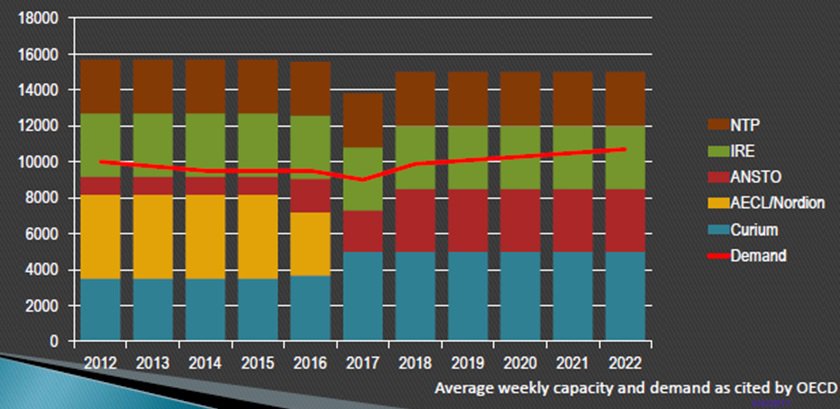
The demand for Mo-99 is expected to grow modestly over the next four years, peaking at approximately 11,500 Ci per week. Interestingly, the anticipated upswing follows a reduced call for Mo-99 in 2017. Currently, the OECD estimates that worldwide demand for Mo-99 is at 9000 six-day Ci per week. Mature markets account for approximately 84% of the demand, while emerging markets take the remaining 16%. The growth rate in mature markets is expected to remain stable at 0.5% through 2021.
Mo-99 production capacity at major producers (six-day Ci per week). (Courtesy: Sally Schwarz)
Whatever demands are to come will be handled by fewer Mo-99 suppliers, however. On March 31, the National Research Universal (NRU) nuclear reactor in Chalk River, Ontario, Canada, went offline for the final time after serving North America for decades. Even before its permanent closure, the NRU reactor manufactured little if any Mo-99 since October 2016. In addition, the Osiris reactor in France shut down at the end of 2015. Their departure leaves four Mo-99 manufacturers who now must cover the loss.
Australian Nuclear Science and Technology Organization (ANSTO)
ANSTO‘s Open Pool Australian Lightwater (OPAL) nuclear reactor currently produces some 2300 Ci per week. With the help of a $168 million ($128 million US) investment from the Australian government, ANSTO is in the process of completing work on its state-of-the-art ANSTO Nuclear Medicine (ANM) Mo-99 production facility. ANM this month received its license to operate and begin testing its Mo-99 production process in May.
“It involves introducing the irradiated low-enriched uranium target plates from the OPAL reactor to the hot cell, extracting and purifying Mo-99 from them, and going through various medicine manufacturing sequences, such as quality control checks,” Jane Senior, general manager for ANM, wrote in an email to AuntMinnie.com.
ANM will take over the primary Mo-99 manufacturing duties from the OPAL reactor, with production increasing to approximately 3500 six-day Ci per week at full capacity, which is scheduled to occur before the end of this year. That amount would allow ANSTO to serve Australia’s needs and potentially accommodate approximately 25% of global demand.
ANM’s ability to perform three Mo-99 runs in one day, rather than one run per day at OPAL, is also expected to provide additional supplies during peak weekend periods.
Curium
Nuclear medicine firm Curium was created in April 2017, three months after IBA Molecular’s acquisition of Mallinckrodt Nuclear Medicine. The entity’s roots date back to 1996 when Dutch radiopharmaceutical producer Nuclear Research and Consultancy Group (NRG) began Mo-99 production at its High Flux Reactor (HFR) in Petten.
Today, Curium takes its Mo-99 supply from the HFR; the Belgian Reactor 2 (BR2) in Mol, Belgium; and the Maria reactor in Warsaw, Poland. Last year, Curium increased its take from four to five runs per week, which brought its capacity to approximately 4500 Ci per week. If necessary, Curium could increase its output to six productions per week.
In addition, Curium has outage reserve capacity arrangements with the three reactor operators, which could add approximately 100 weeks of supply during a Mo-99 shortage. And if one of those reactors goes offline, one of the other two facilities can make up the difference.
NTP Radioisotopes
NTP Radioisotopes in South Africa has its own dedicated nuclear reactor that manufactures a number of targets, including Mo-99. The Safari-1 reactor processing facility completed its conversion to low-enriched uranium (LEU) last September. The reactor’s capacity for Mo-99 is in the range of 1400 Ci per week.
“We want to be in nuclear medicine and the technetium-99m supply business for many years to come,” commented Piet Louw, executive manager for NTP Radioisotopes, during a June 2017 SNMMI forum on Mo-99. “We believe that 20 years from now there will still be a big demand for technetium, and we want to be there to service this demand. We are committed to it and we are making the necessary investments.”
Institute for Radioelements (IRE)
While it is capable of greater capacity, IRE‘s license allows for three days of Mo-99 production or 3500 Ci per week using an LEU process. That output represents approximately 25% of the weekly global demand. IRE also has contracts to take Mo-99 supply from the HFR in the Netherlands, the BR2 in Belgium, and the LVR-15 reactor in the Czech Republic.
“The problem we faced in 2009 and 2010 was not a capacity problem, because the capacity was there,” Jean-Michel Vanderhofstadt, CEO of IRE, recalled at the SNMMI event. “The problem was reliability. Reliability is the key in this business.”
Mo-99 alternatives
Demand for Mo-99 has held fairly steady since the shortage in 2009. One reason for the decline last year may be that nuclear medicine practitioners are wary of history repeating itself and believe they should have other radioisotope options.
“I think part of that [decrease in 2017] is because people have been looking for other isotopes they can use, so they are not so strongly dependent on Mo-99 because of the shortages,” Cutler said.
Among its tasks, Brookhaven’s MIRP program distributes certain commercially unavailable radioisotopes to the nuclear medicine community and develops new radioisotopes for nuclear medicine research. The facility has an accelerator to produce radionuclides and isotopes for imaging.
“One of the prominent uses for Mo-99 is for imaging the heart. Another agent that can be used to do that is strontium-rubidium, which we can make on the accelerator,” Cutler said. “The demand [for strontium-rubidium] has been higher than what is produced. The use of rubidium has been increasing because of the [Mo-99] supply problems.”
At Washington University in St. Louis, there are four clinical cyclotrons that manufacture F-18 FDG, nitrogen-13 ammonia, technetium-99m sestamibi, and carbon-11 choline, among others. The radiotracers are primarily used onsite and not distributed unless the facility receives a call from a nearby imaging centre.
“Although nuclear medicine is not growing rapidly, it still is a very important diagnostic tool and we have a very broad base in the US,” Schwarz said. “We certainly need to be thinking about how we can produce Mo-99 and have technetium-99m.”
Earth’s wet areas – land in the high latitudes and tropics – are getting wetter while dry areas are becoming more dry, according to 14 years of observations from the Gravity Recovery and Climate Experiment (GRACE) mission. The pattern is due to a mix of factors, including water management by people, man-made climate change and natural climate cycles.
“What we are witnessing is major hydrologic change,” said Jay Famiglietti of NASA’s Jet Propulsion Laboratory (JPL), US, in a press release. While water loss in some regions, like the melting ice sheets and alpine glaciers, is clearly driven by warming climate, he noted, it will require more time and data to determine the driving forces behind other patterns of freshwater change.
“The pattern of wet-getting-wetter, dry-getting-drier during the rest of the 21st century is predicted by the Intergovernmental Panel on Climate Change models, but we’ll need a much longer dataset to be able to definitively say whether climate change is responsible for the emergence of any similar pattern in the GRACE data,” Famiglietti said.
A joint NASA/German Aerospace Centre endeavour, GRACE launched a pair of satellites in 2002. Measuring the distance between the two satellites revealed changes in Earth’s gravity field caused by movements of mass – such as water – on the planet below. The mission ended in October 2017.
For this freshwater analysis, Famiglietti and colleagues combined GRACE data with precipitation data and imagery from other satellites, and reports on human agriculture, mining and reservoir operations.
“This is the first time that we’ve used observations from multiple satellites in a thorough assessment of how freshwater availability is changing, everywhere on Earth,” said Matt Rodell of NASA’s Goddard Space Flight Center. “A key goal was to distinguish shifts in terrestrial water storage caused by natural variability – wet periods and dry periods associated with El Niño and La Niña, for example – from trends related to climate change or human impacts, like pumping groundwater out of an aquifer faster than it is replenished.”
The GRACE Follow-On mission is due to launch from California soon.
In the first episode of our new podcast, Physics World Weekly, we bring you a selection of stories on light and light-based technologies. 16 May 2018 was the inaugural International Day of Light, a UNESCO-backed initiative to promote the role light plays in science and society. This annual initiative will provide the legacy of the International Year of Light (IYL 2015), which saw thousands of activities take place across 147 countries, reaching an estimated audience of 100 million people.
In the podcast, Physics World journalist James Dacey visits a pub in Bath where he meets Peter Mosely, a researcher at the centre for photonics and photonic Materials at the University of Bath. On the International Day of Light, Mosely gave a public lecture about his group’s work and its possible applications in quantum computing and cryptography. He tells Dacey about the opportunities and challenges of doing public outreach events.
Also in the podcast, Physics World’s general physics editor Hamish Johnson is in conversation with the magazine’s industry editor Margaret Harris. They discuss a new Institute of Physics report on the state of the photonics industry in the UK and recommendations for its growth. Johnston also speaks about a story he recently covered about how leaks of natural gas can be detected using laser frequency combs.
If you enjoy the podcast then you can subscribe via iTunes or your chosen podcast service. Join us again for another instalment next week. In the meantime, you can also listen to our longstanding monthly podcast, Physics World Stories.
The distribution of pressure inside the proton has been mapped by physicists using the electron accelerator at Jefferson Lab in Virginia, US. By putting a new twist on Compton scattering, the team showed that the extreme repulsive pressure experienced by quarks in the centre of the proton is balanced by strong attractive forces around the edges. The research sheds further light on how quarks are confined inside protons and other hadrons – which is one of the most important mysteries of modern particle physics.
Quantum chromodynamics says that the strong nuclear force binds quarks into protons through the exchange of force particles called gluons, much as the electromagnetism binds electrons into atoms by the exchange of photons. Whereas electromagnetism gets weaker with increasing distance, the strong nuclear force gets stronger. Therefore, knocking a quark out of a proton and studying it in isolation is impossible. Instead, striking a single quark too hard gives the gluon field so much energy that a new quark-antiquark pair is created: “You would produce either a neutron plus a meson (a bound state of a quark and an antiquark) or a proton plus a meson,” explains Jefferson Lab’s Volker Burkert. “We want to study the transition from a proton to a proton so we can see what’s happening in the proton itself – not in the transition to some other state.”
In 1996, Xiangdong Ji of the University of Maryland proposed a way to do this using a process called “deeply virtual Compton scattering”. This involves firing high-energy, spin-polarized electrons at protons. Ji realized that such an electron could exchange energy and angular momentum with a proton in the form of a high-energy virtual photon, which only exists for a tiny fraction of a second. The proton then releases some of this extra energy in the form of a real photon. Ji showed theoretically that, if the scattered electron and proton and the emitted photon were all detected, this could reveal the pressure inside the proton.
Essential developments
Deeply virtual Compton scattering was first detected experimentally in 2000 by Burkert’s group at Jefferson Lab and, independently, by physicists in Germany. Subsequently, there have been several essential experimental and theoretical developments by Burkert, Ji and many others such as measurements of the probability that the process will occur (the scattering cross section) for spin-polarized electrons of various energies and calculations of the links between scattering and internal pressure.
In the new research, Burkert and colleagues at Jefferson Lab brought all of this together for the first time in an experiment. They measured deeply virtual Compton scattering between a spin-polarized beam of 6 GeV electrons and a cryogenic liquid hydrogen target to probe the internal structure of protons. They calculated that there was a repulsive pressure in the proton’s centre of about 1035 Pa – greater than in the centre of a neutron star. Around 0.6 fm (0.6 x 10⁻¹⁵ m) from the centre, however, the forces became strongly attractive and peaking at 0.8 fm radius. The researchers say that this is a significant improvement over our previous understanding of the pressure inside the proton. They anticipate it should be possible to reduce their errors further following the Jefferson Lab accelerator’s recent upgrade from 6 GeV to 12 GeV, potentially unlocking the secrets of quark confinement. The researchers also intend to explore deeply virtual Compton scattering in neutrons.
“It’s a good, interesting study and a first step into the extraction of the quark pressures inside a proton,” says particle physicist Kresimir Kumericki of the University of Zagreb in Croatia. He wants more technical details of the researchers’ error analysis but he says that “even if the uncertainties are larger [than they claim], it’s still important that…such analysis can be used to get a physical picture of the proton.”
Universal concept
“I think it’s a really interesting generalization of the theoretical concept of pressure,” says Oleg Teryaev of the Joint Institute for Nuclear Research in Dubna, Russia. “Pressure unites all the scales, from the universe and cosmology – where you have the cosmological constant – to stars, to hydrodynamics, to heavy-ion physics and now finally to protons. All elements of this relation can be studied and I am looking forward to that with excitement.”