Magnetically focused protons line up for radiosurgery

Improvements in imaging technologies have enabled earlier detection of cancers, creating a need to treat increasingly smaller targets. For proton therapy, however, as the field size decreases below 1.0 cm diameter, multiple Coulomb scattering (MCS) causes broadening of the proton beam. The ensuing beam degradation is typically overcome by using additional treatment beams. But researchers at Loma Linda University are investigating another option: magnetic focusing of protons.

The idea is to counteract MCS by focusing the proton beam immediately before it enters the tissue. Focusing is achieved using a triplet of quadrupole magnets, which produce beams with the near-circular cross sections required to irradiate small spherical targets.

“The main clinical application of magnetic focusing will be irradiation of targets less than 1 cm diameter,” explained senior author Andrew Wroe. “These targets are seen with some regularity in intracranial radiosurgery, and early detection is leading to targets of this size in a number of other anatomical regions.”

The Loma Linda team has now used Monte Carlo simulations to investigate the dosimetric impact of this approach (Phys. Med. Biol. 63 055010).

MC modelling
Wroe and colleagues used Monte Carlo simulations to model protons travelling through a beam line and delivered to a water phantom. They chose a proton energy of 118 MeV to match the range in water (10 cm) commonly used for intracranial radiosurgery. Magnet parameters were selected to match commercial rare-earth permanent magnetic materials.

The researchers compared unfocused collimated proton beams (UNF) with proton beams focused using the magnet triplet (MF3). To do this, they performed baseline simulations with 5, 6, 7, 8, 9, 10 and 11 mm diameter UNF beams, plus matched MF3 beams. Matching was achieved by varying the magnetic field gradient of the triplet (100, 150 or 200 T/m), inter-magnet separation and initial beam diameter. In some cases, more than one combination of initial beam diameter and magnet gradient matched a UNF beam, resulting in 11 investigated MF3 configurations.

All MF3 beams produced spots at the Bragg peak depth with low eccentricity and full-widths at the 90% dose contour from 2.5 to 5 mm. In the 10 cases where the MF3 initial beam diameter was greater than the UNF beam diameter, the focused beams had 16-83% larger peak-to-entrance dose ratios, and 1.3 to 3.4-fold increases in dose delivery efficiency, compared with their matched UNF beams.
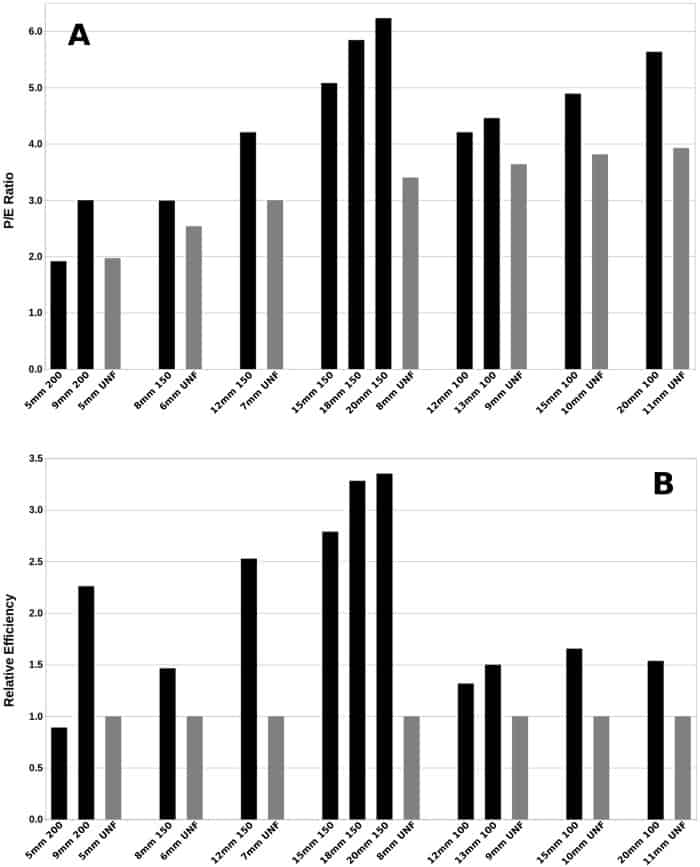
MF3 versus UNF beam properties.

An increased peak-to-entrance dose ratio implies a reduced entrance dose, which for head lesions, translates to a lower dose to the cortex, subcortical regions and scalp. Increased delivery efficiency, meanwhile, could reduce treatment times and increase patient throughput.

“Focused proton beams have the potential to irradiate small radiosurgery targets with lower entrance dose, fewer treatment beams and shorter treatment times compare to current beam delivery methods,” explained lead author Grant McAuley.

“With the shift towards shorter treatments (such as SBRT and SRS courses) for a wider range of clinical sites, the dose rate enhancement potential of magnetic focusing could lead to not only more conformal, but also shorter treatments, which is an important consideration as dose per fraction increases,” Wroe noted.

In cases with more than one MF3 configuration matching a particular UNF beam, certain configurations exhibited superior beam properties. For example, peak-to-entrance dose ratio and efficiency tended to increase with larger magnet gradients and larger initial MF3 beam diameter.
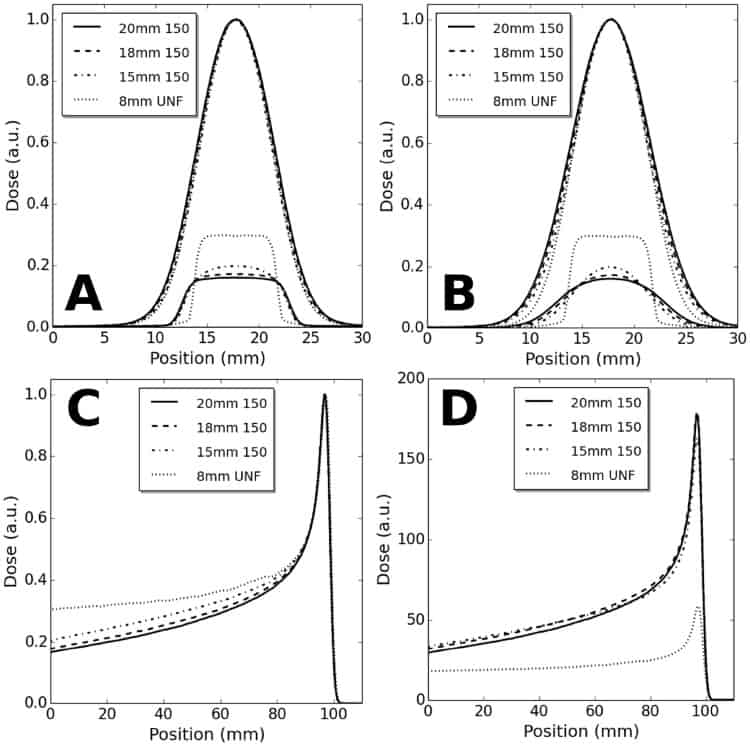
Multiple MF3 beams compared with a single UNF beam

Larger beam diameters, however, generally increase the integral dose. For MF3 beams focused with magnet gradients of 150 T/m and 100 T/m, integral doses were 0-14% and 10-20% larger than their UNF counterparts, respectively, although focusing tended to shift dose from the 80%-20% dose range to below 20% of reference dose.

They researchers note that, for a given magnet gradient, it may be possible to reduce integral dose by using a smaller initial beam diameter, without significant performance loss. They also emphasize that this increased integral dose is based on a single-beam comparison, whereas the increased peak-to-entrance dose ratio may enable removal of at least one treatment beam, greatly reducing the overall integral dose.

Into the clinic
For clinical implementation, focusing magnets made of rare-earth permanent magnetic materials can be manufactured at reasonable costs. Such magnets require neither power nor cryogens and could be easily incorporated into existing proton treatment nozzles.

The researchers envision that they will optimize the focusing system for 3-4 specific target field sizes, such that 3-4 magnetic focusing cones can be employed for proton treatment. The cones would be prescribed during treatment planning and when a specific focusing diameter is required, the appropriate cone will be selected and used in the treatment.

“The optimization will involve balancing parameters including treatment efficiency, peak-to-entrance dose ratio and penumbra. Once this optimization is completed and the cones manufactured, it will not need to be repeated for each patient or use of the system,” Wroe explained. “We are currently working on the prototype system and hope to present the experimental results at the AAPM Annual meeting this year.”


‘Dieselgate’ impacted climate as well as human health

Improved diesel technology, combined with generally better fuel economy, has led to the widespread belief that diesel vehicles are more environmentally friendly than their petrol counterparts

But a new study shows diesel cars with “defeat devices” may have no environmental benefit over petrol cars.

The research looked at the on-road driving impact of Volkswagen cars, compared with the results from laboratory tests.

While previous studies have looked at the health impact of high nitrogen oxide (NOx) emissions from diesel cars with defeat devices, this research, published in Environmental Research Letters, is the first to examine the effect on climate change.

It had two key findings. It showed that, depending on the driving conditions, diesel vehicles with defeat devices can create extra temperature impacts over time.

Second, it found that the climatic advantage of “clean diesel” can disappear if the vehicles have defeat devices.

Katsumasa Tanaka, from the National Institute for Environmental Studies in Japan, is the lead author. He said: “The potential impact is significant. We know VW tuned vehicles to pass lab tests while breaking the respective emission standards on the road, to improve driving performance and fuel consumption. As many as 11 million VW vehicles worldwide gained approval in the lab tests by relying on cheating software. That amounts to 40 per cent of the VW passenger cars sold in the EU from 2009–2015.”

The research team compared the emissions data of two defeat device-equipped VW diesel vehicles – one in “compliance” or laboratory mode, the other in non-compliance or “real world driving” mode.

They then used climate modelling to simulate the temperature response to the vehicles’ emissions over one and 15 years, an assumed vehicle’s lifetime.

They found that the climate effects caused by the non-compliant vehicles over a year showed more complex changes than those shown in the lab tests. This results from excess NOx emissions from on-road driving, which manifest as competing climate effects over various timescales.

Marianne T Lund, a co-author at CICERO Center for International Climate Research in Norway, said: “The picture is complex. The effects from on-road emissions show themselves first as strong short-term warming. This results from tropospheric ozone (O3) responding to excess NOx. In the medium term, the warming drops, due to a reduction in methane concentration and the decay in short-term ozone response.

“But this is followed by long-term warming caused by carbon dioxide emissions, as the methane cooling effect disappears.”

The results show the extra climate impacts of the non-compliant vehicles, shown as the difference between the impacts of the on-road and lab results over 15 years, depend on the timescale as well as the underlying driving patterns.

The non-compliant diesel vehicles produce larger warming climate impacts in the short term than compliant diesel vehicles of equal characteristics, but create smaller impacts in the mid-term.

Yet, differences in the long-term temperature changes, determined by the differences in CO2 and unaffected by NOx, are inconclusive regarding the direction of change.

The question of “clean diesel” offering an environmental advantage is also affected by defeat devices, as well as timescale and driving conditions.

Tanaka explained: “Emissions from diesel vehicles in compliance mode show smaller climate impacts (six to 20 per cent less) than comparable petrol vehicles. But when we look at the results from diesel vehicles in non-compliance mode, we find a slightly larger long-term warming under urban driving conditions, as opposed to a smaller longer term warming under highway driving conditions. This means that the presence of defeat devices undermines the legitimacy of arguments for “clean diesel”.

He concluded: “Our study supports the direction of new emission regulations requiring more data from on-road operations. Designing next-generation policies tackling diesel vehicle exhaust requires input from various perspectives, as well as interdisciplinary discourse.

“The climate impacts need addressing as one of the central issues together with: human health, climate policies, engine technologies, regulatory mechanisms, legitimacy, and ethics to inform policymaking associated with diesel vehicle exhaust.”

Plant physics: the April 2018 issue of Physics World is now out

Image of the cover of the April 2018 special issue of Physics World on plant physics

In an interview with the BBC in 1981, Richard Feynman explained how science let him more fully appreciate the beauty of the natural world. Whereas one of his friends, who was an artist, complained that science could turn even a flower into something dull, Feynman argued that science “only adds to the excitement and mystery and awe” of such an object.

To him, a plant was more than just something pretty to look at; it had a scientific beauty in its structure and colour too. Feynman, though, never studied plants – unlike some of the physicists featured in the April 2018 special issue of Physics World on “plant physics”, which is out now in print and digital format.

There are five features for you to tuck into, including one Feynman would surely have loved, examining the ingenious disordered nanostructures that help flowers to become coloured and attract pollinators. You can also learn about the challenge of growing plants in space, a physics technique to image a plant’s roots, and a “pump-free” system for cooling hypersonic planes that mimics the “transpiration” that carries water from a tree’s roots to its leaves. We end by asking: could quantum physics explain photosynthesis?

Remember that if you’re a member of the Institute of Physics, you can read the whole of Physics World magazine from the start of every month via our digital apps for iOS, Android and Web browsers. Let us know what you think about the issue on TwitterFacebook or by e-mailing us at pwld@iop.org .

For the record, here’s a run-down of what else is in the issue.

  • Physicists mourn Stephen Hawking – The world-famous cosmologist not only carried out groundbreaking research but also brought physics to new audiences.
  • Brexit: views from the top – Matin Durrani and Margaret Harris talk to five figureheads from European science about the threats to researchers and hi-tech companies from Britain leaving the European Union
  • Europe’s new neutron lab forges ahead – Matin Durrani travels to Sweden to catch up on construction of what will be the world’s leading neutron-scattering facility when it opens in 2023
  • Inspiring through games – Hannah Renshall argues that tabletop games can be a powerful tool to get more people interested in physics
  • Achieving innovation – Innovation in physics is simple in principle, but much harder in practice. James McKenzie reckons a business start-up award could be just the thing to help
  • A flowering success – Botany may be as valuable for physicists as physics is for botanists, finds Robert P Crease
  • Rocket for rocketeers – To survive far away from Earth, astronauts need to have green fingers. But the science of growing plants in extraterrestrial environments has a way to go, as Jon Cartwright reports
  • A flower’s nano-powers – When it comes to shapes and colours, flowers are one of nature’s most praised objects – but there is more to them than meets the eye. Tobias Wenzel and Silvia Vignolini reveal an ingenious strategy flowers use to become coloured and attract pollinators
  • Top tips from tree tops – The ability of trees to cool by transporting water from their roots to the leaves has been known for centuries. But as Stephen Ornes discovers, the principles of transpiration are also inspiring innovative techniques to cool vehicles travelling at hypersonic speeds, where unwanted heat is a problem too
  • Rooted in physics – Roots are fundamental to a plant’s survival, but some of their behaviour at a cellular level remains a mystery to scientists. Jess Wade talks to Giovanni Sena, who is particularly interested in how electric fields can affect root growth and regeneration
  • Is photosynthesis quantum-ish? – Is there something inherently quantum about the highly efficient natural process that is photosynthesis, or are researchers barking up the wrong tree? Philip Ball investigates the debate
  • Circle of influence – Andrew Robinson reviews Exact Thinking in Demented Times: the Vienna Circle and the Epic Quest for the Foundations of Science by Karl Sigmund
  • Beyond maths to meaning – Brian Clegg reviews Beyond Weird: Why Everything You Thought You Knew About Quantum Physics is Different by Philip Ball
  • In pursuit of the purest quartz – From a PhD in semiconductor physics to head of Quartz Products at Airbus Defence and Space, Richard Syme looks back at a long and enjoyable career
  • Once a physicist – meet Tim Head, who runs Wild Tree Tech – a software consultancy that builds data analysis products and teaches courses on machine-learning.
  • Field of schemes – Tushna Commissariat examines a mystery in Nebraska in this month’s Lateral Thoughts

And don’t forget, if you have any thoughts on the issue do let us know on TwitterFacebook or by e-mailing us at physics.world@iop.org.

Optimizing 3D polymer scaffolds for cartilage repair

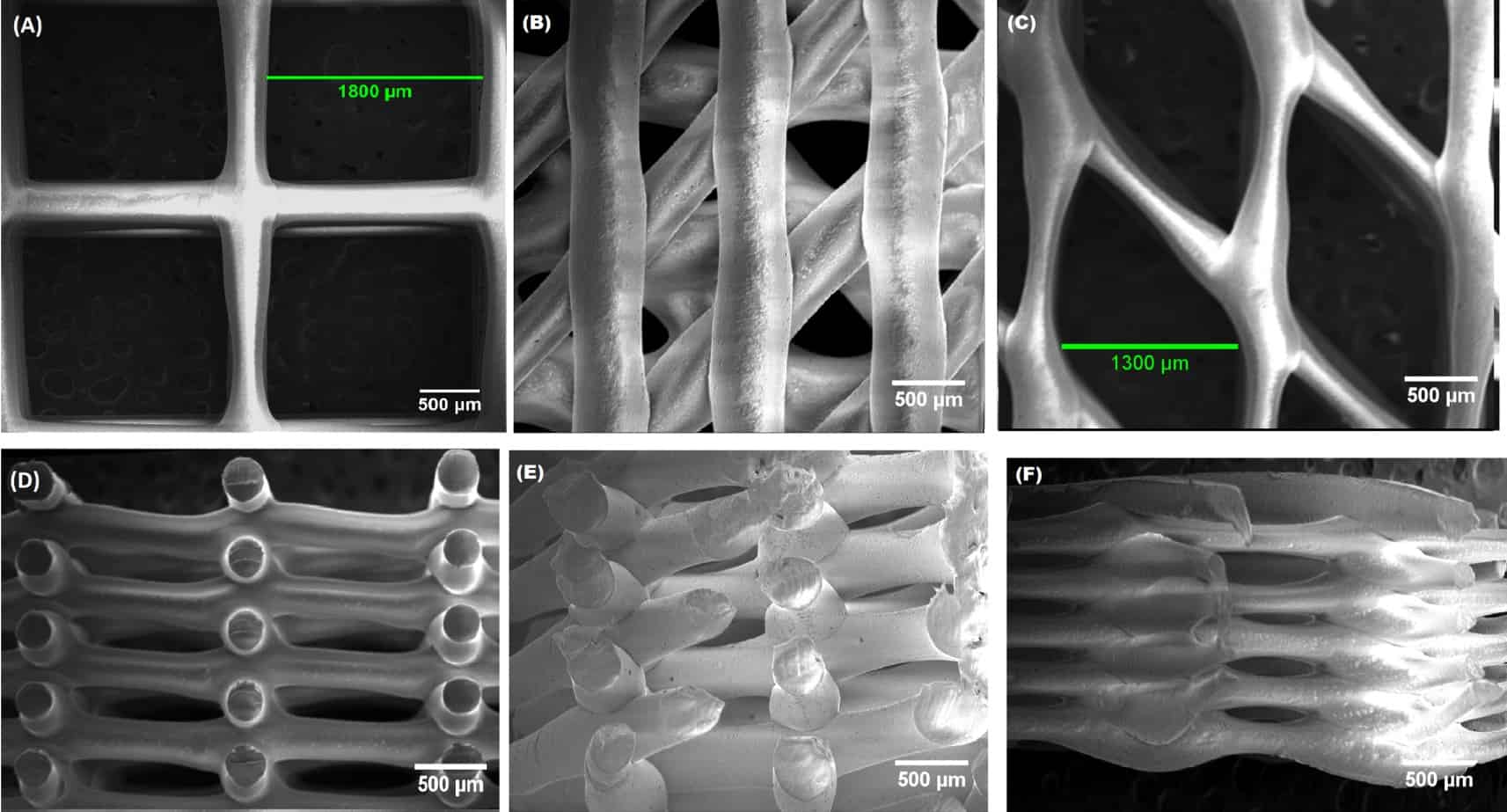
Artificial scaffolds created by 3D printing of polymeric materials have become a focus for tissue engineering research for applications such as repairing cartilage in patients with osteoarthritis. A team at the University of Saskatchewan in Canada recently investigated how the molecular weight and shapes of pores in scaffolds made from poly(e)-caprolactone (PCL) affect their mechanical properties, which ideally should match the type of cartilage being treated. Adeola Olubamiji, lead author of the study – which was originally published in the journal Biofabrication – talks to Physics World about her group’s findings as well as more recent progress.

SEM images of 3D-printed PCL scaffolds

Could you give us a little background to your work?

Cartilage tissue engineering involves fabricating 3D constructs that mimic the biological and mechanical properties of human articular cartilage. Although naturally occurring biomaterials such as collagen, hyaluronic acid and chitosan show promise here, especially because they promote chondrogenesis and mimic the biochemical properties of cartilage, they are expensive and are not very strong mechanically. They also degrade fairly quickly. Because of these drawbacks, researchers are looking for alternative, easily-sourced synthetic polymers that have better mechanical and degradation properties.

What sorts of polymers could be employed in tissue engineering?

Synthetic polymers such as polyglycolide (PGA), poly(L-lactide) (PLLA) and poly(d,l-lactic-co-glycolic acid) (PLGA) are routinely employed in scaffold-based tissue engineering applications. The problem here, however, is that these material scaffolds are too rigid. Researchers have recently found that adding PCL to PLLA reduces this polymer’s rigidity while increasing its visco-elasticity and flexibility.

PCL is also good in that it can be reabsorbed into biological tissue, degrades slowly (over time periods of months to years), is cheap, biocompatible and non-immunogenic. In our Biofabrication paper, we looked at how to optimize 3D-printed PCL scaffolds for cartilage tissue-engineering applications.

Could you describe this study and the main results you obtained?

We studied how the molecular weight of PCL and the geometry of the pores in scaffolds made with this material affected its mechanical properties. We also looked at how the polymer strand size, strand spacing and strand orientation affected these properties.

The results show that the molecular weight is important for mechanical properties such as the compressive moduli and yield strength of the 3D-printed PCL scaffolds. Indeed, we found that PCL with a molecular weight of 45 K was a good choice for making viscoelastic, flexible PCL scaffolds that can bear weight – which is an important function of natural cartilage. As for the strand properties, we found that strand size, spacing and orientation all affect the tensile moduli of the scaffolds, but that only strand size and spacing significantly affect the scaffolds’ compressive moduli and porosity.

All in all, our study shows that modulating the PCL’s molecular weight and the shape of its pores can help in the design of PCL scaffolds with mechanical and biomechanical properties that better mimic the mechanical behaviour of human articular cartilage.

How has your work moved on since the publication of your biofabrication paper?

We have successfully implanted 3D-printed hybrid scaffolds in small animal models, with the aim of regenerating articular cartilage damaged by osteoarthritis. We will now be modifying these structures and looking at how they behave in larger animal models.

Biodegradable scaffolds show promise for cartilage repair and we believe that we can make significant advances in these constructs by engineering biodegradable structures with carefully controlled microarchitectures.

  • This article is one of a series of reports reviewing progress on high-impact research originally published in the IOP Publishing journal Biofabrication.


Clothes washing mystery solved by physicists

A fresh water rinse is just as important as washing in detergent for getting your clothes clean, according to physicists in the US and the UK. They claim that the rinse cycle plays a key role in removing dirt from deep within textiles, by setting up chemical and electrolyte gradients that draw it out. This could lead to the development of more efficient and environmentally friendly washing machines, they add.

Washing machines wash clothes with water mixed with detergent and then rinse them with fresh water before finally spinning them. Washing detergents are surfactants, compounds that lower the surface tension between liquids and other substances, making it easier for them to mix. When washing clothes, they help the water mix with and loosen dirt on the fabric. Conventional understanding is that rinsing then flushes the fabric and washes the dirt away.

Stagnant cores

But, there is a problem with this idea. In most fabrics there are tiny pores that do not allow any significant fluid flow inside them. According to Sangwoo Shin at the University of Hawaii, Patrick Warren of Unilever in the UK and Howard Stone of Princeton University, it should take several hours for micron-sized particles to diffuse out these micrometre-sized pores. Yet significant numbers of particles do leave these pores on much faster time scales. The question as to how this is possible is known in the washing industry as the “stagnant core problem”.

Looking at this problem, the trio noted that when detergent-saturated fabric is exposed to fresh water the surfactant molecules rapidly move out of the stagnant core. They hypothesized that the surfactant gradient established when the fabric is rinsed – with a high concentration of surfactant within the fabric’s pores and a low concentration in the surrounding water – causes the surfactant particles, along with the dirt, to undergo diffusiophoresis, the directed motion of particles up or down a chemical gradient.

To test the theory, the team used a microfluidic channel connected to a set of 50 µm wide, dead-end pores. These pores acted like the stagnant core of a piece of fabric, with little flow into them when a fluid flowed through the channel. They filled the pores with fluorescent, 0.5 µm, polystyrene particles suspended in a surfactant solution. They then flushed the microfluidic channel with a surfactant solution of the same concentration and with a surfactant solution 100-times weaker.

Electrolyte gradient

The concentrated solution flushed the polystyrene particles out of the entrance to the pores, clearing them to a depth of roughly the width of the pore, but had no impact on the particles deep in the pores. After flushing the entrance of the pores, the weak solution, however, caused the particles in the pores to migrate out into the channel over a period of 10 min. The researchers say that a significant contribution to this diffusiophoresis is electrophoresis, with the low concentration rinse creating a surfactant gradient with an electrolyte gradient that forces particles to migrate out from the core.

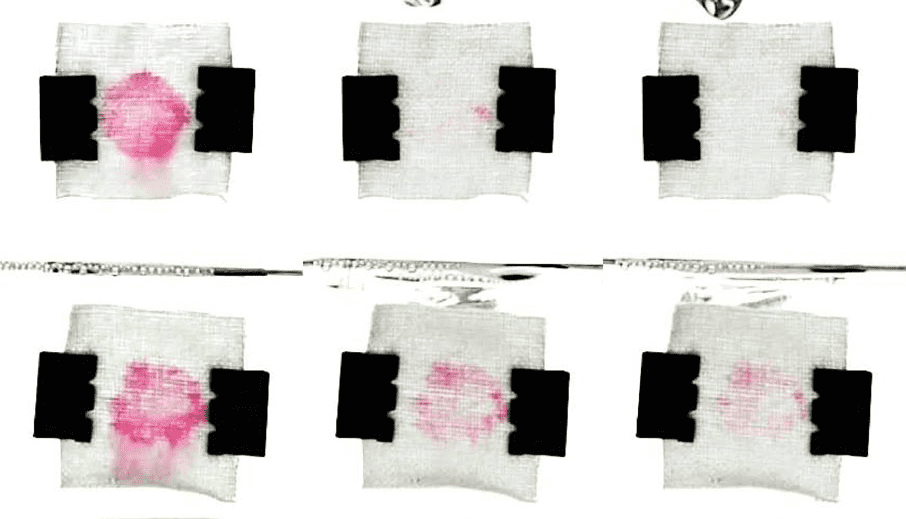
Stained fabric after rinsing

The team also tested their theory on fabric. They found that a piece of cotton stained with polystyrene latex is cleaned better and faster when it is rinsed with fresh water after being soaked with detergent, than if it is rinsed with the same detergent solution (see figure).

The surfactant gradient and the resulting diffusiophoresis results in the removal of the stain from the fabric and the polystyrene particles from the pores because the surfactant binds to the particles. This also means that the processes works effectively for most types of dirt and stains.

Similar surfaces

“The surfactant (detergent) strongly adsorbs onto the dirt surface, making them possess similar surface characteristics,” explains Shin. “It is the surface potential that drives the diffusiophoresis, so any substances that have similar surface properties should behave more or less the same.”

We can design a better wash-rinse cycle for optimal cleaning

Sangwoo Shin, University of Hawaii

As well as solving the stagnant core problem, Shin says that the results could help improve washing machines. “Since the current finding suggests that the rinsing is the key player in dirt removal, we can design a better wash-rinse cycle for optimal cleaning,” he told Physics World. “For example, a chaotic, churning motion of the laundry drum might not be essential. This could reduce energy consumption and noise. Multiple rinsing cycle might not be needed, which could save fresh water.”

Shin adds: “This study could also shed light on other similar applications that require the removal of particles and droplets from deep pores through the use of chemical gradients, such as in petroleum production or skin pore cleansing.”

The research is described in Physical Review Applied.

Washout model enhances particle range verification

In vivo monitoring of beam range and applied dose is a key enabler for precision particle therapy delivery. One approach under investigation is PET imaging of positron emitters generated during treatment. But for accurate treatment verification, correction of biological washout is essential.

PET verification of particle therapy (proton and carbon ion) works by imaging positron emitters – mainly 11C and 15O – produced along the beam path as the beam interacts with tissues in the patient. The resulting PET images can then be compared with a calculated reference activity distribution. In living objects, however, diffusion of the positron emitters causes biological washout of activity, which can significantly affect the spatial distribution of the PET signal.

For in-beam and in-room PET, 15O is the prevalent contributor, due to its relatively short half-life of 2.03 min. For off-line PET (performed after treatment), 11C – with a half-life of 20.39 min – dominates. Current biological washout models were developed based on animal studies of 11C beams. But such models might not be suitable for early time frames, as washout of 15O and 11C ions may behave differently.

To provide more accurate modelling of 15O biological washout, a research team from Tokyo Women’s Medical University and the National Institute of Radiological Sciences measured the washout rates of 10C, 11C and 15O ion beams in the rabbit brain. They employed the whole-body dual-ring OpenPET, a full-ring in-beam PET system that acquires data during pauses in pulsed beam delivery and immediately after irradiation (Biomed. Phys. Eng. Express 4 035001).

Radioactive beams

PET verification of patient treatments employs the positron emitters generated by the proton beam. However, this is a weak effect, so for this study the team employed radioactive beams of positron-emitters, generated as secondary beams in the Heavy Ion Medical Accelerator in Chiba (HIMAC).

“The precision of autoactivation imaging is low due to poor statics of the positron emitting nuclides generated during irradiation,” explained first author Chie Toramatsu. “Using a radioactive primary beam overcomes the problem.”

The researchers irradiated the brains of three anaesthetized rabbits with 10C and 11C beams, starting PET imaging simultaneously with the start of irradiation. They performed measurements using the OpenPET prototype, which comprises two 660-mm diameter detector rings, with the animal placed in the 90 mm gap between the rings.

First, the team delivered 3×20 spills of 10C to the target, followed a few minutes later by three spills of 11C (this was possible due to 10C’s very short half-life of 19.2 s). They performed PET for 200 s for the 10C and 40 min for the 11C beam. Subsequently, the rabbit was sacrificed, and after 120 min, re-irradiated with 10C and 11C beams in the absence of biological effects.

Three other rabbits were irradiated with three spills of 15O, and imaged for 20 min. The experiment in the dead condition was performed immediately afterwards.

PET images summed over 0-150, 0-2400 and 0-600 s (for 10C, 11C and 15O, respectively) revealed that the PET intensity in the region-of-interest (ROI) was significantly lower in the live animals. This was due to the washout effect and was observed for all three irradiation types.

Washout model

To analyse the washout effect, the researchers generated time activity curves (TACs) from the acquired PET data divided into 30 s frames. They used multiple component model analysis to obtain the washout rates from these TACs.

OpenPET images and time activity curves

Plotting ROI activity (in arbitrary unit) versus time demonstrated that, due to the washout effect, ROIs values decreased faster in the live animals. The researchers note that 15O and 11C ions exhibited different biological decay behaviours, with the washout rate of the 15O beam significantly larger than that of the 11C beam.

For 10C and 11C, the TACs of the ROIs fitted well to three exponential functions. The observed washout rates of these fast, medium and slow components were 21.04, 0.34 and 0.004 min-1, respectively. These values are consistent with previous rat and rabbit studies. For 15O, TACs fitted well to two exponential functions, with medium and slow biological decay rates of 0.72 and 0.024 min-1, respectively.

To integrate PET-based dose verification into particle therapy, in-room and in-beam PET are likely the optimal approaches, as short-lived nuclides such as 15O are still abundant and the overall signal intensity will be significantly higher. The authors note that to employ such a setup clinically, modelling biological washout for 15O is essential for correct prediction of activity distributions, and suggest that the 15O washout rate obtained in this study is applied. They add that the long-term aim is to establish an appropriate washout model, for both washout correction and to guide adaptive therapy.

“The washout effect can be used to monitor tumour tissue changes due to irradiation in real-time,” Toramatsu explained. “For example, the washout rate might be slower and the signal intensity lower in necrotic tumour because of poor vascularization and hypoxia; this means that higher dose should be delivered.”

The team is now examining the chemical reactions between tissue elements and positron emitters to understand the biological effects that are reflected in the washout.

Analogue computer could use sound to make rapid calculations

A compact analogue computer based on an acoustic metamaterial has been proposed by Farzad Zangeneh-Nejad and Romain Fleury at the Federal Institute of Technology (EPFL) in Lausanne, Switzerland. They have shown that the system should be capable of rapid differentiation, integration, and instantaneous image processing, and the duo believe it could achieve yet more impressive feats in the future.

Analogue computers use interactions involving physical entities such as light, electrical current or a mechanical system to perform specific calculations. Some of the most sophisticated analogue computers were developed in the early to mid-20th century to help guide artillery and aerial bombing strikes.

While the advent of digital computers made these computers obsolete, they are now enjoying a resurgence thanks to ongoing research into artificial materials called metamaterials. These materials can be engineered to manipulate the light or sound waves passing through them in new ways – opening the door to new types of analogue computer.

 Subtle engineering

“Metamaterials are artificial structures composed of periodic subwavelength inclusions, which can be subtly engineered to provide the desired macroscopic characteristics of the overall material,” explains Zangeneh-Nejad.

Metamaterials have already been used to create analogue computers that manipulate electromagnetic waves to perform mathematical operations. Zangeneh-Nejad and Fleury set out to design a device comparable to these optical computers, but using sound waves. However, the distinctive properties of sound waves meant that the researchers first needed to carefully consider how to design their metamaterial.

“Usually, when sound is incident on a hard wall, it reflects without being subject to any particular transformation, and the only thing that happens is the direction of propagation changes,” says Fleury. “Our metamaterial is capable of performing complex signal processing tasks on sound waves when they are reflected, directly on the fly and without delay. It can achieve this instantaneously without converting [sound] into electrical signals.”  Through their calculations, the physicists uncovered the physical properties required of their metamaterial. “It requires a very special acoustic property that does not exist in nature: an acoustic refractive index larger than that of air,” explains Fleury.

No transform required

An important feature of the proposed device is that it performs operations directly in the spatial domain. Previous metamaterial-based computers have worked in the frequency, or Fourier domain, requiring bulky Fourier transform sub-blocks to convert signals into the spatial domain. The new metamaterial has no need for these additional elements. “In our computing system, the mathematical operator of choice is directly performed in the spatial domain using a metamaterial known as a high-index acoustic slab waveguide,” Zangeneh-Nejad explains.

The duo have shown how their device could perform differentiation and integration, as well as instantaneous image detection. Writing in a preprint on arXiv, they explain how future generations of their design could be used to solve more complex differential equations, such as the Schrödinger equation. “We showed how more complex operators such as second order differentiator can be constructed simply by cascading more and more slab waveguides,” says Zangeneh-Nejad. Importantly, the researchers have worked-out that computing devices made from acoustic metamaterials could be entirely compatible with current computing infrastructure. “Our system is free of any Fourier bulk lens, highly miniaturized and potentially integratable in compact architectures, and can be implemented easily in practice.”

The physicists will now further explore the capability of their waveguide to perform calculations at faster rates than conventional computers. “We are investigating applications of our metamaterial in compressive sensing, ultrafast equation solving, neural networks, and a large variety of other applications necessitating real-time and continuous signal processing,” Fleury explains. Their device also has the potential for exploring the dynamics of complex biological systems, allowing for new advances in medicine. As Zangeneh-Nejad adds, “our system could explore the computation processes in human brains, and many other natural systems like DNA, membranes and protein-protein interactions”.


New European XFEL beamline will be sovereign UK territory

A new beamline under construction at the European X-ray Free Electron Laser (XFEL) has been designated sovereign UK territory. Dubbed BreXFEL, the beamline will allow British scientists to continue to use the European XFEL in Hamburg, Germany after the UK leaves the EU. The announcement comes just two weeks after the UK upped its involvement in European XFEL by becoming a member state.

The European XFEL produces coherent pulses of X-rays that have a wide range of applications including physics, material science and chemistry. The UK has been involved with the design, construction and operation of the facility for over a decade. However, the UK’s 2016 decision to leave the EU could mean that British scientists will have to go through the lengthy and expensive process of obtaining German visas to work at the facility.

Dedicated link

The UK already plans to install a dedicated fibre link between Hamburg and the Diamond Light Source in Oxfordshire so that scientists can run experiments without having to leave the UK. “That was a good start,” says Kevin Keegan of the University of Hamburg, “but it would be much better if British scientists could work freely at the facility after Brexit”.

Keegan, who transferred to Hamburg from the University of Liverpool in 1977, says that he made a “hair-raising discovery” last year. “Derelict land to the south of the XFEL used to be a British Army base,” he explains. “It was sovereign British territory and in an oversight, was never ceded back to Germany when demolished in 2005”.

After an intense lobbying effort, UK scientists convinced the German and British governments to build a new UK-only beamline that will initially house one experiment: the Femtosecond Array Raman Goniometer Experiment (FARaGE). There is scope for a further instrument and the leading design is the Brilliant Optical Resonance Imaging Spectrometer (BORIS). Yet scientists are concerned about its running costs, which could be as much as £350m per week.

Living quarters

BreXFEL will have living quarters for British scientists as well as a Budgens supermarket and a Wetherspoon pub. “It will be a bit like a Costa Blanca on the Elbe,” says Leigh Ving, who is head of Exiting the EU at UK Research and Innovation.

At the moment it is unclear if there will be tariffs on the X-rays as they cross from Germany to the UK

Leigh Ving, UKRI

However, she also points out that several important issues remain unresolved: “At the moment it is unclear if there will be tariffs on the X-rays as they cross from Germany to the UK”. “We had hoped that BreXFEL could remain in the customs union, but that was vetoed by Belgium”.

Development aid and renewables: from aid to trade?

Over the years, a lot of support has been provided for renewable energy projects in Africa, most recently under the UN Sustainable Energy for All programme, with the EU taking something of a lead. However, a shift in emphasis from development aid to economic partnership and trade is emerging, with private sector investment, local economic development and local enterprise seen as central, for example via Germany’s new Compact with Africa initiative, the so-called Marshall Plan for Africa.

The German Federal Ministry for Economic Cooperation and Development’s proposal, “Africa and Europe – A new partnership for development, peace and a better future” says that “we need to move away from the donor–recipient mentality that has predominated for many decades and shift towards an economic partnership based on initiative and ownership” and that “it’s not the governments that will create all the long-term employment opportunities that are needed, it’s the private sector. So it’s not subsidies that Africa needs so much as more private investment”.

In particular, it says “It is vital that Africa’s young people can see a future for themselves in Africa. The average age in Africa is 18. Soon Africa’s population will top 2 billion. That means that 20 million new jobs will be needed each year, in both urban and rural settings. Developing the necessary economic structures and creating new employment and training opportunities will be the central challenge. Africa’s young people also need contact and interaction with Europe. Europe must develop a strategy that allows for legal migration while combating irregular migration and people smuggling.”

You can see internal EU political issues at work here. German development minister Gerd Müller says “Germany and Europe have an interest to save people’s lives, to limit the effects of climate change and avoid ‘climate refugees’, to prevent mass migration and to help create a future for Africa’s youth.”

Local energy initiatives are seen as a key, with Germany’s energy co-operatives set to serve as a model. According to DW News, “The German Development Ministry is keen to use this expertise to help create similar groups in Africa. Over the next five years, the plan is to set up 100 partnerships in which German cooperatives can share their knowledge and experience with African community groups – in eight countries across the continent.”

The original US-led post Second World War Marshall plan was designed to aid economic recovery in Western Europe, although, not incidentally, it also helped consolidate US and Western economic and, some might say, political hegemony. In the new African version, the EU would be seeking a different relationship with Africa, less focused on aid and more on trade and local enterprise and employment creation. Its focus on markets might also be seen as a way to respond to doubts about the effectiveness of current aid programmes.

The EU’s new External Investment Plan adopts many of the same ideas as the German Marshall plan, calling for a shift from grants to private sector initiatives and partnerships.

However, there are different views. The Global Justice Now group says that “aid spending has been driven by notions of charity, national self-interest, and an ideological belief that free markets and multinational business can solve the world’s problems”, noting that “aid strategy seems to be increasingly about using aid money to benefit corporations rather than communities”. It claims that “Promoting free-market reforms and subsidizing the private sector not only ignores the fact that development should be about rights, equality and empowerment; it also ignores decades of lived experience about the best economic strategy for a developing economy.”

In this context, whether the German Marshall plan for Africa, aiming to create a new entrepreneurial and investment impetus, is the best approach, remains unclear. For example, in their new book Sustainable Energy for All: Innovation, Technology and Pro-Poor Green Transformations (Routledge), Ockwell and Byrne have argued that, although “the idea of private sector entrepreneurs driving innovation and technological change in developing countries seems to have captured the imagination of international policy-makers and donors” since it “fits in neatly with normative commitments to neo-liberal ways of doing development”, in reality “It is ill-conceived for the specific circumstances that exist in a wide range of different contexts: differences in relation to types of technologies; differences in social practices facilitated by technologies; differences in socio-cultural variations of these practices; differences in levels of technological capabilities existing in different countries, regions or communities; differences in politics and political economies, and so on.”

It seems clear that more attention has to be given to a wider socio-technical approach, less concerned with hardware and more concerned with social change processes. Indeed, that may be a requisite for technological success. Change is needed, but it must be both in terms of energy goals and in the ways in which projects are designed, funded and managed.

The German Marshall plan for Africa recognizes the need for widespread change, both within Africa and outside. Within Africa it says “corrupt elites still have too much influence”. They often “prefer to channel their money abroad instead of investing it locally” and “let multinationals exploit the country’s natural resources without creating domestic value chains”. Externally, it says that “Europe’s policy on Africa was for decades often guided by its own short-term economic and trade interests [while international corporations were] falling short in some areas, namely with regard to meeting local environmental and social standards and compliance regulations. This has resulted in Africa losing more than one trillion US dollars in the last 50 years that could have been used for sustainable development, with illicit financial flows currently amounting to 50 billion US dollars per year. 60% of losses are due to aggressive tax avoidance by multinational corporations.”

While some of this may be addressed by the sort of reforms it proposes, for example in terms of fair trade and combating illicit financial flows, arguably a somewhat more radical approach to aid and to technological and economic change is needed than just relying on economic partnerships and the creation of more favourable local investment opportunities.

Certainly there are many potential pitfalls with aid programmes, especially if they are top down and market led. As a recent study based on experience in sub-Saharan Africa concluded, “[Effective change] requires moving beyond notions of a cohesive state serving as rule-enforcer and transition manager. It also requires that technology be viewed more broadly, as not just as hardware that is transferred, but a set of practices and networks of expertise and enabling actors. And while markets have an important role to play as vehicles for achieving broader ends, they are not an end in themselves but rather one (and not the only) tool capable of shifting socio-technical systems in lower-carbon directions.”

That is very much the line also taken in Ockwell and Byrne’s book mentioned above and in the Pivot e-book that Terry Cook and I have just completed for Palgrave: Renewable Energy: from Europe to Africa, which should be out soon. Among other things, it looks at how the “jobs” metric has emerged as a leading EU development policy driver, focused on investment in renewables. As I note in my next post, providing interim subsidies for that may be sensible, but what matters is what kind of jobs.

The EU, of course, isn’t the only player. The new Palgrave book also looks at how China is taking over as a major player in energy project investment terms in Africa, adopting a somewhat different, more directly commercial, approach. Interestingly, President Trump has cut back on USAID generally, but has decided to leave Obama’s $7bn Power Africa programme untouched. That may be partly since it is mostly private sector led, but it may also reflect US fears about China’s growing influence in Africa. That opens up some interesting geopolitical and development issues. Whether any of these external interventions will actually help Africa remains to be seen, but given the huge range of social and economic problems it faces, it clearly does need help.

PET factors help assess Hodgkin’s lymphoma outcome

Certain quantitative PET parameters can help clinicians predict how well patients with Hodgkin’s lymphoma will react to their treatment, according to preliminary results from a study conducted in the Ukraine and presented at ECR 2018 in Vienna.

In a comparison of several variables, the researchers found that metabolic tumour volume and mean standard uptake values (SUVmean) were statistically significant indicators of event-free survival.

“The end-of-treatment PET quantitative parameters may be utilized to help detect patients at high risk of early Hodgkin’s lymphoma relapse,” said study co-author Mykola Novikov from the department of diagnostic radiology at the Israeli Oncologic Hospital (LISOD) in the Kiev region.

Modality of choice

The use FDG-PET/CT is a well-established method for evaluating patients with Hodgkin’s lymphoma and is considered the gold standard for imaging the progression of the disease. The hybrid modality also is the primary choice for staging, restaging and response to therapy.

“Qualitative and visual assessment is considered to be the standard in multiple trials and in tailoring therapy, for example being incorporated in additional clinical decision-making,” Novikov told ECR attendees. “But the quantitative approach remains a point of ongoing research and investigation regarding metabolic information in these types of patients.”

This multicentre study was the first attempt by Ukrainian researchers to collect PET data on patients with Hodgkin’s lymphoma from a variety of imaging centres.

“Unfortunately, we have to admit there is huge variability and inconsistency of imaging, which dramatically affects the eligible patient population, so we have produced only preliminary results for now,” Novikov added.

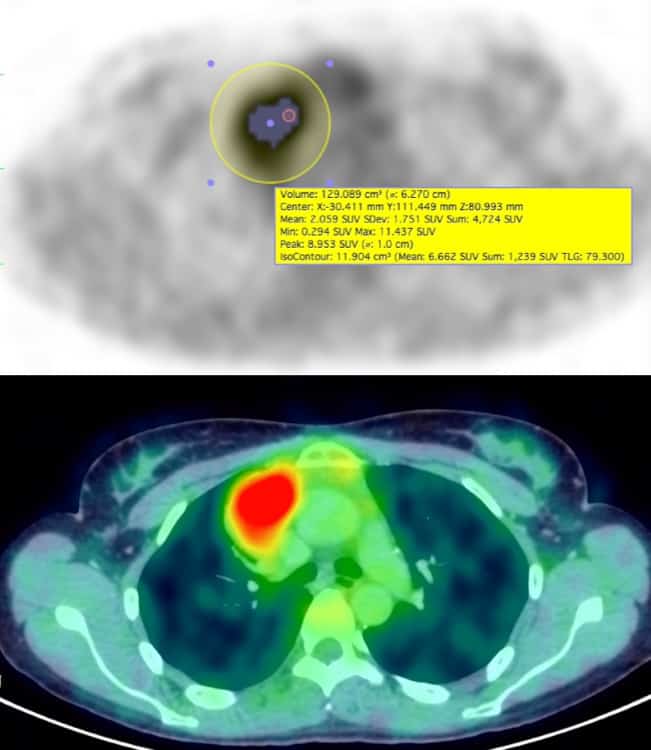
PET/CT scan of a patient with Hodgkin's lymphoma

The aim of this study was to retrospectively calculate and analyse metabolic quantitative PET parameters in patients with Hodgkin’s lymphoma, and to evaluate possible correlations between quantitative PET indicators and event-free survival among these patients.

The researchers gathered 45 patients with Hodgkin’s lymphoma; 53% of the cases involved either stage I or stage II disease, while the remaining 47% presented with stage III or stage IV disease.

As part of the treatment regimen, the patients received either doxorubicin, bleomycin, vinblastine and dacarbazine (ABVD) treatment or a combination of bleomycin, etoposide, doxorubicin, cyclophosphamide, vincristine, procarbazine and prednisone (eBEACOPP), which is typically used in Europe.

In addition, three PET scans were performed. The first exam was conducted at baseline; the second scan after two cycles of therapy; and the third exam at the end-of-treatment at least four weeks after therapy completion.

To determine the efficacy of quantification parameters, researchers used a fixed threshold segmentation method with a maximum standard uptake value (SUVmax) of 41%, as recommended by the European Association of Nuclear Medicine (EANM). From that point, the researchers calculated SUVmax, peak SUV, mean SUV, metabolic tumour volume and total lesion glycolysis (TLG) at all three PET scan time points.

PET parameters

In reviewing the results, Novikov and colleagues found the overall response rate to cancer treatment was 95.5%, with 73% of patients with negative results and the remaining 27% with positive PET images on the second interim PET scans. At the end of treatment, negative predictive value changed to 82% and positive predictive value to 18% (p < 0.05).

Axial PET and fused PET/CT image

A further analysis of PET parameters discovered which variables were most effective in predicting event-free survival. For example, a multivariate analysis revealed that positive predictive value was the only statistically significant factor in determining event-free survival with a hazard ratio of 1.07 (1.0 to 1.15, p = 0.00008).

Based on the Cox regression model, metabolic tumour volume and SUVmean based on the third PET scan were most statistically significant in event-free survival. Metabolic tumour volume recorded a hazard ratio of 1.07 (1.0 to 1.13, p = 0.005), while SUVmean registered a hazard ratio of 2.0 (1.4 to 2.82, p = 0.0001).

Conversely, quantitative metrics based on baseline and the second interim PET scans were not statistically significant in terms of determining the clinical outcome of the Hodgkin’s lymphoma patients.

“In conclusion, the end-of-treatment PET quantitative parameters may be utilized to help detect patients at high risk of early heart gives lymphoma relapse,” Novikov added. The researchers cited several limitations of the study, which included the relatively small patient cohort and heterogeneous study population. They recommended additional investigation with more patients and follow-up PET scans at different intervals during cancer treatment.

“Also, we should try different quantification methods for comparison to find the most robust and valuable method to predict the most valuable quantitative indices,” Novikov concluded.

  • This article was originally published on AuntMinnieEurope.com.
    © 2018 by AuntMinnieEurope.com. Any copying, republication or redistribution of AuntMinnieEurope.com content is expressly prohibited without the prior written consent of AuntMinnieEurope.com.
Copyright © 2026 by IOP Publishing Ltd and individual contributors