Wood-fired power generation could harm climate

Bioenergy

Using wood for power generation could worsen climate change through to at least the end of the century. That’s according to researchers in the US, who found that carbon dioxide released into the atmosphere from wood-fired power generators takes many decades to be recaptured by new trees.

The topic is pertinent as governments are considering their energy choices to meet climate targets such as the EU’s goal of 20% renewable energy by 2020. This includes considering sustainability criteria to ensure that the use of biofuels delivers real carbon savings and protects biodiversity.

“A molecule of carbon dioxide emitted today has the same impact on the climate whether it comes from coal or biomass,” said John Sterman of MIT, US. “Declaring that biofuels are carbon neutral, as the EU and others have done, erroneously assumes forest regrowth happens quickly and with certainty. Neither is true.”

Sterman and colleagues used dynamic lifecycle analysis to examine changes in carbon dioxide emissions when wood bioenergy replaces coal. They calculated that burning wood emits more carbon dioxide into the atmosphere than coal because of greater losses in processing and combustion. Recapturing that carbon dioxide takes from decades to over a century, depending on the tree species and forest, and only happens if the harvested lands are allowed to regrow.

In the meantime, climate change worsens and the impacts – such as higher sea-level and ocean acidification – persist for centuries, according to the team.

The researchers note that their results are optimistic: the climate impact of wood bioenergy worsens if harvested lands are converted to agricultural use; if the new forest is subject to fire or damage from disease; or if the price of coal falls as wood cuts coal demand, leading to a rebound in coal use elsewhere.

Sterman believes that options such as wind and solar provide a more immediate and more certain contribution. “To have a decent chance of limiting global warming to the United Nations Paris Climate Agreement limit of no more than 2°C above pre-industrial levels, we need to keep fossil carbon in the ground and trees on the land,” he said. “Wind and solar, with storage, are already cheaper than fossil fuels in many areas. And, unlike wood, they reduce greenhouse gas emissions from day one.”

The researchers are keen to see complete accounting for emissions from all energy sources, including emissions at the point of use and arising in the supply chain. “Offsetting reductions in atmospheric carbon dioxide should be credited only when – and if – there is net new growth on the lands harvested to supply the biomass,” Sterman added.

The researchers used an interactive climate simulation model dubbed C-ROADS, which they adapted to evaluate the dynamics of a range of bioenergy scenarios.

The team published the results in Environmental Research Letters (ERL).

Quantum battery could get a boost from entanglement

Physicists in Italy have designed a “quantum battery” that they say could be built using today’s solid-state technology. They claim that the device, which would store energy in the excited states of qubits, could charge up very quickly thanks to entanglement and that it could provide power for quantum computers of the future.

This research is part of a push by physicists to study the thermodynamics of very small systems, such as atomic or molecular heat engines and refrigerators. In 2012, Robert Alicki of the University of Gdansk in Poland and Mark Fannes of Leuven University in Belgium investigated how much work could be extracted reversibly from a quantum-mechanical system used to store energy temporarily. They found that by entangling many quantum batteries together they could boost the energy output per battery such that for very large numbers of them the output approached the upper limit imposed by classical thermodynamics.

Other groups have since built on that work, with one led by Kavan Modi at Monash University in Australia last year having found that collective effects can increase the charging rate of quantum batteries (even if the quantum states involved are not entangled). Now, Marco Polini and colleagues at the Italian Institute of Technology (IIT) in Genoa have shown that these theoretical ideas could in fact be realized in practice.

Qubit conversations

The Genoa team proposes housing multiple two-level quantum systems, or qubits, inside a single optical cavity (see figure). Light with a specific wavelength is shone into the cavity – in the form of a laser pulse, for example – where it excites the qubits from their ground to excited states while at the same time entangling them. This arrangement, the researchers calculate, increases the device’s charging power in proportion to the square root of the number of qubits, whereas the charging rate remains flat if qubits are housed in separate optical cavities. As Polini puts it, the use of a common cavity means that “every qubit talks to every other qubit”.

Polini says that their system doesn’t violate any laws of thermodynamics since it merely involves a higher rate of energy flow from source to battery than is possible conventionally, rather than any increase in the total amount of energy. The scheme involves a trade-off between charging power and stored energy, with the balance between the two determined by how strongly photons and qubits couple to one another.

Polini explains that the research, while theoretical, is more practically oriented that previous work. “Historically, the few papers in the literature on quantum batteries come from scientists in the quantum information community, who are more interested in fundamental theorems than in actual solid-state implementations of their ideas,” he says. “We read their papers [on quantum batteries] and saw that this can be done in the lab.”

Prototype in three years

According to Polini, the proposed quantum batteries could use qubits built either from superconductors or from semiconducting quantum dots. He says that they are hoping to build a proof-of-principle quantum battery in conjunction with experimentalists from IIT and three other European institutions – having submitted a grant application to the European Union’s flagship programme on quantum technologies. He reckons that the collaboration could potentially build a battery with up to five qubits within the next three years.

Polini, however, is keen to emphasize that the technology is not designed for powering laptops or other familiar electronic devices. As he notes, the quantum batteries would discharge extremely quickly – on the order of nanoseconds – and would also store exceptionally small amounts of energy. Indeed, he says, the energy stored in a quantum battery is linked to the difference in a qubit’s energy levels amounts to about 0.001 eV, whereas a typical laptop battery stores a few 1024 eV. “These devices will not replace normal batteries,” he says.

Instead, Polini sees the batteries in future powering purely quantum-mechanical devices, such as quantum computers. An array of perhaps a few thousand qubits, he estimates, might be available in “10 or 20 years” from now. The array, he envisages, would operate in a loop, so that each qubit recharges while the computer taps the energy from successive qubits. “Our dream is that you have an integrated circuit based on quantum technologies,” he says. ”Every unit of the circuit would work quantum mechanically, including the battery.”

Noisy challenge

Modi says it’s “really surprising” that the IIT researchers have managed to find “physical architectures that accommodate our toy models”. But, he cautions, they must show that their technology can resist environmental noise. “Most likely we won’t see a quantum battery anytime soon, and it’s not clear how we might use such a battery,” he says. “There is a lot of theory that has to be done before we can do experiments, and some day engineering.”

The battery design is described in Physical Review Letters.

Graphene nanoscrolls mimic man’s best nose

Graphene’s mechanical stability, high electrical conductivity, and compatibility with a diverse array of carbonaceous functionalization chemistries makes it an alluring host system for novel gas sensors. Now researchers have overcome some of the fabrication challenges in the way of using graphene in bio-mimicry of one of nature’s greatest sensors, a dog’s nose.

Dogs’ remarkable sense of smell has been well-known for centuries. Within a dog’s nose lies a rich mesoscopic structure of capillaries, packing an enormous olfactory sensing area into a small volume. Graphene nanoscrolls – nanosheets uniformly wound around themselves – have been proposed for use as a man-made analogue of this capillary structure. The challenge to this point has been the fabrication of graphene nanoscrolls that measure up to performance expectations.

Past attempts at making nanoscrolls started with graphene oxide in its un-reduced or partially reduced states. As a consequence, the nanoscrolls formed lacked the stellar electronic and surface chemistry properties of graphene. Another significant challenge was maintaining good uniformity of the scrolls formed.

Yao Wang, Lei Jiang, Guofu Zhou and colleagues found a method to overcome past challenges to nanoscroll fabrication. They used an aromatic polymer, poly(sodium p-styrenesulfonate) (PSS), which acts as a surfactant when dispersed into an aqueous solution of graphene oxide. Noncovalent interactions between π-orbitals on the polymer and the graphene oxide bind the surfactant to its target and reduce aggregation of graphene oxide nanosheets, allowing full reduction of their surface bonds.

The researchers poured the aqueous solution into a glass bottle, flash-froze it by immersing it in liquid nitrogen, and then loaded it into a “lyophilizer”- freeze drier – to sublimate the ice away. Throughout the sublimation process, the nanosheets begin scrolling gradually, becoming fully scrolled once dehydration is complete.

Examining the wrap-up

Characterizing the resultant nanoscrolls, the research team found excellent uniformity in the length, diameter, and straightness of their tubular structures. They also used molecular dynamics simulations and cryo-SEM during the lyophilization process to shed light on the scrolling behaviour. The flash-freezing procedure establishes a vertical temperature gradient within the glass bottle. Ice crystallizes along this gradient, and thus the embedded nanosheets freeze along this vertical orientation as the process rapidly occurs.

As the ice begins to sublimate, a thin strip of the nanosheet is exposed. Molecular dynamics simulations show that a preferential binding of PSS one side of the graphene oxide nanosheets gives rise to the curvature of the nanosheet during scroll formation, in part from the hydrophilic nature of the PSS layer.

The researchers were then able to create gas sensors by dispensing droplets of dispersed nanoscrolls onto interlacing silver-palladium electrodes. The sensors formed linear ohmic devices whose resistance was modulated by the presence of the target analyte, here NO2. Compared with similar graphene-based sensors, those produced by the new lyophilization approach exhibited an improved sensitivity as well as excellent selectivity for NO2.

Full details of the research are reported in ACS Nano 10.1021/acsnano.7b08294.


Watery wonder

“A buoy is as good as a barnacle,” declares Tristan Gooley in the introduction to his new book How To Read Water: Clues and Patterns from Puddles to the Sea. Gooley, who describes himself as a natural navigator, invites readers to discover a newfound sense of awe for liquid H2O by observing its interaction with the natural and man-made world. The result is a hybrid between a classic popular-science book and a practical guide to interpreting signs in nature that could aid anyone from the serious marine navigator to the casual Sunday stroller.

Gooley integrates personal anecdotes with scientific explanations and historic tales – many around natural navigation techniques of indigenous groups. For instance, we hear about the Pacific islanders who can accurately locate their whereabouts by reading ripple patterns in the sea. When waves refract around land masses, they generate ripple shadows and interference patterns, with each island creating its own unique “ripple map”. Always on the lookout to relate phenomena to everyday scenarios, Gooley invites us to witness the exact same process occurring around a stepping stone in a garden pond.

Throughout the book Gooley frequently refers to physics and what physicists have to say on the issues, covering topics such as capillary action, eddy currents and rogue waves. But he deliberately eschews mathematical formulae in favour of descriptions, and the 20 chapters are rich in arcane language. By the end of the section on rivers and streams, you’ll know your “riffles” from your “glides” and your “pillows” from your “holes”. There’s a nostalgic pleasure in reading about geography school-textbook classics such as river thalweg and oxbow lakes, though some readers may find such well-trodden subjects to be a bit, ahem, meandering.

But it would be unfair to criticize the book for a lack of cutting-edge research; that is not Gooley’s aim. This is unashamedly an expertly curated collection of knowledge passed down over the ages. Gooley makes an impassioned argument that understanding natural patterns in nature only serves to enhance their magical qualities. With this book in your pocket and your smartphone left at home, your next amble around the local fishing lake will be overflowing with watery wonder.

  • 2017 Sceptre 376pp £9.99pb

Flicking the light switch controls extracellular stiffness

What occurs within cells is well documented as being important to both healthy function and disease, but what occurs outside of the cell can be just as important – if not more so – to these same functions. The research field of “mechanotransduction” concerns the effect of physical interactions between a cell and its extracellular environment (the extracellular matrix), and how these interactions affect cell behaviour and expression. Modelling these interactions in the lab is vital to discovering their roles in both physiological and pathogenic processes.

For tissue engineering and biofabrication, researchers use specialized biomaterials called hydrogels to replicate the native extracellular matrix of a cell. Typically, hydrogels are composed of polymers that allow for high water saturation and have tuneable physical properties, making them important tools for mechanotransduction research.

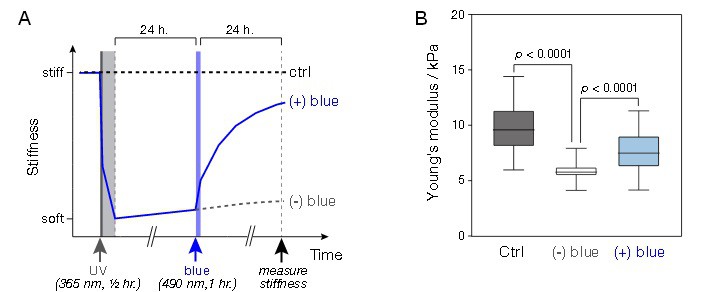
Researchers from the University of Manchester have developed a sophisticated hydrogel system with reversibly tuneable physical stiffness, controlled by either near-UV or blue light exposure. This development allows for the stiffness of a cell’s external environment to be controlled by irradiating the hydrogel with specific wavelengths of light (ACS Appl. Mater. Interfaces 10 7765).

This technique builds on previous methods of tuning hydrogel stiffness, which commonly rely on either altering pH or ionic concentration, or chemically modifying the hydrogel. All of these mechanisms have the potential to alter cell behaviour and adversely affect results beyond those variables intended to be measured.

The hydrogel system developed by the Manchester team uses polyacrylamide polymers with azobenzene cross linker, and negates the need for cell behaviour-altering treatments. The researchers demonstrated the capability of the hydrogel system to reversibly alter stiffness, by reducing hydrogel stiffness through exposure to near-UV light, and heightening its stiffness through exposure to blue light.

Effect of UV and blue light exposure on hydrogel stiffness

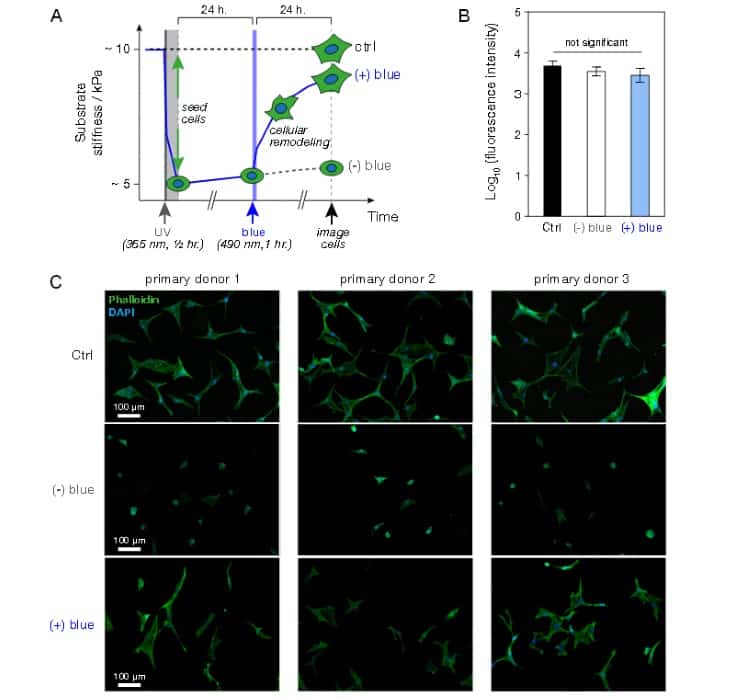
To decipher the effects of this approach on cell viability and DNA damage, the group used their hydrogel system in conjunction with mesenchymal stem cells. This class of stem cell is used commonly in tissue engineering and regenerative medicine studies, owing to its capability to have growth directed by being placed in substrates of specific stiffness. The researchers established that neither the blue light nor UV light was able to cause significant cell death, although it was clear that UV light significantly damaged cellular DNA. This finding led the group to implement cell seeding onto the hydrogel system after UV irradiation.

Effects of hydrogel stiffness on cell morphology

The team also investigated specific effects on cell morphology from the altered stiffness. They found that the physical stiffening of the hydrogel promoted cell spreading, whereas the softer UV-treated hydrogels had a more rounded morphology. The authors state that these results reinforce previous literature findings.

The hydrogel system developed by these researchers allows analysis of substrate stiffness and its effect on cell behaviour in real time. The authors indicate that future biological applications for this system include studying mechanotransduction in relation to fibrosis, aging and even developmental biology.

Where will palm trees reach their limit?

Palm tree

As climate changes, plants will redistribute their ranges. Now a team from the US and Canada has asked “how cold is too cold for palms?”

“Palms are sensitive indicators of changing climates, both in the remote geological past and in the present day,” said David Greenwood of Brandon University, Canada.

Although palm trees can’t propagate in freezing temperatures, they’ve recently been found in the foothills of the Swiss Alps, as garden escapees.

Greenwood and colleagues discovered that the absolute limit of palm distribution depends on the average temperature of a region’s coldest month, which must be over 2°C.

“As an example, this means that at present, Washington DC is just a little too cold [slightly over 1°C in January] for palms to successfully propagate in the wild, but you can expect range expansion in the coming decades as average winter temperatures warm up,” said Tammo Reichgelt of Columbia University, US.

The study also revealed that the presence of palms in the fossil record indicates that past temperatures remained at or above a minimum of at least 2 to 5 °C.

“A palm tree conjures up images of the tropics,” said Reichgelt. “But palm trees weren’t always confined to the tropical places.”

How much cold a palm can tolerate depends on the position of its species on the palm family phylogenetic tree, the study showed.

“If you find a palm fossil and can determine its affinity to a modern subgroup of the palm family, you can, using our data, determine the temperature of the climate when that palm was growing,” said Reichgelt.

Reichgelt and colleagues reported their results in Scientific Reports.

Race to space and beyond

Ad Astra: an Illustrated Guide to Leaving the Planet, the latest book by broadcaster and author Dallas Campbell, apparently defies gravity because I just couldn’t put it down. I may go as far as suggesting that a copy should be stashed in the payload of SpaceX’s next Falcon Heavy launch, just to give it a bit of extra lift as it blasts away from the Earth.

Space exploration comes in many forms, from radio astronomy to cosmochemistry, but it is human spaceflight that tends to captivate people the most. Ad Astra traces this path from its beginnings in the 1600s with goose-powered spacecraft, right up until the present day. Woven into the bold, overarching stories of the Space Race are tales and titbits about the individuals and imaginations that made it all happen. From the minds that designed the first rockets, to the first paws in orbit, to the hands that stitched the Apollo spacesuits, nobody is forgotten and no Moon rock is left unturned. Ad Astra left me with the feeling that the story of space exploration, while largely a story of incredible engineering and scientific feats, is above all a story about us: humanity.

It’s easy to suppose “the history of human spaceflight” is a topic that’s been written about a million times before (and you wouldn’t be far wrong), but Campbell sheds new light on it and casts it in a new tone. His writing style is informal, charming and welcoming. Full of wit and humour, this book felt like it was written by a good friend, rather than somebody I’ve never met.

Lately, it seems that every week bears news of a private company announcing bold new plans that will see more commercial presence in space. From space tourism with Richard Branson’s Virgin Galactic, to people on Mars (apparently) within a decade with Elon Musk’s SpaceX, the days when space exploration was purely in the hands of governmental organizations are over. It’s often difficult to keep up with the fast-changing world of commercial space exploration, but Campbell nicely summarizes the current state of play. Perhaps most importantly, he lets you know how feasible each option of getting into space is for the everyday person. It turns out that it’s pretty unlikely most of us will leave the Earth any time soon, but Campbell acknowledges this somewhat disheartening point with self-deprecating humour and jest. In a world that often seems full of trouble and turmoil, Campbell has reminded me that the future of space exploration is bright, and that there’s a lot to look forward to.

In a world that often seems full of trouble and turmoil, Campbell has reminded me that the future of space exploration is bright

Tim Gregory

Campbell also goes into great detail about the rigours involved in the astronaut selection process. If you’ve already got your heart set on becoming an astronaut, this book won’t put you off (quite the opposite). But if you’re on the fence about chasing a career in low-Earth orbit or beyond, this book will push you to one of two extremes. It will either make you want it so much that your heart will ache for a seat in the Soyuz (it is the coolest job in the universe, after all). Or the extreme demands and often undignified examinations will convince you there’s nothing you’d like less.

Written in short sections, Ad Astra is an easy book to set aside and pick up again later, which makes for perfect reading on the train, during lunch breaks or on the launchpad. Overall, the book has the feel of a reference guide, so I probably won’t read it again from cover to cover, but I’ll definitely be going back over my favourite sections and enjoying them for years to come. It will also act as a good revision guide for space exploration facts, figures and trivia – great for the “space” round at pub quizzes.

Ad Astra is presented differently from your usual popular-science book – it is almost a beautifully illustrated scrapbook. The choice of photographs, newspaper snippets, and drawings compliment the text seamlessly. The occasional double-page spread of iconic space images, such as the Cupola observatory window on the International Space Station, really took me by surprise and provided pause for thought. It’s not just a great book to read; it’s also a great book to look at.

Campbell’s enthusiasm is contagious and will grab those with even a vague interest in space exploration right from the first page. Not much prior knowledge would be needed to follow the content of this book, making it an ideal read for both newcomers to the world of space and self-professed space geeks alike. It is, in fact, an absolute must-have for anybody with even a passing interest in the history of human space flight and astronautics. And if you’re a wannabe astronaut like myself, Ad Astra is essential reading, alongside your favourite Russian phrasebook and Scuba Diving for Dummies.

  • 2017 Simon & Schuster UK 256pp £16.99hb

3D single-atom force sensor goes sub-attonewton

A 3D force sensor that can image single trapped ions with a resolution on the sub-attonewton scale could be used in a number of practical areas, including as a probe to detect the electric fields surrounding biomolecules and nanoparticles, and to investigate surface properties. The new sensor is very similar to a recently demonstrated atomic microscope force sensor but it has a substantially higher density and potential for further improvement.

Measuring force with high sensitivity is important for investigating the fundamental physics of magnetic, atomic, quantum and surface phenomena. It is also important for precisely measuring physical quantities, such as the effect of gravity on time in the theory of general relativity.

In recent years, researchers have developed high-resolution imaging techniques based on laser-cooled trapped ions that have opened up the possibility of making ion-based sensors that could resolve an external force in three directions using a single atomic ion. This is thanks to Hooke’s law F= kiΔxi, which allows to convert displacement measurements Δxi into a force measurement Fi through the associated spring constants ki.

Paul trap

The new ion trapping apparatus made by Erik Streed and colleagues of the University of Brisbane in Australia consists of a single 174Yb+ ion confined in a so-called Paul trap formed in a 3D quadrupole created by two radio-frequency-excited tungsten needles. The researchers cool the ion down to 0.5 mK using laser radiation with a wavelength of 369.5 nm. They resulting fluorescence (which also has a wavelength of 369.5 nm) is collected using a binary phase Fresnel lens and imaged onto a cooled electron-multiplying charge-coupled device camera (EMCCD) with a total magnification of 395.9 ± 0.6 nm.

Streed and colleagues are able to measure full width at half maximum (FWHM) diameters in the image of their trapped ion of 378 and 393 ± 1 nm in the x and y directions respectively. The researchers attribute most of the error in their measurement to mechanical drift because they did not specifically engineer their system to be stable for long periods on the nanometre scale. This situation can be readily improved with a suitably designed system, they say.

With a 20 second exposure time (and accounting for systematic drifts), they can determine the ion’s centroid position with a precision as high as 2.8 and 10 nm in the x and y directions.

Atom-sized version of a ball attached to a spring

“Our force sensor is essentially the atom-sized version of a ball attached to a spring,” explains Streed. “Since our atom is missing an electron, it is electrically charged and therefore very sensitive to electric fields. When we apply an electrical force, it thus pushes the atom so that it changes its position. We know how tightly the atom is being held in the trap and can therefore very accurately measure (on the scale of nanometres) how much it has moved. We can subsequently calculate the magnitude of the force (spring constant) that pushed it.”

The Brisbane team measured spring constants of 7.29 ± 0.02, 7.83 ± 0.02, and 29.22 ± 0.04 zN/nm at measured trap frequencies of 800 ± 1, 829 ± 1, and 1601 ± 1 kHz respectively using its technique.

3D force sensing

When in focus, the ion image is insensitive to motion along the third, z, direction so the researchers had to use a trick to be able to measure force in 3D. “Generally, when you take a picture of an object, you can only see it in 2D. Our trick consists of moving the atom a little bit out of focus, and then measuring if it is becoming more out of focus or more in focus to calculate how much it has moved in the third dimension.”

Since we are measuring the force at what is nearly a single point, we do not have to be concerned about the systematic problems that occur when there are multiple atoms involved, Streed tells nanotechweb.org. “Previous sensors like this one worked using the Doppler effect, so ions needed to be moving for us to be able to detect the force. What is more, the force needed to be at a frequency close to the one that the ions naturally wanted to move at. This made averaging more difficult.

Longer camera exposure produces a better image

“In our case, if we want a more sensitive measurement, all we need to do is take a longer camera exposure to obtain a better image of the ion, and so determine its average position with a higher accuracy.”

So, what about possible applications? “I am also a biophysicist so am interested in using this sensor to probe the electric field surrounding individual biomolecules as they are unravelled,” says Streed. “My colleagues and I would also like to probe surfaces with it, mostly of other types of ion traps, because it is these surfaces that limit their performance for applications such as quantum computing.”

The new 3D sub-attonewton force sensor is detailed in Science Advances 10.1126/sciadv.aao4453.

Flat-band polaritons spotted in Lieb lattice

A lattice of semiconductor pillars that supports the conduction of polariton quasiparticles has been created by physicists at ITMO University in St Petersburg, Russia and the University of Sheffield, UK. The square “Lieb” lattice has a special symmetry that occurs in some high-temperature superconductors and the research could provide insights into that poorly-understood phenomenon.

In recent years, physicists have become intrigued by the properties of Lieb lattices. As well as occurring naturally in cuprate high-temperature superconductors, Lieb lattices have also been made using ultracold atoms and arrays of optical waveguides.

One fascinating property of electrons and other particles subject to the periodic potential of a Lieb lattice, is that they have “flat bands” in which there is no relationship between the energy and velocity of the particles. This gives the particles near infinite effective mass. Flat bands are of great interest to physicists because they are related to some types of superconductivity, magnetism and other quantum properties of solids.

L-shaped cells

This latest Lieb lattice system was created Dmitry Kryzhanovskii at the University of Sheffield, ITMO’s  Ivan Shelykh and colleagues. Their micropillars are made of a compound semiconductor and are about 3 µm in diameter. The unit cell of their Lieb lattice contains three micropillars arranged in an L-shape (see figure). The unit cells are arranged in a square array with a lattice constant of about 6 µm.

The lattice supports the conduction of polaritons – which are particle-like entities formed when the electric field of a photon interacts with the conduction electrons in a material. “Such hybrid particles interact with each other, much like electrons do in a solid body,” explains Kryzhanovskii. “Now we know how polaritons condense in flat bands, how their interaction breaks the radiation symmetry and how their spin or polarization properties change.”

The system is particularly useful because the physical parameters that govern the behaviour of the polaritons can be fine-tuned by changing the properties of the lattice – something that is much more difficult to do in crystalline materials such as superconductors.

Quantum-tunnelling paths

With this ease of control, the researchers maintained continuous spin rotation in their polaritons, allowing for remarkably long observations of their polarization. “From a fundamental viewpoint, polariton crystals are interesting in that they provide a great variety of quantum phases and effects that we cannot study in standard crystals,” says Shelykh. These effects included distinctive emission patterns from different electron orbitals, revealing quantum-tunnelling paths that depend on polarization — an effect never previously observed.

The high tuneability of the polariton system could also have promising potential for applications in quantum computing. In this case the polarization state of a polariton could be used to represent a quantum bit (qubit) of information.  “Polarization is an ideal candidate for quantum-level information processing,” says Shelykh.

The research is described in Physical Review Letters.

Can nuclear be used to balance renewables?

Nuclear plants are designed to run flat out, in part to recoup their large construction costs. Their output can be varied a bit, but this entails thermal stresses and potential safety issues with the build up of active xenon gas that is released when fission reactions are reduced. It needs time to decay. That limits how often and how quickly the plant can be ramped down and then back up so as to match changes in energy demand (“load following”) and the varying output of renewables. So basically nuclear plants are inflexible. Do they have any role for balancing variable renewables? 

It is sometimes claimed that some reactors can do better than others. For example, EDF says its reactors can vary outputs to match renewables by 80% twice a day. That’s fine for dealing with the daily cycles in energy demand, but what about cycling them more often?

A new study by Craig Morris says that, although some individual French and German nuclear plants can (and do) ramp up and down rapidly, they can’t do this often and he notes that, in such cases, most of the rest of the nuclear fleet continues to run inflexibly, so as to avoid economic losses. If more nuclear plants had to operate flexibly, the nuclear fleet economics would suffer, posing a serious problem for France if it wants to retain a 50% nuclear element while expanding renewables. So Morris concludes that, while ramping is possible, so far, as a whole, “the French and German reactor fleets, held to be the most flexible world wide, do not seem to have ever ramped by more than a third in a day, which is less than gas and coal”, and are unlikely to be able to do this more.  In which case, their continued use, as renewables expand, will impose increasing costs on the energy system, with green power curtailment losses mounting more than they would do if nuclear was not on the grid and more effective balancing measure were favoured.

In exploring this issue Morris argues it’s important “to make a distinction between ancillary services (to support grid frequency) and proper load-following”. The former are limited to a small percentage (generally 5% or less in the literature) of power output adjustment; such changes are indeed frequent in the German and French reactor fleets. Load-following is potentially much larger, “so the question is what the maximum upward and downward ramp could be – and how often it could occur both per day and over a reactor’s service life”. And his simple message is that they can’t all do it much or often without major problems.

Basically, Morris says nuclear just gets in the way: a mix of nuclear, wind and solar will be the most expensive option, unless future nuclear reactors can ramp like current open-cycle gas turbines. Which is unlikely. Certainly for the large reactor designs currently being built or proposed.

The report doesn’t look at small modular reactors (SMRs). Some may be more flexible. For example, NuScale’s mini PWR system is planned to have six 50 MW modules, each of which can be ramped up and down (or not) separately, so spreading the strain and cost. Since it uses well established PWR technology, that is the most developed SMR option so far. Most of the other SMR options are further off and, if they eventually reach commercial deployment, they are all likely to have to be in or near cities, so they can supply heat to them to offset their cost. Some may be able to vary their output if run in CHP mode – by changing the ratio of heat to power output. The molten salt reactor design is claimed to be able to do this. But, if they ever become a reality, would we really want to operate these small near-urban nuclear plants in this mode?

Meanwhile, given the load following issue and existing reactor types, it is hard to make sense of the current grid balancing situation in the UK. None of the UK nuclear plants load follow, but they have been included in the capacity market, with extra contracts for being available to cover when there is a supply shortfall, e.g. when renewables are low and/or demand high. The 24 GW of gas capacity that has been contracted in the latest T4, four years ahead, capacity market auction round can do that, it’s very flexible. So, of course, can the smaller amount of storage capacity that has won contracts, at least for a short period. Even the few coal plants still left can do that. But the near 8 GW of nuclear? It’s meant to be run as fixed base-load. Is its output actually kept a bit low just in case its full output is ever needed? Unlikely.

There will be a bit of flexibility, as Craig Morris suggests, for frequency balancing, as with all large power plants on the grid; see my last post. Is it that we are paying nuclear for? At £8.40/kWh pa, under the overall T4 contract.  A nice little earner. Certainly, in terms of  power, with around 42 GW of flexible capacity in all contracted under T4 (leaving out nuclear) there should always be something available to meet power shortfalls, even with the current 35 GW or so of renewables, which might sometimes not be delivering much. And with all the fossil plants and pumped hydro/battery storage also being available to back up nuclear should it go off line, as has happened quite regularly.

Renewables will continue to expand of course – by 2035 there might be 45 GW. But just in case you thought that balancing some of that with nuclear might be possible in future, the Hinkley nuclear EPR plant is not scheduled to load-follow. And it seems unlikely if any of the other proposed new large nuclear plants (Wylfa, Oldbury, Moorside, Sizewell, Bradwell) would do – it would undermine their already precarious economics. Though as now, they may be added to the capacity market, to be there for background support, if that makes any sense. A more cynical view is that, as now, this inclusion is just a way to provide nuclear with an extra subsidy, which, like the rest of the contracted capacity, is paid for by a surcharge on consumers’ bills.

Some say that the whole capacity market is a bit of a con. Here’s an overall Capacity Market policy critique. Certainly we do need balancing capacity, although storage and demand side management, and maybe interconnector imports, ought to be preferred and expanded. Since they are flexible, gas plants can also be useful and relatively cheap to run, although it does still seem odd to subsidize them for this purpose – but that’s partly since renewables are getting so cheap there might otherwise not be enough of them left to provide balancing. Longer term, gas plants could also use biogas and syngas, instead of fossil gas, so there is still a case for them for balancing. However, subsidizing nuclear even more via the Capacity Market payment seems really odd.

Looking more broadly, beyond balancing, it is also sometimes claimed that we will need nuclear in the UK and globally, since renewables can’t be scaled up fast enough to deal with climate change, whereas nuclear allegedly can. That has taken a bit of knock from a paper by Amory Lovins et al., which challenges the way historical data has been used and points to the rapid current growth of renewables.

That’s also the case in Africa, where, as I report in my next post, new approaches are being adopted to accelerate renewables deployment, leaving nuclear, at best, on the margins.


Copyright © 2026 by IOP Publishing Ltd and individual contributors