Static electricity is an everyday phenomenon, but it is not well understood. Researchers at the University of Chile have now added another piece to the puzzle by conducting experiments on the charge distributions of free-falling particles. They found that same-sized particles within the sample had the same range of surface charge densities, suggesting that particle size plays a major role in static electricity. Their work could improve our understanding of how charge behaves on insulating surfaces, with implications in areas ranging from planet formation to lightning generation in volcanic plumes and clogging in industrial processes.
Static electricity is also known as contact electrification because it occurs when charge transfers from one object to another as the two touch each other. (Think of rubbing a balloon on someone’s head to make their hair stand on end). The phenomenon is present in many situations, including pollen transport, grinding coffee, and ash particles in volcanic plumes, which can generate lightning. Electrostatic charging also creates strong electric fields in sandstorms on Earth and dust storms both here and on Mars. Charged dust could even be involved in the formation of rocky planets.
To understand and model the effects of electrostatic charging, researchers need to find out how particles become charged and, once that happens, how these charges are distributed. “In an ideal experiment, we could study a large ensemble of same-material, initially neutral grains,” says Nicolás Mujica, the physicist who led the study. “After many contacts and collisions between the grains, we should observe a stationary and stable charge probability distribution function that has both positive and negative charges.”
Researchers have previously observed this effect by imaging the trajectories of particles in free fall as an electric field was applied to them in microgravity conditions. The charge probability distribution functions (PDFs) measured in these experiments are generally non-Gaussian, with “fat” tails that may point to the existence of memory effects in the charge exchange process between the particles. “It is much more likely to have highly charged particles in an ensemble that what we would naively expect,” Mujica says.
Free-fall videography technique
Mujica and colleagues measured the charge distributions of ZrO2:SiO2 composite particles using a free-fall videography technique they developed in a previous study. The particles ranged from 172 to 545 μm in diameter and each sample focused on a single size. As well as buying the particles from the same vendor to ensure they were as identical as possible, the team further characterized them using x-ray fluorescence (XRF) and atomic force microscopy (AFM) to determine their precise chemical composition and surface roughness, respectively.
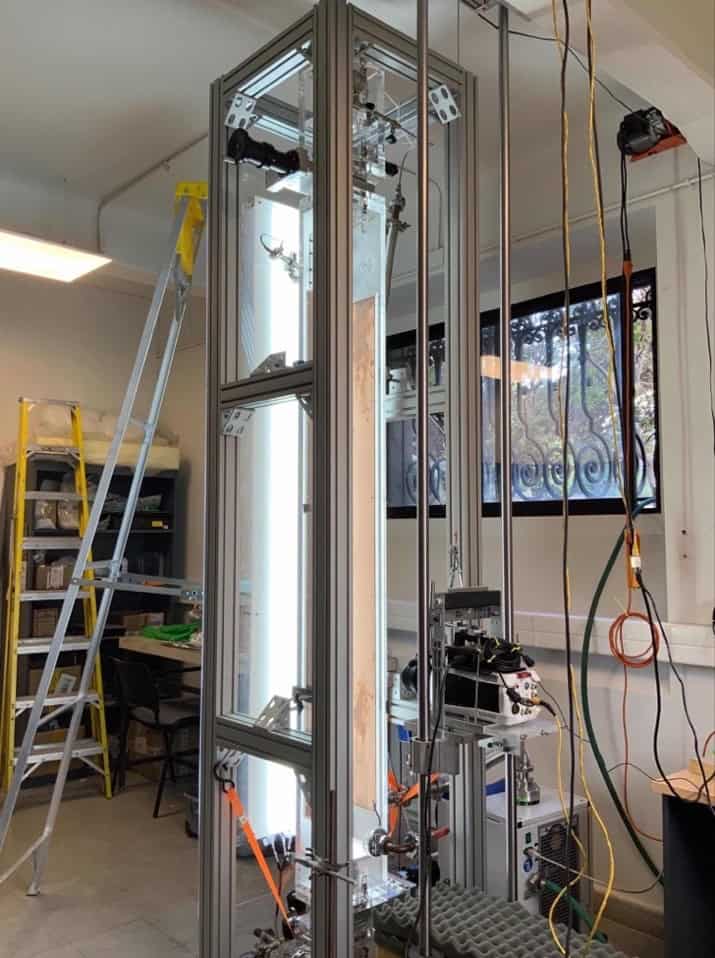
In their experiments, the Chile researchers released the particles from a 3 m drop tower, which is essentially a huge, transparent hourglass structure under vacuum with electrodes on either side that generate a static electric field. Inside this tower, the particles rub against each other during their quasistatic flow and become either positively or negatively charged in the process. The static electric field accelerates these charged particles sideways, and the researchers measure this acceleration by capturing the particles on video as they exit the tower. By combining the particles’ known mass with their measured accelerations, the team can calculate the particles’ charges.
Next, Mujica and colleagues plotted the probability that a certain amount of charge would be found on a given particle. Since charges could be either positive or negative, all the PDFs, regardless of particle size, resembled non-Gaussian curves with peaks at zero charge. However, the widths of these curves varied systematically with the surface areas of the particles. According to the researchers, this result indicates that the charging of the particles depends on the particles’ size.
Towards a microscopic model of charge exchange
The researchers say their study began with a simple question: how do planets form? “There are some important missing pieces in this big puzzle and one of them is the effect of electric charges,” Mujica says. The team’s results, he says, are evidence that charge can indeed help particle clusters to form in space.
Their main challenge, he recalls, was constructing the drop tower. The first prototype did not work because of a fundamental design problem, and while the second worked better, it broke after a few years because of the forces (about 40 kN) exerted on each side of the chamber due to the vacuum within. “The third and current version is working fine and we expect it to live long enough to take more useful data,” Mujica says.
Surface contamination holds the key to a static electricity mystery

The researchers, who report their work in Physical Review Materials, say their next step will be to develop a microscopic model of charge exchange from which they can determine the measured charge distributions. “We will then adapt this model for mixtures of particles, either of different sizes or materials, and try to simulate more realistic situations, comparing the predictions with measurements,” says Mujica.
“It has also been recently demonstrated that adventitious carbon, a thin, ubiquitous layer of carbonaceous contamination (typically a few nm thick) that forms on most surfaces exposed to air, plays a big role in the way oxide particles exchange charge,” he adds. “We therefore intend to study the charge segregation that usually occurs between large and small grains and the effect of surface cleaning processes.”