Researchers at the University of the Witwatersrand (Wits) in Johannesburg, South Africa, have succeeded in harnessing a relatively unexplored property of light – its topology – to robustly transfer information through the atmosphere. The work could advance the development of more reliable long-distance optical communications, including space-based ones, and connect remote and underserved communities worldwide.
Their work is detailed in two separate studies, one based on classical and the other on quantum optics. These studies show that the topological information can remain remarkably robust – even when the states of light carrying this information are subject to the severe distortions caused by atmospheric turbulence. Instead of relying entirely on increasingly sophisticated hardware or computational algorithms to correct atmospheric distortions before or after light transmission, the new concept provides a fundamentally different way of thinking about robust optical communication in complex environments, such as air or water, they say.
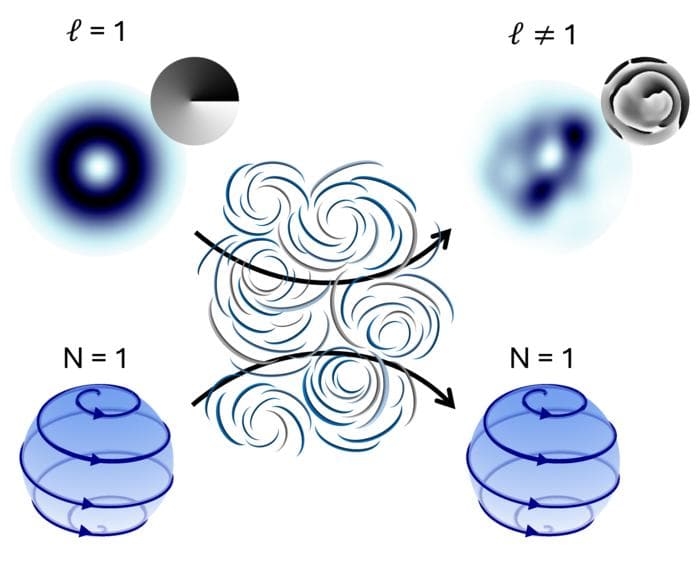
Both studies are based on the same fundamental idea: creating an optical topological structure known as a skyrmion in a light field and testing whether it remains robust when it passes through a distorting environment, explains Andrew Forbes, who is head of the Structured Light Lab at the Wits School of Physics. Skyrmions are quasiparticles with a two-dimensional, knot-like structure and were first observed in magnetic materials. They have, however, recently been seen in electromagnetic fields and the electric field of light waves. Here, the swirling structures are created by twisting the polarization or spin vectors of light in space so that every polarization is found exactly once, twice, three times and so on – the count being the skyrmion number. Skyrmions are topologically stable, which means that external perturbations do not affect them in any way.
Real-world test
In the first study, Forbes and colleagues used laser light with a wavelength of 532 nm shaped into various vectorial beams using a spatial light modulator and a modified Mach–Zehnder interferometer to generate optical skyrmions with skyrmion numbers of 1, 2 and 3. These numbers, which are always whole integers, describe how twisted the vortex-like structure of the skyrmion is. They then sent the laser light through a 270-m-long real-world free-space optical link located on Wits’ Braamfontein campus in the centre of Johannesburg.
The researchers measured the topology of the skyrmions with a Stokes polarimetry setup and found that the skyrmion number remains robust in a wide variety of atmospheric conditions, ranging from “calm, cool morning air to the highly erratic and intense distortions at midday” when it is hotter. “This result holds true even when the vectorial polarization of the underlying laser beam has been highly scrambled by atmospheric turbulence effects – and was therefore unrecognizable,” says Forbes.
In-built correlations
In the second work, the team created the topology through the in-built correlations between two photons entangled in their optical angular momentum (OAM). The OAM quantum states are not themselves stable in distorting environments and the information they encode is easily lost. The researchers investigated the robustness of a skyrmion with a skyrmion number of 1 in a controlled laboratory environment by studying photons in media with varying levels of turbulence.
The result? Despite local distortions, the skyrmions maintained topological numbers close to 1. This, they say, suggests the topological number is fundamentally decoupled from modal crosstalk induced by the turbulence and the spreading of an individual photon’s OAM.
Despite the very different physical systems, both experiments reveal a similar result, says Forbes: the conventional properties of optical fields can be strongly degraded by distortions, while the topological information encoded in those states remains remarkably robust. Together, the two works demonstrate that topology can be harnessed in both classical and quantum optical systems as a robust carrier of information in very different communication and information-processing scenarios.
Robust protection
Topology is a concept that appears throughout physics, from fundamental particle physics to magnetism and condensed matter systems. In many of these systems, explains Forbes, topology comes with a physical protection mechanism – such as an energy barrier – that explains why a topological structure is resistant to external disturbances. In optics, however, the situation is rather different. Optical topologies can be created and manipulated with relative ease, but their robustness is not necessarily guaranteed by any particular underlying physical protection mechanism. “We therefore wanted to address a fundamental question: how robust is optical topology when light encounters a real-world, highly distorting environment?
“The atmosphere provides a particularly interesting testbed because it is highly relevant to optical sensing and communications and represents an extreme case where the distortions vary rapidly both in space and time,” he tells Physics World. “Demonstrating robustness in this setting was therefore both a fundamental test of the dynamics and resilience of optical topologies and an indication of its potential practical value.”
Hurdles and challenges
One of the major challenges was simply doing precision optical experiments outdoors, he adds. “We had to contend with the unpredictability of nature: changes in sunlight and temperature, wind, rain and even the thermal expansion of buildings, which can affect optical alignment, making it difficult to maintain stable measurements over long periods.”
Another hurdle to overcome was to find a way of measuring the optical topology itself. Existing methods to do this can be quite sensitive to experimental noise and imperfections, so the researchers say they had to carefully distinguish genuine changes in the optical channel from apparent changes introduced by the measurement process. Ultimately, this meant developing new ways to both obtain and process the experimental data so that they could reliably track the topological properties of the light despite the noise that was present.
Applications include free-space optical, satellite and space communications, and linking remote or underserved communities, where atmospheric turbulence and the lack of physical infrastructure can present significant challenges, says Forbes. “More broadly, topology could be useful beyond communication,” he adds. “Indeed, its underlying robustness could potentially be exploited for optical sensing, information processing and other applications where light has to propagate through complex or noisy environments.”
Switchable skyrmions light up terahertz communications

The quantum experiment adds another possibility, he notes. “We know that entanglement decays in real-world conditions that are not pristine. Our work shows that despite this, the quantum information stored in the topology remains intact. This may allow us to distribute information across a quantum network in a more reliable and robust manner.”
Looking ahead, the Wits researchers say they will now assess whether the robustness they have observed extends to other kinds of challenging environments, such as underwater and biological tissue, where scattering, birefringence and other phenomena can be much more prevalent than in the atmosphere.
“We also want to develop detectors and techniques for measuring optical topology,” says Forbes. “Improving how we characterize these structures will be important for moving from proof-of-principle experiments towards practical applications.
“Finally, we would like to actually exploit the robustness of the topology we have identified in high-speed communication experiments. This means implementing realistic communication protocols and investigating how much information can be reliably transmitted using a ‘topological alphabet’.”