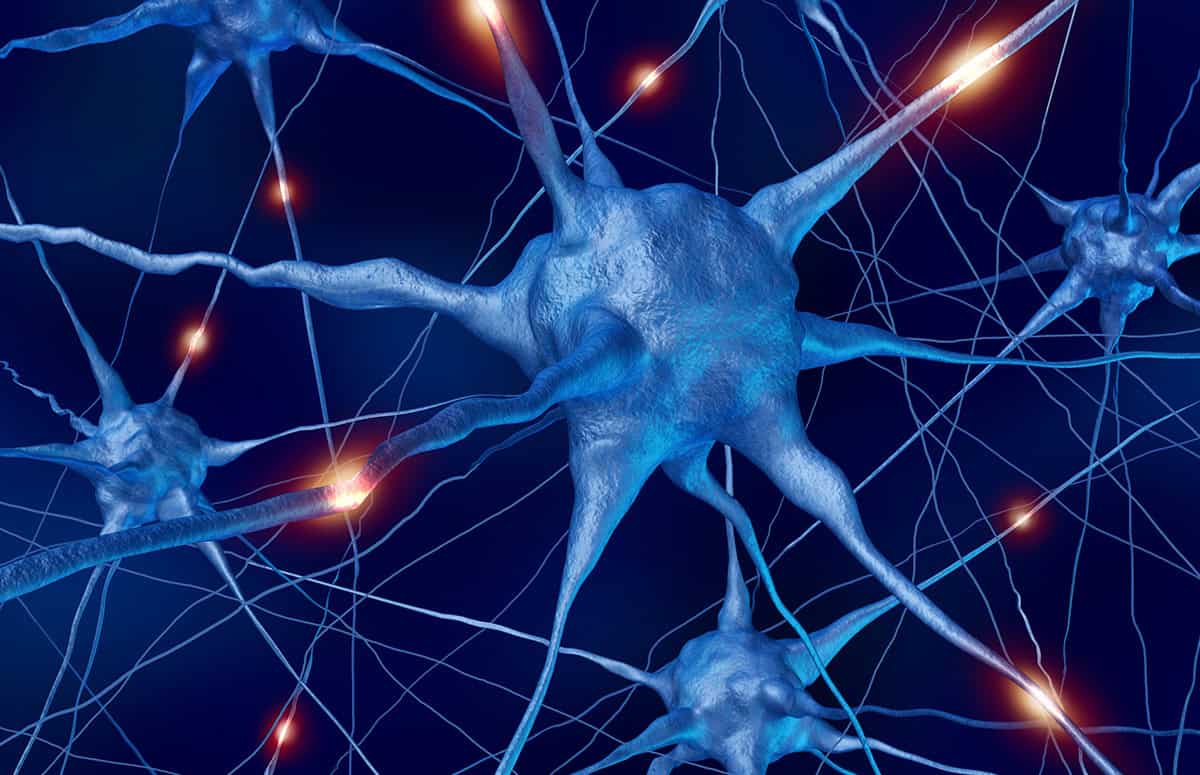
Combating the persistent death of neurons is a long-standing challenge in treating Alzheimer’s disease, in which neurons are forced into programmed cell death, causing cognitive decline. Once neurons die, the brain lacks the capacity to simply replace them. Current therapies can only slow neuronal degradation and cannot replenish the loss of neuronal circuits within the brain. In a new study published in Cell Biomaterials, researchers offer a different strategy: rather than protecting existing neurons, they engineer new neurons from cells that the brain already has plenty of.
The team, led by Peisheng Xu at the University of South Carolina, use their previously developed Nano-ERASER platform, a polymer nanogel designed to ferry antibodies across the blood–brain barrier and into specific brain cells. In their latest research, they load their Nano-ERASER cargo with an antibody that targets a protein called PTBP1 found inside astrocytes (another type of brain cell). The process reprogrammes the brain to make new neurons, helping to combat neuronal death.
Why target PTBP1?
Aside from neurons, our brains contain various other types of brain cells that support neuronal function. Among the most abundant of these cells are astrocytes, which are responsible for controlling the environment around neurons. The PTBP1 protein helps keep astrocytes in their support-cell identity, maintaining their cellular state by suppressing genes that would otherwise push them into becoming neurons. So, by reducing levels of PTBP1, it’s possible to nudge astrocytes to change their cellular state and become new neurons, a process called astrocyte-to-neuron conversion.
While astrocyte-to-neuron reprogramming, by way of targeting PTBP1, has long been contemplated using emerging gene-editing or RNA-based technologies, one major hurdle is targeting astrocytes, without affecting PTBP1 in surrounding tissues and cells. Xu and colleagues previously engineered a nanogel that can surpass this specificity problem in an interesting way: rather than editing genes or blocking the production of proteins, it instead uses antibodies to target PTBP1.
Antibodies are another type of protein produced by immune cells that are designed to find and destroy foreign substances. By programming the antibodies to target PTBP1 specifically, the antibody’s sensor (the TRIM21 receptor) marks the antibody-tagged PTBP1 for destruction, thus driving astrocyte-to-neuron conversion. This “Trim-Away” technology acts at the level of the protein; it leaves no permanent genetic alteration, acting more like a dial than a complete off-switch.
How does it work?
Before worrying about specificity, the first roadblock to delivering drugs to the brain is the blood–brain barrier, a dense, tightly sealed layer of cells that lines every blood vessel within the brain. The blood–brain barrier in itself is one of biology’s toughest engineering problems: albeit useful for protecting the brain, it blocks the delivery of large biomolecules such as antibodies.
To surpass this delivery problem, the researchers use their established nanogel technology, Nano-ERASER. They engineered a polymer-based nanoparticle that encapsulates the PTBP1 antibody, protecting it through circulation and allowing its passage across the blood–brain barrier, before releasing the antibody only once it is inside its target, the astrocytes.
By combining the nanogel technology with specific antibodies for PTBP1, a treatment they coin TN-PTBP1, the researchers address two fundamental limitations: the ability to effectively ablate PTBP1 in astrocytes alone; and the specific delivery across the blood–brain barrier and into astrocytes.
What did they find?
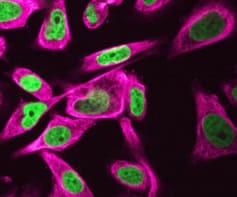
The researchers tested the effectiveness of the TN-PTBP1 treatment with increasing levels of complexity. Starting with in vitro models, they showed that astrocytes grown in a dish were stripped of PTBP1 and successfully converted into neurons. Likewise, in human brain organoids (lab-grown tissues that mimic a real brain), the treatment converted astrocytes to neurons.
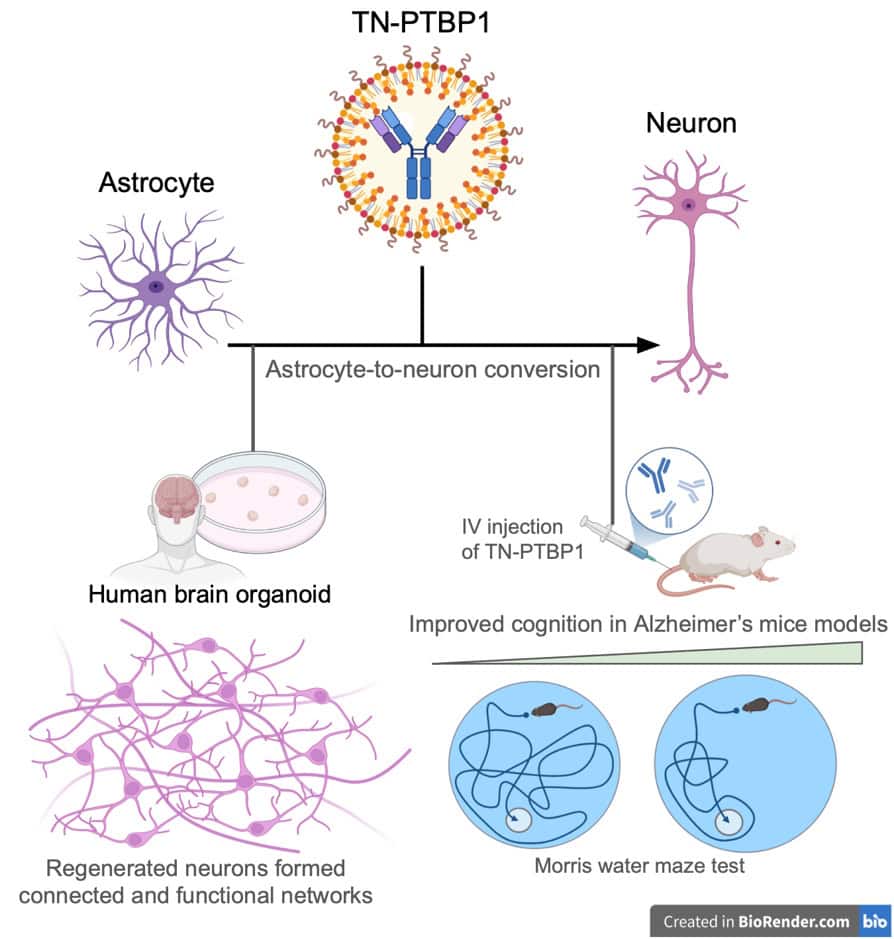
The real test is whether TN-PTBP1 has the same capabilities in vivo, so the researchers tested it on live mice engineered to develop Alzheimer’s-like pathology. Across all three models, the astrocytes didn’t just convert into neurons, they fired just as neurons would, mimicking their electrical activity.
In the mice, two injections of TN-PTBP1 were enough to reverse the disease trajectory. The number of neurons within the hippocampus increased and the mice relearned skills they’d lost, becoming capable once again of building proper nests and navigating a water maze more efficiently. Another unexpected finding was that instead of negatively impacting inflammation due to the loss of support cells, TN-PTBP1 reduced brain inflammation and amyloid-beta buildup, another hallmark of Alzheimer’s disease pathology.
“Not only did TN-PTBP1 treatment replenish lost neurons, but it also created a supportive environment for the remaining and newly generated neurons to survive,” says Xu. “Therefore, the TN-PTBP1-induced improvement in cognitive function may be maintained for a long time without frequent treatment.”
Stimulating the brain at 40 Hz to treat Alzheimer’s disease

From human brain organoids to mice, the treatment successfully created new neurons. For a field used to treatments that can only slow disease progression, this is a huge milestone. The researchers show that we can go beyond delaying the outcome, and that reversing Alzheimer’s disease may be possible.
Next, they will focus on evaluating TN-PTBP1’s long-term safety, optimizing the dosage and mapping the integration of these newly generated neurons into existing neural circuits. Most excitingly, the team plan to assess how applicable this treatment is to other neurodegenerative diseases. This game-changing approach to reversing neurodegeneration could one day completely reshape how we treat neurodegenerative diseases.