A cloud that appears above a Martian volcano every morning during the planet’s spring owes its origins to a mechanism never previously observed in nature. This finding, which is based on theoretical modelling by researchers at LMD/CNRS/Sorbonne Université in Paris, France, challenges basic assumptions about how clouds form on other planets, as well as here on Earth.
Most clouds on Earth form when moist air cools and water vapour condenses as ice onto preexisting dry particles, such as dust, in the atmosphere. This process is known as heterogenous nucleation. For water molecules to form ice crystals directly, without the need for a solid “seed”, the atmosphere would need to be supersaturated with water vapour. Though theory predicts that this should be possible, scientists regarded this spontaneous, or homogenous, nucleation process as unlikely to occur in the atmosphere of any real planet.
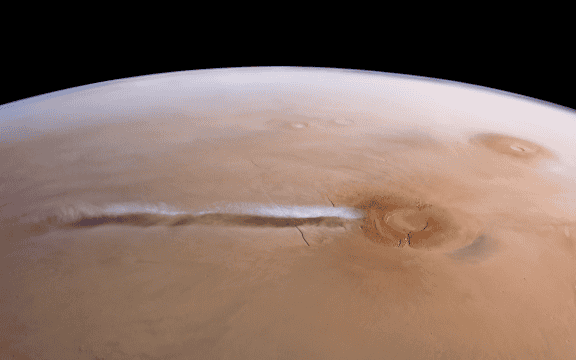
Enter the Arsia Mons Elongated Cloud (AMEC). First imaged by NASA’s Viking Orbiter 2 in 1977, and later by the European Space Agency’s Mars Express spacecraft, the AMEC forms at an altitude of approximately 45 km over the western side of the 20-kilometre-high Arsia Mons volcano. It then expands via wind-driven advection, ultimately reaching spans of up to 1800 kilometres. By midday, it is gone.
Astronomers have long puzzled over how the AMEC forms, not least because classic mesoscale atmospheric models fail to replicate its elongated tail. “We started investigating the AMEC in the first year of my PhD,” says Jorge Hernández-Bernal, a planetary scientist who led the new research. “We have been observing it for years and trying to understand it with the support of simulations by a meteorological model, which were initially unable to reproduce the cloud.”
Combining two models
To solve this mystery, Hernández-Bernal and colleagues drew on data from the three cameras aboard Mars Express: the Visual Monitoring Camera, the High Resolution Stereo Camera and OMEGA. “Mars Express can image large swathes of the Martian surface at high resolution,” explains Hernández-Bernal. “It is one of the few Mars-orbiting spacecraft – alongside ESA’s ExoMars Trace Gas Orbiter – able to observe during morning hours, when the AMEC is present.”
The team combined these observations with a Mars mesoscale model based on the Mars Planetary Climate Model and their own simulations derived from classical nucleation theory.
The results show that as strong winds hit the summit of Arsia Mons, they create intense, localized atmospheric gravity waves that propagate several kilometres up into Mars’ thin lower mesosphere.
The air displaced by these waves then cools drastically, dropping as much as 30 K in just 10 minutes. As temperatures fall below 130 K, the air can no longer hold as much water vapour; indeed, the vapour already present reaches levels 105 times higher than this colder air can sustain. Under these extreme, water-saturated conditions – 100 000 times the levels usually seen on Earth – the kinetic barrier to spontaneous freezing collapses, allowing water vapour molecules to self-assemble into pure ice crystals.
Is homogeneous nucleation unique to the AMEC?
At some point, Hernández-Bernal says the team noticed that this model scenario contained conditions compatible with homogeneous nucleation, and that this process could be what forms the cloud’s long tail. “Then we started experiments introducing homogeneous nucleation in actual models and the results showed a pretty good reproduction of the cloud,” he says.
Liquid water could abound in Martian crust, seismic study suggests

One remaining question, Hernández-Bernal tells Physics World, is whether homogeneous nucleation on Mars occurs only in the AMEC, or whether it also crops up somewhere else: “I know of some other clouds observed on Mars that could maybe involve homogeneous nucleation too, but more investigation is needed.”
He and his colleagues, who report their work in Nature Geoscience, now plan to study submicron aerosols on Mars and their potential effects on clouds. “We will be looking at whether these clouds could challenge our idea of homogeneous nucleation – and maybe prove us wrong,” he says. He adds that the team is also planning to observe the AMEC in more detail, though such observations will be challenging. “Satellites move very fast compared to the size of the cloud and we need very specific observations,” he notes.