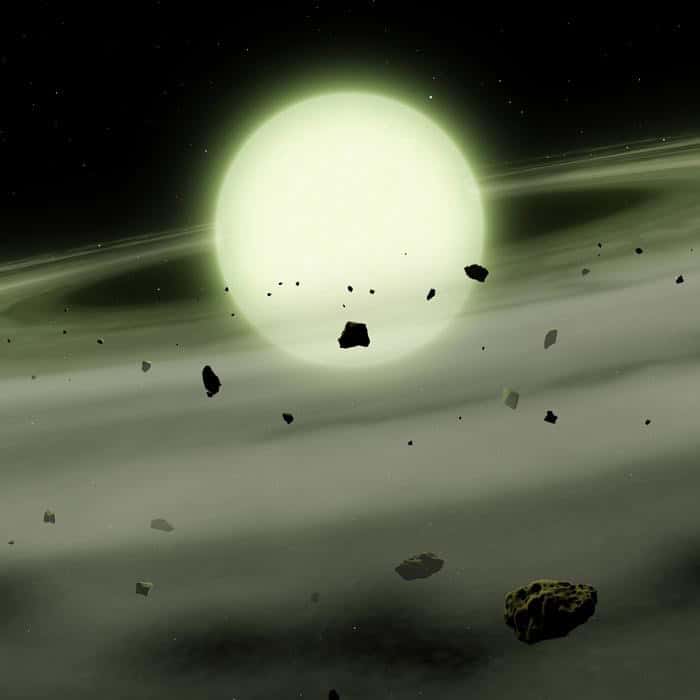
Astrophysicists have discovered the first star that appears green to the human eye. Located nearly 282 light-years from Earth, the star is one of many unexpectedly colourful white dwarfs identified in a recent study, challenging common misconceptions about what these stars can look like.
“I have analysed tens of thousands of white dwarf spectra over the years and have always wondered what these stars would really look like if we could see them up close,” says study leader Mark Hollands, an astrophysicist at the University of Warwick, UK. “As an astronomer, it’s easy to get bogged down in the detailed physics and almost forget you’re studying real objects that truly exist out there in the universe. This work makes the physics of stars more tangible and highlights the human connection to what we do as scientists.”
Our understanding of star colour draws on the concept of blackbodies, which are objects that absorb all incident radiation and emit it in a spectrum that depends solely on temperature. Human beings, for example, are relatively cool, so we emit radiation almost entirely in the infrared. In contrast, if you heat a piece of metal to 1000 K, it will glow red, then orange as its temperature increases further. At 6000 K – the temperature of the Sun’s surface – a blackbody will glow white, and some very hot, very bright stars such as Sirius and Rigel glow blue.
White dwarfs are much dimmer than these super-bright stars. They are remnants of Sun-like stars that have reached the final phase of their lives, and they get their name because the first ones to be observed were hot, meaning they appeared white or pale blue through a telescope.
If we could get close enough to see white dwarfs without a telescope, however, the coolest among them would shine in other colours. This is because their atmospheres are extremely dense (roughly 1g/cm3) and contain either hydrogen, helium, or both. When trace elements collide with hydrogen/helium atoms in this super-dense atmosphere, they undergo quantum interactions that distort their energy levels, allowing them to absorb light over a wider range of colours.
First genuinely green star in the galaxy
In the latest work, which appears in RAS Techniques and Instruments, Hollands and colleagues ran the light spectra of white dwarfs in several different categories through a model of human colour vision. They found that the colour of each star as it would appear to the naked eye depended on the chemical composition of a star’s atmosphere. Carbon-rich white dwarfs are typically pink or purple, for example, while cooler white dwarfs with mixed hydrogen/helium atmospheres often take on a cyan or pale blue tinge.
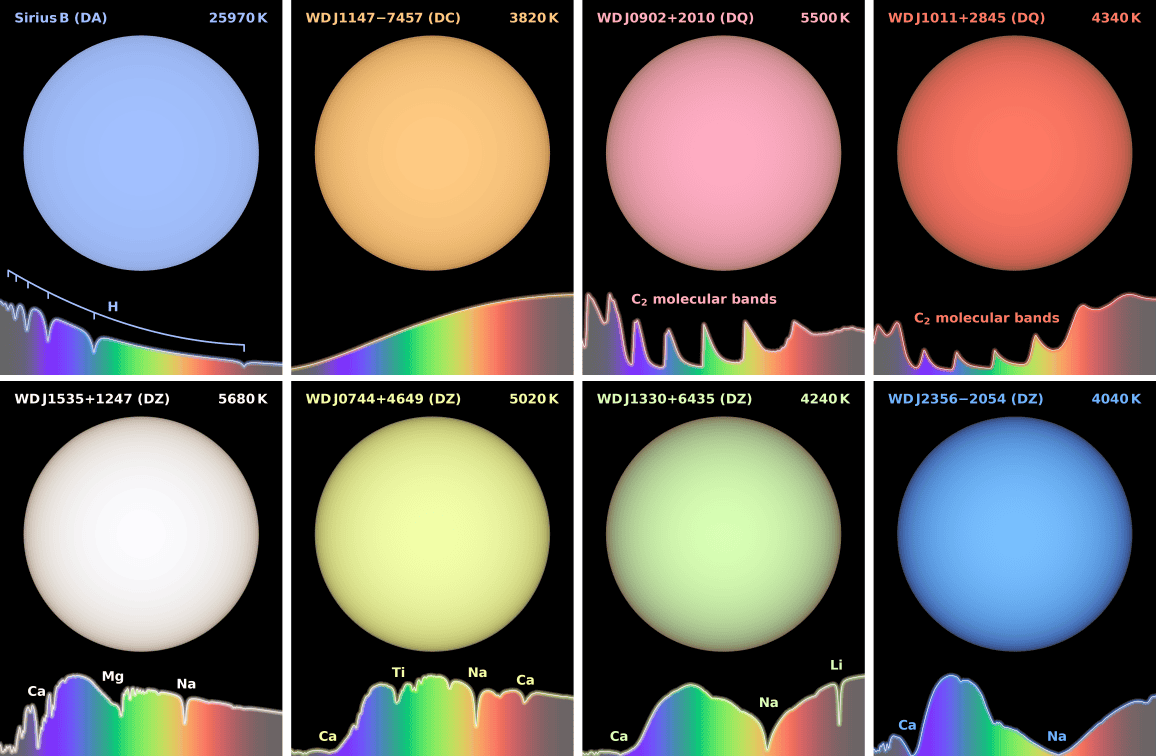
The most surprising finding, says Hollands, concerned a white dwarf star with a temperature of around 4000 K. Known as WDJ1330+6435, this white dwarf has accreted so much planetary debris from broken bits of asteroids or comets that its atmosphere is rich in sodium and calcium metal. These metals give it an unusual – possibly even unique – colour.
“Normally, sodium absorbs only a very specific shade of orange (this is the same orange as in old sodium streetlamps), but this white dwarf can absorb light over a wider range of colours – that is, some yellow, lots of orange and some red as well,” Hollands tells Physics World. “Similarly, the calcium in its atmosphere absorbs violet light. The resulting mixture of wavelengths results in a pale green colour.”
The researchers say that, to the best of their knowledge, no other star, living or dead, has ever been credibly reported as shining in this colour, making WDJ1330+6435 the first genuinely green star in the galaxy.
An unusual approach
While astronomers often use spectra to explore the properties of distant stars, Hollands says it is unusual for such studies to focus on human perceptions. Fortunately, he and his colleagues didn’t have to start from scratch. “Understanding how the spectra of real-world objects appear to the human eye is important in many domains – for example, as a fundamental step for correctly calibrating cameras and TV/computer displays,” he explains. Some techniques from colour science are also mathematically similar to a common astronomy tool called synthetic photometry, he adds.
Two-faced white dwarf star leaves astronomers puzzled

The next few years will be an exciting time for white dwarf research. So far, astronomers have identified almost 400,000 such stars, mostly using data from the European Space Agency’s Gaia observatory. However, around 90% have never been observed spectroscopically – at least not yet.
“Several other large spectroscopic surveys have recently started, or are about to start, taking data for millions of stars (including white dwarfs) across the galaxy,” Hollands says. “No doubt we will find lots more white dwarfs with unusual looking spectra, so I will certainly be on the lookout to see if any of these appear in peculiar hues to the human eye.”