A new report by the Trump administration that outlines a model for the future government support for science and technology has drawn heavy criticism from the US scientific community. Entitled Science: A New Golden Age, it emphasizes developments by public-private partnerships at the expense of university-driven research with critics asserting it places politics above science.
The 104-page report aims to update a 1945 document – Science, the Endless Frontier – that was issued by Vannevar Bush, who served as director of the US government’s Office of Scientific Research and Development in the 1940s. The report eventually led to creation of the National Science Foundation (NSF) in 1950.
The 2026 report focuses on how government R&D spending reaches the scientific community and claims that the US research enterprise has become too centred on established research institutions rather than individual researchers.
The report wants the government to significantly reduce the amount and number of grants it gives universities and instead make large investments in industry and non-profits. It also calls for a significantly scale-up of the use of artificial intelligence in science.
“We must renew the R&D enterprise on which our scientific leadership depends,” US science adviser Michael Kratsios and Office of Management and Budget (OMB) director Russell Vought write in an accompanying memorandum.
Yet critics says that funding for exploratory science is not the administration’s only target. “It’s very clear that Kratsios/Trump want to destroy universities, or what he calls ‘legacy institutions’,” says public policy expert Shobita Parthasarathy from the University of Michigan. “There is no respect for basic research, which has historically driven innovation in the US [but that] industry won’t fund.”
Neal Lane, former US science advisor who served as NSF director between 1993 and 1998, takes issue with how individual agencies are asked to implement the points raised in the report. “Unlike previous rules, which were uniform guidance, allowing an agency like NSF to set their own rule, the new rule is a binding uniform regulation applying to all agencies as written,” he says.
Lane is also unhappy with the report’s dismissive approach to peer review, which it argues slows down innovation, proposing instead to diversify funding mechanisms with alternatives such as “golden tickets” rapid grants and prize challenges.
“For many decades, expert peer review has been regarded as the gold standard for funding research and publishing the results,” he says. “It is not credible for the administration to claim it supports ‘gold standard science’ without peer review.”
‘Misguided approach’
While some see merit in aspects of the report, or at least a need to rethink the underpinning of scientific research, the American Association of University Professors (AAUP) see the administration’s approach as a misguided way to address those challenges. “Reforms must strengthen scientific independence – not weaken it,” an AAUP statement asserts.
That view is echoed by the Federation of American Scientists (FAS), which note that while the report calls for a “lighter, faster, and more capable research enterprise”, it says that the to the “uniform guidance that governs how federal grant funding is administered runs counter to that goal”.
The report comes as the administration’s proposed budget for financial year 2027, which Congress must approve, would cut overall government spending on R&D by 22%, with support for the NSF slashed by more than 50%, NASA by 23% and the Department of Energy’s Office of Science by 15%. The OMB also proposes guidelines that would allow agencies to terminate grants that “no longer serve agency priorities or the national interest”.
Tess DeBlanc Knowles, a senior director at the US thinktank the Atlantic Council, says US science will be hit badly if those cuts go ahead. “No amount of experimentation can counteract the damaging effects that dramatically reduced funds will have on the foundation of the US’s scientific and technological leadership and ability to train the next generation of scientists,” she says.
A new report by the American Institute of Physics has found that physics and astronomy PhD graduates are quitting the US in record numbers. The proportion of non-US citizens leaving the US post-degree nearly doubled, from 16% in 2024 to 29% in 2025 – the largest one-year increase since 1997. The report also says about 12% of US citizens post-physics PhD left the US in 2025, compared to just 5% two years earlier.
Kristian Dominek Barajas is head of quantum theory at the UK-based quantum computing company Oxford Ionics, which merged with the US firm IonQ in 2025. Barajas got his PhD – which was focused on developing analytic methods for high-accuracy models of driven quantum systems beyond the rotating-wave approximation – at the University of California Los Angeles, US, via the American Physical Society’s Bridge Program. The programme provides pathways into research for qualified students who might not otherwise continue their physics education. He now serves as chair of the APS Committee on Minorities (2025–2026), where he helps shape national initiatives that support physicists from historically marginalized backgrounds – particularly people of colour, LGBTQIA+ physicists, and physicists with disabilities.
What skills do you use every day in your job?
Because I’m relatively new to the field, I often have to break difficult questions down into simpler ideas before I can grapple with them. That has trained me to take a really complicated problem and give it my best guess, and that first-pass intuition often gets me surprisingly close to the full solution.
The other thing I’d highlight is leadership skills. I come from an untraditional background – it took me a long time to do my undergraduate degree, and afterwards I worked in a lot of different jobs, including working at a pet store, where I was training to become a team lead. When I went to grad school, I applied through the APS Bridge Program, which is great, and it gave me an opportunity to get into research. But again, my path wasn’t traditional: I did soft condensed matter physics for four years, and then my advisor passed away unexpectedly, so I switched fields to trapped ions because I needed to graduate. I had no background in quantum physics at that point, so it was quite a transition.
Experiences like this added up. By the time I joined Oxford Ionics right before the merger with IonQ, even though I was the “greenest” person in my team in terms of being new to the field, I had the most leadership experience. That meant I went from being an entry-level quantum theorist to a senior quantum theorist in two or three months. A month and a half later, I became the atomic, molecular and optical (AMO) theory manager. The experience I’d gained made it easy to set priorities and get people to go in the correct direction.
What do you like best and least about your job?
My least favourite part of the job is that I don’t get to read much new research. The job is so fast-paced and there’s so many things happening every day that getting the chance to sit down and read an article is quite rare. I use AI tools to help me find and keep up with new research. Part of my workflow involves asking AI to identify relevant papers and give me an initial sense of what I need to know. I still skim the papers themselves as much as I can, but I don’t get the chance as often as I’d like to pick up a manuscript and spend a whole day working through it like I did in academia.
We also don’t always have the time to write papers about what we’re doing. It’s not that we aren’t allowed to – in fact, we’re encouraged to pursue that if we want to do it – but finding time is challenging.
I’m constantly getting to do new and interesting physics, and I absolutely love that about my job
The upside is that the pace at which I get to do research far, far outweighs what I experienced in academia. What we accomplish on our team in four to six weeks is comparable to the amount we would do in six months in academia. It is absurd how fast we get to move. I’m constantly getting to do new and interesting physics, and I absolutely love that about my job.
What do you know now that you wish you’d known at the start of your career?
I wish I’d known that feelings of imposter syndrome don’t always have to be something to fear. For me, they can also be a reminder that there is still so much more to learn, and that can be exciting. That’s why I was so excited for the opportunity to earn my PhD in physics: it gave me the chance to keep learning. Now, whenever that old imposter feeling comes up, I try to see it as an opportunity to learn rather than a reason to hold myself back. I wish I had embraced that earlier in my career and not been so afraid to try things.
Na₂Mn₃O₇ is a magnetic material that behaves unusually and therefore can provide insight into how magnetism emerges in complex materials. Magnetic materials contain entities known as spins, which can be thought of as tiny magnets with north and south poles. These spins interact with neighbouring spins, and as a material is cooled, they often align into an ordered pattern that extends across the entire material, known as long-range magnetic order.
However, Na₂Mn₃O₇, which contains magnetic Mn⁴⁺ ions, behaves differently. It has strong magnetic interactions, very little disorder, and a two-dimensional arrangement of magnetic ions. Under these conditions, a material with relatively large spins would normally be expected to develop long-range magnetic order at low temperatures. Surprisingly, no magnetic ordering is observed, even at very low temperatures.
The material also exhibits two distinct magnetic crossovers. Around 110-120 K, the magnetic susceptibility reaches a broad maximum, indicating that strong magnetic correlations are developing. Around 60-70 K, a feature appears in the specific heat, showing that the system is undergoing a further internal reorganisation. The presence of two separate temperature scales suggests that the magnetism develops in two stages.
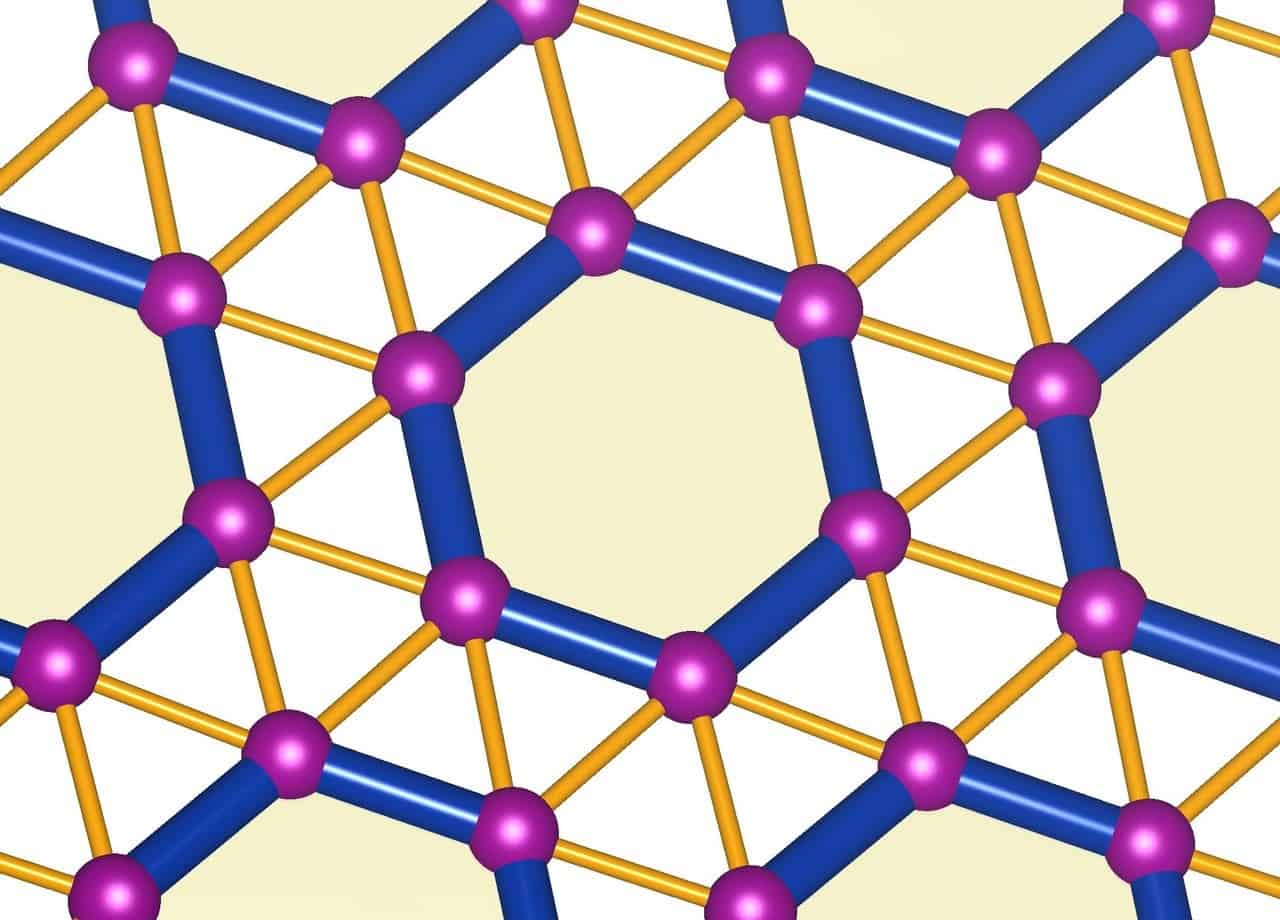
The crystal structure of Na₂Mn₃O₇ organises the Mn spins into strongly correlated hexagonal units, connected by weaker and frustrated interactions. This hierarchy suppresses conventional magnetic order and produces a molecularized two-dimensional magnetic state. (Courtesy: Iqbal/Indian Institute of Technology Madras)
Using theoretical and computational techniques, the researchers showed that this unusual behaviour originates from the crystal structure of Na₂Mn₃O₇. The crystal structure divides the magnetic lattice into strongly connected hexagonal clusters of six Mn ions. These clusters behave like magnetic ‘molecules’, with the spins inside each hexagon becoming strongly correlated. Interactions between different hexagons are much weaker and frustrated, preventing the formation of long-range magnetic order across the material.
This research is important because it demonstrates that even large-spin magnetic materials can exhibit quantum-disordered behaviour. More broadly, it shows that crystal structure can be used as a tool to engineer new magnetic states by organising spins into strongly correlated clusters that suppress conventional magnetic ordering.
“What is striking in Na₂Mn₃O₇ is that the crystal structure does more than slightly distort the magnetic lattice. It reorganises the spins into strongly correlated hexagons that behave as emergent magnetic molecules, while frustration and quantum fluctuations prevent these units from ordering collectively.“ – Yasir Iqbal, Indian Institute of Technology Madras
Graphene, an atomically thin material of a single layer of carbon atoms, is a fascinating material for high-speed electronics, spintronic devices, and neuromorphic components due to its exceptional tunable electrical conductivity. One area of research focuses on understanding how electrons flow through graphene to enable the design of advanced devices. For applications, ultrathin metal-oxide layers (e.g., aluminum oxide and titanium oxide) are routinely deposited on graphene, which deliberately alter electron flow and provide greater control over its properties, in devices ranging from transistors to spin valves. However, although the effects of these coatings are known, researchers have not previously been able to directly observe what is happening inside the device. Instead, their understanding has relied primarily on theoretical models, numerical simulations, and indirect electrical measurements.
In this work, the researchers used X-ray Photoelectron Spectroscopy (XPS) to map electrical potentials across devices while they were operating. They examined the electrical landscape, identifying regions with steep slopes corresponding to strong electric fields and flatter regions corresponding to weaker electric fields, to determine how oxide coatings modify this landscape. They found that metal oxides flatten the electrical landscape through a process known as p-type charge-transfer doping. This occurs when the oxide removes some electrons from the graphene, altering its local electrostatic environment and reducing the voltage gradient. As a result, local electric fields become weaker. The oxide layers suppress the electric fields, reducing them by more than 50%, a significant effect for device operation. A key advance of this research is the visualisation of this effect at very high spatial resolution, whereas previously it could only be inferred from electrical resistance measurements. In addition, by making a direct comparison with electrical measurements, the researchers confirmed the observed effects are due solely to electrostatics and charge redistribution.
Modern electronic devices increasingly depend on controlling electricity at very small scales. By locally adjusting electric fields using oxide coatings, researchers gain an additional design tool that enables different regions of a graphene circuit to be tuned independently. This is particularly important for spintronic devices, which are highly sensitive to local electric fields, and neuromorphic computing hardware, which requires precise control of local electrical properties.
This work represents a breakthrough in the ability to directly map charge distributions and electric fields inside operating 2D-material devices, enabling improved device design.
But despite women accounting for more than 40% of Indian science graduates, they still only make up about 16% of all physics faculty at universities in India, close to the disappointing global average of roughly 17%. As in many other parts of the world, there are myriad reasons for the low numbers, ranging from social pressure to prioritize families over research careers to a lack of visible role models and even sexual misconduct.
IOP Publishing, which publishes Physics World, recently held a webinar to celebrate the contributions of female physicists in India and explore the challenges they face. It featured Kaveri Hukku, chief executive of ATOS Instruments Marketing Services, Asima Pradhan from SOA University, who recently retired from the Indian Institute of Technology in Kanpur, and Urbasi Sinha from the Raman Research Institute in Bangalore.
Senior leader Shobha Shukla, who organized the IOP Publishing webinar, is one of India’s top researchers in nanophotonics and materials science. (Courtesy: IIT Bombay)
The webinar was organized by Shobha Shukla from the Indian Institute of Technology Bombay in northern Mumbai, who co-chaired the event with Physics World editor-in-chief Matin Durrani. One of India’s leading researchers in nanophotonics and materials science, Shukla is also a member of the editorial board of IOP Publishing’s Journal of Physics: Photonics.
“We are celebrating the women who are writing history in labs, industry and lecture halls right now,” said Shukla in her opening remarks. “This celebration is not a luxury. It is a necessity. It is how we build a culture of equity and innovation.” The following is an edited summary of the webinar, which you can watch in full on the IOP Publishing website.
Expert views
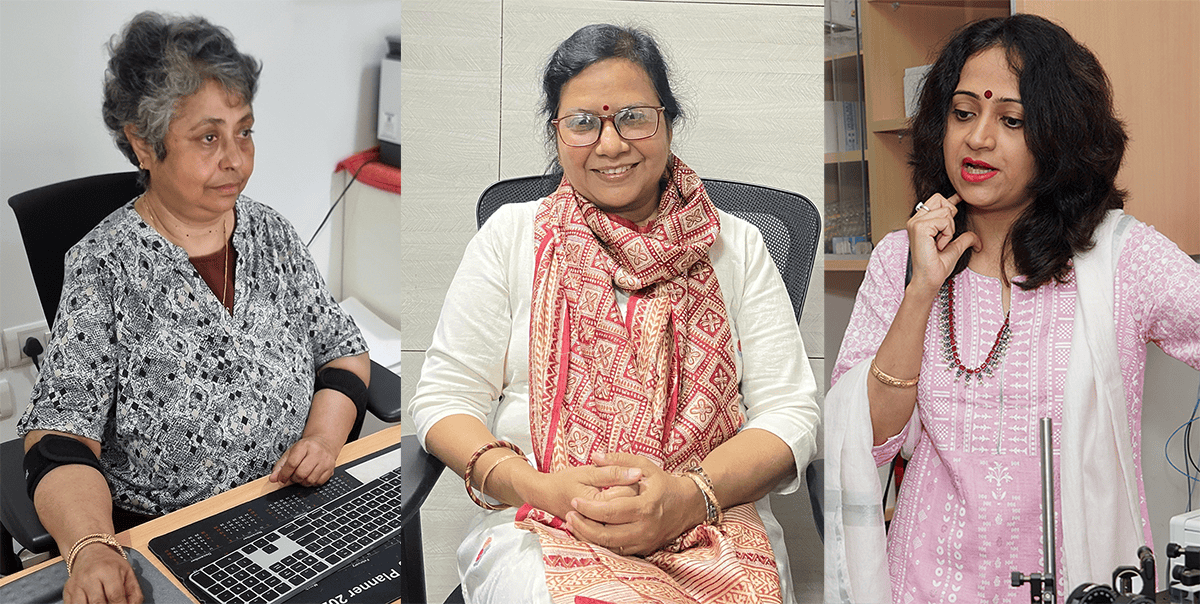
Women with wisdom The three participants on the IOP Publishing webinar were (from left to right) Kaveri Hukku, Asima Pradhan and Urbasi Sinha. (Courtesy: Kaveri Hukku; IIT Kanpur, SOA University; Raman Research Institute)
Kaveri Hukku did a bachelor’s and master’s degree in physics before going into industry, where she is now chief executive of the Bangalore‑based firm ATOS Instruments Marketing Services. Founded in 2013, it supplies research institutions and companies in India with advanced scientific instrument and equipment developed by third-party manufacturers from across the world.
Asima Pradhan is a laser physicist whose main interest lies in biomedical optics. With a PhD from City University of New York, Pradhan was based at the Indian Institute of Technology (IIT) in Kanpur for more than 30 years. After formally retiring in 2024, she is now an adjunct professor at SOA University in Bhubaneswar, where she also works for her start-up firm PhotoSpimedix, which is developing portable optical devices for clinical applications.
Urbasi Sinha, who studied physics at Jadavpur University and has both an MSci in natural sciences and a PhD from the University of Cambridge, UK, is head of the quantum information and computing (QuIC) lab at the Raman Research Institute in Bangalore. It is one of the first labs in India to use entangled and “heralded” single-photon sources for quantum science and technology applications – including India’s first project on satellite-based quantum communication.
How has your career developed and what kind of research are you currently involved in?
Kaveri Hukku: My story is actually very simple. Growing up, I was only interested in sports and games. There was no time for studies in my life. But when adulthood came knocking on my door, my parents sat me down and said “You need to support yourself – you’re not going to do it with your table tennis”.
So with some knowledge in maths and physics, I did a BSc in physics and then a master’s. After that, I found myself at the Indian Institute of Technology Bombay, where I managed to do some physics research at a serious level for a couple of years. But due to many circumstances outside my control, a PhD never happened.
Just as I was trying to decide on a future course for my life, our lab bought an ellipsometer [a device that measures changes in the polarization of light after it interacts with a sample], but the firm who sold us that system couldn’t set it up. It took me a few nights, but I managed to set it up, and from that I also got a job offer with the company. That started my career with instrumentation.
Urbasi Sinha: What excited me about physics from a very early age was how it combined clarity of thought with a sense of wonder, and this is what has driven me throughout my career. I’m an experimental quantum physicist, and I have worked extensively on different aspects, whether it is quantum optics, interferometry, quantum communication, randomness, and so on.
Essentially, I have used single photons and entangled photons both for making foundational insights and for developing emerging technologies. What is so exciting about my research is that it allows one to ask very deep questions about the nature of quantum mechanics, while also building systems that may have real technological value.
A recurring theme has been to connect fundamental aspects of quantum mechanics with practical questions of trust, validation and performance. A large part of my research currently is focused on quantum communication networks; the challenge of connecting photon sources with quantum memories, entanglement swapping, building these entanglement distribution-based quantum networks as part of India’s national quantum mission.
Basic impact Urbasi Sinha’s research involves asking fundamental quantum questions and then using that knowledge for practical advantage. (Courtesy: iStock/guirong hao)
Asima Pradhan: After completing my master’s degree in physics in India, I moved to the US to do a PhD in experimental biophotonics under the supervision of Robert Alfano at the City University of New York. Coming from a family of doctors and engineers, I’d been keen on working in biophysics and, during my PhD, I did the first fluorescent spectroscopy experiments on human tissue. I’m very proud to have been part of that pioneering work.
When I came back to India and joined IIT Kanpur,. I was based in the physics department, where an interdisciplinary research culture simply did not exist
Asima Pradhan
Then I did a postdoctoral stint at the University of Montreal, Canada, where I conducted some work on photodynamic therapy, collaborating with the physics, chemistry and pathology departments. I had a really good time working in such an interdisciplinary area, but when I came back to India and joined IIT Kanpur, the scenario was very different. I was based in the physics department, where an interdisciplinary research culture simply did not exist back then.
I worked around that and started collaborations with hospitals. We conducted experiments on light-tissue interactions with polarized light. From there, we went into translational research where we actually made a device for use in hospitals. So having begun my professional journey studying particle physics and field theory, I’m now trying to be an entrepreneur. I took voluntary retirement from IIT Kanpur two years ago, but I’m still doing research as an adjunct professor at SOA University in Bhubaneswar.
What skills do you use every day in your role?
Kaveri Hukku: Our profession can be made as simple or as demanding as you want it to be. I try to maintain high technical and analytical skills because the scientists I deal with do a lot of very involved science. But they don’t always come and ask for, say, a specific camera. Instead, they will just tell me what research goal they want to achieve.
So to keep up with them, even on a very simple level, you have to know a little bit of science. You also need to be pragmatic and say if a particular instrument is not right for the experiment, and which devices would be better for their aims. Moreover, it’s a people-facing job, so you have to be able to communicate, and have integrity and honesty such that people feel in safe hands.
Urbasi Sinha: Beyond having a textbook knowledge of physics and maths, precision is very important, as are good human skills. Patience is another vital attribute to have, whether we know it or not, as is the ability to persist when progress is slow. As I’ve grown older, I’ve also realized that communicating research in a way that excites people is vital, because we want to ensure that our field thrives.
Asima Pradhan: Technical skills, such as precision optical alignment, electronics and Monte Carlo simulations, are essential. But soft skills are vital too. For example, if you want to secure funding, you need to understand the psychology of the people sitting on the other side. The same goes for conducting interdisciplinary research: it can be very difficult to convey things using terminology everybody understands.
What do you like best and least about your job?
Kaveri Hukku: What I like most is keeping in touch with physics and physicists because they still let me potter about their labs and look over the shoulders of their students to make some comment here and there. And I get to work with a lot of young people, which always keeps you young yourself. It’s very satisfying seeing young scientists now building their own labs and wanting to buy instruments from me. That part gives me great joy: in my very small way to be part of their science journey, especially women.
The thing that I really don’t like, and never have, is travelling. My job involves a lot of travelling, packing bags, airports, hotels – but it’s not my cup of tea.
Urbasi Sinha: What I enjoy most is hearing about the everyday problems of younger people in the lab and helping them troubleshoot. I also enjoy translating fundamental quantum mechanics into technology. We do a lot of that sort of work in our in the lab – in fact, we have launched a start-up company called QuSyn Tech, where we are actually building a product.
What I don’t enjoy is avoidable friction. In any academic system, there’s inevitably some friction because research can be challenging. But when there are obstacles that are institutional, administrative or bureaucratic – or when things get petty, especially with our gender – that’s what I don’t enjoy very much.
Asima Pradhan: What I enjoy most is the fact that tissue fluoresces. I always say that when you shine light on someone and if you have the right camera, we all glow. The diffuse scattering itself is, for me, still very exciting. Playing with light and tissue gives me a lot of satisfaction, especially seeing the colours on tissue due to elastic scattering and fluorescence. Now I have a device that I’m testing in hospitals, and so it gives me pure joy just to see that we can get fluorescence from a patient.
What I do not enjoy is the fact that funding is always a little limited. There are restrictions, there are over-regulations, when there should be a certain amount of freedom. Even now, after retirement, I still feel the same.
What difficulties have you faced in your career and how did you overcome those barriers?
Kaveri Hukku: I actually faced huge challenges because, when I started my career, I was pretty much the only woman who was in this field. People would wonder why a woman had come to give this product presentation and she doesn’t even have a pretty face? What is she going to get out of this?
So it was hard getting acceptance, and then there was travelling and the expectation that you would not take time off for family. It was a very warped work–life balance that I had to take on as a challenge back then, because the commercial world was – and is – cut-throat.
If you just keep at it and you believe in yourself, I think you can overcome any gender bias
Kaveri Hukku
Even now, I can still be the only woman at a meeting, but I just keep going. If you just keep at it and you believe in yourself, I think you can overcome any gender bias.
Powerful force Women make up 40% of all science graduates in India but still face barriers advancing their careers. (Courtesy: Shutterstock/krishnasomya)
Urbasi Sinha: So far as my personal family and extended family is concerned, I have been very privileged. I don’t think I’ve had any barriers in terms of what I wanted to do. But there can be less dramatic barriers, such as being underestimated as a woman or being held to different standards, just because you are a different gender from the rest. It could even be that important decisions are shaped in informal spaces where not everyone may be included.
In the sitcom Friends, there’s this beautiful episode in which Rachel wants to be part of her office culture, but all the decisions are made out on the balcony where everyone is smoking. Rachel doesn’t smoke, but she decides to pick up smoking just to be part of the group. It’s hilarious because it’s a sitcom, but it captures the sentiment very well. Decisions are often taken in surroundings that some of us do not naturally belong to, for whatever reason.
I have definitely encountered challenges of those kinds, the underplayed ones, over the years. What has helped me most has been to stay very anchored in the science, build a very clear intellectual identity, and to remain focused on depth and originality. I also think it’s important to be well prepared, have good documentation and be willing to speak up when needed.
What has helped me most has been to stay anchored in the science, build a clear intellectual identity, and remain focused on depth and originality
Urbasi Sinha
So I think one develops both resilience and perspective that not every obstacle reflects your worth. That is very important for us to realize as women. And we should not internalize low expectations or limiting assumptions. In the long run, strong work and consistency matter a great deal.
Asima Pradhan: My father was a well-known physicist, which inspired me to study physics. But when I was doing my undergraduate degree 50 years ago, we had a class full of boys and there were only a few girls there. This is true in IIT today; you still see fewer girls.
The boys came from boys’ schools, and had not seen many girls, so they caused some disturbances. Because of this, we had to stand outside, wait for the teacher to come in and then sit in the front, and we hated it. That actually affected us to some extent, but we took it all in our stride. In contrast, during my pre-doctoral studies, we had seven girls and three boys, so that was a privilege – and, interestingly, all of us stayed in physics.
What do you know today, that you wish you knew when you were starting out in your career? And what advice do you have for other women physicists at the start of their career?
Kaveri Hukku: I wish I had known that handling money is extremely important. Whenever money is involved – whether it is in your professional life, with your siblings or with your friends – always keep finances very clear and very well-documented and then you will maintain your relationships well. Money can be like poison, but if you handle it well, you can do a hell of a lot with it. You should neither be scared of it nor give it enough power, but give it the respect it needs and figure out how you want it to be part your life.
Urbasi Sinha: We often talk about working hard, which is very important, but it’s also about what you choose to spend your time on. I have realized, as I have matured, that the choices of problems, collaborators and environment matter just as much as how hard I work.
It’s also important to build depth in your subject and not just say yes to everything. Sometimes we, as women, have a tendency not to say no. Maybe we find it a little more difficult to say no. But if we don’t, then we end up being a Jack of all trades or, in our case, a Jill of all trades, and master of none. That is something I’ve learned as I’ve grown older.
Personal growth Kaveri Hukku thinks women should focus on deepening their knowledge and not be afraid of saying “no”. (Courtesy: iStock/gorodenkoff)
Another thing – and it’s interesting because I didn’t think this in the beginning – is that visibility does matter. The phrase “good work speaks for itself” is something we say, but then at some point it is good to communicate work as well. And Physics World, of course, is the perfect forum for this. Confidence and communication early on as a scientist are important.
My advice to young women physicists would be to invest in real expertise, to cultivate a scientific voice of your own, and not to underestimate your capacity for leadership, because you can seek out mentors, but also those who will really advocate your case.
And finally, sometimes we say: “Only when I’m completely ready, will I step forward”. But you’re never completely ready. So, step forward. Confidence will follow.
Asima Pradhan: When I came back to India from the US, I didn’t realize certain things. For example, I got a job at one place and my husband, who happens to be a physicist too, got a job somewhere else. We were very clear that, once we got back to India, we would somehow be together at some place, but that did not happen. It did not happen due to many reasons that I feel should change.
There are unwritten rules about couples not being in the same department. Some people work around such things, but it did not happen for us. We ended up working for 30 years at two different places, and only now are we together after our retirement. So the younger women need to figure out what their priorities are.
If your priorities are both family and your profession, then do not compromise too much. The next generation loses out by that. So one has to negotiate before committing. The system should also work around it. The times were different when I joined and I see change. However, it is still not enough.
You can rewatch the IOP Publishing webinar on which this article is based at tinyurl.com/2w79m3cs.
Usually, when physicists want to model the merger of two black holes, they use supercomputers. Now, however, physicists in the US have found a possible shortcut. In a study published in Physical Review Letters, they show that, of the final states permitted by energy and angular momentum, the remnant of a non-spinning black hole merger ends up in a state quite close to one that maximizes the system’s entropy – a surprising and puzzling result that reinforces the deep connection between thermodynamics and black holes.
“Our group has long believed that black hole thermodynamics could provide a new perspective on binary black hole mergers,” says team member Monica Rincon-Ramirez, a postdoctoral researcher at Pennsylvania State University. “While black hole thermodynamics is well established for equilibrium systems, much less is understood in the highly dynamical regime of mergers.”
Merging black holes
Black hole mergers occur when two black holes that orbit each other spiral inward with increasing speed, losing both energy and angular momentum by emitting gravitational waves until they eventually converge in a violent clash. After the moment of merger, the remnant oscillates vigorously, “ringing down” into a quiescent, rotating object known as a Kerr black hole that can be described in terms of just two quantities: mass and spin.
Meanwhile, the gravitational waves – ripples in the fabric of spacetime – from this energetic collision propagate through space virtually uninterrupted. These gravitational waves encode information about their source, and when we detect them on Earth (millions of light-years away from their origin), we can use them to predict the remnant’s size and spin. However, doing this requires solving complex equations from Einstein’s general theory of relativity using computationally expensive numerical simulations.
Connecting black holes and thermodynamics
Thermodynamics is the branch of physics concerned with the relationships between energy, heat, work and temperature. For ordinary matter, thermodynamics can describe how energy flows from one system to another in simple terms, even for complex systems with numerous particles and degrees of freedom. For example, rather than meticulously tracking each individual particle, concepts such as entropy – a measure of a system’s disorder – can be used to describe the final state of the entire system.
Physicists have long known that black holes obey laws that closely parallel the laws of thermodynamics, with the event horizon and surface gravity of black holes being analogous to entropy and temperature, respectively. Building on this established connection, Rincon-Ramirez and colleagues at the University of Mississippi, the University of California, Berkeley, and Northwestern University as well as Penn State investigated whether black hole thermodynamics could go beyond describing the properties of isolated, stationary black holes and provide, in addition, a principle for determining the final state of a merger.
The maximum-entropy conjecture
After accounting for the energy and angular momentum carried away by gravitational waves, the researchers tracked the evolving mass and angular momentum of a binary, mapped these values to those of hypothetical Kerr black holes, and calculated the corresponding entropy. They found that the Kerr entropy reaches a maximum at a mass and spin strikingly close to the final mass and spin predicted by numerical relativity simulations. Indeed, the two methods agreed with each other to within a few percent. “The Kerr entropy turned out to be remarkably meaningful for the binary system as a whole,” Rincon-Ramirez says.
Interpreting and presenting these results proved to be a challenge, however. “What we found was completely unexpected,” says Rincon-Ramirez. After deliberating among themselves as to why the final black hole’s parameters should lie so close to those of the maximum-entropy black hole, they ultimately chose to extend the conversation to the scientific community. By presenting their puzzling results and a broad conjecture, which they term the “maximum entropy conjecture for black hole mergers”, they hope to sharpen their findings through rigorous testing and eventually place them on a firm mathematical foundation within general relativity.
In the meantime, the researchers plan to extend their conjecture to more general binary black hole systems. By studying systems such as highly spinning and eccentric binaries, they hope to gain further understanding of the role of thermodynamic quantities in general relativity. “Ultimately, we hope this work will contribute to a more complete thermodynamic framework for highly dynamical spacetimes,” Rincon-Ramirez says.
Deuterium nuclei fired into thin foils of palladium and titanium keep fusing when the nuclei’s incident energies are reduced to the level where the process should be all but extinguished. Instead, physicists in the US have found that as the incident energy is reduced, the fusion rate plateaus – even at the lowest energies probed. Indeed, the low-energy fusion rate exceeds predictions for isolated nuclei by more than 1018. While significant, the enhanced fusion rates remain far too small for energy generation.
The results suggest that a metal’s electrons and internal defects can influence how fusion occurs, according to the researchers at the University of California, Davis and Lawrence Berkeley National Laboratory
Nuclear fusion powers the stars, but here on Earth it has so far been impossible to create a practical fusion reactor that delivers usable energy to the electricity grid
“Fusion is hard in the laboratory because positive nuclei repel each other,” explains team member Thomas Schenkel at Berkeley. Quantum mechanics offers a loophole – nuclei can tunnel through the repulsive barrier without having enough kinetic energy to overcome it. However, the tunnelling probability is very small at low energies.
Not fade away
Physicists measure these nuclear collision energies in kiloelectronvolts (keV). Today’s fusion reactors tend to operate plasmas at temperatures that correspond to collision energies of about 10 keV. Below that, reactions fade away, and earlier experiments showed that fusion pretty well stopped near 5 keV.
Yet a solid is a very different environment to a plasma. “Metal lattices contain electrons, defects, and locally concentrated deuterium, all of which can combine to create reaction environments that do not exist in a conventional plasma,” says Jeremy Munday who along with Micah Karahadian is based at UC Davis . The metal’s electron cloud partly shields the repulsion between nuclei, letting them approach more closely. This “screening” effect has been studied since the 1990s and is still not fully understood. The field also carries the scars of the 1989 cold-fusion debacle, during which experiments reporting enhanced fusion rates in solids at room temperature could not be reproduced.
Schenkel and Munday came to this field in the 2010s as participants in a Google-funded effort that revisited the 1989 claims. The programme found no evidence for room-temperature fusion, but it seeded their current collaboration.
Membrane reactor
The team’s apparatus places a metal foil, a quarter of a millimetre thick, between two very different environments. “At the heart of our experimental setup is a type of membrane reactor that combines an electrochemical cell with a deuterium ion beam,” says Schenkel. On one side, an electrochemical process – “similar in principle to charging a battery,” says Munday – pushes deuterium into the metal from a liquid. On the other side, in vacuum, a beam of deuterium ions strikes the same foil, burying itself just a few millionths of a millimetre below the surface.
Each fusion event spits out a fast proton or neutron, caught by two independent detectors. “Detecting these products independently, along with extensive background and control measurements, gave us confidence that the signals came from fusion,” Munday says.
As the team reduced the incident energy, they were surprised. “We observed the well-known exponential rate drop, but then the rates did not drop anymore but rather plateaued as we further decreased the ion energy,” says Schenkel. The plateau appeared below about 2 keV in both metals, and loading extra deuterium electrochemically roughly doubled the yield.
“This is an enormous relative enhancement, although the absolute fusion rate remains far too small for energy production,” Munday stresses. “The immediate significance of our work is therefore the discovery of a new physical regime in which the material actively influences the nuclear reaction, rather than the demonstration of a practical energy source.”
Welcome corroboration
Konrad Czerski, professor of nuclear and medical physics at the University of Szczecin, Poland, sees the result as welcome corroboration. “The Berkeley study represents an independent confirmation of the effect found by our research group over two years ago within Europe’s CleanHME project,” he says. His team saw a similar plateau in zirconium, palladium and titanium with a different technique. The palladium results of the two groups agree well, he notes, but the titanium data differ.
Czerski is not persuaded by the American team’s explanation, which attributes the plateau to unusually strong screening in the foil’s damaged surface layer. His group’s measurements, he argues, “demonstrate unambiguously that the yield plateau arises from fusion of deuterium at ordinary thermal energies, and the screening energy doesn’t change.”
The disagreement underlines how much remains open in the field. “The most important next step is to identify the microscopic origin of the low-energy plateau,” says Munday. This would involve untangling the roles of screening, surface damage and the way deuterium moves and gets trapped in the metal. The US team also wants to test whether light or crystal vibrations can affect the reaction rate. Near-term applications, he suggests, might include compact neutron sources rather than reactors.
Czerski has a bolder vision for the future. “The experimental setups and the results obtained can launch a new research field focused on materials and enhancing the electron screening effect in nuclear reactions,” he says – one that “can finally lead to commercial applications, and even possibly to construction of a new energy source.”
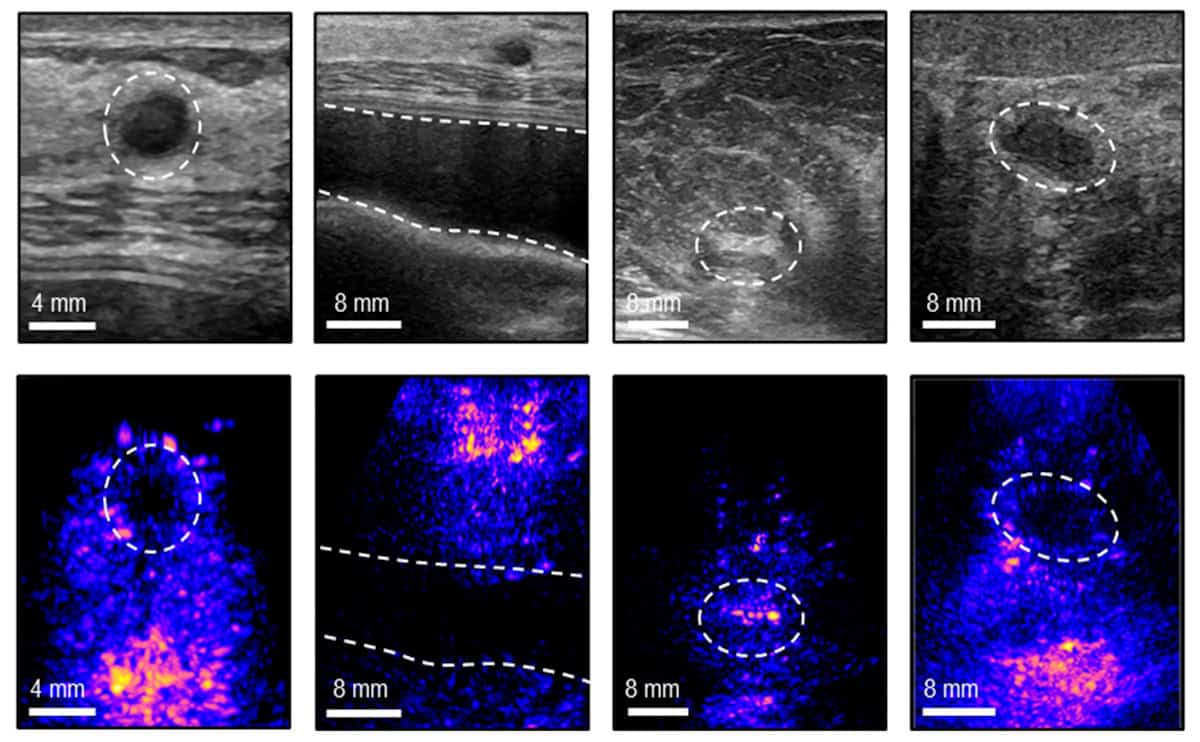
In vivo ultrasound images From left to right: a cyst, breast implant, dense fibrous tissue and solid mass. The top row shows conventional 2D ultrasound images while the bottom row shows the corresponding images using the 3D PURE system. (Courtesy: the researchers)
Women at high risk of breast cancer are more susceptible to developing cancers in the gap between routine screening exams. These so-called “interval cancers” tend to be fast-growing and account for 20% to 30% of all breast cancer cases.
To identify aggressive cancers that develop between scheduled screenings, researchers at Massachusetts Institute of Technology (MIT) have developed a point-of-care ultrasound system that generates high-resolution 3D images of breast tissue. The 3D portable ultrasound system for real-time examination (3D PURE) supplements mammography with its ability to detect anomalies reliably in dense breast tissue (in which mammography is less sensitive).
Guided by an easy-to-use visual interface, 3D PURE enables a nurse, a physician such as a primary care provider or gynaecologist, or even the patient herself to frequently perform longitudinal breast imaging.
Second-generation design
Principal investigator Canan Dagdeviren explains that this second-generation prototype overcomes limitations of a prior system designed by the MIT team, through advances in transducer design, acoustic materials and adaptive beamforming. These developments have enabled real-time wide-angle 3D imaging in a portable form factor, with improved image resolution to accurately identify cysts, solid masses, fibroadenomas and microcalcifications.
The ultrasound system comprises a newly designed 128-element box-shaped 2D transducer array incorporating a corner-gap offset geometry, which suppresses peak crosstalk by 3.73 dB at the corner-most element. This design prevents amplifier saturation, and supports operational transmit voltages of up to 24 V. The array is integrated into a compact multilayer electronics stack comprising preamplifiers, transmit electronics and a custom chirp data acquisition system.
There’s also a conductive backing layer (a toluene-diluted polyurethane matrix with a high percentage of tungsten and zirconia filler) that forms a continuous shielding layer around the elements, improving acoustic attenuation and providing electromagnetic shielding. The compliant mechanical nature of the material enhances acoustic damping, reducing ultrasound reverberations more effectively and improving signal fidelity.
“The addition of a backing layer to the ultrasound transducer is a key advantage to the system,” explains co-lead author Md Osman Goni Nayeem. “It provides both better directionality of ultrasound waves and better bandwidth, which improves the resolution and quality of the resulting images.”
The researchers also incorporated layered aberration-correction reconstruction (LACR), an adaptive 3D beamformer, into the 3D PURE design. LACR compensates for the heterogeneous speed-of-sound in the breast, which comprises glandular and fibrous tissues plus a superficial layer of fat. They believe that this represents the first wide-angle 3D ultrasound imaging system to implement aberration-correction beamforming.
“What we are trying to do is predict the speed-of-sound properties of the tissue being imaged, and then use that to reconstruct the image more accurately. We see up to a 10% improvement for the resolution just by applying this [beamforming] technique,” says co-lead author Shrihari Viswanath in a press statement.
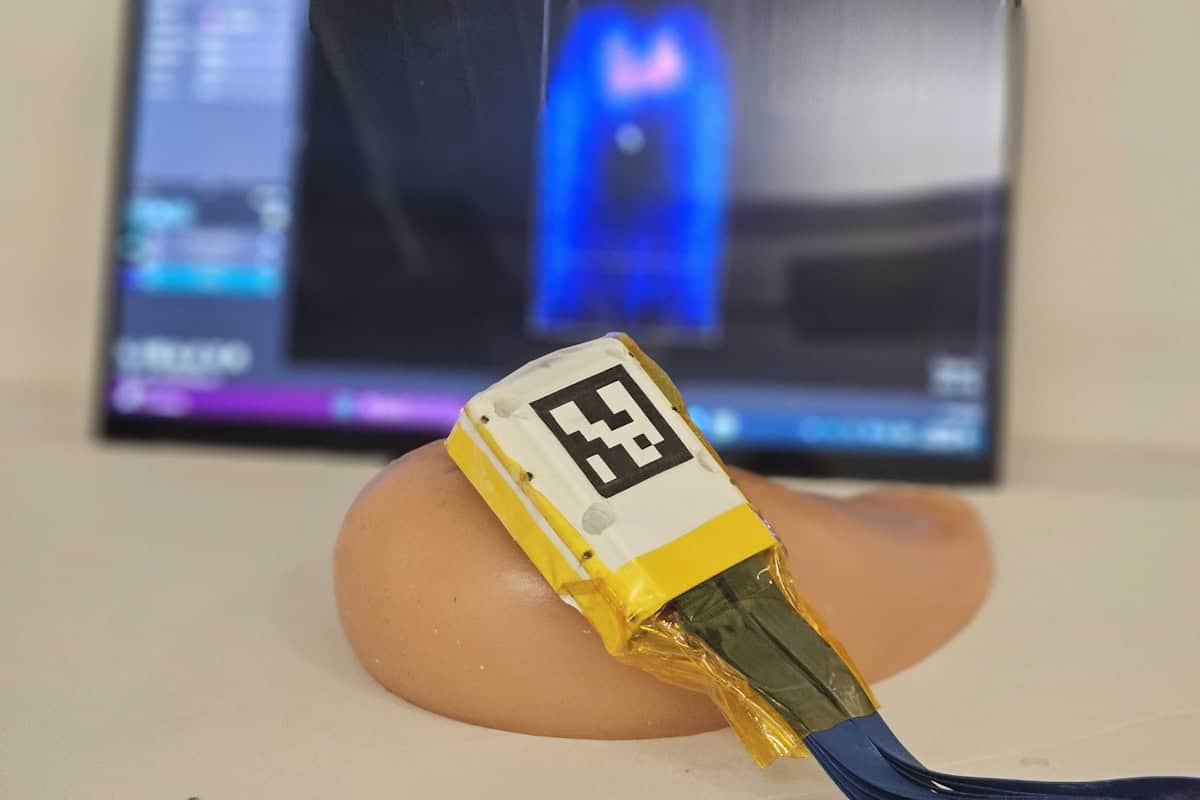
Experimental validation The 3D ultrasound probe is positioned on a tissue-mimicking breast phantom for visualization of embedded microtargets. (Courtesy: the researchers)
The system is designed for ease of use. A visual user interface called “Mirror my First UltraSound” (MyFUS) guides users to reliably reposition the ultrasound probe at the same anatomical location during repeated imaging and long-term monitoring. Meanwhile, a wide field-of-view minimizes the number of scans needed to cover the entire breast.
The team undertook an in vitro study comparing the performance of the 3D PURE system with that of a conventional 2D handheld ultrasound system (HHUS). Ten study participants imaged a breast-shaped tissue phantom embedded with sub-millimetre targets. Nine of the 10 participants showed improved microtarget detection efficiency with 3D PURE relative to the conventional system – identifying more of the targets using 3D PURE (79.7%, compared with 60.7% for the 2D HHUS), with a higher detection efficiency (14.02% of available targets per minute, compared with 9.58%).
The researchers also worked with radiologists to assess a variety of breast anomalies in vivo. The radiologists verified that the 3D PURE system could accurately visualize calcifications, cysts, implants, fibrous tissues and solid masses within a large volumetric field-of-view. The researchers independently validated the system’s accuracy when imaging dense fibrous breast tissue and rib structures.
Seven volunteers with no prior experience of using an ultrasound system tested the MyFUS visual interface. After initial instruction by an ultrasound technician, they were able to repetitively position the probe at a specific location on their breasts, achieving a 94.10% mean overlap value on frontal projections, and 87.42% on side projections. This test reconfirmed that novice users could achieve reproducible longitudinal monitoring results with the aid of the visual interface.
The researchers now hope to create an interface for use with mobile phones or tablets. This type of system could make breast ultrasound more accessible to patients in economically constrained countries lacking adequate breast cancer scanning and regions with shortages of trained ultrasound technicians.
“The high operator dependence of conventional ultrasound is a barrier to its use in decentralized or home-monitoring settings,” the researchers write. “The MyFUS vision interface transforms longitudinal monitoring from an expert-driven procedure to a self-guided, reproducible process that can be used by novice users. This reproducibility is vital for longitudinal monitoring in limited clinical settings, to regularly track the growth of an anomaly or the response of a tumour to therapies without visiting clinics.”
Peeing at the Grand Prix just got a lot more meaningful. In the latest episode of Physics World Stories, Lucy Bell-Reeves and Olivia Wilson, who work for the start-up NPK Recovery, based at the University of the West of England, explain how their mobile system upcycles urine into fertilizer, right where it’s produced.
The pair unpack the physics and chemistry behind their approach, contrasting it with the energy-intensive Haber-Bosch process, which converts natural gas into ammonia under extreme heat and pressure at centralized plants. With the UK importing 100% of its nitrogen, and recent global conflicts exposing the fragility of fertilizer supply chains, the case for local, circular alternatives is growing stronger.
Host Andrew Glester hears about the pair’s experience at the British Grand Prix in Silverstone, the UK’s leg of the Formula 1 World Championship. Bell-Reeves and Wilson reflect on what it’s like to experience the “Grand Pee”, and how attendees react when they discover where their urine ends up.
While not pitched as a replacement for industrial-scale ammonia production, the system offers a smart fix for off-grid sites facing sudden spikes in human waste.