Dark points within light waves can travel faster than the waves themselves. This finding, which is based on new measurements by researchers at Technion – Israel Institute of Technology, confirms a 50-year-old prediction and could help push atomic-scale imaging past its current limits.
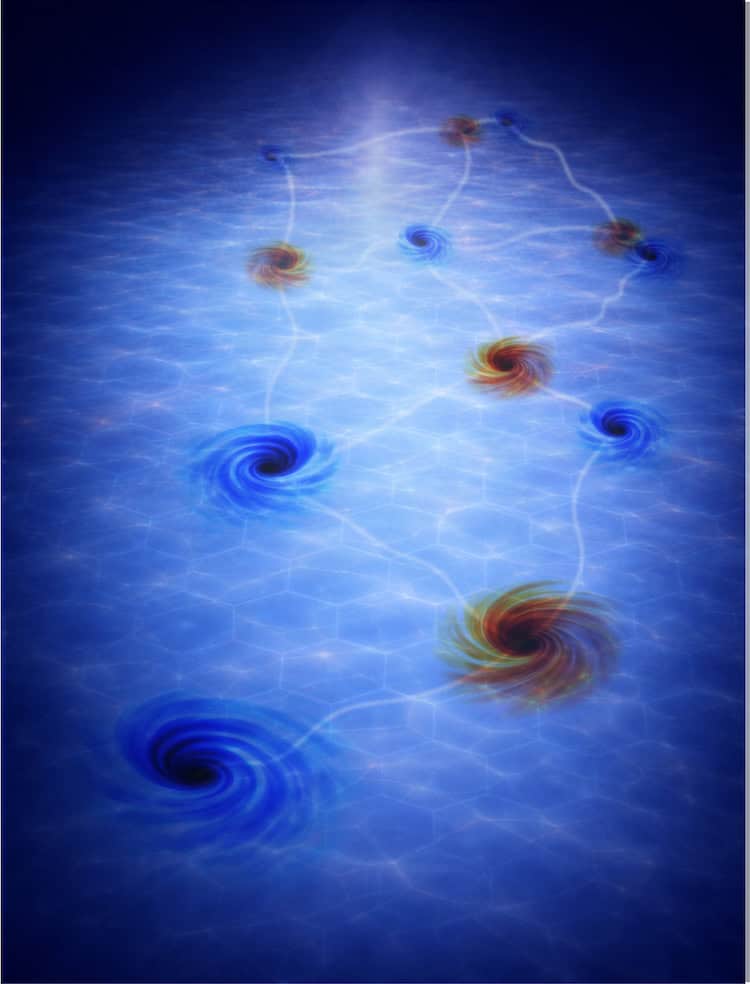
Formally known as optical phase singularities, dark points are vortices within light waves where the wave’s amplitude drops to zero. “Simply put, these ‘zero points’ are points of complete darkness embedded within the light field,” explains study team member Tomer Bucher.
In the 1970s, theoretical studies by the physicists John Nye and Michael Berry suggested that such points could move faster than the waves in which they form. Until now, though, no-one had managed to test this prediction by measuring these structures’ movement experimentally.
Unprecedented spatial and temporal resolution
The Technion team’s experiments did not involve beams of light propagating through a vacuum. Instead, the researchers searched for optical phase singularities within flakes of hexagonal boron nitride (hBN), an atomically thin, two-dimensional (2D) material. Light waves in this material travel in the form of polaritons, which are particle-like entities that develop when the electric field of a photon interacts with the conduction electrons in a material. “These hybrid structures can be thought of as light waves that have unusually low velocities (roughly 100 times slower than the speed of light in vacuum) or as sound waves that have unusually high velocities,” Bucher explains.
Even with these reduced velocities, Bucher and colleagues needed special instrumentation to observe the processes at play deep within a single cycle of light. For this, they turned to a modified ultrafast transmission electron microscope (UTEM) composed of a laser and advanced opto-mechanical apparatus. Using an interferometry technique known as free-electron Ramsay imaging, they achieved what Bucher calls “an unprecedented combination of spatial and temporal resolution” of 20 nm in space and 3 fs in time.
To make sense of the complex interference patterns they observed, the researchers developed advanced computational algorithms to extract the exact amplitude and phase of the light-matter waves and reveal their hidden “singular skeleton”. They also deployed automated tracking algorithms to follow the exact space-time trajectories of dozens of singularities simultaneously across massive datasets.
These techniques revealed that when singularities with opposite charge meet, they annihilate each other. Just before this happens, though, they accelerate to extreme (formally divergent) velocities that exceed the speed of light in a vacuum – something that is allowed under Einstein’s principles of special relativity because the singularities are massless and carry neither energy nor information. “This result highlights a beautiful ‘paradox’ where the slower light-matter waves are the ones found more likely to host topological features that ‘race’ across its surface at impossible, superluminal speeds,” Bucher says.
A bad cavity comes good
As is often the case, the study started out as a completely different project. The researchers’ original goal was to study unique light-matter interactions and high-resolution dynamics in high-quality hBN cavities fabricated by a colleague, Bar-Ilan University’s Hanan Herzig Sheinfux, during a stint with Frank Koppens at ICFO in Barcelona, Spain.
“Ironically, the specific sample that became the focus of this paper was initially considered a ‘bad’ cavity,” Bucher recalls. “However, my colleague Arthur Niedermayr noticed something surprising in the raw data: patterns that looked like multiple singularities moving around. We therefore pivoted our focus; reconstructed the full phase and amplitude from the raw measurements; and created a fully aligned temporal movie to track these singularities frame by frame.”
It was during this tracking that the researchers observed vortices that accelerated to extreme velocities right before vanishing. This unexpected finding triggered a deep dive into the possible origins of such behaviour. Eventually, their search led them to Nye and Berry’s 1974 paper, as well as related work by Berry and Mark Richard Dennis in 2000. “Our experimental measurements agree incredibly well with the old and the new theoretical predictions,” Bucher says.
A universal advanced theory
As well as confirming the spatial statistics of the singularities laid out in these previous works, Bucher tells Physics World that he and his colleagues were able to extend the theory to capture the singularities’ full joint distance-velocity dynamics. Importantly, the extended theory is universal, meaning that the phase-space correlations they observed should apply to phase singularities across all types of wave systems, not just in optics. “Our findings will thus deepen our understanding of topological defects, which are common to all areas of physics – from superfluids to superconductors,” Bucher says.
Metamaterial sculpts heart-shaped darkness from light
In terms of direct applications, Bucher says the singularities he and his colleagues studied could be used to advance super-resolution microscopy and to encode high-density information within the orbital angular momentum of light. “The analytical methods we developed could help mitigate common artifacts in electron microscopy (such as the notorious ‘bee-swarm’ effect), ultimately pushing atomic-scale imaging to new limits,” he adds.
The researchers, who report their work in Nature, say they now plan to probe 3D line singularities and higher-order topological defects, which offer an even richer landscape for information encoding. “We also plan to investigate topological phases in other 2D materials and heterostructures, with the goal of resolving exotic phenomena like ‘optical skyrmions’ in real-time,” Bucher reveals. “Finally, we are actively developing near-field tomography techniques to capture the full 3D bulk dynamics of these complex waves – which if successful, will be a major milestone in electron microscopy.”