The Quantum Fringe filled the summer with inspiring events for students, scientists and the general public, and also celebrated the third anniversary of Edinburgh’s Quantum Software Lab
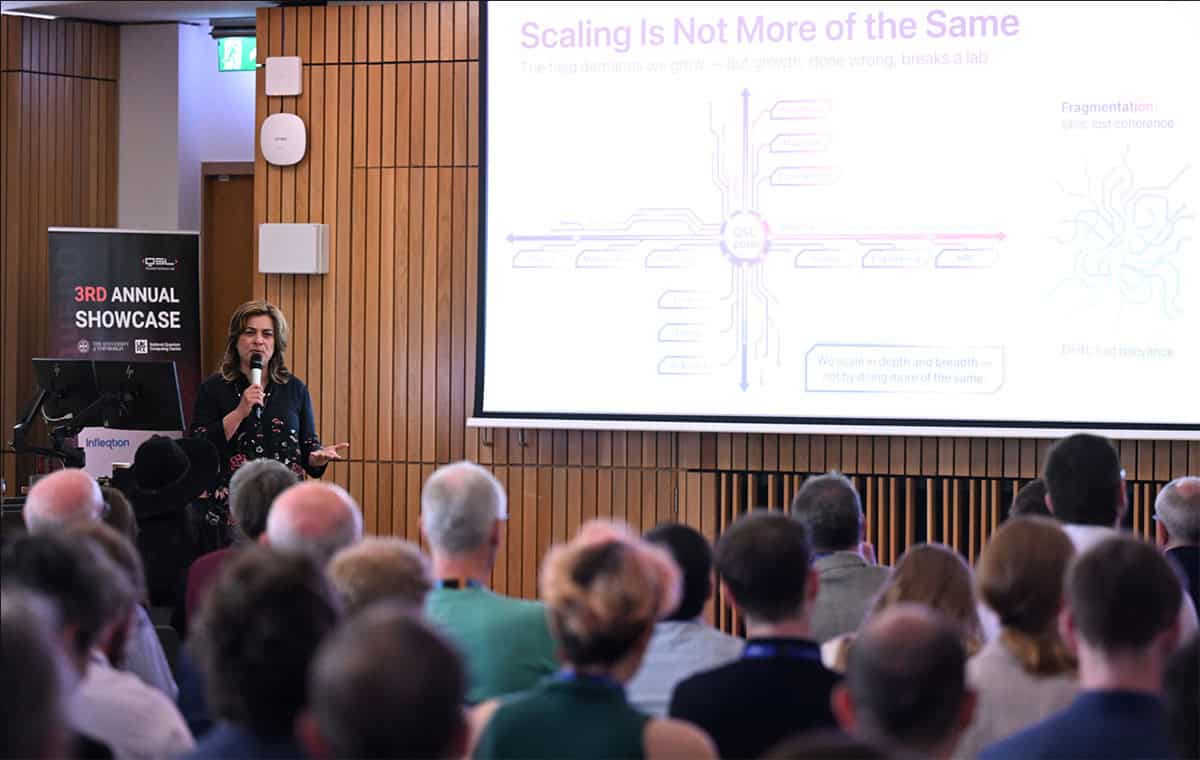
The Quantum Software Lab (QSL) at the University of Edinburgh is going from strength to strength. Buoyed by its strategic partnership with the UK’s National Quantum Computing Centre (NQCC), in just three years the lab has become a globally recognized hub for creating software solutions that generate practical value from emerging quantum computers. With more than 70 researchers working across applications, algorithms and the underpinning theory and software, the QSL is also poised to lead a £20m project that will drive the delivery of tools, methods and systems for useful quantum computing.
The growing momentum at the QSL has also provided the impetus for the Quantum Fringe, a festival of events that debuted in 2025 to mark UNESCO’s International Year of Quantum Science and Technology. Modelled on Edinburgh’s world-famous Fringe festival, the programme provides a showcase for quantum-inspired events that have been convened by different organizations for a diverse range of audiences.
“The Quantum Fringe belongs to everyone who takes part, whether they are researchers, scientists in government and industry, or students at university or school,” says Elham Kashefi, Director of the QSL and Chief Scientist of the NQCC. “That’s the whole point: no-one can do this alone, and each of the 16 events in this year’s festival provided an opportunity for the community to come together.”
That cross-cutting ethos was evident in several collaborative workshops. As an example, a two-day event organized by the research hub for Integrated Quantum Networks (IQN) enabled scientists from different sectors and backgrounds to share expertise on the authentication requirements that will be needed to ensure the security of future quantum communications. Tutorial sessions enabled a broad spectrum of experts to engage meaningfully in technical discussions, while informal networking helped to establish new connections between the research and business communities.
Another workshop, this time organized by the QCi3 research hub, encouraged interactions between academics and industry experts by exploring the applications and integration challenges for quantum computing in the defence sector. Meanwhile, the aptly named TartanQEC workshop, organized by the Universities of Edinburgh and Strathclyde, welcomed more than 120 researchers from the UK and Europe to discuss practical methods for quantum error correction (QEC). Talks spanned hardware co-design, implementations, and software development, and the event was headlined with a keynote on QEC schemes for superconducting quantum computers by Andreas Wallraff of the ETH Zürich in Switzerland.
Building the ecosystem
Experts from start-up companies were involved too, with the QSL convening a workshop that brought together hardware vendors and the research community to discuss scalable frameworks for verifying and benchmarking the performance of rapidly evolving hardware architectures. Legal firm Simmons + Simmons offered start-up firms an insight into the legislation that can protect their core technology and guide their future growth plans, while the regular AIMday provided an opportunity for companies of all sizes to work with academics to explore a series of industry-relevant challenges. This year’s event was the largest yet, with more than 60 participants tackling such problems as using quantum optimization to design a multi-hub logistics network for the UK.
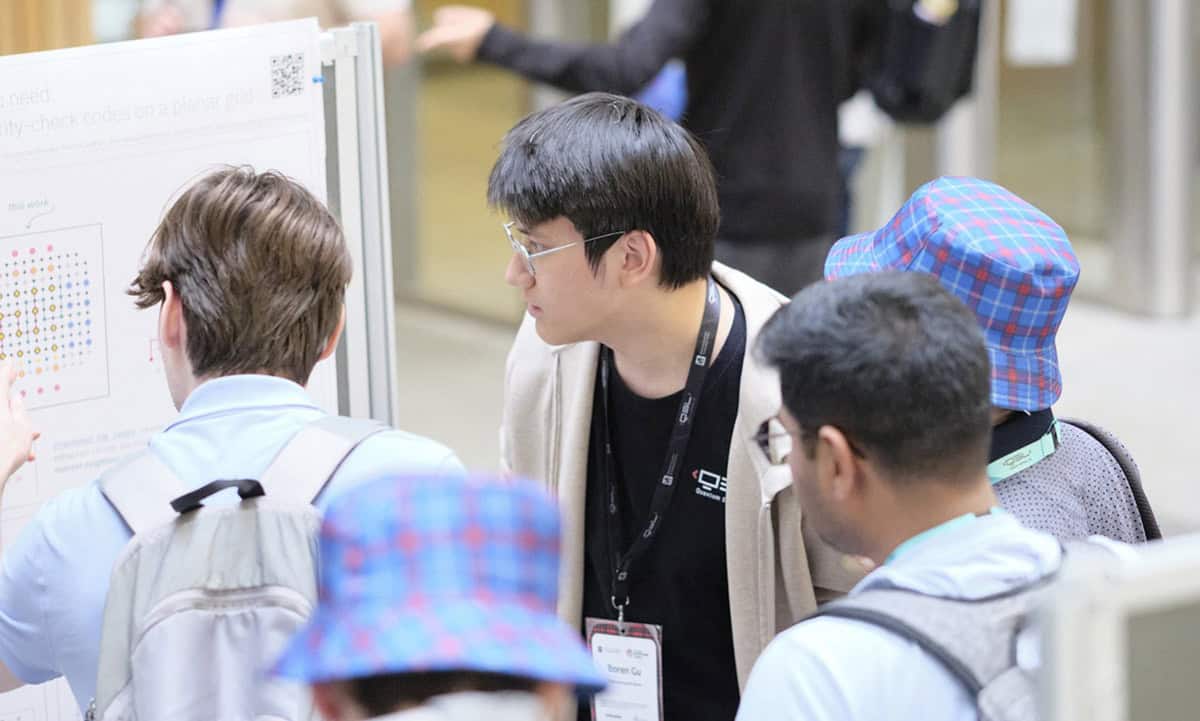
QSL also organized two educational events to inspire the next generation of quantum researchers. A three-day summer school enabled high-school students to find out what a research career might look like, learn the basics of quantum computing from practising scientists, and gain hands-on experience in coding techniques. Meanwhile, a week-long event offered postgraduate students and early-career researchers a deep-dive into quantum informatics within the stunning and peaceful surroundings provided by the Isle of Skye.
Reflecting the eclectic nature of the Edinburgh Fringe, the programme also featured an evening of music and poetry inspired by key concepts in quantum physics. Performed by Erika Andersson, a quantum researcher at Heriot-Watt University, along with computer scientist Ruth Aylett and a group of professional musicians, “Quantum Worlds” offered the audience a creative exploration of complex scientific ideas such as superposition, wave-particle duality, and quantum entanglement. The response was enthusiastic, with audience members commenting that the performance “helped to understand the science” and “made quantum physics feel more approachable”.
Making an impact
Among this multitude of events, the Quantum Fringe offered an opportunity for QSL to mark three years since its launch in 2023. In that time the team has grown from around 15 members to almost 100 researchers working across all facets of quantum software, ranging from foundational quantum theories through to the development of powerful quantum algorithms and real-world applications. “Quantum computing is almost always told as a hardware story, but a machine only matters if it can give you an answer that is useful and that can be trusted,” says Kashefi. “That is a software problem.”
The QSL’s anniversary event showcased some of its key achievements, and highlighted how the lab’s strategic partnership with the NQCC has shaped and enriched its research agenda. One particular benefit has been the opportunity for software specialists at the QSL to work directly with quantum hardware, with the NQCC now hosting seven testbed platforms based on all the leading qubit modalities.
“It is really important for us to build the engineering knowledge and skills needed to work with these machines,” says Caitlin Jones, a senior QSL researcher. “The hardware may not yet be perfect, but if we don’t try to use real devices we might come across unforeseen bottlenecks or miss opportunities that we might not have considered.”
As an example, PhD student Mario Herrero Gonzáles is investigating the use of quantum machine learning to generate new samples that are similar to an existing dataset. Herrero Gonzáles uses a classical computer to train the model and a quantum machine to generate the samples, with the aim of optimizing the quantum part of the solution to run on a neutral-atom platform from Infleqtion. “The Infleqtion team helped Mario to understand the timings of the gate operations and the sources of errors,” explains Jones. “That allowed him to reduce the noise by recompiling the programme to exploit the gate fidelity and connectivity offered by neutral-atom systems.”
Another project is developing an adaptable computational approach to the problem of classically hard sampling, which is a good match for quantum photonic platforms. A team led by Leo Monbroussou has been working with two of the testbed providers, ORCA Computing and Aegiq, that have developed photonic platforms with different architectures and control mechanisms. “Having a direct dialogue with the hardware experts has really helped to push the research forwards,” says Jones. “Through the collaboration with the NQCC we have been able to embed that knowledge into the way that we approach software development.”
This established operating model provides a strong starting point for the new research programme, called QATCH (short for Quantum Advantage TurboCHarger), that is worth £20m from the UK government over the next four years. “We have an existing body of knowledge on how to run software on real quantum systems, which is really valuable and hard to create from scratch,” says Jones. “QATCH gives us more runway to design more ambitious experiments, such as developing code that will run on different hardware devices for cross-platform benchmarking and optimisation.”
QATCH also marks a change of emphasis for the QSL team. While the first three years focused on exploring potential routes to achieving quantum advantage, QATCH has a clear mission to deliver the tools, methods and systems that will drive real and evidenced impact from quantum computing in the UK. “The QATCH programme will launch the UK’s first full-stack feedback loop, serving as the software engine that translates fundamental theory into verified applications,” says Kashefi. “Through daily co-creation between our researchers, hardware vendors, and industry end-users on the national testbeds, we are ensuring that software actively drives forward the design and utility of these new quantum machines.”
- This year’s Quantum Fringe was supported by the NQCC, Infleqtion, Quantinuum, Riverlane, Classiq, IBM, Institute of Physics, National Physical Laboratory, Nu Quantum, with input from Edinburgh Innovations, the Centre of Doctoral Training in Quantum Informatics, the QCi3 and IQN hubs, the Quantum Software Alliance, and Quantum Computing Application Cluster