Innovative scintillation detectors are pushing the boundaries of radiation detection, unlocking unprecedented speed, accuracy and clarity in a range of fields, including non-destructive nuclear monitoring, environmental safety and mining
Scintillation detection advanced rapidly during and after the Second World War, with a major breakthrough coming in 1948 when physicist Robert Hofstadter discovered that thallium-activated sodium iodide (NaI(Tl)) was an exceptionally effective scintillation material for detecting gamma rays. This discovery laid the foundation for practical gamma-ray spectroscopy and established NaI(Tl) as a cornerstone of radiation detection.
The principle behind scintillation detection is relatively simple. When a high-energy gamma-ray photon from a radioactive source enters a scintillator crystal, the gamma ray deposits energy in the crystal, which is converted into scintillation light. This light is directed onto a photoreceptor—such as a photomultiplier tube or a silicon photomultiplier—which converts the optical pulse into an electrical signal. The amplitude of that signal directly corresponds to the energy of the incoming gamma ray, allowing scientists and engineers to build a detailed spectrum of the radioactive source.
Today, there is a wide range of methods for detecting and discerning radioactive sources. One of the most prevalent is NaI(Tl). While versatile and relatively inexpensive, NaI(Tl) has moderate energy resolution, typically around 6–7% at 662 keV for common detector configurations, i.e. just a basic ability to distinguish between different energies of incoming radiation, making precise identification of multiple radioactive species challenging.
The gold standard for energy resolution (<0.2%) is high-purity germanium (HPGe), a semiconductor technology that very clearly separates closely spaced isotope signatures. However, HPGe detectors are more complex and costly, and require cryogenic cooling traditionally using liquid nitrogen or mechanical cryocoolers.

“Lanthanum bromide is kind of special,” explains Diane Fruehauf, Business Unit Director (Radiation Detection) at Excelitas Technologies. “It hits the sweet spot where you can have better energy resolution than traditional scintillators, but it’s simple, it’s compact, it’s fast and you can operate at room temperature. You can get a lot of the performance advantages without the cryogenic cooling.”
Beyond a highly respectable energy resolution of ~2.6%, cerium-doped lanthanum bromide (LaBr3(Ce)) also exhibits an exceptional response speed. With a primary decay time of approximately 25 nanoseconds—compared to hundreds or thousands of nanoseconds for other scintillators—its fast response enables high count-rate operation and rapid data collection, making it particularly valuable when measuring intense radioactive sources.
Luxium™ Lanthanum bromide in action
These properties make LaBr3(Ce) an ideal scintillator for radiation detection in a wide range of situations. One application is border security, explains Guillaume Gautier, Product Manager at Excelitas Technologies. “For example, it enables the signature of nuclear materials to be discriminated and identified from radioisotopes commonly encountered in medical applications, preventing materials of concern from getting masked,” he says. “These emitted gamma-ray photons are close in energy but, unlike other scintillators, lanthanum bromide can discriminate between them accurately.”

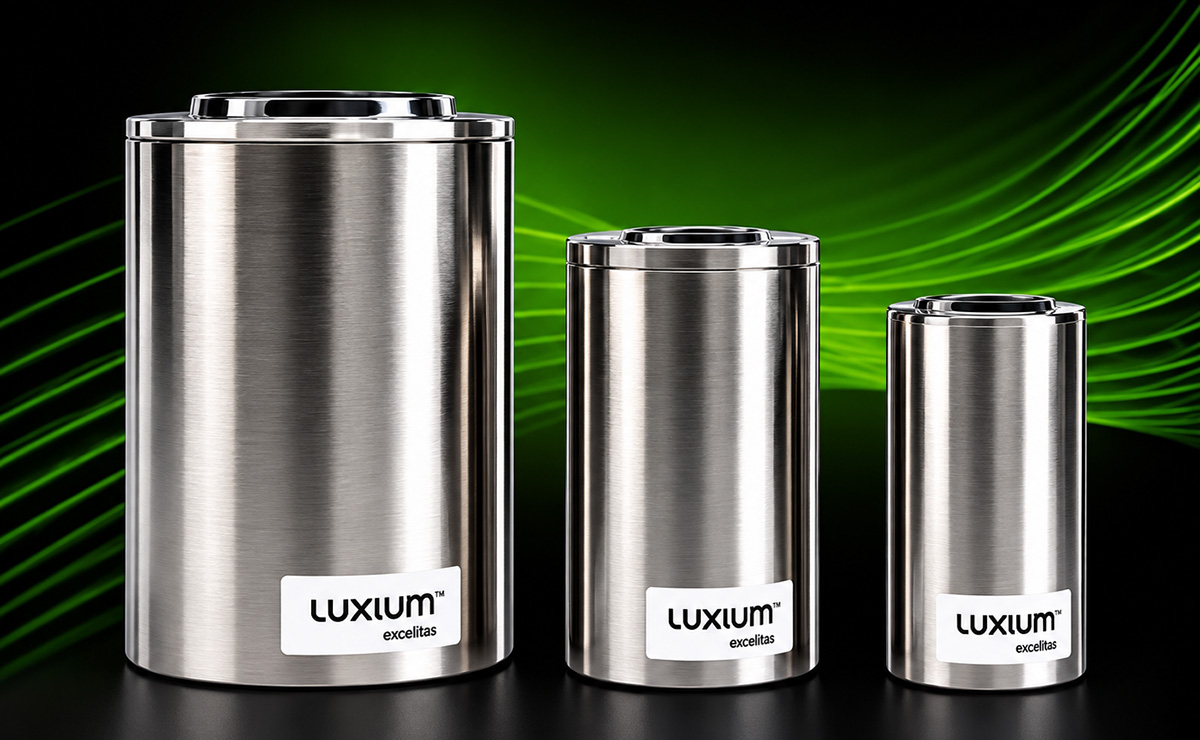
Another key use-case is environmental monitoring. After the Fukushima nuclear accident, for example, Luxium™ Lanthanum bromide detectors (made by Excelitas Technologies) have been used to survey the surrounding areas for radioisotopes. And they are used in routine environmental monitoring too, with independent agencies utilizing LaBr3(Ce) detectors to map field contamination, inspect soil or agricultural runoff, and verify environmental safety.
A more complicated application is prompt gamma neutron activation analysis (PGNAA). This works by bombarding a target material with neutrons, causing atomic nuclei to emit characteristic gamma-ray photons almost instantaneously. These photons are then detected and resolved by a high-performance LaBr3(Ce) scintillation crystal.
“It’s used in mining, for example,” says Gautier. “You activate the raw material and you detect the composition, and from this you are able to analyse—in the field—whether it contains anything valuable, such as lithium or rare-earth elements, before you begin extraction.”
Precision manufacturing and the Excelitas advantage
Excelitas Technologies has a longstanding history of innovation with LaBr3(Ce). Originally developed through academic research in Europe in the early 2000s, these crystals showed significant potential for high-performance radiation detection. Saint-Gobain Crystals recognized that potential and pioneered their commercialization, building decades of expertise in the development and manufacture of LaBr3(Ce) detectors. After rebranding to Luxium Solutions for a brief time, the company was acquired this year. Today, that expertise continues as part of Excelitas Technologies.
Nowhere is this expertise more valuable than in growing large, high-purity LaBr3(Ce) single crystals with uniform light yield. This task is made difficult because the crystals are sensitive to ambient moisture and require absolute chemical purity during growth to maintain structural integrity and optical clarity. The solution was to take control of the whole process in-house. “We control our purification and refine our materials ourselves, which gives us a level of process control that directly yields reliable, high-quality crystals,” explains Fruehauf. “Our goal is to deliver consistent performance from crystal to crystal, year after year.”
More recently, the team has focused on pushing lanthanum bromide’s properties even further, developing what they have branded ‘Luxium™ Enhanced Lanthanum bromide’. By co-doping the crystal structure with cerium and strontium, Excelitas engineers improved the scintillation proportionality, yielding higher light output and even sharper resolution.
“With standard Luxium™ Lanthanum bromide, we guarantee energy resolution under 3%,” explains Gautier. “With our enhanced version co-doped with strontium, we lower that threshold below 2.5%, guaranteeing levels down to 2.3% or even 2.2% in optimum conditions.”
And now, the company is not only manufacturing raw crystals for OEMs, but also detector assemblies integrated with photomultiplier tubes or silicon photomultipliers. Backed by Excelitas’ broader photonics and electronics portfolio, the company is well-positioned to deliver complete end-to-end detection solutions for a wide range of demanding field applications.
“At the company, we’re always learning and the technology is always evolving, but ultimately it comes down to helping customers make faster, better decisions in the field,” says Fruehauf. “Whether it’s monitoring environmental safety or identifying critical materials for new technologies, the more efficient and accurate we can help everyone be, the better it is for everyone.”