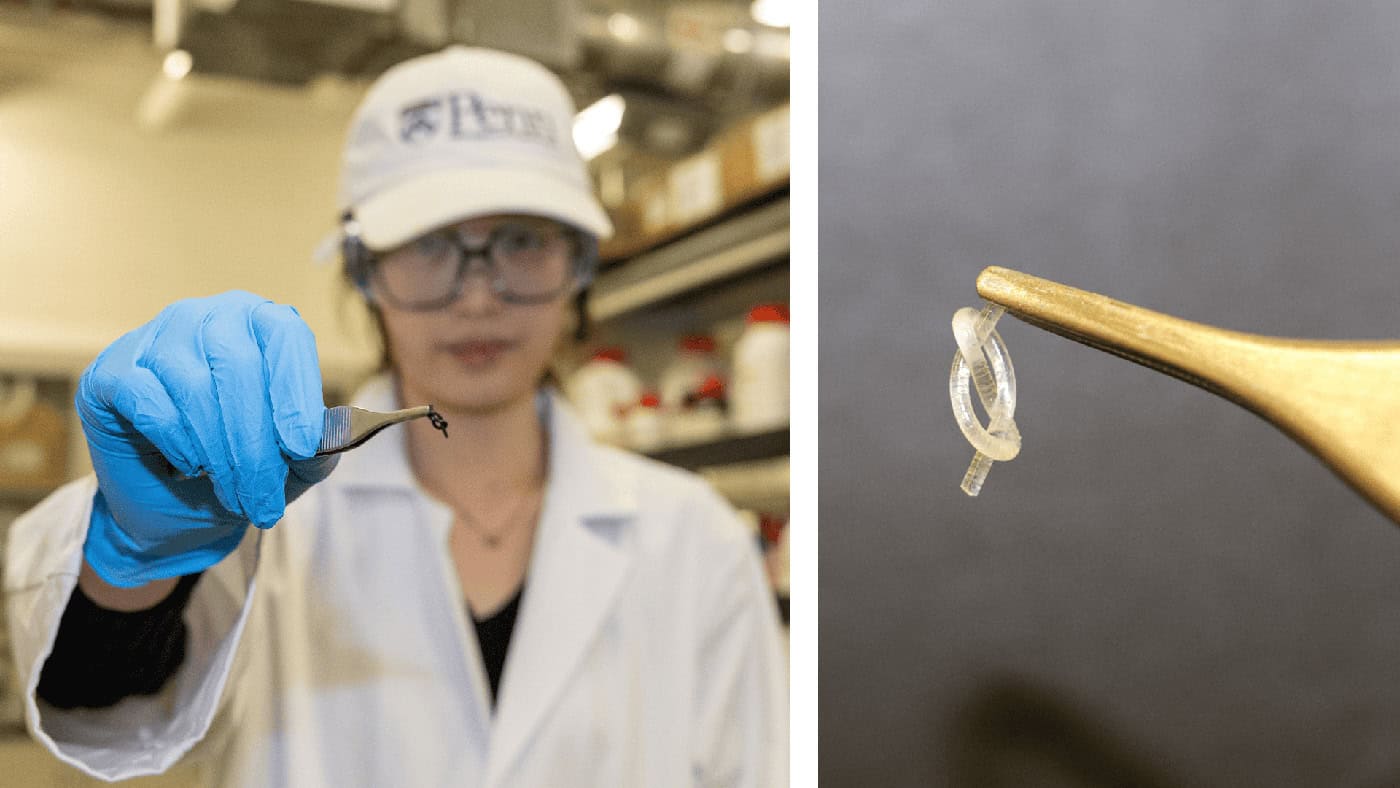
Researchers at the University of Pennsylvania and the University of California, Los Angeles, have created a tiny, soft knot-like fibre that can jump metres into the air.
The fibre is less than a millimetre thick, and a few millimetres long and contains a Kevlar core surrounded by a shell of liquid crystal elastomer (LCE).
The Kevlar provides strength and stiffness while the LCE adds some flexibility and responsiveness.
“People think of a knotted fibre as something passive,” says Shu Yang from the University of Pennsylvania. “But if you design the elasticity and materials carefully, the knot itself becomes an active system.”
When the fibre is knotted it behaves like a spring held in place by a latch, which can be undone via changing the temperature.
When the temperature is increased to 60–90 °C, the LCE shell contracts and untwists, which loosens the knot just enough to trigger an abrupt untying.
All that stored elastic energy then converts into kinetic energy, propelling the fibre almost 2 m into the air – a feat comparable to the jumping capabilities of a springtail bug (for a video see here).
Changing the knot’s topology and the materials used allows the researchers to tune how the fibre moves after take-off. For example, a simple overhand knot results in a flipping motion while a figure-eight knot leads to the fibre spinning. Harvard’s springtail-like jumping robot leaps into action
Inspired by the flight of Maple seeds, the team attached a thin, leaf-like appendage to the fibres, finding that where the wing is positioned on the knot resulted in the fibre landing far away or curving backwards towards its starting position.
Given the fibres can be activated with temperature, the researchers think the robot could find applications in agriculture and reforestation.
“We often start by exploring interesting phenomena,” adds Yang. “Then we ask how far we can push them and whether they can solve real problems.”