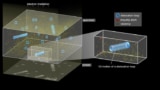
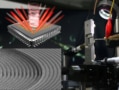
Plasmonic nanocubes make an ultrafast thermal camera
New multispectral photodetector could find applications in medicine, food safety and precision agriculture
Read article: Plasmonic nanocubes make an ultrafast thermal camera
Thank you for registering with Physics World
If you'd like to change your details at any time, please visit My account
Isabelle Dumé is a contributing editor to Physics World. She has more than 10 years of experience in science writing and editing in condensed-matter physics relating to technology/nanotechnology/biotechnology, astronomy and astrophysics, energy and the environment, biology and medicine. She has an MSc in advanced materials and a PhD in magnetism. In her spare time, she helps to organize cafés scientifiques.

New multispectral photodetector could find applications in medicine, food safety and precision agriculture
Read article: Plasmonic nanocubes make an ultrafast thermal camera
Devices with a more highly curved spiral arm or two spiral arms that mimic hand kneading could produce a better-quality dough
Read article: Bread machines get a much-kneaded physics makeover
Researchers coin the term "phoamtonics" to describe a new field of study that exploits the photonic properties of foam-based structures
Read article: 3D foams could control light
Physicists irreversibly split photon wavepackets using unconventional technique
Read article: Light forks one way in a Bose–Einstein condensate
Mathematical model puts new constraints on fundamental sensing limits
Read article: How well can biological cells sense their environment?
Exciton energy is critical to the light-emitting performance of quasi-2D perovskites
Read article: Managed triplets improve perovskite LEDs
New method could turn waste products into oils, lubricants and waxes found in everyday detergents and cosmetics
Read article: Catalytic technique ‘upcycles’ single-use plastic
New measurements point to a formation period of days rather than thousands of years
Read article: First solar system solids formed much more rapidly than previously thought
New technology could be used to create intelligent and reprogrammable robots
Read article: Nanomagnets control shape-morphing micromachines
New device could be used in health-monitoring applications and even to detect diseases such as diabetes
Read article: Silk-based sensor analyses sweat biomarkers in real time