In this podcast, you will hear three members of the Physics World editorial team – Matin Durrani, Margaret Harris and Tushna Commissariat – make the case for their favourite books on the shortlist, while James Dacey moderates the discussion. How well does each book meet our criteria of being well written, scientifically interesting and novel? What are their strengths and shortcomings? And in an unusually competitive year for the award, which book emerged as the overall winner?
Shortlist for Physics World‘s Book of the Year 2013 (alphabetical by author)
When Physics World published a list of the five biggest unanswered questions in physics earlier this year in its 25th anniversary special issue, “What is consciousness?” was not on it. The reason for its exclusion seemed, at the time, straightforward: although the nature of consciousness is one of the toughest conundrums of modern science, it is not one that is commonly associated with physics. Biology and neuroscience, yes. Philosophy, certainly. Perhaps even art or poetry. But not, for the most part, physics.
In his book Physics in Mind: a Quantum View of the Brain, author Werner Loewenstein sets out to convince readers otherwise, and thereby “sink into oblivion” the idea that “biology is biology, and physics is physics, and never the twain shall meet”. The result is, in the words of our reviewer Seth Lloyd “an intellectual rollercoaster ride” that takes in ideas about the nature of time, evolution, electrochemical signalling, information theory and, ultimately, quantum computing – a burgeoning field that Loewenstein believes may hold vital clues to the problem of consciousness.
The word “may” is important here. In the hands of a less scrupulous author, a book such as Physics in Mind could easily have strayed into the world of “quantum woo”, in which the weird effects of quantum mechanics are conveniently trotted out as the explanation for every problem, with scant regard to evidence. But Loewenstein, despite his enthusiasm for applying physics principles to biological topics, is careful to avoid such traps. This balance of ambition and restraint is one reason why Physics in Mind is the choice for the magazine’s 2013 Book of the Year.
To be eligible for the award, which is made by the magazine’s editorial team, a book had to be reviewed in Physics World in 2013 – and, of course, it also had to meet our criteria of being well written, scientifically interesting and novel. Physics in Mind did well in all three categories, but particularly in the writing. Loewenstein’s prose is both distinctive and enticing, and his beautifully clear explanations of more “traditional” physics topics such as quantum computing and the cosmological arrow of time are among the best we have seen.
However, unlike some previous years – notably 2009, when the inaugural award went to The Strangest Man, Graham Farmelo’s biography of Paul Dirac, and 2012, when David Kaiser’s How the Hippies Saved Physics took top honours – there was no runaway winner in 2013. It was a much tighter-run race, and of the shortlist of 10 books, at least four were seriously considered for the top spot, with the rest not far behind.
To learn more about these other contenders – and the thought processes behind selecting the winner – listen to our latest podcast. In it, you can hear Physics World editor Matin Durrani, reviews editor Margaret Harris and reporter Tushna Commissariat champion their favourites from the shortlist, with host James Dacey guiding the discussion.
Congratulations to Loewenstein and all the other shortlisted authors, and be sure to keep an eye on the reviews section of this website for more great physics books in 2014.
In October we published a special anniversary issue of Physics World, which is still available as a free PDF download. The issue features our pick of the five technologies that are emerging from physics research that have the potential to make significant impacts on people’s lives around the world. Linked to this article, we also produced a series of short films in which we visited the research centres in the UK that are developing some of these technologies. In this film we visit Imperial College London to explore the idea of creating a “perfect lens” using artificial structures known as metamaterials. Such a device could reveal natural structures that are tantalizingly beyond the reach of today’s microscopes and that could revolutionize nanotechnology and the biosciences. If you enjoy this, then you might also like to watch the other two films in this series about quantum computing and graphene’s potential to provide drinking water.
Quantum computing: challenges, triumphs and applications
In our podcast leading experts explain how quantum mechanics could be harnessed to revolutionize computing. (Courtesy: iStockphoto/Bellenixe)
Quantum computing is one field of research that has the potentially to truly transform a technology. Such machines, which would exploit superposition, entanglement and other quantum phenomena to perform super-fast calculations, could make today’s best computers look like basic toys. In March we released this podcast in which physicsworld.com editor Hamish Johnston meets various members of the quantum-computing community to talk about their approaches to developing this technology. Most researchers in the field agree that quantum computing has great potential but that big challenges still remain before we can produce practical devices on a commercial scale. In the podcast, Hamish does meet one man, co-founder of Canada’s D-Wave Systems Geordie Rose, who controversially claims to have already built – and sold – quantum processors.
Sleepless nights at the synchrotron
Scientists throughout the ages have been known to work exceedingly long hours in pursuit of breakthroughs. No writer has captured the essence of this better than the inventor Thomas Edison with his famous saying “Genius is one per cent inspiration and 99 per cent perspiration.” The most passionate researchers of today are no different and in September we released this short film about the experiences of the scientists who travel to the European Synchrotron Radiation Facility (ESRF) in Grenoble, France, to use its intense X-ray beams for imaging experiments. For researchers, this experience can be both exhilarating and stressful, as they often face a race against the clock to get their results within the short amount of time that has been allocated to them by the facility. This short film focuses on two research groups that are both interested in recreating the high-pressure environments reminiscent of the ocean floor and the Earth’s interior. In both senses of the word, the pressure is on for these scientists.
The enigmatic life of J Robert Oppenheimer
The enigma files In our podcast you can learn more about this pivotal figure in the history of modern physics from his biographer Ray Monk. (Courtesy: AIP Emilo Segré Visual Archives)
Science writing – when done effectively – involves an awful lot of passion combined with hard graft. This was certainly the case for the philosopher Ray Monk, who spent 11 years working on his new biography of J Robert Oppenheimer, entitled Inside the Centre. In June Margaret Harris, reviews editor of Physics World, produced a podcast featuring an interview with Monk about the themes raised in his new book. Monk talks about the enigmatic life of Oppenheimer, who was one of the key figures in the Manhattan Project but who later ran into trouble with the US government for his socialist leanings. Monk also discusses the efforts he made to get to grips with Oppenheimer’s physics, including the latter’s theoretical work on mesons and the gravitational collapse of neutron stars.
And finally…
In October we had the honour of hosting a public lecture presented by Andre Geim, who shared the 2010 Nobel Prize for Physics with Konstantin Novoselov for their discovery of graphene and their subsequent studies of this one-atom-thick form of carbon. At the sell-out event, attended by more than 400–people, the Nobel laureate talked about why he is still so passionate about fundamental research. He told the story of the graphene discovery and discussed some of the exciting applications of the material that are beginning to emerge. The audience was also treated to a description of Geim’s earlier work on levitating frogs, which led to him sharing an Ig Nobel prize in 2000. We recorded the lecture and combined it with Geim’s slides to create this video presentation for you to enjoy.
As I walk across the curving slopes of the valley to the north of Saana – a fell in the far north-west of Finland – I’m greeted by an unexpected sight. Dotted against the blanket of low-lying shrubs are heaps of rusting metal. Despite its remote location – roughly 300 km north of the Arctic circle – this area was the scene of the last battle during the German army’s retreat northwards in 1945. Now protected as a memorial, the twisted panels from the German defences are surprisingly well preserved; no doubt the winter temperatures here, which sink to an average of –13.4 °C in January, slow corrosion.
The German bunkers have left their mark in other ways too. Even a small change to the landscape, such as a hole or ridge, can affect its vegetation, as physical geographer and ecologist Miska Luoto from the University of Helsinki explained to me in August when I visited the village of Kilpisjärvi, now home to a university research station. Of course, it’s not just war-time excavations that have moulded this area; the terrain is continually disturbed by processes such as frost, wind, late-lying snow and water flow.
The concern is that as temperatures rise, cold-tolerant plant species that are found only at high elevations could become extinct
The concern driving Luoto and his eight colleagues is that as temperatures rise, cold-tolerant plant species that are found only at high elevations or at Arctic latitudes could become extinct. These “Arctic–alpine” plants include species such as mountain avens and white Arctic mountain heather. “Where only the peak of a mountain is suitable for these alpine species, there’s a lot of worry that as conditions warm and lowland species move up, they will essentially be squeezed off the top and lost,” says Peter le Roux, Luoto’s former colleague who is now at the University of Pretoria, South Africa.
Luoto and his team have spent the last three summers intensively studying the vegetation on and around Saana, with the aim of working out the factors, including disturbance, that affect which plants grow where. They intend to use this data to predict the vegetation mix over larger areas than they can study – both now, and in the future, based on projections of temperature and precipitation from climate models (see box).
The project is unusual not only for looking at landscape processes as well as plant ecology, but also in the sheer amount of data it is collecting. By the time the researchers have finished, they will have around 500 different measurements of factors such as topography, geomorphological and hydrological disturbance, species presence, soil temperature and soil moisture, from each 1 m grid square in their study. With a grand total of 3360 grid squares, that’s pretty impressive. What’s more, Luoto has discovered that by including disturbance, such as frost churning the ground, or water flow, the models’ predictive powers are improved.
The physics of climate change
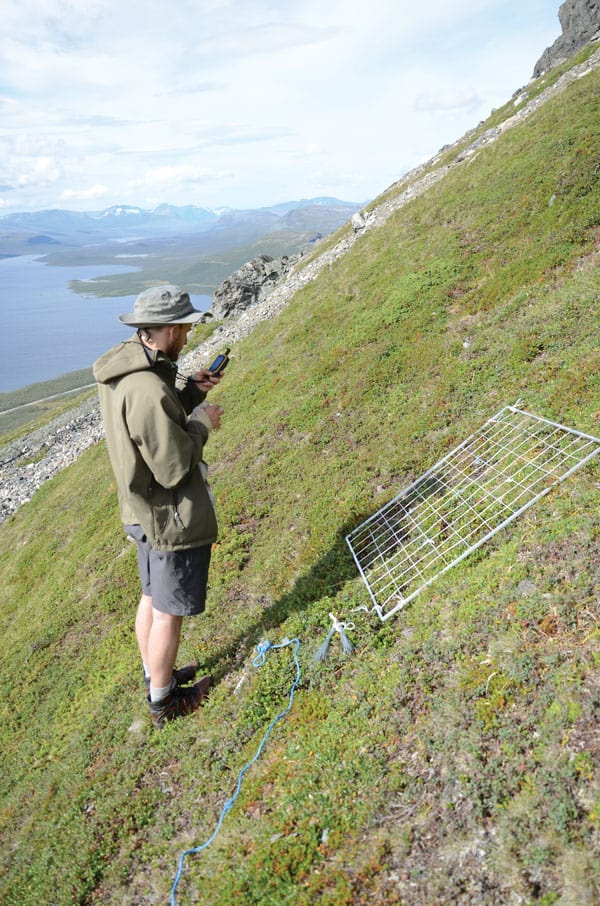
Bit by bit A University of Helsinki team painstakingly studies vegetation in Saana one square metre at a time. (Courtesy: Liz Kalaugher)
Back in 1896, Swedish physicist Svante Arrhenius, who was interested in ice ages, was the first to calculate how carbon dioxide – or carbonic acid as it was known at the time – in the Earth’s atmosphere affects temperatures on the ground. To do this he used measurements of infrared radiation from the full Moon. When the Moon was near the horizon, the radiation had to travel through more of the Earth’s atmosphere than when the Moon was directly above. These different atmospheric path lengths meant greater or lesser contact with carbon dioxide and water vapour along the way. “A simple calculation shows that the temperature in the Arctic regions would rise about 8° to 9 °C if the carbonic acid increased to 2.5 or 3 times its present value,” he wrote in the London, Edinburgh and Dublin Philosophical Magazine and Journal of Science.
Nowadays, instead of the Moon, physicists use sophisticated climate models that run on supercomputers. Put simply, the models, such as the UK Met Office’s HadGEM3, split the Earth’s atmosphere and ocean into small cubes. The contents of each cube obey the basic laws of physics and chemistry, including the rules of thermodynamics and the fluid dynamics principles that govern flow of air and water as the Earth rotates. The conditions in each cube affect the next.
To start the process rolling, modellers tend to use initial conditions such as observations of temperature at the Earth’s surface as well as in the oceans and the atmosphere. They then let the model run as the clock ticks forward, projecting temperatures for many years into the future under the different conditions, such as increasing greenhouse-gas concentrations, that they impose. It is temperature and precipitation outputs from models like these, fed into regional climate models, that Miska Luoto and his team of geographers and ecologists are using to project the effects of climate change on vegetation such as Arctic–alpine species.
Trek to the top
On a typical morning during my visit to this remote region I’d wake up with my fleece hat pulled down over my eyes in an attempt to stave off an early alarm call from the Sun, which became much brighter at about 3 a.m. after nominally “setting” at midnight. After breakfast, I’d head off with two or three members of the team and hike to the area they planned to study that day.
From our base at the Kilpisjärvi Biological Research Station, which had views across to Sweden on the other side of Lake Kilpisjärvi, we’d cross the main road – where reindeer like to stop traffic – and walk up through the mountain birch woods that hug Saana’s lowest slopes. Occasionally we had to wave away from our faces one of the autumnal moths that were experiencing a population boom and stripping the birch trees of their leaves.
As we emerged from the forest and onto the mid-level slopes, a mix of low-growing perennial shrubs such as crowberry, dwarf birch and juniper took over. The juniper serves as a measuring device in its own right as it reveals the level of snow here in winter – branches sticking out above the snow blanket suffer repeated freezing and thawing and so do not thrive, limiting the height of the shrub to that of the snow. The crowberry, meanwhile, provided a tasty snack for the researchers, who took care, of course, only to sample berries from outside their survey areas.
To make sense of the mix of species on these mid-level slopes, it’s essential to understand the effects of running water – indeed, a stream in the valley to the north of Saana demonstrated how much difference it can make. Grasses, sedges and herb species – plants that would normally only occur at lower altitudes – clustered in the boggy ground surrounding the stream. While it is standard for the mid-level slopes to have 8–15 plant species per square metre of ground, near water that figure can rise to 40. A few trees were even creeping up the river; their presence can shelter other plants and increase snow accumulation in winter, providing extra protection from the cold.
Grid by grid
Species per square metre is just one of the measurements made by the Helsinki team. So far they’ve surveyed 21 grids, each 8 m wide and 20 m long – about the size of a singles tennis court – and divided them up into 1 m squares. The grids are marked out using wooden barbecue skewers that, by happy accident, have the brand name Saana, which is also a Finnish girl’s name. It’s low-tech but the sticks do a good job – until inquisitive reindeer knock them over.
The sites are chosen to represent a range of aspects, elevations and topographies: there are six each on Saana’s northern and southern slopes; and three each on the western slopes, near the top of the fell and in the valley to the north. Aspect is important because solar radiation can be as much as eight times higher on south-facing sites than on northern slopes.
This year the researchers also ventured further away from Saana and surveyed 1 m squares at points along transects (lines of measurement), enabling them to assess how vegetation changes, for example, on a path that climbs straight up the hill or is parallel to the slopes.
For each square, whether it’s in a grid or on a transect, the team has analysed the vegetation, noting all plant species present and the percentage of the ground that each type of plant covers. Luoto himself assessed the landscape topography and disturbance – those extra factors that he has found improve the predictive power of vegetation models. At several points across each grid, the team also sampled soil temperature, pH and biomass, while factors such as slope angle, altitude and aspect come from digital elevation models.
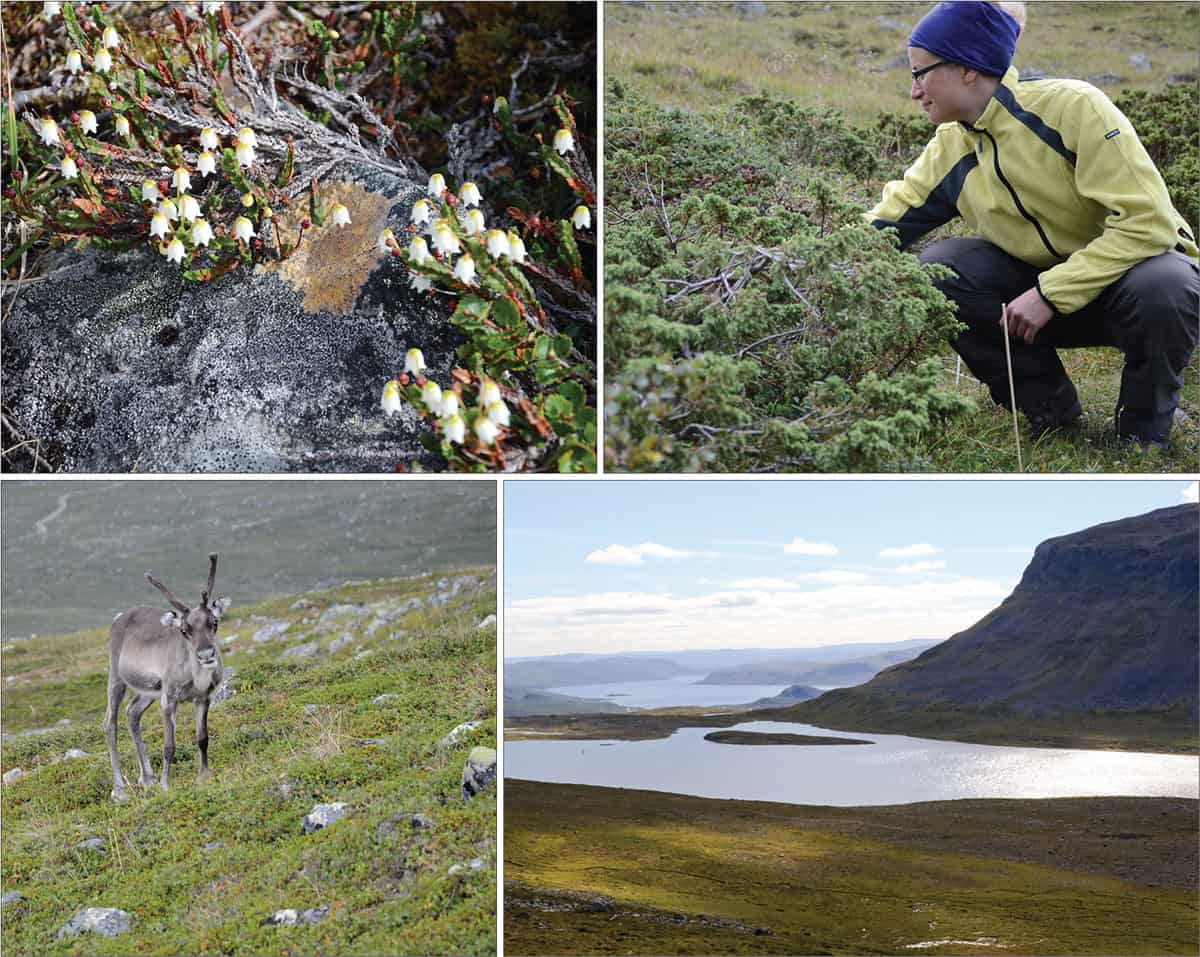
Under scrutiny Miska Luoto’s team studies species such as white Arctic mountain heather (top left) and juniper (top right) in the region of Saana fell (bottom right). Arctic–alpine plants are affected by disturbances, including by animals such as reindeer (bottom left). (Courtesy: Liz Kalaugher)
I spent two days with Luoto visiting a selection of transects near and on the fells of Korkea (High) Jehkas and Iso (Big) Jehkas. Luoto was the only person responsible for topography and disturbance assessments throughout the project, in order to keep the method consistent. He and other team members surveyed the vegetation independently from landscape factors to avoid biasing their results. At each transect point we reached – marked by coloured forestry tape that was hard to spot, making the GPS kit a godsend – Luoto assessed the surface shape of each of four 1 m squares by assigning a slope rating relative to the surrounding area, on a scale of one to 10.
Evaluating disturbance, meanwhile, required Luoto’s keen eye for identifying the physical processes that have affected the ground. Much of the disturbance here is related to frost activity. The top couple of metres of soil freezes every winter, creating seasonal frost, while high up in the mountains – above 800 m – there is permafrost. Soil and bedrock is frozen all year round at depths of more than 5 m or so below the surface. Repeated freezing and thawing of the soil gradually squeezes stones to the surface as the ground contracts and expands – a process known as cryoturbation. Meanwhile, recurrently frozen ground can creep gradually downhill, creating characteristic “solifluction terraces”.
Wind can play a role too – on the edges of small ridges, it blows away the fine soil particles leaving only gravel and rock behind. And then there’s snow. Although it was gone by the time of my visit in August, signs of its presence remained. When the snow starts to melt in late May, new streams break out around the hills. These can wash nutrients into an area and play a direct role in vegetation growth, as well as disturbing the soil. Some resilient snow patches, generally in high-altitude hollows and dips shielded from the Sun, remain later into the year and create their own disturbance.
Troubled sanctuary?
While disturbance might sound undesirable, for Arctic–alpine plants it is a blessing. On those wind-swept edges, for example, the poor soil prevents the alpines’ more vigorous lowland cousins, such as crowberry and dwarf birch, from taking hold. This means that species such as white Arctic mountain heather, mountain avens and Diapensia lapponica are able to thrive. Luoto and colleagues’ analysis shows that the disturbances that affect plant growth the most, giving Arctic–alpines a greater advantage, are solifluction, water flow and late-lying snow.
Of course, the disturbance here is not just physical – there are biological influences too. The impact of humans is relatively low but reindeer, lemming and willow ptarmigan graze on the vegetation. The lemming population is cyclical; in a good year the animals can be bigger grazers of herbs than reindeer, which normally hog the number one spot. Two years ago there were so many of the rodents in this area that their corpses littered the roadside and you could stand on them by mistake. Now only their burrows are visible – small holes among the rocks with droppings by the entrance – and the occasional lemming track in grassy areas, presumably made in the winter when the animals tunnelled beneath the snow.
Onto the plateau
As we climbed up onto a plateau on Korkea Jehkas, the vegetation changed dramatically. The ground was almost barren, except for a few hardy specialists. The perennial shrubs that grow lower down don’t do well at these higher altitudes, where colder temperatures mean a shorter growing season and strong winds blow away the winter snow, leaving plants less protected. It is here that Arctic–alpine species finally come into their own, along with lichens and mosses, as well as some grasses where it’s wet. The white Arctic mountain heather was flowering; in a boulder field Luoto pointed out a glacier buttercup, the most northerly vascular (veined) plant in the world and the highest-growing in Europe, reaching altitudes of more than 4000 m in the Alps.
It’s this type of habitat that is under threat of being forced off the top of the mountain as temperatures warm and perennial shrubs become able to survive higher up. There are glimmers of hope, in the form of small patches of land that happen to be relatively cold and disturbed – these could act as refuges for the Arctic–alpine species that would otherwise lose their homes. But it’s not a great prognosis. “The outlook for these species is maybe not as bad as forecast, but it doesn’t change the fact that the populations would be seriously affected by climate change,” says Le Roux. For example, plants might end up less connected to other populations of the same species; that’s bad news for their genetic diversity.
As I stand in the sunshine I can’t imagine what Saana will look like in just a couple of months, when snow and darkness cloak the landscape once again, let alone what conditions will be like by the end of the century. Society’s climate negotiations are arguably much harder to predict than the climate itself – ultimately it is likely to be the decisions we make about our greenhouse-gas emissions that will most drastically affect this area in years to come.
In seeking to make sense of night skies, astronomers have always had to rely on electromagnetic radiation – from visible and infrared light to X-rays and gamma rays. The team behind the Physics World Breakthrough of the Year has, however, ushered in an era of “neutrino astronomy”, whereby particles – not radiation – are the tools of the trade.
The researchers did this by building a colossal detector deep under the ice at the South Pole. Despite the many challenges of doing science in such a remote and inhospitable environment, the IceCube South Pole Neutrino Observatory has spotted extremely high-energy neutrinos that originate from far beyond the solar system.
Neutrinos are notoriously difficult to detect and IceCube uses a huge 1 km3 volume of ice as a giant particle detector. IceCube can also determine the direction from which a neutrino came, making it an incredibly useful telescope. Indeed, it could solve an important astrophysical mystery by revealing the origins of cosmic rays. These high-energy charged particles are created in the same locations as cosmic neutrinos but are deflected en route by magnetic fields and cannot be traced back to their origins.
According to IceCube’s principal investigator Francis Halzen, by far the greatest challenge in building the detector was drilling the 2.5 km-deep holes in the ice into which the detector components were lowered. In total, 86 holes each 60 cm in diameter were drilled at a rate of about three per week using hot water. The drilling could only be done during the brief polar summer and as a result it took four years to complete the process.
Pleasant surprises
As the detector was being built, the scientists got several pleasant surprises, says Halzen, who is at the University of Wisconsin-Madison in the US. One was that the ice in the region of the detector has much better optical properties than expected. Indeed, it is much clearer than the pristine fluids used in other neutrino detectors.
Clarity is important because IceCube uses strings of photomultiplier tubes to detect the faint Cerenkov light that is given off by fast-moving charged particles that are created when a neutrino collides with a nucleus in the ice. As well as boosting the performance of the detector, the high quality of the ice will make it easier to expand the detector volume, because new holes can now be separated by about 300 m rather than the current 25 m.
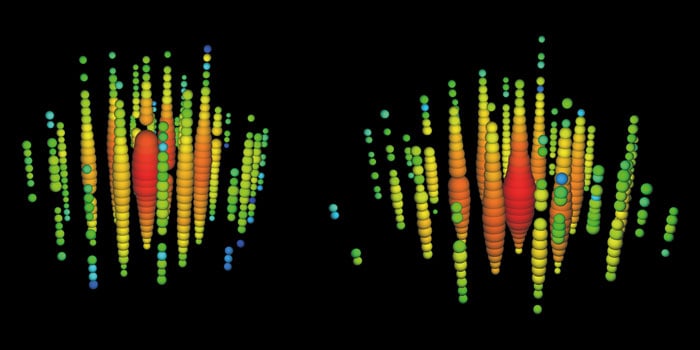
Bert and Ernie The shower of particles on the right was detected by IceCube on 3 January 2012 and was created by the highest energy neutrino ever observed. Called Ernie, its energy is estimated to be 1.14 × 10¹⁵ eV. The image shows the signals detected in various photomultiplier tubes strung along several cables in the ice. The shower called Bert is on the left. (Courtesy: IceCube Collaboration)
The biggest surprise, however, was the measurement of a shower of particles created by an extremely high-energy cosmic neutrino – dubbed Ernie – that was made even before the detector was fully commissioned. What was unexpected about Ernie – and Bert and about 20 other neutrinos – is that a large portion of the energy of the neutrino was deposited in the detector. This allowed the team to determine minimum values of the energies of these neutrinos to within about 15%.
Tracking muon neutrinos
The team had thought that such events would be extremely rare, and had planned on focusing its attention on cosmic muon neutrinos. These particles interact with the detector to produce a muon that can be tracked with great accuracy. This means that the cosmic origin of the neutrino can be pinpointed to better than 0.4 degrees – much better than for Ernie and Bert – but its energy cannot be measured accurately. So now scientists using IceCube have two distinct ways of studying cosmic neutrinos.
IceCube is expected to run for 20 years, and in addition to supporting research in neutrino physics and neutrino astronomy it has also joined the hunt for dark matter. It will also be used to study the interior of the Earth by the neutrinos it emits.
“The success of IceCube builds on the efforts of hundreds of collaborators around the world – from the design, the deployment in a harsh environment and the AMANDA prototype to data harvesting and physics analysis. The Breakthrough of the Year award is a superb way to ultimately honour these efforts,” says Olga Botner at Uppsala University, who is an IceCube spokesperson.
Now for the rest of our picks for the top-10 breakthroughs of 2013. They are listed below in no particular order. The top 10 were chosen by a panel of six Physics World editors and reporters, and the criteria for judging the top-10 breakthroughs included
fundamental importance of research;
significant advance in knowledge;
strong connection between theory and experiment; and
“To the international team of nuclear physicists that used the REX-ISOLDE and MINIBALL facilities at CERN to create and study the first pear-shaped nucleus.”
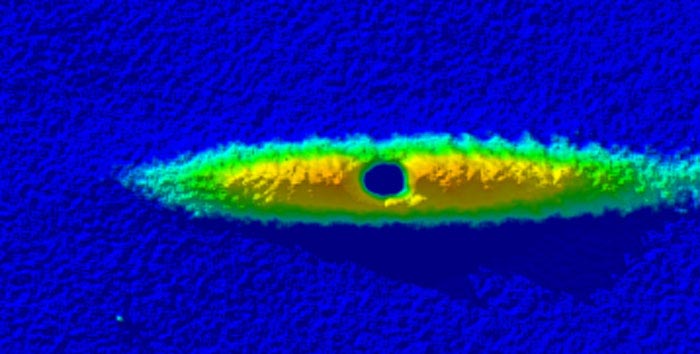
Pear-shaped nucleus A representation of the radium-224 nucleus in the x, z plane, with the colours as the y-axis scale. (Courtesy: L P Gaffney)
Since the 1990s, physicists had suspected that some nuclei have lopsided shapes that are driven by subtle underlying “octupole” interactions between their constituent protons and neutrons. That prediction was confirmed this year for radon-220 and radium-224. As well as shedding further light on the difficult problem of calculating the properties of large nuclei, pear-shaped nuclei could also offer a way of measuring the permanent electric dipole moment of an atom, which is forbidden by the Standard Model of particle physics.
“To Mikhael Lukin at Harvard University and Vladan Vuletić at the Massachusetts Institute of Technology and colleagues, who are the first to create ‘molecules’ of light.”
Photons normally pass through each other without interacting – so the idea of a molecule made of light seems bizarre. But a photon does interact with the media that it passes through, which can affect how the media responds to subsequent photons. By carefully engineering this interaction in an ultracold atomic gas, Lukin, Vuletić and colleagues have caused pairs of photons to draw together as they pass through the medium. The result is a two-photon molecule of light that could find application in optical communications and computing systems.
“To scientists working on the European Space Agency’s Planck space telescope for making the most precise measurement ever of the cosmic microwave background (CMB) radiation.”
The universe as seen by Planck Cosmic-microwave-radiation-background anisotropies observed by Planck. (Courtesy: ESA/Planck Collaboration)
Our basic understanding of the universe underwent an important revision this year thanks to the scientists working on Planck, which was launched by the European Space Agency in 2009. We now know that the proportion of the universe made up of dark energy is slightly less than previously thought, but there is more dark matter and ordinary matter than previous studies of the cosmic microwave background radiation (CMB) had suggested. Planck also concluded that the universe is about 80 million years older than previously thought. In addition, the Planck data contain tantalizing hints of anomalies in the temperature of the CMB in different parts of the universe, which could point towards new physics.
“To Aneta Stodolna of the FOM Institute for Atomic and Molecular Physics in the Netherlands, Marc Vrakking at the Max-Born-Institute in Germany and colleagues for taking the first direct images of atomic orbitals.”
Anyone who has studied science has seen representations of atomic orbitals, but until this year no-one had ever managed to actually take a direct image of an orbital. Stodolna and Vrakking took the atomic snapshot with their new “quantum microscope”, which detects electrons that are ejected from helium atoms by laser light. When the atoms are put into a Rydberg state with an extremely large atomic orbital, the result is a clear image of the orbital’s nodal structure.
“To Mike Thewalt of Simon Fraser University and colleagues for storing quantum information for up to 39 minutes in a solid-state device at room temperature.”
Quantum-information systems rely on quantum states that endure for long enough for information to be processed. Unfortunately, noise, heat and other environmental factors cause most quantum states to decay long before they are useful. What Thewalt and colleagues have done is to find a way to ensure that nuclear spins in a piece of silicon retain their quantum nature for an astonishing 39 minutes. This shatters the previous room-temperature record of 2 s and could bring us one step closer to “quantum money” that would be impossible to counterfeit.
“To Max Shulaker and colleagues at Stanford University for making the first carbon-nanotube computer.”
Up close with the first carbon-nanotube-based computer A scanning-electron-microscopy image of a section of the first carbon-nanotube-based computer. (Courtesy: Butch Colyear)
Carbon nanotubes are tiny tubes of carbon with walls as thin as just one atom. They have a range of desirable electronic properties, which in principle could be used to make faster and more energy-efficient electronic devices. While other researchers have created transistors and other individual devices, Shulaker and colleagues developed a suite of new fabrication techniques that allowed them to integrate 178 carbon-nanotube-based transistors to create a computer that can store and execute a program.
“To astronomers working on the South Pole Telescope for being the first to measure B-mode polarization in the cosmic microwave background (CMB) radiation.”
The IceCube collaboration may have bagged the Physics World 2013 Breakthrough of the Year award, but another discovery from the South Pole also makes it into our top-10 list. It is for the first detection of a subtle twist in light from the cosmic microwave background (CMB), known as B-mode polarization. This twist has long been predicted and its detection paves the way for a definitive test of inflation – a key theory in the Big Bang model of the universe.
“To Florian Schreck and colleagues at the Institute for Quantum Optics and Quantum Information in Innsbruck for creating the first Bose–Einstein condensate to be cooled using just lasers.”
Cool state A laser-cooled Bose–Einstein condensate. (Courtesy: IQOQI/PRL)
The traditional way to making Bose–Einstein condensates (BECs), which are essentially macroscopic quantum states, involves cooling a gas of atoms using lasers to a temperature of near to absolute zero and then allowing the remaining hot atoms to escape via “evaporative cooling”. This process is, however, time-consuming and discards most of the original atoms. Now, a team led by Florian Schreck is the first to cool a BEC using lasers alone, which is a much more efficient technique and could allow BECs to be used in a wider range of practical applications, including atom lasers.
“To three groups that have independently made the first measurement of Hofstadter’s butterfly in a solid-state system. One group is led by Philip Kim of Columbia University, another is led by Roman Gorbachev of the University of Manchester and another by Pablo Jarillo-Herrero and Ray Ashoori at the Massachusetts Institute of Technology.”
Butterfly seen at long last Plot of electron density (horizontal axis) versus magnetic-field strength from data obtained by the Columbia team. (Courtesy: C R Dean et al. Nature 10.1038/nature12186)
Nearly 40 years ago, Douglas Hofstadter calculated the energy levels of electrons exposed to a magnetic field in a 2D solid and expressed the results in a stunning fractal pattern that looks like a butterfly. While the butterfly has been spotted in experiments that are analogous to 2D solids, it had never been seen in a real solid material. But this year three independent groups saw the butterfly in graphene systems, publishing their results over the course of two days this year. As you can see from the image above, it was worth the wait.
An international team of astronomers has accidentally spotted the first space molecules bearing a noble gas, argon. The surprising discovery, in the debris of an exploded star, reveals the element’s isotopic composition, confirming long-standing predictions that argon is forged in such doomed stars.
Once called inert gases, the elements in the final column of the periodic table have closed outer shells of electrons that normally prevent them from exchanging electrons with other atoms to form molecules. In 1962, however, chemists discovered molecules containing xenon and now call these elements noble gases instead. But no-one had ever seen a molecule in space harbouring a noble gas, even though one such gas – helium – is the universe’s second most abundant element.
Mike Barlow, an astronomer at University College London, and his colleagues were using the Herschel Space Observatory to study supernova remnants, including the well known Crab Nebula. It resulted when a massive star 6500 light-years from Earth in the constellation Taurus ran out of fuel, sparking a brilliant explosion that our ancestors witnessed in 1054.
Looking for common molecules
Barlow and his colleagues wanted to observe the Crab Nebula’s dust, which radiates its heat at the far-infrared wavelengths that Herschel detects. They also searched the Herschel spectra for lines from common molecules such as carbon monoxide.
The scientists never found those molecules. Instead, they saw two mysterious emission lines – one at a wavelength of 243 microns, the other at 486 microns, exactly twice as long. “That was a giveaway that it was a simple diatomic molecule – two atoms rotating about each other,” says Barlow. After failing to find a match with common diatomic molecules, the scientists realized that they had spotted the argon hydride molecular ion, the chemical formula of which is ArH+.
“It was very surprising to us,” Barlow says. “Nobody had predicted the molecule. We call the discovery serendipitous to make it sound a bit more scientific, but it was an accident – a lucky discovery.” The peculiar molecule probably forms when singly ionized argon – an argon atom with one of its electrons missing – meets molecular hydrogen (H2) and grabs a hydrogen atom.
Argon (atomic number 18) is the eleventh most abundant element in the universe and the third most common gas in the atmospheres of Venus, Earth and Mars. The element makes up 0.93% of the air that we breathe. Most terrestrial argon is argon-40, which comes from the decay of radioactive potassium-40 in rocks.
Lighter argon isotope
We call the discovery serendipitous to make it sound a bit more scientific, but it was an accident – a lucky discovery
Mike Barlow, University College London
But theorists have long predicted that massive stars should manufacture large quantities of a lighter argon isotope, argon-36, which has equal numbers of protons and neutrons. Other astronomers had already detected argon atoms in the Crab Nebula. “But there was no direct proof that it was argon-36,” Barlow says, because atomic spectral lines from different argon isotopes have nearly the same wavelengths, making it difficult to distinguish them.
For molecules, however, the task is easy, because molecules containing different argon isotopes emit radiation at noticeably different wavelengths. Therefore, the argon-hydride molecules revealed the element’s isotopic composition: it is argon-36, just as the theory predicts.
Cherished beliefs borne out
“It’s nice to see cherished beliefs borne out,” says astronomer Stan Woosley, a supernova expert at the University of California at Santa Cruz, who was not involved with the discovery. Early in its life, a massive star shines by converting hydrogen into helium, as the Sun does. Then the star begins burning the helium into carbon and oxygen, which eventually forge still heavier elements. Argon arises during the oxygen-burning stage, in which one oxygen-16 nucleus hits another, creating sulphur-32. The sulphur nucleus is in an excited state and usually emits a helium-4 particle, thereby becoming silicon-28. The helium-4 particles strike the silicon-28 and sulphur-32 nuclei to make argon-36 and also calcium-40.
Woosley says that the timing of argon’s creation depended on the star itself, which astronomers think was born eight to 16 times as massive as the Sun. If the lesser figure is correct, he says the element originated primarily in the supernova. If instead the star was born with the larger mass, it created most of its argon before the explosion, during the last few months of its life.
Massive stars should also produce smaller amounts of another argon isotope, argon-38. If scientists can detect it, they could compare its abundance with that of argon-36. “It’s a direct test of nuclear reaction theory in supernovae,” says Barlow. He hopes to use ground-based telescopes to search the Crab Nebula for the heavier argon isotope, because the Herschel Space Observatory recently ceased observations.
Barlow and his colleagues are publishing their discovery online today in Science.
Latin America – including the Caribbean – is a region composed of around 40 nations containing some 600 million people. Most of these countries were under colonial rule by European states for centuries and, after independence in the 20th century, many suffered from dictatorships, political instability and civil wars. Economically, much of Latin America is based on natural resources or manufacturing, although that is now slowly changing with around 80% of the population in Latin America living in high-density cities.
It is well known that science, technology and innovation are critical to a country’s development. Yet research and development expenditure in Latin America is still very small, accounting for between 0.07 and 0.52% of GDP across the continent (compared with 2–3% in Europe and North America). The number of researchers is also critically low: according to figures from the United Nations Educational, Scientific and Cultural Organization (UNESCO), the worst offenders are Guatemala, El Salvador, Honduras, Nicaragua and Paraguay, which have the lowest rate of full-time researchers in Latin America with less than 100 per million. Only Argentina – with around 1000–2000 researchers per million – approaches the rate of developed nations.
Part of the problem is that it was not until the 1950s that physics became a professional career in nations such as Argentina, Brazil, Chile and Mexico, while for other countries in the region that switch happened even more recently. Yet for all the difficulties, according to a UNESCO headcount in 2009, almost half – 45.2% – of researchers in Latin America are women, apparently giving the region the highest average proportion of female scientists in the world.
However, the UNESCO figure contrasts hugely with other estimates. For example, a study by Argentina’s Science and Technology Council in 2005 showed that only 30% of the country’s researchers in physics were female. A similar headcount by the Mexican Physical Society (SMF) in 2010 revealed that of staff at universities and research centres, just 16% were women, while in Brazil, around 20% of physics faculty are female. The SMF has also published data on university departments in other countries, which show that in Chile, Colombia and Peru, for example, women account for around 16%, 12% and 6%, respectively, of all staff.
With funds scarce for science in general in Latin America, talking about women in science may sound trifling. Indeed, some researchers – both women and men – consider gender-focused programs unnecessary, discriminatory or segregationist. After all, there are many other urgent issues to address in these countries – including poverty and illiteracy.
Unfortunately, other than for some of the countries mentioned above, it is very difficult to get proper statistics for the number of women in science across Latin America. Few national science councils provide such information and university research groups on gender and science are scarce. But despite the limited data, there does seem to be a large gender gap within Latin America and, as with every other gap, it should be addressed. Increasing the number of female scientists would boost the overall scientific population and help the region overcome its inequity. Quite simply, there needs to be a robust scientific structure in Latin America where both women and men have the facilities that support their research, help solve national problems and spur economic development.
Concrete steps
Apart from knowing exactly how many women work in physics in Latin America, there is also a need to continue to support them. We need additional funds to help women and mechanisms to recognize their work and promote them to high-rank faculty positions. Giving women more visibility will provide girls with role models and may convince them to pursue a career in science. But as physics has become a profession only in recent years, I believe our community is open-minded and supportive of such changes. Increasing awareness of discriminatory attitudes, sexual harassment or machismo in general will give women a motivating and friendly environment that will benefit all of us.
In some countries, steps have already been taken and policies introduced. For example, in Brazil an analysis of the number of papers and the paucity of women in the highest levels of academia has led to the introduction of new programmes that support girls at risk of dropping out of school. Argentina, Brazil and Chile now give parental leave to graduate students who have children. And in Mexico there is a programme of scholarships at bachelor level for single mothers, while extended periods for research evaluation and awards are allowed for women who taken time off to have a family. This year’s national conference of the Mexican Physical Society also saw a panel discussion on gender issues.
Yet these programmes, although welcome, are not enough and more action has to be taken. As a result of recent International Union of Pure and Applied Physicists (IUPAP) conferences on women in physics, various national working groups were set up. Teams from Argentina, Brazil, Colombia, Ecuador, Mexico, Peru and Puerto Rico aim to jointly develop a common framework to study the situation of women in physics that allows us to propose public policies to tackle the issue. I am convinced that such joint action is needed. By working together, with the support of IUPAP, women will be able to expand their capacities and increase their contribution to physics.
An ordinary material responds to an electric field, say, according to how the atoms and molecules polarize. But in a metamaterial, the atoms and molecules are replaced by slightly larger elements, such as tiny metallic rings. By designing their structure, you can design into these materials electric and magnetic properties that have never been seen in natural materials.
What are people working on now in basic metamaterials research?
What people are still doing is they’re having fun, and just seeing what you can do with this technology. There’s also a related technique called transformation optics, which teaches you what sort of metamaterial you need to put the electric and magnetic fields where you want them.
So nothing about invisibility cloaks then?
The cloak, of course, was wonderful for the public because it rang so many bells, but that was just the extreme of how far can you go with these technologies.
So what could be the first application of metamaterials?
The most advanced one is by a US company called Kymeta, which is a spin-out from the patent firm Intellectual Ventures, in Seattle. Kymeta uses metamaterials to build satellite-communications receivers.
Satellite receivers are one of the things where metamaterials are making things cheaper, better
How is this different from a normal receiver?
A usual receiver is a 30 cm steerable dish. It’s heavy and takes quite a bit of power to run the electric motor. There is a more sophisticated version of a receiver called a phased array and that’s in the form of a flat plate that is full of little dipole antennas that you can steer the direction of electronically – nothing moves mechanically.
What’s wrong with using a phased array receiver?
It’s expensive – many tens of thousands of dollars! You’ve got hundreds of thousands of transistors, making the phased array an order of magnitude more expensive than a dish.
So how can metamaterials help?
Metamaterials are cheap and can do this job of making a phased array, as you can make them tuneable by putting a little nonlinear device there.
How close is this device to market?
Kymeta has a product ready to go, which it will license to satellite-communications companies. The firm has capital of around $50m – half of which came from Microsoft founder Bill Gates.
How much will this receiver cost?
Kymeta hopes to market it for under a thousand dollars. So that’s one success story. It is one of the things where metamaterials are helping make things cheaper, better. The receiver can also plug into a USB port in your laptop, which is nice.
Are there any other applications for metamaterials?
My colleague Richard Syms in electrical engineering at Imperial is using hundreds of little metamaterial elements called split-ring resonators and stacking them together to make a wire. Instead of conducting electrical current, this wire conducts magnetic flux down the centre of these little resonators. It only works at one frequency but that’s fine if you’re dealing with magnetic resonance imaging (MRI).
How are such scans currently done?
With heart scans, for example, doctors usually cut a nearby vein and then they push this little coil of wire up near the heart so it can pick up the weak magnetic signals that are produced when hydrogen nuclei in the body are excited using an external RF field.
Why does the technique need improving?
When you turn the magnetic signal into an electrical one it travels down the wire, but the wire is about the right length to resonate with the exciting signal, which is usually quite powerful. If that wire gets hot it then sticks to the side of the vein – not a good experience.
What properties do metamaterials have to solve this problem?
While the body responds dramatically to an electrical current, it hardly responds to a magnetic one. Syms’ wire takes the magnetic signal and keeps it as a magnetic signal that travels safely out of the body.
Why are defence agencies so interested in metamaterials research?
There’s a whole lot of stuff happening that I never hear about because a lot of it has gone confidential because it’s useful. The US defence agency DARPA, for example, allows you to publish everything while you’re in the “what if?” stage, but once you get devices, you then find that the wraps go over it and it goes into patents and what-not.
Any defence research you can tell us about?
There is something called compressive sensing, which is a way of taking a very limited amount of data from a scene and using that data to construct a very accurate image with less information than you’d use for a whole scene capture.
How does that work?
The way they do that is a version of this satellite-communications receiver, only instead of receiving a signal, using terahertz or low-frequency radiation you actually throw out a signal around the room and “sense” the room.
Nice idea? Laputa: a nation governed by scientists. (Gulliver’s Travels, Leipzig Edition, 1910)
Can you miss a fictional place? I do, thanks to the recent US government shutdown. The episode made me yearn for Laputa – the strange flying kingdom described in Gulliver’s Travels. Written in 1726, Jonathan Swift’s novel is a masterpiece of political satire. Among his targets was the notion that scientists would make good rulers, which Swift skewered in his depiction of Laputa. But October’s events in Washington got me thinking fondly of the place.
For readers not au fait with the shutdown, it began when a group of Congressional Republicans blocked a federal spending bill required to keep the government operating. They did so as part of an elaborate scheme to kill a specific law they did not like. That law, which expands healthcare to the nearly 50 million Americans who lack it, had been legally enacted and declared constitutional. The Republicans, however, refused to pass the spending bill unless this law was retracted. They were able to do this because, despite the fact that their party received a minority of votes in the last election, it holds a majority in Congress thanks to quirks of the US electoral system.
According to the US financial services company Standard & Poor’s, the resulting 17-day shutdown caused more than $24bn of damages. It closed federal agencies and halted much of the infrastructure behind America’s eminence, including medical-research programmes, early-childhood education, climate-change research, much pollution testing and food inspection, some passport and visa approval, and trials of the $8bn James Webb Space Telescope.
Laputa was borderline functional, but the episode left me thinking that things would have played out better there.
Bacon versus Swift
In Swift’s tale, Laputa is a circular flying island 7837 yards in diameter. If positioned over the Capitol Building in Washington, DC, it would just cover the National Mall along with the White House, Supreme Court and most key administrative buildings. Laputa flies using a magnet, resembling a large weaver’s shuttle, six yards long and three yards wide at its maximum cross-section. Thanks to magnetic features of Balnibarbi – the land below that Laputa governs – Laputa’s scientists can move the flying island by changing the magnet’s orientation.
Swift was spoofing Francis Bacon’s work New Atlantis (1624), which depicted a scientific society called Solomon’s House that governs a utopia called Bensalem. Swift was also spoofing the Royal Society, whose founding in 1660 was partly inspired by Bacon’s work. Science apart, Laputa is fairly dysfunctional. Its inhabitants are hyperfocused on abstract and speculative ideas and have next to no patience for practical matters. To cope with their short attention spans, Laputans hire servants to flail them with sticks to remind them to focus during conversations, and to prevent them from slamming into things while walking.
The Laputans are “slow and perplexed” when thinking about anything but science and music, and rarely deign to converse with Gulliver, finding him hopelessly obtuse about these matters. They disdain practical geometry so much that their houses are misshapen, built without right angles. Their clothes fit badly, for the tailors take measurements with quadrants and compasses. Laputans care about the Sun’s health more than their own, and their medical practice is crude.
On the mainland, Gulliver complains of a slight bout of colic, and is taken to a doctor whose cure involves inserting a bellows into the patient’s intestines and sucking or blowing out the disease. After witnessing an experimental test of that procedure carried out on a dog, which dies on the spot, Gulliver declines treatment. Gulliver talks to scientists pursuing schemes to soften marble to make pillows, extract sunlight from cucumbers, turn ice into gunpowder, and resolve political disputes by sawing the brains of opponents in half and putting them together. Left to themselves inside one skull, he is assured, the brains will quickly achieve moderation and “good understanding”.
Scientists, in Swift’s send-up, would make poor rulers. Even Bacon, whose New Atlantis was the first scientific utopia, implicitly recognized this; while Bensalem’s key institution is Solomon’s House, it is not the sole governing body. One reason why Bacon thought scientists should not rule alone is that, while scientists pursue knowledge as an end in itself, politicians seek to use such knowledge as a means for other ends. The realities sought and delivered in the laboratory, in other words, are a different kind from those sought and delivered in the political arena.
Another limitation of scientists is timescale, a point pithily expressed by the sociologists Harry Collins and Robert Evans. “The speed of politics,” they write in Rethinking Expertise (2009), “exceeds the speed of scientific consensus formation.” These two features make it likely that the outcome of scientific rule would look more like Laputa than the utopian Bensalem.
The critical point
After the shutdown started, US politicians made special arrangements to reopen certain of the country’s most famous symbols, including the Statue of Liberty – a symbol of American openness – and Mount Rushmore in South Dakota, which features sculptures of the heads of four famous US presidents. The politicians also retained their perks; the Congressional gyms, for example, remained open. Otherwise, they pursued their cause with a messianic zeal. In a beautiful example of circular reasoning, Republican Representative Steve King from Iowa said he and his bedfellows were taking action “because we’re right, simply because we’re right”, continuing to demand that the hated healthcare law be retracted as the price of reopening the government.
Laputa’s buildings may have been crooked, its land poorly cultivated, its healthcare scary, and its leaders confounded by practical tasks. But even its scientific rulers did not treat their opinions as gospel truth, and practised inquiry as a precondition for resolving disputed matters. And at least Laputa flew.
Two years ago, a six-volume paean to molecular gastronomy made a surprise appearance in Physics World‘s annual list of the year’s best physics books. Written by Nathan Myrhvold – a PhD-level physicist and a former Microsoft executive whose CV also includes a one-year stint as Stephen Hawking’s postdoc – Modernist Cuisine made our list thanks to its descriptions of scientific cookery, including explanations of how to use standard laboratory equipment such as water bottles and centrifuges in food preparation (see “Cooking up a storm“).
Myrhvold’s follow-up effort, The Photography of Modernist Cuisine, lacks the scientific heft of its predecessor, but as these photos illustrate, it is breathtakingly beautiful and full of surprises.
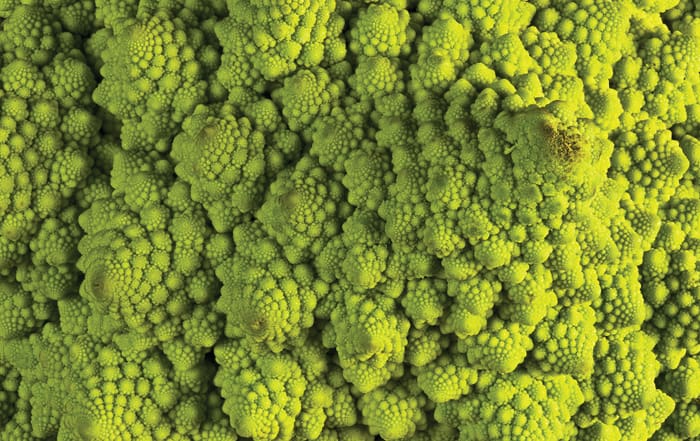
Intricate patterns in a romanesco cauliflower. (Courtesy: Nathan Myhrvold/Modernist Cuisine LLC)
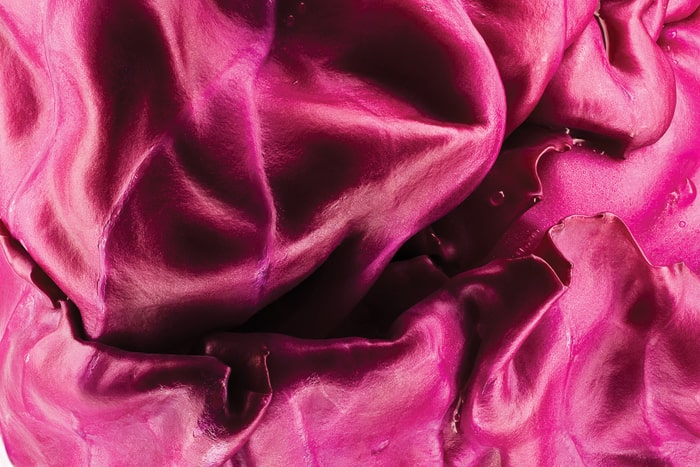
The image at the top, for example, may look like a distant planet viewed through the porthole of a spacecraft, but it is actually the bottom end of a blueberry: the “planet” is part of the berry’s ovary, while the rough-edged lobes of the “porthole” are the remains of its blossom, or calyx. The next image shows the fractal-like patterns characteristic of a romanesco cauliflower, while the delicate folds of bright-pink material are found on the surface of a cabbage.
Bright-pink folds on the surface of a cabbage. (Courtesy: Nathan Myhrvold/Modernist Cuisine LLC)
In the final photo, below, oil is ignited as it bursts from an orange as it is peeled.
Setting the oil in orange peel on fire. (Courtesy: Ryan Matthew Smith/Modernist Cuisine LLC)
With a “wingspan” of more than a third of a metre, a mass of nearly 6 kg and a hefty price tag, The Photography of Modernist Cuisine is not the sort of book that can be tucked discreetly into a Christmas stocking. Still, the book – which includes a “how we did it” chapter that delves into the photographic techniques and the back stories of some of the book’s 405 photos – is a visual feast, and we think it will appear under a few trees this season.