Postcard from Brazil – satellites and space weather

By Matin Durrani in São José dos Campos, Brazil

Two people died today in Brazil when a crane fell into the roof of a sports stadium in São Paulo that was due to host the opening ceremony of next year’s football World Cup.

The incident was not perhaps the best indication of Brazil’s technological know-how in a country that is keen to show its best face off to the world. But I saw a better example of Brazilian expertise today at the National Institute of Space Science (INPE) in São José dos Campos – a city of about 700,000 people 100 km north-east of São Paulo.

My visit to the INPE was hosted by Elbert Macau (whose middle name is Einstein, by the way), where my colleague Susan Curtis and I saw two key activities at the institute.

(more…)

Does the positron ‘excess’ really exist?

The positron “excess” measured by two independent space missions and linked by some physicists to dark matter or pulsars does not exist, according to new theoretical work done by an international team of researchers. Instead, the researchers have calculated a “robust” upper limit for the positron flux created via interactions of high-energy cosmic rays with ambient gas in the galaxy and say that the flux measured by the Payload for Antimatter/Matter Exploration and Light-nuclei Astrophysics (PAMELA) experiment and the Alpha Magnetic Spectrometer (AMS) lies below this limit.

Unexplained excesses

Positrons are the antiparticles of electrons. In 2008 the PAMELA collaboration released exciting data from its satellite, suggesting that cosmic rays above the Earth’s atmosphere contain an excess of high-energy positrons. The result was interesting because standard cosmic-ray theories suggested that the positron fraction should drop with increasing energy. But what was really exciting was that the excess could be the first evidence of dark-matter particles annihilating. However, doubts were cast over the initial PAMELA results and it was thought that the satellite could be confusing positrons with the far larger numbers of protons reaching its detectors.

Then in 2011 NASA’s Fermi Gamma-Ray Space Telescope confirmed PAMELA’s positron excess, followed by the AMS collaboration in April this year. Subsequently, the PAMELA collaboration has presented a new analysis of its data that confirms the excess. There are two popular explanations for this excess – one is that annihilating dark-matter particles are generating high-energy electrons and positrons and the other is that the positrons are being created in pulsars.

Plotting cosmic rays

But now, Kfir Blum and Boaz Katz at the Institute of Advanced Study at Princeton in the US and Eli Waxman at the Weizmann Institute of Science in Israel are arguing that there is no real positron excess. They say that the positron observations are well within their calculation of an upper limit of the number of high-energy positrons created when cosmic rays collide with ambient galactic matter. Indeed, the researchers suggest that the current positron measurements shed new light on the physics of cosmic-ray propagation – not dark matter or pulsars.

In their study, the researchers consider what they call the simplest reliable model to explain the positron flux. Their source is high-energy or “primary” cosmic rays that interact with gas and other matter that abounds in the galaxy. Blum tells physicsworld.com that this theory allows them to accurately calculate the amount of positrons that are produced in these “secondary” collisions and that many other species of particles, such as antiprotons and nuclei such as borons, are produced in these collisions. “While we can easily calculate the source of the positrons, predicting their actual flux at the Earth is harder,” says Blum. To make such predictions, a robust theory that explains how cosmic rays propagate in the galaxy is necessary and that is what is currently lacking.

Poorly understood propagation

Blum claims that this is a complicated theoretical problem that is not yet properly understood. “Lacking a reliable theory of the propagation of cosmic rays, the best we can do for positrons – reliably – is to predict a robust upper limit for their flux. The positron flux measured by PAMELA and AMS02 lies below this upper limit, and is consistent with it so there is no excess,” he says. Blum further explains that most of the claims of a positron “excess” are based upon speculative theoretical models of cosmic-ray propagation and since the problem itself is poorly understood “these models, more often than not, use many simplifying assumptions. When one tries to get to the bottom of the acclaimed ‘excess’, the issue always boils down to one or a few of these underlying simplifying assumptions, that may simply not be correct in the real world”.

If future data end up showing a positron flux above our limit, this could mean that an exotic source is needed. I for one would be thrilled. But this is not where I’d put my money in light of the data we have now. Kfir Blum, Institute of Advanced Study

The team also points out that it has applied its methods to antiprotons that are also produced in cosmic-ray fluxes. The difference between these calculations lies in the fact that antiprotons do not change their energy as they travel through the galaxy, while positrons do. “As a result of this simplification, for antiprotons we can compute precisely their actual flux [instead of an upper limit],” says Blum, explaining that the team uses this fact to validate its calculations. “Indeed, the measured antiproton flux agrees nicely with our prediction,” he says. In fact, the researchers have previously done similar upper-limit calculations for the 2009 PAMELA data, and say that the subsequent confirmation with AMS-02 only adds support to their theory.

Confined times

When asked if the new theory can explain why the positron fraction is rising with energy, Blum says it may be yet another hint of an interesting feature of how cosmic rays propagate. “As we show in our paper, one way (though not the only one) to obtain this kind of behaviour would be if the confinement time of the cosmic rays in the galaxy decreases with increasing energy – more rapidly so than the time it takes an average secondary positron to lose a significant fraction of its energy.” If this is indeed the case, then what the experiments are witnessing with the positrons merely amounts to rapidly falling confinement times of the cosmic rays.

Blum says the team’s theory can be tested experimentally in several ways. First, upcoming AMS-02 positron data at even higher energies will continue to check whether the observed flux remains below their robust upper limit, or not. “If future data end up showing a positron flux above our limit, this will rule out the secondary interpretation immediately. This would be wonderful news as it could mean that an exotic source is needed. I for one would be thrilled. But this is not where I’d put my money in light of the data we have now,” says Blum. He also explains that future AMS-02 measurements of secondary radioactive cosmic-ray nuclei, such as beryllium and aluminium isotopes will add independent information on the cosmic-ray confinement time. “This can then be contrasted with the positron data, to find out if we have a consistent picture. These radioisotope data are promising, as they could test for a failure of the secondary source hypothesis even in the case where the upper limit on the positron flux is not violated.”

Supernova source?

“What would have been more interesting is if they had been able to answer the question: what is the actual source of the ‘secondary origin of cosmic-ray positrons’?” says Subir Sarkar, a particle theorist at the University of Oxford in the UK who was not involved in the current work. Sarkar says his group’s research has shown that the source may be nearby supernova remnants that are accelerating high-energy protons, which interact with the ambient matter to make positrons that are also accelerated. “The prediction we made for the positron fraction – based on independent measurements of the positron/electron flux by the Fermi satellite – are consistent with the AMS-02 findings,” says Sarkar.

While Blum and colleagues admit that it is, in principle, possible that pulsars or dark matter may contribute to the experimentally measured flux, he insists that there is a good, if not definitive, theoretical reason to doubt the presence of a significant contribution from such an additional exotic source. “It would be quite surprising if a completely unrelated physical process, such as dark-matter annihilation, contributed to the positron flux in just the right amount to make the observed flux agree so well with the pure secondary prediction, neglecting energy loss,” concludes Blum.

The research is published in Physical Review Letters.

Postcard from São Carlos – a hub for Brazilian science

Traffic jams in São Paulo

By Susan Curtis in São Carlos

Sitting in one of São Paulo’s famous traffic jams as part of the Physics World fact-finding mission, we slowly turned into a road named after Order e Progresso (Order and Progress), the motto that forms a key element of the Brazilian national flag. I couldn’t help smiling, because there wasn’t much order on the roads, and precious little progress either.

The crazy traffic in Brazil’s largest city is just one reason why many physicists prefer to be stationed in the University of São Paulo (USP)’s science and engineering campus in São Carlos, some 200 km north-east of the mega-city.

(more…)

Physicists ask photons ‘Where have you been?’

A new version of the famous double-slit experiment has allowed physicists in Israel to measure a phenomenon that is bizarre even by the counterintuitive standards of quantum mechanics. By placing a double-slit experiment along one path of a larger double-slit experiment, the researchers have shown that photons traverse a section of the apparatus that they neither enter nor exit. The effect, the team argues, is best understood by invoking a little-used interpretation of quantum mechanics that was first proposed in 1964.

Perhaps the simplest and starkest demonstration of wave–particle duality is the famous double-slit experiment. Particles such as photons or electrons that are emitted discretely behave as waves when they pass through two slits and build-up an interference pattern when detected individually on a screen.

In this latest version of the experiment, Lev Vaidman and colleagues at Tel-Aviv University used Mach–Zehnder interferometers as double slits and photons as particles. The optical interferometer uses a beamsplitter to divide the photon beam into two separate paths that are then recombined and sent to a detector. A difference in the lengths of the two paths dictates how the beams interfere when recombined, which affects the intensity measured by the detector.

Three possible paths

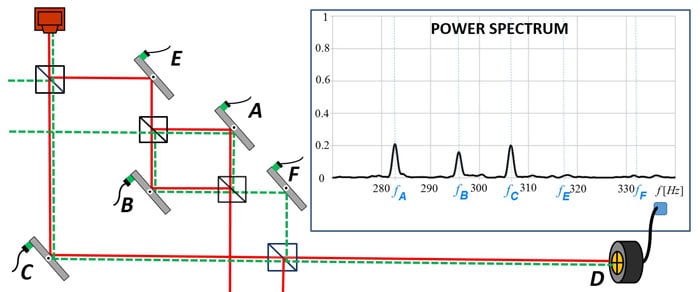
In the Tel Aviv experiment, an inner Mach–Zehnder interferometer is placed in one path of an outer interferometer so that the recombined beam continues its journey through the outer device and on to a detector (see figure below). This means that a photon has three possible paths from source to detector. The goal of the experiment is to find out which paths are taken by at least some photons arriving at the detector. This is called a weak measurement, and is consistent with the laws of quantum mechanics because it does not involve measuring the path of any specific photon.

Diagram showing the two-interferometer experiment

To make their measurements, the researchers set all the mirrors in the interferometer vibrating slightly, each at a different frequency. As a mirror vibrates, it alters the pathlength of any light reflecting from that mirror. This alters the phase difference when the beam is recombined, changing the intensity at the detector. As every mirror is vibrating at a unique frequency, oscillations in the detected intensity at a particular frequency indicated that photons have touched a specific mirror.

The researchers arranged the two pathlengths through the inner interferometer so that the two paths interfered destructively when they recombined. Therefore, no light could leave the inner interferometer. One might expect, therefore, that the only oscillation in the detected intensity would come from the mirror bypassing the inner interferometer, but this was not what the researchers found.

Bizarre conclusion

The detected intensity did indeed oscillate at the frequency of this bypass mirror, but it also oscillated at the frequencies of the mirrors in the inner interferometer. It did not, however, oscillate at the frequencies of the mirrors directing light into or out of this inner interferometer. This leads to the bizarre conclusion that some photons received by the detector had passed through the inner inteferometer, but had never entered it and never left it.

The researchers believe that this validates an unconventional interpretation of quantum theory called the two-state vector formalism. It was first proposed in 1964 by Yakir Aharonov, Peter Bergmann and Joel Lebowitz. Here, the probability of finding a particle in a particular place is the product of two vectors: one evolving forwards in time from the source and one evolving backwards in time from the detector.

A photon can touch a mirror if and only if both waves are non-zero at that point. The inner interferometer causes any wave leaving it to be identically zero. The forward-evolving wave is zero on the way out, and so no photons can be found here. The backward-evolving wave travels backwards through the interferometer and is therefore zero on the way in, so no photons can be found here either. Within the inner interferometer, however, both forward- and backward-evolving waves are non-zero, and so photons pass through both arms (see figure).

Intuitions and explanations

Vaidman stresses that the two-state vector formalism does not actually make different predictions from the conventional wave-mechanics approach devised by Erwin Schrödinger in the 1920s. However, the results of this experiment seem highly counterintuitive and are difficult to rationalize using the traditional method. “You can define constants and you can have intuitions about what is going on using the two-state vector formalism,” says Vaidman, “But it’s not something that standard quantum mechanics cannot explain in the end.”

Onur Hosten of the University of Illinois at Urbana-Champaign, who was not involved in the experiment, says that whether you consider the experiment using the two-state vector formalism or using the conventional wave-mechanics approach, the effect is generated by the fact that performing a weak measurement inevitably perturbs the system. Oscillating the mirrors does itself change the pathlengths, thereby destroying the perfect destructive interference between the two paths of the inner interferometer and allowing the wavefunction to leak out. The probability of a photon leaking out is effectively zero, however, because the probability is proportional to the square of the wavefunction, which tends to zero much faster than the wavefunction itself. “From my perspective, it’s really interesting to understand why you get the results you do,” says Hosten, adding “but it’s also interesting that a weak measurement gives you some disconcerting answers.”

The results are to be published in Physical Review Letters. A preprint is available on arXiv.

  • Weak measurements are explained in detail in the article “In praise of weakness” by Aephraim Steinberg, Amir Feizpour, Lee Rozema, Dylan Mahler and Alex Hayat of the University of Toronto

Viruses breathe new life into batteries

Research into lithium–air batteries that may in the future power electric cars and other electronic devices has just received a boost – from a virus. Scientists at the Massachusetts Institute of Technology (MIT) in the US have shown that using genetically modified viruses greatly increases the surface area of nanowires that work as electrodes in a battery’s cathode, thereby improving the battery’s charge-storage capacity.

A typical battery consists of a cathode, an anode (normally made of lithium), an ion conductor (or an “electrolyte”) through which charged ions flow easily, and a separator to keep the two ends apart. An electric current is produced as the positively charged lithium ions move from the anode to the cathode during cell discharge. When a battery is recharged, an external current makes the ions flow in the opposite direction, which results in the ions being stored at the anode.

Better batteries?

In recent years another type of battery, known as a lithium–air battery, has shown promise, and the development of these batteries could lead to electric cars being on the road for longer between charges. Such batteries oxidize lithium at the anode using a lightweight “air cathode” that replaces the much heavier metal-oxide cathodes used today. While the batteries hold much promise, at present traditional electrochemical capacitors perform much better – lithium–air batteries can only be charged and discharged a limited number of times before they start losing their charge-storing capacity. The batteries’ electrodes also need to be made from more durable and long-lasting materials.

Now, Dahyun Oh, a graduate student at MIT, and colleagues have found that increasing the surface area of the wire that acts as the electrode – thereby increasing the area where electrochemical activity takes place during the charging or discharging of the battery – could solve some of the above problems. The researchers also found that they could use a rod-shaped virus called M13 to grow the electrode materials – manganese-oxide wires that are a “favourite material” for the cathodes of lithium–air batteries. The virus is able to capture molecules of metals from water and bind them into various structural shapes. The scientists created an array of nanowires, each measuring about 80 nm across and “wrapped with very small amounts of nanoparticles of precious metal such as palladium or gold”, says Oh.

According to the researchers, their virus-crafted nanowires showed improved performance in lithium–air batteries because, unlike wires made using traditional chemical methods, the virus-built structures had a rough, spiky surface, which greatly increases their surface area. In addition, the viruses produced a 3D structure of cross-linked wires instead of isolated wires, thus giving the electrode greater stability. Angela Belcher, who is the lead researcher of the MIT team, likens the viruses’ growth to that of an abalone sea snail growing in its shell – it collects calcium from seawater and deposits it into a solid, linked structure.

Although the research is still in its early stages and such bio-batteries are not yet commercially available, the group does have a functional prototype that was tested through 50 cycles of charging and discharging. The scientists also used the biological approach to form functional materials “for solar cells, water splitting and cancer imaging”, according to Oh.

Environmentally friendly

Nanowire fabrication with viruses is simpler than most conventional methods – it can be carried out at room temperature and using a water-based process, instead of manipulating hazardous chemicals at high temperatures. And the process of building such bio-batteries uses no toxic or harmful materials, claim the scientists, making the batteries environmentally friendly. Traditional batteries contain heavy metals such as lead, mercury and cadmium. If they are not disposed of correctly, they end up in landfill and their toxic contents can enter the ecosystem.

Biology to the rescue

A number of the team members have been working on using viruses for bio-batteries for several years. In 2006, the researchers manipulated the genes inside a virus to form a nanowire anode a 10th the width of a human hair for a lithium-ion battery, followed by a study in 2009 where they also used viruses to build the cathode for the same lithium-ion battery.

But theirs is not the only research into bio-batteries. Electronics giant Sony has been looking into making such a battery, based on the proton–electron associated reaction and where glucose is used directly as electrodes, for the past decade. In addition, an Israeli start-up company called Store Dot claims to be “about five years away” from making the first commercially available bio-batteries. Its product is based on a new class of quantum dots – so-called nanodots of biological origin – that work as biological semiconductors and are able to store a charge, and can be used to make quick-charging, high-capacity batteries.

Using viruses for lithium–air and lithium-ion batteries as the medium for synthesis was “out-of-the-box thinking” says Jie Xiao at the Pacific Northwest National Laboratory, who was not involved in the study. She says that although it is still too early for the concept of lithium–air batteries to go to market, the research could “inspire other groups to work in this direction by adopting alternative approaches that may accelerate lithium–air-battery technology development”.

Take a look at the video below, courtesy of MIT, which illustrates how the wires for the batteries are grown.

The research is published in Nature Communications.

Boson book scoops Royal Society prize

By Margaret Harris

It’s been a good year for particle-physics prizes, and the Higgs-stravaganza continued last night in London as the cosmologist and author Sean Carroll walked away with the £25,000 Royal Society Winton Prize for his book The Particle at the End of the Universe.

Carroll’s book – which includes a behind-the-scenes account of how the Higgs boson was discovered, as well as explanations of the Higgs field and other concepts – was the “unanimous” choice of the prize’s five-member judging panel. Uta Frith, an emeritus professor of cognitive psychology at University College London and the judging panel’s chair, called The Particle at the End of the Universe “a real rock star of a book,” and cited Carroll’s energy and passion for his subject among the reasons why it beat out the five other books on the shortlist.

(more…)

Herschel in a minute

By Michael Banks

Here is an example of how to condense four years’ worth of space observations into just a minute.

The animation above, which was created by Pedro Gómez-Alvarez of the European Space Agency (ESA), shows a timeline of more than 37,000 scientific observations made by ESA’s Herschel Space Observatory.

The video runs from Herschel’s launch on 14 May 2009 until the infrared observatory made its last observation on 29 April 2013 as the craft’s detectors ran out of coolant.

Herschel – a far-infrared and submillimetre telescope – had two main goals: to study star formation in our galaxy; and galaxy formation across the universe.

Named after the German-born astronomer who in 1781 discovered Uranus, the probe carried a 3.5 m-diameter mirror – the largest to be deployed in space – and investigated light with wavelengths of 55–670 µm.

The craft was placed in an area of space some 1.5 million kilometres further out from the Sun beyond the Earth. Known as Lagrange point L2, it is where a space probe can usefully hover, little disturbed by stray signals from home and without having to use much fuel to keep it in position.

You can find some of the incredible images taken by Herschel at ESA’s multimedia gallery.

Postcard from São Paulo – turning Abdus Salam's dream into reality

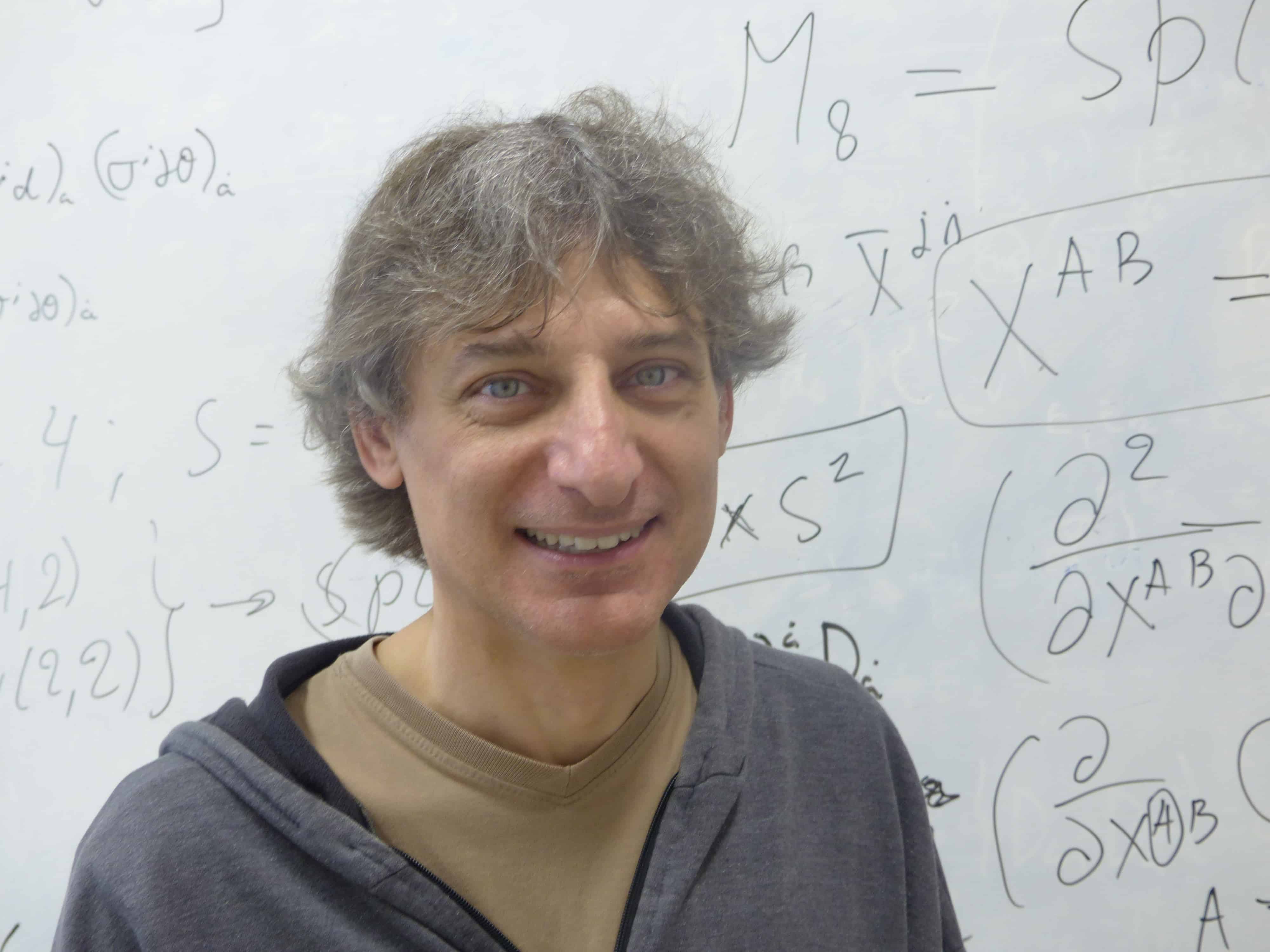
Photo fo Nathan Berkovits

By Matin Durrani in São Paulo

Today was the second day of the Physics World trip to Brazil and I flew from Rio de Janeiro down the coast to São Paulo, which is about an hour’s flight away. After yesterday’s disappointingly poor weather in Rio, things aren’t any better further south – in fact, it’s probably raining even more heavily today.

São Paulo is the largest urban area in South America, as becomes obvious from the forest of tower blocks that you skirt over on approaching the city’s downtown airport.

But the city is also, according to US-born string theorist Nathan Berkovits, an enjoyable place to live. In fact, Berkovits has an extra reason to like the place – having worked at the São Paulo State University (UNESP) for almost two decades, he was last year appointed acting director of a new theoretical-physics institute that’s already one of the leading places of its kind in South America.

(more…)

Why do beer bottles foam when struck on top?

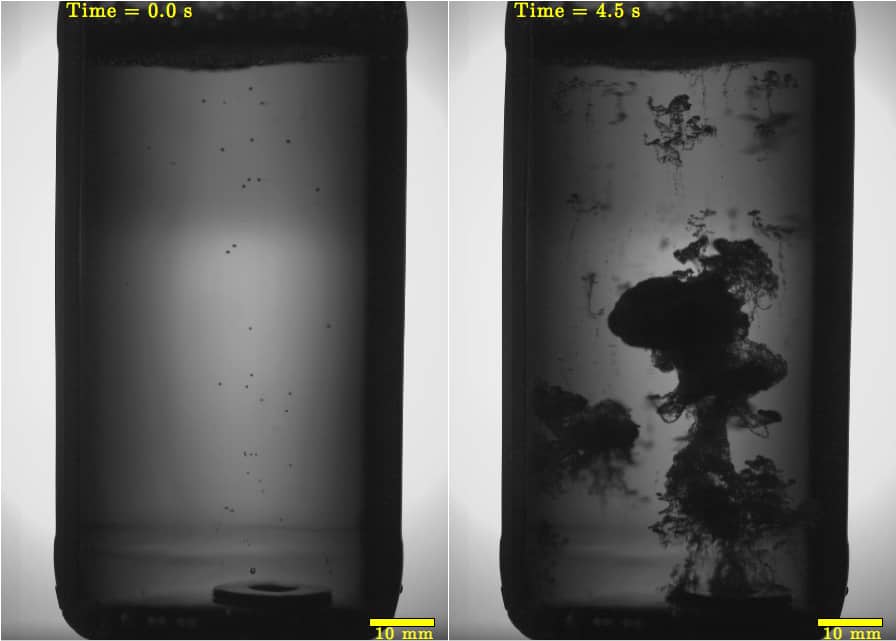
A foamy mess in the making (Courtesy: Javier Rodríguez-Rodríguez)

By Hamish Johnston

We’ve all had a friend who does it – you’re deep in conversation at a party, beer bottle in hand, when someone sneaks up and taps the top of your bottle with theirs, causing a foamy mess to erupt from your bottle. And to add insult to injury, their bottle doesn’t foam.

Now, physicists in Spain and France have studied this curious effect and gained a better understanding of how it occurs. While their work won’t prevent wet shoes and slippery floors at university social gatherings, the researchers believe their work could provide insights into geological features such as oil reservoirs, mud volcanoes and “exploding lakes”.

(more…)

Model explains why liquid suspensions suddenly turn solid

A new model combining fluid dynamics with granular dynamics can provide important insights into discontinuous shear thickening – a curious effect that causes some fluid-like materials to suddenly behave like a solid. Developed by physicists in the US, the model agrees with key experimental observations and could help researchers develop new technologies based on shear thickening, such as flexible body armour.

Suspensions of tiny solid particles dispersed in fluids can exhibit a range of bizarre properties that have proven difficult for physicists to fully understand using traditional fluid dynamics. Most notably, they do not have a constant viscosity: some suspensions become runnier when they are stirred faster or pushed harder, while others become thicker. Albert Einstein first evaluated the effect of suspended particles on viscosity in 1906, and there have been numerous theoretical models since then. None of these, however, has adequately explained discontinuous shear thickening: the abrupt solid-like stiffening that is easily observed in a suspension of corn starch in water.

In the new research, Ryohei Seto and colleagues at the City College of New York considered the essential nature of a suspension – a mixture of solid grains and liquid medium. This allowed them to combine ideas from fluid dynamics with those from granular physics. In fluid dynamics models, suspended particles are forbidden to touch, and all interactions are mediated by the fluid medium. In contrast, there is no medium in granular physics, or the medium is a gas that offers little resistance to particle contact. As a result the macroscopic dynamics of granular physics are the product of individual interactions between the granules.

Chains of force

At low shear, the viscosity is mainly caused by the difficulty the medium has in squeezing itself between the solid particles as the suspension is moved. In reality, there are direct contacts between the particles, and these do add to the viscosity. Forces applied to one particle can sometimes be passed directly to the next, creating a chain of particles moving together. However, these force chains are well dispersed and too short to have a significant impact on the macroscopic behaviour of the suspension.

Above a certain shear rate, however, the direct contacts between particles become more numerous as the particles are forced closer together more and the medium is unable to flow between them fast enough. This creates more chains of particles moving together, and allows the chains to get longer. At a certain point, the chains get tangled up in each other and lock together, and the suspension becomes an amorphous solid with liquid in the gaps between particles.

While this kind of jamming behaviour is well understood in granular physics, the New York researchers’ model is the first to start from the basic forces on a suspended particle and capture this liquid–solid crossover. “Starting from basic assumptions familiar to the hydrodynamics community,” says Seto, “we introduced some particle contact, and we borrowed a model from granular physics to describe contact. So our work is bridging two fields.”

The model does a good job of reproducing a range of experimental results obtained in several different labs. Indeed, Seto explains that the group’s model provides a unified explanation of results that had been interpreted in different ways in the past.

Heinrich Jaeger at the University of Chicago is impressed by the team’s work: “I’m very excited about this paper combining ideas from two perspectives – the granular perspective, which starts from solid on solid and then worries about what happens when you put liquid in, and the suspension rheology perspective that starts from a liquid and wonders what happens when you put particles in.”

Aside from scientific interest, both Seto and Jaeger say that the work has technological applications. “Discontinuous shear thickening is typically thought of as a problem in industries,” says Jaeger. “If you are trying to transport these dense suspensions through pipes and they suddenly lock up this would be a potential disaster. Therefore it is very important to have a good approach to controlling this behaviour.” He adds that there are also applications in which it is desirable, such as flexible stab vests or other protective clothing. “At slow agitation the material behaves rather liquid-like, while sudden impacts can activate this shear thickening, which immediately turns the material into a more solid-like form.”

The research is published in Physical Review Letters.

Copyright © 2026 by IOP Publishing Ltd and individual contributors