Launch your own personalized lunar mission

By James Dacey

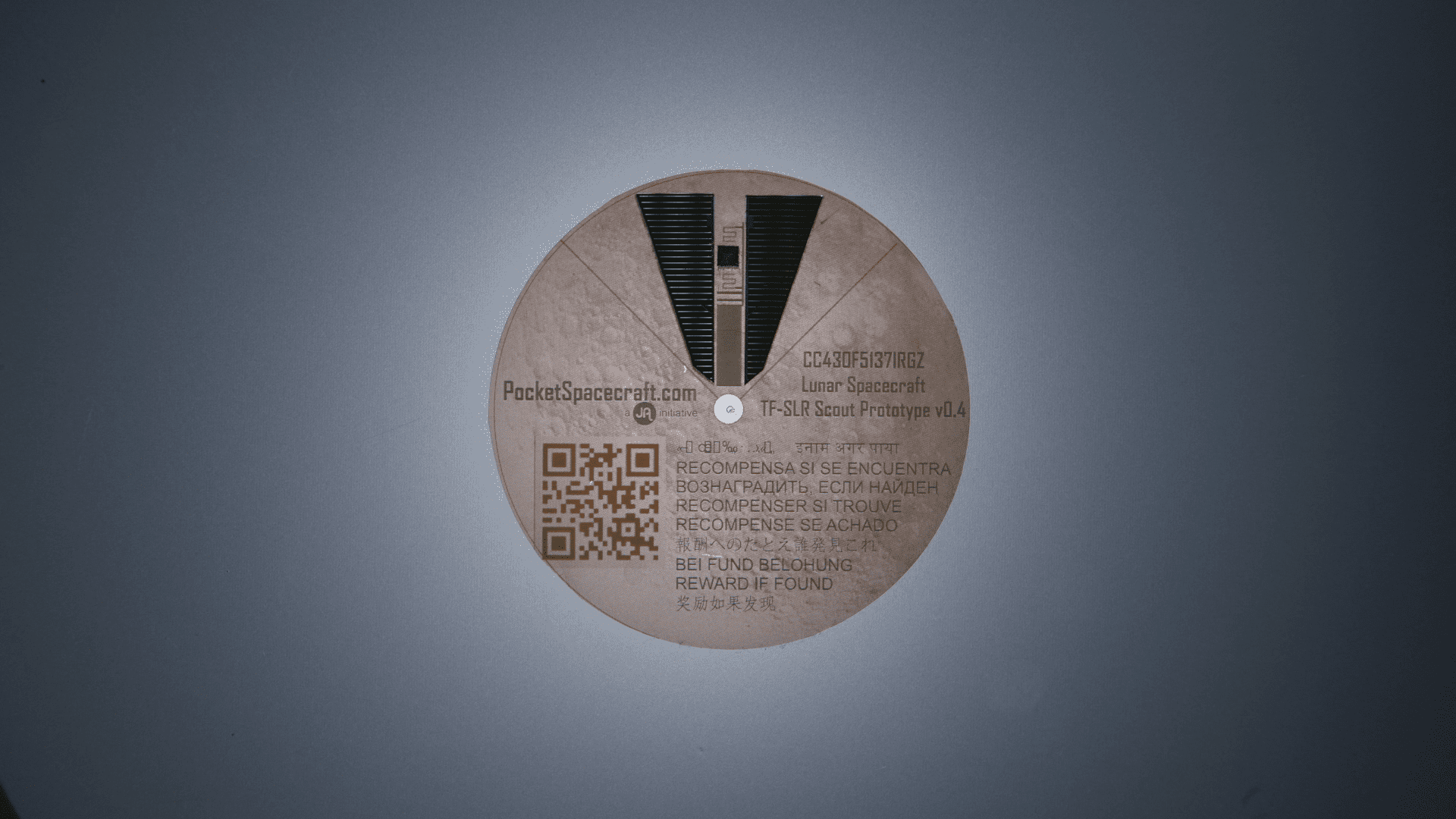
Photo of thin spacecraft

If you’re looking for a gift idea for a budding Buzz Aldrin then you might want to read on. A new crowd-funding initiative is offering the general public the chance to launch and control our own miniature missions to the Moon. Apparently, we are being given the chance to personalize our own “pocket spacecraft” that will hitch a ride on a commercial rocket before breaking free and spiralling down onto the lunar surface.

The project is the brainchild of some of the people behind the first space mission funded on KickStarter – a website that allows creative ventures to raise funds from the public. That initial project, called KickSat, offered people the chance to launch miniature satellites into the Earth’s atmosphere. It was a success and the mini satellites will be launched via a NASA mission later this year. This latest project is also being run through KickStarter and this time round we can send our space machines to the Moon.

(more…)

What is the greatest asset a physicist could bring to our understanding of cancer?

By James Dacey


When you think about the types of scientist involved in the study of cancer you probably wouldn’t immediately think of physicists. But a burgeoning field of research referred to as the “physics of cancer” is seeing physical scientists bring new tools and fresh perspectives to this most complicated of diseases. The July issue of Physics World – which can be downloaded for free – is a special issue that looks at some of the most fascinating experimental and theoretical work in this field.

After taking a look at the issue you might want to take part in this week’s Facebook poll:

What is the greatest asset a physicist could bring to our understanding of cancer?

Fresh pair of eyes on a longstanding problem

Ability to identify key variables within a complex system

Focus on physical properties such as forces and fields

Other (please suggest as a comment here or on our Facebook page)

To take part please visit our Facebook page.

(more…)

Atomic Van der Waals force measured for the first time


Scientists in France are the first to make a direct measurement of the Van der Waals force between two atoms. They did this by trapping two Rydberg atoms with a laser and then measuring the force as a function of the distance separating them. The two atoms were in a coherent quantum state and the researchers believe that their system could be used to create quantum logic gates or to perform quantum simulations of condensed-matter systems.

The Van der Waals force between atoms, molecules and surfaces is a part of everyday life in many different ways. Spiders and geckos rely on it to walk up smooth walls, for example, and the force causes proteins inside our bodies to fold into complicated shapes.

Named after the Dutch scientist Johannes Diderik van der Waals – who first proposed it in 1873 to explain the behaviour of gases – it is a very weak force that only becomes relevant when atoms and molecules are very close together. Fluctuations in the electronic cloud of an atom mean that it will have an instantaneous dipole moment. This can induce a dipole moment in a nearby atom, the result being an attractive dipole–dipole interaction.

Indirect measurements

There have been many indirect measurements of Van der Waals forces between atoms. Examples include analysing the net forces experienced by macroscopic bodies or using spectroscopy to work out the long-range behaviour of the force between two atoms in a diatomic molecule. However, a direct measurement has eluded scientists until now.

This latest research was done by researchers at the Laboratoire Charles Fabry (LCF) in Palaiseau and the University of Lille. “What we have done here, for the first time to our knowledge, is to measure directly the Van der Waals interaction between two single atoms that are located at a controlled distance, chosen by the experimenter,” says Thierry Lahaye, who is part of the LCF team.

Controlling the distance between normal atoms – while measuring the force between them – is extremely difficult because the relevant distances are tiny. To get round this problem the team used Rydberg atoms, which are much larger than normal atoms. Such atoms have one electron in a highly excited state. This means that they have a very large instantaneous dipole moment – and therefore should have very strong Van der Waals interactions over relatively long distances. They also have unique properties that allow them to be controlled with great precision in the lab.

Pairs of atoms

The experiment begins with two rubidium atoms trapped in two tightly focused laser beams separated by a few microns. Laser light at a specific wavelength is then shone on the atoms, which causes the system to oscillate between the ground state and one or two Rydberg atoms. The team found that when conditions were just right, the system oscillated between the ground state and a pair of Rydberg atoms, one at each laser focus. By measuring these oscillations, the team worked out the Van der Waals force between the two Rydberg atoms.

By adjusting the trapping laser beam, the team can move the Rydberg atoms closer together or further apart. As the researchers changed the distance R between the atoms, the force varied as 1/R6 – exactly as expected for the Van der Waals force.

In addition to the force measurement, the team was also able to show that the quantum evolution of the state of the two interacting Rydberg atoms was fully coherent – something that “has never been seen in atomic physics” claims LCF group member Antoine Browaeys.

Just like quantum logic

This coherent evolution of two interacting atoms is identical to that of a quantum-logic gate operating on two quantum bits (qubits). Browaeys believes that this suggests that two atoms interacting via Rydberg–Van der Waals interactions is a promising system for creating high-fidelity quantum gates. “The result is bringing us closer to a quantum computer,” he says.

Indeed, the scientists say that the long-term significance of their experiment is not the force measurement itself, but rather the high degree of control of the Rydberg atoms that they have achieved. “This will allow us to engineer small quantum systems of increasing size, from two to hopefully a few tens of Rydberg atoms, over which we have full control of the interactions,” explains Lahaye.

Such systems could find use in quantum information processing or the quantum simulation of condensed-matter systems such as quantum magnets.

Steven Rolston of the Joint Quantum Institute at the University of Maryland, who was not involved in the study, calls the work an important milestone towards creating quantum-information devices because it shows that the Van der Waals interaction between atomic qubits behaves as expected.

The experiment is described in Physical Review Letters.

New diamond centre cuts the ice

By Margaret Harris

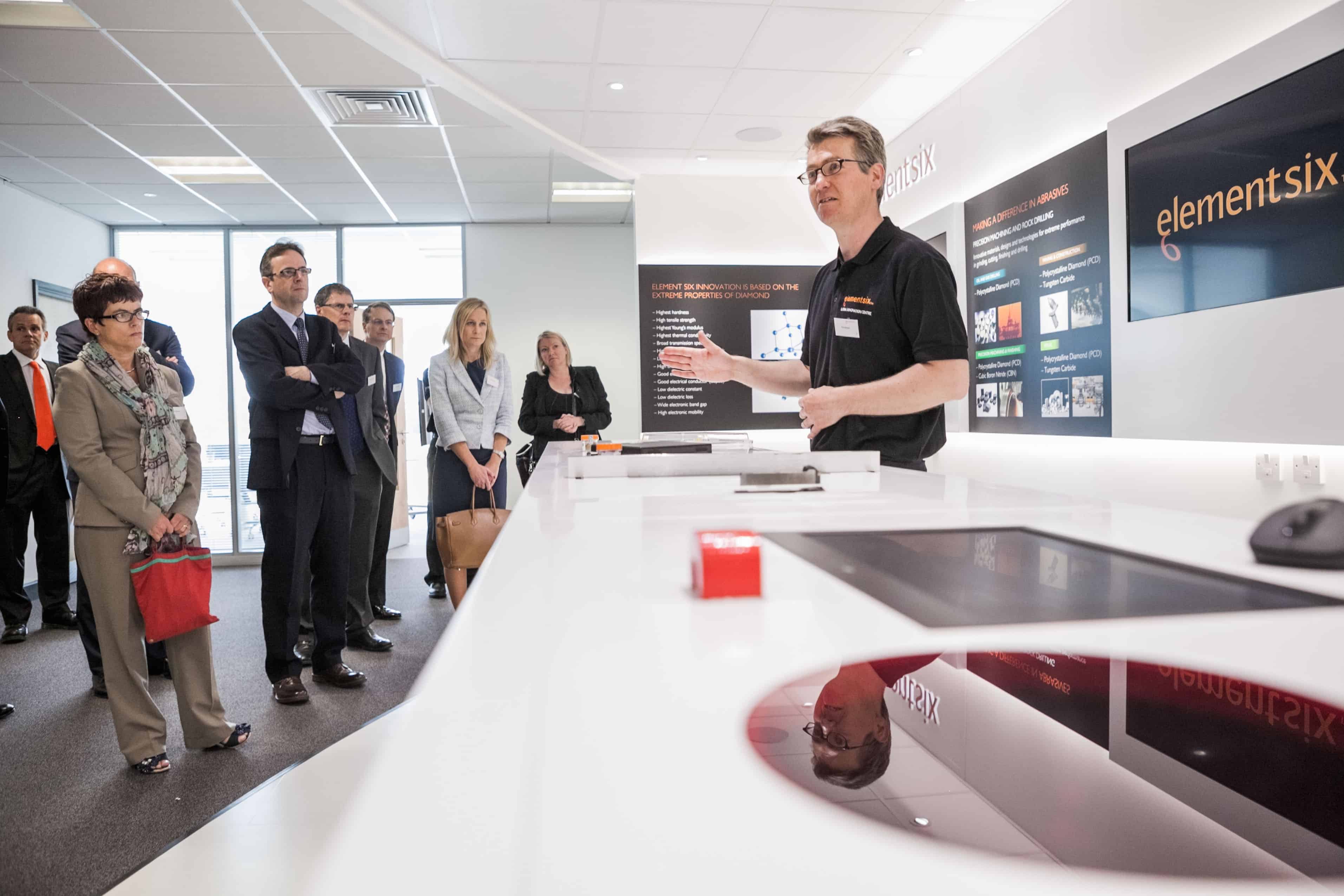
An Element Six employee shows visitors some of the company's products

The Harwell Science and Innovation Campus added another jewel to its crown yesterday when the industrial-diamonds firm Element Six officially opened its £20m new R&D facility on the Oxfordshire site, which is already home to organizations such as the Rutherford Appleton Laboratory and the UK’s flagship synchrotron, the Diamond Light Source.

I’d heard about Element Six’s plans thanks to this article, which appeared in the careers section of June’s Physics World. The author, Stephanie Liggins, is a physicist who joined Element Six after completing her PhD at the University of Warwick, and towards the end of the article she mentioned that she would soon be moving to the company’s new Global Innovation Centre – which she described as “the world’s largest synthetic-diamond research and development facility”.

(more…)

Lensless camera acquires images efficiently

A new kind of camera that does not form a physical image has been developed by scientists in the US. Employing just a single sensor and an array of apertures rather than a lens, the device can acquire the image of a scene using fewer measurements than conventional cameras. According to its inventors, it would be particularly good for surveillance operations and could also be adapted for non-visible imaging at wavelengths such as infrared, millimetre-wave and terahertz.

Conventional cameras use a lens to project an image onto photographic film or an array of charge-coupled devices. What Paul Wilford and colleagues of Alcatel-Lucent’s Bell Labs in New Jersey have instead done is to use a single point-like sensor to record the intensity of light that has passed through an array of tiny apertures placed between the object and the sensor. The researchers essentially create an image in time instead of space and do so using just a fraction of the measurements needed in normal digital cameras.

One aperture at a time

Each of the apertures in the array can be independently opened and closed using a computer. The simplest way to record an image is to open one aperture at a time, measuring the intensity of the light arriving at the sensor that has bounced off the object and passed through just that aperture. The number of required measurements is therefore the number of apertures, with the process equivalent to building up an image from a pinhole camera one pixel at a time.

Instead of using this simple method, the team uses an established signal-processing technique known as compressive sensing to reduce the amount of data needed to reconstruct an image. Wilford and colleagues do this by generating pseudo-random patterns of open and closed apertures within the array. Rather than measuring the intensity of light passing through one aperture at a time, the combined intensity from all of the apertures (open and closed) is measured. It then generates another pseudo-random pattern and measures the light transmitted by that, and so on.

“The pseudo-random patterns of the apertures make it possible to capture the information from the scene with a reduced number of measurements,” explains Wilford.

LCD apertures

The team built its aperture array from a monochrome liquid-crystal display (LCD) comprising some 65,000 squares that can be made either transparent or opaque. The sensor is a single pixel from a photovoltaic sensor that records the intensity of red, blue and green light falling on it. The research group enclosed the array and sensor inside a light-tight box about the size of a small microwave oven and used a computer to generate the aperture patterns and synchronize this pattern generation with the recording of the intensity measurements. These measurements were then converted into images in a separate step.

Image of a football taken with the Bell Labs system

The researchers imaged a football, a pile of books and a toy sleeping cat, and found that they could generate reasonable images of these objects using just a quarter (or in the case of the football an eighth) of the measurements that would be needed using a conventional camera. They also imaged the books using two sensors in different positions at the same time, showing how multiple sensors can be used either to reduce the time needed to capture an image or to improve its resolution.

According to Wilford, the device has a number of advantages over conventional cameras. The absence of a lens, he says, potentially makes it cheaper, lighter and free of distortions, with the image quality in theory only limited by the resolution of the aperture array. He adds that the device could be used for low-power imaging, since only a fraction of the data is collected at source and no processing is required to compress the image. The camera would be particularly well suited to surveillance, where the aim is to record changes in a scene and not to make detailed images of it. Wilford adds that it might also be used for imaging at different wavelengths where sensors are expensive.

Technical hurdles

However, the team acknowledges that it must overcome a number of technical hurdles before commercializing its device. The main one is speed. Limited by the working frequency of the LCD display and the sensor’s response time, one picture takes between several minutes and an hour to acquire. Boosting the frequency will mean making the apertures much smaller if energy consumption is to be kept under control. One option, according to Wilford, is to use microelectromechanical systems (MEMs) – moving devices built from components measuring as little as microns across.

Tiny, fast-moving apertures introduce a new problem – how to collect enough light in each measurement to create an image. A rival team at Rice University in Texas has made a similar device but has used lenses both to focus the light from an object onto an aperture array and then to direct the outgoing light on to a single-pixel sensor. Wilford admits that increasing the signal-to-noise ratio of his group’s sensor to the point where it can cope with the aperture speeds needed to produce videos will be “a challenge”, but underlines his group’s desire to “get away from this idea of creating a physical image”. “We face a number of practical issues,” he says, “but this is not by any means outside the realm of today’s technology.”

The camera is described in two preprints on the arXiv server (arXiv:1306.3946 and arXiv:1305.7181).

Physics on the big screen

By Tushna Commissariat

A new documentary of Stephen Hawking’s life is due in cinemas later this summer, with the esteemed physicist himself narrating the film. Hawking, as the documentary is simply dubbed, takes a personal look at the life of the celebrated scientist – his early days as a student in Oxford and his ongoing battle with motor neurone disease – as well as documenting his academic achievements.

(more…)

Institut Laue-Langevin secures funding until 2023


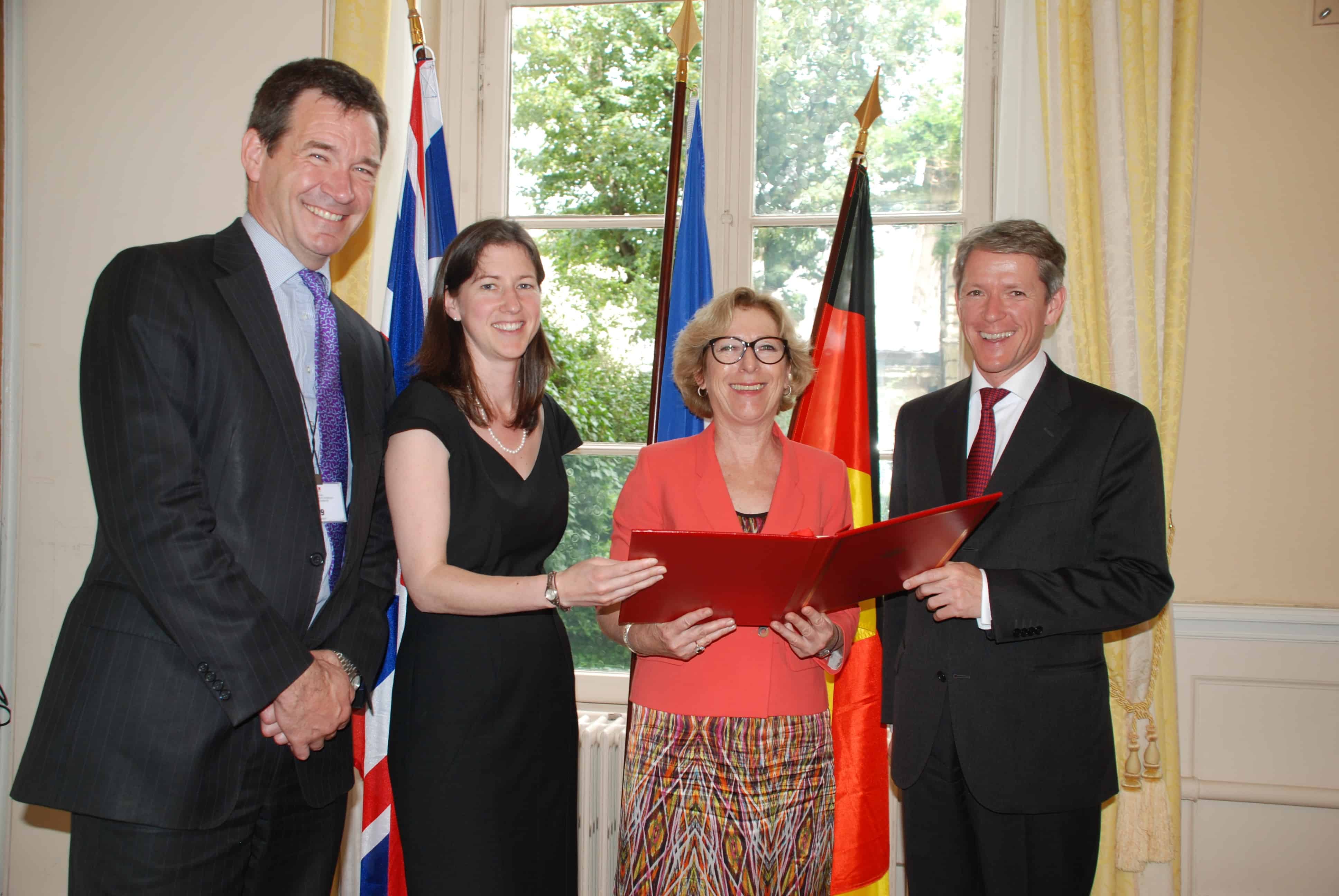
Smiles all around as the Institut Laue-Langevin secures funding for the next decade (Courtesy: ILL)

By Hamish Johnston

Despite the tough economic conditions in much of Europe, scientists who use one of the continent’s leading scientific facilities have something to smile about. The UK, France and Germany have agreed to continue funding the Institut Laue-Langevin (ILL) neutron facility for at least another decade.

(more…)

Twisted light carries data over 1 km in optical fibre

A new type of optical fibre that can carry “twisted” light over long distances has been developed by researchers in the US, Israel and Denmark. Their “vortex fibre” and associated encoding and decoding technologies allow data to be transmitted using the orbital angular momentum (OAM) states of light. In principle, the system could be used to increase the rate at which information can be sent along an optical fibre – and could ultimately boost the data-traffic capacity of the Internet.

As more information is sent across the Internet, researchers are looking for new ways of boosting the data capacity of the optical fibres that carry digital communications. While there are several new schemes under development, they all have drawbacks, such as the need for intensive signal processing or complicated multicore fibres.

Recently, scientists have shown that information can be encoded into the OAM of light. Light with OAM has a wavefront that rotates around the propagation axis, creating a spiral or vortex. By contrast, an ordinary light beam has a wavefront with an orientation that remains fixed with respect to its direction of propagation.

Coupling problems

In principle, OAM could be combined with conventional multiplexing techniques to boost the rate at which data can be transmitted along optical fibres. A major problem, however, is that even the slightest bend, twist or temperature variation in a fibre can cause light in one OAM transmission mode to jump into other modes. This coupling of modes leads to the rapid loss of information and it was only possible to send OAM-encoded data less than a metre along conventional fibres.

Microscope image of a cross-section of the vortex fibre

A new system that gets around this problem has been created by Siddharth Ramachandran and colleagues at Boston University, Alan Willner’s group at the University of Southern California (USC), researchers at Tel Aviv University and the fibre-maker OFS-Fitel, Denmark.

According to Ramachandran, who led the development of the fibre, the new system is designed so that the phase velocities of the OAM modes are different. This minimizes the probability of coupling between modes as the signals propagate along the fibre.

Circle and ring

At the centre of their new fibre is a region about 8 μm in diameter that comprises an inner circle and a concentric ring (see figure “Cross-section of the vortex fibre”). Both of these regions have indices of refraction that are greater than the rest of the fibre. This fibre is designed to carry four distinct modes – two zero-OAM modes that propagate in the inner circular core and two OAM modes that propagate in the outer ring. As well as minimizing the coupling of light between the zero-OAM and OAM modes, the design also reduces coupling between the OAM modes and two other “parasitic” modes that could occur in a fibre.

About 1.1 km of the fibre was manufactured by OFS-Fitel. “We were intent on showing this to work only with fibres that could be produced in a real production environment and all the fabrication steps we used were identical to those used in commercial producing optical fibres,” explains Ramachandran.

Development of the system that encodes and decodes the OAM pulses was led by Willner at USC. Dubbed OAM mode-division multiplexing (OAM-MDM), the system encoded data into four separate channels. These are defined in terms of the OAM (0 or 1) and circular polarization (–1 or 1) of the light. Using just these four modes, the team was able to transmit data over a 1.1 km fibre at a rate of 400 Gbit/s.

Eight Blu-rays per second

The system was also able to reproduce each quartet of OAM modes at 10 different wavelengths of light – a technique called wavelength-division multiplexing (WDM). This boosted the transmission rate to 1.6 Tbit/s – the equivalent of transmitting eight Blu-ray discs every second. While such data rates are routinely achieved by commercial WDM systems, this is the first time that OAM-based transmission has been achieved over distances greater than a metre.

Ramachandran believes that the transmission could be further boosted by minimizing losses in the system. “The one good thing about having started with fibre fabricated on a real production line is that it gives us hope that, where/when OAM supporting fibres are needed, our approach would have already addressed the manufacturability issue,” he adds.

The system is described in Science.

John Pendry wins 2013 Isaac Newton Medal

Photograph of John Pendry, winner of the 2013 Isaac Newton medal

The British theoretical physicist who helped build the first working “invisibility cloak” has won the 2013 Isaac Newton Medal of the Institute of Physics, which publishes Physics World. John Pendry of Imperial College, London, receives the international award for “his seminal contributions to surface science, disordered systems and photonics”. The Newton medal – the Institute’s most prestigious prize – has been awarded annually since 2008.

The medal is given for “outstanding contributions to physics” and includes a £1000 prize. This year’s award will be presented at a ceremony in London on 15 November and Pendry will also give the Institute’s Newton Lecture in October. Previous winners of the medal include Martin Rees, Leo Kadanoff, Edward Witten, Alan Guth and Anton Zeilinger.

Perfectly elegant

In a career spanning nearly 50 years, Pendry has worked on the physics of surfaces, low-energy diffraction and X-ray spectroscopy. However, he is probably best known for his more recent work on “metamaterials” and also on “transformation optics” – a concept that he developed. This research has led to the experimental realization of invisibility cloaks, perfect lenses and other remarkable electromagnetic devices.

Metamaterials are engineered structures that respond to electromagnetic waves in unusual ways, such as having a refractive index that varies throughout and even – in some cases – taking on a negative value. In a landmark paper published in Physical Review Letters in 2000, Pendry described how a metamaterial could be created with a negative index of refraction for microwave radiation. Such a structure was built the following year by David Smith and colleagues at the University of California, San Diego. In 2006 Pendry teamed up with Smith (now at Duke University) and colleagues to use negative-index metamaterials to create the first invisibility cloak.

While the mathematics describing how electromagnetic radiation interacts with metamaterials can be complicated, Pendry realized that it could be described elegantly by borrowing ideas from Einstein’s general theory of relativity, which is the basis of transformation optics.

“In his illustrious career, John has revolutionized the way physicists think of materials and, in particular, the way materials react to light,” says Peter Knight, president of the Institute. “His theories have inspired experimentalists around the world to design metamaterial devices including, of course, the highly anticipated invisibility cloak.”

For more on the physics of invisibility, download a free PDF of the July special issue of Physics World, which is devoted to that topic.

You can also watch John Pendry’s colleague at Imperial College, Martin McCall, explain how invisibility cloaks work in the video “Can we make objects invisible?“.

Physics of cancer: free PDF download of the July 2013 issue

By Matin Durrani

Medical physicists have made – and continue to make – many valuable contributions to the treatment, diagnosis and imaging of cancer using X-rays, magnetic fields, protons and other subatomic particles. But some physicists are trying to tackle cancer through a very different approach. Rather than seeing cancer purely in terms of genetic mutations, these researchers are instead examining the physical parameters that control how cancer cells grow, evolve and spread around the body.

Find out more by downloading your free PDF copy of the July 2013 special issue of Physics World on the “physics of cancer”.

(more…)

Copyright © 2026 by IOP Publishing Ltd and individual contributors