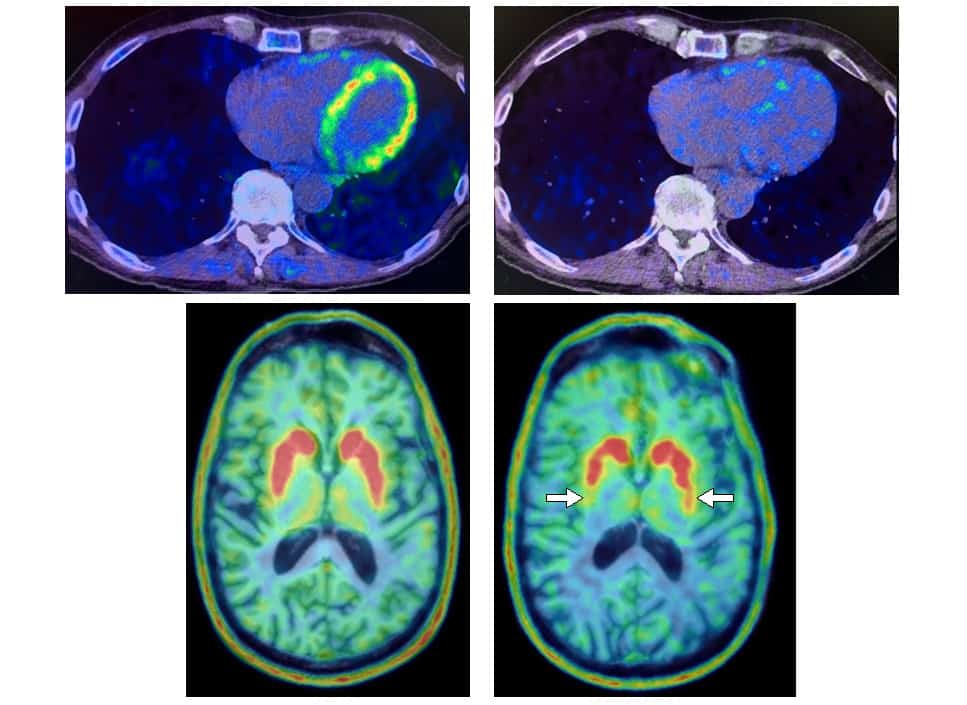
Early detection Heart and brain PET scans from a study participant who developed Parkinson’s disease support a “body first” progression. The top scans show low 18F-dopamine-derived radioactivity in the heart (right) and a normal 13N-ammonia PET scan (left), which preceded a loss of dopamine-producing neurons and symptom onset. (Courtesy: David S Goldstein lab/NINDS)
Researchers have been trying to answer questions about Parkinson’s disease and Lewy body dementia – including where these neurodegenerative diseases start – for decades.
But research by Goldstein and others has contributed to a “body first” hypothesis. That earlier work demonstrated, in part, that people with Lewy body diseases have depleted cardiac norepinephrine, which is normally released by nerves supplying the heart. (Norepinephrine is derived from dopamine, a neurotransmitter with low levels in the brains of people with Parkinson’s disease.)
The latest research by Goldstein and his team, now published in the Journal of Clinical Investigation, suggests that 18F-dopamine PET scans of the heart could be used to identify at-risk people who will go on to develop Parkinson’s disease or Lewy body dementia.
PDRisk Study
Based on their research from the late 1990s, which demonstrated that 18F-dopamine PET scans could separate three autonomic synuclein disorders (brain diseases characterized by abnormal deposits of the protein α-synuclein that form clumps called Lewy bodies), the researchers hypothesized that people who have multiple risk factors for Parkinson’s and who have a loss of sympathetic nerves in the heart will go on to develop symptomatic disease. They tested their hypothesis through the PDRisk Study, a prospective, observational research study that ran for nearly 15 years before it ended in 2023.
In the PDRisk Study, 34 participants at risk for Parkinson’s had cardiac 18F-dopamine PET scans every 18 months for up to 7.5 years, or until they were diagnosed with the disease. Participants had three or more Parkinson’s risk factors (family history of the disease, loss of sense of smell, dream enactment behaviour, and/or symptoms of orthostatic intolerance). Imaging protocols included 18F-dopamine PET and 13N-ammonia PET scans of the heart, plus 18F-DOPA scans of the brain (the 13N-ammonia scans ruled out diagnoses of other conditions that might contribute to loss of sympathetic nerves in the heart).
The researchers found that at-risk individuals with low 18F-dopamine-derived radioactivity in the heart were more likely to develop Parkinson’s or Lewy body dementia during follow-up, compared with individuals having the same risk factors but with normal radioactivity PET scans. Of the nine participants with low cardiac 18F-dopamine-derived radioactivity at their first PET scan, eight were later diagnosed with Parkinson’s or Lewy body dementia. Only one of 11 participants with normal initial radioactivity developed a central Lewy body disease.
‘Rolls Royce’ of cardiac sympathetic imaging
Once injected, 18F-dopamine is quickly taken up by sympathetic nerves and then stored in vesicles. Levels of “normal” and “low” 18F-dopamine-derived radioactivity in the PDRisk Study were determined from a 2011 Journal of Clinical Investigation paper that summarized 18F-dopamine radioactivity data from different relevant participant groups and were confirmed using three years of follow-up data from the PDRisk Study.
“The vesicular storage process is very energy-requiring. If you have a storage deficit – a ‘sick but not dead phenomenon’ where the nerves are there, but they’re sick – the slope of decline in radioactivity is much faster than usual,” explains Goldstein. “If there’s an energy crisis, or the vesicular uptake process is deficient, 18F-dopamine is shunted towards 18F-DOPAC, and radioactivity would come out. The slope of decline in radioactivity would be steep.”
Evidence of this was observed in the PDRisk Study, Goldstein says.
“Most studies about treating Parkinson’s have been about trying to slow the neurodegenerative process…but they have started with people who are symptomatic. And that means you’re working at a severe disadvantage, because most of the neurodegeneration has already happened,” says Goldstein. “I’m not interested in treating or slowing the progression of symptomatic disease. I’m interested in preventing or delaying the onset of symptomatic disease. I think we have a way now to predict who, at least in people who have multiple risk factors, are going to develop a symptomatic central Lewy body disease during follow-up.”
“I do want to spread the word about 18F-dopamine PET scanning. It’s the Rolls Royce of cardiac sympathetic imaging. Other institutions in the United States don’t offer 18F-dopamine scans because insurance doesn’t cover it because it’s research. It’s research because other institutions don’t offer it. It’s a Catch-22 that I haven’t been able to solve yet,” Goldstein says.
As quantum technology improves, researchers are able to connect increasing numbers of components to create nascent quantum computers. An important challenge is knowing what components and configurations have the most potential for creating useful systems. Now, Leopoldo Sarra and Florian Marquardt have shown how machine learning can be used to implement the deep Bayesian experimental design of large-scale quantum networks.
Marquardt is based at the Max Planck Institute for the Science of Light in Germany, where the research was done. Sarra has since moved to the Flatiron Institute in the US, from where he spoke to Physics World about the research.
What is deep Bayesian experimental design?
Experimental design is the branch of science that deals with the selection of experiments to be performed to characterize a physical system or phenomenon. When designing a new experiment, scientists must consider the hypotheses they want to test or falsify, and prioritize those that are likely to be more useful. There are often very complicated dependencies between the physical quantities of interest and the accessible quantities scientists can observe. The implications of an experimental result are usually not obvious.
Bayesian experimental design is a technique for automatically identifying the most useful experiments that will allow us to understand as much as possible about a physical system. In particular, starting from some initial knowledge or expectation about a system, it builds a statistical model that quantifies the uncertainties in our knowledge and how they change when a given experiment is performed. Thus, it quantifies the utility of an experiment and, therefore, finding the most useful one.
However, this technique is known to be computationally very expensive. Traditionally, very rough approximations (or even just heuristics) were needed to make it feasible. With the recent development of artificial intelligence techniques such as neural networks (also called “deep learning”, hence the word “deep”), it is now possible to make much better approximations of the Bayesian technique, leading to more efficient and accurate results.
What are the main challenges facing people who are designing quantum technology platforms?
Present-day quantum devices are extremely challenging to build and operate. They are strongly affected by interference and environmental noise, which can undermine their reliability and the ability to build large devices by connecting many of them together. In particular, despite manufacturing efforts to produce identical devices, each component will always be slightly different due to fabrication imperfections, and thus will have a slightly different behaviour than expected. In addition, a component’s behaviour may also be affected by environmental conditions (such as temperature fluctuations, ambient noise, etc.). Therefore, the ability to understand the actual operating regime of a device and to properly account for and correct these deviations from the expected behaviour becomes crucial.
How can deep Bayesian experimental design help solve these problems?
Since it is simply not possible to manually characterize each quantum device each time before use, automated techniques must be employed. Bayesian experimental design provides a way to characterize a quantum system with a minimum number of measurements. It can be used to compare different approaches and understand the most efficient ones. While manually-designed strategies can provide a solution, we expect Bayesian techniques to be much more efficient, providing faster and more accurate results. Their advantage is twofold: first, they tell you how to incorporate the result of a new experiment into previous knowledge; second, they tell you which experiment to run next. Any inefficiency in either step would result in longer characterization times or lower accuracy.
What you have done in your paper “Deep Bayesian experimental design for quantum many-body systems”?
In this work, we took from some of the state-of-the-art techniques in artificial intelligence that deal with the estimation of the quantities necessary to use the Bayesian framework, and we investigated their possible application to quantum systems. The goal was to understand how useful they can be for characterizing a quantum device, how efficient they would be, and what technical challenges need to be overcome for future practical applications. We considered some of the most common platforms (coupled cavities and qubit arrays) and explored the application of these techniques to find their operating parameters. We compared the efficiency with some more naïve characterization strategies, such as performing random measurements or uniform measurements in a parameter range. We also studied the effect of different design choices as well as the impact of noise in the predictions.
What did you find and how could it further the development of quantum technologies?
Deep Bayesian experimental design provides a way to update the knowledge of the system’s parameters and their uncertainty after each measurement in situations where the relationship between the measurement result and the parameter update is not trivial. While standard techniques typically find only a single outcome that is most likely to describe the system, a deep technique approximates the entire distribution. As a result, it can reveal the limits of a given characterization strategy. If the uncertainty of a parameter does not decrease after many measurements, it typically means that the measurement setup does not allow unambiguous determination of that parameter.
By looking at the selected measurements, we see that “effective strategies” emerge that combine the exploration of different measurement settings (where the most relevant measurement configurations are identified) and the exploitation of the identified settings to reduce the uncertainty.
Furthermore, we have shown the advantages of an active characterization strategy, in which each experiment (next measurement) is chosen to maximize utility, compared to other simpler measurement strategies. For efficient characterization of a quantum device, which may depend on many different parameters and be affected by various sources of noise, performing random measurements that do not take into account previous results is clearly suboptimal.
Future developments of this technique will lead to much more reliable quantum devices.
It sounds like you will be following up this work with further research
With this work, we have shown that deep Bayesian experimental design provides concrete advantages in the characterization of quantum systems compared to simpler techniques. The next steps would be the technical improvement of the presented method to allow fast applications on real quantum devices and the possibility to scale up to larger systems. While currently the algorithm has to be re-run after each measurement, one possibility would be to first learn an entire measurement suggestion strategy through many simulations, and then use this faster predictor for use with the real device.
More generally, the ability to have a model of a physical phenomenon, to assess its uncertainty, and to understand which experiments are most useful to improve it is the basis of the scientific method. While currently we simply model the quantum system with some unknown parameters, and different experiments simply correspond to different measurement settings, we can envision a future algorithm that acts as a kind of “artificial scientist”, capable of exploring a physical phenomenon on its own. The study of Bayesian experimental design in quantum techniques will also lead to advances in this longer-term vision.
During the last two decades of the 20th century, atomic physicists repeatedly broke the record for the coldest temperature in the universe. These achievements rested on a handful of advances, including laser cooling (as described in part 1 of this history), the magneto-optical trap and techniques such as Sisyphus cooling that worked better than expected (as described in part 2). By 1990, physicists were routinely cooling tens of millions of atoms to temperatures a few tens of microkelvin above absolute zero – a thousand times colder than conventional cryogenics and a fraction of the “Doppler cooling limit” predicted for laser-cooling simple atoms.
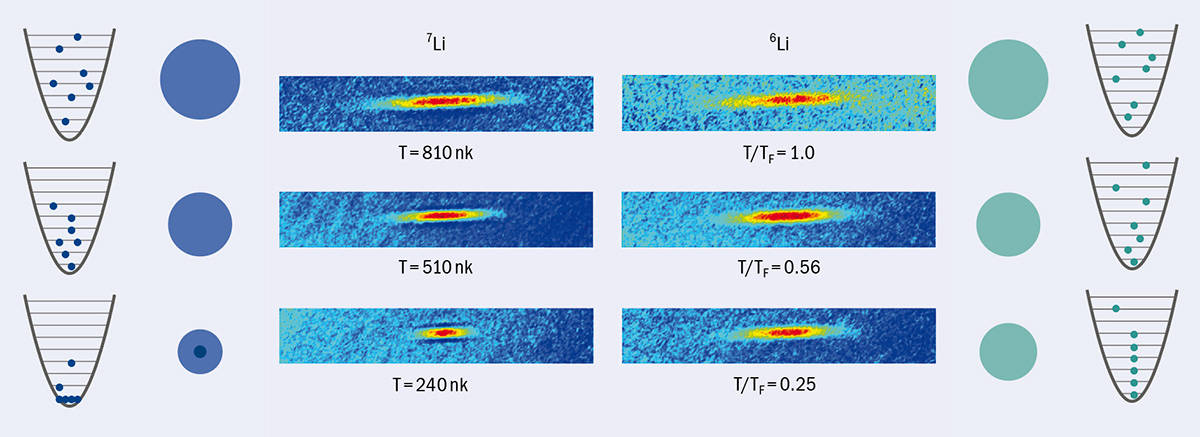
As dramatic as this plunge was, though, an even more challenging drop in temperature beckoned: a further factor of 1000, from microkelvin to nanokelvin. This additional drop would introduce a new realm of physics known as quantum degeneracy. Here, low temperatures and high densities force atoms into one of two exotic states of matter: either a Bose–Einstein condensate (BEC), in which all of the atoms in a gas coalesce into the same quantum state, or a degenerate Fermi gas (DFG), in which the total energy of the gas stops decreasing because all the available energy states are full (figure 1).
BECs and DFGs are purely quantum phenomena, and an atom’s total spin dictates which of them will form. If the atom has an even number of electrons, protons and neutrons, it’s a boson and can undergo BEC. If the total is odd, it’s a fermion and can make a DFG. Different isotopes of the same element sometimes behave in opposite ways – physicists have made BECs of lithium-7 and DFGs with lithium-6 – and this difference in low-temperature behaviour is one of the most dramatic demonstrations of the fundamental division between quantum particles.
1 Quantum statistics in action
(Courtesy: Chad Orzel/IOP Publishing; Randy Hulet, Rice University)
At high temperatures, both bosons (blue dots) and fermions (green dots) are distributed across a wide range of the available energy states. When released from a trap, they expand outward to form a spherical cloud with a width that reflects their temperature. As the atoms are cooled, they shift to lower energy states and the size of the cloud decreases. However, whereas bosons can have multiple atoms in the same state, fermions can have only a single atom in each state. Below some critical temperature, this fact leads nearly all the bosons to collect in a single energy state, forming a Bose–Einstein condensate, which shows up as a small and very dense clump in the centre of the cloud. In a degenerate Fermi gas, on the other hand, all the low-energy states are filled, so the cloud cannot shrink further. The experimental images in the centre of this diagram show clouds of bosonic (left) and fermionic (right) lithium atoms behaving differently as they are cooled. Here, TF is the Fermi temperature, which marks the onset of quantum degeneracy in fermions.
As with previous breakthroughs described in this series, the dive to quantum degeneracy came about thanks to new technologies introduced in research labs scattered around the world. And – again as with the earlier advances – one of these technologies arrived entirely by chance.
Laser cooling on the cheap
In the mid-1980s, Carl Wieman was studying parity violation in caesium atoms at the University of Colorado, Boulder, in the US. These studies require time-consuming and exacting spectroscopy measurements, and Wieman’s PhD student Rich Watts developed a way to do them using diode lasers like the ones being manufactured by the million for CD players.
After spending years figuring out how to stabilize and control these cheap, solid-state devices, Watts (quite reasonably) wanted to finish his PhD, so he and Wieman looked around for a shorter-term experiment to test them. The answer they hit upon was laser cooling. “It was this fun little side thing to finish off this student’s thesis,” recalls Wieman, “and that’s completely how I got into [laser cooling].”
In 1986 Watts and Wieman became the first to laser cool a beam of caesium atoms. Watts was also the first to laser cool rubidium, as a postdoc with Hal Metcalf at Stony Brook University in New York, and he participated in the seminal experiments that revealed sub-Doppler cooling in Bill Phillips’ lab at the US National Institute of Standards and Technology (NIST) in Gaithersburg, Maryland. However, like another key player we will meet in this history, Watts left the stage too soon, dying aged just 39 in 1996.
Wieman, meanwhile, needed a new scientific target, something that could only be done with cold atoms. He, along with new colleagues and competitors, found it in a very old idea with an impeccable scientific pedigree: Bose–Einstein condensation.
A race to the bottom
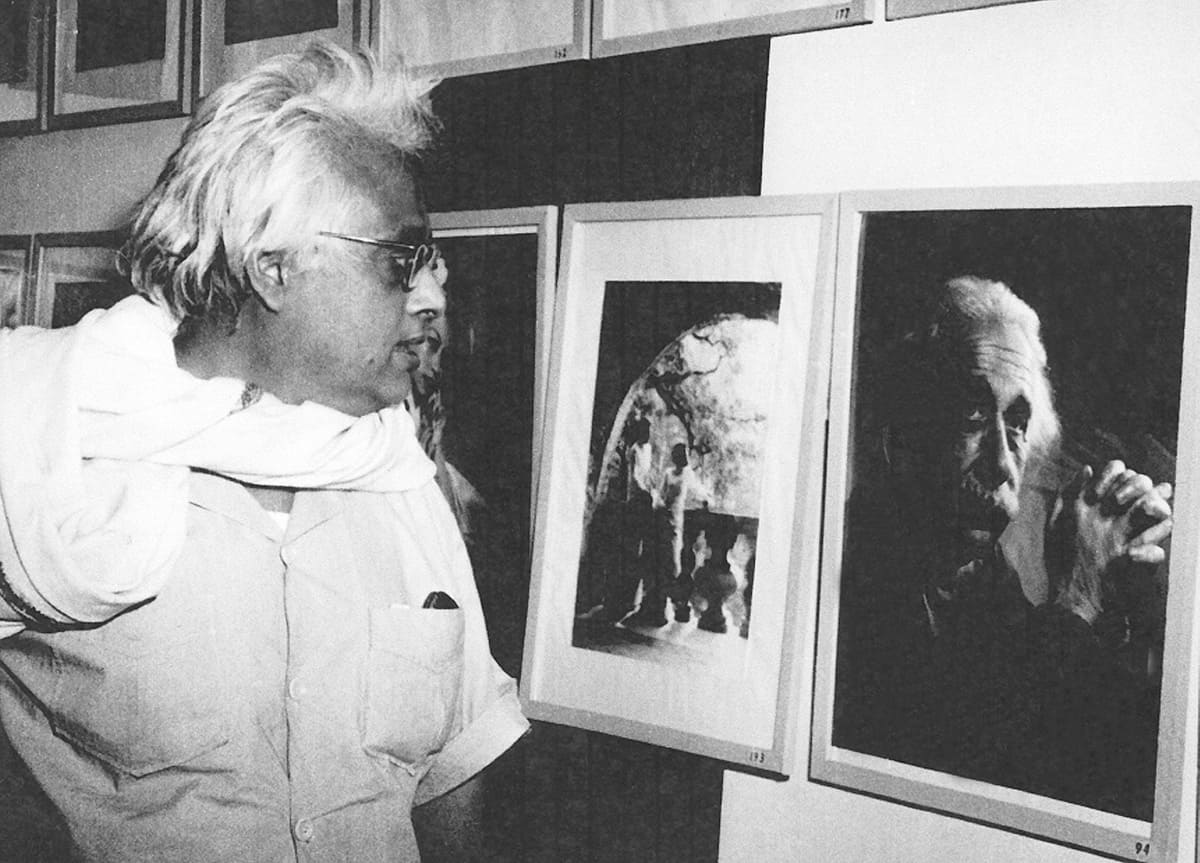
In 1924 Satyendra Nath Bose was a physicist at the University of Dhaka in what is now Bangladesh. While teaching the new and rapidly developing field of quantum physics, he realized that Max Planck’s formula for the spectrum of light from a hot object could be derived from the statistical rules governing the behaviour of photons, which are far more likely than classical particles to be found in the same states.
How it all began When Satyendra Nath Bose’s derivation of Planck’s law was rejected for publication in 1924, he sent a letter directly to Albert Einstein asking for his help. Einstein immediately realized the importance of what Bose had done and arranged for it to be published in Zeitschrift für Physik. (Courtesy: AIP Emilio Segrè Visual Archives, Gift of Kameshwar Wali and Etienne Eisenmann)
Bose had trouble getting his work published, so he sent a copy to Albert Einstein, who loved it so much he arranged for it to be published in Zeitschrift für Physik alongside a paper of his own. Einstein’s contributions included extending photon statistics to other types of particles (including atoms) and pointing out an interesting consequence: at very low temperatures, the most likely state of the system is for all the particles to occupy the same energy state.
This collective state is now called a BEC and is closely related to superfluidity and superconductivity, which are observed in liquids and solids (respectively) at temperatures near absolute zero. The BEC transition itself, though, could in principle occur in a dilute gas of atoms – just like the ones atomic physicists began creating in the 1970s.
There were a few barriers, though. One is that the critical temperature at which a BEC forms is determined by density: the lower the density, the lower the critical temperature. Although Sisyphus cooling made microkelvin temperatures possible, laser-cooled atomic vapours are so diffuse that their transition temperature is even lower, in the nanokelvin range. It is also lower than the “recoil temperature” associated with atoms absorbing or emitting a single photon. Cooling below this limit must therefore be done without lasers.
One evaporation at a time
The general solution to these problems came from Daniel Kleppner and colleagues at the Massachusetts Institute of Technology (MIT). It is similar to the mechanism that cools a cup of tea. The water molecules in the tea move at different speeds, and the fastest have enough energy to break free and float away as water vapour. Because these “escapees” carry a greater-than-average amount of energy, the remaining molecules end up colder. Once the energy in their motion is redistributed through collisions between molecules, the system reaches a new equilibrium at a lower temperature (figure 2).
Kleppner’s method is known as evaporative cooling, and it requires two elements: a means of selectively removing the hottest atoms from the trap, and a rate of collisions between atoms that is high enough for the sample to re-equilibrate afterwards. The first element came hand-in-hand with the solution to the photon recoil problem: atoms can be kept “in the dark” by transferring them from a magneto-optical trap (MOT) to a purely magnetic trap like the one Phillips first made in 1983. The higher energy of the “hot” atoms requires a larger magnetic field to confine them, and this large magnetic field produces a Zeeman shift in the atoms’ energy levels. A properly tuned radio-frequency signal can thus flip the “hot” atoms at this high field into an un-trapped state without disturbing the colder ones. The colder atoms left behind are also restricted to a smaller volume, so as the temperature decreases the density increases, bringing the system closer to BEC in two ways.
2 How low can you go
(Courtesy: Chad Orzel/IOP Publishing)
Evaporative cooling works by removing the highest energy atoms (red) from a trapped vapour containing a large number of atoms distributed across the available energy states in the trap. The atoms left behind will undergo collisions that redistribute the total energy among the atoms. Although some of them will gain energy (orange), the average energy (and thus the temperature) will be lower, as indicated by the dashed lines. This process of removing hot atoms and redistributing energy is then repeated, lowering the temperature further.
The collision issue, however, is out of experimentalists’ hands. The relevant rate is described by a single parameter: the so-called scattering length for a pair of colliding atoms in particular states. If this scattering length is moderately large and positive, the evaporation will proceed rapidly and the resulting condensate will be stable. If the scattering length is too small, the evaporation will be very slow. If it is negative, the condensate will be unstable.
The obvious solution is to pick an atom with the right scattering length, but this parameter turns out to be exceedingly difficult to calculate from first principles. It needs to be determined empirically, and in the early 1990s no-one had done the necessary experiments. Consequently, the groups that began pursuing BEC chose different elements from the periodic table, each hoping that “theirs” might turn out to be “right”. Wieman and his new colleague Eric Cornell even switched from caesium to rubidium because rubidium’s two stable isotopes doubled their chances.
“That’ll never work”
Because a MOT can be turned into a purely magnetic trap simply by switching off the lasers and running more current through the magnet coils, the first steps toward BEC were a straightforward extension of laser-cooling experiments. The resulting “quadrupole trap” configuration has just one major problem: the field in the centre of the trap is zero, and at zero field, atoms can change their internal states to one that is not trapped any more. Plugging this “leak” of atoms from the trap centre requires finding a way to keep the trapped atoms from changing states.
For several years, this was a major area of laser-cooling research. In addition to Cornell and Wieman, one of the main contenders in the intensifying BEC race was Wolfgang Ketterle of MIT. His group developed a way of pushing atoms away from the zero-field region using a blue-detuned laser focused on the centre of the trap as a “plug”. Cornell and Wieman, for their part, used an all-magnetic technique they called a time orbiting potential (TOP) trap.
Atom tamers (top) Eric Cornell and Carl Wieman in their laboratory at JILA shortly after they observed the first BEC. (bottom) Wolfgang Ketterle in his laboratory at MIT in 2001, the year he shared the Nobel Prize for Physics with Cornell and Wieman. (Courtesy: Ken Abbott/University of Colorado at Boulder; Volker Steger/Science Photo Library)
Cornell developed the TOP on a flight back from a conference in early 1994, motivated in part by the need to limit disruption to their apparatus. Though he and Wieman didn’t have room for another laser beam, they could add a small extra coil around an axis perpendicular to the quadrupole coils, and that would shift the zero-field position. Atoms in the trap would move toward the new zero, of course, but not quickly. If they used two small coils on different axes driven by oscillating currents to move the zero in a circle a few hundred times per second, that might be enough to keep it, in Cornell’s words, “everywhere where the atoms aren’t”.
They tested the idea that summer, using a small coil driven by a cheap audio amplifier. At first, the added field made the coils wound around their glass vapour cell rattle alarmingly, and the driven coils made a piercing, high-pitched whine, but the principle was sound, so they built a sturdier version. A few months later, in early 1995, Cornell discussed trap schemes with Ketterle, and came away thinking that the MIT team’s optical plug was “never going to work. It’s basically gonna be a big old swizzle stick pointing in there.” However, he acknowledges that Ketterle may have felt the same about the TOP: “He’s probably thinking ‘That’s the stupidest idea I ever heard in my whole life.’ So we both went away very satisfied from that conversation.”
As it happened, both techniques did, in fact, work. Cornell and Wieman were the first to demonstrate this, performing a series of experiments in which they shone a laser beam through their cold atom cloud. During these “snapshots”, atoms in the cloud would absorb photons from the laser, leaving a shadow in the beam. The depth of this shadow was a measure of the density of the cloud, while the size of the cloud indicated the temperature of the atoms. As the evaporation progressed, the snapshots showed a spherically symmetric cloud of atoms slowly shrinking and cooling as hot atoms were progressively removed.
Then, in June 1995, at a temperature of around 170 nanokelvin, something dramatic happened: a small dark spot appeared at the centre of their images, representing atoms at a drastically lower temperature and higher density. Cornell says it didn’t take long to work out what was going on: “The central density just shoots up. What’s happening there if not Bose–Einstein condensation?”
To confirm their suspicions, he and Wieman converted some of their shadow images into the now-iconic three-dimensional plots (see “The coolest result” image) showing the thermal atoms as a broad pedestal and the BEC as a “spike” emerging in the centre. The shape of the spike – wider in one direction than the other – encoded a clue. Because their TOP trap was stronger in the vertical direction than the horizontal, the condensate was squeezed more tightly in that direction, meaning it expanded more rapidly in that direction after release. While they had not predicted this shape change, they were quickly able to explain it, adding to their confidence that they had reached the “holy grail” of BEC.
Cornell and Wieman announced their results (unusually, for those days) in a press conference in early June 1995. Their paper was published in Science the following month. In September, Ketterle and colleagues produced their own set of 3D plots showing a similar “spike” emerging as their cloud of sodium atoms reached the transition temperature. Cornell, Wieman and Ketterle went on to share the 2001 Nobel Prize for Physics for the achievement of BEC in dilute atomic vapours.
Fermions get their champion
In the early months of 1995, Cornell recruited a new postdoc, Deborah “Debbie” Jin. Her husband John Bohn, a physicist at NIST in Boulder, recalls Cornell saying, “A lot of people will tell you that BEC is still years off, but I really think we’re going to do it.” He was right: the first BEC happened between the time Jin agreed to take the job and when she started work.
Jin came from a different research community – her thesis was on exotic superconductors – but she quickly learned about lasers and optics, and played a key role in early experiments probing the properties of BEC. As a rising star, she had numerous offers of a permanent position, but she elected to stay at JILA, a hybrid institution that combines expertise from the University of Colorado and NIST. There, to distinguish her work from that of Cornell and Wieman, she decided to pursue the other class of ultra-low-temperature behaviour: degenerate Fermi gases.
Where bosons are governed by statistical rules that make it more likely for two of them to be found in the same energy state, fermions are absolutely forbidden from sharing states. Applied to electrons, this is the Pauli exclusion principle that explains much of chemistry: electrons in an atom “fill up” the available energy states, and the exact state of the last electrons determines the chemical properties of a given element. Fermionic atoms in a magnetic trap obey a similar rule: as the gas is cooled, the lowest states fill up. At some point, though, all of the low-energy states are full, and the cloud can’t shrink any further. As with BEC, this is a purely quantum phenomenon, having nothing to do with interactions between the particles, so it should be observable in a gas of ultracold atoms.
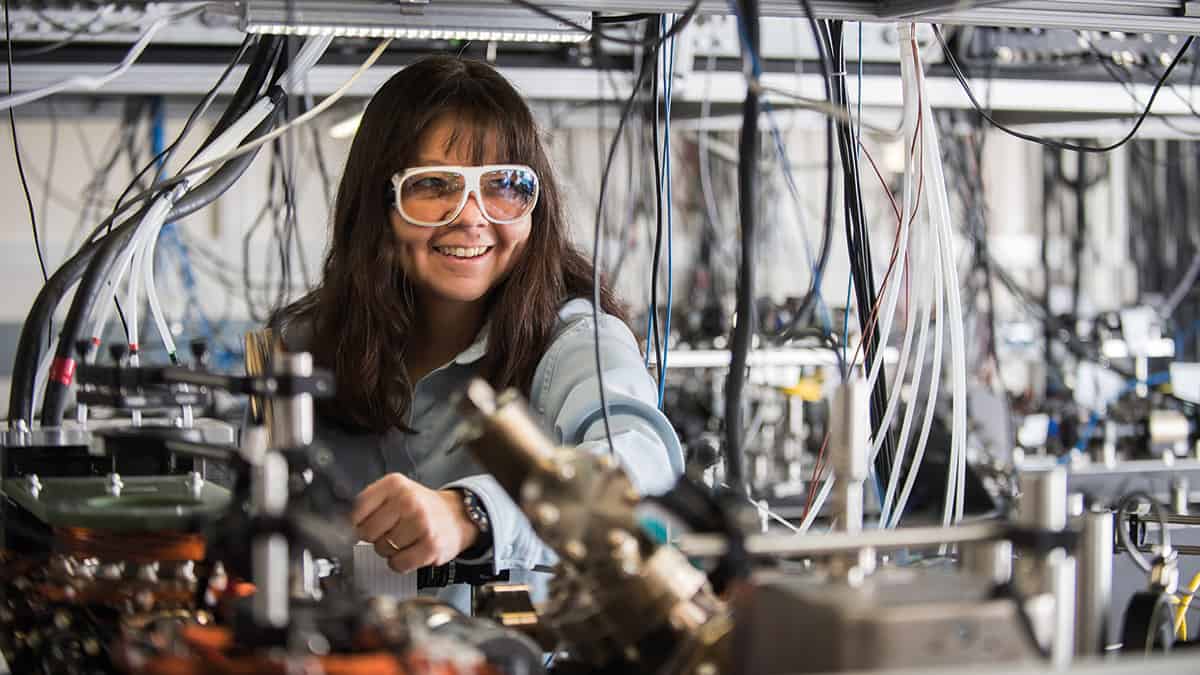
Lasting legacy Debbie Jin in her lab at NIST in Boulder, Colorado, where she pioneered the study of degenerate Fermi gases and ultracold chemistry. (Courtesy: Dave Neligh for NIST)
Jin started at JILA in 1997 with a single graduate student, Brian DeMarco, who had been hired by Cornell but switched to work with Jin on Cornell’s recommendation. As DeMarco recalls, Cornell told him, “If you and Debbie can be the first people to make a DFG, it’ll be a big deal, and there’s a good shot of doing it.”
The pair began with an empty lab, lacking even furniture. Bohn recalls them sitting on the floor in the office he shared with Jin, assembling electronics for their future lasers. Within a year, though, they had a working apparatus for magnetic trapping and evaporatively cooling fermionic potassium atoms.
The quest for a DFG poses two challenges beyond those faced in the BEC race. The first of these is that at ultra-low temperatures, the collisions needed for the re-equilibration step of evaporative cooling stop happening because the prohibition on two fermions being in the same state keeps them from colliding. To solve this, Jin and DeMarco placed half their atoms in a different internal state, providing enough cross-state collisions to enable evaporation. At the end of the process, they could remove one of the two states and image the rest.
The second issue is that while the experimental signature of BEC is a giant density spike in the middle of the atomic cloud, Fermi degeneracy is more subtle. The key phenomenon of atoms refusing to clump together manifests itself undramatically in the form of the cloud ceasing to shrink further once the transition temperature is reached. Working out how to distinguish the degenerate gas from the thermal cloud took careful modelling and an imaging system that could reliably measure tiny changes in the shape of the distribution.
Despite these challenges, a mere 18 months after starting with an empty room, Jin and DeMarco published the first observation of a degenerate Fermi gas. A few years later, teams led by Ketterle, Randy Hulet at Rice University, Christophe Salomon at ENS in Paris, and John Thomas at Duke University, followed.
Beyond prizes, though, Jin’s legacy is substantial. The sub-field she started has grown into one of the most important areas of atomic physics, and her former students and colleagues continue to lead the study of ultracold fermions. In recognition of her commitment to mentoring, the APS created an annual Deborah Jin Award for Outstanding Doctoral Thesis Research in Atomic, Molecular or Optical Physics.
A history of ongoing discovery
This series covers a little more than half a century. During that time, the idea of using lasers to manipulate atoms went from an idle curiosity in the mind of a single Bell Labs physicist to a foundational technique for a vast swathe of cutting-edge physics. Laser-cooled ions are now one of the most important platforms for the development of quantum information science. Laser-cooled neutral atoms provide the basis for the world’s best atomic clocks. And the quantum degenerate systems first observed by Cornell, Wieman, Ketterle and Jin spawned a huge sub-field that connects atomic physics to condensed-matter physics and chemistry. Laser-cooled atoms continue to be vital for physics research, and new history is being written daily in labs around the world.
From the fastest woman to run across the US to the mechanics of dancing peanuts, physics has had its fair share of quirky stories this year. Here is our pick of the best 10, not in any particular order.
I’m a Barbie…role model
This year Barbie created “one-of-a-kind role model dolls” to honour seven female leaders in science, technology, engineering and medicine. They included Susan Wojcicki, chief executive of YouTube, German microbiologist Antje Boetius from the Max Planck Institute for Marine Microbiology, as well as the UK space scientist and science educator Maggie Aderin-Pocock. The Barbie doll inspired by Aderin-Pocock, which won’t be on general sale, has a starry dress reminiscent of the night sky and comes with a telescope accessory for stargazing. Aderin-Pocock, who chancellor of the University of Leicester, says that when she heard the news of a Barbie in her honour she “danced around the living room” with her daughter. “When I was little, Barbie didn’t look like me, so to have one created in my likeness is mind-boggling,” says Aderin-Pocock. “It’s such an honour to receive this doll that is celebrating my achievements.”
Nuclear effects
Many physicists will have enjoyed this year’s Hollywood blockbuster. We’re not talking about Barbie, but the biopic Oppenheimer, directed by Christopher Nolan. In particular, many would have appreciated the film’s visual effects, such as the detonation of the first atomic bomb. Nolan claims however, that no computer-generated imagery (CGI) was used to create these scenes. To check if Nolan is telling the truth, independent filmmaker William Baker and colleagues had a go at recreating the effects without using CGI. With just a few simple ingredients, such as water and pigment powder, they managed to get impressively near to the close-up scene of burning fuel as well as the nuclear explosion itself. “I think we figured out exactly how Nolan’s team did these shots,” Baker concludes.
Shape-shifting robot
In the classic 1991 film Terminator 2: Judgment Day, Arnold Schwarzenegger’s robot assassin, the T-800, comes up against the T-1000 Advanced Prototype, which is made from a liquid metal called “mimetic polyalloy” that can reform into any shape it touches. Researchers in China and the US this year came close to recreating in the lab some of the T-1000’s special abilities. They did this by designing miniature robots that can rapidly and reversibly shift between liquid and solid. First, they embedded magnetic particles in gallium, a soft metal with a low melting point. Then they applied an alternating magnetic field, which not only heats the magnetic particles, making the body become a liquid, but also allows it to become mobile. In one video released by the team, a 10mm-tall LEGO-like minifigure liquifies to ooze before passing through bars in a mocked-up cell. It then cools inside a mould before the figure reforms back into its original shape.
Escape from physics
Would you fancy your chances in a physics-based escape room? Well, now you can try thanks to a new, free-to-play online game. Designed by Dan Cooper, a chemistry teacher from south-west England, Escape the Lab was funded by the Institution of Engineering and Technology. The game is based at the Rutherford Appleton Laboratory in the Oxfordshire, UK, where players navigate the RAL Space centre and tackle a series of challenges, such as calculating the kinetic energy of an Ariane rocket just after launch. Your aim is to reveal a lost password that will enable engineers to launch the latest mission. Along the way, players meet members of staff at the lab and talk about their careers. Cooper says that the game’s challenges are based on the specification of a GCSE physics course but that the main aim of the project is to showcase engineering careers to physics students. “It will hopefully increase interest in physics and engineering,” Cooper says.
One they made earlier: micro model of the Belle II experiment at KEK, Japan made using LEGO blocks. (Courtesy: KIT ETP Belle II team)
Build your own Belle
There have already been LEGO versions of CERN’s Large Hadron Collider, the James Webb Space Telescope and even a Kibble balance and now you can add a “micro” version of the Belle II experiment at the KEK particle-physics lab in Japan. Created by a team led by Torben Ferber at the Karlsruhe Institute of Technology, the model has 75 pieces and apparently takes less than 10 minutes to construct. Despite its tiny size, however, the design still includes details of Belle II’s particle identification system as well as the blue and yellow coloured octagon shape of the detector. In case you get the urge to create a model for your desk, Ferber and colleagues have published a parts list and building instructions.
Lost Lemaître film
Georges Lemaître, who died in 1966, is best known for his pioneering work on the expanding universe and the Big Bang. A professor of physics at Belgium’s Catholic University of Louvain, he was also – rather unusually – a Catholic priest. This year a rare video interview of Lemaître emerged that was recorded two years before his death. The video, which was first broadcast in 1964, is about 20 minutes long. Most of it was thought to be lost, but a mislabelled reel has since been found and has been uploaded to the Internet by the Belgian broadcaster VRT. Speaking in his native French and subtitled in Flemish, Lemaître talks about cosmology as well as religion. Notably, the interview was done before the discovery of the cosmic microwave background – which provided strong observational support for his ideas.
Twist and shake
You may remember the great bottle flipping craze of 2016, which saw people film themselves throwing a partly filled plastic drinks bottle into the air so that it rotates and – with a bit of skill – lands upright. Now here’s a new twist: take a plastic bottle, fill it partially with water, and then set it spinning about its long axis. When you drop the bottle, you’ll find it hardly bounces. Researchers in Chile have now found that the rotation forces water up along the walls of the bottle, which, upon impact, generates a vertical jet in the centre of the liquid that acts as a shock absorber, soaking up much of the kinetic energy. The team also created a theoretical model that agrees with the experimental findings and correctly predicts that the most effective suppression of bouncing occurs with the highest rotation rates – up to 12.7 revolutions per second – and with the bottle about 40% full.
Dancing peanuts
If you drop a peanut into a glass of beer, it will sink to the bottom of the glass. Yet after a few moments the nut will float to the surface of the beer, where it will remain for a few moments before it sinks and the process repeats again. Researchers in Germany have now studied the “beer-dancing peanut” by painstakingly dropping peanuts into a litre of lager. They found that the bubbles from the beer accumulate on the surface of the peanut until it is buoyant and then floats to the surface. When the peanut reaches the surface, its rotation makes the bubbles burst and causes the nut to sink back down. The process repeats itself for a remarkable 150 minutes before the peanut finally comes to rest.
Engineering icons: a small section of the new Tube map. (Courtesy: Transport for London)
Underground icons
Transport for London – which runs the London Underground – partnered with the Royal Academy of Engineering (RAE) to create a Tube-style map depicting famous people in the history of engineering. Created to celebrate National Engineering Day on 1 November, the map showcases 274 engineers, including Hertha Ayrton (in place of the Bond Street tube stop), Alan Turing (Goodge Street) and Alexander Graham Bell (Regent’s Park), while the Nobel-prize-winning physicist and fibre-optics pioneer Charles Kao is in place of Harrow-on-the-Hill. The tube lines have also been rebadged to reflect key areas of engineering such as Life and Health in place of the Central Line, Energy and Power (Hammersmith and City) and Computing, Technology and AI (Northern). “The work of engineers often goes unrecognized,” says RAE chief executive Hayaatun Sillem, who thinks the map will “uncover the stories of ingenuity, teamwork and persistence that have made their mark on the city around us”.
On the run
Physicists often have talents that stretch well beyond academia – and Harvard University’s Jenny Hoffman is no exception. Hoffman, who studies the electronic properties of exotic materials, this year became the fastest woman to run across the US. She took just 47 days, 12 hours and 35 minutes to make the 5000 km journey from San Francisco to New York City. Astonishingly, she beat the previous record time (set by Sara Villines in 2017) by more than a week. This was Hoffman’s second attempt – in 2019 she got just over 4100 km from the California coast before a knee injury brought her to a halt in Ohio. Hoffman told the Harvard Gazette that despite the amount of time she spent alone she didn’t think about physics. “I love my students, and I feel really grateful that I have a great group of creative people who work well as a team, and even while I was gone, they got the science done,” she says.
You can be sure that next year will throw up its fair share of quirky stories from the world of physics. See you next year!
Spheres, globes or orbs: call them what you like, they have always been part of physics even in its early days as “natural science”. The symmetric perfection of a sphere made it the obvious – though wrong – choice for Aristotle’s vision of the cosmos, which saw celestial bodies travel in circular orbits around the Earth carried by nested, rotating crystalline globes.
Later, we learned that because a sphere has the smallest ratio of surface area to volume among standard shapes, a water drop adopts this shape as its lowest energy state. More recently, metrologists have used a polished 1 kg silicon sphere that has had its volume hyper-accurately measured to precisely yield Avogadro’s number.
The properties of curved bodies have also been used to display physics and technology to the public. The 1964 New York World’s Fair featured the Ovoid Theater, a 27 m-high football-shaped venue that housed 500 visitors at a time to view presentations about the future of computers. In 2010 CERN opened its Universe of Particles exhibition in a spherical structure also 27 m tall.
These manifestations of roundness fade away compared to the Sphere, which opened in September 2023 in Las Vegas. With a diameter of 150 m, it is said to be the world’s largest spherical structure. Designed by the architects Populus and funded by a firm specializing in large entertainment venues, it holds more than 17,000 spectators and relies on lots of physical ideas.
The exterior of the Sphere glows with light and colour from 54,000 m2 of programmable light-emitting diodes (LEDs) that display images ranging from fireworks and an undersea scene to adverts of upcoming dome events. Inside, another 15,000 m2 of LEDs form a 270o wrap-around screen. The first custom-made film it showed, Postcard from Earth, tells the story of life on our planet before humanity leaves for distant exoworlds.
Other ways the Sphere depends on physics and mathematics are described on its website. It notes the importance of π for determining the properties of a sphere and shows the maths behind the Sphere’s geodesic structure, made of triangular elements and popularized by the American designer Buckminster Fuller.
The Sphere is a modern realization of an old idea for an 18th-century monument to Isaac Newton
The website tells us of the wave analysis used to project sound from thousands of speakers and of the fluid-dynamics theory behind the wind and atmospheric effects that accompany film showings. Visitors can also learn about the optical analysis needed to display high-resolution images on large curved surfaces.
The Sphere is a modern realization of an old idea for an 18th-century monument to perhaps the greatest physicist of all time – Isaac Newton – whose analytical approach was influential even beyond physics. In 1784, long after Newton’s death, the visionary French architect Etienne-Louis Boullée called him “Sublime spirit! Vast and profound genius! Divine being!” and designed a stupendous structure to honour him.
The design, which Boullée rendered in beautifully shaded drawings, was to be a hollow sphere some 150 m in diameter – by coincidence exactly the same as the Las Vegas Sphere. Embedded in a massive base, it would be circled by rows of huge cypress trees, which represent mourning. Inside, at its base, Boullée envisaged the sphere holding a sarcophagus for Newton.
Fit for a physicist In 1784 Etienne-Louis Boullée designed a cenotaph for Isaac Newton that was a hollow sphere 150 m in diameter embedded in a massive base and circled by rows of cypress trees. It was never built, but the Las Vegas Sphere bears a striking resemblance to Boullée’s plans. (Courtesy: gallica.bnf.fr/Bibliothèque nationale de France)
Visitors would reach the sarcophagus through a tunnel, and from there gaze up at the vast empty volume above. Empty, but not utterly dark. The sphere was to be pierced with openings representing various celestial bodies and through which daylight would pour. At night, according to Boullée’s drawings, a central globular light source some 30 m across would fill the sphere with a brilliant glow.
Boullée’s design was truly only a vision. It could not be built then, nor was there an artificial light source that could fill the imagined structure. Newton, who had been buried at Westminster Abbey in London, remained at his resting place, where his grave – along with a white-and-grey marble monument to him – can still be found.
But Boullée’s construction shares with the Las Vegas Sphere its impressive size and inventive use of light, however generated. By simulating the night sky during the day, Boullée wanted to symbolize Newton’s exploration of the cosmos. In filling the sphere with light in the dark hours, Boullée wished to remind us of Newton’s seminal studies of light.
Will the Las Vegas Sphere ever explicitly celebrate the wonders of nature, science and physics – say, as a kind of planetarium – or honour a scientist? Having cost an eye-watering $2.3bn to build, the Sphere must first reach commercial success. Only then will we perhaps one day see images of Newton and other scientific greats surprisingly but justifiably towering over the colour and action of Las Vegas.
There are many physicists working on materials and every year we look forward to writing about some of the most exciting research in this field. This year was no exception and here are some of our favourite materials stories from 2023.
In an era when new materials are devised using artificial intelligence, I find it comforting that we are also in the midst of a resurgence of interest in wood. It is surely one of the most ancient of materials used by humans and today researchers around the world are developing new ways to use this renewable resource to create exciting materials. Now, Isak Engquist of Linköping University’s Laboratory for Organic Electronics and colleagues in Sweden have built a transistor out of a plank of wood. They did this by incorporating electrically conducting polymers throughout the material in a way that creates space for an ionically conductive electrolyte. Their new fabrication technique makes it possible to use wood as a template for numerous electronic components, but the team admits that wooden transistors would come no-where near the performance of conventional devices. One possible application could be the integration of electronics into living plants – but even if there are few practical uses for a wooden transistor, it is still a neat trick.
Like wood, water is a ubiquitous material with extraordinary properties. Unlike most substances, solid water is less dense than liquid water, making aquatic life possible across vast swathes of the Earth where temperatures regularly fall below 0 °C. Ice is known to come in at least 20 different crystal structures. Now, researchers in China led by Lifen Wang and Xuedong Bai of the Beijing National Laboratory for Condensed Matter Physics and the Songshan Lake Materials Laboratory in Dongguan are the first to confirm the existence of cubic ice, which has a diamond–cubic structure of water molecules. This ice is believed to be responsible for Scheiner’s halo, which is an extremely rare optical effect that creates a ring of light around the Sun at about 28°. This is unlike the usual 22° halo caused by refraction through hexagonal ice crystals. The team created cubic ice on a freeze plate made from monolayer graphene and monitored its formation using cryogenic transmission electron microscopy. Their technique could prove useful for studying how ice of all kinds forms on surfaces.
Happy break-up Illustration showing how antiparallel spin filters are used to split a Cooper pair into a spin-up electron and a spin-down electron. (Courtesy: Department of Physics/University of Basel/Scixel)
One of the triumphs of 20th-century physics is the BCS theory of superconductivity, which was developed in the 1950s to explain why some materials have zero electrical resistance at very low temperatures. The idea is that electrons in these superconductors pair-up to create bosons. These “Cooper pairs” can then condense to form a superfluid-like substance that can flow without resistance. While there is indirect evidence for the existence of Cooper pairs, physicists had yet to measure a negative correlation between the spins of electrons in a pair – which would be direct evidence for a pair’s existence. Now, physicists in Switzerland and Italy led by Arunav Bordoloi at the University of Basel have used two quantum dots to extract Cooper pairs from a tiny piece of superconductor. They then split the pairs and measured their spin polarizations, finding that they usually pointed in opposite directions – just as predicted by BCS theory.
Decades ago when I was at university, fractals were all the rage – in part because of the high quality visualizations created by Benoit Mandelbrot. So, I am always interested when they pop up in research today. In February, Claudio Castelnovo at the University of Cambridge and colleagues in the UK, Germany, the US and Argentina showed that a new type of fractal is lurking in a spin ice. Spin ices are materials with magnetic moments that are frustrated because they cannot settle into a periodic configuration at low temperatures. Instead, the moments become frozen with a degree of disorder similar to that found in water ice. In 2009, physicists argued that excitations in some spin ices behave like magnetic monopoles. Now, Castelnovo and colleagues have shown that these monopoles move in a fractal world of ever branching trajectories, rather than being free to move in 3D. Studying monopoles in spin ices could be important for a host of applications, says team member Jonathan Nilsson Hallén who is based in Cambridge and Dresden. “Spin ices are one of the most accessible instances of topological magnets, and magnetic monopoles in spin ices are one of the best understood examples of fractionalized excitations,” he says.
The white fur of the polar bear provides camouflage in the snowy Arctic landscape. However, you might think that a white coat would do a bad job of warming bears in the sunshine. This is not the case because polar bear fur is designed to channel sunlight to the bear’s dark skin, where it is absorbed efficiently. What is more, the fur is very good at trapping heat radiated by the bear’s skin – essentially creating a greenhouse effect. Now, Trisha Andrew and colleagues at University of Massachusetts Amherst have created a new double-layered fabric inspired by polar bears that absorbs energy from the Sun and indoor lighting and traps it to maintain warmth. When exposed to a light intensity of 130 W/m2 (a dull midwinter day in England) it keeps its wearer just as warm as cotton fabric would – but at temperatures that are 10 °C colder and while weighing 30% less. “Our polar bear fabric could be very useful for managing space heating, which consumes huge amounts of energy, in a more energy-efficient manner, by heating people indoors using ambient lighting instead of room heating,” says Andrew.
Lurking for decades Researchers have discovered Pines’ demon, a collection of electrons in a metal that behaves like a massless wave. It is illustrated here as an artist’s impression. (Courtesy: The Grainger College of Engineering/University of Illinois Urbana-Champaign)
We do love a quasiparticle here at Physics World, so we were delighted that in 2023 physicists detected the “Pines’ demon” at long last. First predicted in 1952 by David Pines and David Bohm, this quasiparticle is a quantized electron-density fluctuation in a plasma. The quasiparticle forms when electrons in different bands of a metal move out of phase with one another such that they keep the overall charge static. In effect, a demon is the collective motion of neutral quasiparticles – and a demon is also massless and unable to interact with light. All of this makes the quasiparticles very difficult to detect. Now, Peter Abbamonte of the University of Illinois Urbana-Champaign (UIUC) in the US, and colleagues have found evidence for the demon using a technique called electron energy loss spectroscopy to identify an excitation associated with Pines’ demon in single crystals of strontium ruthenate.
Humans seem to have a love–hate relationship with concrete. The material’s practicality underpins much of the built environment, yet we decry its sometimes brutal appearance and the vast amounts of carbon dioxide emitted during its production. Now, a team in the US led by MIT’s Franz-Josef Ulm, Admir Masic and Yang-Shao Horn have developed a type of concrete that can be used to create supercapacitors for storing energy. Production begins with a dry mixture of carbon black and cement, to which water and superplasticizers are added. As the material solidifies it creates a fractal-like network of pores that makes the material a conductor with a very large surface area. This is exactly what you want for the electrodes of a capacitor, where the greater the surface area, the greater the capacitance. According to the team, a concrete capacitor the size of a 3.55 m cube would be able to store about 10 kWh of energy. A house built with foundations that contain these capacitors could therefore store a day’s worth of energy – produced by solar panels, for example – and release it when needed. The material could also be used in the base of a wind turbine, where it could store surplus energy until it is needed. The technology could also be used to store renewable energy in infrastructure such as roads and car parks, where the energy could be transferred by induction to vehicles.
Physics World‘s coverage of the Breakthrough of the Year is supported by Reports on Progress in Physics, which offers unparalleled visibility for your ground-breaking research.
It’s been another banner year for quantum science and technology, with academic research groups and tech firms celebrating significant achievements in quantum computing, quantum communications and quantum metrology as well as fundamental quantum science. Three of these advances – a quantum repeater that transmits quantum information over a distance of 50 km; a double-slit experiment in time; and a simulation of an expanding universe in a Bose-Einstein condensate – appeared in our list of the year’s top 10 breakthroughs, but with so many exciting things going on, we can’t resist celebrating a few others. Here, in no particular order, are some highlights.
Joining the hardware dots
Some innovations hit the headlines right away. Others lay the groundwork for future breakthroughs. In May, Johannes Fink and colleagues at the Institute for Science and Technology Austria claimed a place in the second group by demonstrating a protocol for entangling microwave and optical photons. This is important because the superconducting circuits that make up many of today’s most advanced quantum computers operate at microwave frequencies, but the fibres and other equipment used to send information over long distances work at optical frequencies. If we want to build a network of many quantum computers and make them talk to each other, we will therefore need strong, reliably quantum connections between these two frequencies.
Now that Fink and his team have shown that such connections are possible, prospects for quantum networks based on superconducting qubits look rosier, though the protocol still needs refining. As one independent expert observed, “We should not think that this makes everything easy now – it’s just the beginning, but that doesn’t take away from the quality of the experiment.”
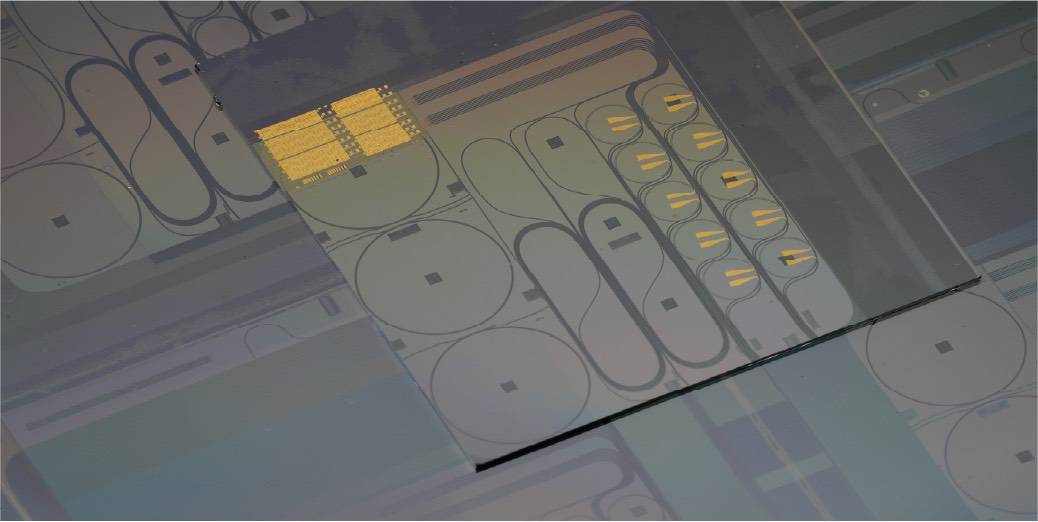
All in one: A photo of the photonic integrated circuit. The chip was fabricated in layers, with the laser on top and the waveguides at the bottom. (Courtesy: Chao Xiang)
A similarly slow-burn advance occurred in August when researchers in John Bowers’ group at the University of California, Santa Barbara, put a laser and a photonic waveguide on the same chip for the first time. Integrated photonic systems like these will be crucial to scaling up quantum computers based on trapped ions or atoms, but lasers and waveguides haven’t always played well together. Specifically, when light from a laser enters a waveguide, some of it gets reflected, and if this reflected light gets back to the laser, the laser’s output becomes unstable. By designing a chip that avoids these unwanted interactions, Bowers and colleagues made the job of future quantum hardware designers much easier.
Milestones in quantum metrology
In the year the first commercial optical atomic clock went on sale, quantum metrologists also notched up an achievement at the other end of the technology readiness scale. Just as optical clocks are more precise than their microwave-frequency predecessors, clocks that “tick” every time an atom’s nucleus undergoes an energy transition would be more precise still. They might even be precise enough to catch fundamental constants in the act of fluctuating on very short time scales, which would violate the Standard Model of particle physics.
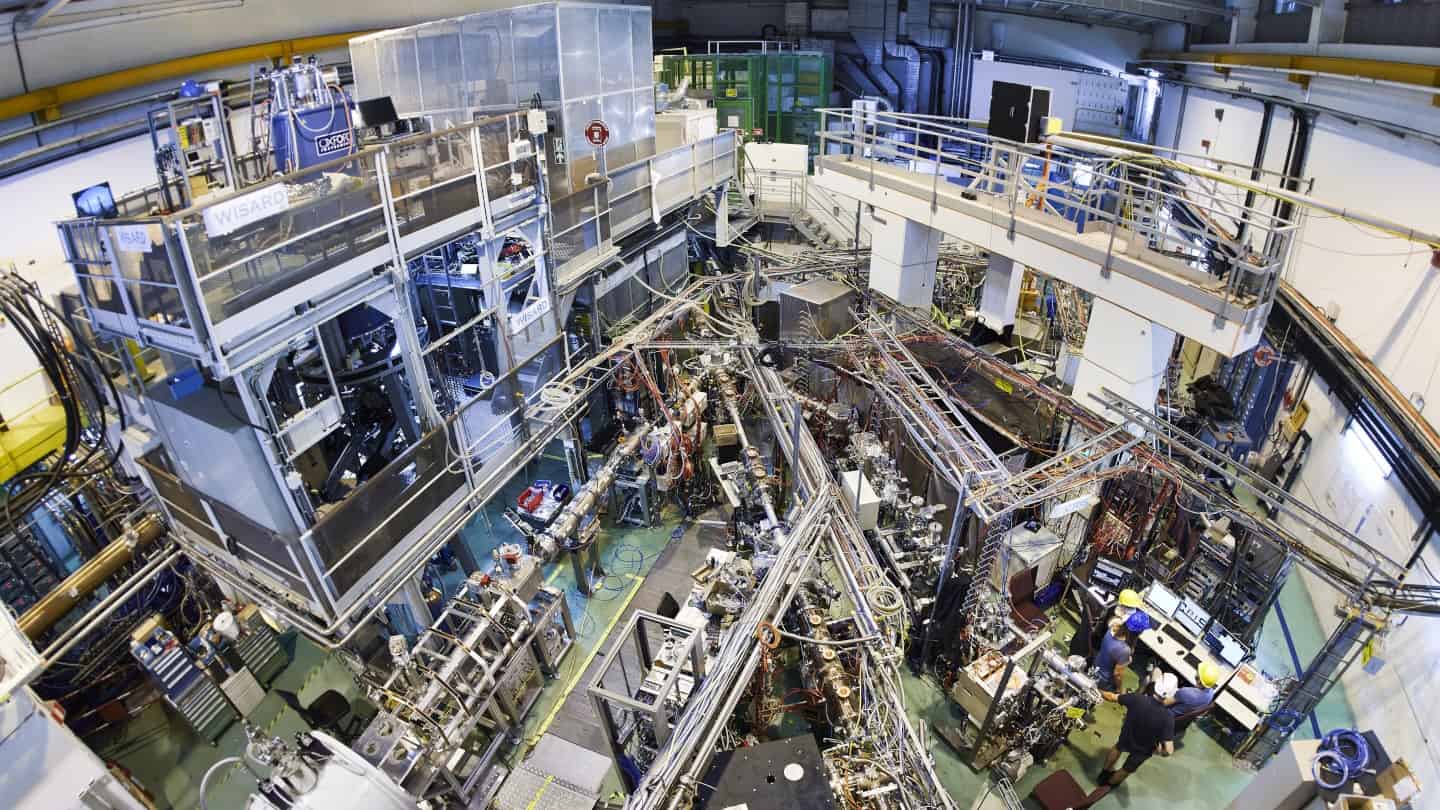
Nuclide beamline: ISOLDE at CERN as seen from above (Courtesy: CERN)
The problem is that no-one knows the frequencies of these nuclear transitions well enough to drive them with a laser. In June, though, physicists at CERN got closer to finding out when they detected a photon emitted by a thorium-229 ion as it returned to its nuclear ground state. Though much work remains to be done, the result is nonetheless a step towards the next generation of ultra-precise timekeeping.
Meanwhile, physicists at the University of Colorado, Boulder, US, put down a marker in their quest to measure the electron electric dipole moment (eEDM) to ever-greater precision. A non-zero value of this quantity would violate the Standard Model, and in August, a team led by Jun Ye and Eric Cornell announced that the eEDM must be less than 4.1 x 10⁻³⁰ e cm, with an uncertainty of 2.1×10⁻³⁰ – a precision equivalent to measuring the Earth to within the dimensions of a virus.
The emergence of effective quantum error correction
Odd atom out: By finding a way to identify atoms in the “wrong” state and erase them from the system, researchers at Princeton, Yale and Caltech showed how to make quantum operations more efficient in neutral-atom machines. (Courtesy: Caltech/Lance Hayashida)
Errors are the bane of quantum computers, and demonstrating ways to correct them is a major goal of quantum computing research. In 2023, these efforts started to pay off. In February, researchers at Google Quantum AI announced that they had suppressed errors in their superconducting-qubit device by implementing a surface code. This type of quantum error-correcting code encodes a logical (that is, error-corrected) qubit in the joint entangled state of many physical qubits. The following month, a team at Yale University in the US demonstrated a different approach to the same problem, using a qubit encoding called a GKP code to suppress errors with the help of additional information embedded in superconducting transmon qubits.
Arguably the year’s most impressive error-correction result, however, came just a few weeks ago, when Mikhail Lukin and colleagues at Harvard University, QuEra Computing, the Massachusetts Institute of Technology and the NIST/University of Maryland Joint Center for Quantum Information and Computer Science reported that they had created an array of 48 logical qubits using neutral atoms.
Even before this announcement, 2023 was looking like a breakout year for neutral-atom quantum computers, which are having a moment after a long period of trailing behind devices that use superconducting circuits or trapped ions as qubits. Will 2024 be the year they leap ahead? Or will their rivals find new advantages to exploit? Watch this space!
The best of the rest
Finally, a few of 2023’s quantum achievements stand out for their sheer ingenuity. This year saw the first observation of quantum superchemistry, which occurs when chemical reactions speed up because the reacting molecules are all in the same quantum state. It also marked the first time anyone had spotted quantum entanglement in top quarks, which have a lifetime of just 10-25 seconds. The most ingenious quantum result of the year, though, is surely the demonstration of an engine that runs on the energy difference between bosons and fermions. As an example of the links between classical and quantum physics, it could hardly be better.
Physics World‘s coverage of the Breakthrough of the Year is supported by Reports on Progress in Physics, which offers unparalleled visibility for your ground-breaking research.
This year, the Physics World team selected a medical innovation as the Breakthrough of the Year: the development of a digital bridge that restores communication between the brain and spinal cord, enabling a man with paralysis to stand and walk naturally. We also reported on several other neural engineering advances, including a neuroprosthesis that restores communication to those who cannot speak and an award-winning implant that could help regulate blood pressure in people with spinal-cord injuries.
And that’s just one example of the impact of physics-related research on the healthcare sector. In 2023, we wrote about a host of medical physics and biotechnology advances, from photon-counting detectors that produce high-quality images with less contrast media to hydrogels that help grow new brain tissue to shoot-through FLASH proton therapy. Here are a few more highlights that caught our eye.
Novel takes on nuclear medicine
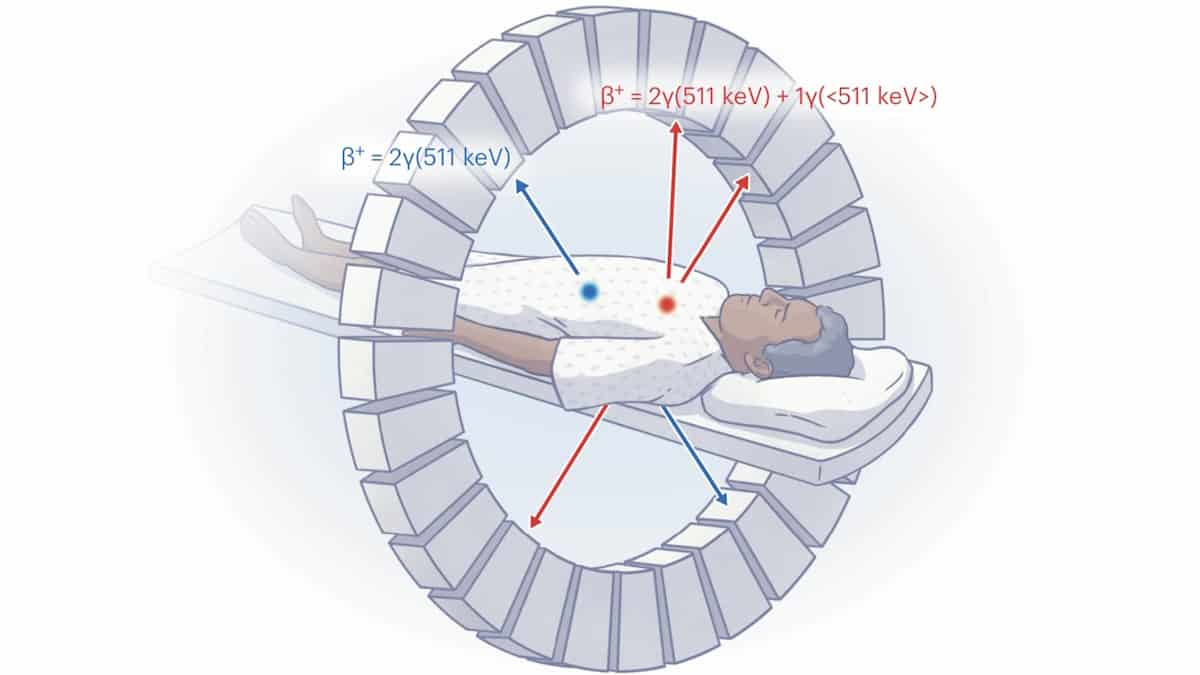
Among the many developments in positron emission tomography (PET) technology announced this year, a research team headed up at Memorial Sloan Kettering Cancer Center and Complutense University of Madrid devised a novel image reconstruction method that enables in vivo imaging of two different PET tracers simultaneously. This “multiplexed PET” technique, which increases the amount of information attainable during a single scan, can be implemented on preclinical or clinical PET systems without having to modify the hardware or image acquisition software.
Dual isotope imaging Overview of multiplexed PET using a pure positron emitter and a positron–gamma emitting radionuclide. (Courtesy: E C Pratt et al Nat. Biomed. Eng 10.1038/s41551-023-01060-y)
Aiming to meet the ever-increasing clinical demand for PET scans, researchers at Ghent University in Belgium are developing a walk-through total-body PET scanner. Their proposed upright imaging system, which looks a bit like an airport security scanner, is expected to be both cheaper and quicker to use than standard PET instruments.
And researchers at UC Davis used total-body PET to perform first-in-human immunoPET imaging of T cell biodistribution in three healthy individuals and five patients recovering from COVID-19. Quantification of immune cell distribution and kinetics in humans can shed light on how the immune system responds to viral infections, and help researchers develop new vaccines and improved treatments.
Radiotherapy for the future
The introduction of MR-guided radiotherapy, which uses MRI to visualize tumours and surrounding organs with high accuracy while the patient is on the treatment table, enables clinical advances such as real-time plan modification and imaging of moving tumours during treatment delivery. But integrated MR-linac systems hold potential to do a lot more.
Researchers at the University Hospital of Zurich investigated an approach called adaptive fractionation, which exploits inter-fraction motion (rather than simply compensating for it) by adjusting the prescribed dose according to the distance between the tumour and organs-at-risk (OAR) on each day. In other words, a patient is prescribed a higher radiation dose on days when their tumour–OAR separation is large and a lower dose on days when this separation is small.
Elsewhere, a team at the University of Toronto’s Sunnybrook Health Sciences Centre studied the use of diffusion-weighted imaging (DWI) on an MR-linac to improve treatment of the aggressive brain cancer glioblastoma. The idea here is to use DWI to identify regions of treatment-resistant tumour and deliver higher doses to these targets.
Upright radiotherapy Leo Cancer Care’s patient positioning system is installed at Centre Léon Bérard in Lyon, France. (Courtesy: Leo Cancer Care)
Another technology to keep a close eye on is the introduction of upright radiotherapy, pioneered by Leo Cancer Care. Back in January we reported on a patient positioning system that allows cancer patients to receive radiotherapy whilst sitting upright – in contrast to having to lie on their back – a position that should reduce organ movement during treatment and may also be more comfortable for the patient. Since then, several studies have confirmed the benefits of this upright approach for various tumour types, orders have been placed, and the positioning system is now pending 510(k) regulatory clearance for clinical use in the USA.
Wearable wonders
Each year we see the emergence of ingenious wearable devices for countless new healthcare monitoring and diagnostic applications; and 2023 was no exception.
Mobile cardiac monitor Sarnab Bhattcharya, Nanshu Lu and colleagues are developing a chest e-tattoo that could detect early signs of heart disease. (Courtesy: The University of Texas at Austin)
For starters, a team headed up at The University of Texas at Austin created an ultrathin, stretchable electronic tattoo that provides continuous cardiac monitoring. Attached to the chest via a medical dressing, the e-tattoo could detect early signs of heart disease outside of the clinic. Meanwhile, a wearable ultrasound transducer developed at the University of California San Diego could be used to monitor patients with serious cardiovascular conditions, as well as to help athletes keep track of their training.
Other novel wearables reported this year include a ring device that accurately gauges how intensely its wearer is scratching their skin, a miniaturized ultrasound scanner that may provide earlier detection of breast cancer, and earbud biosensors that continuously and simultaneously measure the electrical activity of the brain and levels of lactate in sweat.
Finally, researchers from the Medical University of Vienna designed a prototype MRI coil that can be worn like a sports bra. The so-called BraCoil is a vest-like receive-only coil array made of flexible coil elements that enables 3 T MR imaging of patients in both supine (lying on their back) and prone (lying on their front) positions. Designed to improve comfort, and reduce preparation and acquisition time, the BraCoil also produced an up to three-fold improvement in signal-to-noise ratio compared with standard coils.
Physics World‘s coverage of the Breakthrough of the Year is supported by Reports on Progress in Physics, which offers unparalleled visibility for your ground-breaking research.
Today’s internet distributes classical bits and bytes of information over global, even interstellar, distances. The quantum internet of tomorrow, on the other hand, will enable the remote connection, manipulation and storage of quantum information – through distribution of quantum entanglement using photons – across physically distant quantum nodes within metropolitan, regional and long-haul optical networks. The opportunities are compelling and already coming into view for science, national security and the wider economy.
By exploiting the principles of quantum mechanics – superposition, entanglement and the “no-cloning” theorem, for example – quantum networks will enable all sorts of unique applications that are not possible with classical networking technologies. Think quantum-encrypted communication schemes for government, finance, healthcare and the military; ultrahigh-resolution quantum sensing and metrology for scientific research and medicine; and, ultimately, the implementation of at-scale, cloud-based quantum computing resources linked securely across global networks.
Right now, though, quantum networks are still in their infancy, with the research community, big tech (companies like IBM, Amazon, Google and Microsoft) and a wave of venture-financed start-ups all pursuing diverse R&D pathways towards practical functionality and implementation. A case study in this regard is QUANT-NET, a $12.5m, five-year R&D initiative that’s backed by the US Department of Energy (DOE), under the Advanced Scientific Computing Research programme, with the goal of constructing a proof-of-principle quantum network tested for distributed quantum computing applications.
Out of the lab, into the network
Collectively, the four research partners within the QUANT-NET consortium – Berkeley Lab (Berkeley, CA); University of California Berkeley (UC Berkeley, CA); Caltech (Pasadena, CA); and the University of Innsbruck (Austria) – are seeking to establish a three-node, distributed quantum computing network between two sites (Berkeley Lab and UC Berkeley). In this way, each of the quantum nodes will be linked up via a quantum entanglement communication scheme over pre-installed telecoms fibre, with all the testbed infrastructure managed by a custom-built software stack.
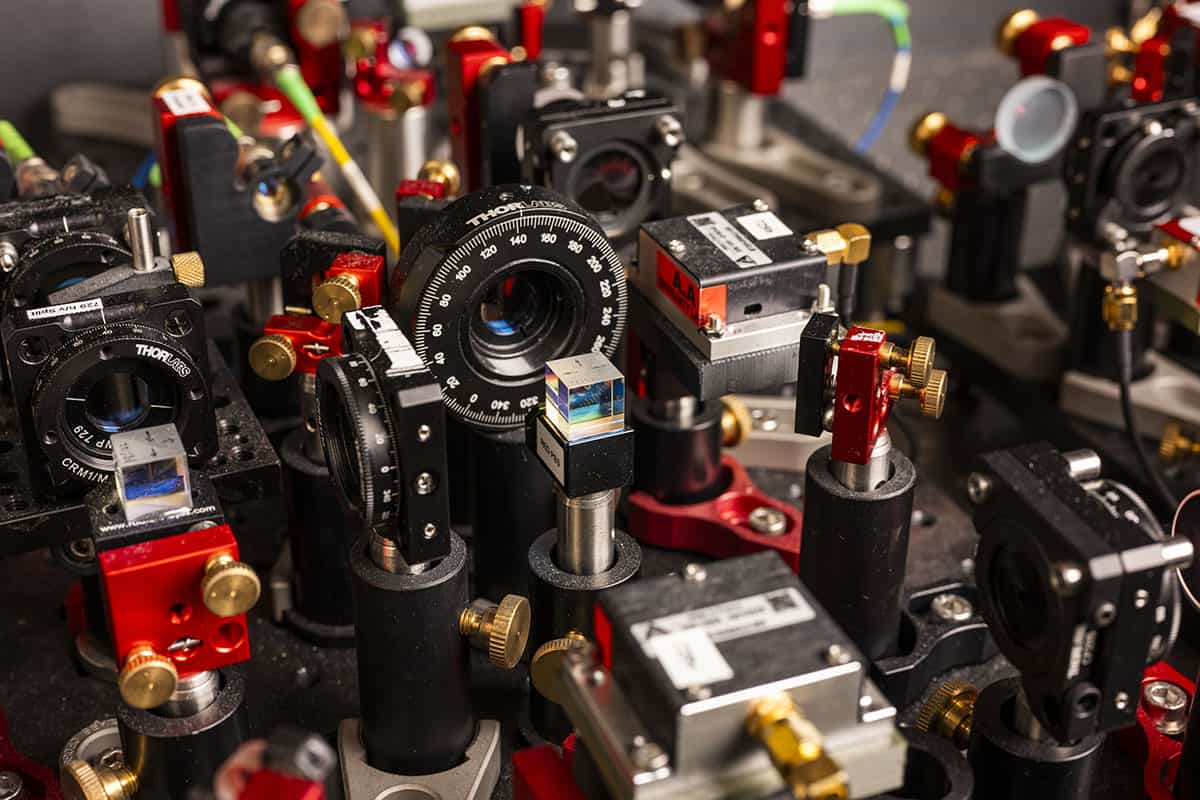
Enabling technologies An optical set-up in the UC Berkeley physics lab designed to switch the amplitude, frequency and phase of laser light used in the QUANT-NET ion-trap quantum processors. (Courtesy: Bart Nagel Photography)
“There are many complex challenges when it comes to scaling up the number of qubits on a single quantum computer,” says Indermohan (Inder) Monga, QUANT-NET principal investigator and director of the scientific networking division at Berkeley Lab and executive director of Energy Sciences Network (ESnet), the DOE’s high-performance network user facility (see “ESnet: networking large-scale science”). “But if a larger computer can be built from a network of multiple smaller computers,” he adds, “could we perhaps fast-track the scaling of quantum computing capability – more qubits working in tandem essentially – by distributing quantum entanglement over a fibre-optic infrastructure? That’s the fundamental question we’re trying to answer within QUANT-NET.”
ESnet: networking large-scale science across the US and beyond
ESnet provides high-bandwidth network connections and services to multidisciplinary scientists across more than 50 research sites of the US Department of Energy (DOE) – including the entire National Laboratory system, its associated supercomputing resources and large-scale facilities – as well as peering with more than 270 research and commercial networks worldwide.
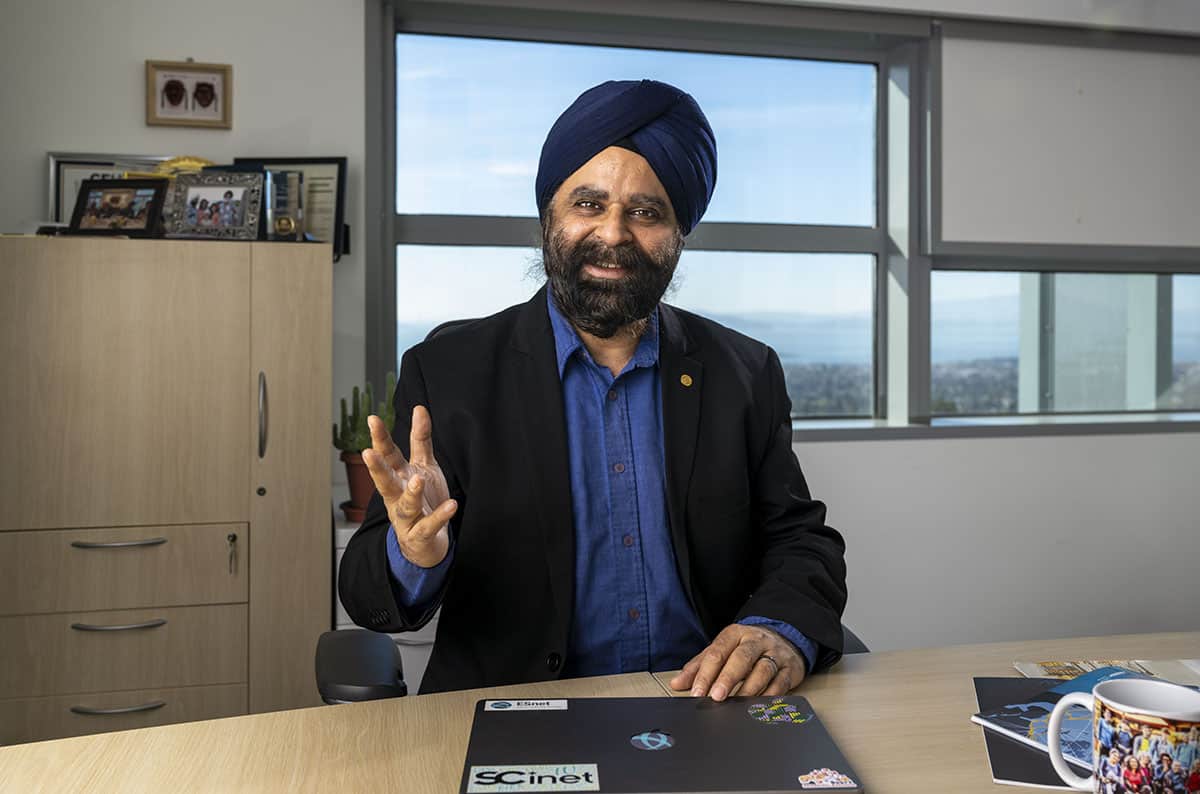
Network effects Inder Monga, QUANT-NET principal investigator and executive director of ESnet. (Courtesy: Bart Nagel Photography)
Funded by the DOE Office of Science, ESnet is a designated DOE User Facility managed and operated by the scientific networking division at Berkeley Lab. “We think of ESnet as the data circulatory system for the DOE,” says Inder Monga, ESnet executive director and head of the QUANT-NET project. “Our teams work closely with both DOE researchers and the international networking community as well as industry to develop open-source software and collaborative technical projects that will accelerate large-scale science.”
The positioning of QUANT-NET within Monga’s remit is no accident, tapping into the accumulated domain knowledge and expertise of the ESnet engineering teams on network architectures, systems and software. “The QUANT-NET goal is a 24/7 quantum network exchanging entanglement and mediated by an automated control plane,” notes Monga. “We are not going to get there in the scope of this limited R&D project, but this is where we’re heading from a vision perspective.”
Another motivation for Monga and colleagues is to take quantum communication technologies “out of the lab” into real-world networking systems that exploit telecoms fibres already deployed in the ground. “Current quantum networking systems are still essentially room-sized or table-top physics experiments, fine-tuned and managed by graduate students,” says Monga.
As such, one of the main tasks for the QUANT-NET team is to demonstrate field-deployable technologies that, over time, will be able to operate 24/7 without operator intervention. “What we want to do is build the software stack to orchestrate and manage all the physical-layer technologies,” Monga adds. “Or at least get some idea of what that software stack should look like in future so as to automate high-rate and high-fidelity entanglement generation, distribution and storage in an efficient, reliable, scalable and cost-effective way.”
Enabling quantum technologies
If the QUANT-NET end-game is to road-test the candidate hardware and software technologies for the quantum internet, it’s instructive from a physics perspective to unpack the core quantum building blocks that make up the testbed’s network nodes – namely, trapped-ion quantum computing processors; quantum frequency-conversion systems; and colour-centre-based, single-photon silicon sources.
With respect to the networking infrastructure, there’s already been significant progress on testbed design and implementation. The QUANT-NET testbed infrastructure is complete, including fibre construction (5 km in extent) between the quantum nodes plus the fitting out of a dedicated quantum networking hub at Berkeley Lab. Initial designs for the quantum network architecture and software stack are also in place.
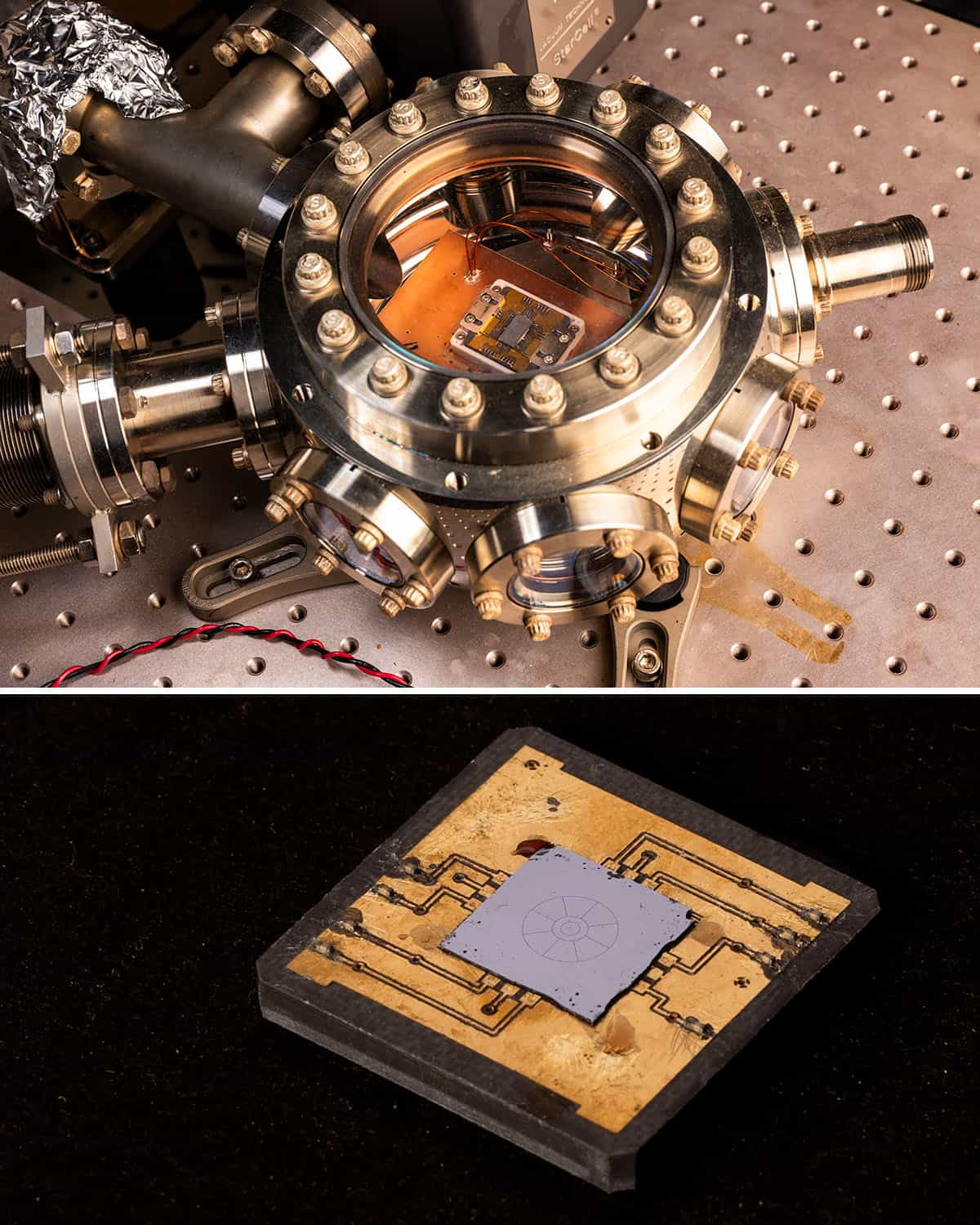
Trapped An ion trap housed within its vacuum system (top), with close-up of a trap mounted to a printed circuit board (bottom). Voltages applied to the trap electrodes confine Ca+ ions about 100–200 microns above the chip surface. (Courtesy: Bart Nagel Photography)
The engine-room of the QUANT-NET project is the trapped-ion quantum computing processor, which relies on the integration of a high-finesse optical cavity with a novel chip-based trap for Ca+ ion qubits. These trapped-ion qubits will connect via a dedicated quantum channel across the network testbed – in turn, creating long-distance entanglement between distributed quantum computing nodes.
“Demonstrating entanglement is key as it provides a link between the remote quantum registers that can be used to teleport quantum information between different processors or to execute conditional logic between them,” says Hartmut Häffner, who is a principal investigator on the QUANT-NET project with Monga, and whose physics lab on the UC Berkeley campus is the other node in the testbed. Equally important, the computing power of a distributed quantum computer scales significantly with the number of qubits that can be interconnected therein.
To entangle two remote ion traps across the network is far from straightforward, however. First, the spin of each ion must be entangled with the polarization of an emitted photon from its respective trap (see “Engineering and exploiting entanglement in the QUANT-NET testbed”). The high-rate, high-fidelity ion–photon entanglement in each case relies on single, near-infrared photons emitted at a wavelength of 854 nm. These photons are converted to the 1550 nm telecoms C-band to minimize fibre-optic losses impacting subsequent photon transmission between the UC Berkeley and Berkeley Lab quantum nodes. Taken together, trapped ions and photons represent a win–win, with the former providing the stationary computing qubits; the latter serving as “flying communication qubits” to link up the distributed quantum nodes.
At a more granular level, the quantum frequency-conversion module exploits established integrated photonic technologies and the so-called “difference frequency process”. In this way, an input 854 nm photon (emitted from a Ca+ ion) is mixed coherently with a strong pump field at 1900 nm in a nonlinear medium, yielding an output telecoms photon at 1550 nm. “Crucially, this technique preserves the quantum states of the input photons while providing high conversion efficiencies and low-noise operation for our planned experiments,” says Häffner.
With entanglement established between two nodes, the QUANT-NET team can then demonstrate the fundamental building block of distributed quantum computing, in which the quantum information in one node controls the logic in the other. In particular, entanglement and classical communication are used to teleport quantum information from the controlling node into the target node, where the process – such as a non-local, controlled NOT quantum logic gate – can then be executed with local operations only.
Engineering and exploiting quantum entanglement in the QUANT-NET testbed
The establishment of ion–ion entanglement between two trapped-ion quantum nodes relies on synchronous preparation of ion–photon entanglement (in the spin and polarization degrees of freedom) within each network node (1). The cycle starts with ion-state initialization, after which a laser pulse triggers emission of a near-infrared photon in the optical cavity of each ion trap. After quantum frequency conversion (2), the resulting telecoms photons (entangled with the respective ions) are sent towards a so-called Bell State Measurement (BSM) node in a bid to create ion–ion entanglement via measurements on the polarization states of the two photons (3). The process repeats (4) until both of the photons are transmitted successfully through their respective fibre and registered jointly at the BSM node, heralding the creation of ion–ion entanglement (5). This entanglement is stored until the quantum network requests to use it as a resource – for instance, to transmit quantum information via teleportation.
Finally, a parallel work package is under way to explore the impact of “heterogeneity” within the quantum network – acknowledging that multiple quantum technologies are likely to be deployed (and therefore interfaced with each other) in the formative stages of the quantum internet. In this regard, solid-state devices relying on silicon colour-centres (lattice defects that generate optical emission at telecoms wavelengths around 1300 nm) benefit from the inherent scalability of silicon nanofabrication techniques, while emitting single photons with a high level of indistinguishability (coherence) required for quantum entanglement.
“As a first step in this direction,” adds Häffner, “we plan to demonstrate quantum-state teleportation from a single photon emitted from a silicon colour-centre to a Ca+ qubit by alleviating the issue of spectral mismatch between these two quantum systems.”
The QUANT-NET roadmap
As QUANT-NET approaches its mid-way point, the goal for Monga, Häffner and colleagues is to characterize the performance of discrete testbed components independently, prior to integration and tuning of these elements into an operational research testbed. “With network system principles in mind, our focus will also be on automating the various elements of a quantum network testbed that typically might be manually tuned or calibrated in a lab environment,” says Monga.
Aligning QUANT-NET R&D priorities with other quantum networking initiatives around the world is also crucial – though differing, and perhaps incompatible, approaches will probably be the norm given the exploratory nature of this collective research endeavour. “We need many flowers to bloom for now,” Monga notes, “so that we can home in on the most promising quantum communication technologies and the associated network control software and architectures.”
Longer term, Monga wants to secure additional DOE funding, such that the QUANT-NET testbed can scale in terms of reach and complexity. “We hope that our testbed approach will enable easier integration of promising quantum technologies from other research teams and industry,” he concludes. “This in turn will provide for a rapid prototype–test–integrate cycle to support innovation…and will contribute to an accelerated understanding of how to build a scalable quantum internet that co-exists with the classical internet.”
Physics isn’t a popularity contest, but the 10 most read articles published on the Physics World website in 2023 nevertheless make an interesting collection of highlights, lowlights and every kind of light in between. If you didn’t spot these stories when they first appeared, here’s your chance to find out what the fuss was about.
We said in 2022 that the best was yet to come for the James Webb Space Telescope (JWST), and we weren’t wrong. In 2023, NASA/ESA’s shiny new infrared eye in the heavens spotted an ionized molecule that could be involved in the emergence of life; found pairs of rogue planets wandering through the Orion nebula; and refined our knowledge of redshifts in distant galaxies. Heck, it may even have seen “dark stars” – hypothetical objects powered by the annihilation of dark matter rather than boring old fusion reactions. But the JWST story that got the most attention from Physics World readers was science writer Rob Lea’s account of how early galaxies reionized the early universe. This reionization was one of the most important events in the history of astronomy, because it allowed light that would otherwise have been absorbed by hydrogen to travel stupendous distances through time and space to all manner of objects – including the telescope that discovered it. We think this is pretty exciting, which is why it’s also in our list of the year’s top 10 breakthroughs.
One of the great things about physics is that results from hundreds of years ago are often as valid – and as useful – today as they were when physicists first came up with them. Take Christiaan Huygens, whose biggest discoveries came in the two most popular fields of 17th-century physics: optics and mechanics. Three and a half centuries later, Xiao-Feng Qian and Misagh Izadi of the Stevens Institute of Technology found an unexpected connection between these areas of Huygens’ work. By analysing two optical coherence properties, Qian and Izadi showed that they are quantitatively related to centre of mass and moment of inertia through the Huygens-Steiner theorem for rigid body rotation. Neat, eh?
This year was almost certainly the hottest since records began, and the outcome of December’s COP28 summit on climate change won’t change the planet’s alarming trajectory any time soon. Still, Physics World readers took heart from two positive green technology developments in 2023: a lithium battery in China with the highest energy density on record, and a concentrated solar reactor in Switzerland that produces “green” hydrogen at a rate of more than 2 kilowatts and efficiencies above 20%. Both innovations are ably described in this pair of stories by Physics World corresponding editor Isabelle Dumé.
Artistic licence If the physics had been more accurate, the Pink Floyd cover might have been a little less iconic. (Courtesy: Mason Maxwell @masonmax98)
The prism-and-rainbow cover of Pink Floyd’s 1973 album Dark Side of the Moon is an iconic piece of art, but as a piece of physics, the band might as well have set the controls for the heart of the Sun. In this light-hearted essay written to mark the album’s 50th anniversary, physics teacher Tom Tierney describes how he challenged his students to measure the prism’s angle of refraction and find a real material that corresponds to it. The closest possibility, it seems, is the mineral zincite, but ultimately this cover design sent scientific accuracy off to a great gig in the sky.
As the physics Nobel laureate Niels Bohr was (allegedly) fond of saying, it’s hard to make predictions, especially about the future. But that hasn’t stopped the Physics World editorial team from trying to predict the winners of each year’s Nobel Prize for Physics, and in 2023 we got our predictions partly right, correctly including Anne L’Huillier and Ferenc Krausz (though not their co-laureate Pierre Agostini) in our list of possible physics-prize winners. Predicting the 2023 Nobel Prize for Chemistry, meanwhile, was easier than usual thanks to an unprecedented leak of the winners’ names several hours before the official announcement. We’re guessing that winners Moungi Bawendi, Louis Brus and Alexei Ekimov aren’t complaining.
The usual trajectory of a hot technology start-up resembles that of a rock-n-roll star: they live fast, they die young, and depending on how well they’re managed, they either go out in a blaze of IPO glory or get crushed under a pile of federal criminal charges. For some businesses, though, failure takes much longer, and William D Cohan’s book Power Failure: the Rise and Fall of General Electric (reviewed here by Anita Chandran) offers an in-depth analysis of how it happened at one of the 20th century’s biggest technology firms.
For a fortnight at the end of July and the beginning of August, the scientific world – or at least the part of it that spends too much time on social media – went gaga over claims that researchers in Korea had synthesized the first room-temperature superconductor. A material that conducts electricity without resistance under everyday conditions (as opposed to liquid nitrogen temperatures or millions of atmospheres of pressure) would be a major technological breakthrough, so it’s easy to see why the announcement attracted attention. Alas, a flurry of attempts to replicate the supposedly superconducting behaviour of the material called LK-99 came to nothing, and materials scientists had to find something else to do with the rest of their summer holidays.
Which brings us to the most popular article published on the Physics World site this year:
It isn’t every year that a physics-related film becomes a summer blockbuster, so it’s not surprising that our review of Christopher Nolan’s biopic Oppenheimer got plenty of attention from Physics World readers. The jury is out on whether a movie about the deep moral ambiguities of atomic weapons could ever be considered “good advertising” for physics as a discipline, but it certainly got people flocking to the cinema. The film was a massive box-office hit, thanks in part to the “Barbenheimer” phenomenon that saw it paired with the summer’s other big cinematic success story, Barbie, in a surreal double billing. Though the Physics World editorial team’s review of Oppenheimer lacked the star power of Cillian Murphy, Margot Robbie and Ryan Gosling, it nevertheless took the crown as the most-read article published on the Physics World website in 2023.