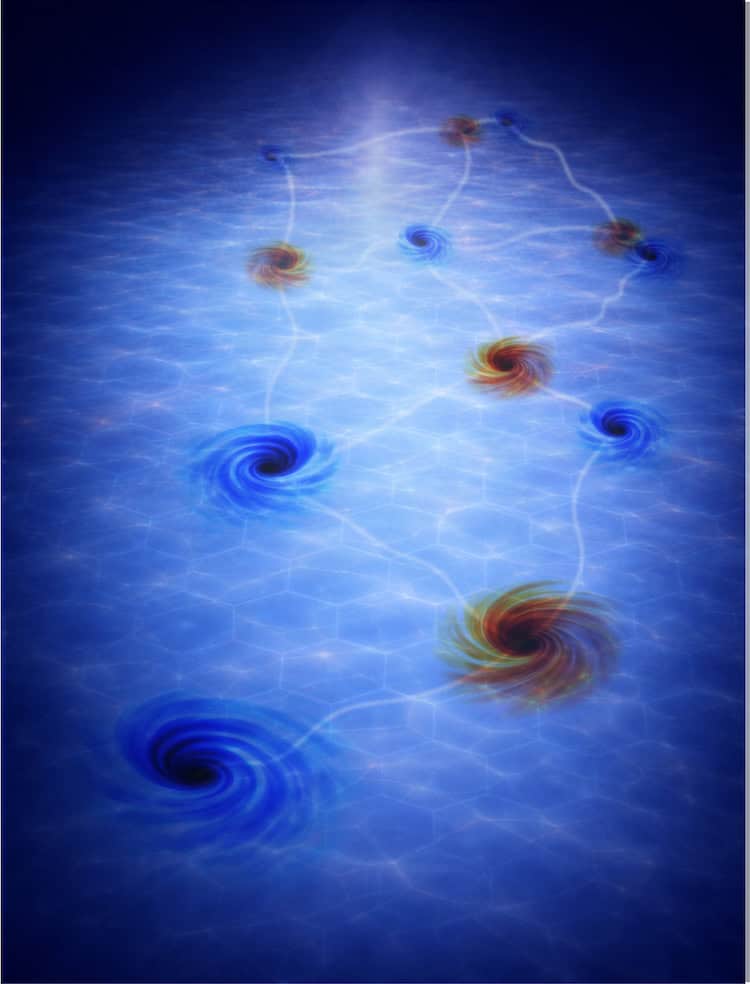
A conceptual illustration of a glowing pool with blue and orange vortices, representing the measured dark points alongside the honeycomb atomic structure of the hBN material studied. (Courtesy: T Bucher and colleagues)
Dark points within light waves can travel faster than the waves themselves. This finding, which is based on new measurements by researchers at Technion – Israel Institute of Technology, confirms a 50-year-old prediction and could help push atomic-scale imaging past its current limits.
Formally known as optical phase singularities, dark points are vortices within light waves where the wave’s amplitude drops to zero. “Simply put, these ‘zero points’ are points of complete darkness embedded within the light field,” explains study team member Tomer Bucher.
In the 1970s, theoretical studies by the physicists John Nye and Michael Berry suggested that such points could move faster than the waves in which they form. Until now, though, no-one had managed to test this prediction by measuring these structures’ movement experimentally.
Unprecedented spatial and temporal resolution
The Technion team’s experiments did not involve beams of light propagating through a vacuum. Instead, the researchers searched for optical phase singularities within flakes of hexagonal boron nitride (hBN), an atomically thin, two-dimensional (2D) material. Light waves in this material travel in the form of polaritons, which are particle-like entities that develop when the electric field of a photon interacts with the conduction electrons in a material. “These hybrid structures can be thought of as light waves that have unusually low velocities (roughly 100 times slower than the speed of light in vacuum) or as sound waves that have unusually high velocities,” Bucher explains.
Even with these reduced velocities, Bucher and colleagues needed special instrumentation to observe the processes at play deep within a single cycle of light. For this, they turned to a modified ultrafast transmission electron microscope (UTEM) composed of a laser and advanced opto-mechanical apparatus. Using an interferometry technique known as free-electron Ramsay imaging, they achieved what Bucher calls “an unprecedented combination of spatial and temporal resolution” of 20 nm in space and 3 fs in time.
To make sense of the complex interference patterns they observed, the researchers developed advanced computational algorithms to extract the exact amplitude and phase of the light-matter waves and reveal their hidden “singular skeleton”. They also deployed automated tracking algorithms to follow the exact space-time trajectories of dozens of singularities simultaneously across massive datasets.
These techniques revealed that when singularities with opposite charge meet, they annihilate each other. Just before this happens, though, they accelerate to extreme (formally divergent) velocities that exceed the speed of light in a vacuum – something that is allowed under Einstein’s principles of special relativity because the singularities are massless and carry neither energy nor information. “This result highlights a beautiful ‘paradox’ where the slower light-matter waves are the ones found more likely to host topological features that ‘race’ across its surface at impossible, superluminal speeds,” Bucher says.
A bad cavity comes good
As is often the case, the study started out as a completely different project. The researchers’ original goal was to study unique light-matter interactions and high-resolution dynamics in high-quality hBN cavities fabricated by a colleague, Bar-Ilan University’s Hanan Herzig Sheinfux, during a stint with Frank Koppens at ICFO in Barcelona, Spain.
“Ironically, the specific sample that became the focus of this paper was initially considered a ‘bad’ cavity,” Bucher recalls. “However, my colleague Arthur Niedermayr noticed something surprising in the raw data: patterns that looked like multiple singularities moving around. We therefore pivoted our focus; reconstructed the full phase and amplitude from the raw measurements; and created a fully aligned temporal movie to track these singularities frame by frame.”
It was during this tracking that the researchers observed vortices that accelerated to extreme velocities right before vanishing. This unexpected finding triggered a deep dive into the possible origins of such behaviour. Eventually, their search led them to Nye and Berry’s 1974 paper, as well as related work by Berry and Mark Richard Dennis in 2000. “Our experimental measurements agree incredibly well with the old and the new theoretical predictions,” Bucher says.
A universal advanced theory
As well as confirming the spatial statistics of the singularities laid out in these previous works, Bucher tells Physics World that he and his colleagues were able to extend the theory to capture the singularities’ full joint distance-velocity dynamics. Importantly, the extended theory is universal, meaning that the phase-space correlations they observed should apply to phase singularities across all types of wave systems, not just in optics. “Our findings will thus deepen our understanding of topological defects, which are common to all areas of physics – from superfluids to superconductors,” Bucher says.
In terms of direct applications, Bucher says the singularities he and his colleagues studied could be used to advance super-resolution microscopy and to encode high-density information within the orbital angular momentum of light. “The analytical methods we developed could help mitigate common artifacts in electron microscopy (such as the notorious ‘bee-swarm’ effect), ultimately pushing atomic-scale imaging to new limits,” he adds.
The researchers, who report their work in Nature, say they now plan to probe 3D line singularities and higher-order topological defects, which offer an even richer landscape for information encoding. “We also plan to investigate topological phases in other 2D materials and heterostructures, with the goal of resolving exotic phenomena like ‘optical skyrmions’ in real-time,” Bucher reveals. “Finally, we are actively developing near-field tomography techniques to capture the full 3D bulk dynamics of these complex waves – which if successful, will be a major milestone in electron microscopy.”
Espresso, flat white, cappuccino, cortado – there are dozens of ways you can get your coffee fix. Every day more than two billion cups of coffee are brewed worldwide, making it one of the most traded products on Earth. In fact, it is the seventh most traded commodity on the planet (after crude oils, natural gas, gold, silver and copper).
Produced mainly in south and central America, south-east Asia and east Africa, coffee sustains the livelihoods of more than 25 million farming households. But its future is increasingly precarious. Coffee plants need the right temperature range, rainfall patterns and altitude to thrive, but climate change is disrupting it all.
This has led to falling yields and rising prices. For example, the price of Arabica beans – the most dominant coffee variety – rose by more than 80% in 2024. In the UK, this led to the price of beans at supermarkets rising 20% and the cost of some instant coffee surging by 40%, while coffee shop prices were up 30% from 2021 to 2024.
And it’s not just that coffee is affected by climate change – the climate is impacted by coffee. It has one of the largest carbon footprints of any plant-based product, mainly due to the clearing of tropical forests, fertilizer and water use, and processing techniques.
So how can those of us making the drinks help with the coffee and climate crisis?
At-home scientists
Coffee is an unusual drink. Unlike products such as whisky, wine and beer, it is brewed at the point of consumption, whether that’s in a café or restaurant, or in a home. “The very last step, which is probably the most complicated, is all done by untrained scientists,” says Christopher Hendon, a computational materials chemist and coffee expert at the University of Oregon.
From farm to cup A cup of coffee starts with the coffee farm workers planting the seeds and picking coffee berries – but climate change is starting to affect crop yields. (Courtesy: iStock/SupawadeeAdam)
It is estimated that it takes 155 people to make a cup of coffee – all the way from the farmer who plants the seed in the ground, to the barista who hands you your cup of coffee. “154 people can do their job perfectly,” says Dan Pabst, manager of innovations and product development at coffee provider Melitta North America. “But if that last person doesn’t pay attention, does something wrong and the coffee doesn’t taste right, they’ve just ruined all that hard work.”
This is where physics can help. Beyond longer-term, large-scale solutions such as re-engineering coffee plants or tackling climate change, physics can actually tell us a lot right now about what happens during the seconds and minutes it takes to brew a cup of coffee. It is a surprisingly complex process and by understanding it, we can improve the quality of the drink and even reduce the amount of coffee needed, cutting waste and helping the environment.
Under pressure
Let’s start with the espresso – those concentrated coffee “shots” you get in tiny cups that also form the base for your latte, americano or cappuccino (and many more).
The Specialty Coffee Association (SCA) has historically defined an espresso as a 25–35 ml beverage prepared from 7–9 g of coffee through which water heated to 90–96 °C is forced at 9–10 bars of pressure for 20–30 seconds. “While brewing, the flow of espresso will appear to have the viscosity of warm honey and the resulting beverage will exhibit a thick, dark golden crema,” states the SCA. This can be achieved using an espresso machine (figure 1), or with smaller contraptions at much lower pressures such as a moka pot or AeroPress.
1 Espresso basics
(Courtesy: iStock/GerasimovSergey)
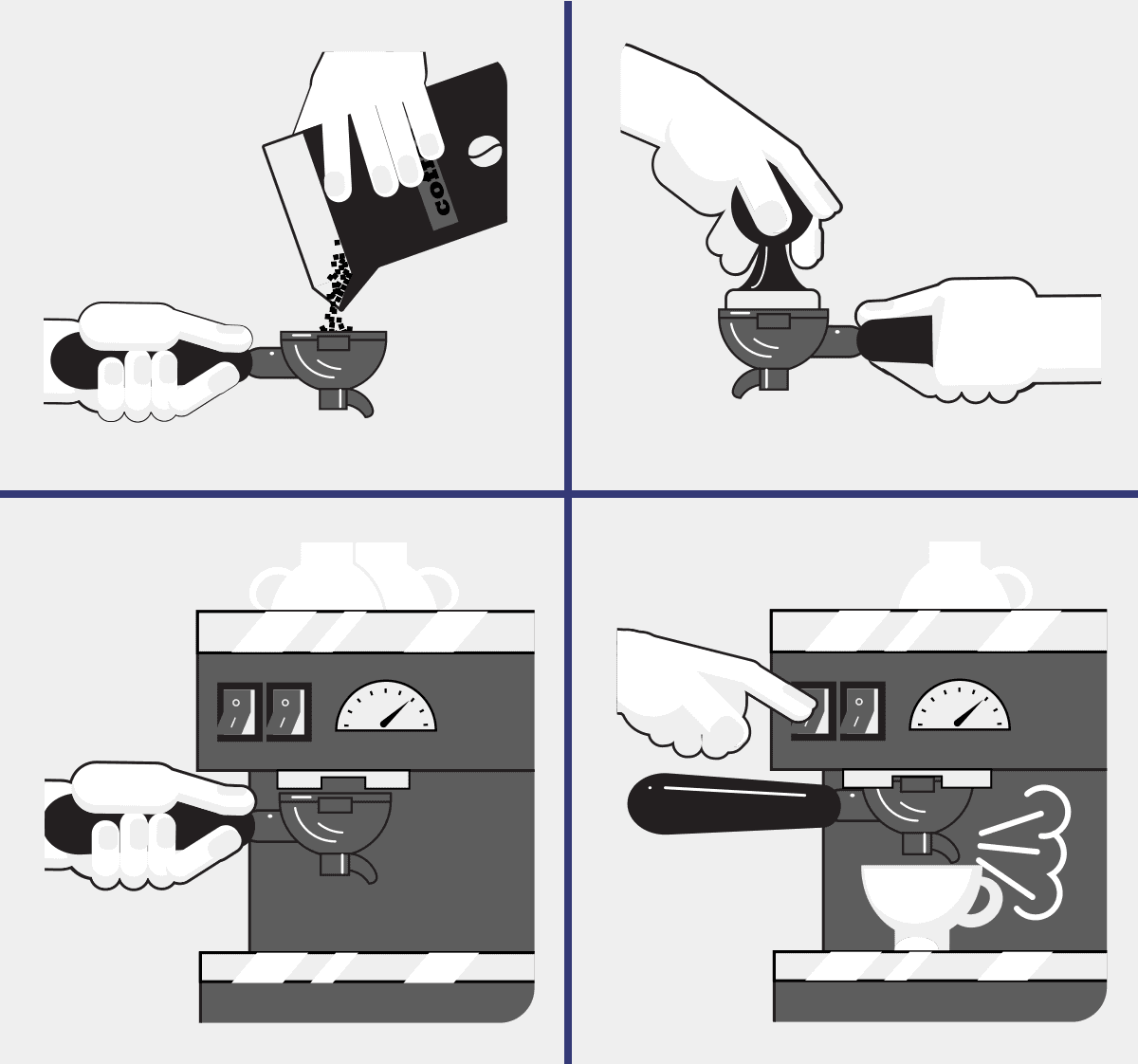
If you’ve ever had an espresso-based coffee, you’ll know that making that base shot of concentrated caffeine is more than just putting some beans in a machine and pressing go. Like with any experiment in a lab, there is a strict process with a range of variables (and a bunch of lingo). Here’s a quick and very basic guide to making an espresso with an espresso machine:
The coffee beans are ground down into a powder-like substance
The ground coffee is then measured out in a “basket” at the end of a “portafilter” (top left)
To ensure this coffee is evenly distributed, baristas then lightly tap the basket, and some may manually move it around
Next the coffee is pressed down in the basket using a “tamper” to make it tightly and evenly compacted (top right), creating the coffee “puck”
Before the portafilter is attached, it’s a good idea to purge the machine with water to ensure no contamination from the previous brew
Now it’s time to actually “pull the shot”. The portafilter clicks into place (bottom left) and, if following the historical definition, high-pressure hot water (9–10 bars, 90–96 °C) is pushed through the puck for 20–30 seconds resulting in 25–35 ml of espresso (bottom right)
In 2017 the SCA and the Barista Guild of America surveyed baristas around the world to see how they were preparing their cups of espresso and if they were following the historical definition. Turns out that the average barista brews an espresso with 18–20 g of coffee in 25–30 seconds using water heated to 93 °C at 9 bars of pressure. This produces an average shot of 36.5 g.
Go online and you’ll also find all sorts of claims about how to produce a perfect coffee. “From a scientific point of view, this advice is often given with no substantial evidence,” says Maciej Lisicki, a physicist at the University of Warsaw. Keen to understand the real science behind a good espresso, Lisicki and his colleagues looked at the complexity of flow in coffee brewing (arXiv:2512.21528).
One frequent claim by coffee experts is that the optimal brewing pressure for an espresso is around 6–9 bars, and that pushing it higher yields diminishing returns. To find out why, Lisicki’s team rigged a café-grade espresso machine with a pressure sensor at the pump outlet, and a precision scale under the coffee cup so they could calculate flow rate. They prepared the puck using a high-spec coffee grinder and automatic tamper to ensure consistency, and then brewed shots of espresso at pressures ranging from 1 to 12 bars. “We strive for our espresso to be the same every time,” says Lisicki. To visualize their structure, the researchers also took X-ray micro-computed tomography (micro-CT) scans of the coffee pucks before and after brewing.
Fluid flowing through a porous medium, such as sand, glass beads or packed soil, usually follows Darcy’s law, with flow rate increasing linearly with the pressure of the liquid. But the researchers found that this was only true for coffee up to around 5 bars. Above that, the flow rate flattened and then fell as pressure increased.
The team observed that as the coffee is brewed, the puck starts compacting under mechanical load, causing its pores to collapse and its permeability to decrease faster than the rising pressure can increase the flow. “The dynamics of espresso brewing is governed by this poroelastic effect,” Lisicki says. “There is an interplay between the porosity and the elasticity of the coffee matrix.”
Ultimately, the work confirmed what the coffee experts had observed. There is no point pushing the pressure beyond about 8 or 9 bars as the flow rate has already peaked.
The coffee in your coffee
Next, to explore how coffee dissolves over time, the team separated an espresso into different vials every five seconds as it brewed. An optical refractometer then measured the total dissolved solids in each vial. This, says Lisicki, tells you “how much coffee is in your actual coffee”.
The work showed that the first few drops of coffee that fall into your cup are very concentrated, but there aren’t many of them because flow rate is initially low. The flow rate then increases, but the amount of dissolved solids falls. This creates a sweet spot at around 15 to 20 seconds where the dissolved solids entering the cup peak, due to the balance between the increasing flow and decreasing solids.
Again, this tallies with expert opinion. “What we see is that most of the substance, the solubles, go into your cup within the first 30 to 35 seconds,” Lisicki says.
After talking to a friend who works as a barista, Lisicki and his colleagues also explored an annoying problem in coffee brewing known as channelling. This happens when the water finds a path of least resistance in the puck and forms a “channel” through the coffee grains. When they brewed coffees with artificially induced channels in the puck, the researchers found that the flow rate was as expected but the total amount of dissolved solids that were extracted was very low. Essentially, the water doesn’t permeate the rest of the puck, so you can’t extract all its coffee.
In fact, the team found that the more careless you are about preparing your coffee puck, the higher the chances of channelling. To mitigate this, you should stir the coffee grounds to make the puck as homogenous as possible and tamp it evenly. “You don’t need to tamp it very strongly, but tamping is important because if you don’t tamp then it’s easier for the water under high pressure to find a preferential flow path,” Lisicki says.
More from less
But even before you tamp your puck, how you prepare your coffee grains affects your drink’s quality. This is where grind size matters (figure 2). Back in 2020 Hendon and an international team were funded by the Coffee Science Foundation – the research arm of the SCA – to study ways to make highly reproducible espresso (Matter2 631).
The group started by looking at what happens in the coffee grinder. You might think that a more finely ground coffee will maximize the surface area exposed to water, thereby maximizing extraction. Hendon and his colleagues discovered, however, that this was not the case.
2 Infiltrating the puck
(CC BY 4.0 NC Physics of Fluids37 013383)
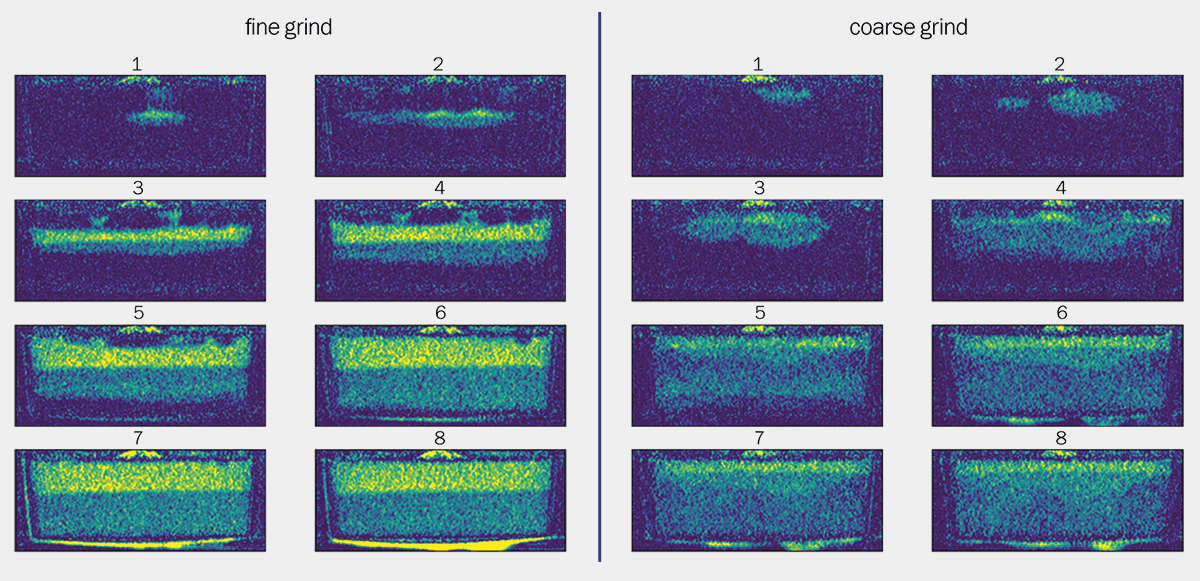
When water is initially pushed through a dry espresso puck, it can take up to one-third of the brewing time to permeate the entire bed of ground coffee. But according to mathematician Ann Smith and colleagues, this process remains relatively neglected by mathematical models of coffee extraction.
“Understanding the infiltration process gives insights into the extraction rate across the coffee bed,” says Smith, who is based at the University of Huddersfield in the UK. “Over-extracting coffee results in bitter taste while under-extraction leads to both weak brews and wasted resources.”
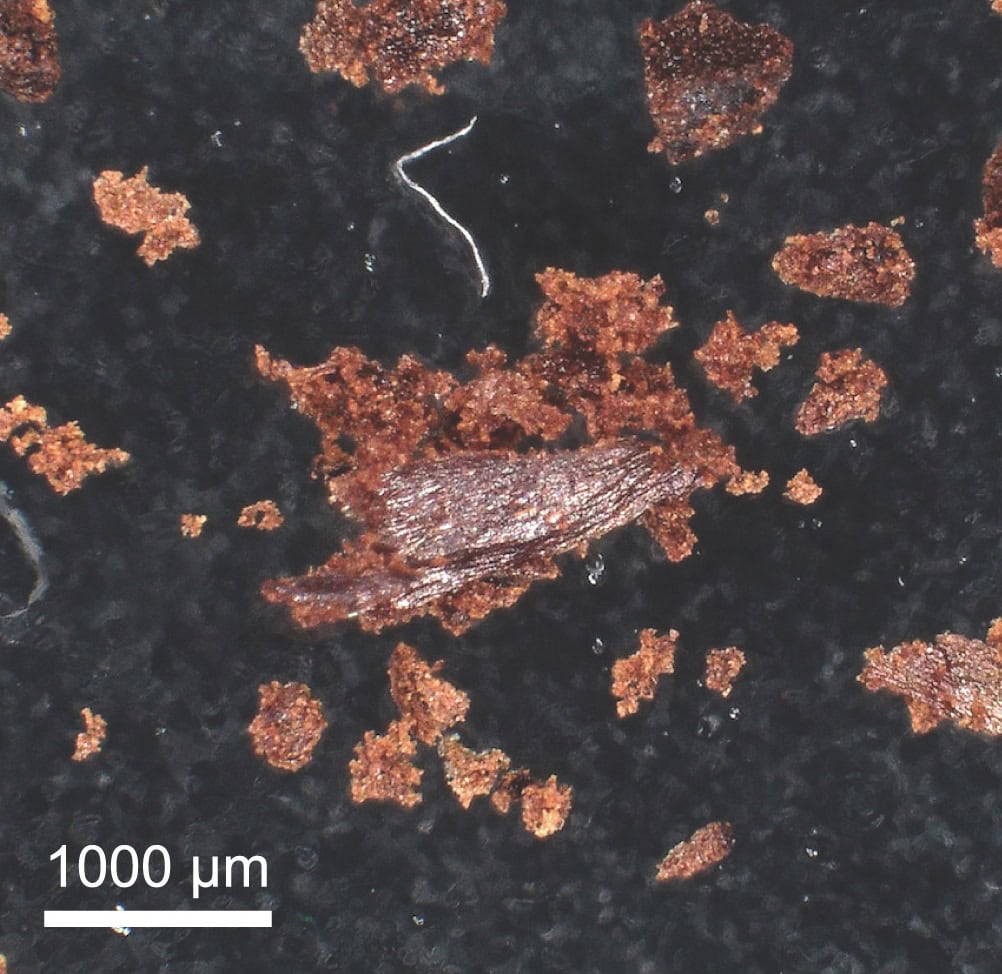
To study infiltration dynamics through both a coarse and a fine grind, the researchers set up an espresso machine at the centre of a rotating X-ray tomography system, which allowed them to build 3D reconstructions of the pucks (Physics of Fluids37 013383). They found that water travels more slowly but more uniformly through a fine grind (left) than a coarse grind (right), which can be seen in the above cross sections of the coffee pucks showing the absorption data for the first 8 seconds of brewing time. The researchers also built a flow model of the water permeation, which showed a good fit to the experimental data.
The team plans to build on the model by looking at other infiltration influences, such as brewing temperature and pores in the puck. “We have pioneered a new technique for experimentally validating coffee models, opening up several interesting avenues of future research,” the team says.
As grind size decreases, from coarse to fine, the amount of coffee that gets extracted initially rises but then peaks and falls. If the grind is too fine, the coffee bed clogs so that water can no longer percolate uniformly through it. Much like with channelling, some areas are over-extracted, while others are barely touched
“If you find the tipping point, you’ll realize the amount that you’re extracting on average [with a coarser grain] is actually much higher than if you ground finer,” Hendon explains. This means you also need less coffee to make an espresso of the same concentration.
The bottom line of the team’s experiments and mathematical modelling is that to get the most reproducible shots just use less coffee and grind it more coarsely.
Pabst echoes that advice: “My recommendation for people at home, without knowing anything they are doing, 90% chance that if you use less coffee and grind a little coarser [your coffee] will actually taste better.”
Hendon and his team trialled their “waste reduction protocol” at a small café in Eugene, Oregon in the US. By grinding more coarsely and reducing the dry coffee mass by 25%, from 20 g to 15 g, the business increased its revenue by more than $3000 over a year, without sacrificing drink strength or flavour.
Based on estimated US espresso consumption figures from the time, Hendon and his colleagues suggested that if their findings were implemented across the entire US, it could save the country about a billion dollars per year.
Volcanic coffee
It was not until Hendon teamed up with a volcanologist that he figured out why finer grinds clog the coffee bed and reduce extraction. Joshua Méndez Harper at Portland State University studies electrification in volcanic eruptions, where magma fragments charge up as they grind together in the plume, generating lightning. Coffee grinding, it turns out, creates a similar phenomenon (Matter 7 266, iScience 27 110639).
Together, Hendon and Harper found that friction between beans and the fracturing of beans during grinding generates static electricity. By passing coffee through a grinder a second time at a coarse setting, which removes fracturing from the process, the researchers discovered that most of the static charge arises from fracturing rather than friction.
According to Hendon, the more times you fragment your coffee, the more static electricity you generate. “You’re making lots of small particles when you grind finer, but they clump together to form an aggregate [because of static], which is effectively impermeable to water,” he adds (figure 3).
A team of scientists including coffee expert Christopher Hendon found that pores in a coffee puck clog if the coffee is ground too finely. After teaming up with volcanologist Joshua Méndez Harper, he discovered this was due to the grinding process introducing static charge, which caused the coffee to form aggregates, like those shown, that blocked water flow.
The solution, the researchers found, is to squirt a little bit of water on the beans before you grind them. “That totally suppresses the static accumulation,” Hendon says. Wetting whole beans with less than 0.05 ml of water per gram of coffee – or about 0.5 ml for an average espresso shot – resulted in a marked shift in particle size distribution by preventing clump formation.
But again, the coffee experts got here first. In the coffee industry, this is known as the Ross droplet technique and was anecdotally thought to reduce static charge, even if the physics wasn’t well understood. Pabst says that a lot of the recent findings “are not necessarily newer ideas, they are validating what we have taught in the industry for many years”. But he describes it as an exciting time, with science providing deep insight into industry knowledge.
Moisture content of the beans is another key variable, Hendon’s team found, with drier, darker roasts charging most strongly and therefore benefiting most from pre-wetting. The researchers also found that the right amount of water results in near-zero grounds being retained by the coffee grinder, again due to the reduced static charge.
They note that their findings have implications for waste reduction and drink quality. Hendon says that adding water during grinding allows you to reduce coffee mass by about 25%, while maintaining espresso concentration.
Pour-over science
Coffee is not just espresso.
Among the myriad of coffee-making techniques available, pour-over coffee is increasingly popular with enthusiasts due to its reputation for being better able to extract the unique characteristics of different coffee beans. A popular set-up uses a conical filter or “dripper” containing a filter paper, and the process is simple – you put coffee grounds in the filter, pour in hot water, and let the coffee drip out into a cup. There is a wealth of variables – such as grain size, water temperature and water speed – that allows whoever is holding the kettle to experiment and vary the process.
Drip drip drop Pour-over coffee allows the brewer to experiment with variables such as water temperature and grind size. (Courtesy: iStock/ArtRachen01)
As with an espresso, the challenge is to bring the water into uniform contact with every particle in the coffee bed. If the stream is too slow, for instance, it might run to the edges of the cone, flow through the filter paper and drain away without touching the grains in the centre.
To investigate how pouring technique affects this, Mathijssen and colleagues used a transparent glass cone similar in shape to a popular pour-over filter, and ultrathin filter paper. They then filled it with silica gel particles as a transparent model for coffee grains, and illuminated the set-up with a laser sheet while filming it with a high-speed camera.
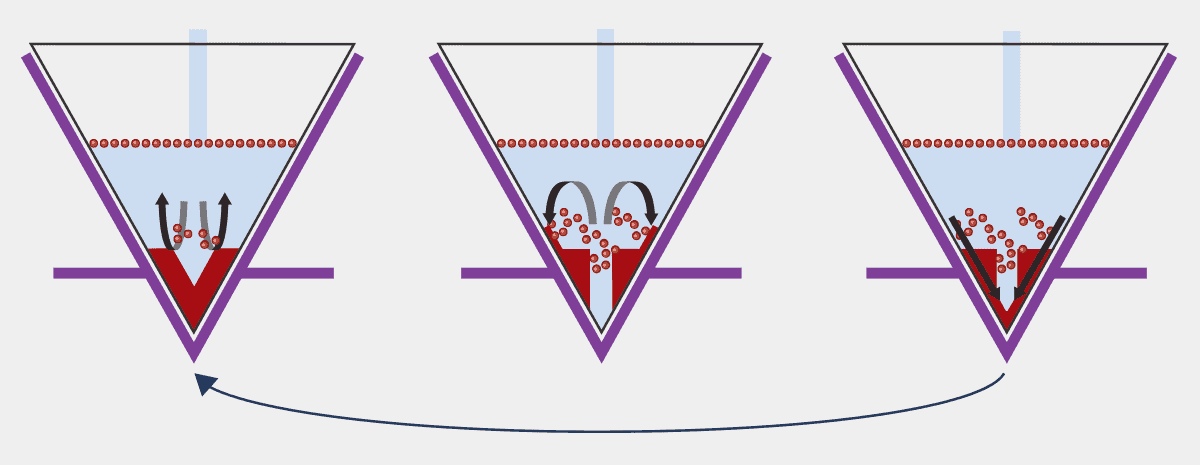
The experiment revealed the importance of pour height for a static kettle. Pour from close range and the slow stream fails to effectively disturb the coffee bed. Lift the kettle to around 20 cm above the filter and something different happens. “We found that as you increase the height of the kettle this kind of avalanche dynamic emerges,” describes Mathijssen.
The increased energy in the stream enables it to dig deep into the coffee bed, suspending the particles and creating a hole in the middle. Particles around the side then slide into the centre and are themselves suspended, establishing a recirculating vortex (figure 4).
The stages of coffee grinds moving in a pour-over coffee set-up. First, a water jet starts to erode the coffee bed, causing the granules to become suspended and mixed into the water (left). These then accrete outwards towards the edge of the coffee bed (centre). The movement of granules from the bottom to the top edge causes the bed to collapse inwards (right), and the entire process repeats while the water jet continues.
“Every single particle in that cone is moving up and down through this vortex, so you get very nice and even extraction,” explains Mathijssen. “All of the particles see the water for an equal amount of time.”
But go too high, above about 30 cm, and surface tension breaks the stream into droplets – a process known as the Rayleigh–Plateau instability. The drops fail to dig deep into the bed, so the vortex does not form and coffee extraction falls. There is a sweet spot at a height of around 15–20 cm, Mathijssen says.
When the researchers switched back to coffee, they found that higher pours did indeed create stronger coffees with more total dissolved solids.
One cup at a time
These studies highlight a common theme. Decent coffee extraction is about creating uniform fluid contact with a porous medium that tends to be heterogeneous. And if it goes wrong, it is probably due to some failure of that uniformity.
As climate change squeezes yields and pushes prices higher, the coffee industry faces growing pressure to do more with less. Physics cannot protect vulnerable growing regions from drought and rising temperatures, but its insights can ensure that coffee is not wasted in the final seconds or minutes by a poorly prepared puck, a clumped grind or a lazy kettle lift.
“The best thing we can do,” says Hendon, “to be good custodians of any agricultural product is figure out how to use less of it so that more people can enjoy it.”
The “bumblebee” bat – a little animal weighing just 2 g – has inspired researchers to make the first palm-sized drone that can efficiently navigate in confined, dark and cluttered environments. The drone, which works using echolocation and operates on a milliwatt of power, could find applications in search and rescue missions in difficult-to-access spaces, say the researchers at the Worcester Polytechnic Institute in the US who developed it.
The bumblebee bat thrives in deep, dark caves and can perceive objects as small as just 0.1 mm thanks to ultrasound-based echolocation. The bat sends short chirps and then listens to the echoes produced as the sound waves bounce off surfaces. This ability is all the more astounding since the animal has only simple biosensory apparatus and just two million neurons.
The new drone, developed by a team led by Nitin Sanket, differs from existing autonomous aerial robots that require sophisticated sensors to work – including light detection and ranging (LIDAR), radio detection and ranging (RADAR), tactile sensors and infrared-based depth cameras, to name just a few. These complicated devices cannot easily be deployed in cluttered environments under difficult environmental conditions, such as fog, dust, smoke, low light and/or snow. This makes them unsuitable for search and rescue missions in disaster zones, where such conditions are often the norm.
Another major problem with existing robots, explains Sanket, is that they generate a lot of propeller noise, making echolocation difficult. “It’s like trying to listen to your friend while a jet engine is taking off next to you,” he says.
The new device, which is detailed in Science Robotics, employs a physical acoustic shield inspired by the ear cartilages of bumblebee bats to overcome this problem. In addition, the team used an artificial-intelligence (AI)-based neural network denoising framework to recover weak echoes from noisy signals.
New device works well in the wild
Ultrasonic sensing is insensitive to most environmental conditions, such as smoke, snow, dust and darkness, that are visually degrading and render light-based sensors like cameras or LIDARs ineffective. As such, they work very well in the wild, says Sanket. “This will allow this new class of robots to be readily deployed for search and rescue in real-world settings where conditions are dynamic, unpredictable and visually degraded, bringing us one step closer to deploying swarms of aerial robots to look for survivors.”
The researchers built their aerial device using standard off-the-shelf parts for motors, and flight- and electronic speed controllers. They custom designed a carbon fibre frame and 3D-printed other structural parts. The on-board computer is a Google Coral Mini development board and the ultrasound sensors are made by TDK Electronics and designed by team member Richard Przybyla. The robot measures around 16 cm across, costs roughly $400 and works using just 1.2 mW of sensing power.
The robot uses echolocation to determine obstacle locations in 3D using trilateration, explains Sanket. “This means that once it has found the obstacles, it plans a path around them to avoid them and go towards a goal direction (like North, for example).”
At the heart of the device is noise reduction using the physical shield and the neural network (dubbed “Saranga” by the team), which reduces noise by looking at echo signatures over time, in the same way as the bat’s neuronal signal processing system does. The researchers trained the network entirely in simulation and say that it can be adapted to the real world without re-training/fine-tuning.
Looking to nature’s experts
The idea for the project actually started out as a joke during Halloween of 2024, remembers Sanket, when he and his students wanted to build a robot that emerged from smoke for a video. “That film was much harder to make than we anticipated, and it turned into an obsession, forcing us to solve a real problem: how to make robots navigate in visually degraded/challenging conditions.”
“To find the answer, we looked to nature’s experts, bats, which not only live but thrive in damp, dark and dusty caves and can pinpoint something as thin as a human hair,” he explained.
In their experiments, Sanket and his colleagues had to study how bats deal with low signal-to-noise ratios. They found that bats change their cartilage stiffness to muffle noise and have peculiar nose-leaves (ridges on their nose) to modulate sound chirps. They based their physical acoustic shield on these structures.
According to the researchers, these highly-functional autonomous tiny aerial robots could be deployed in critical humanitarian applications such as search and rescue, cave exploration and combating poaching – tasks currently infeasible using existing aerial robots. “They could, for example,” says Sanket, “be sent into disaster areas where human or larger helicopter access is limited, thereby alleviating the challenges and pressures associated with saving lives.”
Looking ahead, the Worcester Polytechnic Institute team is now working to increase the robot’s flying speed and reduce its size even further. “We speculate that looking at novel forms of flight mechanisms is the key,” Sanket tells Physics World.
By including weights associated with particles, researchers in the US, South Korea and Germany have generalized significantly the concept of hyperuniformity of multi-particle systems.
Hyperuniformity refers to a structural property in which at large enough length scales there is hidden order. Hyperuniform systems behave like they have no order at small length scales, similar to liquids, but at larger length scales they behave like crystals. This dual character leads to important applications for such materials, and the addition of weights allows for this characterization to extend to cases where additional properties of particles are included – such as a particle’s charge or mass.
The simplest example of a hyperuniform material is a crystal in which atoms or molecules are arranged in a uniform lattice that repeats in all directions. In addition to crystals, there are two classes of hyperuniform structures that are of great interest to physicists: quasicrystals and exotic disordered systems. Quasicrystals have highly ordered structures, but their patterns never repeat – so they are not true crystals.
Exotic disordered systems are of great interest to Salvatore Torquato of Princeton University, who was involved in this latest research on hyperuniformity. He tells Physics World that these systems are especially interesting because “they can behave like perfect crystals in the way they suppress large-scale density fluctuations and yet have characteristics of liquids or glasses at small length scales”.
Omnidirectional mirrors
From an engineering point of view, being both liquid-like and crystal-like is very useful. For example, crystalline materials will transmit light at specific wavelengths and incident angles and reflect light at others. In 2022, Torquato and colleagues showed that these optical “band gaps” should also exist in some exotic disordered systems, but without the restriction on incident angles. They suggest that this property could be used to create omnidirectional mirrors that operate only for light at certain wavelengths — unlike everyday mirrors, which reflect light at all wavelengths.
In their latest work, Torquato and colleagues have extended the theoretical description of hyperuniform systems by assigning “weights” to a material’s particle constituents. These weights can be scalar or vector properties. Examples of scalar properties include the charge or mass of a particle; whereas vector properties include the dipole moment or velocity of a particle.
Toraquato and colleagues discovered that under this more general framework of hyperuniformity, including weights can take a particle system which, without weights, is hyperuniform to one which is not (and vice versa).
Different atomic species
For example, one could begin with a standard hyperuniform system comprising identical particles and then imagine that the particles can have one of several different masses. In the real world this would describe a material made of several different atomic species.
The team’s work is important because it represents a significant expansion in the number and richness of systems that can be studied and potentially classed as hyperuniform. Furthermore, weighting provides engineers with additional degrees of freedom that could be used to fine tune hyperuniformity to create new and useful materials.
Torquato is hugely excited about future directions of this work: “Our generalization of hyperuniformity to weighted many-particle configurations opens up an immense set of problems. Our next steps will be driven by what we find to be the most exciting prospects”.
It might not seem obvious at first glance, but physics and finance have much in common – especially at the frontiers of quantitative analysis. Both fields use mathematics, data and computational models to tackle complex systems. Physicists are trained to build models that test hypotheses, all while embracing the idea of inherent uncertainty and a rapidly changing environment.
Financial markets are much the same, as they constantly change and evolve as data flows in, feedback loops are formed, and fast-paced decisions are made. As a physicist, there is a natural overlap between the skills that finance firms are looking for, and your academic training and abilities.
The idea of using physics to make sense of financial markets is not even that new. It has been around for over a century, with one of the earliest examples being attributed to French mathematician Louis Bachelie developing his “Theory of Speculation” in 1900, which used the concept of a random walk to analyse fluctuations in the Paris stock exchange.
Modern quantitative finance covers a wide range of subjects, all of which involve using mathematical and statistical methods. Most physicists can therefore adapt to working in this sector, provided they have some additional training. Traditionally, “quants” – quantitative analysts working across investment, markets, research and risk – get involved in option pricing and risk, requiring stochastic calculus, Monte Carlo techniques, and solving partial differential equations. Today’s quant roles more commonly involve supporting algorithmic or systematic trading; using data analytics, machine learning, and statistical and optimization methods.
Almost every one of these roles does require coding skills, especially when implementing models and algorithms in specific areas. Furthermore, the use of generative artificial intelligence (GenAI) to drive or enhance software development is now becoming standard. Physicists in the finance sector may also end up working as software developers, traders, risk managers and investment bankers.
To get a better idea of what it means to make this move from physics to finance, Physics World caught up with five professionals who went from the lab to the trading floor – some recently, some many decades ago. Antonia Lim, Ashreya Jayaram, Han Lee, Benjamin McRoberts and Sean Chang reflect on how their careers evolved, and explain the skills they carried over from physics. They also look back on the trade-offs they encountered along the way and offer advice to today’s graduates seeking to carve out their own careers in the sector.
Antonia Lim
(Courtesy: Impact Cubed)
Antonia Lim is chief investment officer (CIO) at global investment advisory firm Impact Cubed, which she joined in 2024. With 25 years of experience transforming investments and businesses, Lim began her career at Kleinwort Benson and Dresdner Bank (now Commerzbank), before going on to become global head of quantitative research at Barclays and then head of quantamental investments at Schroders. Lim holds an MPhys (masters of physics), specializing in theoretical and quantum physics, from the University of Oxford, UK. She is also independent chair of Weatherbys Private Bank’s investment committee and board advisor, and a member of theCFA Research and Policy Centre’s technical committee.
I loved the four years I spent at Oxford, as well as the sheer intellectual breadth of physics: it trained me to move between abstract ideas, mathematical models and real-world questions, which is something that has stayed with me throughout my career. To me, physics is a wonderful mix of understanding how things really work, puzzles, maths and creativity.
The move into finance was not part of a grand plan. With hindsight, it started with my MPhys research project within a very popular part of the condensed-matter department, affectionately known at the time as the “Chaos Lab”, which was essentially the financial modelling department in physics. I was interested in the modelling and coding, and my dissertation focused on option-hedging strategies [techniques used to reduce investment risk] with transaction costs.
It was my first real exposure to the idea that methods rooted in physics could also be used within markets and decision-making under uncertainty. What appealed to me most was the modelling itself: taking a messy real-world problem, making sensible assumptions, and then testing how well the model works. After graduating, I ultimately chose to join a private bank because I thought it would be interesting and fun, though I was very close to accepting a role in defence engineering.
I’m now CIO at Impact Cubed, where we develop customized indices, analytics, tools and data capabilities with a strong sustainability focus. Although I do not use the specific content of my physics degree day to day, I use the methods and habits constantly: mathematical reasoning, structured problem-solving, comfort with complexity, and the discipline to test whether an answer is plausible before trusting it.
Physics also taught me to properly define a problem before trying to solve it. That sounds simple, but in finance it is incredibly important, whether you are building an index, designing an investment process, or challenging a model that is elegant mathematically but too far removed from the real world.
On the softer-skills side, physics gave me confidence in tackling unfamiliar problems and explaining technical ideas clearly. Over the years I have worked with people from many different disciplines, and one of the most valuable skills has been translating between technical precision and practical decision-making.
Finance can be intellectually stimulating because the problems are constantly evolving, and impact society at large. I’ve held the very serious responsibility of investing the livelihoods of millions of people. Within the quant sphere, there is a really strong community of people who enjoy models, evidence and rigorous thinking, so in that sense it can feel very familiar to physicists. Indeed, when I joined the London Quant Group decades ago, it felt like home straight away.
The pointy end of finance is shaped by market cycles and commercial pressure, which creates a degree of individual uncertainty that some can find draining. But if you enjoy solving practical problems and working at the intersection of theory, data and human behaviour it is an exciting place to build a career.
My advice to graduates looking to join finance today would be to not worry too much about making a perfectly linear plan. Physics gives you a very transferable toolkit, and there are already many physicists in finance, particularly in quantitative roles, so it is a move that can feel surprisingly natural.
Han Lee
(Courtesy: Han Lee)
Han Lee is co-founder of RLXPartners, a technology-startup venture consulting and investment firm. He has a PhD in theoretical physics from the University of Cambridge, UK, where he worked on quantum many-body problems in condensed matter. Lee has previously had numerous leadership roles in finance, most recently as global head of quantitative strategies and automated trading for the fixed income division at Morgan Stanley. Before that he was global head of quantitative analytics at RBS.
When I started in the financial sector in the early 1990s, quantitative and mathematical finance was still a relatively new field, albeit one that was rapidly growing. It coincided with a major expansion of the financial markets, in particular the increasing complexity in financial derivatives. These changes provided many opportunities and challenges, which sounded interesting to me.
At the same time, the industry was actively seeking to find quantitative analysts with physics, maths or engineering backgrounds, which made the decision for me to move into finance straightforward. The sector still looks to hire physicists and those with a scientific background, but it has become much more competitive.
When it comes to skills from my physics background, both problem solving and scientific intuition are very transferable. Having the ability to harness familiar mathematical methods or programming techniques – or quickly learning new ones – to solve problems is a core component of the work. Physics also teaches a powerful combination of rigour when required, and an understanding of how and when to use approximations and estimations. Critical soft skills include communication and teamwork.
The pros and cons of a career in finance are straightforward. People are usually aware of very high starting salaries, especially in banking and hedge funds, as compared to staying in academia. Less well-known is how quickly this can increase once you progress and gain experience.
It can also be a very exciting and stimulating work environment, and can be very rewarding to see your work leading directly to results that have immediate impact. Potential challenges or downsides are that there is a relatively intense and competitive working culture, which can bring stress and some uncertainty; which won’t suit everyone.
Furthermore, not all physics graduates and postgrads might want to move to a completely different field. Although finance can have interesting and complex problems to work on, the focus is quite different from working in academia. The latter would allow for a much higher degree of intellectual freedom, and some would consider this not only intrinsically valuable but also capable of having a significant and wider positive impact.
Ashreya Jayaram
(Courtesy: MRM Photos)
Ashreya Jayaram is a quantitative strategist in the corporate and private bank division of Deutsche Bank. She did her PhD in physics at the Johannes Gutenberg University of Mainz, Germany, focusing on the theory of biologically-inspired nonequilibrium systems. After a postdoc at the University of Stuttgart, Jayaram moved to a career in quantitative finance at Wells Fargo, before taking on her current role at Deutsche Bank.
My decision to move from physics to finance came when I realized I was not suited to an academic career and instead I began looking out for options in industry. I was looking into avenues where I could continue to build useful models that capture real-world observations, which was a part of my academic career that I most enjoyed. This led me to quantitative finance.
To understand if quantitative finance was my cup of tea, I used online resources to educate myself about financial markets and the kind of models practitioners use to describe them – and here I am today. A key skill that I developed during my physics degree that is applicable in my job now is the ability to break down complex problems into simpler and more tractable forms. It’s also important to identify the vital elements that drive the behaviour of observables of interest (for example, profits) – a skill that is systematically developed in theoretical physics.
Another useful skill is the ability to manage multiple projects simultaneously with different collaborators. I also have to communicate effectively with diverse audiences of varying backgrounds, which is an ability I developed during the course of my PhD and I believe helps me in my current role.
What excites me most about my job today is the dynamic and unpredictable nature of financial markets. Their far-reaching impact on everyday life creates a high-energy work environment, which I find both engaging and enjoyable.
If you’re looking to move into the field, my advice would be to find out more about the different roles in the financial world and the diverse range of skills they demand. For physicists with no exposure to finance, it would beneficial to read about what you might enjoy working on, and look into some self-formulated projects and internships to see if it does align with your interests.
Benjamin McRoberts
(Courtesy: Benjamin McRoberts)
Benjamin McRoberts is head of European power engineering at Citadel. He spent the last decade working at Goldman Sachs, most recently as the head of EMEA Commodities Strats. McRoberts studied mathematics and physics the University of Bristol in the UK. He also completed an MSc in financial mathematics at the University of Warwick.
During my BSc at Bristol, I realized pretty early on that I preferred the theoretical side over the practical, and I switched to the joint honours MSci mathematics and physics course after my first year. This allowed me to replace some of the experimental physics courses with more of a mathematical physics focus so I could study concepts such as applied partial differential equations, fluid dynamics and quantum information theory.
My final year master’s dissertation focused on the “weak measurement” quantum mechanical phenomenon, and while I explored the idea of doing a PhD after my master’s, I ultimately fancied a change of scenery. I also found the open-ended nature of pursuing further academic research a little bit daunting, and I wasn’t ready to commit another four years or so to something I wasn’t totally sure about.
I had a sense that finance might provide some interesting quantitative problems that I could use my educational background for, and I was likely influenced by a careers fair hosted by my university. I did consider a few other avenues such as technology consulting and teaching, but ultimately the large annual graduate intake for investment banking in London appeared to provide the most opportunity.
After applying for a series of summer internship programmes at the end of my third year, I secured an offer from the Australian investment bank Macquarie. That summer I worked within their infrastructure funds business, which raised investment capital from large asset managers and pension funds, investing it in infrastructure projects across Europe, such as airports, toll-roads and utilities. That internship led to a full-time graduate offer that I gladly accepted, kicking off my graduate career in finance.
I worked at Macquarie for a year but decided to build my skills with a master’s in financial mathematics at Warwick. While I was contemplating if this was the right path for me, I read a book by particle-physicist turned quant Emanuel Derman, titled My Life as a Quant: Reflections on Physics and Finance. It really captivated me and I still highly recommend it, especially for those with a physics background considering a career in finance.
During that degree, I built on some of the basics of probability and statistics I’d learned on my undergraduate course, to cover new topics like stochastic calculus and derivatives pricing. I also got more of a taste of computer programming, through a module focused on C++ which I really enjoyed. I quickly realized that I had made a good career choice by going back to university.
After leaving Warwick, I spent two years as a quantitative analyst at a commodities trading firm before joining Goldman Sachs in their “commodity strategies” group in London. Over the last decade I’ve worked across their commodities complex – from precious and base metals to power and gas, and oil products – covering derivatives pricing/modelling, trading tools and analytics, as well as automated trading.
Last year, I had the opportunity to join the US-based multinational hedge-fund and financial services company Citadel. I was extremely impressed by the calibre of people I met during the interview process, and similarly since joining the company. This, together with the firm’s reputation for its rigorous and sophisticated investment approach, gave me the confidence that it was the right move for me.
Since finishing my master’s, I’ve consistently made use of my technical educational background. Sometimes that’s been explicitly – using skills from linear algebra, calculus and differential equations – but sometimes indirectly from generally learning to be better at abstract problem solving and not giving up when faced with a difficult intellectual challenge.
What I’ve loved the most about working in the commodities markets is having the ability to use sophisticated mathematical techniques to solve problems in the real world. On the flip side, it’s a demanding and fast-paced environment, which requires commitment and tenacity to succeed.
What has sustained me throughout is a real passion and enjoyment for what I do. You typically get to work with a group of talented and motivated individuals. There is a strong feeling of camaraderie and shared pride in your work, which is something I’ve always appreciated.
For physics graduates looking to get into the finance, remember that physicists typically make great quantitative finance professionals. I’ve worked with and hired many and they tend to do very well – partly thanks to their willingness to find creative and varying solutions to any problem. Your formal scientific training coupled with an appreciation for a whole swathe of real-world applications gives physicists a fantastic foundation for such a career.
Sean Chang
Sean Chang is a quantitative researcher at Citadel Securities. Chang completed a PhD in condensed-matter physics at the University of British Columbia, Canada before moving into the financial sector.
My PhD focused on low-dimensional condensed-matter theory, and while I enjoyed the research, my advisor was not very supportive, and I decided not to take on a postdoc. While I was struggling to find what to do after I graduated, I met someone from my department who had graduated the year before.
He introduced me to the idea of being a quantitative analyst, as the role mostly involved solving partial differential equations. He recommended some books I could read on the topic and then offered me a job at a local financial software company FINCAD (now Numerix) as a quant. After a few years at the company, I spent the next decade or so at Citibank and later at Bank of America Merrill Lynch. Six years ago, I joined my current company, Citadel Securities in the UK.
The whole quant industry changed profoundly after the 2008 financial crisis. Before the crisis, it was mainly about how to price a complicated financial contract using fancy models. But now the industry has moved towards algorithmic electronic trading on simple vanilla products. So at the beginning of my career, there was a lot of focus on pricing theory. Now it’s more data analysis and how we can improve algorithms.
I don’t use any technical skills from my physics degree in my day-to-day job (although maybe one day we will find some practical quantum field theory application to finance). Most of my work instead involves software engineering, which I didn’t learn much about during my physics degree. But the skills that are much more useful and transferable revolve around scientific thinking and the ability to tackle a hard problem.
Many people think that a job in finance is stressful and that we have a bad work/life balance. I personally feel it’s a lot less stressful and much better balance for me personally – in fact, I realized soon after my first job that most of us don’t work during the weekend, which was great.
If you’re considering a career as a quant, I would recommend doing your research to find out more about the whole sector in general and see if it aligns with your abilities and your needs. And never stop learning!
Gwenaëlle Lefeuvre studied physics at Sorbonne Université in Paris, France, before moving to Université Paris Cité to do a PhD in experimental particle physics. After postdocs at Syracuse University in the US and the University of Sussex in the UK, she left academia and worked for 10 years at the UK company Micron Semiconductor Ltd. Here, Lefeuvre set up a business unit dedicated to designing and manufacturing CVD diamond sensors.
Lefeuvre now works as the network coordinator for Photonics Bretagne – a non-profit association in Brittany, France. As an innovation hub, the organization supports the development of the photonics ecosystem across industry, research and education in Brittany, and helps integrate photonics technologies into other sectors.
What skills do you use every day in your job?
When it comes to skills I need for my role, my scientific background is just the starting point. I am the contact point between the Photonics Bretagne team, our members, our European partners, and any other parties interested in what photonics have to offer. While my background gives me credibility, what I really use is the inquisitive spirit that a physics education imprints in us. I ask a lot of questions, all the time and to everyone, so I can better understand what people work on, what they need, and how their products can be used in different situations.
Of course, this means that communication and networking are also crucial. Representing my member companies, for example, means that I must be able to translate what they are offering so it’s understandable for people who might work in a very different sector, such as mobility, agriculture or cosmetics.
Finally, being flexible is a must. I wear different hats depending on the task at hand, and need to be able to switch them around quickly.
What do you like best and least about your job?
I love many aspects of my role, but top of the list is having the opportunity to keep learning about new technologies and applications. The breadth and depth of knowledge my co-workers and our members possess is as humbling as it is inspiring. While I am more of a “generalist physicist” myself, I have worked on many different types of experimental systems so can appreciate the expertise at play.
I also enjoy the diversity of my work, which makes my days fun and varied. I might be meeting with members and looking for ways to support them; organizing a delegation visit with my European partners; or advocating for photonics in cross-sector events – and that’s just naming a few of my responsibilities. There is never a dull day.
With the diversity of my role and my enthusiasm to find out more comes the challenge of prioritizing. There are so many things I would love to be doing, but we are a small team and we must focus our efforts on those actions that can best serve our community. And of course, the administrative and reporting tasks are never loved by anyone and take up more valuable time than I would like. They are a constant in every job though, and can be managed through good planning.
What do you know today, that you wish you knew when you were starting out in your career?
Three things come to mind. The first is that it’s helpful to know whether you will enjoy becoming a highly specialized researcher, or if you would thrive in a more general role. Higher education in physics is designed around gaining a finer and finer degree of specialization. I realized during my postdocs that I was not enjoying staying in one given field (neutrino physics, in my case) as much as I expected to. What I loved was working hands-on with different types of sensors, which is a more transversal specialization, so to speak. Not everyone is built to be a specialist and there is nothing wrong with that. Many career options are open to those who embrace remaining curious about everything, provided they have a strong background to back it up.
There are so many ways to work in, with or for the physics community – the main limiting factor for my younger self was probably my own imagination
Secondly, it’s worth remembering that people change, and ambitions do too. It has been said many times in this column, but life isn’t linear and neither is a career. It is important to account for the person you will become, so that you don’t make choices today that will make your future self unhappy or stuck. There are so many ways to work in, with or for the physics community – the main limiting factor for my younger self was probably my own imagination. Luckily, many degrees now include broadening experiences like semesters abroad or entrepreneurship classes.
Finally, I wish I had realized earlier that people love it when we ask them questions about their work. Doing so does not showcase our ignorance but our interest – it’s a true win-win.
Experience of RTsafe succeSRS/SBRT implementation for Varian Halcyon machine.
This presentation focuses on the implementation of end-to-end dosimetry audits for SRS/SBRT treatments using the RTsafe independent audit system on a Varian Halcyon machine.
SRS/SBRT are advanced radiotherapy techniques that deliver very high ablative doses of radiation, with great accuracy, precision and conformality. As we know, in radiotherapy, even small errors in the acquisition of CT images for simulation, in planning, dosimetry, treatment delivery, or patient positioning can lead to negative consequences.
Given the high-dose gradients and submillimeter accuracy required in stereotactic radiotherapy, the audit evaluates the entire treatment chain – from imaging and target definition to planning, delivery and dose verification. The role of such audits in detecting geometric and dosimetric uncertainties is highlighted, along with their contribution to ensuring treatment accuracy, consistency and patient safety in high-precision radiotherapy. Last but not least, especially at the beginning of the implementation of these techniques in a new radiotherapy department, the audit can also help to validate the specific procedures for SRS/SBRT and the professional training for the members of the treatment team.
Florin Costache is a medical physicist expert in radiotherapy across multiple clinics, while also serving as a radiation safety officer, with more than 20 years of professional activity in clinical and academic environments. Throughout his career, he has worked in leading radiotherapy centers in Romania, contributing to commissioning, quality assurance, dosimetry and advanced treatment planning using modern systems such as Varian platforms. Florin’s expertise spans advanced radiotherapy techniques, radiation safety and the implementation of quality assurance systems in clinical practice.
In addition to his clinical work, Florin is a lecturer, course coordinator and former president of the Romanian Medical Physics Society, with numerous scientific publications and conference presentations.
Newton’s and Einstein’s theories of gravity apply across distances of hundreds of millions of light–years. That is the conclusion of an international team of scientists, whose measurements of the gravitational acceleration of galaxy clusters have been made over the largest distances ever studied.
The study supports the Standard Model of cosmology, which invokes the gravitational effect of dark matter to explain the large-scale structure of the universe. As a result the team claims that its observation is at odds with alternative theories of gravity such as modified Newtonian dynamics (MOND).
“We’re seeing a clear pattern: these alternative models of gravity are running out of room to manoeuvre,” the study lead, cosmologist Patricio Gallardo of the University of Pennsylvania in the US tells Physics World.
However, an astronomer who studies MOND argues that the result – and the conclusion – is not clear cut. “I’m not convinced that they’re testing MOND,” says Stacy McGaugh, a professor of astronomy at Case Western Reserve University in the US.
Vast distances
The debate revolves around dark matter, which is a hypothetical substance that the majority of astronomers believe is responsible for the “extra gravity” observed in the universe that cannot be explained by the presence of visible matter alone. But the evidence for dark matter is circumstantial and this leaves room for theories such as MOND – which suggests that a small modification to gravity at low gravitational accelerations precludes the need for dark matter.
To probe the nature of gravity over large distance scales, Gallardo’s 40-strong team measured the gravitational acceleration between pairs of galaxy clusters (pairwise clusters) separated by distances ranging from about 100–750 million light–years.
They used the kinematic Sunyaev–Zel’dovich (kSZ) effect to provide information on the motions of the clusters. This involves the cosmic microwave background (CMB) radiation, which comprises photons left over from the Big Bang. As these microwave photons pass through a galaxy cluster, they scatter off free electrons and receive an energy boost that the team detected using the Atacama Cosmology Telescope in Chile.
Gravity tends to pull these clusters together and this Doppler shifts the kSZ energy boost. This subtle effect was detected for the first time in 2012.
A statistical method called the pairwise kSZ estimator determined the average infall velocity of cluster pairs.
Clean comparison
“This estimator gives us a clean way of comparing the theoretical predictions made by cosmologists of the pairwise accelerations under the influence of gravity,” says Gallardo.
Gravitational acceleration on the length scale of interest was then determined by combining the infall velocity observations with the distribution of galaxies as mapped by various surveys. They found that gravity follows an inverse-square law with regards to distance, just as predicted by the gravitational models of Newton and Einstein.
Gallardo argues that if MOND is correct, then the observed fall in gravitational acceleration would not be as steep as the inverse square.
“Even if an alternative theory of gravity predicts the distributions of galaxies, it will still fail to predict the pairwise velocities without introducing a component of invisible dark matter,” says Gallardo.
However, not all astronomers agree with this conclusion.
“It appears that they’ve worked out what they expect conventionally, then projected this onto what they imagine MOND would do, [but] it isn’t actually a MOND calculation,” says McGaugh.
Galaxy distributions
McGaugh questions how well the pairwise velocities can be isolated from the gravitational tugs of all the other galaxy clusters around them.
Gallardo counters, “It is right that everything pulls on everything, but that is precisely the beauty of this technique”. At its basis is the correlation function of galaxies, which describes the probability that two galaxies will be within a given distance of each other. At its the heart is the distribution of matter in the universe, as laid out in the Big Bang and described by the Standard Model of cosmology.
“If clusters are too close to each other, then the details of how they are placed will matter, but as distances grow and the universe looks more and more isotropic, the averages tend to smooth out and the equations governing the evolution of the distribution of matter take over,” says Gallardo.
McGaugh argues that something else, called the external field effect, happens at large distances. This is a concept in MOND where the gravitational acceleration produced by all the other objects in the universe is non-negligible and can affect smaller systems, such as a pair of galaxy clusters.
Background acceleration
“Once one gets far enough out, this takes over when the background acceleration of everything else is greater than that between any two objects,” McGaugh says.
McGaugh cites a paper in The Astrophysical Journal on which he was co-author. It describes how the gravitational acceleration field in the local universe can be calculated from the known distribution of galaxies. He describes that field as “a mess” and that the approach of Gallardo’s team averages over the subtleties.
Nevertheless, Gallardo remains bullish. “When we look at different scales and tracers of the gravitational potential such as anisotropies of the CMB, the polarization of the CMB, the baryon acoustic oscillations, the lensing of the CMB and galaxy lensing, they all seem to favour the existence of dark matter and disfavour modifications of gravity,” he says.
However, MOND has its own accomplishments, such as being able to predict the gravitational acceleration curves of galaxies, explain the plane of dwarf galaxies found around the Milky Way and Andromeda galaxies, and even the orbits of wide binary stars. But while Gallardo acknowledges that MOND “has partial successes in some regimes,” it “fails to provide a unified and consistent view of how gravity influences the history of the universe.”
In response McGaugh feels that crucial elements of MOND are being papered over and ignored.
“They’re basically reinventing the wheel without knowing a better wheel was already in the literature,” he says.
You might think that a bee’s stinger, a rose’s thorn or a razor-like animal tooth has a sharp pointed tip, rather like “cone-shaped” needles used for injections. Yet a closer look finds otherwise, and these objects are usually rounded at the tip, curving gently like a parabola.
Why this is the case is a mystery and it was thought that it was the result of convergent evolution, in other words different species independently arriving at similar solutions.
This is partly because a rounded curve penetrates skin better as it distributes forces more evenly throughout the tissue. The rounded shape is also less prone to breaking than a perfect cone.
Physicist Kaare Hartvig Jensen from the Technical University of Denmark (DTU), however, was not convinced by the evolution argument. “There is a general notion that almost everything in nature exists for a reason,” he says. “But if you look at an unused tooth, it does not necessarily have [a rounded] shape, and if you observe the shape later in the organism’s life, the parabola will emerge.”
Jensen thought that simple mechanical wear might be behind the effect, and so with his DTU colleague John Sebastian, they went about testing this hypothesis.
To do so they were inspired by industrial durability testing where a robot sits on a chair every few seconds to test its robustness, for example.
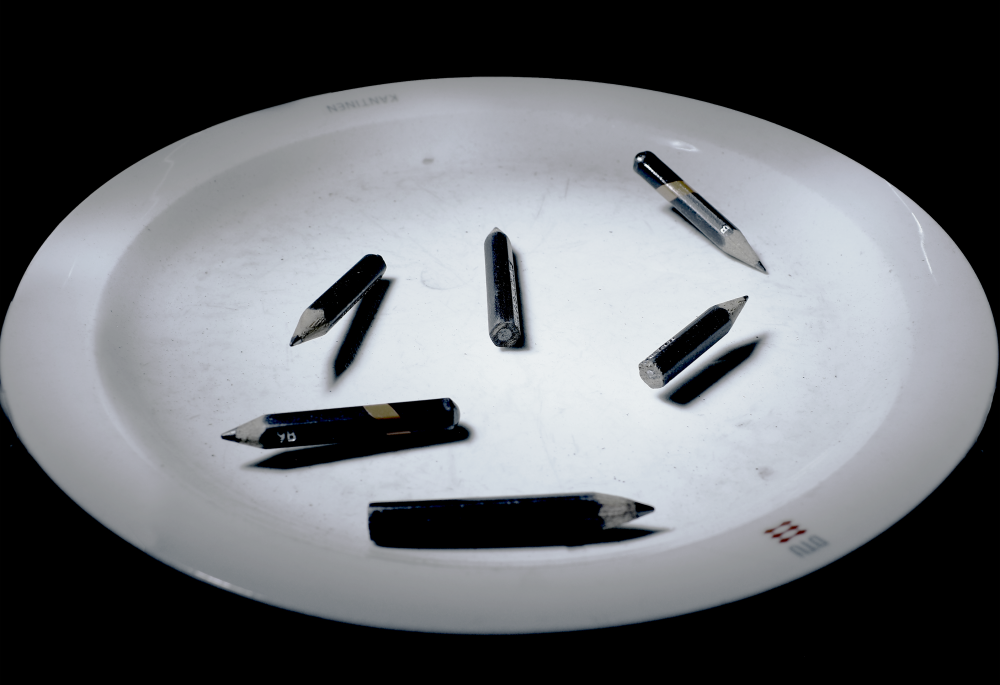
Their set-up involved a plate atop a vibrating machine containing a number of objects. “Initially, I attempted to build a device using sharpened chalk, but it produced a lot of dust,” he told Physics World. “Ultimately, I settled on pencils.”
Collision course The pencils were vibrated on plate for over four hours. (Courtesy: John Sebastian, Technical University of Denmark)
They sharpened the pencils as stand-ins for their biological counterparts and put them on the plate for over four hours as they constantly collided with each other. The team also carried around pencils in a small box in their pockets for several days, again to expose them to random collisions and movements.
They found that no matter how sharp the pencils were to begin with, their tips always developed the same rounded parabolic shape.
“This points to something more fundamental: that random processes in and of themselves can lead to a universal form,” adds Jensen. “The parabola is a stable shape across scales, from a thorn to an elephant’s tusk. The tips are thus not necessarily designed perfectly from the start – they become so through random wear.”
Jensen admits that – rather than in the isotropic case with pencils – most real biological materials have some structure to them, being stronger in one direction than another.
“I would like to explore what shapes result from random wear on these structured materials,” adds Jensen. “Perhaps we can start with something like nails – sharp right after cutting, then gradually blunting. Exactly how this occurs would be of interest.”