Afghan scientists fear for the future in war-torn country

Calls have been made to help scientists in Afghanistan after the country was plunged into chaos in August when the Taliban regime took power in the war-torn country. Universities and other educational institutions have already closed their doors and science education has ground to a halt. Some scientists have even fled abroad, believing themselves to be direct targets of the Taliban.

Science in Afghanistan may not exist in the foreseeable future and it is especially difficult for the upcoming generation as they may grow up in a place without science

Baktash Amini

Many Afghan scientists fear they are at risk of retaliation from the Taliban, who have said their values do not lie with scientific advancement. Those scientists include hundreds of researchers who have worked for or with NATO and other international institutions or who have taken part in internationally funded research programmes. Women are under particular threat, with the Taliban opposing women’s education.

In a letter released late last month, Scholars At Risk (SAR) – an international network of  more than 500 higher education institutions in 40 countries – urged European governments to take “immediate action” to help scientists trapped in Afghanistan. SAR has called for continued evacuations of scientific staff and their families, despite the process ending when the US permanently left the country on 30 August. It also wants universities to host scholars in temporary positions, set up a fellowship scheme and place fewer restrictions on visa applications for Afghan scholars.

The next generation

One physicist at risk is Baktash Amini from Kabul University, who is Afghanistan co-ordinator for the International Centre for Theoretical Physics (ICTP) based in Trieste, Italy. He is currently seeking asylum in Italy where he hopes that he can continue his research. But Amini fears for his colleagues who have been left behind and says that returning to Afghanistan is now no longer an option.

“The future prospects for the development of science in Afghanistan seem to be ambiguous,” he says. “Careers have ended, and funding will not be continued. Science in Afghanistan may not exist in the foreseeable future and it is especially difficult for the upcoming generation as they may grow up in a place without science.”

Afghan science has faced continual hardships over the past two decades, with many prominent scientists opting to pursue their research careers elsewhere. “Ever since Afghanistan was invaded 20 years ago, it has been very difficult for science, but at least we managed,” Amini says. “Over the [last few] years we pushed for the scientific community to have a good base: it all starts with having a proper educational foundation. It is sad to see that all of those efforts have been put in an unknown future”.

Amini helped to set up initiatives through the ICTP to help Afghan physics. He says that many Afghans currently in Europe are teaming up to create a community to give the younger generation a chance. “The goal is to support brilliant young minds by providing scholarships and fellowships to pursue their higher education outside [Afghanistan],” he says. “In the long term, this would have a significant impact on the country – it seems the only way we can provide a scientific future for Afghanistan.”

Exciton ‘surfing’ could boost the efficiency of organic solar cells

Organic solar cells (OSCs) are fascinating devices where layers of organic molecules or polymers carry out light absorption and subsequent transport of energy – the tasks that make a solar cell work. Until now, the efficiency of OSCs has been thought to be constrained by the speed at which energy carriers called excitons move between localized sites in the organic material layer of the device. Now, an international team of scientists led by Akshay Rao at the UK’s University of Cambridge have shown that this is not the case. What is more, they have discovered a new quantum mechanical transport mechanism called transient delocalization, which allows OSCs to reach much higher efficiencies.

When light is absorbed by a solar cell, it creates electron-hole pairs called excitons and the motion of these excitons plays a crucial role in the operation of the device. An example of an organic material layer where light absorption and transport of excitons takes place, is in a film of well-ordered poly(3-hexylthiophene) nanofibres. To study exciton transport, the team shone laser pulses at such a nanofibre film and observed its response.

Exciton wave functions were thought to be localized due to strong couplings with lattice vibrations (phonons) and electron-hole interactions. This means the excitons would move slowly from one localized site to the next. However, the team observed that the excitons were diffusing at speeds 1000 times greater than what had been shown for similar samples in previous research. These speeds correspond to a ground-breaking diffusion length of about 300 nm for such crystalline films. This means energy can be transported much faster and more efficiently than previously thought.

Surfing vibrational waves

To further understand the phenomenon, the lead author of a paper describing the research Alexander Sneyd explains the next task for the researchers: “We are very interested in testing whether this new mechanism occurs in other organic materials to see whether it is a general phenomenon, as appears to be the case for transient charge delocalization. We also want to extend the set of design principles which permit transient delocalization, while also exploring its behaviour in different temperature and pressure regimes”.

Rao and colleagues propose that this unusually fast transport of the excitons is due to a phenomenon called transient delocalization, where the excitons “surf” large distances rapidly in the nanofibre films by accessing a wave of delocalized states via energy exchange with vibrational modes in the material. In other words, quantum mechanical effects allow the excitons to temporarily become delocalized and therefore travel much further over the span of a second than if only the nearest neighbor site could be accessed by the exciton at any time.

Having demonstrated this new highly efficient transport mechanism, the team has established that current models for energy transport in OSCs need to be reconsidered. “This new transport mechanism opens up new avenues to explore highly efficient energy transport in OSC materials, both from a fundamental point of view, and in the context of devices, where better transport will allow one to explore entirely new kinds of device architectures which don’t rely on the traditional nanoscale bulk heterojunction architecture,” says Sneyd.

The research is described in Science Advances.

Non-invasive NanoVelcro device detects potentially fatal pregnancy disorder

Detecting placenta accreta spectrum using a NanoVelcro Chip

Placenta accreta spectrum (PAS) is a high-risk pregnancy complication that occurs when the placenta is not able to naturally separate from the mother’s uterus after delivery. The undetached placenta must then be removed through clinical intervention, which can lead to life-threatening issues such as severe haemorrhage. PAS currently occurs in 1 in 500 pregnant women; however, this proportion is increasing worldwide due to the rising rates of caesarean delivery.

To improve maternal outcomes after delivery, there is a need for a sensitive and accurate tool that can detect PAS during the early stages of pregnancy, enabling the disorder to be effectively managed by an interdisciplinary clinical team. Recently, an international team, led by researchers at the University of California, Los Angeles (UCLA) and Cedars-Sinai in Los Angeles, has assessed a non-invasive cell-capturing device called the NanoVelcro Chip, which aims to provide early detection of PAS. The team published the results of this study in Nature Communications.

“Early and precise detection of this very high-risk obstetrical problem can greatly improve outcomes for both the mother and baby,” says co-first author Yalda Afshar from UCLA in a press statement. “With the unreliability of the current screening methods for placenta accreta, we saw a pressing need to create easy-to-implement screening that can be conducted early in the pregnancy in all healthcare settings regardless of resources available to patients.”

Selective cell capture

During a normal pregnancy, trophoblast cells adhere to the uterine lining and aid in the development of the placenta. These placental trophoblasts are then shed from the uterus and enter the maternal bloodstream. However, an error can occur during this process that causes an abnormally high number of trophoblasts to attach to the uterine lining. This can lead to an increased number of circulating trophoblasts within the blood, indicative of an elevated risk of PAS. The NanoVelcro Chips are therefore designed to non-invasively detect quantitative changes in these circulating trophoblasts within the blood of pregnant women.

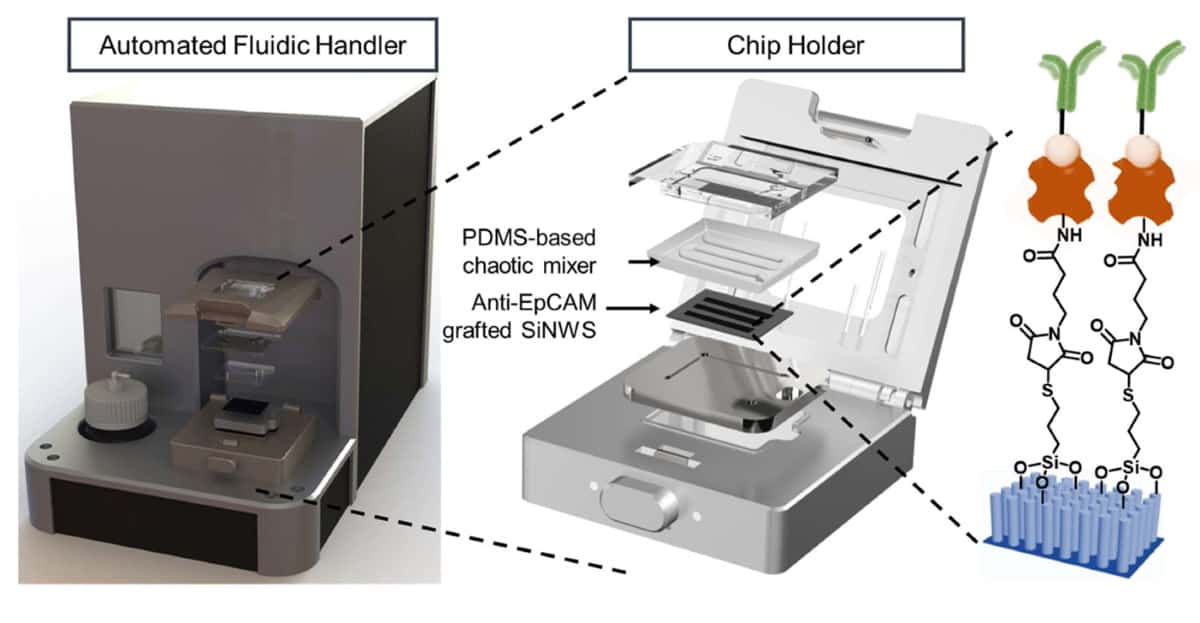
The NanoVelcro Chip is held in a device that distributes the blood sample throughout the microchip’s two functional components. The top component contains a layer of polymer-based chaotic mixer, which promotes the frequency of contact between the blood cells and the microchip’s nanostructure.

The bottom component contains a silicon nanowire substrate coated with a molecule-adhesion layer.  This layer contains antibodies that specifically recognize single and clustered circulating trophoblasts, while the nanowires function to lock up these cells within the microchip. The number of circulating trophoblasts captured by the NanoVelcro Chip determines the risk of having PAS disorder.

Overview of the NanoVelcro Chip

Detecting PAS disorder

In essence, NanoVelcro Chips act like biological Velcro strips that have been specifically designed to entangle single and clustered circulating trophoblasts in the mother’s bloodstream. To determine the efficacy of this novel microchip, the researchers used the NanoVelcro Chip device to analyse blood samples from 168 pregnant women diagnosed with PAS disorder and 15 healthy non-pregnant females.

The results of this pilot study showed that the detection rates of these circulating trophoblasts were significantly higher in the pregnant women with PAS than in the healthy control group. These findings were validated through the examination of placental tissues biopsied from PAS patients. Further validation using immunocytochemistry ensured that the cells captured on the microchip were indeed single and clustered circulating trophoblasts.

Ultimately, this novel microchip device provides the potential to aid in the early detection of PAS. “Timely detection and diagnosis of PAS provide opportunities to improve prenatal care and minimize maternal and neonatal morbidity,” the authors conclude. “Our study demonstrates a promising non-invasive technology for detecting PAS that does not rely on imaging instruments or expertise by taking advantage of the in vitro diagnostic value of NanoVelcro Chips.”

Are you good enough to cross the valley?

If you’ve never heard of the “valley of death” before, it’s quite simple. It’s a metaphor to describe what happens after a new company has raised seed money or early-stage funding to develop a product – but before it has started to generate revenue from that product. In crossing the valley of death, the firm can find it hard to raise additional funds since its business model has not yet been proven. And because developing a new product is so unpredictable, it can be hard to know when (or even if) a company will have a real product that customers can buy.

The fundamental difficulty for physics-based and other “deep-tech” businesses hoping to cross the valley is that it can take years to commercialize their products. And you often can’t just get those products ready faster by throwing more money at the problem. You don’t even know when your product will win any acclaim from customers, when it’ll have passed any business or environmental regulations, or how many improvements you’ll still have to make to ensure it sells in big enough numbers.

Rival firms are trying to get better, cheaper versions of your product to market faster

What’s more, all companies operate in a commercial market, where rival firms are constantly trying to get better, cheaper versions of your product to market faster. It’s therefore crucial you keep an eye on your competitors who will be moving the commercial goal posts too. However, if a start-up company does eventually survive “death valley”, it’s a big achievement, signalling to investors that the business has a commercial future with customers that want its products or services.

No illusions

In crossing the valley, it helps to have developed a properly validated business model with predictable revenue streams, which will make later-stage investors more willing to fund your firm. Another option is to take on a debt, such as a loan or invoice financing, to fund this stage. Generally speaking, however, the longer it takes a firm to earn any income, the more likely it’ll be to fail.

Trouble is, most founders are under the illusion that the first funding round will be the hardest and that, once they secure that cash, life afterwards will get easier. But the reality is that there are far more early-stage and “angel” investors willing to take a punt on a new firm than there are late-stage investors ready to sign fat cheques to fund the handful of successful companies that are now making money. Between those extremes lies the valley of death where it’s hard to call the winners and the risks are high.

Thankfully, venture capitalists – people who invest in firms in return for a stake in the business – are well aware of these pitfalls. They generally have the financial and sector experience to help you navigate the valley of death. Nevertheless, it’s still a risky business: very few companies are like Dropbox and Instagram, which quickly made handsome profits and offered investors a massive return on investment in a very short period of time.

Deep-tech businesses are crucial to society as they are often working on important problems, such as “net-zero” carbon-emission goals.

Deep-tech businesses are usually not like that, taking generally 2–10 years to reach the market and with more investment needed to get there. However, such firms are crucial to society as they are often working on important problems, such as helping us to achieve “net-zero” carbon-emission goals. The only way to make these longer-term investments attractive to investors is to offer incentives.

Help at hand

Here in the UK, the government thankfully has its finger on the pulse, with its announcement in July of a scheme known as Future Fund: Breakthrough. It will see the UK commit £375m of funding to fast-growing firms looking to raise at least £30m of investment provided they have previously raised at least £5m. Private investors will have to demonstrate they have secured 70% of the funding, with the lead investor making the connection between the business and the Breakthrough fund.

This scheme comes as a follow-up to the UK government’s previous Future Fund initiative, which was unveiled in March 2020 to support businesses during the pandemic. That scheme, which is now closed, provided more than £1bn of convertible loans to almost 1200 firms.

The new Breakthrough scheme, which is designed to speed up the deployment of innovations that could solve some of society’s greatest challenges, will cover everything from quantum computing and clean technology to the life sciences. This is vital investment given that even a 1% growth in these highly innovative firms could, according to the UK government, grow the UK economy by £38bn.

Rishi Sunak, the UK chancellor, is a key supporter of the scheme. “Our Future Fund: Breakthrough scheme,” he said, “will enable innovative businesses in every corner of the UK to access the finance they need to scale up and bring their transformational technologies to market – all while creating high-skilled jobs and boosting the economy.”

It will be administered by the British Business Bank’s subsidiary, British Patient Capital, whose chief executive Judith Hartley thinks that the UK is “fertile ground” for creating high-growth companies based on cutting-edge technologies, thanks to its many top universities and strong track record in science and research. “Through the commercialization of R&D,” she says, “these transformative companies will help accelerate the deployment of innovative breakthrough technologies that can transform major industries, develop new medicines, support the transition to a net-zero economy and strengthen the UK’s position as a science superpower.”

The schemes are good news, especially as the UK government’s spending on R&D is expected to reach £14.9bn in 2021. That’s the highest level in four decades and part of the UK’s attempts to increase investment in innovation to 2.4% of economic output by 2027. In helping firms cross the valley of death, I hope the new scheme will ensure the UK quickly gets over the economic impact of the COVID-19 pandemic.

Double-layered borophene is created at long last

For the first time, a stable sheet of double-layered borophene has been created. The feat was achieved by a team co-led by Mark Hersam at Northwestern University and Boris Yakobson at Rice University, who created the material by accident. Their discovery could lead to the development of new technologies based on borophene, which is a 2D material like graphene.

Boron is one of the lightest and most chemically versatile elements on the periodic table. In 2015, Hersam colleagues discovered that the element can exist in flat, atomically-thin sheets dubbed borophene. Six years on and the material is now known to possess both electrical and mechanical properties that could rival those of carbon-based graphene.

However, unlike graphene, which can be easily made by peeling sheets from graphite, borophene sheets must be grown directly on a metal substrate – making the material much more difficult to fabricate. Indeed, researchers had been unable to prepare borophene in its double-layered form because the material would revert to its 3D bulk structure.

Flat terraces

In their study, Hersam, Yakobson and colleagues were investigating how the growth of single-layer borophene is affected by the properties of metal substrates. Initially, their experiment involved heating a silver sample to extremely high temperatures. This led to the formation of flat terraces on the surface, each several microns across and separated by single-atom steps.

As borophene grew on top of this substrate, a combination of microscopy techniques revealed that in some cases, a single borophene layer can spread beyond the boundaries of its terrace to cover the layer growing on an adjacent lower terrace. There, the material formed two bonded borophene layers: separated by roughly three atomic widths, which did not revert to the bulk structure.

While these sheets retained the highly desirable electrical and mechanical properties of single-layer borophene, the researchers propose that the space between the layers could be incredibly useful for energy or chemical storage. For example, the inclusion of a layer of lithium ions could enable the manufacture of highly advanced 2D batteries.

While the widely varied geometries of carbon nanotubes and multi-layered graphene have been widely explored so far, the team believes that borophene could display an even richer diversity of structures. In future experiments, they aim to explore these possibilities in more detail. Structures that they plan to explore include double layers with alternative atomic arrangements; and thicker borophene sheets, featuring three or more bonded layers. If materials with desirable properties are found, it could lead to new advances in fields as wide-ranging as electronics, sensing, solar energy, and quantum computing.

The research is described in Nature Materials.

Microwave imaging could provide safer, more comfortable breast cancer screening

Microwave breast imaging (MBI) represents a promising non-invasive technology for detection of breast tumours. It does not utilize ionizing radiation nor require breast compression, potentially offering a safer and more comfortable method for breast cancer screening.

As of 2020, 10 MBI prototypes had been clinically tested. Researchers at Galway University Hospital and the National University of Ireland Galway have now performed first-in-human testing of an eleventh: the Wavelia system developed by MVG Industries. The clinical investigation, described in Academic Radiology, demonstrated Wavelia’s ability to detect and localize breast tumours, and to quantify the accuracy of lesion localization. The system proved to be safe and was well tolerated by the 25 women participating in this evaluation.

MBI is based on the differences in the electrical properties of malignant and normal breast tissue at microwave frequencies. Cancerous tissue has increased water content and vascularity compared with healthy tissue, resulting in a higher dielectric constant. MBI can quantify the location, shape and/or morphological properties of lesions based on this dielectric contrast. The measured data are then inverted by an imaging algorithm to produce an image of the breast.

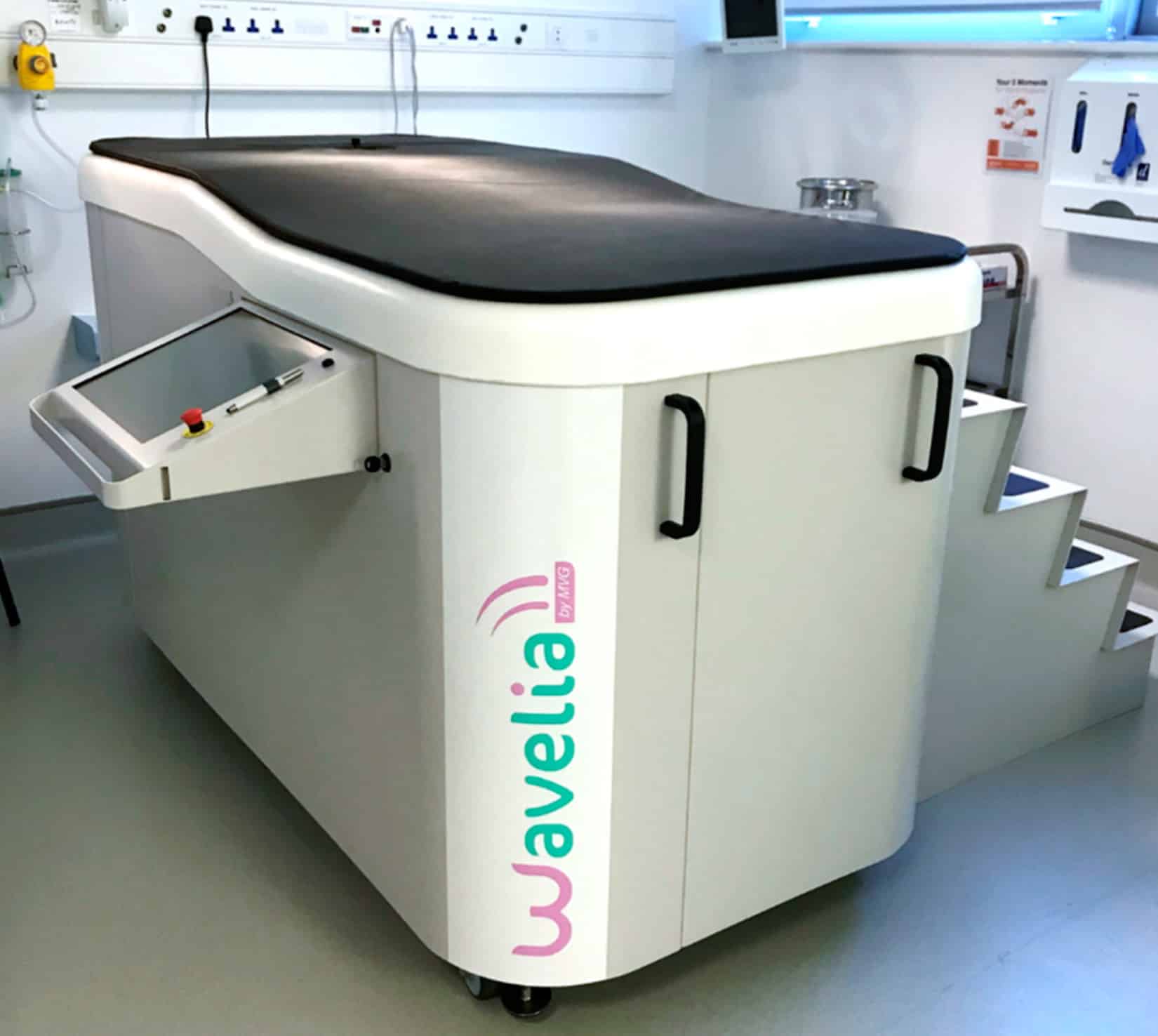
Wavelia MBI system

The Wavelia prototype includes two subsystems, the optical breast contour detection (OBCD) subsystem and the MBI subsystem, each integrated in an identical examination table. The OBCD subsystem consists of a 3D stereoscopic camera placed below the table, which is scanned to reconstruct the external surface of the breast and calculate breast volume, with the patient lying in prone position. The MBI scan is then performed using low-power, non-ionizing microwaves that propagate through the breast.

The Wavelia MBI system uses 18 equally-spaced wideband Vivaldi-type antennas arranged in a horizontal circle outside a cylinder containing coupling fluid. Each probe illuminates the imaging domain in turn, while the remaining antennas receive the electromagnetic scattering at various angles around the circle. The probe array also moves vertically, illuminating the breast at 5 mm intervals to capture the dielectric contrast for the entire breast. The system uses the MBI data to generate 10 mm-thick coronal sections of the breast, and then integrates the partially overlapping consecutive sections to form a 3D MBI image.

Clinical investigation

Lead author Brian Moloney and co-authors analysed MBI scans acquired from 25 patients, with 24 included in the final data analysis. The cohort included 11 patients with invasive carcinoma (six cases of invasive ductal carcinoma (IDC) and five of invasive lobular carcinoma (ILC)), plus four cases of benign breast disease, eight patients with a breast cyst and one with a complicated cyst.

MBI detected four of the six IDC lesions and all of the ILC lesions, correctly localizing seven of the nine detected cancerous lesions. The two IDCs that were not detected were less than 10 mm in size. Of the 13 benign cases, MBI detected 12 lesions and accurately approximated the location for 10 of these.

The patients also participated in a survey assessing the acceptability of the MBI process. This included questions regarding the scanning time, system vibration and noise, the temperature and smell of the surrounding liquid, and the comfort of the examination table. They were also asked whether they would recommend the procedure to other women. Responses were favourable, with 92% reporting that they would recommend the procedure.

Importantly, no clinical trial-related adverse events were recorded, highlighting the safety profile of the Wavelia MBI system.

Based on feedback from this study, the team developed a second Wavelia prototype. Technical upgrades include: an enlarged opening in the examination table to improve scan quality for larger breasts; upgraded antennas to improve imaging of the posterior of the breast; integrated thermoregulation; chemical stabilization of the transition liquid; integration of a patient positioning aid module in the MBI scanner; enhanced radiofrequency emission/reception chain; and mechanical support of the sensor array to improve signal stability and scan repeatability.

The researchers tell Physics World that a second clinical investigation is planned for early 2022 using the advanced prototype. “A multi-stage adaptive design is being considered for implementation in this clinical study, allowing us to first assess the technical performance of the upgraded Wavelia MBI prototype on an initial patient dataset,” they explain. “The identification of clinical cases for which Wavelia MBI could bring added value, as an adjunct imaging modality to conventional imaging, will be ultimately explored on larger and more diverse patient datasets.”

There is still much work to be done to make MBI a feasible breast cancer scanning technology. In addition to reducing the exam time, which for this study averaged 50 min, MBI systems must be able to image a wide range of breast sizes, detect small, non-palpable breast pathologies and achieve a non-negligible false positive rate. Large MBI clinical trials are required to confirm automated and consistent detection of various breast pathologies in breasts of differing tissue density.

The researchers, however, are positive about the technique’s capabilities. “The Wavelia MBI system holds significant potential for detecting breast abnormalities, while offering the patient a favourable experience over conventional mammography. This novel modality may also add significant value to the existing detection paradigm for ILC, which can evade conventional imaging,” they conclude.

The Sun’s enigmatic crown

The Sun’s corona is the beautiful crown-shaped glow that becomes visible to us on Earth during a total solar eclipse. Strangely, although the corona is a million times dimmer than the solar surface beneath, it is a million kelvin hotter. This video introduces the mystery of the hot solar corona and why a solution could leave us better prepared for the perils of space weather.

Find out more in the article ‘The enduring mystery of the solar corona’, originally published in the September 2021 issue of Physics World.

Terahertz radiation drives compact ultrafast electron diffractometer

A compact ultrafast electron diffractometer that can sit on a lab bench has been built by physicists in Germany. The team, led by Dongfang Zhang and Franz Kärtner at the Center for Free-Electron Laser Science in Hamburg, created their instrument by compressing bunches of electrons to ultra-short durations, using millimetre-wavelength terahertz radiation. With further improvements, their approach could greatly improve accessibility to ultrafast physics for many different research institutions.

Ultrafast electron diffractometers are powerful tools for probing molecular dynamics, which unfold over femtosecond timescales. The technology involves generating compressed bunches of electrons, which are diffracted by a sample. Afterwards, the characteristic diffraction patterns produced can be picked up by a detector, providing researchers with a snapshot of the molecule’s structure. By repeating the process in rapid succession, physicists can then accurately measure temporal changes within the material.

In the latest electron diffractometer designs, radio frequency waves are used to generate the shortest and brightest bunches possible – which are crucial in ensuring the highest possible time resolution. Yet due to the long wavelengths of this radiation, the equipment involved is typically bulky and complex – limiting its accessibility for many researchers.

Terahertz manipulation

In their study, Zhang and Kärtner’s team instead turned to terahertz radiation to generate and manipulate electron bunches. Terahertz radiation is at higher frequencies that radio waves and has recently shown promise in providing compact, ultrafast electron sources that can generate short, high-energy electron bunches at high repetition rates. This allowed the researchers to design an electron diffractometer small enough to fit on a tabletop.

To test the capabilities of their new instrument, the team first heated a silicon crystal sample using a short laser pulse, then used bunches of around 10,000 electrons, compressed to durations of just 180 fs, to probe its expansion over the next picosecond. As they hoped, the subsequent electron diffraction patterns agreed with the well-known properties of silicon expansion.

Highly synchronized

Another benefit of the diffractometer is that uses a single laser to produce the terahertz radiation, heat the sample, and generate, manipulate and compress the electron bunches. This allowed the measurement process to be highly synchronized – delivering high temporal resolution at a repetition rate of 1 kHz.

So far, the team’s experiments have studied samples as thick as 35 nm. Through further optimization, they hope that this could be increased to as much as 1 micron. If achieved, the technique could provide a highly desirable alternative to X-ray diffraction, which is often used to study ultrafast dynamics within thicker samples. Since electrons deposit far lower amounts of energy, they could be far better suited to investigating more delicate materials.

Ultimately, Zhang, Kärtner, and their colleagues hope that their innovations will make ultrafast electron diffractometers far more accessible to smaller labs, potentially opening up extensive new opportunities for research.

The instrument is described in Ultrafast Science.

Chain mail fabric stiffens under pressure

Physicists have designed a chain mail fabric that is easily foldable in normal conditions but becomes much stiffer when compressed. The lightweight and tuneable fabric was developed by Yifan Wang and colleagues at Singapore’s Nanyang Technological University and the California Institute of Technology. It comprises an intricate structure of interlocking, 3D-printed components – and undergoes a sudden phase transition when pressure is applied to its exterior.

From medieval chain mail armour to woven Kevlar sheets, structured fabrics have a diverse range of useful properties that include high impact resistance, heat regulation, and electrical conductivity. These properties arise from tailored combinations of material properties and component geometries. Building on existing designs of these materials, researchers are creating new smart fabrics that can vary their physical properties in response to environmental stimuli.

Wang’s team created its fabric by 3D printing a chain mail from a nylon plastic polymer. Their design comprises a lattice of interlinking, centimetre-sized components, each shaped as the hollow frame of an octahedron. Under ambient conditions, the fabric can be easily folded and deformed into complex shapes – but this changes dramatically when the fabric is encased in a flexible plastic envelope and then compacted by evacuating the envelope.

Jamming transition

Putting pressure on the fabric in this way raises the packing density of their chain mail: increasing the level of contact between each component and its neighbours. As a result, the material undergoes a jamming phase transition, where the hollow particles became rigidly interlocked – making them far more resistant to bending and deformation.

Wang and colleagues determined that their fabric could carry a load of over 50 times its own weight when stiffened, and also displayed just 17% of the deformation of its unconfined state when impacted by a fast-moving steel ball. Altogether, these experiments showed that the chain mail becomes over 25 times stiffer, when confined at pressures of roughly 93 kPa. In addition, the team showed that lattices comprised of aluminium particles had the same flexibility as nylon but could be jammed into far stiffer structures than their nylon counterparts.

The researchers say that if the components could be fabricated on smaller scales, these fabrics could have numerous applications: including stab- and bullet-proof vests, protection for high-contact sports, and wearable exoskeletons. The latter could provide enhanced mobility for elderly people or extra support for workers who lift heavy loads.

Elsewhere, the fabrics could be used to develop electrical devices with highly touch-sensitive interfaces. Wang’s team now hope to explore the potential for simpler, alternative stiffening mechanisms including magnetism, electrical currents, and temperature.

The research is described in Nature.

Thinking outside of the box – but not too far from it

Stephon Alexander’s riff on “Fear of a Black Planet” – the ground-breaking 1990 album by hip hop band Public Enemy – for the title of his latest book had me hooked before I read a single word. I’m a big fan of exploiting the fascinating links between music, mathematics and physics to engage audiences who might otherwise think science is not for them. A couple of years ago I had a great deal of fun writing When The Uncertainty Principle Goes To 11: or How to Explain Quantum Physics with Heavy Metal for the publisher Ben Bella (December 2018). Alexander, a theoretical physicist specializing in cosmology and quantum gravity at Brown University, is, however, in a class of his own when it comes to the music-physics nexus.

In his first book, The Jazz of Physics, he combined memoir, history of science and his musical expertise as an accomplished saxophonist to tell a profoundly personal story of finding deep connections between what initially appear to be entirely disparate subjects and phenomena (May 2016). Ultimately, the message that resonated most strongly was that physics needs the type of creative, left-field improvisation that drives the most affecting and influential music. Alexander’s new book Fear of a Black Universe: an Outsider’s Guide to the Future of Physics expands significantly on that same theme, while broadening the argument that physics is diminished, in a major way, if it does not accept and incorporate views outside the mainstream.

Alexander blends anecdote and vignette with a whistle-stop tour of topical, controversial and unresolved problems in modern cosmology

The author again draws deeply on his own personal experience and unique perspective. When he received his PhD from Brown College in 2000, Alexander was one of only three Black physicists enrolled on physics doctoral programmes in the US. Throughout the book, he blends anecdote and vignette with a whistle-stop tour of many of the most topical, controversial and unresolved problems in modern cosmology. That mix of science and memoir is a key strength of the book and is, with very few exceptions, seamless.

Alexander brings the physics to life by framing it within the appropriate historical, sociological, and/or personal context, often with a sprinkling of humour. I particularly enjoyed his reminiscence on cosmologist João Magueijo’s cutting riposte to an invited speaker at Imperial College London who described his theory as sick due to an inherent instability: “I want the damned instability,” replied Magueijo. “After all, you are an instability!”

At his best, Alexander is a talented and engaging science communicator, effortlessly wielding analogy and metaphor to energetically carry the reader along. In this book, however, his scientific explanations are somewhat variable – clear and accessible descriptions of introductory quantum mechanics, for example, contrast starkly with the rather more terse and arcane sections on core aspects of cosmology and particle physics.

If the intended audience is mainly made up of professional physicists, then this can be overlooked to an extent. But what is the more general reader, not acquainted with the minutiae and vagaries of quantum geometry, to make of the following passage, for example? “The theory that describes D0-branes falls into a class of quantum geometric theories called noncommutative geometry. What is intriguing is that a handful of approaches to quantum gravity all have some semblance to a pre-space, where geometry itself is fuzzy, or non-commutative.”

The proof copy of Fear of a Black Universe that I received for review has a quote on the back from David Spergel, winner of the 2018 Breakthrough Prize in Fundamental Physics, comparing Alexander’s book favourably with Stephen Hawking’s A Brief History of Time. But as Time magazine’s book critic Paul Gray wrote in 2001, “Of every 100 people who bought A Brief History of Time, three finished it”, not least because Hawking likewise took no prisoners when it came to describing core aspects of his research field to the non-physicist.

While any author would be happy to have the commercial clout of Hawking, it would be a great shame if Alexander’s book suffered a similar fate in terms of actual readership, because it makes a strong case for the importance of diversifying science, and deserves to be widely read. Yet with that said – and despite completely agreeing with Alexander on the central importance of valuing and elevating minority and outsider perspectives – I cannot bring myself to endorse his argument that we should embrace even the wildest, most unconstrained riffing when it comes to furthering physics. To quote that famous aphorism, often attributed to Carl Sagan: “It’s important to keep an open mind, but not so open that your brains fall out.” Even pioneering jazz musician John Coltrane – an abiding influence on Alexander – had to know the rules so as to break them.

Heisenberg could hardly have been more scathing of Schrödinger, writing that “the more I think of the physical part of the theory, the more detestable I find it”

In a chapter titled “If Basquiat were a physicist”, Alexander argues that “both the art world and the physics world have deviant actors. The difference is that the art world has embraced graffiti, while the scientific community has yet to embrace those who take risks.” Well, that depends on what we mean by taking risks. Louis de Broglie’s leap of scientific imagination in imbuing matter with wavelike characteristics was hardly the most traditional of approaches, nor was Erwin Schrödinger’s development of his famous equation. Werner Heisenberg, in an infamous letter to Wolfgang Pauli, could hardly be more scathing of Schrödinger, writing that “the more I think of the physical part of the Schrödinger theory, the more detestable I find it… In other words, I think it is shit.”

Physics has nevertheless embraced these and other leaps of imagination made by those who laid the foundations of quantum mechanics, but with an important justification for doing so: their intense focus on interpreting empirical measurements. Connection with experiment and observation is paramount. Quantum mechanics has Hermitian operators at its very core precisely because they allow us to describe physical observables – only real eigenvalues exist in the real world.

Yet increasingly, in some strands of 21st-century theoretical physics, empiricism is viewed as an afterthought, at best – and Alexander’s book disappointingly continues this trend. After all, those irksome mundane measurements tend to rein in our imaginations. Why have a beautiful theory brought down by an ugly experimental result?

Indeed, when it comes to the many-worlds interpretation of quantum mechanics, of which Alexander writes approvingly, the requirement for empirical evidence is routinely dismissed. A recent viral video, which which has had more than 10 million views, from science communicator Derek Muller (best known for his YouTube channel “Veritasium”), is titled “Parallel worlds probably exist. Here’s why”. Yet how much empirical evidence is there to justify a choice of this interpretation over any of the many others out there? None. (At least in this universe.)

In the second half of the book, titled “Cosmic Improvisations”, Alexander outlines a variety of what might be best described as physics jams – free-wheeling, other-worldly theories. But it’s in his final chapter, “The cosmic mind and quantum cosmology”, that he really over-extends himself. Physics is in a very bad place indeed if we are expected to take the likes of self-styled “quantum healer” Deepak Chopra seriously, as Alexander encourages.

For those unfamiliar with Chopra, a single representative quote is enough to get the measure of the man, when he says that “viewing your body from the perspective of quantum physics opens up new modes of understanding and experience for the body and its ageing. The practical essence of this new understanding is that human beings can reverse their ageing.” We do both our subject and its popularization to non-physicists a major disservice by suggesting that Chopra’s mysticism is in any way credible. Should we also take actress Gwyneth Paltrow’s similarly quantum-inspired “energy healing” seriously? To argue that it is somehow closed-minded or exclusionary to roundly reject Chopra’s groundless guff devalues Alexander’s more compelling arguments elsewhere in the book.

Imagination, creativity, and a willingness to think “outside the box” are certainly aspects of physics that we should embrace, and Fear of a Black Universe makes a convincing case that we need greater diversity in worldview, mindset and culture. But thinking inside the box has also been a mainstay of quantum mechanics: the humble particle-in-a-box underpins quantum physics 101 and so much more.

As philosopher Francis Bacon, the father of empiricism, stressed centuries ago, “The understanding must not therefore be supplied with wings, but rather hung with weights, to keep it from leaping and flying.” We need fewer, not further, flights of fancy in modern physics.

  • 2021 Basic Books $17.99hb 256pp
Copyright © 2026 by IOP Publishing Ltd and individual contributors