20,000 channels of seismic data reveal Arctic climate change

Let’s start with the project. What were you doing up on the North Slope?

We wanted to try a technique called distributed acoustic sensing (DAS) under ice for the first time. The way DAS works is that you take a standard fibre-optic cable, like the ones used for telecommunications, and on one end of the cable you have a device called an interrogator that rapidly pulses laser light down the fibre. This creates a certain amount of backscattered light – there’s Rayleigh scattering, Brillouin scattering, Raman scattering and so on that all comes back to you. We’re interested in Rayleigh scattering, which comes about due to natural imperfections in the glass (changes in the density of the glass affect its refractive index) and doesn’t change the wavelength of the scattered light.

So you send a laser pulse down the fibre, and then you send out another pulse and compare what you get back. If the fibre has been strained or changed length in the meantime, there will be a phase shift between the two pulses. Then you can use your knowledge of the optical properties of glass to convert the phase shift into a nanometre per metre per second strain rate that tells you what happened to the fibre between the two pulses. In essence, the fibre is like a 40 km-long (in our case) seismometer that sits inside a 4 m-deep trench (which protects the fibre from icebergs that might ground and catch on the cable) in the sea floor and measures vibrations in the Earth.

The nice thing about this DAS technology is that it’s very, very difficult to get a traditional ocean-bottom seismometer or even hydrophones running in the Arctic environment. The transportation access is terrible, the weather can be dangerous – all sorts of things can go wrong. But now, instead of having a few ocean-bottom seismometers for a short period, we have 20,000 channels of seismic data.

How do you get that many channels?

Although the fibre-optic cable is continuous, the strain rate is measured at discrete intervals along it – hence the nanometre-per-metre-per-second units. For this experiment, the intervals were 2 m long, so over the 40 km length of the cable, that’s a total of 20,000 channels coming from this cable, all in an area that previously had virtually no seismic data at all. And if we want to do the same experiment next year to see if there’s been any change in the environment, this fibre is going to be in the same spot for decades – it was installed by a telecommunications company called Quintillion to bring the Internet to the North Slope of Alaska. We’re just piggybacking on it.

What was it like working up there? I guess it was pretty dark in February.

Yes, the Sun wasn’t up for long during the day and it wasn’t very high above the horizon when it was, but I was surprised at how light it was. Everything’s covered in snow, so you get a lot of reflected light. The temperature, though, was –43 °C, with a wind chill of –60 °C, and we had a lot of blowing snow and ice fog when we drove from our accommodation in Deadhorse, Alaska to the cable landing station at Oliktok Point (the most northerly spot in North America that you can drive to, at around 70 degrees north latitude). But the great thing about DAS is that you can take most of the data from inside the landing station. You’re not huddled in a tent out on an ice sheet.

As for how the instruments coped with the conditions, the interrogator is certainly not indestructible. It has a narrow range of temperatures where it’s happy, and you can’t store it below 0 °C without damaging it. That was difficult because on the two-hour drive out to Oliktok, we had to have the instrument taking up a seat in the car – we couldn’t put it in the back of a pickup truck because by the time we got to the field site, it would have been ruined. The interrogator can overheat, too, which is a problem if you use it in the desert in Nevada.

Rob Abbott in freezing fog

Why Nevada?

I originally got interested in DAS because of a series of experiments I was involved in at the Nevada National Security Site, which is where the US did its continental nuclear weapons testing between the 1950s and the early 1990s. Nowadays, we’re doing chemical explosion tests for nuclear nonproliferation purposes, to help us discriminate earthquakes from explosions.

A few years ago, as an add-on experiment – not really expecting to get great data – I proposed using DAS to monitor these explosions. It worked beyond our expectations, and after that, it was like I had a new hammer and I was looking for nails sticking up: I wanted to find more ways to use this fantastic new tool. I had done some previous work in Alaska using traditional seismometers to listen to permafrost melting, so when the first examples of DAS on the sea floor came out late in 2019, I thought, “I wonder if there’s a telecoms networks up in Alaska where I could try this under the sea ice?”

DAS worked beyond our expectations – it was like I had a new hammer and I was looking for nails sticking up

So I sent an e-mail to Quintillion – initially just a cold e-mail sent via the “Ask us about our Internet service” button on their website. But luckily, the person who was monitoring that address had studied geophysics at the University of Alaska, so when I said, “Hey, I’d like to do distributed acoustic sensing on your fibre”, I got an almost immediate response. I had no expectation I’d ever hear from them, but I did, and it was great.

Who else are you working with?

One of our partners on the Arctic project is Silixa LLC, the UK-based company that makes our DAS system. They do a lot of work with the oil and gas industry, which uses DAS for microseismic monitoring in wells and was an early adopter of the technology. But we take data that the oil industry doesn’t, so that strains the limits of DAS and helps Silixa develop their technology further. It’s already working well, though. The explosions I mentioned in Nevada involved 50,000 kg of explosives and the sensors were only 80 m away, whereas in the Arctic we’re listening to tiny ice quakes 40 km out in the ocean.

What are ice quakes?

Ice quakes can happen when ice that’s “fast”, or stuck to the shore, collides with free-floating ice on the sea. They occur within shore-fast ice and within sea ice, too, but they are more common at the interface because it’s an area of great friction – especially when the tide goes in and out, and the wind pushes on the ice as well. You can also get what’s called basal-slip icequakes, where bottom-fast ice grinds on the sea floor.

It’s interesting that we see ice quakes in our data because our sensors are not in the ice: the ice is at the surface, then there’s a layer of water, then the sea floor and then our cable. The physics of how these layers couple is complex. For example, ice is a solid, so it can carry both P (pressure) waves and S (shear) waves, but fluids like water can’t propagate shear waves. That means you can tell the difference between ice quakes and earthquakes, because with earthquakes the system picks up waves that can’t propagate in water.

What else do you hear when you listen under the Arctic ice?

One other thing we hear is what’s known as flexural gravity waves. When the wind relentlessly pushes on the ice, it causes the ice to mound up, and then gravity takes the ice back down. That produces a long-period wave (at least, it’s long in seismic terms – it’s about 40 seconds) as the ice works and flexes. We see that in the data and that’s one of the things we’ll use to measure ice thickness. This is a difficult measurement to do, and a lot of times it’s done from satellites with a resolution that is maybe not as good as we would like.

We hear ocean dynamics as well. The ice does not reach all the way to the sea floor where the cable is, so we see the effect of currents in the ocean as well, under the ice. That is also a very hard measurement to take, so data like this is gold for climate modellers – they can add it to their ocean circulation models.

What do you hope to learn in the longer term?

Our major goal is to gather more information about climate. We’d like to have a better idea of the intensity and distribution of Arctic storms, for example. We should be able to look up the ambient noise level of a storm and determine how severe it is. In the future, we’d like to combine our DAS work with measurements made by buoys, so that we can work out the transfer function between the strain rate of the fibre in the sea floor and the wave height of the buoys, either on ice or in the water. If we know that relationship and it’s robust, then we’ve essentially put 20,000 buoys in the ocean that aren’t going anywhere and we can come back to them year after year. The DAS fibre is going to be there forever in practical terms; at least, I’ll be retired before it’s gone.

That kind of data will help us understand ocean circulation and wave height. So if we find that wave height is increasing every year – and maybe it is and maybe it isn’t, but let’s say it is – then that will have big implications for coastal erosion, which is already a problem on the North Slope. The higher the wave height, the more energy is impinging on the shore, so if we know about it we can make better predictions of how long coastal cities like Utqiagvik can continue in their current locations before they have to move. Fundamentally, we’re listening to the rhythm of the climate.

Top tips for super sandcastles: explore the weird world of sand

A peerless edifice rises into a brilliant blue sky. Around a central, vaguely pyramidal tower, dozens of spires and turrets of assorted shapes and designs jut out between battlements and buttresses. Around the base runs a fortified wall, behind which a watchful dragon emerges from a body of water, while a lighthouse beams down from one side of the imposing structure.

This isn’t the design of a new Physics World head office [alas! – ed.], but that of a colossal sculpture that recently broke the Guinness World Record for the tallest sandcastle ever built. Crafted from 4860 tonnes of sand, spanning 32 m wide and rising to a height of 21.16 m, the castle (see photo above) was constructed by Dutch artist Wilfred Stijer and his 30-strong team of sculptors. It was built, with the aid of an elaborate wooden scaffold, in July 2021 in the Danish seaside village of Blokhus, in North Jutland. Thanks to a layer of glue applied to its surface after completion, the super sandcastle is expected to remain on display for visitors to enjoy until February or March next year, when the next heavy frost will set in.

But working with sand isn’t as easy as it looks. Before Stijer and his team’s success, the world’s tallest sandcastle was a 17.65 m tall structure built in the German seaside resort of Binz by another Dutch sand-sculptor, Thomas van den Dungen. No stranger to pushing sand to its limits, he had previously helped to create the world’s longest sand sculpture (27.3 km) and the largest number of sandcastles built in one hour (2230).

However, Van den Dungen’s previous two attempts to break the tallest-sandcastle record failed after one edifice collapsed days before completion, and the other was foiled by a flight of protected shore swallows that had nested on the construction site. None of us are likely to build anything as ambitious when we’re holidaying on the beach, but is there anything that science can tell us about how to make the perfect sandcastle?

Slippery when wet

A good place to start is with Matthew Bennett, an environmental scientist at the University of Bournemouth in the UK, who in 2004 was commissioned by Teletext Holidays to identify the UK’s best beaches for making sandcastles. Different beaches have different types of sand, so his job was to find out which has the best material to work with.

Arming his students with buckets and spades, Bennett sent them to the 10 most popular beaches in the UK at the time, with instructions to collect samples of sand from each. Once they had brought the material back to the lab, his team dried the sand, poured it into beakers, added water and turned each full container upside down. “We then piled weights on each ‘lab-castle’ top and noted the total weight [it could sustain] before collapse,” Bennett explains.

The key to a strong sandcastle, the team found, was to mix one bucket of water to every eight buckets of sand. That 8:1 volume ratio, which was the same for all 10 locations tested, is in fact roughly the same composition found on real beaches around the point where the water comes nearest to the shore at high tide.

According to Bennett, this perfect ratio ensures that the water helps only to bind the sand, rather than act as a lubricant. Too much water and your structure will flow and collapse, which is what happens when sandcastles meet their natural predator, the tide. Too little, on the other hand, and the sand crumbles.

In fact, the strength of a pile of sand depends on two factors. The first is the structure of individual grains. Those that are more angular and irregular will lock together better than grains that have become rounded by virtue of having been transported a long way – a process that abrades them through the action of wind and waves. It’s why sand containing lots of microscopic, angular fragments of broken seashells is good for building strong sandcastles, Bennett explains. The other, more important, factor is the amount of water held between them, with smaller grains holding more water.

Bennett’s study led him to name Torquay in the south-west of England as Britain’s best place for sandcastles, thanks to what he calls “its delightful red sand”. Close in second is Bridlington in East Yorkshire, with Bournemouth, Great Yarmouth and Tenby all tying for third. “It was a simple but effective experiment,” Bennett recalls, explaining that he still uses the investigation as a fun way to engage people in geological concepts.

He admits, though, that any sand can, in principle, be used to make sandcastles – and that the selection of Torquay’s red sand as the “winner” of his 2004 study was in no small part down to its attractive aesthetic properties. It did help, however, that the sand in question originated more than 200 million years ago when Britain, which was then located in the interior of the supercontinent Pangaea, was part of a desert that outsized the Sahara. Torquay’s sand therefore has lots of fine grains, which Bennett says boosts its cohesive properties.

Bridges, not too far

For a physicist, a sandcastle is simply a structure made of a compacted granular material (sand) mixed with a liquid (water or seawater). But how does this water help sand grains to stick together? The answer lies in the surface tension of the films of water that form between the grains. Just as the surface of water in a test tube curves up at its edges due to adhesive forces between the glass and the liquid, so water forms tiny “capillary bridges” between sand grains. These bridges pull the grains towards each other, minimising the surface area between the water and air while increasing the surface area between water and the sand to which it is attracted.

Now, while an 8:1 ratio of sand to water might be the best for sculpting, it turns out that wet sand is still stable – i.e. acting as if it were a solid – over a wide range of water contents. There’s obviously something odd about the force that holds sand together, which is what inspired Stephan Herminghaus, a physicist at the Max Planck Institute for Dynamics and Self Organization in Göttingen, Germany, to take a close look at the phenomenon.

Figure 1

Rather than studying sand itself, he and his team turned to a model system made of wet, glass beads that were of similar size and shape to sand. Using X-ray microtomography – a technique that creates digital cross-sectional images of an object without damaging it – they were able to create 3D images of the beads and examine what happens as more water is added to the fake sand. The tiny capillary bridges, which initially link two separate grains, begin to get bigger and merge, forming increasingly complex structures that often look like a series of ring pulls from drinks cans stuck together (figure 1).

As the bridges grow, they come into greater surface contact with the grains, which increases the binding effect of the water thanks to its attraction to the sand grains. At the same time, however, the concave arch of the capillary bridge becomes less pronounced, reducing the negative pressure in the water As the negative pressure of the water is what draws the grains together, reducing it causes the grains to be drawn together less.

The two effects balance out, meaning that the simulated sand retains the same stickiness as more water is added to it. However, the rule was found to break down once the water occupied around 15% of the sand pile, or 35% of the total available pore space between the grains. Beyond that limit, the integrity of the pile began to weaken.

You don’t need much water to create big, tall sandcastles: small capillary bridges act like a glue between grains of sand

“The remarkable insensitivity of the mechanical properties [of the pile of sand] to the liquid content is due to the particular organization of the liquid in the pile into open structures,” the researchers note in their 2008 paper (Nature Materials 7 189). In other words, we now know why you don’t need much water to create big, tall sandcastles: it’s all down to the small capillary bridges, which act like a glue between grains.

A thumping good time

But is there a theoretical limit on how high you could build a sandcastle? That was a question that Daniel Bonn, a physicist at the University of Amsterdam in the Netherlands, set out to explore with his colleagues in 2012. They did this by pouring various amounts of wet sand into plastic cylinders of various diameters, before cutting away the mould and seeing how high the columns could be made before they collapsed.

The team found that columns give way when they buckle elastically under their own weight. Given this, the researchers determined that the maximum possible height of a sand column increases in proportion to the base radius of the column to the power 2/3. Do the maths and you’ll see that to build a column of sand twice as high as your friend, you need to make its radius8 2.8 times as big. From measurements of the elastic modulus of the wet sand, meanwhile, they concluded that the optimum strength is achieved at a liquid volume fraction of around 1%.

A sand column and ruler in Daniel Bonn's lab

That figure differs from the ratio Bennett found in his bucket-and-spade study, which is perhaps not surprising given that real sandcastles tend not to be cylindrical, as in Bonn’s study, but often more conical. After all, a cone shape maximizes the stability of a sandcastle structure, as a modelling study published by Wenqiang Zhang from Zhengzhou University in China revealed last year (IOP Conf. Series: Earth and Environmental Science 514 022071).

Asked about practical tips for budding castle sculptors, Bonn says that compaction is key to stability. That’s why professional sandcastle builders usually use machines called “thumpers” that mechanically compact sand before it’s used by repeatedly stomping down on the ground. Compacting sand helps to shorten its capillary bridges, making the sand stronger.

What’s also useful is polydisperse sand containing a wide range of grain sizes. While we tend to think of sand as being made just of quartz, for geologists the term refers to any particles of worn rock ranging in size from 62.5 μm up to 2 mm. Expert castle builders in fact often favour sculpting with “river sand”, which has even finer clay particles ranging in size from 0.98 to 3.9μm. According to Bonn, river sand effectively puts small grains in the pockets between the large ones, thereby creating more capillary bridges and a stronger structure.

Clays, in other words, act as a “glue” between particles, even when there is little or no water. But if you haven’t got river sand, you can get a similar effect using seawater. As your sandcastle dries, salt crystals get deposited on the grains of sand, acting as a substitute glue. It’s one added advantage of building sandcastles at the seaside.

The sands of time

But even if there isn’t a nearby ocean to keep things wet, capillary bridges can form between sand grains as a result of vapour spontaneously condensing inside porous materials and between adjacent surfaces. Known as “capillary condensation”, this phenomenon can affect not only adhesion but also properties such as corrosion and friction in a wide variety of settings. In fact, the ancient Egyptians might even have benefited from making capillary bridges by pouring water onto sand in order to make it easier to pull heavy stonework across (see box).

Capillary condensation is usually described by an equation drawn up by the British physicist and mathematician William Thomson (later Lord Kelvin) in 1871. It links macroscopic properties such as pressure, curvature and surface tension, but the equation also holds at the microscopic scale. Indeed, it has proven to be surprisingly accurate even down to a scale of around 10 nm.

To investigate why this might be, a team led by the Nobel-prize-winning physicist Andre Geim at the University of Manchester recently fabricated the smallest capillaries possible. Some only one atom high, they were created from layers of atom-thin mica and graphite, separated by narrow strips of graphene that served as spacers. Geim and his team found that these tiny capillaries can accommodate only a single layer of water molecules within them (Nature 588 250).

Studying condensation in these capillaries, the team realized that the Kelvin equation remains an excellent description even at the molecular scale – even though at these dimensions, water changes its properties as its structure becomes more discrete and layered. “This came as a big surprise. I expected a complete breakdown of conventional physics,” says lead author Qian Yang. “But the old equation turned out to work well.”

According to the team, however, the qualitative agreement between the equation and reality is also fortuitous. Capillary condensation under ambient humidities creates pressures of around 1000 bars – more than found at the bottom of Earth’s deepest oceans. This pressure may hold the grains in a sandcastle together, but it also fractionally deforms the tiny capillaries in the researchers’ experiments, counteracting the altered properties of water at the molecular scale.

“Good theory often works beyond its applicability limits,” admits Geim. “Lord Kelvin was a remarkable scientist, making many discoveries but even he would surely be surprised to find that his theory – originally observed in millimetre-sized tubes – holds even at the one-atom scale. In fact, in his seminal paper Kelvin commented on exactly this impossibility. So our work has proved him both right and wrong, at the same time.”

Water like an Egyptian

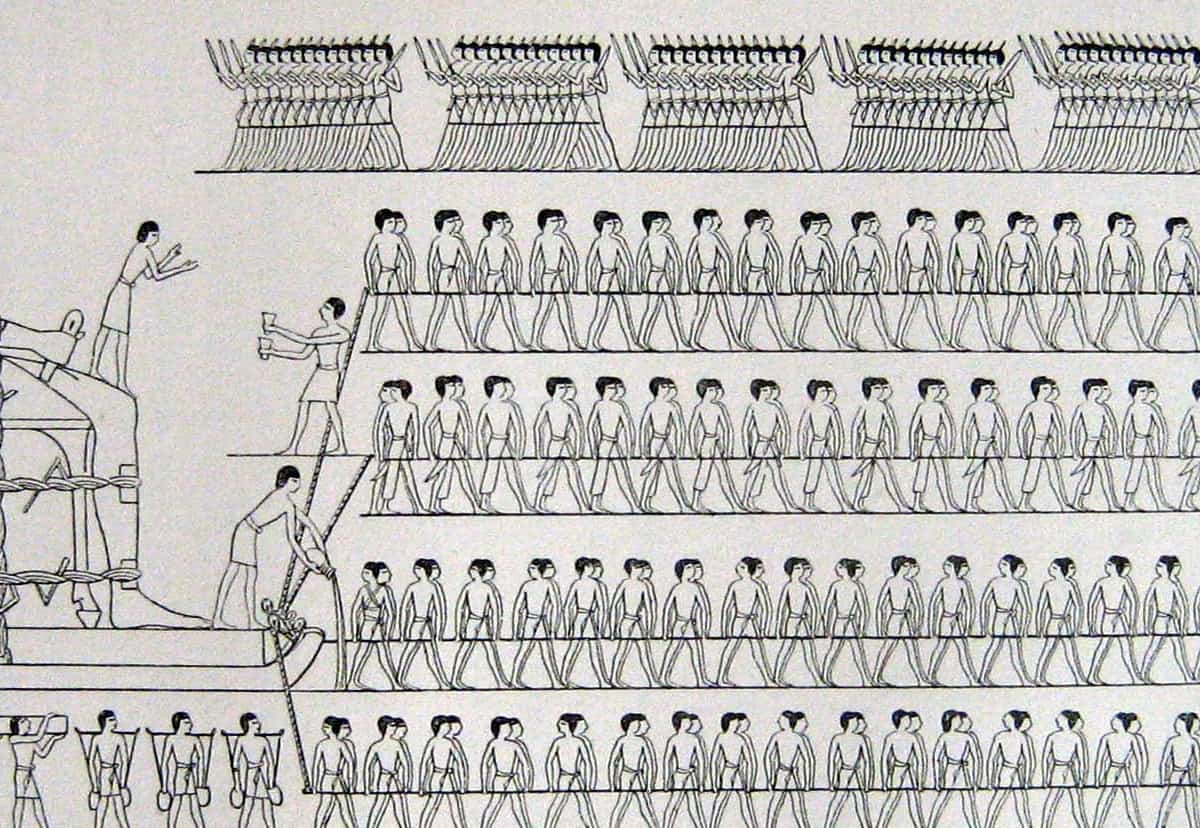
Sketch of a mural that once adorned a wall in the tomb of Djehutihotep

If building sandcastles doesn’t satisfy your construction itch, it turns out that sand and water can be used to help make far more elaborate structures. Writing in a paper published in 2014 (Phys. Rev. Lett. 112 175502), a team led by Daniel Bonn – a granular physicist from the University of Amsterdam – argued that the ancient Egyptians used water to harden desert sand. This tougher stuff allowed the Egyptians to move sledges bearing heavy stones more easily about when constructing pyramids and other colossal monuments.

The inspiration for this notion came from a roughly 3900-year-old mural that once adorned a wall in the tomb of Djehutihotep, one of the most influential nomarchs (or provincial governors) in Egypt’s Middle Kingdom, which ran from about 2050 to 1780 BCE. The decoration depicted a giant colossus of Djehutihotep – the height of four men – being pulled on a sledge across the desert by 172 workers (pictured above).

What’s interesting is that the figure standing at the front of the sledge in the mural is pouring water on the sand over which the giant statue is soon to be hauled, while two other slaves replenish his supply. Egyptologists had long dismissed this curious action as a ritual, but Bonn and colleagues experimentally demonstrated that adding a certain amount of water to sand stiffens it by forming microscopic “capillary bridges” (see main text).

These bridges lower the friction coefficient of the sand, while also stopping sand from piling up in front of the sledge or letting it sink into the sand. Specifically, the team found that the coefficient of dynamic friction halves when the water content of the sand reaches around 5%. Anything more, however, and the friction rises, even surpassing the value for dry sand at a 10% water content.

It gets everywhere

Examining the physics of sand and the capillary forces that hold it together is useful for more than just building the best sandcastle. For example, the imaging techniques developed by Herminghaus and his team to study glass beads can be applied to grain–liquid–air interfaces more broadly. That work could therefore yield practical applications away from the seaside – from stopping powders clumping up to improving our ability to anticipate and prevent landslides.

Nailing down the mechanical properties of wet sand can also inform construction efforts. After all, most roads, railways, houses and buildings are built on sandy soils, but these need to be stable if such structures are to survive. Water can reinforce sand piles, which helps them become more stable, but it can also be a danger in reducing compaction.

As any civil engineer knows, building on un-compacted sand risks “quicksand”, a builder’s nightmare. Consisting of loose sand saturated with water, quicksand can initially appear solid. But being a non-Newtonian fluid, the quicksand liquefies when agitated, for example through a ground tremor. It forms a suspension and loses its viscosity, allowing objects to sink into the sand.

That’s a particular problem in the Netherlands, where Bonn is based, which has lots of quicksand on land reclaimed from the sea using dikes. Known as “polder”, this land cannot be built on immediately, forcing builders to have to wait several years for the sand to compact before starting construction. “If it is not compacted,” says Bonn, “you can sink away and get stuck in it.”

The perfect mix

So before you hit the beach, let’s recap. For a truly breath-taking sandcastle, select a location with a decent amount of finer-sized sand. Take wet sand from around the high-tide mark, which will give you the ideal 8:1 ratio of sand to water. Compact your material to increase stability. If you want a tall tower, aim for a wide base and a conical shape. Then simply unleash your creativity. You’ll have a masterpiece on your hands…until your structure is, inevitably, washed away by the incoming tide.

Paddle board is made from old wind turbine blades, quantum technology for sustainability

Stand-up paddle boarding is up near the top of my bucket list, so I was pleased to learn that researchers at the Fraunhofer Institute for Wood Research, Wilhelm-Klauditz-Institut have created a board that is made from 100% renewable materials – instead of the usual petroleum-based materials. What is more, the light-weight material that they have developed for paddle boards can be used in buildings, cars and ships.

Christoph Pöhler and colleagues created the material using balsa wood from old wind turbine blades. Yes, that’s right, those giant blades can contain up to six cubic metres of wood. When a blade reaches the end of its lifetime, the wood is often discarded and even burnt – which is a waste of a valuable resource.

Pöhler’s team has created a way of separating the wood from the fibreglass that it is bound to. The wood is then pulverized to create a powder that is used to make a light-weight wood foam – a process that does not require the addition of an adhesive.

Flax reinforcement

The hard shell of the paddle board is made from a bio-polymer that is reinforced with flax fibres. The process has been patented and the researchers hope to have a demonstrator model available next year. One possible future use of the material is cladding for the thermal insulation of buildings.

Staying on the theme of sustainability, the folks at The Quantum Daily and Oxford Instruments have put together a nice video (see below) that looks at how quantum technologies could help in the fight against climate change. Examples include how quantum computers could someday rapidly and efficiently do complex calculations that could lead to the development of sustainable technologies – calculations that are well beyond the capabilities of even the most powerful supercomputers.

The video also looks at way of reducing the energy consumption of quantum technologies themselves – which at the moment can be very large, especially for devices that must be cooled to near absolute zero.

New evidence supports dark-spot theory for Betelgeuse’s ‘Great Dimming’

Early last year, the astronomy world was abuzz with speculation that Betelgeuse, a red giant star in the constellation Orion, might be about to go nova. This speculation was prompted by observations that Betelgeuse, which is normally one of the brightest stars in the sky, had dropped from magnitude +0.5 down to a mere +1.64 in a matter of months – something that could have been the precursor to a supernova of a magnitude not witnessed on Earth since the creation of the Crab Nebula in 1054.

As fun as that speculation was (and we indulged in a bit of it ourselves), the real explanation was always likely to be more mundane – and so it proved. By March 2020, Betelgeuse’s dimming had gone into reverse. Ironically, the star got back to normal just as life here on Earth was going haywire.

In June 2021, we got the first detailed explanation of what was going on. In a study published in Nature, Miguel Montargès and colleagues used observations from the SPHERE instrument on the Very Large Telescope in Chile to show that Betelgeuse’s dimming was confined to its southern hemisphere. According to the group’s simulations, this localized dimming occurred because a cool patch that appeared in Betelgeuse’s outer layer caused a dust clump to form in the vicinity of the star – a neat combination of two non-supernova-based speculations put forward to explain the star’s anomalous dip in output.

Now, a second group of astronomers has produced an independent study that both corroborates that result and adds to it. This group, led by Sofya Alexeeva and Gang Zhao of the Chinese Academy of Science Key Laboratory of Optical Astronomy in Beijing, used the Weihai Observatory at Shandong University to obtain detailed spectra of Betelgeuse on four nights in early 2020.

These spectra show that while the star’s effective temperature dropped by at least 170 K during its dimming episode, the chemical abundances of various indicator elements (including carbon, nitrogen and oxygen as well as metals like titanium, iron and strontium) remained stable over time once temperature variations were taken into consideration. This, the astronomers say, supports the theory that the dimming of Betelgeuse was caused by a dark spot emerging on the star’s surface, not by a dust cloud that happened to pass between Betelgeuse and Earth or by a change in the way the star pulses.

I suspect this latest study, which appears in Nature Communications, won’t be quite the last word on the subject. Apart from anything else, the explanation “Betelgeuse got dimmer because a dark spot appeared on its surface” is just begging for a follow-up: okay, so what caused the dark spot? Still, it’s nice to see that the answers to some complex scientific questions are within our grasp – even when the objects in question are hundreds of light-years away.

‘Stop-motion movie of atoms’ reveals short-lived state in nanoscale switch

A new ultrafast imaging technique that captures the motion of atoms in nanoscale electronic devices has revealed the existence of a short-lived electronic state that could make it possible to develop faster and more energy-efficient computers. The imaging technique, which involves switching the devices on and off while taking snapshots of them with an electron diffraction camera, could also help researchers probe the limits of electronic switching.

“In general, we know very little about the intermediate phases materials pass through during electronic switching operations,” explains Aditya Sood, a postdoctoral research at the US Department of Energy’s SLAC National Accelerator Laboratory and lead author of a paper in Science about the new method. “Our technique allows for a new way to visualize this process and therefore address what is arguably one of the most important questions at the heart of computing – that is, what are the fundamental limits of electronic switches in terms of speed and energy consumption?”

Ultrafast electron diffraction camera

Sood and colleagues at SLAC, Stanford University, Hewlett Packard Labs, Pennsylvania State University and Purdue University chose to study devices made from vanadium dioxide (VO2) because the material is known to transition between insulating and electrically conducting states near room temperature. It thus shows promise as a switch, but the exact pathway underlying electric field-induced switching in VO2 has long been a mystery, Sood tells Physics World.

To take snapshots of VO2’s atomic structure, the team used periodic voltage pulses to switch an electronic device made from the material on and off. The researchers synchronized the timing of these voltage pulses with the high-energy electron pulses produced by SLAC’s ultrafast electron diffraction (UED) camera. “Each time a voltage pulse excited the sample, it was followed by an electron pulse with a delay that we could tune,” Sood explains. “By repeating this process many times and changing the delay each time, we created a stop-motion movie of the atoms moving in response to the voltage pulse.”

This is the first time that anyone has used UED, which detects tiny atomic movements in a material by scattering a high-energy beam of electrons off a sample, to observe an electronic device during operation. “We started thinking about this subject three years ago and soon realized that existing techniques were simply not fast enough,” says Aaron Lindenberg, a professor of materials science and engineering at Stanford and the study’s senior author. “So we decided to construct our own.”

Atomic structure remains unchanged

Using this new technique, the team discovered that applying fast electrical pulses to VO2 drives the material into an electronic state that does not usually exist. This state, which lasts for only microseconds, appears when the material transitions from being insulating to conducting. Unusually, the atomic structure of this intermediate, metastable phase remains the same throughout the transition. SLAC team member Xiaozhe Shen explains that this is important because the insulating and conducting states of the material have slightly different atomic arrangements, and it normally takes energy to switch from one to another. However, when the transition takes place through the intermediate state, the switch can take place without any change to the atomic arrangement.

Working with theorists Yin Shi and Long-Qing Chen at Penn State, the researchers realized that the electrically-driven isostructural state is likely stabilized by interfacial interactions between the equilibrium phases, as well as subtle inhomogeneities (disorder) in the material at the nanoscale. They are now studying ways of engineering defects in materials to make this new state more stable and longer lasting.

Ultimately, the research could make it possible to construct devices in which electronic switching occurs without any atomic motion, which would allow the switches to operate faster and use less energy. The team’s new imaging technique also has wider applications: Lindenberg points out that understanding what happens on an atomic scale at the very moment a material is shocked with an electrical pulse is important for several technologies, including batteries in electric vehicles and transistors in smartphones.

The unsung theory: why thermodynamics is as important as quantum mechanics and general relativity

Like many science writers, I have often adopted the conceit that quantum mechanics and general relativity are our two principal (if incompatible) theories of the physical world. With his superb new book Einstein’s Fridge: the Science of Fire, Ice and the Universe, documentary filmmaker Paul Sen has made me doubt that this is the right way to express it. Those two theories might be better positioned as the terms of engagement with the universe: relativity describing the backdrop of space–time, and quantum theory giving a fine-grained account of the stuff within it. But to explain what we actually see happening amid all the teeming particles, we are better served by the subject of Sen’s book: thermodynamics, in all its guises.

Einstein’s Fridge offers an accessible and crystal-clear portrait of this discipline’s breadth, largely told through its history. Beginning as an attempt to understand and improve the machinery of the Industrial Revolution, thermodynamics soon provided the most profound of what physicists today call no-go theorems – statements about what is physically impossible – in the form of the first two laws of thermodynamics. First, energy is conserved in the universe; second, in all that comes to pass, some energy is unavoidably dissipated into a form that cannot be used to do work. From those ingredients, 19th-century scientists realized that we can make deductions about the beginning of the universe (it must have had an unlikely, low-entropy configuration) and its end (in a “heat death” of useless energetic uniformity).

Thermodynamics tells us everything from the prosaic (why ice cream melts), to the global (what powers the engine of the world’s climate system) and even the cosmic (why the Big Bang has left a pervasive microwave background hum). It holds the key to life’s mysteries – how living organisms seem to (but in fact do not) evade the second law, which demands increasing entropy. It undergirds the theories of information and computation, for example via mathematician Claude Shannon’s definition of information entropy. It makes startling predictions about black holes, such as Stephen Hawking’s proposition that they slowly evaporate, which general relativity alone could not reveal. Perhaps most profoundly, the first law (conservation of energy) connects to the deep symmetry properties of physical theory, as German mathematician Emmy Noether proved: energy conservation follows from the time-symmetric behaviour of fundamental physical laws, just as momentum conservation is related to their translational invariance in space.

We too easily forget how central thermodynamics was to the evolution of quantum theory in the first place. It was only by assuming a convenient heuristic about microscopic vibrations that Max Planck was able, in 1900, to develop a theory for how hot bodies emit radiation – specifically, he assumed the vibrations are quantized. It was Einstein, of course, who was bold enough to take that idea literally. Sen reminds us how much of Einstein’s early work was rooted in the microscopic picture of thermodynamics developed by James Clerk Maxwell, Ludwig Boltzmann and others. Einstein used the bulk, aggregate properties of matter to estimate molecular dimensions. Most famously, he provided the theory of Brownian motion that underpins diffusion and enabled the French physicist Jean Perrin to adduce compelling evidence for the reality of atoms in 1908.

Einstein’s fridge itself, which was a rare diversion he took into applied physics, developed in conjunction with fellow physicist Leo Szilard, was therefore of a part with his enthusiasms. Motivated by accounts of deaths from leaky, toxic refrigerants, the duo designed a fridge that had no moving parts and so would be less liable to malfunction. Their idea was developed into a prototype by the German company AEG but fell by the wayside when a non-toxic coolant called Freon was developed by General Motors in 1930. (There has recently been renewed interest in the Einstein–Szilard design.)

Szilard, meanwhile, helped to unravel the conundrum posed by Maxwell in his effort to “pick a hole” in the second law by invoking a tiny being (dubbed a demon by Lord Kelvin) that could selectively separate hot gas molecules from cold. Szilard showed how this scenario could be simplified and automated to eliminate the mysteries of the demon’s cogitation. But it was not until the 1960s that the problem was solved, in a manner that connected thermodynamics to computation. It turns out that the second law is protected by the demands placed on a memory for recording molecular motions: there is an unavoidable entropic cost of erasing information, which sets a fundamental limit on the energy efficiency of computation.

Einstein’s Fridge wanders widely while never losing its connection to the central theme

Sen explains all this with admirable clarity – I particularly welcomed his account of how Kelvin’s temperature scale works, and why it imposes a lower limit on how cold things can get. Einstein’s Fridge wanders widely while never losing its connection to the central theme, and shows how the science that was begun by the 18th- and 19th-century scientists Sadi Carnot, Count Rumford and Rudolf Clausius really does shore up most of modern physics.

In this regard, Sen could have ranged even further afield. Thermodynamics, and its modern incarnation of statistical physics, is really the science of emergent behaviour in interacting many-body systems. This is why its core concepts – such as phase transitions, critical points, renormalization and stochasticity – recur throughout many branches of physics. They appear in the quantum-chromodynamic descriptions of hadrons; the theories of superconductivity and strongly correlated electrons; the mechanisms of living cells (where for example phase separation has recently been recognized as literally vital); and even the behaviour of crowds, traffic and animal swarms.

This makes it the most fundamental description we have of what transpires in the world at all scales, both in nature and in our artificial and technological systems. Sen is right to say that it is “arguably the most useful and universal scientific theory ever conceived”. All the stranger, then, that it has received so little attention in the popular sphere, that it is given such piecemeal treatment in education, and that it has such a dull reputation. (Like Sen, I found it rather tedious and narrow as a callow undergraduate.) All the better, then, that there is now a splendid antidote to that neglect.

  • 2021 William Collins £20hb 320pp

Neutron-science pioneer John Enderby dies aged 90

The British physicist John Enderby has died aged 90. He is best known scientifically for his development of new techniques using neutrons to study the structure of liquids. Knighted for his services to science and technology in 2004, Enderby had a long association with IOP Publishing in Bristol, where he served for many years as scientific adviser. He was also president of the Institute of Physics (IOP).

Enderby was born in Lincolnshire on 16 January 1931. After doing his national service in the Middle East, he earned a first-class honours degree in physics from Birkbeck College, University of London in 1957. He remained at Birkbeck to do a PhD on the properties of liquid metals under the supervision of Norman Cusack.

He then embarked on an academic career, working at the universities of Huddersfield, Sheffield and Leicester, before accepting a chair at the University of Bristol in 1976, where he was head of department for more than a decade. In 1985–1988 Enderby took leave from Bristol to serve as the British directeur-adjoint of the Institut Laue-Langevin in Grenoble, France – which is a leading international centre for neutron science. He was elected a fellow of the Royal Society in 1985 and was an honorary fellow of the IOP.

Alan Soper, who did a PhD with Enderby at Leicester, described him as a “constant source of inspiration and support”. Soper first encountered his future supervisor as an undergraduate. “I was intrigued by his classes,” recalls Soper, “He mostly taught from memory, with little reference to notes, and his lectures usually ended with a question – making it clear that what we had been told up to that point was incomplete and that there was still more to be learned.”

Significant achievement in liquid-state physics

Soper highlights Enderby’s collaboration in the 1960s with Peter Egelstaff, then at AERE Harwell, that used innovative neutron-scattering techniques to demonstrate the validity of the Faber–Ziman theory of liquid binary alloys. He describes this work as “one of the most significant achievements in liquid-state physics that occurred in the 20th century”.

Enderby also had a deep commitment to the UK physics community. “John Enderby has been involved with the IOP, IOP Publishing and the original Physical Society for nearly 60 years,” says Antonia Seymour, chief executive of IOP Publishing. “His first paper was submitted to the Proceedings of the Physical Society in 1959 and he went on to become hugely interested in scholarly publishing, working closely with IOP Publishing staff as a reviewer, an editor and more recently in a scientific advisory capacity. He has been a great friend to IOP Publishing: always supportive and encouraging, with a plethora of ideas for how we might expand our books and journals portfolio.”

Seymour adds, “He will be hugely missed, and IOP Publishing owes Sir John a debt of gratitude for his prodigious contributions to our publishing success over many years.”

He is survived by his wife Susan and four children.

Towards Auger therapy with iodine-infused nanoparticles

Researchers at Kyoto University, the National Institutes for Quantum and Radiological Science and Technology (QST) and the University of California Irvine observed that tumour masses containing iodine-infused nanoparticles shrank when they were hit with single-energy X-rays. Their in vitro laboratory studies are described in Scientific Reports.

Cancer cells and the photoelectric effect

“Cancer radiation therapy is rapidly changing. Utilization of high-Z [high atomic number] elements [such as iodine] that can release electrons upon X-ray irradiation can bring further advances in radiation therapy,” says senior author Fuyuhiko Tamanoi from Kyoto University.

Tamanoi’s team designed and produced silica-based nanoparticles containing iodine and introduced the nanoparticles to one-millimetre in vitro masses of human ovarian cancer cells, human head-and-neck cancer cells and human brain cancer cells. The nanoparticles accumulated in the cancer cells. Tumour masses containing the nanoparticles shrank when bombarded by 33.2 keV X-rays for 30 minutes.

The researchers believe that the reduction in tumour size can be traced back to the photoelectric effect, in which electrons including Auger electrons are released when X-rays hit iodine atoms. They also hypothesize that these Auger electrons interact with the DNA in the nuclei of cancer cells, resulting in double-strand breaks in the DNA that trigger apoptosis, or programmed cell death.

The researchers studied how the nanoparticles accumulate in cancer cells by tagging some nanoparticles with red fluorescent markers and observing their uptake with confocal microscopy. They also confirmed that cells were dying by programmed cell death rather than other mechanisms using a laboratory test that detects DNA damage at late stages of apoptosis.

The future of radiation therapy?

While the iodine-infused nanoparticles can also be taken up by healthy cells, the researchers believe that their accumulation in tumours in animal models confirms preferential uptake in cancer cells. They hypothesized that this happens because tumours are highly vascularized and have porous blood vessel walls, so the nanoparticles leak out of blood vessels and could accumulate in tumours.

The research team also observed that irradiating the tumour masses with 33.2 keV X-rays shrank the masses the most.

“While a sharp peak at 33.2 keV [compared with other energies] can be explained by the absorption of energy by K-shell electrons, it was surprising to observe the relatively sharp decrease in tumour destruction effect beyond 33.2 keV,” says Tamanoi. “We speculate that this was due to multiple electron release events taking place after X-ray irradiation.”

The researchers are continuing their investigations to learn more about the photoelectric effect, how their nanoparticles behave inside cancer cells and in simulation studies, and the implications of both for the development of Auger therapy.

New semiconductor cools computer chips

A novel semiconducting material with high thermal conductivity can be integrated into high-power computer chips to cool them down and so improve their performance. The material, boron arsenide, is better at removing heat than the best thermal-management devices available today, according to the US-based researchers who developed it.

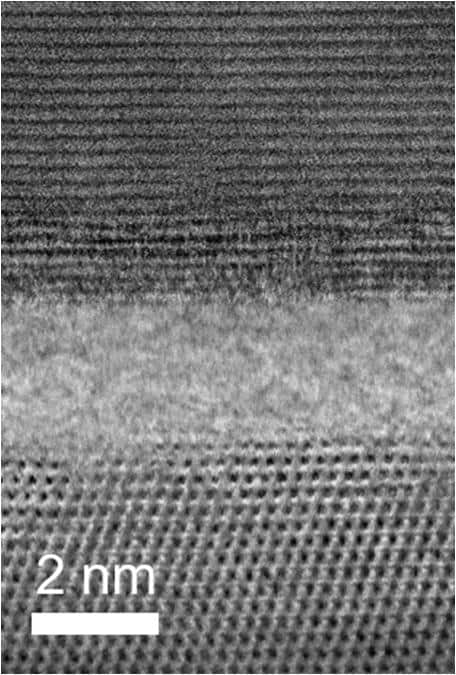
gallium nitride-boron arsenide heterostructure interface

The size of computer chips has been shrinking over the years and has now reached the nanoscale, meaning that billions of transistors can be squeezed onto a single computer chip. This increased density of chips has enabled faster, more powerful computers, but it also generates localized hot spots on the chips. If this extra heat is not dealt with properly during operation, computer processors begin to overheat. This slows them down and makes them inefficient.

Defect-free boron arsenide

Researchers led by Yongjie Hu at the University of California, Los Angeles, recently developed a new thermal-management material that is much more efficient at drawing out and dissipating heat than other known metals or semiconducting materials such as diamond and silicon carbide. This new material is known as defect-free boron arsenide (BAs), and Hu and colleagues have now succeeded in interfacing it with computer chips containing wide-bandgap high-electron-mobility gallium nitride (GaN) transistors for the first time.

Using thermal transport measurements, the researchers found that processors interfaced with BAs and running at near maximum capacity had much lower hot-spot temperatures than other heat-management materials at the same transistor power density. During the experiment, the temperature of the BAs-containing devices increased from room temperature to roughly 360 K, compared to around 410 K and 440 K, respectively, for diamond and silicon carbide.

A new benchmark performance

“We have shown that we can process these BAs heterostructures and integrate them into a high electron mobility transistor chip design,” Hu tells Physics World. “The benchmark performance we have demonstrated shows much promise for applications in high-power electronics and future electronics packaging.”

As well as boasting a high thermal conductivity, Hu adds that BAs is ideal for managing heat for another reason too: it has a low thermal boundary resistance. This means that heat passing through it and then into an interfaced material does not slow down as much compared with other heat spreaders. “This is sort of like if the heat just needs to step over a curb when getting into an adjacent material, versus jumping a hurdle,” he explains.

Unique phonon band structure

The low thermal boundary resistance of boron arsenide stems from its unique phonon band structure. For two interfaced semiconducting materials, this resistance typically depends on the mismatch between the vibrational spectra of phonons (vibrations of the crystal lattices) of both. This mismatch is usually calculated by comparing the temperature at which phonons oscillate with the highest frequencies in each. A small difference in this so-called Debye temperature should result in a lower thermal boundary resistance. Conversely, a big difference implies a higher thermal boundary resistance.

Most semiconductors (including silicon, germanium, gallium arsenide and gallium nitride) and metals have Debye temperatures below 700 K, the researchers explain. Prototype high thermal conductivity materials such as diamond and cubic boron nitride (BN), on the other hand, have much higher Debye temperatures (over 2000 K) because of their large phonon velocities. The thermal boundary resistance for diamond and BN interfaces (once integrated with typical semiconductors) should therefore be high, which somewhat limits their potential applications in thermal management despite their high thermal conductivities. For example, the interface between diamond and GaN has aDebye temperature mismatch of over 1500 K, resulting in a thermal boundary resistance of ~30 m2 K GW−1. BAs, in contrast, has a much lower Debye temperature value (of ~700 K), so it should have a lower thermal boundary resistance after integration.

Spurred on by their findings, Hu and colleagues now plan to integrate the material they have developed into various device architectures and radio-frequency (RF) circuits.  Indeed, they have already succeeded in self-assembling the material to develop high-performance flexible thermal interfaces for wearable electronics and soft robotics.

The researchers report their work in Nature Electronics.

Physics-themed holidays, meet the next director of the European Spallation Source

It is summer holiday season, at least here in the northern hemisphere, and hardworking physicists deserve a break. In this episode of the Physics World Weekly podcast, editors chat about holiday hotspots for physicists including Isaac Newton’s home and dark skies parks for stargazing.

This year marks 50 years of operation of the Institut Laue Langevin (ILL) in France, which is an international centre for neutron science. Helmut Schober is the facility’s outgoing director general, and he talks about how researchers at ILL have joined the scientific battled against COVID-19. He also chats about his hopes for the European Spallation Source neutron facility, which is currently being built in Sweden and will soon count Schober as its director general.

For many physicists, 2021 will be the second consecutive year that they are unable to attend their favourite conferences in person. Fortunately, technology has come to the rescue and virtual meetings are getting much better at filling the gap. We chat about the recent American Association of Physicists in Medicine virtual meeting and find out how access to radiotherapy can be improved in low- and middle-income countries.

Copyright © 2026 by IOP Publishing Ltd and individual contributors