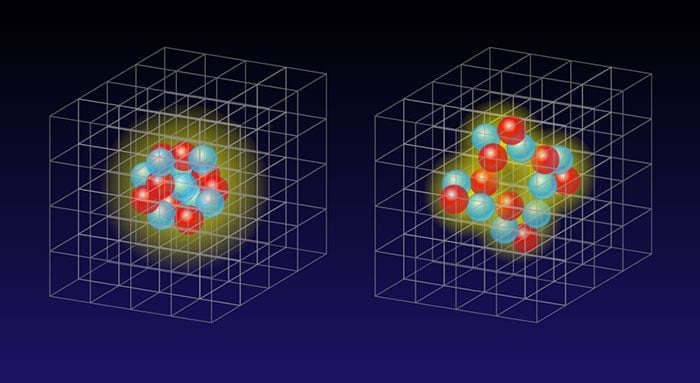
“Alpha clusters” resembling helium-4 nuclei have been spotted on the neutron-rich surfaces of heavy atomic nuclei by an international team of physicists led by Junki Tanaka at TU Darmstadt in Germany and Yang Zaihong at Japan’s Osaka University. The physicists used a high-energy proton beam to knock the clusters off the surfaces of several of tin isotopes and their findings could provide a better understanding of radioactive decay in heavy nuclei and give us important insights into the compositions of neutron stars.
Heavy atomic nuclei tend to contain significantly more neutrons than protons and as a result nuclear physicists believe that these nuclei have neutron-rich “skins” on their surfaces. An understanding of these skins could provide important guidance to astrophysicists developing models of neutron stars – objects about 20 km in diameter with densities on par with nuclei. While neutron stars are made mostly of neutrons, about 5% of their mass comprises protons.
One of the challenges of calculating the properties of neutron stars is understanding how the protons interact with the neutrons. Although neutron stars are much bigger than nuclei, both objects should obey the same physical laws governing how neutrons and protons interact. As a result, studying the neutron-rich skins of nuclei could shed light on the equation of state of neutron stars – a physical model that links the radius of a neutron star with its mass.
Quantum tunnelling
One way that protons and neutrons could interact in a nucleus is to bind together to form an alpha particle (essentially a helium-4 nucleus). In 1928 George Gamow showed that alpha particles can quantum mechanically tunnel out of a nucleus to become free particles – explaining a common radioactive process called alpha decay. While alpha decay is a much-studied effect, it has never been shown conclusively that alpha particles exist in nuclei.
Darmstadt team member Stefan Typel has calculated that alpha particles should form in the neutron-rich skins of heavy nuclei. Now, his prediction has been confirmed by his colleagues who used the 392 MeV proton beam at the Research Centre for Nuclear Physics (RCNP) at Osaka University to knock away alpha clusters from the surfaces of a variety of tin isotopes, containing between 62 and 74 neutrons.
The team found that probability of alpha clusters being knocked away from the isotopes decreases gradually as their neutron numbers increase. Conversely, the thickness of the neutron skin is expected to increase with neutron number– confirming an interplay between alpha clusters and the thickness of neutron skins.
The team’s discovery could lead to a greatly improved theoretical toolset for understanding the properties of neutron stars using data from nuclear physics experiments. It also provides evidence for the existence of alpha particles in nuclei, more than 90 years after Gamow’s prediction.
Progress in Biomedical Engineering was launched as a high-quality journal covering the most significant and exciting areas of biomedical engineering. The first issue was published in July 2019. Our goal is to publish high-impact review and perspective articles that critically analyse the current state-of-the-art progress, report and discuss current scientific and engineering challenges, propose paradigms or approaches to tackle such challenges, and provide a future perspective and vision. The journal aims to have a double-digit Impact Factor within five years of publication, and be one of the top high-impact journals in the field.
What sort of subject areas are covered?
The journal’s broad scope covers all areas within the interdisciplinary field of biomedical engineering. This includes research topics such as biomaterials, biomechanics, theranostics, drug delivery, artificial intelligence in healthcare, biomedical devices, medical robots and biomedical imaging systems.
The diverse range of published content enables timely and impactful discussions between scientists, engineers and clinicians, and facilitates the understanding and improvement of human health and global healthcare.
Who are the targeted readers?
All our published content is currently free to read and free to publish. We aim to make this content accessible to a broad audience, understanding that some of our readers may be engineers or clinicians working in other fields wishing to keep informed of developments outside their own specialization, or looking for an introduction to a new field. All of our authors are asked to convey the importance and relevance of their article’s subject matter to readers both within and outside their specialist discipline.
Why was it decided to only publish review and perspective articles?
The journal aims to provide a venue for discussing advances in research that accelerate the scientific understanding and technological developments in biomedical engineering and global health.
Review articles can provide the community with an overview of the progress of the field, highlight emerging trends and identify key research directions. Perspectives, written by experts in the field, provide additional personal insights into how the field may develop in the future and spotlight emerging areas of research. Together, these types of articles can provide a unique platform for knowledge sharing, and offer researchers the opportunity to collaborate and shape the future direction of research.
Are all articles invited or can researchers also submit content?
The journal is invite-driven, with most review and perspective articles commissioned by the editorial board and publisher. However, we welcome and encourage article proposals from the community, especially from early career researchers who are looking for mentorship opportunities, with the editorial board able to provide comments and feedback on proposals submitted prior to the formal peer review process.
Would you say that the first year of publications has been a success?
Absolutely! Our journal has published some outstanding articles already, across all areas of biomedical engineering and by authors from diverse academic backgrounds and geographies, showcasing the inclusive nature of our journal and the prestigious reputation we are aiming to create.
What are your hopes for the journal’s future in the coming years?
We look forward to the journal’s continued success in publishing high-impact review and perspective articles, championing diversity and inclusivity in our authorship to ensure our journal reflects and engages with the global communities we aim to represent. We anticipate the journal will contribute to the biomedical engineering community significantly in future years, with strong support from our authors, readers, reviewers and the wider community.
To celebrate the journal’s first anniversary, the team produced a video in which Metin Sitti, along with associate editor Eric Brey, and authors Ali Khademhosseini and Selda Sherifova, discuss the journal’s content and strategy, describe the publishing process, and take a look at some of its first published papers.
Do quantum effects play a role in consciousness? Or are the two areas sometimes linked simply because they are both difficult to understand? These are questions at the heart of an emerging field down as quantum biophysics. Find out more in “The light of the mind“, an article from the January 2021 issue of Physics World.
A system of six gravitationally bound stars – each of which eclipses the “partner” star in its binary pair – has been identified by researchers who used machine learning to locate its signal within the vast datasets generated by NASA’s Transiting Exoplanet Survey Satellite (TESS). The discovery of this unusual grouping is both a step forward in our understanding of complex multi-star systems and an example of how artificial intelligence is enhancing astronomical observations.
Although binary and triple star systems are common, groupings of six stars are much less so. Only 18 sextuplet systems have so far been identified, and a sextuply-eclipsing sextuplet system like the one designated TIC 168789840 is rarer still – perhaps even unique. This is because the stars’ orbital plane must be almost edge-on with our line of sight here on Earth for us to see the stars eclipse their partners as they orbit their common centre of mass.
While this alignment is more common in close pairs of stars like the ones that make up TIC 168789840, the probability is still less than 20 per cent, says Brian Powell, a data scientist at NASA’s High-Energy Astrophysics Science Archive Research Center (HEASARC) and co-author of a preprint on the discovery. “The chance that a sextuple would contain all three binaries oriented in such a manner is quite small, not to mention the rarity of the sextuple system formation to begin with,” Powell tells Physics World.
Atypical architecture
At the heart of TIC 168789840 are two pairs of eclipsing binary stars, designated pair A and pair C. Each star in pair A and pair C orbits its partner in a matter of days. Pairs A and C also, collectively, orbit their shared centre of mass. Finally, a third eclipsing binary, pair B, is located farther out and orbits the A–C pair. An eclipse in this system occurs whenever one star in the system is seen to move in front of its fainter partner (a primary eclipse) and then behind it (a secondary eclipse).
Eclipses aplenty Schematic showing the configuration of the sextuple star system. (Courtesy: NASA Goddard Space Flight Center)
To find this six-fold needle in the astronomical haystack, Powell and Veselin Kostov used machine learning and artificial intelligence tools that astrophysicist Alan Smale and other HEASARC staff developed to help identify unusual or complex multiple star systems within the TESS data. This analysis led the NASA Goddard Space Flight Center team to TIC 168789840’s multiple eclipses.
According to Ulrich Kolb, an astrophysicist who studies star formation at the Open University in the UK and was not involved in the discovery, the eclipses in TIC 168789840 are more than just an astronomical curiosity. They also reveal a wealth of information about the six stars that could otherwise only be determined using sophisticated stellar models. “All of [the models] have intrinsic assumptions and ambiguities,” he says. “So finding an eclipsing system like TIC 168789840 is a bit like striking gold.”
Pieces in a puzzle
One puzzling feature of TIC 168789840 is that the primary stars in each of the three binaries all have very similar masses (between 1.22 and 1.30 times the Sun’s mass), radii (between 1.46 and 1.69 solar radii) and temperatures (between 6350 and 6400 K). Their partners, meanwhile, are all K-type stars smaller and cooler than our Sun. Such similarities are “interesting because it is yet another improbable characteristic of this star system”, Powell says.
A further puzzle is that the three pairs of stars in TIC 168789840 orbit one another at relatively close distances. The stars in A and C are 4.8 and 4.2 million kilometres apart respectively, while the stars in the outer binary, B, are separated by 14.9 million kilometres. By way of comparison, Mercury, the innermost planet in our solar system, gets no closer to the Sun than 47 million kilometres.
While closely spaced binary stars are not uncommon, they pose a challenge to star-formation models, which predict that stars should not be able to form within 1.5 billion kilometres (10 AU) of one another. To resolve this apparent contradiction, Andrei Tokovinin, an astronomer at the Cerro Tololo Inter-American Observatory in Chile and a co-author on the present study, suggests that the stars in TIC 168789840 and other close binaries may have formed in other locations and then migrated closer together.
In 2020, Tokovinin and Max Moe of the University of Arizona, US proposed that such migration could be driven by gas accretion from a protostellar nebula surrounding the stars when they are still very young. Because close binaries are often found in triple or quadruple star systems, Tokovinin and Moe suggested that gas accretion could not only drive a binary system closer together but could also provide enough gas to form more stars.
How three stars became six
Tokovinin suggests that a similar thing may have happened in TIC 168789840, but on a grander scale. The similarities between the three primary stars, he says, “prompts the idea that the original primaries, A, B and C, were already forming a bound triple and acquired their companions at the same time, [perhaps] when this triple passed through a dense gas cloud”.
In this scenario, the gas that accreted from the cloud onto the triple system was enough to form the three smaller secondaries. As they formed, this same accretion process led them to migrate inwards, becoming closer to their primary stars. Hence, what started as a triple system, with two stars orbiting one another and a third orbiting them both, became a system of six stars.
“TIC 168789840 provides an exceptional laboratory in which to study possible formation scenarios,” Powell says. “It could be the smoking gun for the accretion-migration model of close binaries.” Kolb, for his part, calls the accretion explanation “a plausible scenario that I think makes a lot of sense”.
Alongside Powell, Kostov and Tokovinin, the core data analysis-team also includes Saul Rappaport of the Massachusetts Institute of Technology in the US, Tamás Borkovits of the University of Szeged in Hungary, and Petr Zasche of Charles University in the Czech Republic. Their paper will be published in a forthcoming issue of The Astronomical Journal. But Powell isn’t satisfied with this one result. “As a data scientist, I’m always looking for interesting data [and] TESS is a goldmine of interesting data – more discoveries are being made in the data every day,” he says. “I have very little doubt that there is a larger star system than this one in the data, simply waiting to be found.”
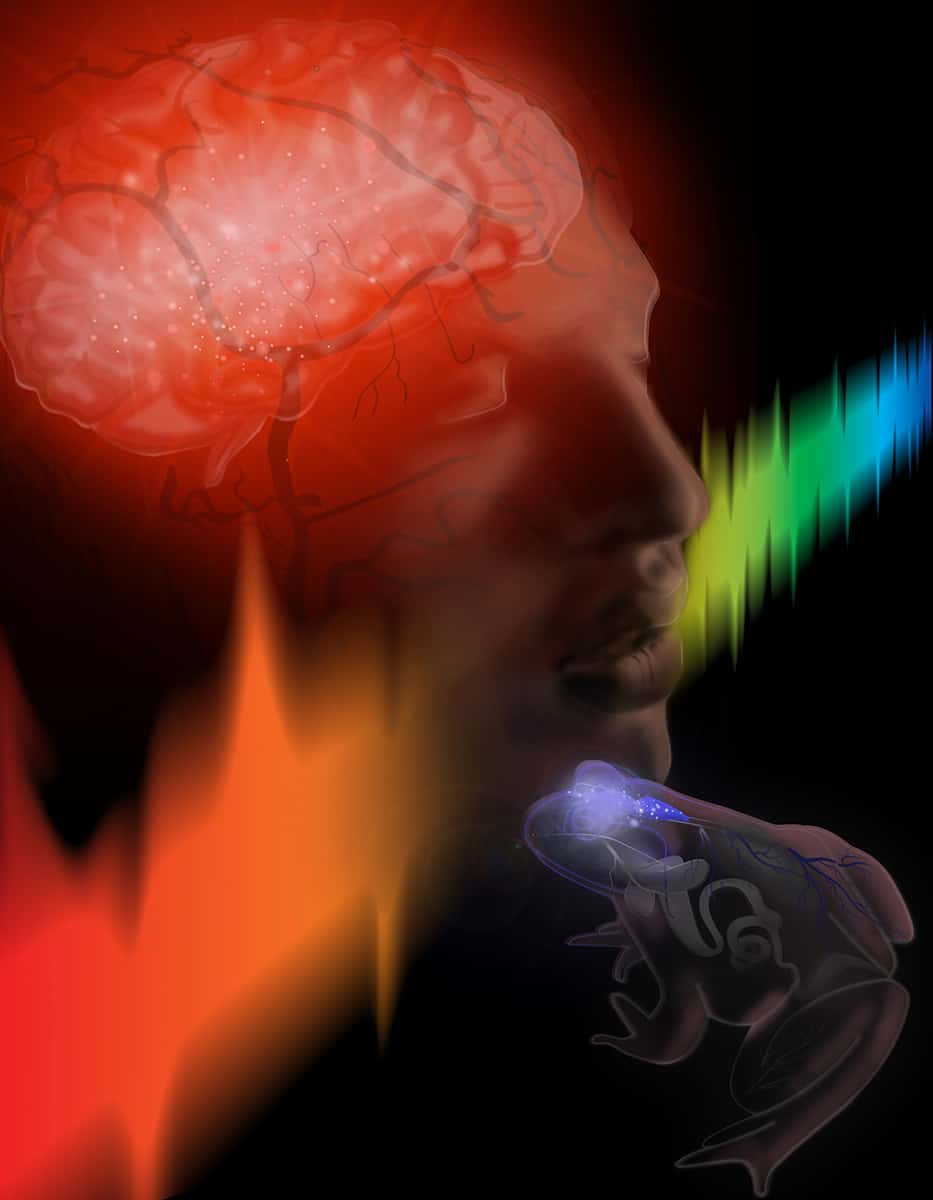
The light of the mind is blue, wrote the poet Sylvia Plath (“The Moon and the Yew Tree” 1961). But it seems it may actually be red.
(Courtesy: Angela Illing)
That’s because recent research suggests a link between intelligence and the frequency of biophotons in animals’ brains. In 2016 Zhuo Wang and colleagues at the South-Central University for Nationalities in China studied brain slices from various animals (bullfrog, mouse, chicken, pig, monkey and human) that had been excited by glutamate, an excitatory neurotransmitter. They found that increasing intelligence was associated with a shift in the biophoton’s frequency towards the red end of the spectrum (PNAS113 8753).
Admittedly, it is unclear what the measure of intelligence actually is, and the study has drawn criticism for its lack of an explanatory mechanism; correlation, as the mantra goes, does not mean causation. However, the role of biophotons – spontaneous ultra-weak near-ultraviolet to near-infrared photons in biological systems – is a growing field of research in neurobiology.
Light has such symbolic resonance for humanity. It features in art, religion, literature and even in how we talk about knowledge – we speak of “enlightenment” and “seeing the light”, for example. It seems fitting, therefore, that it might play a physiological role as well. Just how light is involved in the signalling processes that constitute the central nervous system and its emergent property, consciousness, is still not clear. But inevitably, where there are photons, there might be quantum mechanics.
Photons, after all, are inextricably linked to the birth of quantum mechanics: Albert Einstein’s 1921 Nobel prize was awarded not for relativity or other discoveries, but for his explanation of the photoelectric effect. He theorized that light, which was conventionally accepted to behave as a continuous wave, might also be considered to propagate in discrete packages, or quanta, which we call photons. This, along with Max Planck’s understanding of blackbody radiation, Niels Bohr’s new model of the atom, Arthur Compton’s research into X-rays, and Louis de Broglie’s suggestion that matter has wave-like properties, ushered in the quantum age.
Quantum effects in the brain
While the weirdness of quantum theory has lent itself to some unhelpful pseudoscientific interpretations of consciousness, there has been resistance from scientists to yoke the two together. Just because both subjects are difficult to understand, does not mean that they necessarily inform each other. Despite this, the first detailed theory of quantum consciousness emerged in the 1990s from the Nobel-prize winning University of Oxford physicist Roger Penrose and anaesthesiologist Stuart Hameroff from the University of Arizona (Mathematics and Computers in Simulation40 453). Their “orchestrated objective reduction” (Orch OR) theory has undergone a number of revisions since its inception (Physics of Life Reviews11 39), but generally it posits that quantum computations in cellular structures known as microtubules have an effect on the firing of neurons and, by extension, consciousness.
The theory elicited a number of criticisms but perhaps the most damning followed from the fundamental tenets of quantum theory. A quantum system – which might refer for example to the dynamics of a photon – is a delicate thing. Conventionally, quantum effects are observed at low temperatures where this system is isolated from destructive interactions with its surrounding environment. This would seem to exempt quantum effects from playing any role in the mess and fuss of living systems. Biological systems, such as the brain, operate at physiological temperatures and are unavoidably bound to their environments. As calculated by physicist Max Tegmark at Princeton University in 2000, quantum effects would not survive long enough to have any influence on the much slower rates at which neurons fire (Phys. Rev. E61 4194).
However, this objection has to some extent been mitigated by research done in the broader field of quantum biology. The application of quantum theory in a biological context has had most success with regards to photosynthesis but research on the avian compass, olfaction, enzymes and even DNA also suggest that quantum effects might be implicated more generally in the functioning of biological organisms.
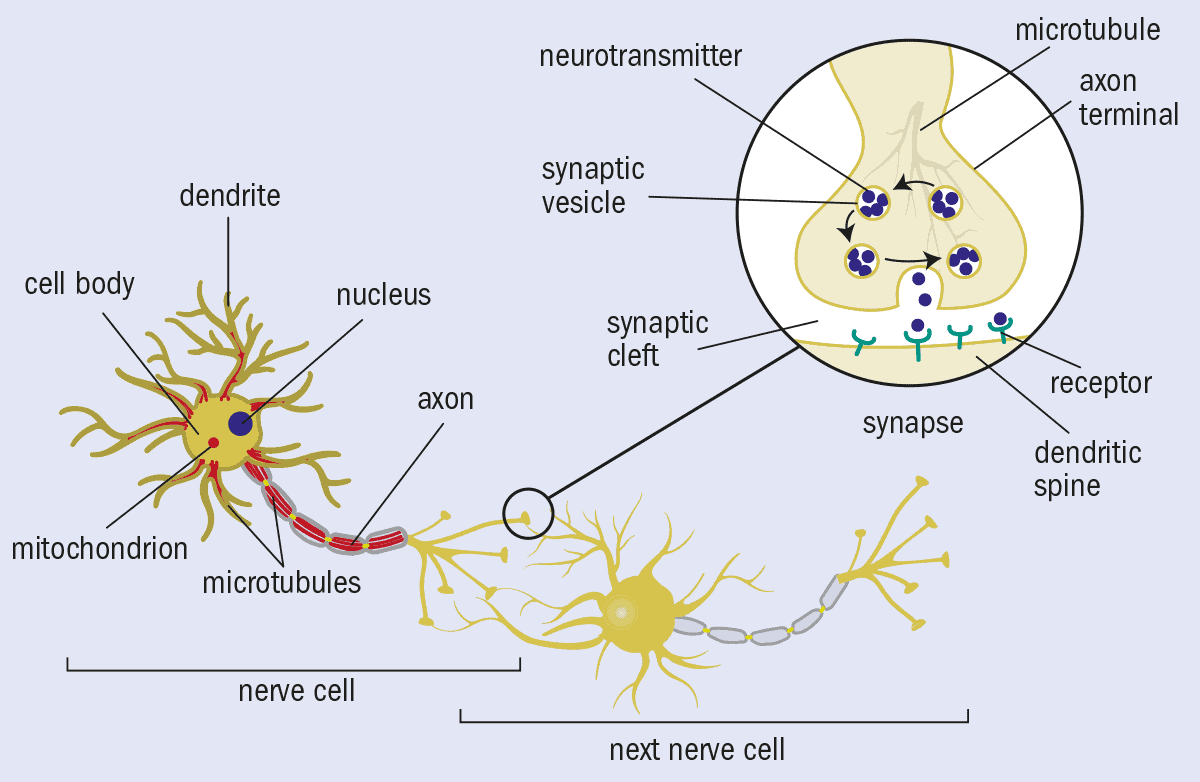
1 The structure and function of a nerve cell Quantum effects in the brain might be better phrased as quantum effects in neural processes, for which this diagram of a nerve cell serves as illustration. Nerve cells consist of three main elements – the cell body, which contains the various organelles; dendrites, which receive incoming signals; and the axon, which transmits this signal. It is thought that signals are passed between nerves where the axon terminal of one nerve cell meets the dendritic spines of the next, at the synaptic cleft. As a signal moves through a nerve cell and reaches the axon terminal, it triggers the release of neurotransmitters into the synaptic cleft. Neurotransmitters bind to receptors on the neural membrane of dendritic spines, opening ion channels and thus altering the next cell’s membrane potential, passing along the signal. Nerve constituents that are important to a discussion of quantum effects are the microtubules, which are formed from the polymerization of a protein known as tubulin, and the mitochondria, often described as the energy centres of the cell. Microtubules give structure to the cellular cytoskeleton and are necessary for cell division as well as the movement of motor proteins, a group of proteins that convert chemical to mechanical energy. The mitochondria use electron transport chains and proton gradients to create adenosine triphosphate (ATP), which powers biological processes. They are also the proposed primary site of biophoton production. (Illustration by Angela Illing. Reproduced from AVS Quantum Sci.2 022901, with the permission of the American Vacuum Society)
In a trivial sense all biology is quantum mechanical just as all matter is quantum mechanical – it is made up of atoms and thus subject to the physical laws of atomic structure first formalized by Bohr at the beginning of the 20th century. The focus of quantum biology, however, is on key quantum effects – those quantum phenomena that seem to defy our classical imaginations, such as superposition states, coherence, tunnelling and entanglement (see box “Quantum phenomena”).
If this is the what of quantum effects in the brain, the where is more straightforward. The brain is made up of nerve cells – elongated cells consisting of a cell body, dendrites and axon (figure 1). Put simplistically, information is passed to and from the brain by the firing or not firing of neurons, a process determined by a nerve cell’s electrochemical potential. This potential depends on the spread of charged ions across the cell membrane, making either side of the membrane more or less positive. In order for a nerve to fire, its resting potential must be increased to the requisite threshold potential. How this signal then passes from one cell to the next is still a matter of debate, but the accepted theory is that this neural communication is managed by chemicals known as neurotransmitters released into the synaptic cleft, which then bind to receptors of the next nerve cell, thereby altering its electrochemical gradient and causing neural activation.
Altered states of consciousness
What better way to study consciousness than by looking at it in altered states – specifically the chemicals that achieve this, such as general anaesthetics. “The only thing we are sure about consciousness, is that it is soluble in chloroform,” said quantum biologist Luca Turin of the Alexander Fleming Biomedical Research Centre in Greece in 2014 (EMBO Reports15 1113). Turin noted that chemicals with anaesthetic capabilities have chemical and structural properties that are very different from each other, leading him to focus on the similar physics that these substances might share. Anaesthetics can bind to various cytoplasmic and membrane proteins. He proposed that anaesthetics facilitate electron currents in these proteins and that this might be demonstrated by looking at changes in quantum spin, where spin describes the magnetic properties of quantum particles such as electrons. What he found was that under the influence of xenon, the simplest of all the anaesthetics, fruit flies showed an increase in electron spin as measured through the use of electron spin resonance (though the origin of the signal is still debatable).
The involvement of anaesthetics in the electronic properties of biological systems is not a completely new theory, having been outlined by Hameroff in addition to Orch OR. What is new is the progress made in understanding how quantum effects might contribute to electronic transfer processes in biological systems. In photosynthesis, there is some evidence that the movement of energy through the structures that constitute the photosynthetic network exploits quantum effects such as coherence (see April 2018 feature “Is photosynthesis quantum-ish?“). Specifically, the structures that seem to allow this coherent transfer are chromophores, the parts of a molecule that give it its colour. Research suggests that instead of moving between the discrete energy levels of an arrangement of chromophores, energy can be spread out or delocalized across more than one chromophore at a time.
What is interesting in the context of quantum consciousness is that nerve cells contain structures such as microtubules and mitochondria that might support coherent energy transfer in a manner similar to that in photosynthesis. Microtubules form part of the cytoskeleton of eukaryotic cells (those with a nucleus enclosed in an envelope, found in plants and animals) and some prokaryotic cells (those with no nucleus envelope, which archaea and bacteria are made of). They provide shape and structure, and are instrumental in cell division as well as the movement of motor proteins. They are made up of polymers of tubulin proteins and within these are chromophores similar to those found in photosynthetic networks. Chromophores are also found in mitochondria, the power stations of the cell. This had led some researchers to suggest that anaesthetics work by disrupting coherent energy processes and in turn disrupting consciousness.
Anaesthetics are not the only chemicals implicated in altered states of consciousness. It is generally accepted that disruptions in the action of neurotransmitters, the molecules by which neurons communicate, contribute to a variety of mental illnesses. Antidepressants, for example, are thought to work by increasing neurotransmitters such as serotonin, the poster-chemical for happiness. However, the exact mechanism of neurotransmitter action is still not perfectly understood. Conventional theory has it that they bind to membrane receptors on nerve cells through a lock-and-key mechanism, where the shape of a particular neurotransmitter matches the shape of the appropriate receptor. The lock-and key mechanism is associated with a number of biological functions, one of which is olfaction (your sense of smell).
However, an alternative theory of olfaction suggests that it may use principles of vibration-assisted quantum tunnelling rather than relying on molecular shape. Recently this theory has been applied to the action of neurotransmitters as well. Vibration-assisted tunnelling is when the energy of a molecule’s movement matches the energy necessary for an electron to tunnel through a potential barrier. In this sense the vibration of a particular neurotransmitter would be recognized by its specific receptor. Using mathematical and computational modelling, researchers tested this by looking at isotopes of different neurochemicals such as serotonin, histamine and adenosine (a review of these studies can be found in AVS Quantum Sci.2 022901). As their mass changes but their shape remains the same, their vibrational frequencies are altered. The researchers were looking to see whether neurotransmitter isotopes had differing effects, thus disqualifying the lock-and-key mechanism, which depends on shape, and supporting the possibility of vibration assisted tunnelling. Although theoretical results look promising the theory has yet to be firmly supported experimentally.
Quantum phenomena
In quantum biology, the quantum effects of superposition, coherence and decoherence, tunnelling, and entanglement play an important role.
Mathematically, a physical system – for instance an atom or photon – is described by a quantum state that contains all the information about it. Superposition is a property of the quantum world that allows a physical system to exist in two or more quantum states, until a measurement is made on it. The non-intuitive phenomenon prompted Erwin Schrödinger’s famously ubiquitous thought experiment where a cat in a box is simultaneously dead and alive until an observer looks in the box. Quantum coherence quantifies this relationship of states in a superposition. And its counterpart, decoherence, describes the loss of such quantum effects.
Quantum tunnelling, meanwhile, involves a particle passing through an energy barrier despite lacking the energy required to overcome the barrier, as would be defined by classical physics. The phenomenon is not fully understood theoretically, yet it underpins practical technologies ranging from scanning tunnelling microscopy to flash memories.
Finally, quantum entanglement allows two particles, such as photons or electrons, to have a much closer relationship than is predicted by classical physics. Over the years, it has played a central role in quantum technologies such as quantum cryptography, quantum teleportation and networks for distributing quantum information. Over the past decade, physicists have been able to transmit pairs of entangled photons over increasing distances, both in the air and along optical fibres.
The brain’s compass
A number of animals are able to sense Earth’s magnetic field, but exactly how they accomplish this is still an open question. Birds, it has been hypothesized, use quantum effects to accomplish their feats of navigation. This quantum compass is called the radical pair mechanism and it relies on the interaction of electron spin with the geomagnetic field. A radical pair is a pair of electrons whose spins are correlated, existing in a superposition of two different states. The ratio of these states is determined by the magnetic field, resulting in a different chemical signature for different alignments in this field. This spin-dependent compass is thought to be located in molecules known as cryptochromes, which are activated by blue light from environmental cues. Until very recently there was no strong evidence that humans had a magnetic sense. However, a new experiment by Kwon-Seok Chae and team at Kyungpook National University in Korea shows, incredibly, that starved humans can sense the geomagnetic field to orient themselves towards the remembered location of food, an orientation that appears to be blue-light dependent (PLOS One14 e0211826).
It has also been shown by Connie Wang from the California Institute of Technology, US, and colleagues that changes to the strength of Earth’s magnetic field cause changes in alpha brain waves – oscillations in the neural activity of the brain in the frequency range 8–12 Hz – in human subjects (eNeuro 6 ENEURO.0483-18.2019). However, it is uncertain whether this effect uses a similar quantum mechanism to the avian compass – in fact, the researchers suggest quite the opposite, that ferromagnetism is responsible for the effect.
In separate studies, changes in alpha waves have been associated with fluctuations in the production of biophotons, measured indirectly by fluctuations in reactive oxygen species, which play a role in cellular communication but are also responsible for numerous bodily problems. They are implicated in ageing, disease and depression and are the reason that antioxidants are so widely touted as being beneficial to health. What is interesting is that studies have shown how magnetic field mediated changes in the spin dynamics of the radical pair mechanism lead to increased reactive oxygen species. It is conceivable, though as yet contentious, that humans use the radical pair mechanism in essential cellular functioning. Exactly what this entails is less clear. It could potentially offer a means to understand the apparent physiological and psychological effects of geomagnetic storms, one of which appears to be increased rates of suicide (Proc. R. Soc. B279 2081).
Neural entanglement
Spin dynamics, the behaviour of quantum particles in a magnetic field, is also at the heart of another theory that suggests that quantum effects play a role in cognition. In this case, however, the spins in question belong to nuclei rather than electrons. Nuclei can have particularly long coherence lifetimes, meaning that their quantum effects persist over timescales long enough to play a role in neural firing and even, possibly, the function of memory.
Cognitive link Neural entanglement as mediated by ‘Posner molecules’, in which phosphate ions (blue) with entangled phosphorus nuclear spins assemble with calcium ions (purple). These Posner molecules are then taken up into different neurons. The spin-zero calcium ions screen the phosphorus spins against decoherence. This spin entanglement may influence subsequent binding dynamics and calcium ion release. Calcium ions are instrumental in the activation of neurons and in this way spin entanglement is translated into entangled neural activation. (Courtesy: Angela Illing)
This notion led physicist Matthew Fisher, from the University of California, Santa Barbara, to suggest that spin-entangled molecules known as Posner molecules might lead to nerves firing in a correlated fashion. This happens through a number of steps. Cellular processes run on energy that is provided by the chemical compound adenosine triphosphate(ATP). When this compound is broken down, it releases phosphates, which are made up of phosphorus (spin-half nuclei) and oxygen (zero nuclear spin). Fisher contends that the spins of the phosphorus nuclei are entangled and that, furthermore, if this quantum entanglement can somehow be isolated from other quantum interactions it might last long enough to have an effect on cognition processes (Annals of Physics 362 593).
He suggests that the phosphates form Posner molecules by binding with spin-zero calcium ions, which act as an effective screen from external interactions. Entangled Posner molecules are then taken up into neurons, bind and release calcium ions, triggering entangled neural activation. Fisher uses this model to suggest why lithium is successful in treating bipolar disorder. Should lithium replace the central calcium ion in a Posner molecule then the non-zero spin of the lithium ion could contribute to decoherence and have a knock-on effect on neural activation.
What is perhaps more surprising with regards to lithium is that different isotopes have been shown to have differing effects on the mothering behaviour of rats. A similar phenomenon has recently been recorded in the action of xenon, an anaesthetic. Na Li and colleagues at Huazhong University of Science and Technology in Wuhan, China, found that differing isotopes of xenon cause differing levels of unconsciousness (Anesthesiology129 271). This seems extraordinary, that changing something as small as the spin of a nucleus might result in macroscopic changes on the level of something as complex as the mothering instinct or, indeed, consciousness itself.
But what’s the use?
While the possibility of quantum effects in the brain is intrinsically fascinating, it might also contribute to the ways in which we treat the brain and disorders related to the brain.
Unravelling exactly how neurotransmitters bind to receptors would contribute to understanding G-protein coupled receptors, such as neural and olfactory receptors, which are one of the primary targets of most pharmaceutical intervention. But more than this, identifying how quantum effects might play out in the brain could offer a completely new way of imagining medical intervention beyond the purely chemical. For example, it could help refine and enhance electroconvulsive therapy (the transcranial application of electric currents) and the less well established but also less invasive method of transcranial magnetic stimulation (the use of magnetic fields to stimulate parts of the brain) as treatments for depression.
Deciphering the role of light could also be beneficial as a number of recent studies have shown it to have a range of physiological effects. Researchers have found that shrimp exposed to excess serotonin-based antidepressants from human contamination were more likely to seek out light, a result that led to increased predation (Aquatic Toxicology99 397). While detrimental to the shrimp, this might tell us about how much of our own physiology is responsive to light, and to what extent light could be pharmaceutically useful.
In another recent study, quantum dots – semiconducting nanoparticles capable of producing light – were successfully used to undo the protein clumping linked to Parkinson’s and Alzheimer’s disease (Nature Nanotechnology13 812). Meanwhile, declining eyesight has been shown to improve through the amelioration of mitochondrial damage by red light treatment (The Journals of Gerontology: Series A75 e49). Photobiomodulation, the application of red or near-infrared laser light, has also shown promise in treating various brain disorders, as well as improving attention, memory and learning (BBA Clinical6 113).
An illumination in every sense of the word, it appears that there may be more than metaphor to the action of becoming enlightened.
A novel non-invasive test for thyroid cancer works by asking the patient to sing at the same time. Developed by researchers in France, the ultrasound-based procedure could determine the health of a patient’s thyroid and help detect any cancerous nodules.
Thyroid nodules are common, but only a small percentage of such nodules are cancerous. Typically, fine needle aspiration is to detect malignant tumours, but only about 5% of thyroid cancers are detected in this way. As the majority of thyroid cancers are hard, the presence of cancerous tissue in the thyroid will increase its stiffness. This makes elastography – a technique that measures tissue stiffness – an ideal candidate for detecting cancerous nodules.
In this study, the researchers designed an experiment based on passive elastography, which extracts elasticity from the natural vibrations in living tissues. Specifically, they exploit the shear waves generated naturally by the human voice to measure the elasticity of thyroid tissue – a technique they call vocal passive elastography (V-PE). They report their findings in Applied Physics Letters.
The researchers – from Université de Tours, CHU Dijon-Bourgogne and Université Bourgogne Franche-Comté – asked a volunteer to sing and maintain a monotonous tone at 150 Hz (roughly the frequency of the note D3), with a loudspeaker playing the same note to guide them. As the participant sings, vibrations in their trachea will induce shear waves in the surrounding thyroid gland.
The team tracked these waves using an ultrafast ultrasound probe placed horizontally against the surface of the neck. They then used correlation algorithms, based on time reversal methods initially employed in seismology, to compute the speed of the shear waves propagating through the thyroid.
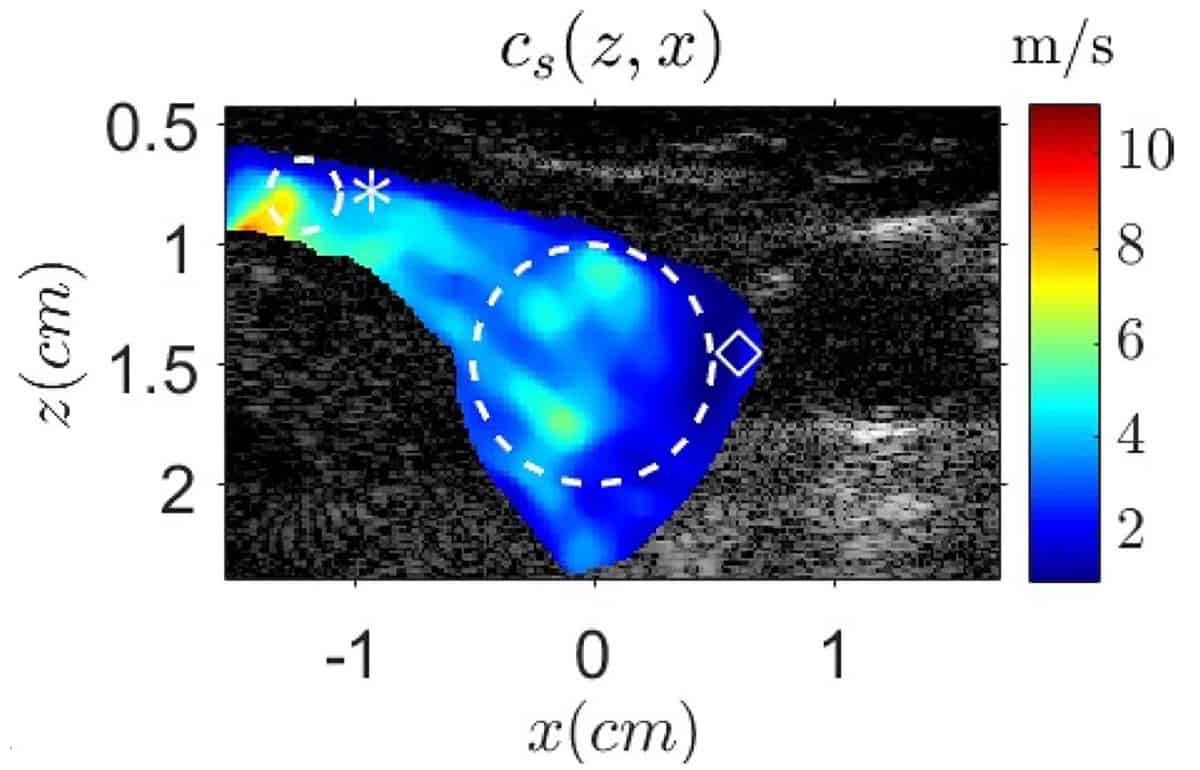
If a tumour is present in the thyroid, the resulting increase in elasticity will cause the shear waves to accelerate. By superimposing a map of shear wave speed onto a thyroid ultrasound image, the researchers can mechanically characterize every point of the thyroid and find any abnormally stiff areas.
Shear wave speed (cs) in the thyroid measured using V-PE. (Courtesy: Steve Beuve)
Using their V-PE method in a volunteer, the team measured the shear wave speed at every point within a mask surrounding the thyroid, with a pixel resolution of 150 × 150 μm. The mean shear wave speed was 3.2 m/s, ranging from 0.7 to 8.8 m/s. To validate their V-PE algorithm, they also used an AIXplorer ultrasound scanner to measure shear wave speed in the volunteer’s thyroid. The measured values agreed well with the V-PE results.
The researchers point out that V-PE is quick and easy to perform. It does not need any specialized equipment to be added to the ultrasound scanner and requires only about 1 s of data acquisition. The longest step is the data analysis, but they have developed a computer program to perform the required computations automatically. The team is now working to improve the user friendliness of the computer interface, as well as investigating the potential of V-PE in other areas near the vocal tract, such as the brain.
“Developing non-invasive methods would reduce the stress of patients during their medical exams,” says first author Steve Beuve in a press announcement. “Having to sing during a medical exam can perhaps help release some of the nervous tension even more.”
Following years of negotiations, delays and disagreements, on Christmas Eve the United Kingdom and the European Union finally agreed a trade deal following the UK’s exit from the EU. With the threat of a “no deal” looming large, the move ended years of uncertainty for UK scientists. The UK now joins Switzerland, Norway and 14 other non-EU nations as having “associated country” status of the seven-year €95bn Horizon Europe programme, which began last month. Yet many of the fine details of the deal still need to be ironed out, while 2020 also saw the end of most of the UK’s involvement in the Erasmus student exchange programme.
UK scientists have done exceptionally well from EU research programmes in previous years. Estimates suggest the UK contributed €5.4bn between 2007 and 2013 but received €8.8bn. As part of the Brexit deal, UK researchers remain eligible for Horizon Europe funding on equivalent terms to their EU counterparts, with the UK’s financial contribution being based on a share of its gross domestic product. Each year the UK’s contributions will be adjusted upwards or downwards, based on how much it has paid in and taken out in previous years.
But crucially it will not be able to take out more than it pays in, meaning that the UK could lose access to a lot of extra funding. “The focus must now be on ensuring a fair and effective means to deliver appropriate association to EU science funding programmes, such as Horizon Europe, outlined in the agreement,” says Royal Society president Adrian Smith. “Any delay in delivering such association will damage UK science.” UK researchers will not be able to take part in Horizon Europe until the details of the association have been agreed.
For UK science, the deal translates into getting notably less funding than before per pound sent to Brussels and, even more importantly, a diminished influence in defining future priorities
Andre Geim
John Womersley, director-general of the European Spallation Source in Sweden, told Physics World that the deal provides most of what the research community had asked for, adding that “it’s a bit disappointing that there hasn’t been more trumpeting of this as a success”. He says that association with Horizon Europe was the highest priority for the UK’s research sector. “It comes as a huge relief to know that it will be implemented, especially after some negative signals last autumn,” he says.
Indeed, in August more than 100 organizations and individuals representing the European scientific community had signed a statement urging the EU and the UK to compromise due to fears the UK would lose its place in Horizon Europe. One of the signatories – Anton Zensus, director at the Max Planck Institute for Radio Astronomy in Bonn, Germany – told Physics World that he was very relieved by the deal, adding that it was “compromise we all have to live with”.
Yet others were not so positive. Physics Nobel laureate Andre Geim from the University of Manchester thinks that associated status will create “a bias against choosing Brits as programme leaders and against accepting UK-envisaged priorities” for funding. “As many people were so afraid of no-deal, this agreement might look like good news,” he told Physics World. “But make no mistake: for UK science, the deal translates into getting notably less funding than before per pound sent to Brussels and, even more importantly, a diminished influence in defining future priorities.” Geim adds that the deal “is the price to pay for jingoism” and will mean “more paperwork, less science”.
Nuclear co-operation
As part of the Brexit deal, the UK will also become an associated country in the Euratom programme. “On a practical level, an association means that the UK will still participate in all EU fusion programme activities,” says Ian Chapman, chief executive of the UK Atomic Energy Authority. Continued membership is subject to formal approval by both sides, but Chapman adds that “it is both parties’ firm intention that the protocol will be adopted at the earliest opportunity”. The deal includes the UK’s ongoing participation in the ITER fusion experiment through membership of Fusion for Energy – the EU body responsible for its contribution to ITER. The Joint European Torus, which is based at the Culham Centre for Fusion Energy in Oxfordshire, is largely funded by Euratom and is currently contracted to operate during 2021, with a further extension being discussed, according to Chapman.
Yet the UK will not be joining every Horizon Europe programme. UK researchers will, for example, be excluded from the European Innovation Council Fund. This new equity fund will provide grants to support start-ups and university spin-offs, but not those in the UK, according to the terms of the trade deal. The future of the UK’s participation in the Marie Skłodowska-Curie fellowships as well as the European Strategy Forum on Research and Innovation is also currently unknown and will require further negotiation.
The UK in addition failed to reach an agreement with the EU over its membership of the Erasmus student-exchange programme. The exit from the exchange scheme, which applies to all students except those in Northern Ireland, came as a surprise as prime minister Boris Johnson had reassured MPs in January 2020 that there was no threat to the UK’s membership of Erasmus. But the two sides were reportedly unable to reach an agreement over costs. Last year a report by Universities UK International found that Erasmus students contributed more than £240m a year profit to the UK economy.
Instead, the UK government announced its own £100m scheme, named after Alan Turing, to support UK students who wish to study abroad. The government said the new Turing scheme would provide funding for around 35 000 students to go overseas, starting in September 2021, adding that it would target more students from disadvantaged backgrounds and areas. But it will not fund students from other countries coming to the UK, cutting an important source of funding for UK universities.
UUKI director Vivienne Stern said that while the Erasmus announcement was “disappointing”, they were “pleased” the government has committed to a new UK programme to fund global mobility. “We now ask the UK government to quickly provide clarity on this Erasmus domestic alternative, and that it be ambitious and fully funded,” she adds. Rachel Youngman, deputy chief executive of the Institute of Physics, which publishes Physics World, says that despite some positives in the deal, the institute is “disappointed” and “concerned” by the decision over Erasmus, adding that the IOP has “consistently argued for the importance of international exchange for university students”.
The business view
Leaving the EU also means change for businesses with new tariffs, customs arrangements, export regulations and other trading conditions. But the impact of the trade deal on the British industrial-physics community may take time to be fully understood given the global pandemic. Arnab Basu, founder and chief executive officer of the Kromek Group, which makes radiation-detection components and devices for medical imaging and nuclear security, told Physics World that so far the supply chain seems to be resilient. Kromek manufactures or sources most of its mechanical components in the UK and much of its electrical components in Asia and the US, meaning little impact from Brexit so far.
However, Basu says there “is some evidence of price increases for purchases from distributors ostensibly related to an uplift in logistics or administrative costs for goods coming in from the EU”. The company has also been advised of potential delays in shipment of goods manufactured outside of the UK, but Basu adds “it is difficult to determine the extent to which that is down to the global pandemic as opposed to Brexit”.
Many physics-based companies must also deal with additional regulations linked to the supply of items for medical therapeutics and imaging. “The biggest implication for our company is that we work in the diagnostics field and we now face two sets of regulations for any product we develop,” says Steve Self, commercial director of Stream Bio, a UK-based start-up that manufactures nanoparticles for applications in bioimaging. “This means that we have to do some additional work to qualify our products for sale in Europe,” he says.
Despite Geim’s disapproval over Brexit, he does see one main advantage in the deal – staying in the European Research Council (ERC). Indeed, there was good news from the ERC last month when UK scientists received the largest number of grants in the council’s first post- Brexit funding round. Eight of its 55 “proof of concept” grants – which explore the commercial potential of scientists’ work – will go to UK-based researchers. “The ERC was among a few prominent defenders of research quality as determined by peers rather than bureaucrats and politicians,” Geim says. “The UK’s participation in the ERC provides an important lifeline for fundamental research.”
Nothing, it seems, can sometimes be everything – at least in frontline scientific research. Ultrahigh vacuum – broadly the “nothingness” defined by the pressure range spanning 10−7 mbar (hPa) through 10−12 mbar – is a case in point. UHV is an umbrella term for a suite of enabling technologies deployed in all manner of fundamental research endeavours: from particle accelerators and gravitational wave detectors to cold-atom physics experiments and scanning force microscopes. At the same time, UHV conditions ensure that scientists are able to probe – using photons, electrons or ions – chemically clean sample surfaces free from any unwanted adsorbates – also a must-have requirement for advanced thin-film growth and preparation techniques such as molecular-beam epitaxy and pulsed laser deposition.
What all of these applications have in common is the need for a holistic approach to vacuum system design in order to routinely deliver – and maintain – the necessarily rarefied and extreme UHV environment. In short, the entire vacuum system needs to be planned and configured along multiple coordinates such that the vacuum chamber, pumps, pressure gauges, connections, leak detection and software control are all optimized as part of a joined-up UHV infrastructure, rather than being treated as isolated components.
Too many choices?
Unfortunately, that’s easier said than done. Zoom in a little closer and it’s evident that vacuum end-users are confronted with no shortage of technology options – all of them with their own pros and cons – when it comes to specifying the core building blocks of a UHV system. Perhaps most fundamentally, the selection of the optimum pumping set-up is far from straightforward, with the need to weigh up capital/operational costs, energy consumption, size and footprint, maintenance intervals and environmental impacts (noise/vibration).
That picture is complicated further by the multiplicity of choices regarding the ideal combination of main pump (ion getter pump versus titanium sublimation pump versus turbomolecular pump versus cryopump) and backing pump (diaphragm pump or rotary vane pump or multistage Roots pump) used to generate UHV conditions – in some cases via rapid evacuation of the vacuum chamber, in others via adsorption of any lingering gas species.
Andreas Schopphoff “Our job is to come up with vacuum innovations that make life easier for our R&D customers.” (Courtesy: Pfeiffer Vacuum)
Now, an R&D team at Pfeiffer Vacuum, a German manufacturer of specialist vacuum systems and components, has published the results of an in-house study that points the way to simpler and more economical pumping set-ups for diverse UHV research applications – whether that’s in small-scale surface-science laboratories or the accelerator complexes of big-science facilities. In short, Pfeiffer Vacuum scientists have shown that it’s possible to routinely generate low-UHV conditions (of the order of 10−11 mbar) by pairing a high-compression-ratio turbopump (in this case the vendor’s HiPace 300 H) with a suitable dry backing pump. Key to the breakthrough is figuring out an effective way to remove the dominant residual gas species – chiefly hydrogen – from the vacuum chamber during draw-down to the UHV regime.
“The back-streaming of hydrogen versus pumping direction of the turbopump has traditionally been the biggest limiting factor when it comes to reaching very low UHV pressures,” explains Andreas Schopphoff, head of market segment R&D at Pfeiffer Vacuum. “So as soon as we get a higher compression ratio – and in turn reduce that back-streaming effect – we’re able to generate much lower pressures than we’ve managed in the past.”
UHV under scrutiny
The deployment of high-compression-ratio turbopumps in this way represents a win-win for UHV system innovation, claims Schopphoff. Most notably, upfront investment and cost of ownership are favourable when compared with conventional approaches to UHV generation (for example, the use of an ion getter pump in tandem with a turbopump, with the latter deployed as backing pump). The new approach is also a lot simpler in terms of implementation, field maintenance and service intervals (typically longer than four years). “As such, this is a pumping set-up that will suit scientific users who want a UHV system that pulls the vacuum and is 100% reliable, 100% of the time,” Schopphoff explains. “It’s also one switch to do it all, with a single programmable controller to drive the turbopump and the dry backing pump.”
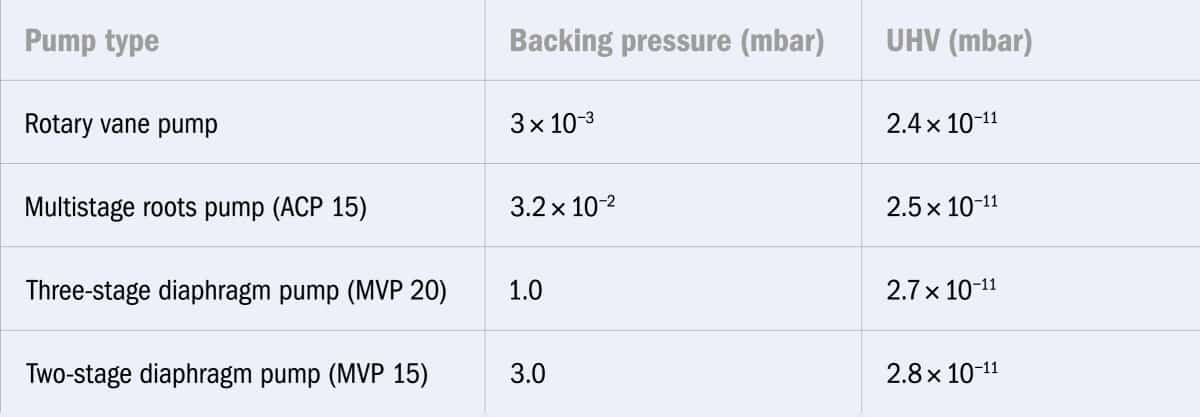
In their experimental study, the Pfeiffer Vacuum team used a small-scale vacuum chamber (500 mm diameter, 120 mm high) that was baked for seven days at 120 °C. The scientists then evaluated the UHV performance of the HiPace 300 H turbopump (hydrogen compression ratio ≥1×10⁷) when paired with four separate dry backing pumps (a rotary vane pump; a multistage Roots pump; as well as a two-stage and three-stage diaphragm pump). The time span for each measurement was one day, using hot-cathode and cold-cathode ionization gauges to track chamber evacuation for each backing/main pump pair (see Table 1).
Table 1 Backing pumps shape up for UHV performance
“For relatively simple vacuum chambers, like the one here in our lab, we found that even a small diaphragm pump is sufficient as the backing pump in combination with the HiPace 300 H,” says Schopphoff. His team also concluded that a multistage Roots pump (in this case Pfeiffer Vacuum’s ACP 15) in tandem with the HiPace 300 H provides an ideal backing/main pump combination to generate low UHV conditions for chambers of 100 L capacity or more.
“This is particularly relevant in a big-science context,” Schopphoff adds, “where users need to generate UHV in the vacuum tubing of a particle accelerator without particulate contamination from the pumping system.” In fact, for an accelerator setting he reckons the optimum set-up would see the HiPace 300 H paired with Pfeiffer Vacuum’s ACP 28 or ACP 40 multistage Roots backing pumps – both of which are fluorine-free and can operate with an extended cable connection of up to 120 m between the control electronics and pump location (to keep the electronics away from harsh radiation environments).
Right now, the priority for Schopphoff and his colleagues is to educate Pfeiffer Vacuum’s R&D customer base about the merits of UHV generation using high-compression-ratio turbopumps – specifically, the HiPace 300 H and its sister product the HiPace 700 H (with hydrogen compression ratio ≥2×10⁷). The company’s webinars on the subject have been well received by the research community, with most of the commercial interest to date coming from university-based vacuum customers.
“The HiPace 300 H is a really good pumping option for UHV, but we’re still trying to make it better,” notes Schopphoff. “Ultimately, our job is to come up with vacuum innovations that make life easier for our R&D customers. This is a solution that does just that.”
A new educational course spearheaded by the Australian-based charity Radiology Across Borders (RAB) promises to improve patient access to imaging services worldwide. Aimed predominantly at those in the developing world or remote areas, it will focus on safety and interpreting common pathologies such as pneumonia, bleeds, trauma, meningitis, bone tumours and emergency conditions.
The International Certificate in Radiology Fundamentals (ICRF), a one-year online programme, is due to launch in February 2021 to allow any health professional to learn the basics of X-ray, ultrasound and CT in order to perform and read exams.
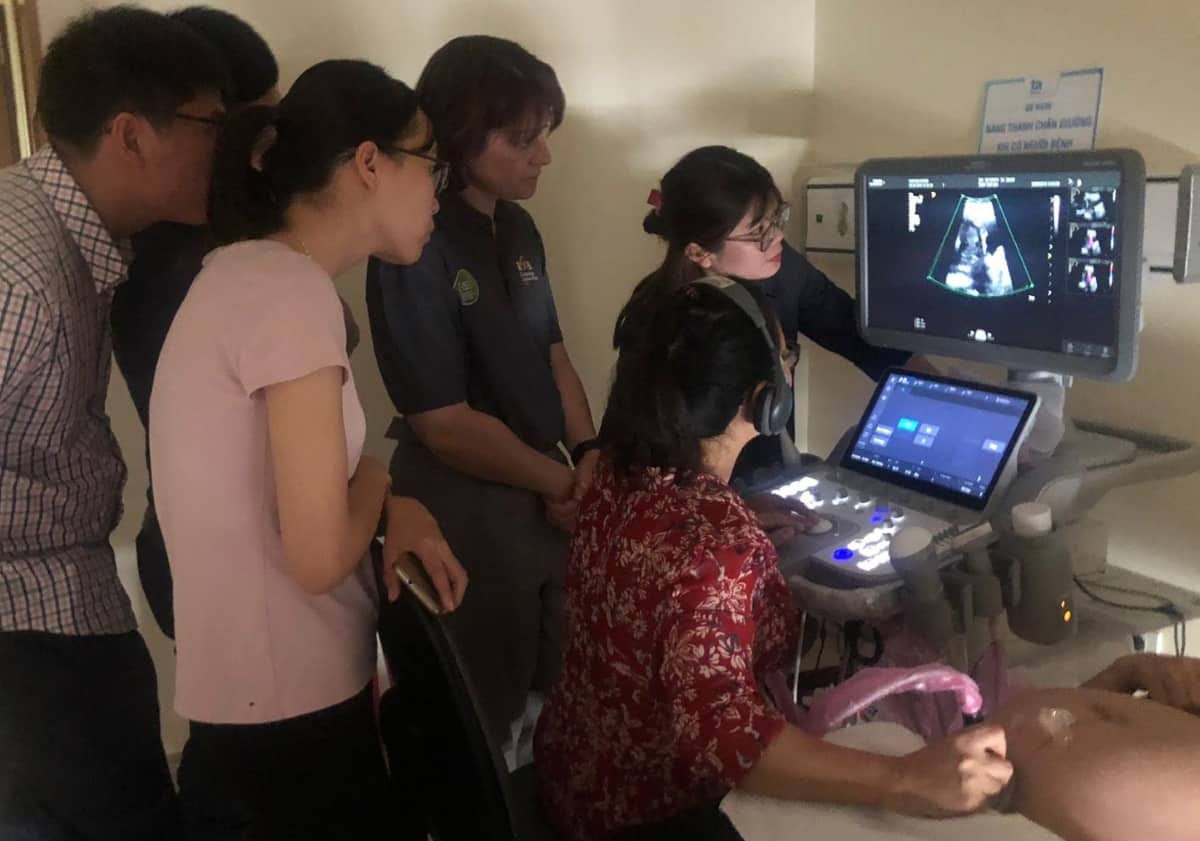
Practical hands-on training in south-east Asia is provided by Salman Ansari, a final-year radiology registrar at Royal Prince Alfred Hospital in Sydney and director of RAB’s collaboration with the Australasian Musculoskeletal Imaging Group (AMSIG). All photos were taken before the COVID-19 pandemic. (Courtesy: Suresh de Silva and RAB)
Besides coursework, there will be regular meetings between the course’s tutors and the 50 participants. The final ICRF will be attained on completion of the course. It will be accredited by a major institution and represent the equivalent knowledge base of a second-year registrar in a developed country.
“This is going to make a huge difference to radiology education in developing nations. We’ve already had 185 individual expressions of interest from 60 countries,” noted radiologist and RAB founder Suresh de Silva, pointing to enquiries from the Indo-Pacific, Mongolia, Vietnam, Colombia, Africa, Algeria, Kenya and Ethiopia.
He also noted there had been applications from the UK, Israel, Ireland, Germany, Serbia, Hungary, Australia, New Zealand and North America, though these nations will not receive priority in the first year. Health professionals may eventually use the certificate as a steppingstone to further radiology specialization training, he said.
How the scheme works
Each participant from developing nations will pay a total of A$500 (€320) for the entire year’s course, though there is RAB funding for those that can’t afford it, noted de Silva. The fee will help sustain the project longer term. It is estimated that the first year of operation will cost the organization close to around A$100,000 (€64,000) for the IT platform and project coordination, and this isn’t factoring in pro bono work by the 14 Australian RAB members who helped create the content and will serve as tutors, as well as the four volunteer Canadian medical students.
Furthermore, RAB estimates that the four years of research and development of ICRF have cost over a million dollars, including the IT and volunteer work.
Radiologist George Koulouris gives a hands-on teaching session in Hanoi, Vietnam. (Courtesy: Suresh de Silva and RAB)
“Importantly, this ICRF initiative will lead to other projects. For example, some participants will have access to imaging units while others won’t. Companies involved with RAB projects both financially and logistically, such as Siemens Healthineers, hopefully will come to the fore for the provision of such equipment to those that complete the training, particularly in countries where RAB doesn’t yet send its own radiologists to undertake field work,” de Silva noted.
While this project was formulated by RAB over four years, the core part of the content comes from the UK Royal College of Radiologists’ (RCR) online Radiology-Integrated Training Initiative (R-ITI) course (eIntegrity). Input has also come from Radiopaedia.org, a wiki-based collaborative educational radiology web resource, and the many RAB radiologists who contributed around 30% of the programme by providing their own material, including video tutorials.
Bruce Forster, head of radiology at University of British Colombia (UBC) in Canada, and Richard Mendelson, emeritus consultant at the Royal Perth Hospital in Australia, have also been instrumental in the development of the ICRF, de Silva added.
Ongoing projects
RAB is continuing its existing educational programmes in the form of global teleconferences on different themes; the RABinars for radiologists will take place every three weeks in 2021 and the RABitts conferences for imaging technologists will occur monthly. These are broadcast to 400 sites in 58 countries.
The charity also aims to provide a timely response to new topics that arise, such as COVID-19, creating lectures and Q&A sessions that can be mailed out to its recipients in developing nations within a week.
RAB’s 2019-created TIDES project provides teleradiology for disaster events, screening and second opinions in several target countries. Currently, TIDES is focusing on second opinions in Samoa and the Cook Islands, where there is no local radiologist and doctors typically have struggled to decide whether to send patients to New Zealand or keep them in the country. Valuable second opinions now are furnished by 26 RAB radiologists across Australia and New Zealand, and the organization is looking to extend this network to include radiologists in other countries, thus expanding services beyond Samoa and the Cook Islands.
As difficult as 2020 was due to the pandemic, RAB started its pilot one-to-one mentorship programme, whereby sonographers and radiographers in developed nations teamed up with their counterparts in developing countries. In 2021, 30 mentors and 30 mentorees registered for the programme, and this will continue in the first part of 2021 with a new intake of participants.
Women’s health has also been under the spotlight with the charity’s VITAL programme. This onsite project involved six sonographers who in 2018 and 2019 were sent to provide a week of hands-on ultrasound training in the Indo-Pacific region, Fiji and Vietnam for breast, obstetrics and gynaecology.
Volunteer sonographer Catherine Robinson provides hands-on training in south-east Asia as a part of the VITAL programme, which addressed breast malignancy and obstetrics/gynaecology ultrasound. The first recipient nation was Samoa. (Courtesy: Suresh de Silva and RAB)
This training was so successful that the plan was to extend it to Mongolia and the Cook Islands in 2020. While the plans were cancelled due to the pandemic, RAB provided online training notes and in 2021 will launch virtual training through weekend teleconferences that will also extend to paediatrics and cover topics such as common abdominal and chest conditions, and complications.
“COVID has hampered much of the face-to-face work that RAB carries out across 12 nations including Cambodia, Mongolia, Sri Lanka, Laos, Vietnam, Myanmar and six countries in the Pacific, but projects that have turned virtual for 2021 are planned to return onsite in 2022,” de Silva said.
Individuals and sites can still access free video content in the RAB library, he added. To date, there have been 1500 lessons provided by 70 to 80 contributing RAB members and 26,000 hits of these in the last 10 months.
RAB is now looking for colleges in Europe or elsewhere who may be interested in providing material for this library. These colleges will be credited for the content and become part of the charity’s network. “Our aim is to make the library the best free resource available,” de Silva noted.
A pair of airborne drones has been used to create a quantum communications channel between two ground stations 1 km apart. The system was developed by Hua-Ying Liu and colleagues at Nanjing University in China and with further improvements it could lead to flexible, highly configurable networks for quantum cryptography.
Quantum communication techniques such as quantum key distribution (QKD) use the laws of quantum mechanics to allow to parties to share cryptography keys with complete security — at least in principle. One implementation of QKD involves sharing the key by the transmission and detection of entangled photons – and a crucial feature of this approach is that the parties can tell if an eavesdropper has intercepted the photons. Once the secrecy of the key is established it can be used to exchange encrypted messages using a conventional communications network.
Today, most quantum communications are done via optical fibres. While this is practical over short distances – say in a metropolitan area – it is difficult to link parties over longer distances because significant signal losses occur in fibres due to photon scattering. Alternatively, photons can be sent up to satellites and then relayed to a distant ground station. While effective, this space-based approach requires costly and inflexible infrastructure, which makes it currently impractical for widespread use.
Inexpensive and flexible
So hence the interest in flying drones, which the Nanjing team used to carry sources of entangled photons in a link that connected two parties on the ground. As well as being relatively inexpensive, drones can be deployed quickly to create a flexible, dynamic network that changes based on need.
A major challenge for the team was how to contend with the diffraction of photons as they travel through the air. Diffraction causes the wavefront of the photon to spread out as it propagates, making it difficult to fully capture the photons using a single-photon detector attached to a telescope.
To reduce the effect of diffraction, Liu and colleagues introduced a second drone to act as a relay between photon source and detection station. After receiving a diffracted photon from the first drone, the second drone uses a specialized optical fibre to refocus the photon towards a receiving telescope on the ground.
In the team’s experiment, the two drones were flown 200 m apart, with each drone 400 m away from a detection station. Overall, the two detection stations, named Alice and Bob, were separated by 1 km. When the researchers generated an entangled pair of photons on the drone nearest to Alice, 25% of the photons were detected by Alice. Bob, however, could only detect 4% of the photons sent via the relay drone. Liu’s team confirmed that these photons were entangled using standard Bell inequality tests.
Although the transmission losses of these signals are still too great to compete with existing quantum communication systems, the researchers hope that the low cost, scalable nature of drone technology will enable rapid improvements soon. The team now plans to expand the size of their network to include multiple drones – which could facilitate communications between large, dynamic networks of users, even within cities. If their technique becomes commercially viable, it could make drone networks an important supplement to fibre optics and satellite networks.