Ask me anything: Michelle Simmons

Michelle Simmons

What skills do you use every day in your job?

There are skills and traits and the most important trait is optimism. Research is hard and so every time you come into the lab you have to maintain an optimistic persona. Also I’ve found it helps to be generally hard working and deep thinking. In terms of practical skills, it is important to be able to sift through lots of information and get to the heart of an issue quickly, while maintaining focus. I’ve also found it’s vital to be able design and build things – whether building a piece of apparatus, going into a clean room to make a device, or having the ability to design something from scratch.

What do you like best and least about your job?

The thing I like doing best is understanding things and doing that in a forum where I have actually read a lot first myself and have open questions that I can brainstorm with people in my team.

Another experience you can’t beat is getting data from a device and then trying to understand it for the first time. That process of not understanding something and then finally nailing it, which can take up to two, three or four years, beats pretty much most experiences in life. I also like building teams – bringing together lots of different skill sets and techniques and then training people to learn those skill sets so we can be in control of our destiny. Executing an experiment in a really good way and then brainstorming it in the end, that’s unbeatable. The worst thing is the admin and bureaucracy. Everything’s online these days and filling in the endless forms gets in the way of the good stuff.

What do you know today, that you wish you knew when you were starting out in your career?

I wish I had known to trust my instincts more. Everyone has a gut feeling and it’s there for a reason, but you need to push that to the end to find out if it’s real or not. I also used to think that when you’re designing, building or testing things you need to have clear space – that you would need to have large blocks of time to do that. But now I’ve learned that every minute of the day matters and you can fit things in if you try – I’ve become more and more efficient the older I get. I also wish I had known how important programming was going to be. For my generation, programming was still something new but being able to programme well and do statistical analysis are two skills that are vital for the future, which will be a data-driven world.

Has the proton radius puzzle been solved at last?

A new and extremely precise measurement of the radius of the proton using hydrogen spectroscopy has been made by Thomas Udem, Randolf Pohl and colleagues at the Max Planck Institute for Quantum Optics (MPQ) in Germany. Their result is similar to a measurement made ten years ago using muonic hydrogen. The muonic result came as a big surprise because it was a significantly smaller value than much of the data published previously. But there is still disagreement amongst physicists about whether this latest measurement settles the “proton radius puzzle” in favour of the smaller value.

Spectroscopy can be used to calculate the proton’s charge radius because the energy levels of the hydrogen atom can each be expressed in terms of just two unknown parameters – the proton radius and the Rydberg constant, with the latter providing an energy scale for all of atomic physics. So, just two spectroscopic measurements are required to calculate the radius. Usually these are of the most precisely known energy transition – between levels 1S and 2S – and one other, such as of the Lamb shift (2S-2P).

The proton radius can also be determined by scattering electrons off gaseous or liquid hydrogen and until a decade ago, the results of all experiments agreed with each other. That agreement was expressed in the precise official figure released by the Committee on Data for Science and Technology in 2014, which is 0.8768 ±0.0069 10-15 m, where 10-15 m is a femtometre (fm).

Muonic hydrogen

Four years earlier, however, a team including Pohl had obtained a new value using spectroscopy of muonic hydrogen – a hydrogen atom with a muon instead of an electron. This measurement was more precise than previous attempts and well outside the error bars – at 0.84184 ±0.00067 fm. That difference prompted excited speculation that electrons and muons might perhaps experience different interactions with protons. However, the lower number has since been confirmed in ordinary hydrogen – via spectroscopy as well as a scattering experiment carried out at the Thomas Jefferson National Accelerator Facility in the US.

Just to complicate the picture further, researchers from the Sorbonne University and Paris Observatory in France in 2018 reported having measured the 1S-3S transition and obtaining a value in line with the official one. The latest research by Udem’s MPQ team also looks at this transition but comes to the opposite conclusion.

Paris group member Simon Thomas points out that the 1S-3S measurement, in common with those of other transitions from hydrogen’s ground state, is complicated by the need for ultraviolet radiation. The idea is to make hydrogen atoms simultaneously absorb two photons with wavelengths of 205 nm. But generating such short wavelengths involves the use of non-linear crystals or gas targets, which are very inefficient.

Frequency comb

Thomas and colleagues used a continuous-wave laser for their experiment, which makes it easier to single out the excitation frequency but results in low output powers. In contrast, Udem’s team has exploited a device known as a frequency comb. This generates a broad spectrum of radiation, consisting of a series of very narrow and equally spaced “teeth”– allowing frequencies to be distinguished from one another. At the same time, this spectral breadth leads to very narrow pulses temporally, which boosts ultraviolet intensities and improves statistics compared with continuous-wave lasers.

As they report in Science, Udem and colleagues at MPQ lowered their statistical uncertainty to just above the minimum level imposed by Heisenberg’s uncertainty principle. They also reduced several systematic effects, including noise introduced by the Doppler shift – which they did by using liquid helium to cool the hydrogen atoms down to a few degrees above absolute zero. Totting up all the possible sources of error, they achieved an accuracy nearly four times better than that of the Paris group.

Taking their new measured value of the 1S-3S frequency – a number consisting of 14 significant figures – Udem and colleagues combined it with a previous measurement they made of the 1S-2S transition. The result is a proton radius of 0.8482 ±0.0038 fm.

“Finally resolved”

Writing a commentary piece to accompany the paper, Wim Ubachs of Vrije Universiteit in Amsterdam, the Netherlands, argues that the latest result has “finally resolved” the proton radius puzzle, which, he adds, “should provide an intriguing topic for historians and sociologists of science”.

The leader of the Proton Radius Experiment (PRad) at Jefferson Lab in the US, Ashot Gasparian of North Carolina A&T State University, agrees that the proton radius puzzle is close to being solved as far as spectroscopic measurements are concerned. But he maintains that the situation is more complex regarding electron-proton scattering, pointing out that his collaboration’s results are only three standard deviations smaller than those from other modern scattering experiments. More accurate experiments are needed to solve the puzzle definitively, he argues, adding that the Jefferson Lab recently approved such an experiment – which, he says, could produce results within three years.

For Thomas, in contrast, the 1S-3S data still need to be clarified. While he thinks that the small value of the proton radius is the “more reliable” of the two, he says it is still not completely clear “what kind of systematic effects could have shifted the result” obtained by his group. To that end, he and his colleagues, in common with the MPQ group, are carrying out measurements of the 1S-3S transition in a very slightly different atom – deuterium, which contains a neutron as well as a proton in its nucleus.

Whatever the explanation, he thinks that the chances of there being new physics that dictates different interactions for muons and electrons are slim. That, he points out, is “contrary to what could have been thought when the proton radius puzzle began”.

Black hole diaries: new book unveils secrets of stellar voids

Black hole. Two rather mild and trivial words in themselves, but put them together and you have the stuff that physics, astronomy and sci-fi dreams are made of. Indeed, black holes seem to evoke similarly enthusiastic reactions from astronomers, cosmologists and laypeople alike. The mere thought of these behemoth regions of space–time – shrouded in fire, consuming everything within reach, including light – inspires interest like few other phenomena in the natural world, especially one that is deeply complex to comprehend.

It was only last month that the Nobel committee awarded the 2020 physics prize to Roger Penrose, Reinhard Genzel and Andrea Ghez for their work on black holes: Penrose “for the discovery that black-hole formation is a robust prediction of the general theory of relativity”, and Genzel and Ghez “for the discovery of a supermassive compact object at the centre of our galaxy”. So for all of you with black holes on the brain, physicist John Moffat’s latest book, The Shadow of the Black Hole, may be just the ticket. Moffatt, a veteran cosmologist, is now professor emeritus of physics at the University of Toronto and a member of the Perimeter Institute for Theoretical Physics. This is his fourth popular-science book (though I am unsure if it does indeed fall into that category) and follows his notable books on particle physics, relativity and Einstein.

Moffat is perhaps best known for his work on gravity, and so it is unsurprising that this latest book is a comprehensive take on its fundamental concepts, as experienced in the most extreme of testing grounds – a black hole. In some ways, it is difficult to describe the exact focus of this book, as it nearly becomes too all-encompassing for what is essentially a 250-page pop-sci primer. You could say that The Shadow of the Black Hole mainly features and celebrates the theories, technologies and results of two of the most significant scientific experiments of this decade.

In 2016 the Laser Interferometer Gravitational-wave Observatory (LIGO) announced its seminal, first ever detection of gravitational waves, produced via the collision of two black holes. More recently, in 2019, the first direct visual evidence (a photograph, to put it simply) of a black hole and its “shadow” was taken by astronomers working on the Event Horizon Telescope (EHT). Those familiar with the work on both these experiments will already be aware of the many different concepts and theories that LIGO and the EHT are based on. These include special and general relativity as well as stellar evolution. Then there’s the interferometric techniques used in LIGO’s Michelson–Fabry–Pérot interferometers and the EHT’s very-long-baseline interferometry. There are also event horizons, singularities, Schwarzschild solutions and Hawking radiation. (I could go on, and on, and on…)

Not content with covering the vast array of these subjects, Moffat also covers thermodynamics, quantum mechanics, time travel and wormholes, particle physics and various cosmological models, and even has a chapter on alternative gravitational theories, which includes the author’s own modified theory of gravity. These extra topics, combined with the heady mix of historical background on the who and how of black-hole physics as it developed through the 21st century, makes this anything but an easy read. Indeed, the author’s narrative style of switching swiftly from historical details to in-depth scientific explanation is often dizzying. Also, as with many science books, I didn’t appreciate chapters jumping back and forth in time, though I acknowledge it is difficult to write a purely chronological account when talking about multiple projects.

Too often I simply needed a break between chapters (if not during), to absorb and work my way through the large amount of information I’d consumed. But, despite not being a breezy read, by the end of The Shadow of the Black Hole, I was left satisfied (albeit exhausted) by the pace and details the book included, not to mention totally caught up on all things black-hole related, right up the most recent of research.

Despite not being a breezy read, I was left satisfied and totally caught up on all things black-hole related

Apart from Moffat’s obvious and wide-ranging knowledge of black-hole and gravity research, I did enjoy the more personal moments in the book, where he talks about meetings, conferences and chats with significant people from the field, spanning his career over the last 60 years. The book’s long prologue, simply titled “LIGO”, details him and his wife Patricia visiting LIGO’s Hanford site in Washington state. The first-person narrative that runs through this chapter is sweet, if a bit over-earnest at times.

In a later chapter on the history of gravitational-wave detectors, he describes meeting Joe Weber (who in 1969 made the first, controversial claim of detecting gravitational waves using a “vibrational bar”) at an international conference in China in the late 1980s. Moffat talks about how the pair decided to go jogging together each day, taking to the streets of Shanghai at the break of dawn. “During periods of catching our breath, overlooking Shanghai’s busy harbour, we would snatch bits of physics conversation, and I talked to him about his gravitational wave experiments. He was bitter about his treatment by the physics community, and still insisted that he was right in his claim of having detected gravitational waves,” writes Moffat.

I would think twice before recommending this as light reading for someone with a general interest in science, but it is better geared to a reader already well-versed in basic black-hole physics. This book is probably the perfect primer for an undergraduate considering a future in cosmology, or for a physicist looking to get a whistle-stop update on gravity, LIGO and the EHT. For those who do persevere through The Shadow of the Black Hole, you will find yourself once more amazed by these stellar graveyards, and the secrets they hold.

  • 2020 Oxford University Press 226pp £19.99hb

Arches of chaos in the solar system, luxury watch has bits of Stephen Hawking’s desk

If we had a “Physics paper title of the year award”, the 2020 winner would surely have to be “The arches of chaos in the solar system”, which was published this week in Science Advances by Nataša Todorović, Di Wu and Aaron Rosengren. In their paper, the trio “reveal a notable and hitherto undetected ornamental structure of manifolds, connected in a series of arches that spread from the asteroid belt to Uranus and beyond”. These manifolds are structures that arise from the gravitational interactions between the Sun and planets. They play an important role in spacecraft navigation and also explain the erratic nature of comets.

The paper is beautifully written, describing the manifolds as “a true celestial autobahn,” and going on to say that they “enable ‘Le Petit Prince’ grand tour of the solar system”. And if that has not piqued your curiosity, the figures are wonderful as well – with the above image being “Jovian-minimum-distance maps for the Greek and Trojan orbital configurations”.

The luxury watchmaker Bremont has released the Hawking Limited Edition watch that contains bits of a wooden desk once used by the late Stephen Hawking. The “exquisite chromometer” also contains pieces of a meteorite and is etched with a view of the night sky as seen from Oxford on 8 January 1942, Hawking’s place and date of birth. What is more, the serial number of the watch is printed on paper from a 1979 paper by Hawking that was cowritten by Gary Gibbons.

One of these watches can be yours for as little as £7995, if you settle for the stainless-steel or “quantum” models, but the white gold model will set you back £18,995.

Interestingly, a preprint of a 1979 paper by Hawking and Gibbons fetched £3000 at auction in 2018. So, check your filing cabinets, there might be something there that you can sell to a luxury watchmaker.

Ultracold atoms put high-temperature superconductors under the microscope

Physicists have deployed a Bose–Einstein condensate (BEC) as a “quantum microscope” to study phase transitions in a high-temperature superconductor. The experiment marks the first time a BEC has been used to probe such a complicated condensed-matter phenomenon, and the results – a solution to a puzzle involving transition temperatures in iron pnictide superconductors – suggest that the technique could help untangle the complex factors that enhance and inhibit high-temperature superconductivity.

A BEC is a state of matter that forms when a gas of bosons (particles with integer quantum spin) is cooled to such low temperatures that all the bosons fall into the same quantum state. Under these conditions, the bosons are highly sensitive to tiny fluctuations in the local magnetic field, which perturb their collective wavefunction and create patches of greater and lesser density in the gas. These variations in density can then be detected using optical techniques.

The new instrument, known as a scanning quantum cryogenic atom microscope (SQCRAMscope), puts this magnetic field sensitivity to practical use. “Our SQCRAMscope is basically like a microscope – a big lens, focusing light down on a sample, looking at the reflected light – except right at the focus we have a collection of quantum atoms that transduces the magnetic field into a light field,” explains team leader Benjamin Lev, a physicist at Stanford University in the US. “It’s a quantum gas transducer.”

Making a practical probe

The SQCRAMscope grew out of Lev’s earlier work on atom chips. In these devices, clouds of ultracold atoms are confined within a vacuum chamber to isolate them from their environment and levitated with magnetic fields generated by a miniaturized circuit, or chip.

One possible application of atom chips is to use these suspended atom clouds as sensitive, high-resolution probes of magnetic fields. But there was a problem: whenever researchers wanted to change the configuration of their chips, or bring a new sample of material near the atoms, they needed to break the vacuum, remove various optical components, take the chip out, and then put everything back. “It would take literally months to change anything,” Lev says. “It was not very good for rapid trials.”

A further complication is that running current through an atom chip causes the chip to heat up, affecting the temperature of any nearby sample in ways that are hard to predict or control. This, Lev observes, is “not ideal if you want to study phase transitions” and other temperature-dependent phenomena.

The Stanford team’s solution was to separate their atom chip from the samples they wanted to study. While the ultracold rubidium atoms in the SQCRAMscope remain inside a vacuum chamber, the chip used to magnetically trap them is located just outside it, with a few-hundred micrometre gap in between for the samples to slide in. “It’s a crazy Rube Goldberg kind of device, but it works,” Lev says.

A pnictide puzzle

After testing their SQCRAMscope on samples of gold wire, the researchers turned to a far more complex material: an iron pnictide superconductor with the chemical formula Ba(Fe1−xCox)2As2. At room temperature, this material is a metal with a tetragonal crystal structure, but as it cools, it undergoes a transition to a nematic phase at a temperature that depends on the doping fraction x. At this point, the material’s crystalline symmetry is partially broken, and it exhibits a characteristic patchwork pattern of magnetic domains. However, the exact temperature of this nematic transition was the subject of some debate, because measurements that were sensitive to the material’s bulk properties gave one answer, while methods that focused on its surface properties suggested another.

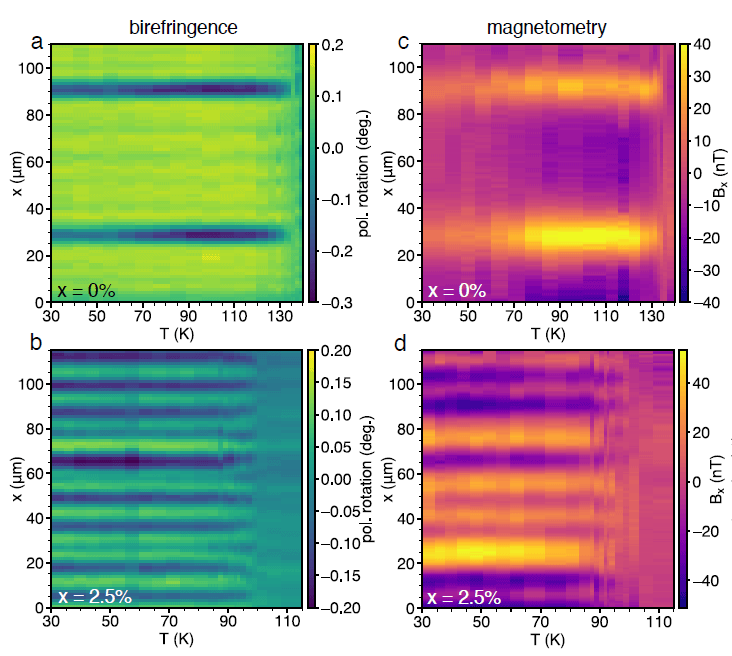
Graph of the sample's birefringence and magnetic field domains show order at temperatures below the transition temperature and disorder above it

Enter the SQCRAMscope. “These spatial patterns [in the magnetic domains] develop on the scale of a few microns, and that’s exactly matched to the spatial resolution of the SQCRAMscope,” Lev says. With help from collaborators in Stanford’s Geballe Laboratory for Advanced Materials, he and his team prepared a sample of the iron pnictide, connected it to gold wires, and used the SQCRAMscope to image magnetic field fluctuations as current flowed through it. By combining these magnetometry measurements with separate measurements of the sample’s optical birefringence, the team could study the sample’s bulk and surface magnetic properties simultaneously, and resolve the debate engendered by previous conflicting measurements.

What they found is that, contrary to hints of a discrepancy in previous studies, the material’s structural transition to a nematic phase and its electron transition occur at the same temperature: about 135 K for an undoped sample, and 96.5 K for a sample with 2.5% doping (see image). “People are excited about multimodal probes, where you can do two distinct measurements at the same time without any sort of change to the sample or substrate,” Lev says. “We have a perfect example of that, and it’s because the atoms are transparent to all wavelengths except for those that are resonant with rubidium.”

Scope for improvements

Now that the SCQRAMscope has proved its worth as a means of studying strongly correlated materials, Lev says that he and his colleagues have “a long list of fun projects to do”. Possible follow-up experiments include using the SCQRAMscope to probe other properties of pnictides (including superconducting electron transport) and study electron transport in 2D materials such as graphene. The team is also improving the instrument’s technical capabilities by reducing its use of cryogens, extending its range of operating temperatures and designing a new mount to make sample exchange easier.

Further details of the study appear in Nature Physics.

Rock, paper…plastic? A quiz about pop songs and bands linked to materials

1. Which of these artists has never had a song with the word “diamonds” in the title?

A. The Beatles B. David Bowie C. Paul Simon D. Rihanna

2. What metal was the title of the 2011 chart-topper by David Guetta, in which the singer Sia likens her strength to this material’s ability to be “bullet-proof” and “stone hard”?

A. Chromium B. Platinum C. Titanium D. Vanadium

3. In Spandau Ballet’s cheesy 1983 hit “Gold”, what attribute of the metal does singer Tony Hadley use to describe his lover?

A. Immutable B. Imperishable C. Incorruptible D. Indestructible

4. Which of these artists once recorded a song called “Made of Stone”?

A. Joss Stone B. Sly and the Family Stone C. The Rolling Stones D. The Stone Roses

5. Lady Gaga’s name can be spelled out using the symbols of which of the following groups of elements?

A. Lanthanum Dysprosium Gadolinium Gadolinium  B. Lawrencium Dysprosium Gadolinium Gadolinium C. Lanthanum Dysprosium Gallium Gallium D. Lawrencium Dysprosium Gallium Gallium

6. What two materials formed the title of a 1965 number-one hit by British band Unit 4 + 2?

A. “Cement and Ceramic” B. “Cement and Clay” C. “Concrete and Ceramic” D. “Concrete and Clay”

7. What was the stage name of Marianne Joan Elliot-Said, the lead singer of influential 1970s punk band X-Ray Spex?

A. Poly Methyl Methacrylate B. Poly Styrene C. Poly Thene D. Poly Vinyl Chloride

8. German pop star Drafi Deutscher – whose career famously nose dived after he urinated off a balcony – had a hit song in 1965 with what three materials in the title?

A. Gold, silver, bronze B. Concrete, cement, granite  C. Marble, stone, iron D. Rock, chalk, clay

9. Which one of the following bands with a metal in the title never, as far as we know, existed?

A. Tin Machine B. Steel Pulse C. Iron Maiden D. Brass Monkey

10. What’s the final element to be named at the very end of Tom Lehrer’s song “The Elements”?

A. Antimony B. Barium C. Sodium D. Zirconium

11. And finally, what Queen song, written by PhD physicist Brian May, is also the atomic mass of potassium?

A. “37” B. “38” C. “39” D. “40”

Stuck for the answers? We’ve listed them below.

With thanks to Lou Bailey, Tami Freeman, Hamish Johnson, Ed Jost and Curtis Zimmermann for inspiration.

Answers: 1. B (David Bowie had a song Diamond Dogs, which had “diamond” in the singular) 2. C  3. D  4. D  5. C  6. D  7. B  8. C (the German song was called Marmor, Stein und Eisen Bricht) 9. D  10. C  11. C

First report of clinical MRI-Linac treatments wins journal citations prize

A research paper describing the first clinical use of a 1.5 T MRI-Linac for MRI-guided radiotherapy has won its authors the 2020 Physics in Medicine & Biology (PMB) citations prize. This annual prize recognizes the PMB paper that received the most citations in the preceding five years.

The paper, First patients treated with a 1.5 T MRI-Linac: clinical proof of concept of a high-precision, high-field MRI guided radiotherapy treatment, was written by researchers from UMC Utrecht, where the MRI-Linac concept was originated, and Elekta, which has now commercialized the system as the Elekta Unity.

Image-guided radiotherapy provides a means to visualize a tumour target in real time; and the use of MRI for this guidance confers exceptional soft-tissue contrast without the need for ionizing radiation. The winning paper describes the first-in-man treatments using the prototype MRI-Linac, which integrates a diagnostic-quality 1.5 T MR scanner with a state-of-the-art linear accelerator.

The team treated four patients with lumbar spine bone metastases, chosen as these tumours are clearly visualized on MRI and the surrounding spinal bone can be detected on the integrated portal imager, providing independent verification of the targeting accuracy. Patients were treated with an intensity-modulated radiotherapy (IMRT) plan created while they were on the treatment table and based on the online MR images.

This study demonstrated that the MRI-Linac concept does indeed work in the clinic and that radiation can be precisely targeted using high-field MRI guidance. Absolute doses were found to be highly accurate, with deviations ranging from 0.0% to 1.7% in the isocentre. Portal imaging confirmed that the MRI-based targeting was better than 0.5 mm, ranging from 0.2 mm to 0.4 mm.

First author Bas Raaymakers, who has pioneered this work on hybrid MRI radiotherapy systems since 1999, suggests that the paper’s popularity may be due to readers being pleased to see that the MRI-Linac worked with patients.

“The possibility of acquiring 1.5T MRI data that reveal anatomical details and motion prior to treatment does resonate very well with existing efforts on image-guided radiotherapy,” he explains. “The fact that these data can also be acquired during irradiation offers all kind of exciting opportunities to move towards real-time adaptive radiotherapy.”

Into the clinic

The paper represented the final step in demonstrating the technical feasibility of the MRI-Linac. Since its publication, the MRI-Linac has gained 510(k) and CE approval and there are now around 30 systems in clinical use around the globe. UMC Utrecht has two clinical MRI-Linacs and a third expected in 2021.

Other advances include the move from treating vertebral bodies to soft-tissue targets, such as lymph nodes, prostate tumours, rectal tumours and others. Improvements in workflow, meanwhile, have led to an average treatment slot of 45 minutes for the majority of patients.

“Within research, we are now prototyping next-generation workflows with intra-fraction replanning to get to the real-time adaptive radiotherapy,” Raaymakers tells Physics World.

PMB authors

The PMB citations prize is marked with the presentation of the Rotblat medal, named in honour of Sir Joseph Rotblat, PMB’s second and longest-serving editor. “This award is a much appreciated recognition and motivation for the entire department and the long-standing, ongoing industrial collaborators,” says Raaymakers.

“Of course, we are intrinsically motivated to keep on improving, it is really fun and rewarding work. But at the same time it feels good that the long journey to get to the clinic is something that is followed and cited by the PMB audience.”

Quantum software company tackles big computing challenges

“My mission is to demystify quantum computing,” says Ilyas Khan, who is founder and chief executive of Cambridge Quantum Computing (CQC) – a UK-based provider of software for quantum computers. Khan is our guest in this episode of the Physics World Weekly podcast, and he explains how CQC helps its clients use quantum computers to solve big problems in the design of pharmaceuticals, machine learning and cybersecurity.

Later in the programme, Physics World editors talk about what is new in physics this week, including how to make a Bose–Einstein condensate using perovskite excitons; a new way of tackling tumours using immunotherapy and a beam of carbon ions; and clever ways of using spin impurities as quantum bits.

This podcast is sponsored by Teledyne Princeton Instruments.

US president-elect Joe Biden set to put science centre stage

One of Joe Biden’s first moves as he became US president-elect earlier this month was to appoint a new coronavirus advisory panel. Featuring senior figures such as Vivek Murthy, a former US surgeon general, and David Kessler, a former commissioner of the Food and Drug Administration, the approach brought relief to many and contrasted sharply with the anti-science rhetoric of departing US president Donald Trump. While Biden emphasized that his administration will be “built on a bedrock of science”, the election failed to deliver a convincing majority for the former vice-president, meaning that his science-based agenda could face an uphill battle in Congress.

For many in the US scientific community, however, Biden’s election represents a return to normality that had disappeared during the four years of Donald Trump. “[Physicists] have expressed delight at the election result and look forward to working with the new administration,” says physicist Philip Bucksbaum from Stanford University, who is president of the American Physical Society (APS). That view is backed by Michael Moloney, chief executive of the American Institute of Physics (AIP), who says that many scientists will now be “eager” to serve in the next government.

Yet the prospective benefits of a science-friendly administration face obstacles. In the short term, Trump’s refusal to concede defeat has slowed down exchanges of information necessary for a smooth transition on 20 January, particularly when it comes to containing COVID-19. The Trump administration has also announced fresh appointments and actions intended to continue its policy of emphasizing economics over science. In mid-November, for example, the administration removed Michael Kuperberg from his post overseeing the National Climate Assessment, which provides the basis for regulations on global warming. His intended replacement is the University of Delaware geographer David Legates, who denies anthropogenic climate change.

A longer-term difficulty is the failure of a “blue wave” to emerge during the elections, which Democrats had hoped would give them control of the Senate and increase their majority in the House of Representatives. The party in fact lost seats, although not its majority, in the House, while control of the Senate now depends on run-off elections for two Senate seats in Georgia on 5 January. An unlikely Democratic win in both seats would produce a Senate divided 50–50 giving the deciding vote to vice-president-elect Kamala Harris. But even with that achievement, the administration could face problems pursuing its science-based agenda given that much legislation requires 60 votes in the Senate to move forward.

Reversing policies

Biden will have some immediate opportunities to fulfil his vow of relying on science. He has nominated Avril Haines, who has an undergraduate degree in physics from the University of Chicago, as director of national intelligence. His administration is also expected to soon overturn three Trump administration actions by re-joining the Paris climate agreement, the World Health Organization and the Joint Comprehensive Plan of Action on Iran. Biden can achieve those aims with executive orders that do not need Senate approval and he can also renew the START treaty on nuclear-weapons reduction, which expires on 5 February. “Certainly, the physics community is interested in seeing an extension,” adds Bucksbaum.

Biden will have some immediate opportunities to fulfil his vow of relying on science

Hope has also emerged regarding climate change, with insiders seeing signs that some Republican legislators have begun to take a nuanced view of the issue. “The scientific evidence has got stronger and the potential outcomes of climate change scarier,” says former US presidential science adviser Neal Lane, who is a senior fellow in science and technology policy at Rice University. “A lot of Republican senators realize there’s a problem here and that they must find a way to change.” Indeed, Illinois Representative Bill Foster, the only PhD physicist in Congress, adds that Republicans on the House Science Committee – with the approval of House Republican leader Kevin McCarthy – have already proposed doubling the US research budget to help develop technologies to mitigate climate change.

During Trump’s presidency, the Environmental Protections Agency (EPA) overturned several government regulations intended to protect other aspects of the environment such as limits on toxic chemicals in the air and soil, the commercial use of government-owned land and the efficiency of car fleets. Since it used executive orders for several of those actions, the Biden administration can counter with its own orders.

The Biden administration is also expected to quickly overturn Trump’s severe restrictions on immigration. “AIP has been on the record about how limits to immigration negatively impact the scientific enterprise as well as how increasing diversity, accessibility and belonging within the STEM workforce will lead to better scientific outcomes,” says Moloney. Those views are backed by Bucksbaum, who says that the APS is working to persuade the new administration to overturn a Trump proposal that would limit certain overseas students’ visas to two years, rather than the traditional duration sufficient to take individuals through the completion of graduate studies.

New appointments

As Biden announces nominees for his cabinet, the science community will focus attention on the new presidential science adviser to replace the current incumbent, atmospheric scientist Kelvin Droegemeier. Lane would like to see a woman in the role for the first time and believes it should be a cabinet-level position. “The first science adviser needs to have a good understanding of health issues,” he says. “They should be the key point person in dealing with the pandemic on the ground.”

Another open post is NASA boss. In an interview with Aviation Week after the election, current NASA administrator Jim Bridenstine announced he would resign – even if Biden asked him to stay on. A former Oklahoma Congressman who has led the agency since April 2018, Bridenstine overcame initial suspicions about his attitude to climate change and many think he has run NASA smoothly and efficiently such as advancing the schedule for human Moon landings. “He’s managed to work well with both [political] parties,” says Lane, a fellow Oklahoman. “He’s done a good job working with SpaceX and moving toward stronger partnerships with the private sector.”

Whether the rest of the government’s science-based agencies can work as effectively as NASA remains to be seen. Several political pundits assert that Biden is a natural conciliator, whose long service in Congress has gained him the respect of Republican legislators. That could help him to achieve agreement on science-friendly policies. “It will be important for both Republicans and Democrats to focus on bipartisan issues,” says Bucksbaum. “Science can then return to the historical position of being something that everybody likes.”

American Physical Society tightens rules on meeting locations

The American Physical Society (APS) has sharpened its criteria when choosing the locations in which to hold future meetings, saying it will ask the leadership of possible cities to report on local policing policies and related demographic issues.

The society will, in particular, examine statistics on the use of force by the local police; policies on police use of strangleholds and other methods of restraint; as well as the status of investigations into the deaths of individuals in police custody. Candidate cities will be expected to train all their police in de-escalation methods; have evaluations of policing performance that include shootings and deaths of unarmed individuals by police officers; as well as have “a well-defined plan and timetable for improving local policing practices”.

The policy has been introduced following the use of excessive force by the police, particularly against members of under-represented or minority groups. “We became aware that members of our community are vulnerable in ways we had never imagined, and we resolved to act,” says Susan Gardner of the University of Kentucky, who chairs the APS’s committee on scientific meetings. APS president Philip Bucksbaum of Stanford University told Physics World that the membership has been the motivation for the move. “We hear loud and clear that our members see that they shouldn’t have to go to meetings in cities where they feel unsafe and threatened,” he says.


Deep-learning model enables rapid lymphoma detection in PET/CT images

Whole-body positron emission tomography combined with computed tomography (PET/CT) is a cornerstone in the management of lymphoma (cancer in the lymphatic system). PET/CT scans are used to diagnose disease and then to monitor how well patients respond to therapy. However, accurately classifying every single lymph node in a scan as healthy or cancerous is a complex and time-consuming process. Because of this, detailed quantitative treatment monitoring is often not feasible in clinical day-to-day practice.

Researchers at the University of Wisconsin-Madison have recently developed a deep-learning model that can perform this task automatically. This could free up valuable physician time and make quantitative PET/CT treatment monitoring possible for a larger number of patients.

To acquire PET/CT scans, patients are injected with a sugar molecule marked with radioactive fluorine-18 (18F-fluorodeoxyglucose). When the fluorine atom decays, it emits a positron that instantly annihilates with an electron in its immediate vicinity. This annihilation process emits two back-to-back photons, which the scanner detects and uses to infer the location of the radioactive decay.

Because tumours grow faster than most healthy tissue, they must consume more energy. Much of the radioactive tracer will therefore be drawn towards the lymphoma lesions, making them visible in the PET/CT scan. However, other types of tissue, such as certain fatty tissues, can “light up” the scans in a similar manner, which can lead to false positives.

Neural networks: accurate and fast

In their study, published in Radiology: Artificial Intelligence, Amy Weisman and colleagues investigated lesion-identifying deep-learning models built from different configurations of convolutional neural networks (CNNs). They trained, tested and validated these models using PET/CT scans of 90 patients with Hodgkin lymphoma or diffuse large B-cell lymphoma. For this purpose, a single radiologist delineated lesions within each scan and classified each one on a scale from 1–5, depending on how sure they were that a lesion was malignant.

The researchers found that a model consisting of three CNNs performed best, identifying 85% of manually contoured lesions (923 of 1087, the so-called true positive rate). At the same time, it falsely identified four lesions per patient (the false positive rate). The time to evaluate a single scan was cut from 35 minutes using manual delineation to under two minutes for the model.

It is extremely difficult to classify every lymph node in a scan as cancerous or not with 100% certainty. Because of this, if two radiologists delineate lesions for the same patient, they are not likely to agree with each other completely. When a second radiologist evaluated 20 of the scans, their true positive rate was 96%, while they marked on average 3.7 malignant nodes per patient that their colleague had not. In these 20 patients, the deep-learning model had a true positive rate of 90%, at 3.7 false positives per scan – making its predictions almost as good as the variation between two observers.

Expected, and unexpected, challenges

Often, one of the biggest hurdles in creating this type of model is that training it requires a large number of carefully delineated scans. The study authors tested how well their model performed depending upon the number of patients used for training. Interestingly, they found that a model trained on 40 patients performed just as well as one trained on 72.

Amy Weisman

According to Weisman, obtaining the detailed lesion delineations for training the models proved a more challenging task: “Physicians and radiologists don’t need to carefully segment the tumours, and they don’t need to label a lesion on a scale from 1 to 5 in their daily routine. So asking our physicians to sit down and make decisions like that was really awkward for them,” she explains.

The initial awkwardness was quickly overcome, though, says Weisman. “Because of this, Minnie (one of our physicians) and I got really close during the time she was segmenting for us – and I could just text her and say ‘What was going on with this image/lesion?’. Having a relationship like that was super helpful.”

Future research will focus on incorporating additional, and more diverse, data. Acquiring more data is always the next step for improving a model and making sure it won’t fail once it’s being used, says Weisman. At the same time, the group is working on finding the best way for clinicians to use and interact with the model in their daily work.

Copyright © 2026 by IOP Publishing Ltd and individual contributors