Hybrid infrared–optical microscope could improve cancer diagnostics

A novel hybrid microscope delivers the same information as standard optical microscopy without the need for detrimental tissue staining, while also providing molecular insight into tissue biopsies. Developed by researchers from the University of Illinois at Urbana-Champaign, the system adds infrared capability to the ubiquitous, standard optical microscope. The new system could deeply impact histopathology, both in the clinics and within research, by offering faster diagnosis, lower cost and wider availability (PNAS 10.1073/pnas.1912400117).

Histopathology is the microscopic study of tissues to spot and identify disease manifestations such as tumours. The gold standard technique requires the addition of dyes or stains to human tissue biopsies. This enables pathologists to see the shapes and patterns of the cells under a microscope and distinguish cancerous tissues from healthy ones. However, even for highly trained readers, such diagnostics can prove tricky and are subjective.

Moreover, the information given by optical microscopes is limited and superficial, as it does not shed any light on the underlying molecular changes driving cancer. Infrared (IR) microscopy, on the other hand, can provide such details by measuring the molecular composition of tissues. But while conventional optical microscopes are widespread and easy to use, IR microscopes are expensive and require the sample to undergo an extensive preparation – making this approach impractical in most settings.

A ready-to-build hybrid microscope

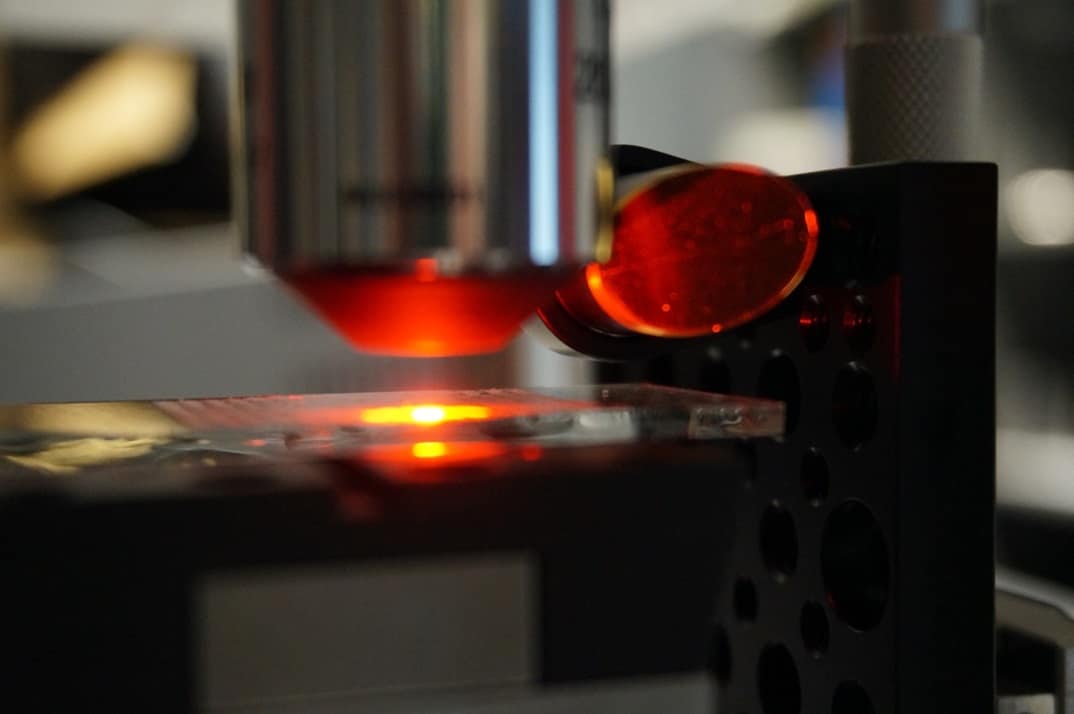
A team led by Rohit Bhargava bypassed the limitations of both techniques by coupling them. The feat was achieved by adding an IR laser and an interference objective to an optical camera, which harnesses the strengths of both modalities.

Hybrid microscope

The hybrid microscope has the same high resolution, large field-of-view and accessibility of an optical system, while its software can use the IR data to compute an image that looks similar to a conventional stained sample. This combination allows researchers to use an all-digital approach to biopsies and derive information about tissue density, scattering, path length or visible absorption that exceeds that offered by standard microscopy.

“We built the hybrid microscope from off-the-shelf components. This is important because it allows others to easily build their own microscope or upgrade an existing microscope,” says first author Martin Schnell, a postdoctoral fellow in Bhargava’s group.

AI helps pathologists

The researchers tested the performance of the hybrid microscope on unstained breast tissue samples and compared the results with conventional techniques. They developed an iterative search algorithm to identify the cell types in each biopsy – such as healthy and malignant cells in the epithelium, stroma, red blood cells and some additional tissues – using the 22 available frequency bands of the IR spectrum. The team subsequently found that only seven bands were needed to obtain accurate classification and five to obtain an area under the curve (a metric assessing a tool’s performance) above 0.90, which could considerably speed up diagnosis.

More work needs to be done on the analysis of the hybrid images. The researchers are now working to optimize machine-learning programs that can measure multiple IR wavelengths, creating images that readily distinguish between multiple cell types, and integrate that data with the detailed optical images to precisely map cancer within a sample.

“It is very intriguing what this additional detail can offer in terms of pathology diagnoses,” Bhargava says. “This could help speed up the wait for results, reduce costs of reagents and people to stain tissue, and provide an ‘all-digital’ solution for cancer pathology.”

A stance against forced retirement

Making reasonable estimates is a core skill for a scientist. When I interviewed candidates to study physics at the University of Oxford, I’d ask them a variant of the “Fermi problem”. Enrico Fermi famously asked students to estimate the number of piano tuners in Chicago, whereas my version asked how many barbers there are in Oxford. Reasonably accurate answers can be obtained using sensible approximations and any available data (Oxford has a population of 120,000, half go to a barber and do so once every six weeks, etc).

I found myself doing a similar calculation when faced with forced retirement as a physics professor at Oxford in 2015. Although the UK’s 2010 Equality Act outlaws fixed-age retirement, an employer can impose an Employer Justified Retirement Age (EJRA) but it must show that it is a proportionate means of achieving some legitimate aim. When my request for a further extension of employment to continue my active and funded research was refused, an employment tribunal upheld my claim of age discrimination. The university is appealing the judgement (bit.ly/2SssP9s).

Female academics data

Oxford claimed its EJRA policy, by creating vacancies, improved gender diversity and opportunities for younger academics. I questioned that it was proportionate by doing a Fermi-style estimation – using reasonable approximations and available data – of the extent to which it could achieve these aims. An EJRA changes only the rate of vacancy creation by bringing forward some vacancies that would occur anyway – no-one works forever. Assuming, initially, that everyone works until retirement and extends their career by 10%, preventing such extensions by an EJRA changes the vacancy rate by 10%. However, data show that, at Oxford, only 40% of employees stayed until retirement and then, at most, only 50% of them wished to extend. The resulting change of 2–4% in the vacancy rate was judged “trivial” by the tribunal and not proportionate to the heavy discrimination involved.

When Oxford introduced its EJRA in 2011, it committed, but failed, to monitor its effectiveness by comparison with the rest of the Russell Group of UK universities, none of which – except Cambridge – operates forced retirement. Using data from the Higher Education Statistics Agency I was able to show that there was no evidence of any impact on gender diversity (see figure above). The effect on opportunities for younger people was similarly trivial as indicated by the proportion of academics aged over 67. These results, confirmed by rigorous statistical analysis by Oxford’s own statistics consultant, the late Daniel Lunn, are entirely consistent with the trivial size of the EJRA’s effect on vacancy creation.

Loss of opportunities

It cannot be right to dismiss active physicists, or indeed any productive academic, at some arbitrary age. It is traumatic to be forcibly retired, especially when one’s work is still in full swing and there are new ideas to be explored. The “emeritus” status offered by Oxford, instead of full employment, is of no use to experimental scientists who need a research team and principal-investigator status to apply for their own research funding.

It is simply ageism that underlies many of the arguments used to justify mandatory retirement. Age is often used as a proxy for competence and this lazy stereotype feeds off the myth that scientists have their best ideas when they are young. Indeed, studies have shown that a scientist’s most impactful work can occur at any stage in their career.

The argument that younger people gain from the “freeing up” of posts ignores the loss of opportunities for graduate students and postdocs provided by experienced, grant-winning, senior academics. It is ageism that sees a 40-year-old as “filling” a post whereas a 65-year-old is “blocking” a post. Apart from providing the dignity and fulfilment of employment, there are general imperatives for people to work longer, including the growing pension burden and increases in life expectancy. Recent studies by the World Health Organization also highlight the physical and mental health benefits of working longer. The International Standards Organization is currently conducting a project on the economic and social benefits of an “age-inclusive” workforce.

Ageism is endemic in our society and attitudes persist that would be recognized as shameful if they related to race, religion or sexual orientation. The University of Oxford’s claim that dismissing older academics is necessary to maintain its high standards is simply ageism, implying that academic performance deteriorates with age. If retirement policies are to be truly evidence-based, they need to be justified by reasoned estimates of proportionality that are consistent with the available data.

Transverse arch puts a spring in your step, biomechanics study reveals


The stiffness of the human foot is strongly influenced by an arch that spans its width, a new study suggests. An international research team, led by Madhusudhan Venkadesan at Yale University in the US, came to this conclusion by doing simulations and experiments of the physical mechanisms underlying the foot’s transverse tarsal arch (TTA). Their discovery could lead to new advances in medicine and biotechnology – and deliver new insights into how bipedalism first evolved in our distant ancestors.

Humans are unique among primates because the inherent stiffness of our feet enables us to efficiently push off the ground when walking and running (see video). The median longitudinal arch (MLA), which runs from the heel to the ball of the foot, is thought to play a critical role in this stiffness.

Stiffened by a bowstring-like arrangement of ligaments, the MLA not only keeps the foot rigid. It also stores and releases mechanical energy like a spring as we walk and run. Yet despite our detailed knowledge about the role of the MLA, the precise relation between midfoot curvature and stiffness is still widely debated among anatomists.

Elastic shells

Venkadesan’s team believe that previous analyses of the foot had overlooked the stiffening influence of the TTA, which spans the width of the foot perpendicular to the MLA.  To understand the role of the TTA, the team subjected uniform elastic shells to curvatures in both longitudinal and transverse directions; stiffening each curve with ligament-imitating springs.

Measurements on the shells – and computer simulations – have revealed that the transverse bending contributes more to the stiffness of the shell than the longitudinal bending. This is independent of other factors including shell size and thickness. The team also tested the importance of the TTA theory using cadaver feet. This showed that by cutting transverse ligaments, overall foot stiffness is reduced by 40%; compared with just 23% for longitudinal ligaments.

Evolutionary history

Venkadesan and colleagues are also exploring how and when the foot’s stiffness and curvature first appeared in the evolutionary history of our ancestors. They have studied a variety of fossils of extinct hominins – which were more closely related to humans than to chimpanzees. This analysis revealed that human-like TTAs predate our own genus, Homo, by over 1.5 million years. This suggests that both the MLA and TTA were critical for the emergence of human bipedalism.

Future studies could also help us better understand the role of the MLA.  For example, the MLAs of individual feet have a range of curvatures that is not reflected in the range of foot stiffnesses. It is possible, therefore that the TTA and MLA work together to create the optimum overall stiffness.

The researchers hope that their insights could lead to new treatments of flatfoot disorders, which can significantly reduce a person’s mobility. The research could also lead to more advanced artificial feet for prosthetic limbs and even robots that can walk and run like humans.

The research is described in Nature.

Open innovation meets the technology challenge of 5G networks

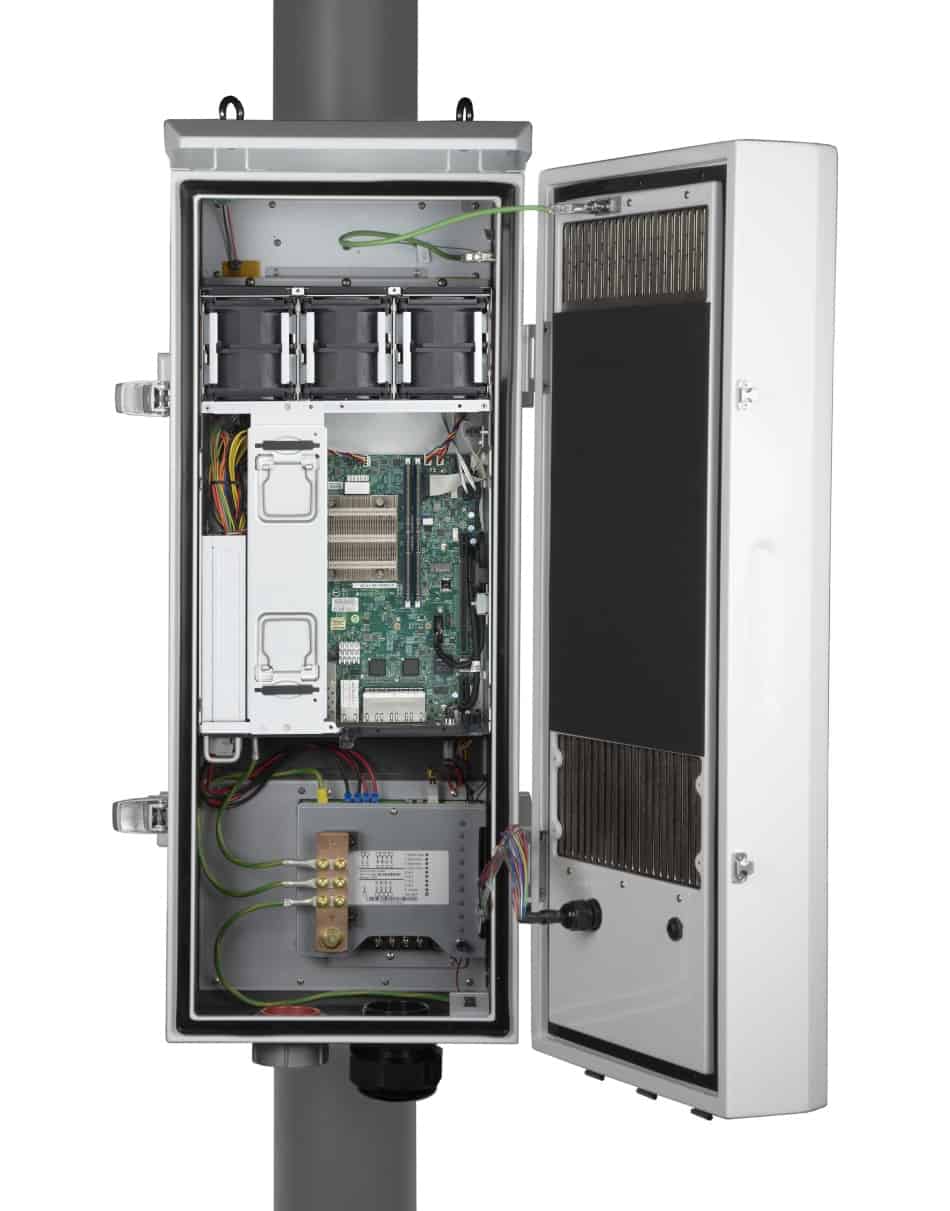
Supermicro’s SuperServer

Mobile operators around the globe are gearing up for a new era of 5G network services. The move to 5G promises higher transmission speeds and more bandwidth, allowing videos and other data-rich content to be uploaded and downloaded up to 20 times more quickly than with current 4G technology. Perhaps even more importantly, 5G networks promise to be much more responsive for time-critical applications: the latency, which measures the time taken for data entered at one point of the network to elicit a response, is set to plummet from 50 ms today to just 1 ms when the roll out is complete.

This improved responsiveness will be crucial for real-time consumer applications, such as self-driving cars, lag-free gaming, and live streaming without the annoyance of buffering. But it will also play an important role in delivering improved and more personalized healthcare services, allowing patients visiting their local clinic to be treated by the best specialists from all over the world via video links, with remote diagnosis and monitoring using systems powered by artificial intelligence (AI). At the same time, first responders with real-time access to sensor data and network-assisted AI will be able to make better informed decisions in the most challenging conditions.

But achieving such performance improvements is forcing mobile operators to rethink and redesign their networks. 5G will exploit higher frequencies to speed up network connections, but this has the effect of shortening the transmission range. More base stations will be needed to provide the same coverage as today, and more computing power will need to be available at the edge of the network – in local offices and branches, for example, and even at the radio tower itself.

“There’s a new wave of technology coming out at the edge to enable low-latency applications, such as those exploiting artificial intelligence and video technologies,” says Jeff Sharpe, director for IoT and embedded solutions at Supermicro, a leading developer of high-performance hardware solutions for datacentres and edge computing. “These technologies will allow network operators to optimize their networks and deliver better services to their customers.”

The new-look network will still have high-performance computing power in the core of the network. That high-end compute would be used, for example, to develop and train the models used for different AI applications. But intelligent edge computing will bring that power to wherever it is needed, allowing end users to exploit the AI algorithms to process and analyse incoming data in real time.

“Operators will also need to exploit cloud-based software solutions to support the move to edge computing,” comments Yaming Wang, director for IoT and embedded solutions at Supermicro. “To do that the operators are focused on adopting an open hardware architecture as well as open-source software.”

That will be a fundamental shift from today’s mobile networks, in which most of the equipment has been sourced from a small number of companies providing proprietary solutions. The effect, says Wang, has been to slow down the evolution of network technology, with many innovations relying instead on the development of improved software services.

As a result, the world’s leading network operators – including the likes of AT&T, Verizon and Deutsche Telekom – have come together to form the Open Radio-Access Network (O-RAN) Alliance. Its mission is to build an open 5G infrastructure from virtualized network elements that allow installed equipment to be used more flexibly, standardized interfaces, and hardware sourced from multiple vendors.

“The O-RAN Alliance was created to accelerate the delivery of products that support a common, open architecture that we, as operators, view as the foundation of our next-generation wireless infrastructure,” explains Deutsche Telekom’s Alex Jinsung Choi. “It will also ensure that we have a broad community of suppliers driven by innovation and open market competition.”

That approach plays to the strengths of a company like Supermicro, which has focused on developing open-architecture hardware platforms and building virtualized solutions with different software partners. These virtual network elements – essentially a combination of hardware and software that performs a specific network function – will be distributed throughout the radio-access network to deliver high-performance computing to end users, and to support the more dynamic needs of 5G services.

“Supermicro sees the edge as different areas,” explains Sharpe. “We have equipment that’s specifically designed to be installed in a customer premise, something like a local banking office that needs high-end technology for security applications. We also have a high-performance server that’s designed to be used in a controlled environment, such as a micro data centre.”

Supermicro’ high-performance server, the 1019P, comes in a compact rackmount format – less deep than standard data centre equipment – that allows it to be deployed in branch offices and other network-oriented indoor locations such as repurposed telephone central offices.  It can run many different applications, and has two expandable slots that can be used interchangeably to provide local computing power or to support network O-RAN applications.

For compute-intensive applications such as AI inferencing, one or both slots can be configured with 2nd Generation Intel® Xeon® Scalable processors, designed specifically for data-centric computing and offering built-in AI acceleration. Alternatively, it can be fitted with Intel®’s Programmable Acceleration Card N3000, a field-programmable gate array (FPGA) that supports site-to-site communications for an open 5G radio-access network.

“Intel® and Supermicro address this network transformation opportunity as partners,” says Allen Leibovitch, senior product marketing manager at Supermicro. “Intel® often supports us in developing hardware and software reference designs, including verified Intel® Select Solutions.”

Supermicro’s SuperServer

Another high-performance server, the SuperServer E403-9D-16C-IPD2 has been designed for installation on the radio tower itself. It also has expandable slots capable of running both FPGA and Xeon®-enabled processing technologies, and the whole package fits inside a standard IP65 environmental enclosure to enable it to operate in the harshest of weather conditions. “Our new outdoor SuperServer brings high-performance data centre capability to the cell site itself,” says Leibovitch. “This will be essential for network providers to deploy dynamic 5G networks and to implement advanced real-time applications and services for their customers,” says Leibovitch.

Visit the Supermicro website to find out more about the company’s open hardware solutions for 5G networks.

Seismic imaging technology sees deep inside the brain

Brain imaging

A computational technique developed to process seismic images of the Earth’s subsurface could allow for high-resolution human brain imaging, reports a new study by researchers from Imperial College London. Although presently in the simulated, proof-of-concept stage only, the development could pave the way towards a cheaper, portable and more universally applicable method for rapid diagnosis of stroke and head trauma, and continuous monitoring of a wide range of neurological conditions (npj Digit. Med. 10.1038/s41746-020-0240-8).

Both of the leading conventional techniques for performing imaging on the brain come with inherent limitations. MR imaging is unsuitable for use on patients who have – or are suspected could have – metallic implants or harbour foreign bodies. It is also impractical for use on severely obese, claustrophobic or uncooperative patients. X-ray CT, meanwhile, involves exposure to harmful ionizing radiation, ruling out its use with young patients or for continuous monitoring. Both modalities also require large, expensive, high-powered machines that cannot practically be set up outside of hospital or laboratory settings.

In contrast, ultrasound imaging is universally safe for use and can be made portable – but traditional applications have not been able to scan within the human skull. This is because the bone attenuates, scatters and reflects the waves in complex ways that cannot be undone by simple algorithms.

In a new study, physicist Lluiís Guasch and colleagues turned to a computational technique known as full-waveform inversion (FWI), which is used by geophysicists to extract three-dimensional images of the Earth’s subsurface from data collected by seismometers on the passage of waves underground. A nonlinear data-fitting procedure, FWI works by using real-world seismic data to create a rough model of subsurface conditions from which wave equations can be solved to produce mock data. The model is then iteratively improved until this output provides the best fit for the real-world data.

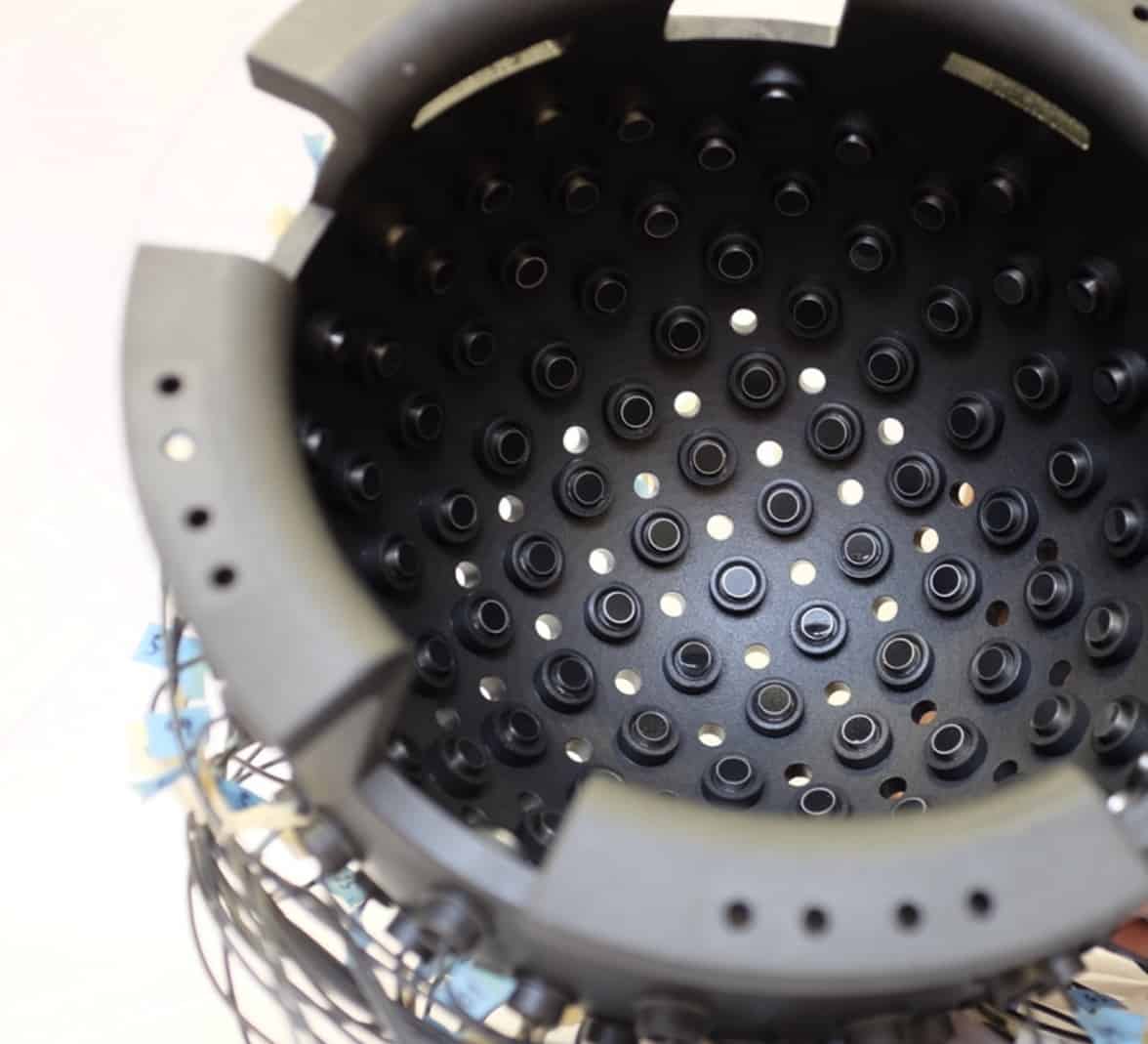
Transducer array

Instead of using seismometers across the Earth’s surface, the researchers instead envisage using a helmet-like mesh of 1024 ultrasound transceivers. Through simulation, they show that in such a set-up, FWI is indeed capable of reconstructing high-resolution images of the brain like an MRI scan – one in which grey matter, white matter, ventricles and structure can be clearly seen. They also demonstrate in the lab that ultrasound transceivers are able to record signals from within a human skull with the required signal-to-noise ratio for processing with their FWI algorithm.

“This is the first time FWI has been applied to the task of imaging inside a human skull,” says Guasch. “In many ways, it is easier to apply FWI in medical imaging than in geophysics.” This, he explains, is because – unlike when dealing with the unique nature of different subsurface images – individual skulls have commonalities that can help guide the image reconstruction process.

“Neurology has been waiting for a new, universally applicable imaging modality for decades; FWI could well be the answer,” adds co-author Parashkev Nachev.

Furthermore, the researchers say that it should be possible to eventually realize a clinical version of their scanner that is portable – sized to fit on a motorbike or within an ambulance – that could allow scans to be undertaken on patients in advance of reaching hospital. Similarly, the device could be mounted on a frame to perform bedside imaging. The one drawback of the approach, however, is that it presently takes considerable time – as the helmet produces 1024 × 1024 individual ultrasound signals, which take around 32 hours to process on a conventional server.

“This is an important piece of work, as most imaging physicists would have assumed that, quite apart from the large signal attenuation that the skull produces, the multiple internal reflections and scattering of the soft tissue signals as they hit the bone interface would render any hope of reconstruction impossible,” says Stephen Williams, an imaging scientist from the University of Manchester who was not involved in the present study. “The paper provides compelling evidence that a physical realization of the concept should be possible, provided that the computer processing time can be reduced by around 200 times compared to the simulations reported in the article.”

The researchers note that three-dimensional ultrasound tomography using FWI could find particular relevance for rapid diagnosis and treatment of stroke. With their initial study complete, they are moving to further develop their prototype system with the goal of producing the first brain image of a live human subject – alongside improving the robustness of their image generation algorithm and lowering computational costs.

Suction forces enable precise bioprinting

A technique described by its creators as “like picking up a pea by placing a drinking straw on it and sucking through the straw” could make it easier to fabricate precise 3D patterns of biological tissues in the laboratory. The approach, dubbed aspiration-assisted bioprinting, could be used for applications such as regenerative medicine, tissue engineering and in vitro modelling of human diseases.

In 3D bioprinting, cell-laden hydrogels or “bioinks” are used to build biological structures layer-by-layer. Recent advances in the field mean that researchers can routinely fabricate patterned tissues and vascular-like networks and perfuse them with living cells and nutrients. The techniques employed vary depending on the viscosity and nature of the bioinks, and include ink-jet printing, microvalve- and extrusion-based bioprinting to name but three.

The great hope of 3D bioprinting is that it will enable patient-specific human tissues to be fabricated in the lab – perhaps even using a patient’s own cells. The problem is that current 3D bioprinting techniques cannot accurately position the densely packed aggregates of living cells that act as building blocks for functional human tissues and organs. These aggregates, known as “tissue spheroids”, can also be rendered non-viable if the printing process damages their biological, structural or mechanical properties. A further challenge is that most techniques cannot print spheroids of different sizes, or accommodate the scaffold-like structures that are the starting point for many tissue-engineering applications.

Aspiration-assisted bioprinting

A team of researchers at Pennsylvania State University in the US has now developed a new bioprinting technique that overcomes these difficulties by using suction to pick up and print different types of spheroids. The spheroids they tested were made of human or mouse mesenchymal stem cell aggregates and ranged in size from 80 to 600 microns. To avoid damaging them, the researchers kept the suction force to a minimum value, which they calculated based on the critical lifting pressure needed to overcome the thermodynamic barrier at the interface between the air, the tissue and the cell growth medium.

By holding the suction forces on the spheroids, team leader Ibrahim Ozbolat and colleagues demonstrated that they could move the spheroids to the proper locations before releasing them. They used this technique in conjunction with conventional micro-valve printing to build up tissues.

Collective capillary sprouting

By controlling the exact placement and type of spheroid, the Penn State team created tissues made from different types of cell, such as bone, as well as tissues that consist of a single cell type. This precise control also enabled them to create a matrix of spheroids with capillaries sprouting in specific directions. Since capillaries deliver oxygen and nutrients to cells, and are thus crucial for tissue growth and viability, controlling their spread is an important step towards creating viable tissues.

As well as bioprinting spheroids, Ozbolat says the team also printed tissue strands and single electrocytes – the modified muscle or nerve cells that generate electricity in fish such as electric eels. The bioprinted electrocytes might be used to fabricate biological batteries for various applications, including pacemakers, cochlear implants and brain chips, he tells Physics World.

The researchers, who report their work in Science Advances, say they are now focusing on improving their system so it can print spheroids at a higher rate, which would allow them to create larger tissue samples faster and with more intricate shapes.

Time crystals enter the real world of condensed matter

Look at a computer processor or a superconducting device and imagine what’s inside – countless electrons flying between the ions that form a solid-state crystal. Now try to imagine it’s all happening not in space but in the fourth dimension of time. Is it possible that condensed-matter devices and conventional electronics can enter the time dimension?

In 2012 the Nobel-prize-winning physicist Frank Wilczek published his seminal article on “quantum time crystals”, in which he posed the provocative question of whether time-translational symmetry – where one instant in time is equivalent to any other – can be spontaneously broken in the lowest-energy state of a quantum-mechanical system (Phys. Rev. Lett. 109 160401). Such symmetry breaking would lead to the spontaneous emergence of a “time crystal”, just as spontaneous translational symmetry-breaking leads to the formation of an ordinary crystal in space (see “In search of time crystals” by Philip Ball, July 2018),

It was a weird idea, and almost no-one understood it. Indeed, the suggested model turned out to be wrong. That’s because in the thermodynamic limit of a large number of particles, in order to minimize energy, quantum particles prefer to stop, rather than to move, even in the presence of a magnetic field (Phys. Rev. Lett. 111 070402, Phys. Rev. Lett. 119 250602). So it’s not easy to see how particles can spontaneously exhibit periodic motion in time by a self-organization process, like they do in space, while they remain at equilibrium, in the state with the lowest possible energy (Phys. Rev. Lett. 114 251603, Phys. Rev. Lett. 123 210602).

The rise of discrete time crystals

Wilczek’s idea did, however, trigger new thinking about whether there might be other ways that crystalline behaviour could be hosted in the time dimension. In 2015 one of us (Sacha) proposed that a periodically driven (and thus non-equilibrium) quantum many-body system – such as a Bose–Einstein condensate (BEC) of ultracold atoms bouncing on an oscillating atom mirror (figure 1) – can spontaneously break discrete time-translational symmetry, due to interactions between the particles. The atoms would start to evolve with a period twice as long as the period of the driving force, to create what is known as a “discrete” time crystal (Phys. Rev. A 91 033617). Classically, such “period-doubling” of a driven oscillatory system is well known. However, in the quantum world, stationary solutions of the Schrödinger equation must follow the period of the force. If a system spontaneously chooses stationary motion with a different period, the discrete time-translational symmetry is broken. We call the symmetry discrete because not every point in time is equivalent to any other for the periodically changing force. The only points that are equivalent are those that correspond to a discrete jump in time by the period of the force.

1 Bouncing on mirrors
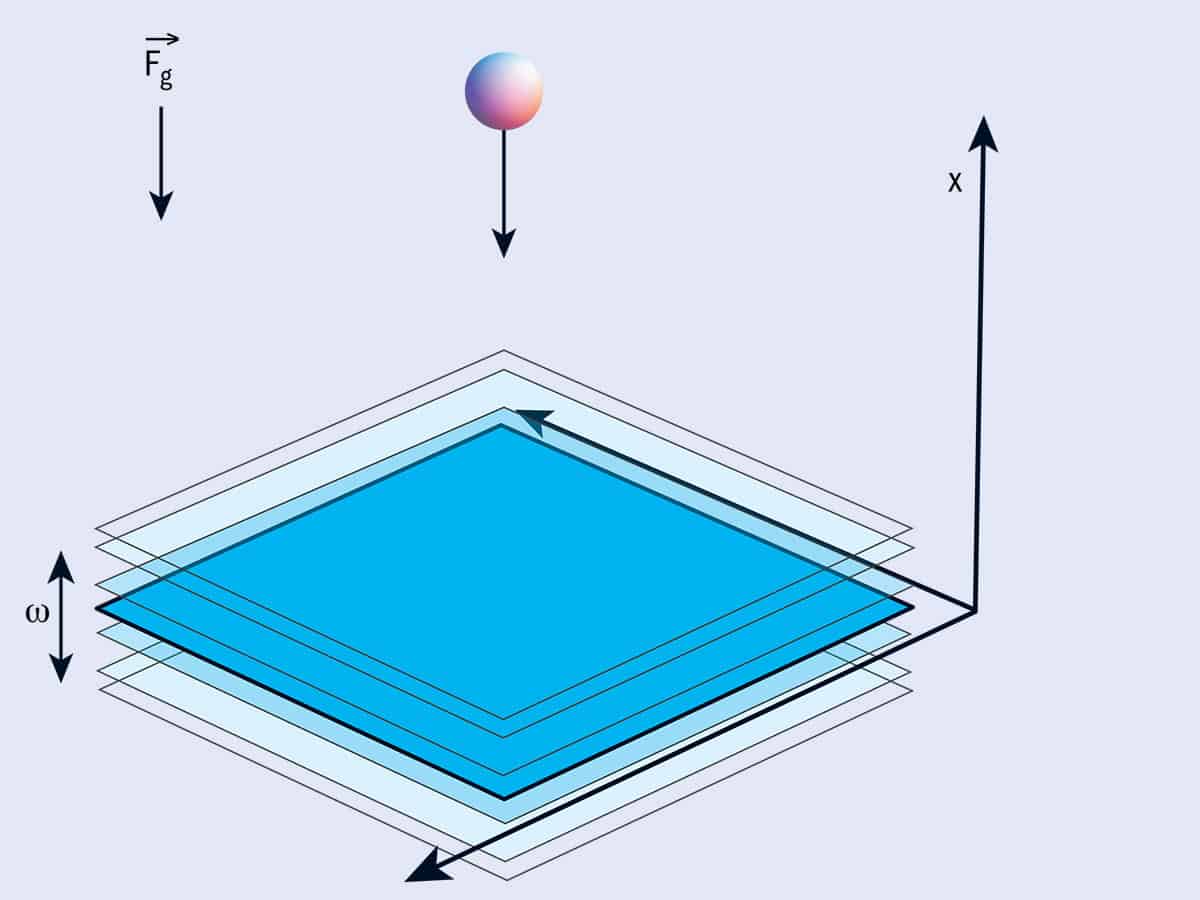
Oscillating atom mirror Bouncing ultracold atoms on an oscillating atom mirror (with period T = 2π/ω) is one way of producing a discrete time crystal. The atom mirror could be, for example, a blue-detuned repulsive light sheet (adapted from original figure by Artur Miroszewski).

Similar ideas were later proposed that involve periodically driven systems of spins, by teams at Princeton University in the US and the Max Planck Institute for Physics of Complex Systems in Germany (Phys. Rev. Lett. 116 250401), and the University of California, Santa Barbara (Phys. Rev. Lett. 117 090402) and Berkeley (Phys. Rev. Lett. 118 030401). These proposals considered a 1D chain of spins – such as a string of ions in electromagnetic traps – which are first prepared in a polarized spin state. The ions are then subjected to a periodic spin-flip driving pulse in the presence of spin–spin interaction and controlled spin disorder, which induces a quantum effect that prevents the system of spins from absorbing energy and heating up. Despite the fact that the driving pulses dictate a certain period, the spin system self-organizes its motion with a period twice as long as the drive. Discrete time crystals break “ergodicity”, according to which a generic periodically driven many-body system should heat up to an infinite temperature. In the proposed spin system, disorder in the presence of particle interaction is expected to be responsible for many-body localization effects, which prevent heat from being freely redistributed and account for the lack of heating.

Within a few months of these initial proposals, preliminary experimental evidence for such discrete time crystals in spin systems was reported by Chris Monroe’s group at the University of Maryland in the US, using a 1D chain of interacting ytterbium-171 ions (Nature 543 217), and by Mikhail Lukin’s group at Harvard University, using 3D ensembles of interacting nitrogen-vacancy spin centres in diamond (Nature 543 221). Similar observations have since been made in NMR experiments by Ganesh Sreejith and colleagues at the Indian Institute of Science Education and Research in Pune, using nuclear spins in organic molecules in solution (Phys. Rev. Lett. 120 180602), and by Sean Barrett and colleagues at Yale University in the US, using phosphorus-31 spins in ordered crystals of ammonium dihydrogen phosphate (Phys. Rev. Lett. 120 180603). In a different kind of system, Peter van der Straten and co-workers at Utrecht University in the Netherlands created a “space–time crystal”, with periodic structure in both space and time (Phys. Rev. Lett. 121 185301). In this experiment a BEC of ultracold sodium-23 atoms was prepared in an elongated trap, and the vibrational motion of the condensate along the radial direction – induced by suddenly changing the radial trap frequency – acted as a driving force. Again, time-periodic oscillations of the atomic density along the longitudinal direction were observed with a period twice the length of the period of the driving force. The atomic density also revealed a spatial periodic structure in the longitudinal direction; in other words, it was a crystal in both space and time.

Ultracold atoms bouncing on an oscillating mirror seem to be much more flexible for realizing discrete time crystals than spin systems do. They could let us create discrete time crystals with dramatic breaking of time-translational symmetry; for example, they can evolve with periods more than an order of magnitude longer than the driving period (Phys. Rev. A 98 013613), thereby creating lots of available “lattice sites” in the time dimension.

Time vs space

Discrete time crystals demonstrate a very important property of solid-state systems: the formation of periodic structures due to spontaneous breaking of translational symmetries. Space crystals can possess a variety of very different and useful properties: they can be insulators, conductors and even superconductors. Can we realize the equivalent of such phenomena in the time dimension?

Take a space crystal that is not perfect because the position of the ions is somewhat random or disordered. If the disorder is sufficiently strong, the electrons can’t form an electric current due to destructive interference between different scattering paths. Instead, they become localized and unable to propagate in space in a way predicted by the physicist Philip Anderson in 1958. But such “Anderson localization” can occur in the time dimension too. To understand why, imagine bouncing a ping-pong ball on a bat. If we were a bad table-tennis player, we’d probably lose the ball because our hand is shaking randomly. However, if the ball were a quantum object – like a BEC of ultracold atoms – quantum mechanics would help us, because the time disorder from our shaking hand would result in Anderson localization in the time dimension (Sci. Reports 5 10787). This is an example of a condensed-matter phenomenon that can be observed in the time dimension when a space crystal is exchanged with a time crystal and disorder in space is substituted by disorder in time (figure 2).

2 Anderson localization
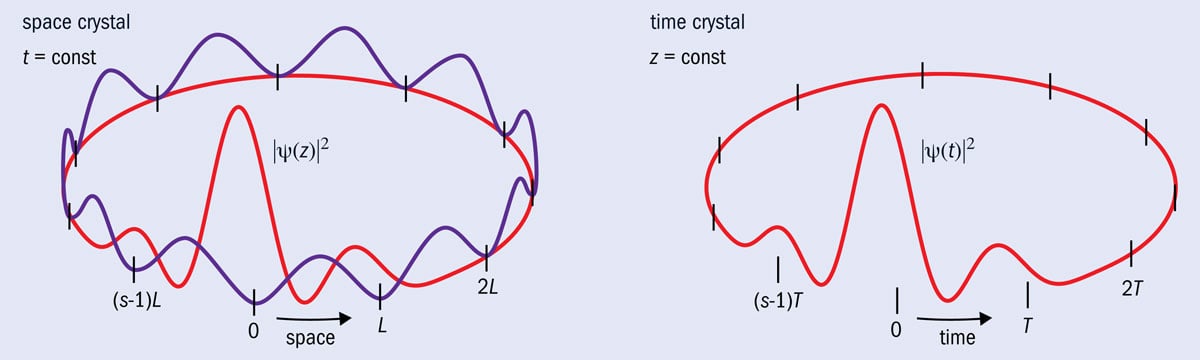
Anderson localizationComparison of the well-known phenomenon of Anderson localization in a 1D space crystal having periodic boundary conditions (a, left) with Anderson localization in the time dimension (b, right). In order to switch from a space crystal to a time crystal we have to exchange the role of space, z, and time, t; that is, we fix the position in space and ask if the probability of the detection of a particle at this point in space |Ψ(t)|2 is Anderson-localized around a certain moment of time.

In an actual experiment, the probability density of the bouncing ultracold atoms at a particular point in space is recorded, and the atoms appear here with an exponentially localized profile in time (Phys. Rev. A 98 013613). An advantage of studying Anderson localization in the time dimension is that it is relatively straightforward to introduce disorder in a highly controlled way, simply by applying some disorder to the oscillation of the atom mirror. In practice, Anderson localization in the time dimension can be used to control the time of the appearance of a quantum system at a given position by means of a fluctuating force.

Child on a swing

The multidimensionality (3D, 2D or 1D) of space crystals and the interactions between the particles are all elements of condensed-matter systems that physicists can use to build useful devices and to provide scope for inventing novel devices in the future. The analogues of these variables are also available in time crystals – in other words, the degrees of freedom in the time dimension offer an additional “knob” to control the properties of physical systems.

Periodically driven systems have been known for centuries, but not every system perturbed by a periodically changing force would appear to have much to do with condensed-matter systems. For example, a swing driven periodically by a child sitting on it and swinging their legs doesn’t appear to have much in common with an electron moving in a space crystal. But, in fact, there is an analogy between the two. There are resonances when a child on a swing is pushing their legs backwards and forwards with a frequency ω that is an integer multiple of the frequency Ω of the oscillations of the swing (i.e. ω = sΩ, where s is an integer and denotes an s: 1 resonance between the driving force and a system evolving along a periodic trajectory). The behaviour of the swing in the vicinity of the resonant periodic trajectory (the periodic “orbit” in a plot of position against time) is well understood in the theory of dynamical systems. In the reference frame moving with the swing, this behaviour can be described by a model similar to that of an electron in a 1D ring-shaped periodic lattice. For values of s >> 1, in the quantum description, electron energy bands (or more precisely “quasi-energy bands”) form (Phys. Rev. Lett. 111 205303). In other words, a time-periodic crystalline structure is created along a resonant periodic orbit, similar to the periodic lattice in a space crystal.

In space crystals, we usually ask how a system behaves or is structured in space at a given moment of time. In time crystals, we are interested in how a system behaves in time when we focus on its appearance at a given position in space

There is another important property of such a periodic system: any condensed-matter behaviour that we can describe by means of the theory of dynamical systems in the frame moving with the swing is observed in the time domain when we return to the laboratory frame. Thus, in order to observe condensed-matter phenomena in the time dimension, we have to ask the child to push (or drive) resonantly s times faster than the swing’s natural period and we need to stand next to the swing, at some particular position in space, and observe if it is behaving in time like an electron in a space crystal. That is, if we want to switch from space crystals to time crystals we have to exchange the role of space and time. In space crystals, we usually ask how a system behaves or is structured in space at a given moment of time. In time crystals, we are interested in how a system behaves in time when we focus on its appearance at a given position in space. However, condensed-matter phenomena – like an electron in a solid-state system – are described by quantum mechanics. Thus, in order to realize condensed-matter physics in the time dimension, the child needs to drive not a classical swing but a “quantum swing”. This could take the form of any quantum system that in the classical description reveals so-called nonlinear resonances, meaning any periodically driven system except a harmonic oscillator (for which the restoring force is linearly proportional to the displacement). For example, we can exchange the swing with ultracold atoms and the child with a periodically oscillating atom mirror to realize condensed-matter physics in the time dimension (figure 1).

Can we realize non-trivial condensed-matter phases – such as topological insulating phases – in the time dimension? Topological insulators are condensed-matter systems that are insulators in their interior but, by virtue of the topological properties of the electronic structure, have conducting surface (edge) states. They are characterized by global topological invariants. An example of a topological invariant is the number of holes a surface has: a sphere has no holes while a torus has one. It is hard to change such a topological invariant because it is not possible to gradually introduce a hole in a sphere in order to change it to a torus – either there is a hole or there is no hole, but there is nothing like a fraction of a hole. Even the vacuum (empty space) has trivial topological invariants. In order to reconcile a change of this invariant at the interface between the vacuum and a topological insulator, there are surface (edge) states that close the gap between the energy bands of the insulator, thereby producing conducting behaviour.

Can a quantum swing behave like an electron in a topological insulator? Yes, for example if we ask the child to push with a combination of a resonant frequency ω and a sub-harmonic frequency ω/2 (Optica 5 1390, New J. Phys. 21 052003). Then the motion of the swing effectively creates a chain of lattice sites along the resonant orbit with staggered hopping amplitudes, and thus reproduces an example of a topological system, called the Su–Schrieffer–Heeger lattice. In order to observe the edge states, we need to create an “edge” in the motion of the swing and then check if there are quantum states that are localized close to it. How can we create an edge in time? We ask the child to jump on the swing from time to time, which introduces a barrier in the chain of lattice sites along the resonant orbit and consequently breaks the time-translational symmetry along the orbit, similar to how a surface breaks spatial-translational symmetry in an ordinary topological insulator. When we stand next to the swing and the edge of a time lattice is passing by, we can observe that the swing follows the edge if the swing is prepared in a quantum edge state. By contrast, other quantum states of the swing are delocalized along the entire resonant orbit, similar to what bulk states do in ordinary topological insulators.

In a similar way, we can use ultracold atoms bouncing on an oscillating mirror to create a time-crystal equivalent of a topological insulator (New J. Phys. 21 052003). Spatial topological insulators are currently a hot topic in condensed-matter physics, and they have potential applications in many areas such as electronics, spintronics and quantum computers. We now see that topological insulating phases can also be realized in the time dimension and the playground for novel applications is broadened.

From one to many

So far we have discussed how single-particle condensed-matter phenomena can be realized in the time dimension, which can be demonstrated with the help of a BEC of non-interacting atoms, where the BEC acts like a single quantum entity even though it’s a many-particle system. But is many-body physics of interacting particles available in time crystals? Again, the answer is yes, because time crystals built with interacting ultracold atoms bouncing on an oscillating mirror can be effectively described by the Bose–Hubbard model, which is widely used to describe the dynamics of interacting ultracold atoms trapped in a spatially periodic lattice. Modulating the mirror’s motion lets you control and engineer properties of the Bose–Hubbard model, such as the tunnelling rate of particles between neighbouring temporal lattice sites. Furthermore, the application of a magnetically tunable “Feshbach resonance” – which occurs when two colliding atoms resonantly couple to a molecular bound state – allows the interaction between atoms to be precisely controlled.

Even though ultracold (neutral) atoms interact via a short-range potential, interactions in the effective Bose–Hubbard models that describe time crystals can be long-ranged and, moreover, they can be controlled and engineered. Atoms occupying a given localized wave-packet that is evolving along a resonant trajectory interact via short-range interactions in the effective Bose–Hubbard model. However, additionally, atoms occupying different localized wave-packets also interact because the different wave-packets pass each other during the course of the time evolution along a resonant orbit – such transient interactions between atoms result in long-range interactions in the effective Bose–Hubbard model that describes the resonant bouncing of atoms on an oscillating mirror. Moreover, if the original short-range contact interaction is properly modulated in time, by varying the Feshbach magnetic field, one can control the effective interactions and engineer very exotic long-range interactions not available in nature (Phys. Rev. Lett. 120 140401). Implementation of exotic long-range interactions may allow the realization of novel quantum phases and phenomena that are not attainable in conventional systems with crystalline structures in space. Again, the playground for novel applications becomes broader.

Time is a single degree of freedom, so it’s hard to imagine what multi-dimensional time crystals might be. However, time crystals with the properties of 2D or 3D space crystals can nonetheless be created

Time is a single degree of freedom, so it’s hard to imagine what multidimensional time crystals might be. However, time crystals with the properties of 2D or 3D space crystals can nonetheless be created. If, instead of a single oscillating mirror, we prepare two orthogonal oscillating mirrors with atoms bouncing resonantly between them, the resonant dynamics is described by a Bose–Hubbard model corresponding to 2D time lattices, and 2D condensed-matter phenomena can then be investigated in the time dimension (figure 3). When we place a detector at a certain point between the mirrors, the clicking of the detector in time will reproduce the behaviour of a system along a cut of a lattice described by the Bose–Hubbard model. Different locations of the detector correspond to different cuts of the lattice. Such a detection of system behaviour in time allows one to investigate 2D condensed-matter behaviour that emerges in the dynamics of a driven system.

3 Degrees of freedom
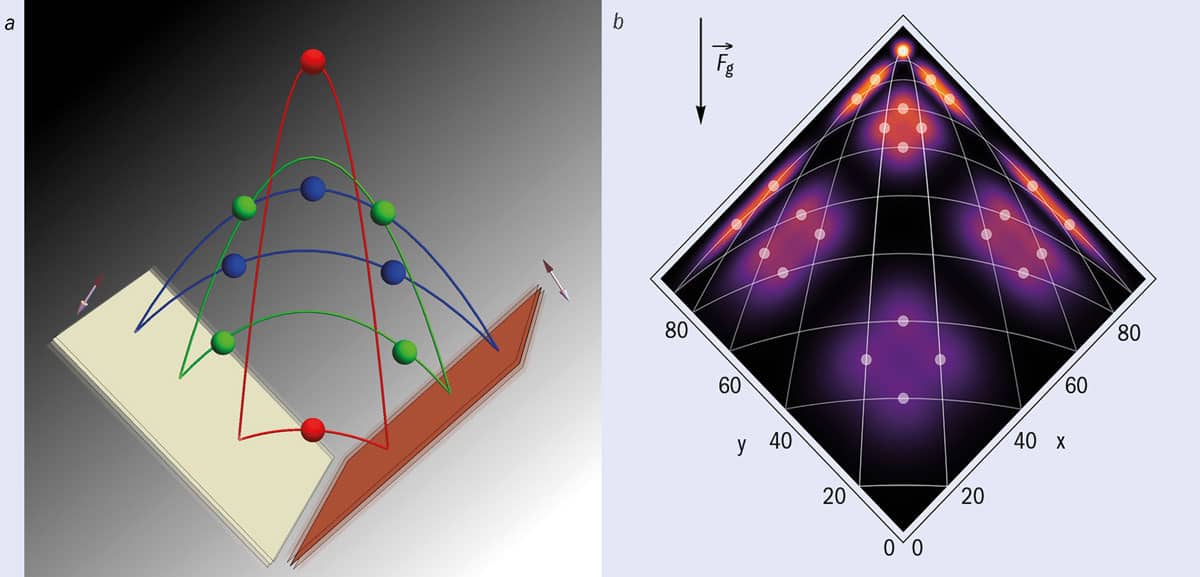
Time lattice(a) Atoms bouncing resonantly between two orthogonal oscillating mirrors (graphic courtesy: Artur Miroszewski). (b) Single-shot photo of a time lattice which is effectively described by the 2D Bose–Hubbard model (reprinted from Phys. Rev. Lett. 120 140401).

Suitable modulation of the mirror’s motion also allows one to realize not only time crystals but also quasicrystalline structures in time, which exhibit long-range order but without any periodicity. An example of a quasicrystal is the Fibonacci quasicrystal, like the pattern of florets in the head of a sunflower. A 1D Fibonacci quasicrystal can be created when a suitably chosen line cuts a periodic square lattice. It turns out it’s possible to generate either a 1D Fibonacci quasicrystal in time using atoms bouncing on a single oscillating mirror or to observe the spontaneous formation of a Fibonacci sequence in the time dimension by bouncing atoms between a pair of orthogonal oscillating mirrors (Phys. Rev. B 99 220303).

The world of condensed matter is now entering the fourth dimension of time. Not only is this intriguing in its own right, but it also opens possibilities for novel research directions and maybe new applications and devices. Physicists have predicted that time crystals could be used to experimentally realize exotic long-range interactions that are not available in nature or even in the quantum simulation of condensed-matter systems based on ultracold atoms in spatial optical lattices. The realm of “time engineering” has opened. It’s hard to predict what will emerge in the future. Combining crystalline structures in space and in time should allow novel devices to be built, because processes that cannot be performed together in space dimensions can be realized separately in space and time. In other words, some processes can be performed by the internal dynamics of a system where importantly there is also crystalline structure. Crystalline structures in four dimensions should open new possibilities. Is time–space electronics just around the corner?


German Physical Society cancels Spring Meetings, but innovation continues

The rapid spread of the coronavirus is continuing to affect the international calendar of scientific conferences, with the German Physical Society (DPG) announcing that all three of its Spring Meetings due to take place in Hannover, Dresden and Bonn are now cancelled. “Given the dynamic development in the spread of the virus we do not want to take incalculable risks for all those involved,” the society said in a statement.

The executive board of the DPG says that it “particularly regrets the loss of scientific communication”, while acknowledging that travel restrictions would have limited the opportunities for discussion with international colleagues and research collaborators. Despite the unforeseen circumstances, the organization remains committed to finding alternative formats to enable some form of scientific exchange, with plans to stream part of the Dresden programme online.

Delegates will also miss the chance to learn about the latest improvements in experimental technologies. While nothing beats a face-to-face conversation or live demonstration, here are some of the product innovations that would have been featured at the show, along with full details of how to find out more.

The right lock-in amplifier for your application

Zurich Instruments, a test and measurement specialist based in Switzerland, produces lock-in amplifiers that operate over every frequency range up to 600 MHz. Various upgrades can be added to each of the basic instruments, such as control-loop mechanisms, digitizers or multi-frequency operation, to extend their capabilities for specific applications without needing to invest in unnecessary features.

Zurich

Zurich Instruments’ flagship instrument, the UHFLI lock-in amplifier, delivers state-of-the art performance for applications such as laser spectroscopy and quantum technologies. Thanks to its low time constant for demodulation of 30 ns, its demodulation bandwidth exceeds 5 MHz – which is also ideal for scanning imaging applications that require speeds up to video rate.

The HF2LI lock-in amplifier covers the frequency range from DC to 50 MHz, and is the instrument of choice for characterizing sensors and actuators, as well as for non-destructive testing and medical technologies. Meanwhile, the MFLI lock-in amplifier comes in two versions: one operates up to 500 kHz, while the other extends the frequency range to 5 MHz. Its embedded data and web servers enable it to be used with any device running a web browser, without the need for software installations.

All of the instruments are equipped with the control software LabOne, which offers a comprehensive toolset for time- and frequency-domain data analysis as well as sophisticated support for setting up control loops, performing noise measurements, and visualizing measurement data. Interfaces for most popular programming languages are also available.

Full details are available on Zurich Instruments’ website, or contact info@zhinst.com to arrange a video call.

AFMs enable next-generation characterization

The Dimension XR family of scanning probe microscopes (SPMs) from Bruker incorporate major innovations for atomic force microscopy (AFM) that significantly expand researchers’ ability to quantify material properties at the nanoscale – whether in air, fluids, electrical, or chemically reactive environments. New additions include a unique nanoelectrical mode called DataCube, scanning electrochemical microscopy for energy research, and an AFM-nDMA mode that for the first time correlates polymer nanomechanics to bulk mechanical properties.

Bruker

Dimension XR SPMs are based on Bruker’s popular Icon and FastScan AFM platforms. They are available in three configurations that provide out-of-the-box capabilities for measuring mechanical, electrical, or electrochemical properties at the nanoscale.

To start with, the nanomechanics configuration combines AFM-nDMA with other advanced modes for fast, quantitative analysis of materials ranging from soft hydrogels to metals and hard ceramics. For nanoelectrical applications the Dimension XR configuration delivers the most complete array of electrical AFM techniques on a single system. This includes the new DataCube mode, which captures both electrical and mechanical characteristics in a single measurement, along with several other modes that extend conventional contact-based electrical modes to correlative electrical and mechanical data.

Meanwhile, the NanoEC configuration exploits Bruker’s unique nanoelectrode probes to perform in-situ topography scans in the electrochemical environment, providing a turnkey solution for real-time quantitative analysis of nanoscale local reactivity. This configuration includes an SECM mode that captures topographic, electrochemical, electrical, and mechanical information with a spatial resolution of below 100::nm.

Visit Bruker Nano Surfaces to find out more about Bruker’s full range of instruments for nanoscale surface analysis

Turbomolecular pumps deliver smart monitoring and control

Agilent Technologies has for the first time added smart connectivity to the latest two additions to its extensive range of TwisTorr turbomolecular pumps. An app called Vacuum Link, which can be installed on Apple or Android phones, enables users to communicate remotely with either of the pumps, making it possible to quickly and easily modify parameters and control the pump’s operation.

Agilent Technologies

“Incorporating connectivity into this new range of turbo pumps makes them unique and means users can always stay on top of their experiments,” comments Giampaolo Levi, who heads up Agilent’s Vacuum Products Division. “These pumps are designed to be another milestone move in the digitalization of the lab.”

The two new pumps also feature a more compact design. The TwisTorr 305 FS model is a standalone unit with an external remote controller, while the TwisTorr 305 IC version features an integrated controller. Its small footprint makes it ideal for equipment manufacturers and other companies that may want to integrate the pump in their instrument, and also allows it to be installed in smaller spaces and mounted in any position.

An advanced function in the Vacuum Link app enables users to extract log files to access and share the pump’s operating data. It also enables direct communication with Agilent’s service and support teams, speeding up the response time.

Agilent says that its TwisTorr turbomolecular pumps offer high compression ratios and pumping speeds, and are also reliable and energy efficient. They can also be used with smaller backing pumps to save space and money.

Explore Agilent’s full range of turbomolecular pumps on the company’s website.

Cool technology enables quantum computing

Expert assembly

Researchers attempting to build the next generation of quantum computers are pushing the boundaries of what can be achieved with current experimental technologies. One of the challenges is testing the behaviour of a complex quantum system when it is sealed inside a cryogenic system cooled close to absolute zero. Not only does it make it difficult to assemble, adjust and maintain the components and wiring needed for each experiment, but it can also place practical limits on the size of the quantum system that can be measured.

Finnish company Bluefors has dedicated itself to making life easier for researchers working with such complex experimental systems. Founded in 2008 by two low-temperature physicists, Rob Blaauwgeers and Pieter Vorselman, the company has perfected a series of cryogenic systems that combine high performance with reliability and ease-of-use.

“Many new technologies, including quantum computing, require a controlled measurement environment at temperatures close to absolute zero,” says David Gunnarsson, the company’s chief sales officer. “Cryogenic systems have traditionally been difficult to use and maintain, and our aim is to eliminate those obstacles and enable our users to focus on being creative in their research.”

Bluefors has built its business from developing cryogen-free dilution refrigerators, which avoid the need for liquid helium as a pre-cooling agent. These so-called “dry” systems – which over the last 10 years have become the technology of choice for low-temperature research – make it easier to install samples into the chamber, offer more space for the experimental load, and enable more automation because they require less hands-on attention than previous “wet” systems.

The Bluefors team has exploited their knowledge of the underlying cryogenics technology to build commercial systems that can accommodate large experimental assemblies and can be operated by non-specialists. “Researchers who installed our equipment in their labs realized that everything was so much easier,” comments Gunnarsson, who believes that ongoing improvements in these cryogenic systems have been a crucial enabler for the upswell of commercial interest in quantum computing. “Quantum technology and the development of new cryogenic systems has gone hand in hand, and has driven both technologies forward,” he says.

Bluefors’ strong links with the scientific community has been the lifeblood that has driven continued innovation. A few years ago, in the first of a series of major upgrades, the company equipped its high-performance XLD cryostat with a side-loading system that makes it simpler and more efficient for scientists to design and build their experiments.

“Normally the measurement infrastructure would be assembled inside the cryogenic system, but this restricts access to the components and wiring,” explains Gunnarsson. “Dilution refrigerators are so tall that ladders are needed to reach all the different levels, making it difficult to assemble the measurement equipment without making mistakes.”

In contrast, the side-loading system allows the experimental components and wiring to be fully assembled on the lab bench, and then transferred into the cryogenic system when it is brought up to room temperature. Such an approach allows researchers to easily check that the connections are attached properly, reducing the need for further adjustments when the experiment is installed in the cryostat.

Researchers who installed our equipment in their labs realized that everything was so much easier

David Gunnarsson

The XLD system comes with six side-loading ports, each of which can accommodate the measurement infrastructure for a different experiment. “Many of our customers want to buy one big fridge that can be used for many users performing different experiments at the same time,” says Gunnarsson. “Experiments can be prepared when the system is cold, and then when it is brought up to room temperature the experiments can be changed at the same time. This allows the system to be cooled down more quickly after the maintenance.”

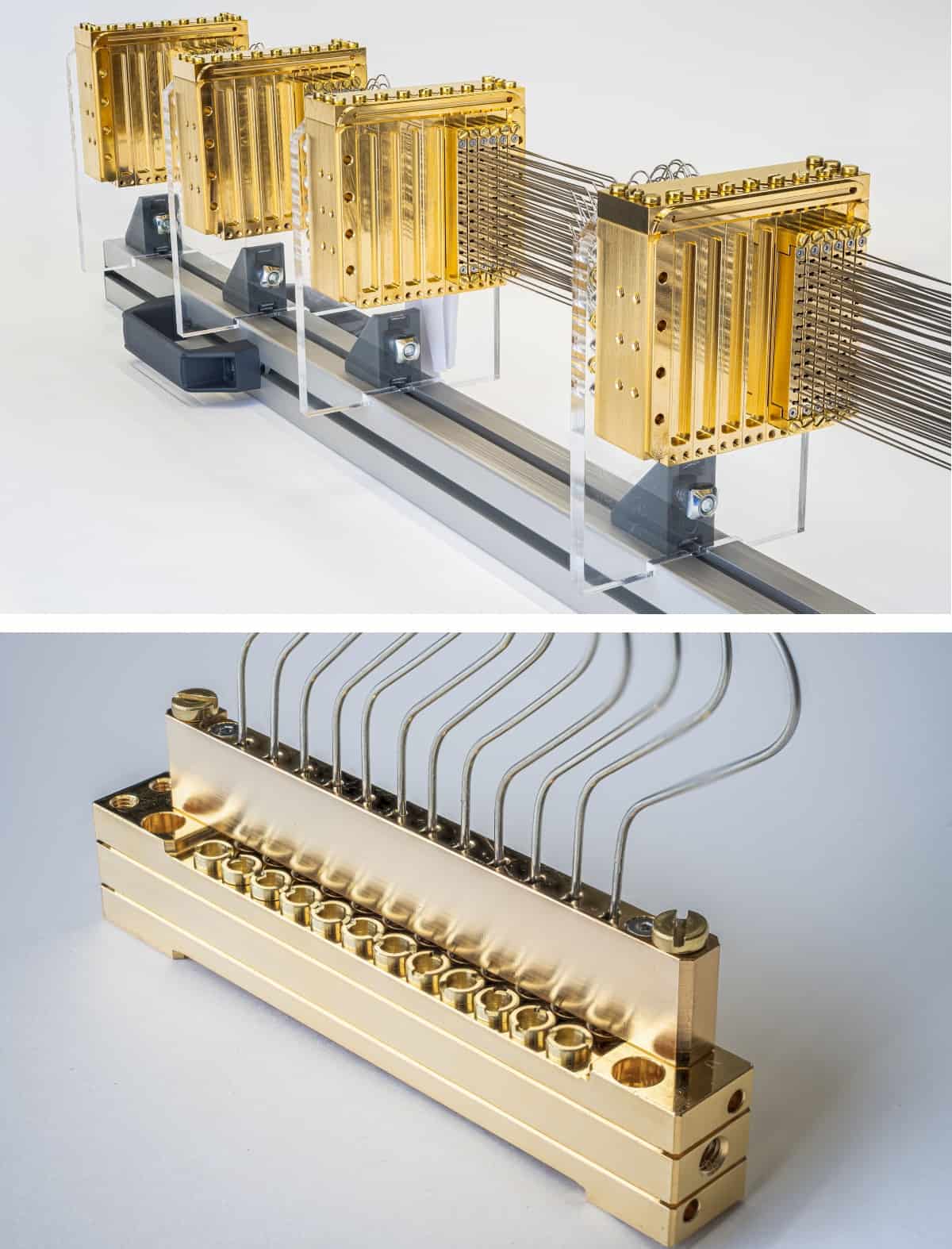
Bluefors has built on this innovation by introducing a modular system that provides a standard way for loading experiments into the cryostat. The components and wiring are assembled inside a module with a standard form factor that simply snaps into the side-loading ports, allowing for quick maintenance of complex assemblies. “The modular system makes it possible to increase the number of wires and components in the system, allows rapid testing and troubleshooting, and ensures quick turn-around for busy multi-user environments,” says Gunnarsson. “All this is done without compromising the thermal properties and strengths of the cryogenic system, which still keeps the operating temperature at millikelvin temperatures.”

Bluefors developed this modular form factor under the framework of the OpenSuperQ project, part of Europe’s Quantum Flagship programme. “It is an open standard that we hope component suppliers will adopt when developing new cryogenic measurement devices,” comments Gunnarsson. “It will make cryogenics a more robust technology, and a standards-based approach should encourage the development of more commercial applications for quantum systems.”

The latest addition to Bluefors’ modular system is the option for high-density wiring, which has become increasingly important as scientists seek to increase the number of qubits in their quantum computing systems. “Until now it has been necessary to attach each component one wire at a time, which is fine for small-scale systems,” says Gunnarsson. “But the footprint of the cryogenic system gets used up quickly as more quantum elements are added, and assembly, installation and maintenance become much more difficult and time-consuming for large numbers of wires and components.”

Density by design

Gunnarsson explains that most experiments in cryogenic systems require several continuous control wires from room temperature down to the lowest temperature in the cryostat. Typically, two or three wires might be needed to control and measure each quantum element – depending on the experimental architecture that has been deployed. The challenge for researchers is how to scale up from lab-scale demonstrations with just a few qubits to more useful quantum computers that will need hundreds of quantum elements.

To address this need, the high-density interface introduced by Bluefors allows researchers to build experiments with more than 1000 high-frequency lines in one system. Making sure that each wire is connected properly is more difficult with such a large number of control lines, so the interface has been designed to allow the wires to be installed in blocks of 12.

The interface exploits standard connectors and coaxial cables for the wiring, and the attenuators have been embedded in a single block that fits into the modular system. Meanwhile, the modular form factor also allows the use of custom components with multiple high-density channels, such as amplifiers, filters and attenuators.

Further into the future, quantum computers are likely to need millions of qubits. It would be impossible to connect that many cables into a cryogenic system, and Gunnarsson says that the research community is still working to develop new technical solutions, such as cold logic and wire multiplexing. “Bluefors is active here and the modular concept will support these developments,” he says.

“Our modular concept makes it possible, now and in the future, to easily maintain a large cryogenic measurement infrastructure,” continues Gunnarsson. “Cryogenics should not be an obstacle that stops anyone from doing an experiment or developing an application; the measurement infrastructure should be readily available so researchers can focus on making their experiment.”

Could bacterial toxins be our next antibiotics?

Hannah Behrens

Using a combination of methods, including X-ray crystallography, small-angle scattering and live-cell imaging, an international research team has probed the structure of a potent new antibacterial agent: PyoS5. By analysing its biophysical and biochemical properties, the scientists – from the University of Oxford, Heinrich Heine University Düsseldorf, the University of Glasgow and the University of Strasbourg – mapped the path by which PyoS5 can be transported into a bacterium (mBio 10.1128/mBio.03230-19).

There is a pressing need for new antibiotics against bacterial pathogens, particularly Gram-negative bacteria, which are responsible for severe acute and chronic infections in humans and are capable of surviving under a variety of environmental conditions. For example, the World Health Organization has classified P. aeruginosa, a Gram-negative, rod-shaped bacterium, a priority pathogen due to its insensitivity to many currently used antibiotics.

Antagonism in bacteria, in which one species kills another, occurs via several routes, the most common being bacteriocin secretion. Bacteriocins are toxins, ranging from small peptides to larger protein molecules, that a bacterium produces to inhibit the growth of competing strain(s). Researchers are currently testing bacteriocins to assess their potential application as antibiotics against multidrug resistant bacteria. One of these, Pyocin S5 (PyoS5), has demonstrated great success in eradicating P. aeruginosa in animal infection models.  However, the import mechanism of the PyoS5 is poorly understood.

Colin Kleanthous

In order to investigate a common import framework, a team led by Colin Kleanthous at the University of Oxford engineered an E. coli bacterium susceptible to PyoS5, as well as other pyocins (such as PyoS4), and proposed a generic pathway taken by these bacteriocins across the outer membrane of Gram-negative bacteria.

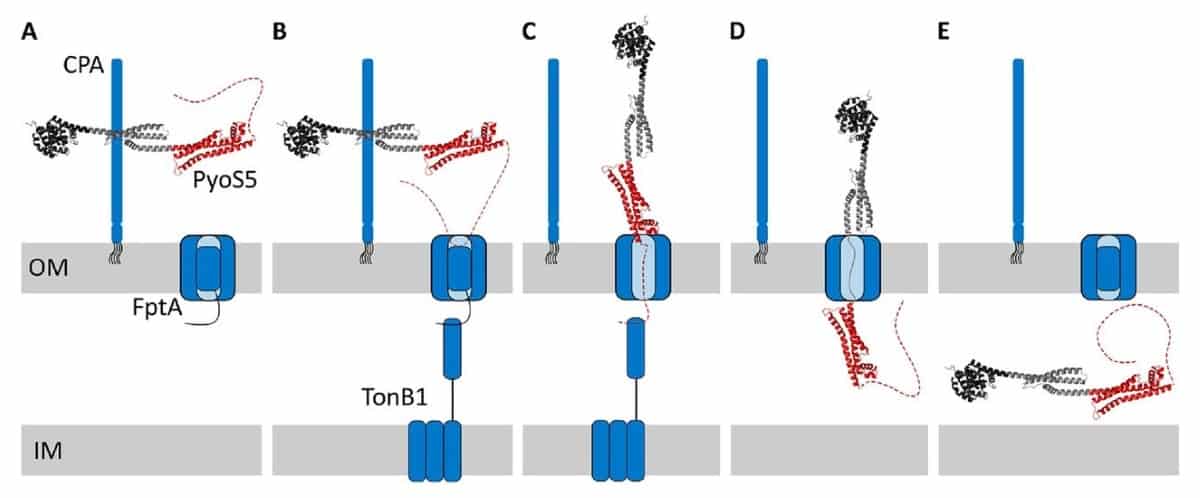
The process by which the PyoS5 enters the bacterium can be visualized using the analogy of a ‘fishing pole’. Three components are involved in this import process: CPA, FptA and TonB1. CPA is a surface antigen that, along with the transporter FptA, is located in the outer membrane, whilst TonB1 is present in the inner membrane. PyoS5 first accumulates on the cell surface by binding to CPA. Using its one of the unstructured ends (the N-terminus), elongated PyoS5 then contacts FptA, whilst its associated unstructured region binds TonB1. Both FptA and TonB1 drive the import of bacteriocin across the cell membrane. In addition, the team showed for the first time that PyoS4 also exploits TonB1 for its import.

Bacteriocin import

Universal uptake mechanism

As common principles are beginning to emerge, the researchers believe that these generic import mechanisms will help us to better understand other Gram-negative bacteria that can be destroyed by bacteriocins. For instance, the toxin entry mechanism in two other Gram-negative bacteria families (Enterobacteriales and Pseudomonadales) was long thought to be unrelated. However, these new findings suggest that the underlying mechanism by which some bacteriocins cross the outer membranes are fundamentally the same for both families.

“We think some of these insights likely apply to the whole family of antibiotics, with more than 3000 members,” concludes Hannah Behrens, lead author of the study.

Copyright © 2026 by IOP Publishing Ltd and individual contributors