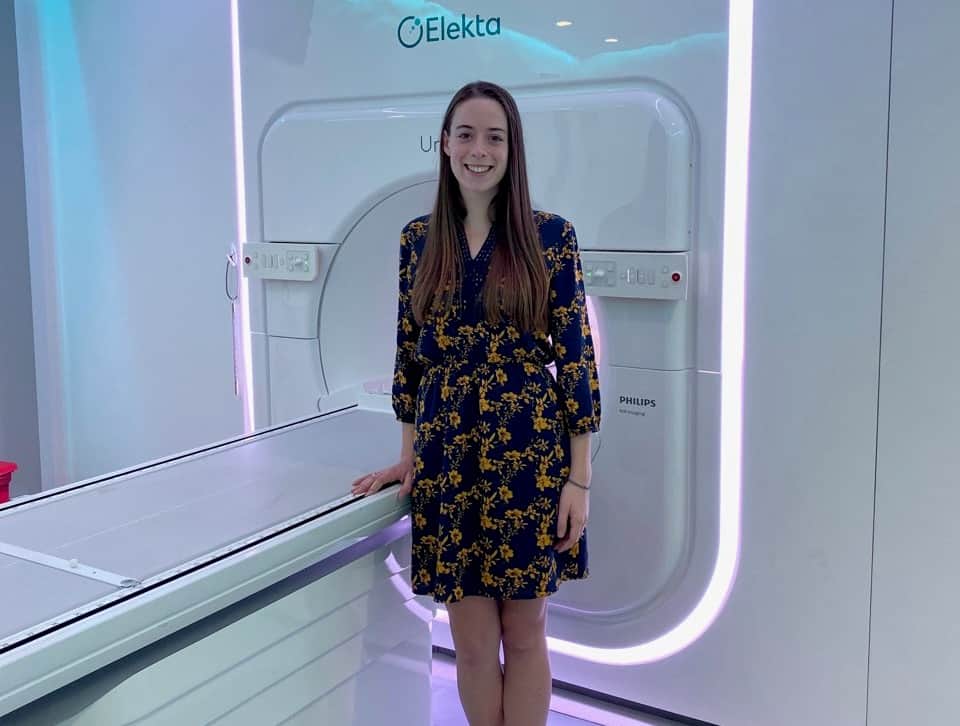
First author Brigid McDonald with the Unity MR-linac at the MD Anderson Cancer Center.
The recent introduction of MRI guidance into the radiotherapy treatment chain brings benefits such as high soft-tissue contrast, zero-dose set-up verification and the ability to perform adaptive replanning. In a high-field MR-linac, however, the strong magnetic field causes hot and cold dose spots at interfaces between high- and low-density regions – a phenomenon known as the electron return effect (ERE).
The ERE causes secondary electrons entering a low-density region to be re-directed back toward the high-density region, creating increased dose deposition in the denser tissue. This creates significant dosimetric challenges – particularly in the thoracic region, which contains interfaces between lung, airways, soft tissue and bone – and requires a dosimetry system that can measure steep dose gradients in three dimensions.
The team investigated two Fricke (ferrous sulphate-based) gels: FXG and FOX. “We chose Fricke gels because they’re easily read out with MRI. This is particularly advantageous for our MR-linac set-up as we can irradiate and image the dosimeter before and after irradiation without having to reposition it,” explains first author Brigid McDonald. “Other gels are visible on MRI, but we’ve found the Fricke gels to be the most straightforward to manufacture in the lab. They’re also extensively characterized in the literature, so we have confidence in their linear dose response behaviour.”
As Fricke gels are optimized to represent soft tissue, McDonald and colleagues added various sized polystyrene beads to create low-density gels that mimic lung tissue. All of the resulting gels had CT numbers of around -600 HU, which is slightly higher than typical lung tissue (-700 to -800 HU) but suitable for use in dosimetry.
Adding beads decreased the MRI signal intensity compared with the standard gel. The researchers also observed that all FXG gels exhibited higher signals than their corresponding FOX gels and that image uniformity generally improved with smaller bead sizes. Based on these results, they selected the optimal lung-equivalent gel as FXG with small (less than 1 mm diameter) polystyrene beads. Dose–response curves for both the optimized gel and conventional FXG showed linear changes with dose up to 30 Gy.
Measuring the ERE
The researchers used the optimized gel formulation to create two identical phantoms containing an inner cylinder of low-density gel surrounded by an outer cylinder of conventional FXG, to simulate a lung–soft-tissue interface. They irradiated one phantom in the Elekta Unity MR-linac and the other in a conventional linac, using the MR-linac to image the two phantoms before and after irradiation.
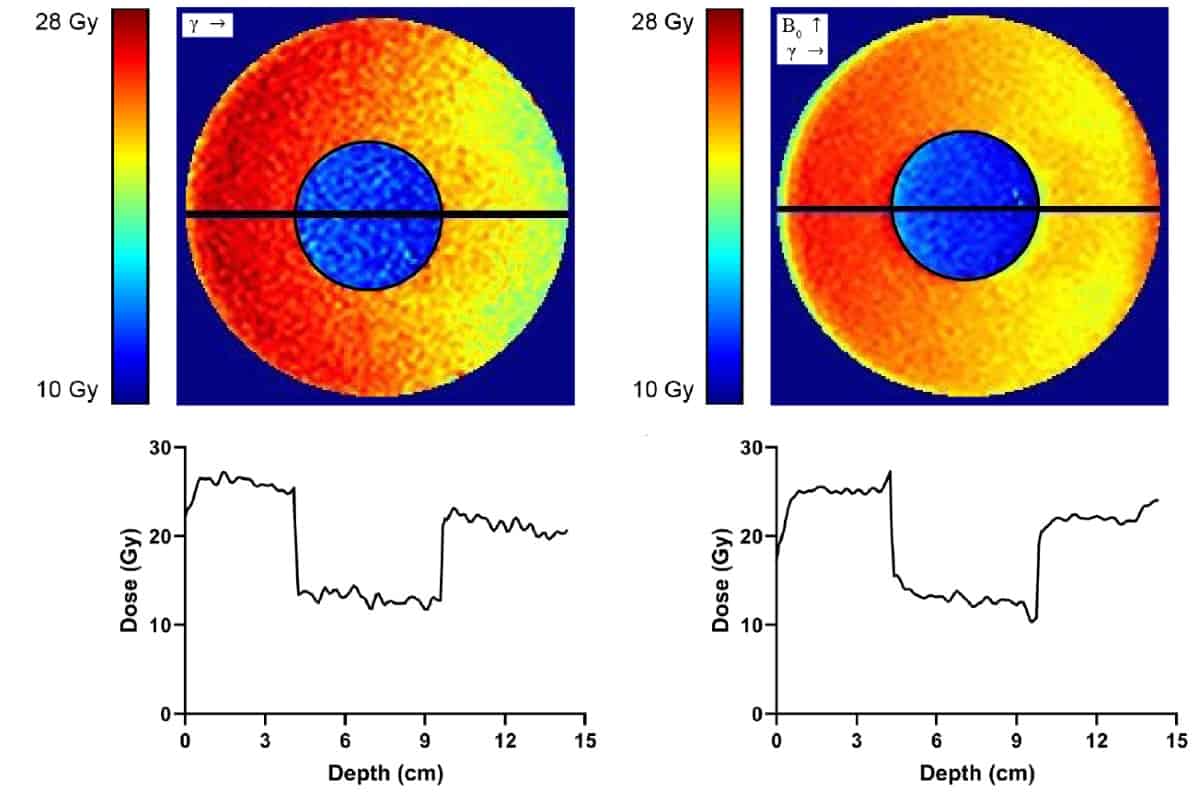
Dose maps generated using the measured dose–response relationships for the two gels showed that the dose decreased as the beam penetrated into the phantom, with a region of lower dose inside the low-density inner cylinder.
Dose maps for phantoms irradiated in a conventional linac (left) and an MR-linac (right), and corresponding profiles acquired along the black lines. (Courtesy: Phys. Med. Biol. 10.1088/1361-6560/ab4321)
The MR-linac-irradiated phantom exhibited a region of enhanced (by 8.7%) dose in the conventional gel just before the beam entered the low-density cylinder, plus a region of reduced (by 17.7%) dose in the low-density gel just before the beam re-entered the conventional gel. The researchers also saw dose enhancement as the beam exited the phantom into air. These hot and cold spots did not appear in the dose map of the linac-irradiated phantom, indicating that they arise from the ERE caused by the magnetic field.
The researchers suggest that the linear dose–response curve seen for the low-density gel shows that it can be used reliably for MR-linac dosimetry up to 30 Gy, though its high-dose behaviour still needs to be determined.
“The focus of this study was to optimize the low-density gel formulation and characterize the uncertainty in the measured dose,” McDonald tells Physics World. “The next steps would be to take CT scans of these phantoms to load into the treatment planning system, calculate the predicted dose distribution, deliver the plan to the phantom and then compare the expected dose to the MRI-measured dose.”
She explains that this method may be a bit more laborious than using a standard QA device such as a diode array, but emphasizes that standard QA devices can’t measure the dosimetric impact of the ERE at density boundaries.
The team plan to start these validation tests using simple phantom geometries, then move on to anthropomorphic phantoms for applications in clinical MR-linac treatments. “One of the cool things about gel dosimeters is that they can be moulded to fit a container of any shape,” explains McDonald. “So we can use our low-density gel to generate anthropomorphic phantoms of the thoracic region, to approximate the radiation dose delivered to a patient.”
Real to reel: Benedict Cumberbatch has depicted both real and fictional scientists onscreen, including Alan Turing in The Imitation Game. (Courtesy: Snap Stills/Shutterstock)
Over the years I have spoken to scientists and actors alike for my podcast The Cosmic Shed, where we explore science and science fiction in equal measure. One actor I’ve interviewed who has portrayed several different scientists is Benedict Cumberbatch. He’s starred in three science-themed movies – first as the botanist Joseph Hooker in Creation (2009), then as the mathematician Alan Turing in The Imitation Game (2014), and most recently as the inventor Thomas Edison in The Current War (2019). He’s also played Stephen Hawking in the 2004 TV film Hawking and Werner Heisenberg in a BBC radio adaptation of Michael Frayn’s play Copenhagen (2013).
“I do like my scientists!” Cumberbatch laughed when I asked him how he had come to be cast in these roles. “I think it’s partly because of the way I look. I could never achieve anything like what these men [I’ve played] have achieved but I think what I can do is portray the thing about them which enabled them to achieve these things – that is their humanity.”
It’s the great stories that most attract Cumberbatch to these parts. For his role in Creation, it was the intimate friendship between Charles Darwin and Hooker that grabbed him, with the pair having exchanged more than 1200 letters over a period of almost 40 years. In one, for example, Darwin revealed how he was “particularly glad of our discussion after dinner; fighting a battle with you always clears my mind wonderfully”.
“That story about how Darwin and Hooker struggled with their friendship to get [Darwin] to publish On the Origin of Species…Hooker’s love for Darwin and his family and trying to help this brilliant but difficult man bridge the gap…I just found that fascinating,” Cumberbatch says.
Despite not being a scientist – he studied drama at university – Cumberbatch has long had a passion for science. “I’ve always loved botany, loved biology,” he says “I love flowers. Love the prints of flowers. The old drawings that Hooker and people like him did and the conditions they did them in. I just think these people were astonishing and if you can shine a light on their story and examine them a little then that’s just great fun.”
Physicists may best remember Cumberbatch for his appearance in Hawking, which was nominated for a BAFTA TV award for best single drama in 2005. “[Hawking was] trying to tackle the biggest questions we face. How did we get here? Is it just us? The most profound questions about existence. Tied to that is a man with an extraordinary biographical story. To bring the beauty of his science and his personal battle, I mean what a joy. What a joy!” Cumberbatch also voiced Hawking’s words for the 2010 documentary series Into the Universe, written by Hawking himself, and even gave a reading at the late physicist’s memorial.
Cumberbatch is famous for putting a lot of research into the roles he plays. “It’s one of the great privileges of this ridiculous privileged job I have. While I cannot hold on to some of the pure mathematics at the centre of those theories, some of the principles are beautifully simple and poetic. You live your life as prose but you think of it as poetry and that’s what art can bring to science. It can extract the image and the idea and turn it into something abstract which can be more easily absorbed.”
“That said, [films] can only ever be adverts for these ideas – the brilliant work of these men and women.” Indeed, he says that the biggest kick he got from starring as Sherlock Holmes in the TV series Sherlock (2010–2017) was when sales of the original books soared. “People are looking beyond this to something they can get to grips with and understand for themselves,” he says. “We can help to galvanize an interest in that. Films are great trailers for the real event. Selling the stories and science beneath.”
As a fan of cinema as well as a star of the medium, Cumberbatch firmly believes that film, as an artform, can play a useful role in science communication. “It’s wonderful that science can be explored with everything that cinema has to offer as an artform because you can make ideas real in a way that the written word often cannot,” he says. “You can help kickstart the imagination.”
Cumberbatch also thinks science fiction can help attract people into science in the first place. “There are kids who go to watch the movies and think ‘oh well a black hole probably won’t open up at the end of my garden’ but they can become fascinated by the science,” he says. “If you can transfix children through the art of cinema then you are doing a great service for science.” Indeed, Cumberbatch says his own interest in science probably came from science fiction, and he has recently played scientists in the genre – most notably Stephen Strange in the Marvel films Doctor Strange (2016) and Avengers: Infinity War (2018).
“Science and cinema will forever be bound because there is so much science in the art of making cinema as well. The people who cut, grade, edit and operate the machinery and light on the day of shooting – these are very smart people with very scientific minds. Even within itself, cinema has a loop which needs science. It needs science to shine light through whatever you are projecting onto a screen to see an image which bounces into your retina and plays tricks with your brain.”
A semi-flexible patch made from a silk-derived carbon material is as accurate as commercial high-performance mass spectrometers at detecting certain biomarkers in sweat, say researchers in China. Although the device still needs to be optimized, its developers at Tsinghua University in Beijing and Northwest University in Xi’an have demonstrated that it can detect the biomarkers in real time. It could thus be used to monitor health, and perhaps even to detect certain diseases.
Sweat contains various health-related biomarkers, including ascorbic acid, uric acid, metabolites like glucose and lactate, and electrolytes such as Na+ and K+. It is therefore an attractive, less-painful alternative to blood samples for assessing a patient’s health. In recent years, various groups have developed flexible and wearable sweat sensors that can monitor these biomarkers in real time, and researchers have made much progress with colorimetric, electrochemical and fluorescence sensors. However, many of these devices are rigid and difficult to manufacture, and the electrode materials they contain (such as gold, silver, metallic oxides and graphene) are poor conductors of electricity.
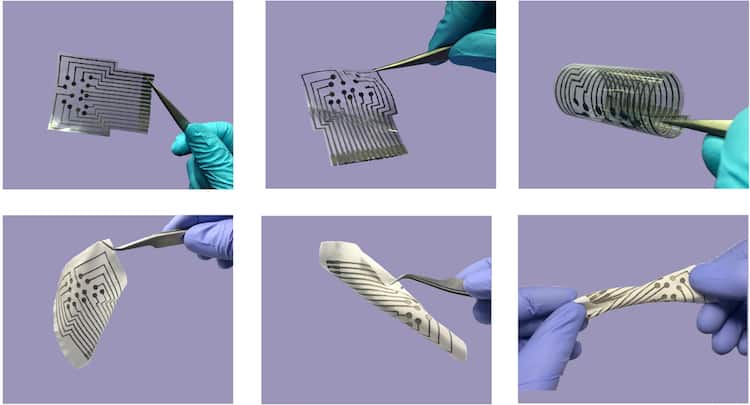
Sensor array on different flexible substrates. Credit: Tsinghua University
Electrodes made from a silk-derived intrinsically N-doped carbon material
Now, a team led by Yingying Zhang at Tsinghua University has fabricated a sweat analysis patch based on an array of electrodes made from a flexible, silk-derived intrinsically N-doped carbon material. This textile has a good wetting ability, meaning it collects sweat efficiently.
The researchers used laser scribing to fabricate flexible conductive circuits from the sensor array. They then integrated six electrochemical sensors into the array and modified the electrodes with different functional materials so that they could selectively detect multiple biomarkers. The last step in the process involved integrating the patch with a signal collection and transmission circuit component to make a wireless, on-body and real-time sweat analysing device.
Six biomarkers measured simultaneously
Zhang and colleagues measured the concentration of six biomarkers (glucose, lactate, ascorbic acid, uric acid, Na+and K+) by recording the corresponding electrochemical current and voltage response of the electrodes while the patches were fixed to the skin of five healthy 20- to 30-year-old human volunteers. The volunteers cycled for 30 minutes, and the researchers say they were able to continuously – and simultaneously – detect all six biomarkers with a high degree of precision. Indeed, their results were comparable to those obtained using commercial high-performance liquid-chromatography mass spectrometry (HPLC-MS). Such high sensitivity is required to capture the small but physiologically relevant fluctuations in the concentrations of bio-analytes, which normally remain within a narrow range, Zhang explains.
“The wealth of information present in sweat could potentially indicate the body’s deeper biomolecular state,” she tells Physics World. “It could thus be used in health monitoring applications to detect health risks such as diabetes, for example.”
In a commercial version of the device, the results of these measurements could be displayed on a mobile phone screen, although Zhang cautions that there is still much work to be done. At 100 microns thick, the patches are relatively bulky (a thickness of less than 10 microns is required), and they cannot be stretched. This makes them sensitive to noise from strain motion – especially at the interface between human skin and the electronics part of the sensor.
In the past two decades, quantum computing has evolved from a speculative playground into an experimental race. The drive to build real machines that exploit the laws of quantum mechanics, and to use such machines to solve certain problems much faster than is possible with traditional computers, will have a major impact in several fields. These include speeding up drug discovery by efficiently simulating chemical reactions; better uses of “big data” thanks to faster searches in unstructured databases; and improved weather and financial-market forecasts via smart optimization protocols.
We are still in the early stages of building these quantum information processors. Recently, a team at Google has reportedlydemonstrated a quantum machine that outperforms classical supercomputers, although this so-called “quantum supremacy” is expected to be too limited for useful applications. However, this is an important milestone in the field, testament to the fact that progress has become substantial and fast paced. The prospect of significant commercial revenues has now attracted the attention of large computing corporations. By channelling their resources into collaborations with academic groups, these firms aim to push research forward at a faster pace than either sector could accomplish alone.
For these industry stakeholders, the question of what form a future quantum processor should take is particularly important. Unlike conventional microprocessors that manipulate information in binary bits, a quantum processor uses qubits: two-state systems that obey the fundamental principles of quantum mechanics. For example, each qubit can be prepared in an arbitrary superposition of two binary states. Hence, in contrast to classical bits that must always be either 0 or 1, a qubit may exist in a complex linear combination of 0 and 1. It is also possible to create selective correlations between different qubits. This property is known as quantum entanglement, and it lies at the heart of the exponential speed-up found in several quantum computing algorithms.
In principle, there are lots of ways to construct qubits. Some advanced prototypes use qubits made of a few dozen ions of rubidium or ytterbium, trapped in a vacuum chamber by time-varying electromagnetic fields. Other systems use lithographically patterned superconducting circuits kept at millikelvin temperatures in dilution refrigerators. Recently, however, experimental breakthroughs in silicon-based nanodevices have brought a third option to the fore. This option is, in effect, to manufacture quantum processors in the same way as conventional microprocessors, by leveraging widely deployed industrial complementary metal-oxide-semiconductor (CMOS) technology.
A silicon quantum computer
The idea of using silicon-based CMOS technologies to build quantum computers was first proposed in 1998 by Bruce Kane, who was then a researcher at Australia’s University of New South Wales (UNSW). In his paper, Kane suggested that arrays of individual phosphorus atoms in crystalline silicon could store qubits in nuclear spins, and that these spin qubits could be read and manipulated using nuclear magnetic resonance techniques.
Kane’s work (and that of other scientists who built on his ideas – see box below) attracted attention within the computing industry for several reasons. The first reason is a consequence of the relentless, Moore’s law-driven miniaturization of silicon devices. Thanks to decades of innovation, it is now possible to make transistors that are only few tens of atoms long. At this scale, however, quantum physics effects begin to prevent transistors from performing reliably – a phenomenon that limits prospects for future progress in conventional computing. This impending end to Moore’s law has prompted researchers in the field to consider new uses of silicon technology in a drive towards “more-than-Moore” electronics.
Another reason for the focus on silicon stems from the properties of the material itself. Noise is one of the great bugbears of quantum information processing, because it can make qubits change state at times and in ways that programmers did not intend, leading to computational errors. Most interactions with the surrounding environment, such as charge instabilities and thermal fluctuations, are sources of qubit noise. All of them can compromise information. Silicon, however, offers a relatively noise-free environment where spins can retain their quantum nature. The major source of unwanted quantum bit errors in silicon transistor-based qubits comes from the nuclear spins of silicon-29, a naturally occurring isotope present in all commercial silicon wafers. Luckily, purification methods can remove this unwanted isotope before the silicon crystals are grown, producing wafers of mostly spin-free silicon-28. For this reason, electron spins in silicon are among the most robust solid-state qubits available.
Perhaps the biggest attraction of silicon-based quantum processors, however, is that at their heart, they use the same technology that the microchip industry has handled for the past 60 years. This means manufacturers can expect to benefit from previous multibillion-dollar infrastructure investments, keeping production costs low. Just as importantly, using silicon as a basis for a quantum computer means that all the clever engineering and processing that went into developing modern classical microelectronics – from dense device packaging to integrated interconnect routing – can be adapted and used to build quantum devices.
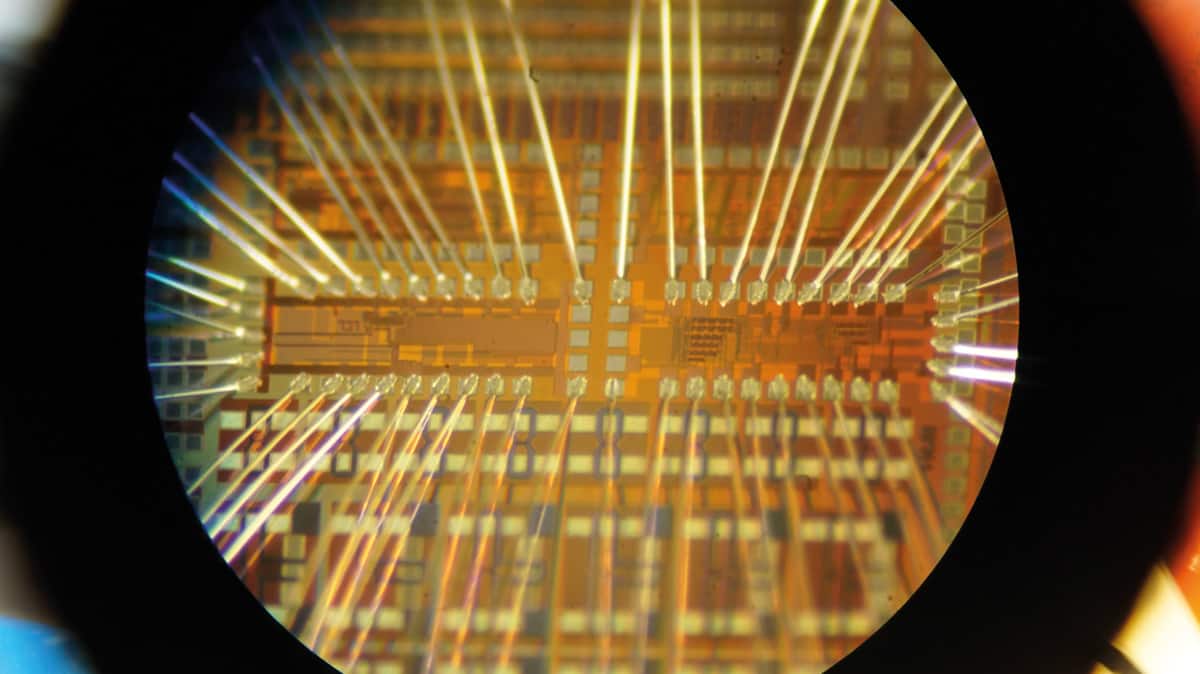
All together now An optical microscope image of quantum bit transistors and conventional electronics fabricated on the same silicon chip. (Coutesy: Hitachi)
On a grand scale
Having this solid engineering foundation will be a major advantage in efforts to overcome one of the biggest challenges in quantum computing: real-time correction of qubit errors. Even in relatively non-noisy systems, qubit errors cannot be entirely avoided, and the process of correcting them (known as a surface-code protocol) depends on a principle known as “qubit redundancy”. The basic idea of qubit redundancy is that one can construct a reliable logical qubit from a collection of noisy, error-prone physical qubits. The number of physical qubits required for each logical qubit depends strongly on the qubits’ error rate, but it could range from as low as a few tens to several thousand.
The error tolerance of qubits built in this fashion makes it possible for the whole quantum system to function correctly. Unfortunately, it also means that a truly powerful quantum computer will require millions of individually controlled physical qubits. Given that today’s most advanced quantum processors contain a few dozen qubits at best, implementing surface-code protocols in future machines will be challenging, to say the least. Issues with device-to-device variability, multi-layer electrical wiring and the need to couple quantum devices to classical control electronics all create headaches for quantum engineers. Before we can scale from a single, isolated pair of qubits to the hundreds of interconnected qubits required to perform calculations in a way that supersedes classical computers, these challenges will need to be overcome.
Researchers’ initial approach to this problem has been to produce concepts and blueprints of what a large-scale quantum computer could look like in silicon. Interestingly, most of these proposals suggest that a future silicon quantum processor should be composed of two layers.
The first layer would be a “quantum layer” in which 106–108 qubits are distributed in a square grid and allowed to interact with their nearest neighbours. This physical arrangement ensures that error-correction protocols can be performed efficiently, and the predicted number of qubits is in line with estimates of the resources necessary to run the most complex quantum algorithms designed to date. The large numbers involved suggest that very large-scale integration (VLSI) silicon technology, which enables chip manufacturers to place billions of components on an area the size of a fingertip, will be needed to create this quantum layer.
The second layer would be a “classical layer” composed of digital and analogue circuits that operate at cryogenic temperatures alongside the quantum processor. The role of this classical layer is not to process the quantum information. Instead, it would measure and control the qubits in situ, ensuring fast feedback between the two layers.
The vision for this two-layer device is clear: a quantum computer that can be manufactured using existing industrial processes, and then integrated with conventional electronics so that everything happens within the same silicon chip. Such a device would truly represent the best of both worlds, and it may also be necessary for solving the so-called input/output (I/O) problem.
Advancing the state of the art
Following Kane’s seminal work, UNSW scientists continued to develop silicon-based quantum technology. They demonstrated (in 2012 and 2019, respectively) that single-qubit and two-qubit logic operations could indeed be carried out using phosphorous atoms. They also showed that qubits could be made by confining single spins in nanometre-size regions of the silicon chip known as quantum dots (QDs). The quantum dot approach is considered more practical than Kane’s original idea because it does not rely on atoms being positioned very precisely in an array. Instead, lithographic techniques are used to arrange the gate electrodes so that the QDs exist in a well-defined pattern.
Silicon devices of this type do not, however, fully meet the stringent criteria for CMOS compatibility. In particular, the process of making the qubits employs techniques such as electron-beam lithography and scanning tunnelling microscopy that are considered unconventional within CMOS manufacturing. With this in mind, scientists at CEA-LETI, a technology research institute in Grenoble, France, took a different approach. They built a qubit device with an industry-standard fabrication process based on 300 mm silicon-on-insulator wafers. The CEA-LETI device, which the researchers developed as part of the European research consortium MOSQUITO (www.mos-quito.eu), consists of a nanowire transistor with an undoped channel and wrap-around gate electrodes. At low temperatures, two QDs form in the upper corners of the nanowire in which individual spins can be trapped (see figure right). Under the effect of a magnetic field, the electron spins align parallel or antiparallel to the field direction, producing the necessary quantum binary states. The need for two QDs arises because one is used to host a qubit, while the other one is used as a sensor to readout the qubit state.
Proof of principle An illustration of a silicon nanowire transistor similar to the one used by CEA-LETI to realize a spin qubit. Two quantum dots are formed in the top corners of the nanowire to trap individual spins. Qubit control is achieved via electron spin resonance techniques with microwave pulsing. (Courtesy: Hitachi)
Thanks to these experimental advances, silicon has cleared all the hurdles required to become competitive quantum-computing technology. The qubit fabrication process is scalable, meaning that mass-production is not only technically viable but also cost-effective. Qubits can be initialized and read out reliably, meaning that they can be reset before starting a computation and, at the end of it, their final state (the result) can be known. Information can be written them in on controlled way, and the qubits retain this information for long enough to perform operations.
These specifications are not too dissimilar from what one would ask of a classical computing technology, but silicon also makes the grade on another, uniquely quantum front. In 2018 researchers at Delft University of Technology in the Netherlands demonstrated that silicon-based qubits can be entangled controllably and with sufficient precision that, even if errors occur while the quantum processor is operating, users should be able to correct them using error-correction protocols. This led to the first programmable two-qubit quantum processor in silicon, which is currently the most advanced in this material.
To understand this problem, it is important to realize that qubits in today’s quantum-computing devices must be wired up one-by-one. This works well when the number of qubits is small, but as the technology develops, it will become impractical for cryogenic systems to support individual wires connecting room-temperature electronics to one million qubits at millikelvin temperatures. Fortunately, techniques from classical electronics offer a solution. In a modern microprocessor, billions of transistors on a chip are controlled efficiently by only a few thousand input and output lines. Hence, in silicon qubits (and indeed in qubits in general, regardless of their physical architecture), scientists and engineers will need to learn how to adapt concepts such as crossbar architectures and signal multiplexing to minimize the number of I/O lines.
Researchers have already performed some proof-of-concept tests indicating that the I/O problem can, in principle, be overcome. However, some specific hurdles remain. The first and possibly the most challenging concerns variability in the properties of quantum devices. Current proposals for large-scale quantum computing assume some level of shared control between qubits to mitigate the I/O problem. Implicit within this is the need for qubits to have a concrete level of uniformity between them, and for this uniformity to be achieved at scale.
In some respects, VLSI technology, thanks to its focus on minimizing the impact of process variation, guarantees a level of reproducibility that no other industry can provide. However, in the quantum realm, variability acquires a much higher degree of importance. Even a single atomic-level defect (for example in the quality of the interfaces or the purity and crystallinity of the material) may lead quantum devices to perform very differently. To accommodate this, the computing industry will need to develop strategies that go beyond the current state-of-the-art for silicon technologies – perhaps by constructing machine-learning models that anticipate qubit performance from room-temperature diagnostic data.
A second hurdle is to integrate CMOS electronics and silicon-based qubits into a single, monolithic chip. Although both technologies can be manufactured using existing silicon industrial processes, these processes currently involve different technological nodes; that is, they employ slightly different processing standards and protocols at the manufacturing stage. A common “classical-quantum” node will have to be developed and consolidated to produce hybrid quantum circuits at scale.
Full integration also implies that both technologies will have to operate at the same temperature. This problem is non-trivial given that qubits operate better at deep cryogenic temperatures (a few millikelvin), while the current models for integrated-circuit design are rarely accurate for temperatures below 20 K. Understanding the behaviour of silicon transistors (either as digital or as analogue circuit elements) at millikelvin temperatures will require a development effort of its own. To support that effort, researchers will need to develop precise models that can be imported into existing electronic computer-aided design tools.
The fact that millions of these elements will have to operate dynamically at these temperatures will also put tight restrictions on power budgets. The available cooling power in cryogenic environments is limited to a few hundreds of microwatts. Hence, the old strategy of simply sending a flow of cooling water around your processing unit is completely out of the picture.
While electrical engineers work to push the operation temperature of cryo-CMOS circuits down, physicists are working to understand how elevated temperatures affect qubit operation. There is optimism that these parallel efforts will produce an intermediate range of operating temperatures, one that will ease the burden on the CMOS industry while also enabling a higher power budget for the dynamical operation of the processor.
A collaborative future
Silicon-based quantum computing has come a long way since the late 1990s. The idea of taking conventional transistors and using them interchangeably as qubits or control devices on the same integrated circuit could, in the long run, prove viable both technically and commercially. The commercial promise of such a device means that research in the field extends beyond the traditional boundaries of university laboratories and into the research centres of global corporations such as Intel and Hitachi, both of which have long-standing collaborations with academic hubs in quantum computing.
It is still too early to say whether silicon will provide a path to the much sought-after general-purpose quantum machine. What is clear, however, is that it is a solid candidate eagerly backed by an industry that is keen to reinvent itself in a post-Moore’s-law future.
Physicists in the US have discovered that large clusters of skyrmions in a liquid crystal undergo collective motions, much like schools of fish. Hayley Sohn and colleagues at the University of Colorado, Boulder, first spotted the behaviour by accident, but quickly realized that they had discovered an intriguing new form of active matter. Their work could lead to the development of new types displays with the potential to transform the ways in which humans and computers interact.
Soft matter systems like liquids, polymers and foams can sometimes exhibit coordinated life-like behaviour that resembles a school of fish escaping a predator or a cluster of living cells organizing itself into a biological structure. These active soft-matter systems have a range of technological applications and the challenge for scientists is how to fine-tune interactions between individual components – such as molecules in a liquid crystal – to get the desired behaviour.
The initial focus of Sohn and colleagues was not to develop methods of control, but rather to study the dynamics of large numbers of topological solitons, or skyrmions, within a liquid crystal. Skyrmions are particle-like excitations that propagate through the material.
Drastic change
Their latest insight came unexpectedly when the team left its experiment alone while on break and returned to find that it had changed drastically. Instead of being randomly oriented as they had expected, the skyrmions had adopted highly synchronized motions. With further experiments, the team found that the structures had developed a polar order within seconds; grouping into fish-like schools through their elastic interactions. These groups then moved around along spontaneously chosen directions.
The observation is unprecedented in active matter systems because, unlike typical building blocks, skyrmions have no physical boundaries, chemical compositions, or density gradients. Furthermore, Sohn and colleagues discovered a versatile technique for controlling the behaviour of the skyrmion schools. This involves tuning an applied oscillating voltage, which changes the elastic interactions between skyrmions.
Sohn and colleagues believe that their discovery could lead to the development of versatile, reconfigurable active matter. If successful, such technology could be used for applications ranging from realistic models of biological systems, to video games in which unexpected events occur without any necessary programming.
The researchers have also showed that the conditions under which the collective behaviour occurs are much like those found in liquid crystal displays. This, they believe, could bring about significant new advances in the display technologies.
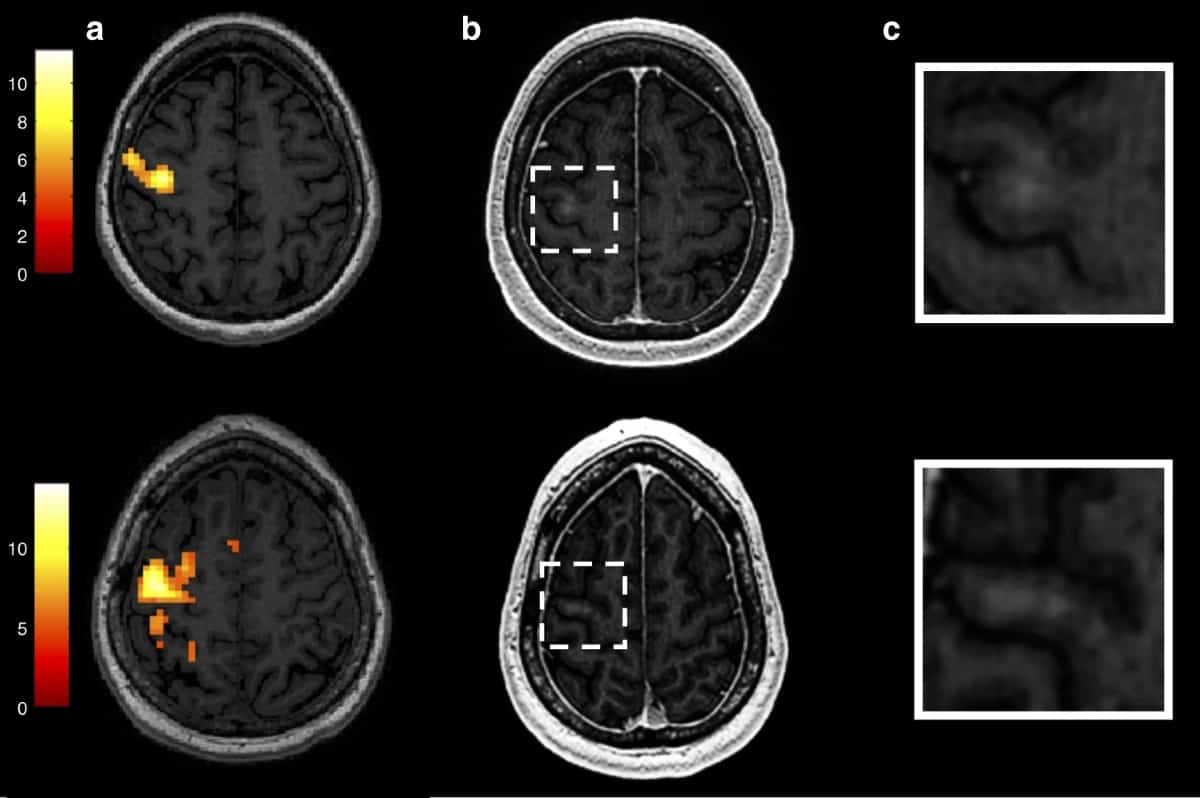
(a) Functional MRI maps the hand control region of the right primary motor cortex in two patients. (b, c) Gadolinium enhancement in MR images shows successful blood–brain barrier permeabilization in the sonicated motor cortex area. (Courtesy: Nature Commun. 10.1038/s41467-019-12426-9)
In a pilot study on four patients with amyotrophic lateral sclerosis (ALS), Canadian researchers demonstrated how drug molecules that are ordinarily unable to enter the brain were able to pass through into the tissue by using focused ultrasound to temporarily disrupt the blood–brain barrier (BBB). While no treatments were tested, the study aimed to test the safety and effectiveness of the technique (Nature Commun. 10.1038/s41467-019-12426-9).
ALS, commonly known as motor neurone disease, is a degenerative disorder of the nervous system that causes widespread paralysis and eventually death. There is no cure and treatments are generally ineffective. Like many neurological diseases, such as Alzheimer’s or Parkinson’s, the development of new treatments for ALS is impeded by an inability to get potentially promising drug molecules into the brain. This is due to the existence of the BBB, a system of physical barriers and cellular mechanisms in the brain’s vascular system that prevent unwanted molecules from entering this sensitive environment.
Drugs that affect the brain, such as anaesthetics, tend to be small molecules, which can pass through the BBB. However, many new promising drugs are very large molecules, such as antibodies and gene therapies, that are kept at bay by the BBB.
The researchers, based at Sunnybrook Research Institute in Toronto, disrupted the BBB in patients using MRI-guided focused ultrasound along with microbubbles: small gas bubbles, around the same size as a red blood cell, coated with a lipid shell, which respond to ultrasound. Microbubbles can be safely injected intravenously and travel through the blood vessels. Once they reach the BBB, ultrasound is applied to make the bubbles expand and contract within the blood vessels, temporarily making them more permeable. This in turn allows drug molecules in the blood to pass through into the brain tissue. The team monitored the whole process using the MRI scanner.
Focused ultrasound is much less invasive than the most effective alternative for drug delivery: directly injecting drugs into brain tissue, which requires opening up the skull. The approach also enables the BBB to be opened in a variety of regions. The phenomenon was first discovered in rabbits around 20 years ago, and a number of early clinical trials have taken place in the last five years. The Sunnybrook group has previously performed similar trials to open up the BBB in patients with Alzheimer’s disease and aggressive brain tumours.
The team used a commercial ultrasound system containing 1024 transducers embedded in a helmet that is placed within an MRI scanner. To reduce the chance of adverse effects and ensure the sound pressures used were correct, the researchers monitored the therapy in real time by detecting the ultrasound emitted by the bubbles, and by monitoring the temperature inside the brain using the MRI scan. The study did not test the efficacy of drug treatments, but instead used a gadolinium-based contrast agent that showed up within the brain tissue on the MRI.
The patients reported no serious adverse side effects beyond headaches and mild pain. One participant showed slight structural changes on the MRI scan that were not associated with any symptoms and had disappeared in a scan a week later. The BBB closed within 24 hours.
While this study didn’t test any drugs and was not aiming to treat the patients, it demonstrated that the approach works and appears safe. The team now aims to move on to delivering drugs using this technique, opening up a path towards more effective treatments for ALS.
Ants are particularly good at avoiding traffic jams and can move about their business even when they occupy more than 80% of the available space – twice the value that stymies human pedestrians or drivers. According to experiments performed by a team of researchers in France, the US and Australia, ant movement is best described by a two-phase flow function that is very different from existing statistical models of traffic engineering.
The work could be important for studying systems that contain large groups of interacting particles, such as those in molecular biology and statistical physics. It might even have implications for programming self-driving vehicles so that they work together cooperatively, like ants.
Led by Audrey Dussutour of CNRS and Toulouse University, together with colleagues at Arizona State University and the University of Adelaide, the scientists studied the behaviour of European Argentine ants (Linepithema humile). This highly invasive species can form “supercolonies” containing several billion individuals and is the largest recorded society of multicellular organisms. Their experimental testbed consisted of a nest and a food source, connected by a 17-cm-long bridge with varying widths of 5, 10 or 20 mm.
35 nests and 170 experiments
In a programme of research that spanned 35 ant nests and 170 experiments, Dussutour and colleagues varied the ants’ density (as measured in ants per unit surface area) by populating testbeds with between 400 and 25600 ants, and filmed the results as the ants travelled from the nest to the food source. The researchers plotted the flow of ants q heading in two directions across the bridge – towards the food source and away from it – as a function of ant density k. They then analyzed the relationship between q and k and fitted their data to traffic engineering models.
The team found that although all the models performed well overall, none of them predicted the behaviour of the ants at intermediate and high densities. The researchers therefore introduced a two-phase flow function, in which flow first increases linearly as the density of ants increases, then reaches a plateau and remains constant thereafter. This function better described the behaviour of the ants, and it is very different to the pattern seen in humans, where slowing flows of traffic eventually lead to jams.
Traffic flow does not slow down for ants
The team say the ants appear to be adjusting their behaviour to their circumstances. For example, the researchers observed that the insects increase their speed at intermediate densities to avoid congestion. Ants also refrain from joining the flow of traffic at high densities (of 18 ants/cm2), preferring to wait until it has thinned out. In both cases, jams are avoided and there is a steady, uninterrupted flow of traffic.
Ants’ self-regulating behaviour ensures that they forage for food efficiently, Dussutour and co-workers say. It is very different to the external rules applied to car traffic, such as stopping at red lights regardless of whether traffic flow is dense or not. Ants, it seems, establish such rules without the help of traffic control systems.
John Miller, founder and co-owner of Modus Medical Devices, explains how the company’s Clearview radiochromic gel can be used as a dosimeter that provides accurate and precise 3D dosimetry measurements when combined with an optical CT scanner. This short video was filmed at ASTRO 2019.
In the movie Lucy (2014), the title character, played by Scarlet Johansson, ingests a lethal amount of a drug. But instead of dying, the drug allows her to access 100% of her brain, making her superhuman with some incredible physical and mental capabilities including telepathy and telekinesis. It’s a plot device used in many movies – such as Limitless (2011 film and 2015 TV series) and Phenomenon (1996) – but one that sets many scientists’ teeth on edge.
“Anything that involves the myth that we only use 10% of our brains is over used and cringe-worthy,” says Kevin Grazier, a planetary physicist formerly at NASA’s Jet Propulsion Laboratory and Marshall Space Flight Center who provided advice for the sci-fi thriller Gravity (2013). “We use our whole brain!”
Scenes and concepts in movies that mangle the science are not only annoying but can also break the cinematic illusion that has been carefully created by a huge team of screenwriters, producers, actors, visual effects artists and directors (see “VFX in movies: from weightlessness to curly hair”, Nov 2019).
“Any time the audience is questioning the science that they are watching on the screen – or they are saying, ‘That’s not what a laboratory looks like’ – is a moment when they are not paying attention to the story,” says James Kakalios, a physicist at the University of Minnesota who provided science advice for DC superhero film Watchmen (2009).
This is where scientists can help. “It is very important for filmmakers to talk to scientists because we’re really good at figuring out what kind of things happening together could possibly make sense,” says Sean Carroll, a theoretical physicist at California Institute of Technology (Caltech), who has been advising filmmakers about science for around a decade. “[Scientists] care about making a world that to the audience makes some kind of sense, both in how people act and in how the laws of nature act.”
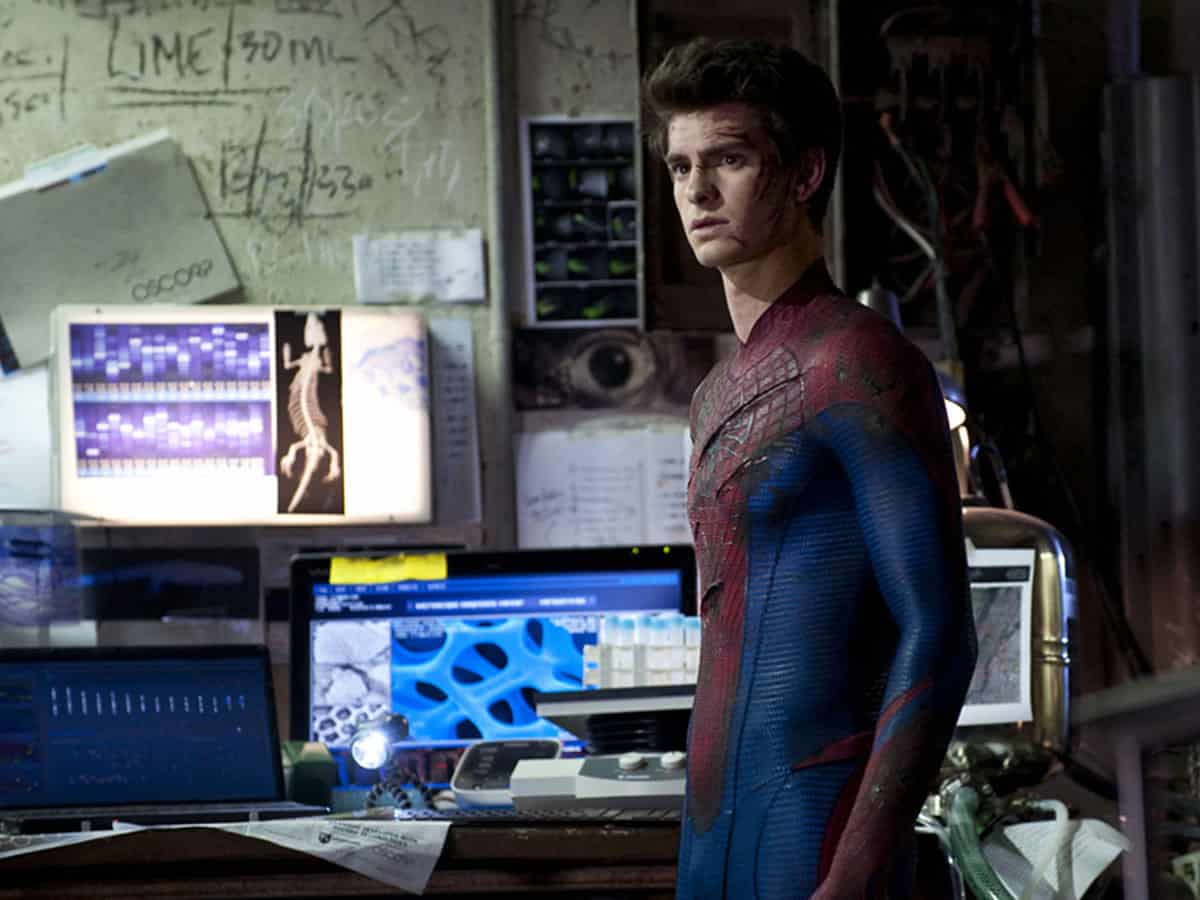
Lessons from the lab: science advisers helped with the set dressing in Amazing Spider-Man. (Courtesy: Columbia Pictures/Sony Pictures/Collection Christophel/Alamy Stock Photo)
While connecting filmmakers with scientists might seem like a logical pairing, it’s not necessarily a natural one. “When I first moved to Los Angeles about 10 years ago, I discovered that Hollywood people were afraid to talk to scientists because the only thing the scientists would ever do is tell them why they were wrong,” says Carroll. “You can’t do that. Even if it is true, it’s not helpful.”
To improve the link, the National Academy of Sciences in the US launched the Science and Entertainment Exchange in 2008. The programme connects screenwriters, producers and directors with scientists to create accurate and engaging stories. It challenges the advisers in its database to come up with a better idea when there’s something wrong with the science in a story.
“I could say, ‘I have no business being here,’ ” says Clifford Johnson, a physicist at the University of Southern California, and consultant for Marvel’s Thor: Ragnarok (2017) and the Avengers film series (2012–2019). “I say, ‘No, my job is to help [filmmakers] tell their story, and what I can do as a science adviser is to use the knowledge I have about the laws of physics in our real universe to help build rules for their universe.’ ”
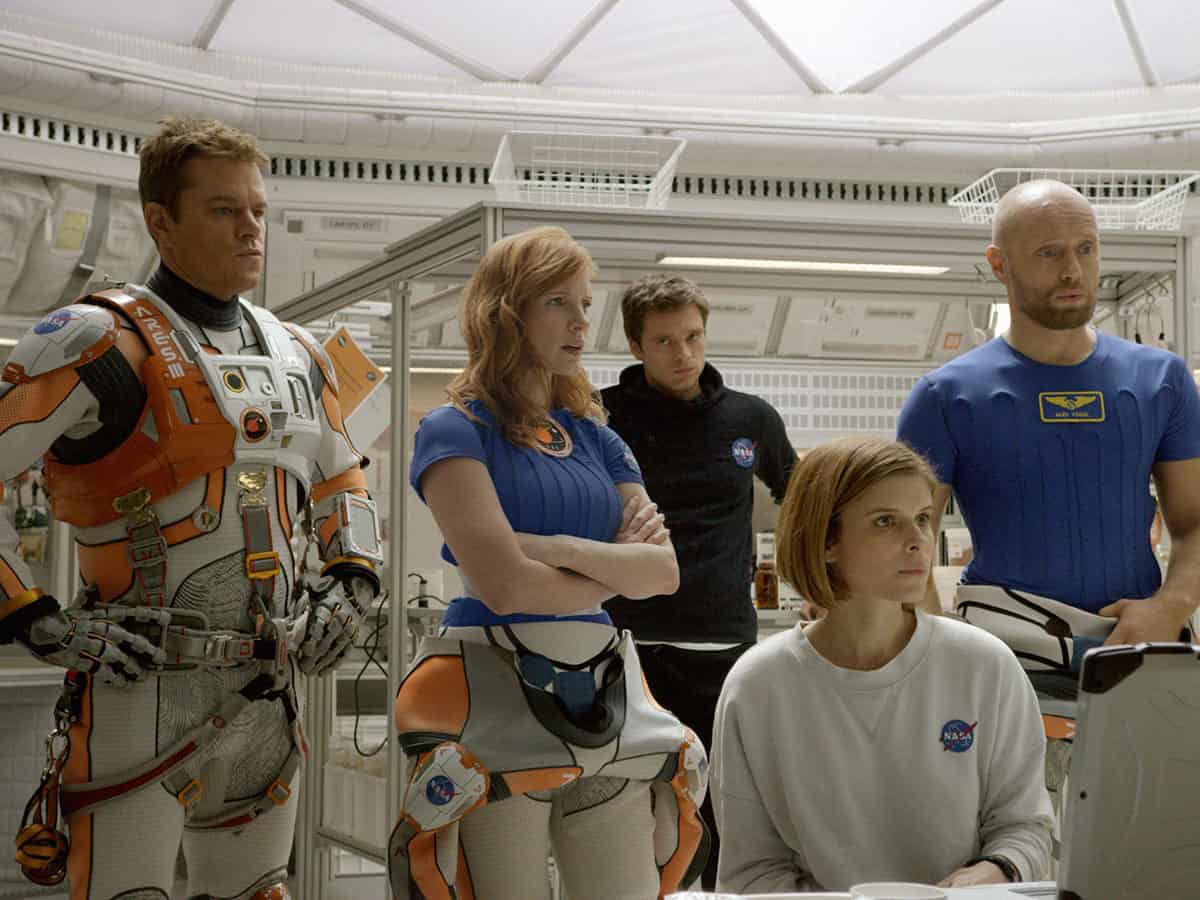
Science advisers may give advice to filmmakers about anything scientific, such as how science is performed in The Martian (above); creating accurate physics models of a wormhole for Interstellar (below); and explaining how Dr Manhattan’s powers work in Watchmen (top of article). (Courtesy: 20th Century Fox/Genre/International Traders/Mid Atlantic/Kobal/Shutterstock)(CC BY 3.0/James et al. 2015 Class. Quant. Grav. 10.1088/0264-9381/32/6/065001)
I’m going to have to science the shit out of this – The Martian
Science advisers can be called upon at any time during the pre- or post-production process of a film (although they are typically not paid for the contribution). They can be involved in anything from generating initial ideas about the story, working with the screenwriter writing the script, reviewing scripts for shooting a scene, or helping to troubleshoot problems with the story during filming.
“One of my favourite moments on set was when the actors needed to argue about something that had nothing to do with the script and I could pick anything that I wanted; so, I picked a cosmological debate about the beginning and end of the universe,” says Mika McKinnon, a field geophysicist and a science consultant for the sci-fi TV shows Stargate: Atlantis (2004–2009) and Stargate Universe (2009–2011). “The only way [the audience] would know what was going on is if you recognized the equation or were on set that day.”
The interaction between filmmakers and a science adviser could be a brief e-mail, an hour-long phone call, a long lunch meeting or multiple interactions that are a mix of these. The scientists may be contacted once or multiple times during the production process and these communications can sometimes extend for years. “A new screenwriter who doesn’t have a lot of films made may call you up for an informal chit-chat over coffee at a stage where they are still coming up with ideas and the script is not yet written,” says Carroll, who was a science adviser for the sci-fi action film TRON: Legacy (2010) and Marvel’s Thor (2011). “Whereas, if you are dealing with a giant studio – like Disney or Marvel – they know what movies they are going to make, and you generally talk to them when the process is well under way and they are looking to touch up some particular issues in the script or special effects or something like that.”
During his consultations for Thor, for example, Carroll was asked how characters would travel across the universe. But when he said you’d need a wormhole, the production company executive said they couldn’t use the word “wormhole” because it sounded “too nineties” and had been used in too many other movies during that period. Carroll suggested calling it an Einstein–Rosen bridge instead – an idea that stuck and was used in the film.
You’re the genius up here. I only drive the bus – Gravity
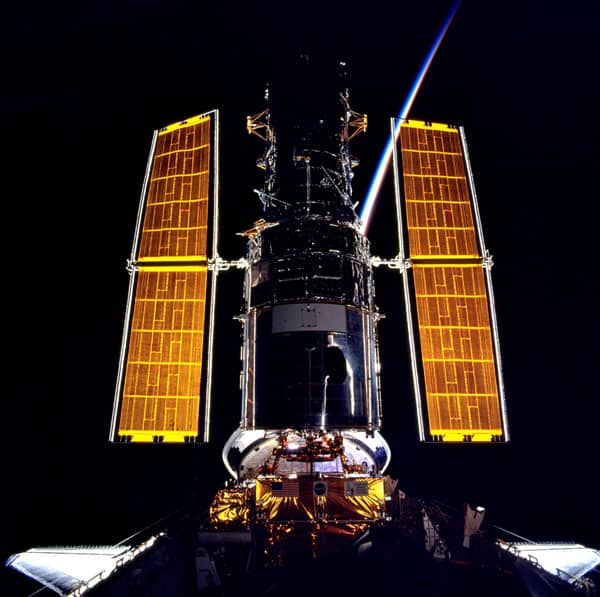
The science adviser might help with the plot or some dialogue, or even with the props that appear in the background of a scene. While working on Gravity, Grazier explains that one of his notes to the studio was that the two solar panels on the Hubble Space Telescope rotate, rather than expand. “Sometimes what you do is just adding a line here or there,” says Carroll. “Some of what you do is almost invisible.”
When the creators of The Amazing Spider-Man (2012) contacted Kakalios, meanwhile, they needed him to come up with an equation for longevity. Kakalios did one better and based his equation on the real Gompertz law, which describes human mortality and why people live to the age that they do. “So, I took the Gompertz equation and I added some ‘mathematical glitter’ and at the last minute they said the equation didn’t look complex enough and could I add some more,” says Kakalios. “So, I did and at that stage it was so late that they basically Photoshopped the paper that I sent to them into the character’s notebook.” It was a small detail that most moviegoers won’t have noticed – apart from Kakalios’ daughter, that is. “She said, ‘You’re the guy who sat next to me helping me with my high-school math; of course I know how you write a sigma,’” Kakalios recalls.
For most scientists, the opportunity to be a science adviser means that they get to use their expertise to problem solve in a different way. “I prefer to spend more time talking with filmmakers about the people who they portray as scientists than I do worrying about if they got this scientific detail right,” says Johnson. “Because I think it is way more important to talk about and to show accurately who does science, who can do science, and what their motivations are about doing it, than dwelling on little facts here and there.”
Johnson explains how the movie The Martian (2015) was unusual in that it showed a wide and varied view of who a scientist is. “You see someone who you could have a beer with, the more business-like director, the uber nerd and the awkward young scientist,” explains Johnson. “You see the full range, which is unusual in a film.”
Your ancestors called it magic, but you call it science – Thor
It’s not just directors and filmmakers who are benefiting from their growing relationship with scientists. One advantage of serving as a science adviser for the film industry is that it gives scientists a great opportunity to talk to the wider public about physics, using the big screen as a hook in outreach activities.
Take Kip Thorne – the Nobel-prize-winning theoretical physicist at Caltech, who served as executive producer and science adviser for the sci-fi film Interstellar (2014). Working with Hollywood, he says, gave him tremendous opportunities to be a science communicator. “I was able to inspire a very large number of people about science – the movie sold roughly 100 million tickets worldwide – and there is no other way that I could possibly have reached so many people with my message of the beauty and power of science,” Thorne explains. “Over the years since Interstellar’s release, a large number of young people, in nations around the world, have told me that this movie influenced them to become scientists.”
McKinnon agrees. “Through watching a show, you, the audience, learn how to think like a scientist or you learn how they see data,” she says.
And sometimes it’s even possible to go the other way too, with a passion for science communication landing you a Hollywood role. At least that’s what happened to Rhett Allain from Southeastern Louisiana University in the US. His love of applying physics to movies and TV shows led to his role as a blogger for WIRED magazine – where he frequently discusses the physics in films – and then to his position as science adviser for CBS’s reboot of the TV show MacGyver (2016–present). “My blog gives me a chance to add to what Hollywood has done.”
For Carroll, being a science adviser is also a chance to challenge his students to think differently. “I had a wonderful example of this for a movie called Inversion,” explains Carroll, referring to a sci-fi film that is yet to be released. “The idea is that at random times and places here on Earth, gravity reverses. So, it’s pushing things away from the Earth instead of pulling – and they invited me to help try to make that seem more realistic.”
The actor playing the lead character, a theoretical physicist, wanted to come to Caltech to meet some actual physicists and understand how they think. “Which I thought was wonderful,” says Carroll. “I gathered a group of my graduate students to meet with her and one of the producers of the movie.”
Initially, his students were hesitant to pursue the idea. “When my graduate students had the [gravity] scenario explained to them, their immediate reaction was, ‘No, that will not happen,’ ” Carroll explains. “So, what I said was, ‘Don’t think of this idea that gravity is reversing – that’s not a theory – think of it as data; think of it as the experiment has already been done and now, you need to try to come up with an explanation for it.’ ”
Sometimes it’s not about working with the laws of nature, it is about creating a set of rules that stay consistent throughout the movie. “If you are going to play that game – of imagining different worlds – then, those worlds have to make sense,” says Carroll. “They have to have some logical coherence to them; both in how people act and in how the laws of nature act.”
All in the detail: Accurately depicting science in films could mean using computer models to simulate the movement of sand (above); or knowing how the Hubble Space Telescope’s solar panels move (below). (Courtesy: Sony Pictures/AA Film Archive/Sportsphoto/Alamy Stock Photo)(Courtesy: NASA)
You do the math. You solve the problem – The Martian
Films, however, aren’t just a great communication and teaching tool for scientists. Sometimes the software that moviemakers use translates to the lab.
When Kakalios had the chance to talk with somebody who created the digital effects for the Sandman character in Spider-Man 3 (2007), he commented that the artists must have filmed actual sand because it looked so realistic. Instead, Kakalios found out that Hollywood was using the exact same discreet element methods (DEM) software that he uses to run simulations in the lab.
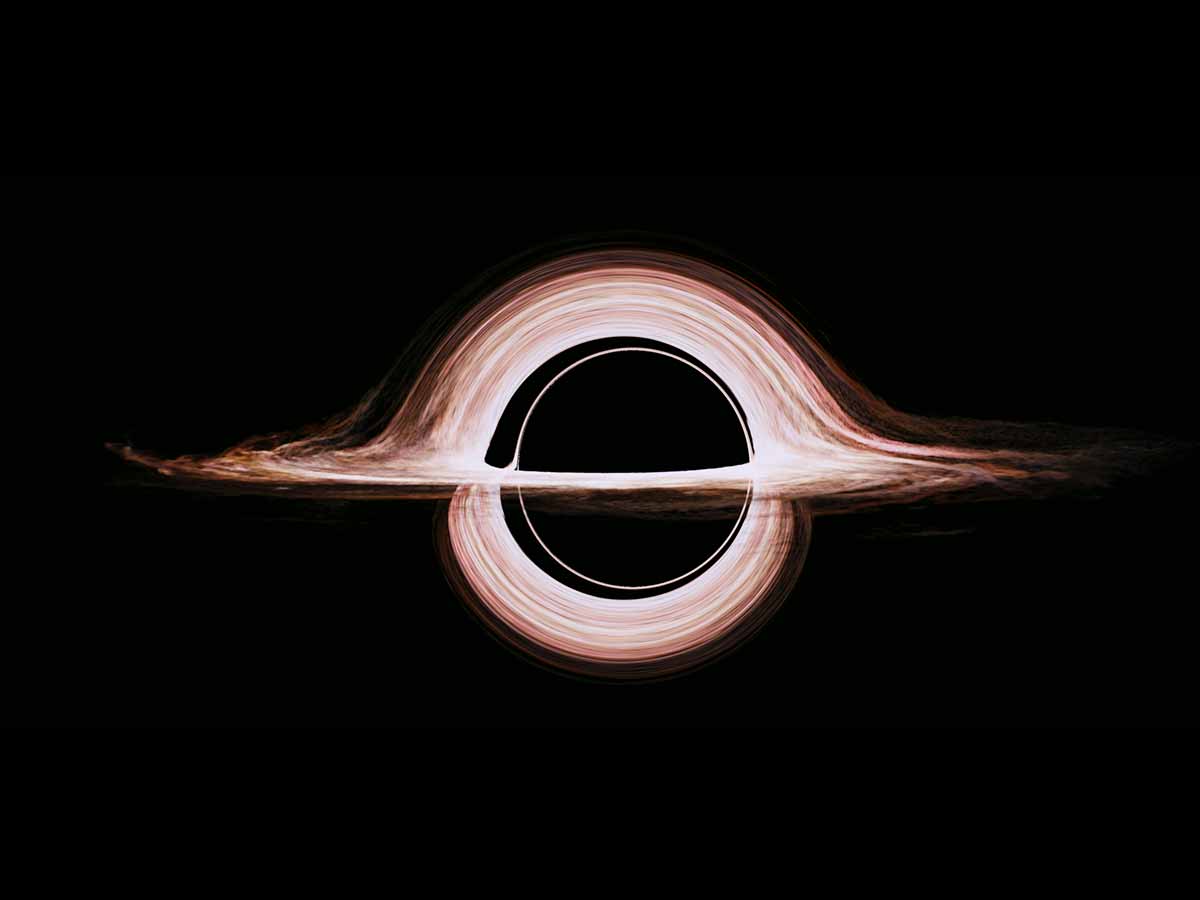
Thorne, meanwhile, worked closely with the visual effects team at London-based visual-effects firm Double Negative to create and bring to life “Gargantua” – the black hole in Interstellar. While Thorne devised the set of equations, the physicists Oliver James and Eugénie von Tunzelmann from Double Negative developed new computer code called the Double Negative Gravitational Renderer. When the visual effects were complete, the collaborators realized that they had created new visualizing software that could be used for both Hollywood productions and scientific research.
For McKinnon, her best educated guess about a binary pulsar system consisting of two stars that creates a deadly burst of gamma rays approximately every 46 minutes turned out to be less science fiction and more science fact. “It was close enough that three years later, scientists discovered this in real life,” says McKinnon.
Houston, I have a bad feeling about this mission – Gravity
Unfortunately, however, it’s not a perfect system and sometimes a scientist’s advice doesn’t make the cut. “One of the misconceptions people have is that science advisers have copyeditor-like discretion over the science,” says Grazier. “For the writer, we are just one more voice or set of notes; not everyone listens to the science advisers.”
Kakalios agrees. “Sometimes the decision comes down to: does Hollywood want to antagonize a million rabid fans or one physics professor from Minnesota,” he says. “I know the decision I’d make and I’m the physics professor from Minnesota!”
Johnson also thinks that the movie industry hasn’t yet learned the value a science adviser can add. “Writers and directors still think of us as a necessary evil to check a couple of things so that they aren’t glaringly wrong, and no-one knows what stage to call us in. It is changing in a positive direction but there is a long way to go.” According to Johnson, ideally a writer working on a science-heavy film should talk to a scientist at an early stage, when they can offer ideas that improve the story and ensure that the science isn’t just there for decoration.
As with most industries, however, it comes down to money. “Until they [filmmakers] realize that it makes sense monetarily to do it, change will be slow,” Johnson concludes. But with the highest grossing film ever at the time of writing being Marvel’s Avengers: Endgame – a film franchise that frequently uses science advisers – perhaps we’ll be seeing fewer scenes like Lucy’s brain myth.
Science advisers on good movie science
Storming ahead: Twister followed advice from meteorologists on storms and storm-chasing. (Courtesy: Shutterstock\solarseven)
Because of my fascination with severe weather and natural disasters, two of my favourite science movies are Twister (1996) and Dante’s Peak (1997). And while doing my own research into these films, I discovered in fact that both used science advisers. Meteorologists at the National Oceanic and Atmospheric Administration’s Severe Storms Laboratory taught the Twister crew about storm chasing, and volcanologists at the United States Geological Survey were technical consultants on Dante’s Peak.
But what about the science advisers I spoke to for this article? What are their favourite depictions of physics on screen?
“I loved the world created in Star Wars,” says Rhett Allain. “And things like the visual of the black hole in Interstellar.” As for Kevin Grazier, he cites 2010: the Year We Make Contact (1985) as a favourite, referring to the sequel of the 1968 classic 2001: A Space Odyssey. “What is interesting is that two of the most exciting scenes in that movie involve getting a relative velocity under the escape velocity and getting a relative velocity over the escape velocity,” Grazier says.
Most science advisers I spoke to, however, highlighted the 2015 Ridley Scott epic The Martian as an example of a movie that represents science well. “I think The Martian did a very good job of sticking pretty darn close to scientifically respectable ideas and, even better than that, it was really a window into doing science in a very high-pressure environment,” says Sean Carroll. “That is what I liked most of all; not the facts about the science being right or wrong, but some impression of how science gets done.”
Clifford Johnson has high praise too for The Martian, which starred Matt Damon struggling to survive alone on the red planet. “One of the things that The Martian did extremely well – which is rare to see – is showing the scientific process,” he explains. “There are entire scenes where we watch the lead character try and figure stuff out to improve his situation; he does experiments; he makes mistakes and tries again. You hardly ever see that in movies.”
“The other thing that was great about that movie was showing the collaboration between scientists,” Johnson continues. “You see the lead character working with his colleagues on Earth and you get to see a full spectrum of different people who can be scientists.”
The motions of the planets have been used to make the best estimate yet of the upper limit of the mass of the graviton – a hypothetical particle that is a quantum of the gravitational field. That is the claim of Leo Bernus at the Paris Observatory and colleagues, who used over a century’s worth of data in their calculations.
In theories that try to provide a quantum description of gravity, the graviton mediates the gravitational force between massive objects. It can be thought of as a gravitational version of the photon, which mediates the electromagnetic force between charged objects. A correct theory of quantum gravity has yet to be developed, but it is possible to test some aspects of nascent theories including their predictions of whether the graviton has a mass.
If gravitational fields have an infinite range – as Einstein’s general theory of relativity dictates – gravitons must be massless and travel at the speed of light. However, some theories of quantum gravity suggest that the graviton could have an extremely small mass. If this were true, it would limit the range of the gravitational force and impose a subluminal speed limit on the graviton.
Orbital deviations
Previous attempts to measure graviton mass have tracked the orbital paths of planets in the solar system and checked for any deviations from paths predicted by general relativity. Recent observations of Mars’ orbit made by Clifford Will at the University of Florida, for example, suggested that the graviton mass must be less than 10-23 eV/c2. In comparison, the upper limit on the mass of the lightest known particle – the neutrino – is about 1 eV/c2.
In their study, however, Bernus’ team noted that Will’s equations did not include the possibility of the graviton having mass, which they say skewed his results towards a zero-mass result.
To address this oversight, Bernus and colleagues adapted previous theories to make the range of the gravitational field a finite and adjustable variable. They integrated this adapted theory into a model called INPOP17b, which predicts the motions of planets, moons and large asteroids in the solar system. Using the position of each body in 2000 as starting conditions, they ran the model backward to 1913 and forward to 2017. They then compared the predicted positions of the objects to their observed positions.
Their analysis gave them a 90% confidence that the range of the gravitational field cannot be any shorter than 1.8×10¹³ km. This corresponded to a graviton upper mass limit of 6.8×10⁻²³ eV/c2 –heavier than Will’s result. As more and increasingly accurate data on the dynamics of the Solar System is gathered, the team hope to constrain this value even further in the future.