Researchers have discovered quantum oscillations of electrical resistivity in an insulator for the first time. The new discovery, made in the mixed valence Kondo insulator ytterbium dodecaboride, is unexpected since these oscillations are usually only seen in metals. The result will help shed more light on the electronic properties of these unusual materials, which are important for fundamental studies in condensed-matter physics.
The orbital motions of conduction electrons on the Fermi surface in metals are quantized in magnetic fields and show up as quantum oscillations in the electrical resistivity of the metal. This so-called Landau quantization is not usually seen in insulators, however. A team of researchers led by Lu Li of the University of Michigan in the US and Yuji Matsuda of the University of Kyoto in Japan has now found that it exists in crystals of ytterbium dodecaboride (YbB12). The bulk of this rare-earth intermetallic compound is an insulator but its surface conducts electricity very efficiently. The quantum oscillations observed by Li and Matsuda’s teams, surprisingly, come from the insulating bulk.
Li and colleagues obtained their result thanks to measurements using the strongest DC magnetic fields available (of 45 Tesla) at the National High Magnetic Laboratory in Tallahassee, Florida. They passed an electrical current through their sample while applying extremely high magnetic fields and measured the electric voltage decrease in it. This technique, which they performed at different temperatures, allowed them to determine the resistivity of the sample.
Distinct quantum oscillations
“We found that the resistivity of YbB12, which is of a much larger magnitude than the resistivity of metals, exhibits distinct quantum oscillations,” explains Li. “These unconventional oscillations arise from the insulating bulk, even though the temperature dependence of the oscillation amplitudes follows the expected and conventional Fermi liquid theory of metals (the “Lifshitz-Kosevich formula”).
“This result confirms that Kondo insulators have a dual nature – they are both electrical insulators and itinerant metals,” he tells Physics World. “This duality is a surprising consequence of the strong correlations between the electrons in the material.”
Scientists in China have released details for a huge particle collider that will produce over a million Higgs bosons in a seven-year period. The conceptual design report for the China Electron Positron Collider (CEPC) calls for a 100 km underground tunnel that would smash together electrons and positrons at energies of 240 GeV. The CEPC would be a successor to the Beijing Electron Positron Collider at the Institute of High Energy Physics (IHEP) in Beijing, which is expected to shut in 2020.
The CEPC, which was first proposed in 2012, is a “Higgs factory” – a facility to measure the precise properties of the Higgs boson, which was discovered at CERN in 2012 by scientists working on the Large Hadron Collider (LHC). An electron-positron machine can make much cleaner measurements than a proton collider like the LHC as its collisions do not produce as much debris. The CEPC will therefore allow the Higgs boson to be studied in unprecedented detail.
A preliminary conceptual design report for the CEPC was originally published in March 2015. That was followed by a progress report in April 2017, but the new 510-page conceptual design report, released this week on the arXiv preprint server, outlines the technical details of the accelerator. A second volume, featuring details of the CEPC detectors, is due to be released soon.
Particle factory
Estimated to cost around $6bn, the “heart” of the CEPC is a double-ring collider in which electron and positron beams will circulate in opposite directions in separate beam pipes. They will then collide at two “interaction points”, which will each contain a particle detector. The report reveals the CEPC will seek to generate over a million Higgs bosons over a seven-year period. The design also calls for the CEPC to operate at 91 GeV for two years to generate a trillion Z bosons as well as run at 160 GeV for a year to produce around 15 million pairs of W+ and W- particles.
We need to know what kind of support from the local government we will receive in terms of, for example, laboratories, living conditions, roads and power supply
Yifang Wang
Scientists will now build prototypes of key components of the accelerator and plan the manufacturing process required to construct the CEPC. If given the go-ahead by the government, construction of the CEPC could begin in 2022 and be complete by 2030. Following a decade of studying the Higgs, Z and W bosons, it is hoped that developments in magnet technology will be sufficient to begin construction of a proton-proton collider inside the existing tunnel in the early 2040s. This would operate in the range of 70-100 TeV and search for particles beyond the Standard Model of particle physics.
The location of the CEPC has not yet been decided with six locations currently satisfying the “technical requirements”. However, it is thought that the leading site is 300 km east of Beijing at the port city of Qinhuangdao. Speaking to Physics World earlier this year, IHEP director Yifang Wang says that a more detailed investigation of the geological conditions at some of the possible sites is needed before a decision can be made. “We need to know what kind of support from the local government we will receive in terms of, for example, laboratories, living conditions, roads and power supply,” he says.
Analysis: China could win the Higgs factory race
The race is on to build a Higgs factory – a successor to CERN’s Large Hadron Collider. For years it was thought that the International Linear Collider (ILC) was in pole position. The ILC’s five-volume technical design report was published in June 2013, calling for a 30 km-long linear collider that would smash electrons with positrons at around 500 GeV. The Japanese physics community quickly got behind the project expressing their desire to host the machine with a site in the Tōhoku region, about 400 km north of Tokyo, chosen as a potential location.
However, the Japanese government has dragged its feet over deciding to support the project and last year — to make the ILC more palatable — physicists came up with a revised plan, reducing the ILC’s energy to 250 GeV and shortening the length of the tunnel to around 20 km. While physicists hope that the Japanese government will now get behind the facility by the end of the year, there are many other projects vying for funding, no less a major new neutrino facility in Kamioka. It is likely that a decision about the ILC will be kicked further down the road.
There is another design for a linear collider to study the Higgs. The Compact Linear Collider would smash together electron with positron at energies up to 3 TeV, but despite a three-volume conceptual design report being released in 2012, it remains behind the ILC in terms of technical development. That now leaves the door open to China and momentum seems to be on their side. Speaking to Physics World earlier this year, Yifang Wang, head of China’s Institute of High Energy Physics, noted that there was “enormous interest” for the CEPC from funding agencies in the country.
Given the amount of cash that the Chinese government is ploughing into science as well as the technical ability of Chinese scientists and engineers to build world-class facilities, it would be hard to bet against the CEPC being first.
Jocelyn Bell Burnell has been awarded a Special Breakthrough Prize in Fundamental Physics for her work on pulsars and her “inspiring scientific leadership over the last five decades”. Bell Burnell says she will donate the $3m prize money from the Fundamental Physics Prize Foundation to create a new fund to support greater diversity for women and people from ethnic minorities. The money will be given to the Institute of Physics (IOP), which publishes Physics World, to support graduate students from under-represented groups.
Bell Burnell rose to fame while working at Cambridge University in 1967, when she identified a mysterious trace in data from a radio telescope she had built. It was a 0.5 cm-long signal that showed a series of regular peaks in luminosity. She concluded that the signal was neither a scintillating source, nor man-made interference but from a pulsar – a rotating neutron star that emits a regular ticking signal of radio waves. In February 1968, the Cambridge team, with her supervisor Antony Hewish as lead author, published a paper in Nature (217 709), announcing the “Observation of a rapidly pulsating radio source”.
Bell Burnell’s discovery of pulsars will always stand as one of the great surprises in the history of astronomy
Edward Witten
The discovery led to one of the first empirical confirmations of Einstein’s general theory of relativity. It also led to Hewish sharing the 1974 Nobel Prize for Physics with fellow astronomer Martin Ryle, though Bell Burnell was overlooked for the award.
“Bell Burnell’s discovery of pulsars will always stand as one of the great surprises in the history of astronomy,” says Edward Witten from the Institute for Advanced Study in Princeton who chairs the selection committee for the Breakthrough Prize. “Until that moment, no one had any real idea how neutron stars could be observed, if indeed they existed. Suddenly it turned out that nature has provided an incredibly precise way to observe these objects, something that has led to many later advances.”
Opening doors
Bell Burnell, a former president of the IOP, says the money will be used to create new graduate studentships for people from underrepresented groups in physics. “We at IOP are delighted to receive this donation from Jocelyn and are looking forward to working with her to develop a programme that opens doors to physics for people from every walk of life,” notes IOP president Julia Higgins.
The details of the fund are still being worked on with further information to be “provided in due course”. IOP chief operating officer Rachel Youngman adds that the donation “will enable us to connect with a greater range of under-represented groups and by doing so, enrich physics as a discipline with an increasingly diverse intake of students practising it”.
This is the fourth Special Breakthrough Prize to be awarded, which are given “in recognition of an extraordinary scientific achievement”. Previous winners include Stephen Hawking, seven CERN researchers who were behind the discovery of the Higgs boson in July 2012, as well as the entire collaboration working on the Laser Interferometer Gravitational-Wave Observatory that announced the direct detection of gravitational waves in February 2016.
Bell Burnell will be given the award at a ceremony on 4 November 2018 in San Francisco where the laureates of the annual Breakthrough Prize in physics, the life sciences and mathematics will also be honoured.
A team at St. Jude Children’s Research Hospital has developed and validated a new intensity-modulated minibeam proton therapy (IMMPT) system. The system is designed to improve high-dose conformity at mid-depths compared with current pencil-beam scanning proton therapy systems. It may be able to improve treatments for brain tumours by delivering more precisely targeted radiation and reducing dose to surrounding normal tissues (Med. Phys. 10.1002/mp.13093).
Intensity-modulated proton therapy (IMPT) systems utilize individual beamlets that have optimized intensities to provide a balance between target dose and dose to normal tissues. They offer improved efficiency, proximal dose sparing and flexible applications compared with legacy double-scattering delivery systems. Improvements have reduced spot sizes to around 3 mm.
To reduce spot sizes further, field collimation is being utilized to improve target conformity and penumbra, the region at the edges of a radiation beam where a rapid dose reduction occurs. To simplify this process, the research team, led by Jonathan Brent Farr, aimed to create a system that produces much smaller clinical proton beamlets without the need for physical collimation.
Farr and colleagues modified a proton therapy system in regular clinical use in the hospital’s Red Frog Events Proton Therapy Center. They made two modifications to the system’s fixed horizontal beamline – adding and activating a vertical scraper to achieve a smaller beam size extracted from the synchrotron, and adopting a thinner vacuum window at the end of the beam line in the scanning nozzle – to enable IMMPT delivery using scanned minibeams. They also improved the proton spot position monitor and patient positioner accuracy to support clinical IMMPT delivery.
The researchers performed integral depth dose (IDD) acquisitions and calibrations, and compared IDDs, spot profiles and transmission chamber energy calibration curves with those from the regular system. They developed and validated Monte Carlo models and used these to produce spot profiles and IDDs. These were then imported into a commercial treatment planning system for dose model fitting, testing and validation.
Two patient plans were developed for a simulated base-of-skull case with small and medium targets proximal to the brainstem: one using a nominal discreet spot-scanning system and the other using the minibeam. The team compared these using dose difference and dose volume histogram analysis. The minibeam patient plan was also evaluated using the department’s standard patient-specific quality assurance programme.
The authors reported that the differences between 96 IDD measurements for the minibeam treatment compared with the standard spot commissioning data were indistinguishable. “The spot sigma is determined to be 1.4 mm at 221 MeV at the isocentre and below 1 mm at proximal distances,” they wrote, adding that “the treatment planning system [data] fit the spot profiles closely, giving a residual error maximum of 2.5% in the spot penumbra tails from 69.4 to 221.3 MeV.”
The resulting IMMPT plans delivered superior target conformity and brainstem sparing for both the small and medium targets. The authors attributed this to a steeper dose gradient compared with IMPT.
Farr tells Physics World that the IMMPT system has received 510(k) clearance from the US Food and Drug Administration and is in routine clinical use at St. Jude. “Currently, the physician-scientists are using the superior dose sparing properties of the minibeam to enhance the care of children with relatively small brain tumours abutting critical structures like the brain stem and optic nerves,” he says.
“An upcoming investigation using the IMMPT system to treat a range of ocular tumours is under development. Here, the additional sparing properties of the minibeam may be used to preserve orbital bone growth for the affected children,” he adds.
Farr, currently director of medical physics at Advanced Oncotherapy, a proton therapy system company headquartered in London, believes that the clinical use of proton minibeams will increase over time. He and his colleagues at Advanced Oncotherapy are working to investigate and develop proton minibeams to yet higher conformity.
Physics is a quiz where the first step is guessing the questions…where you have to keep rewriting the questions and your answers change the questions.
Physics is like watching a dance when you have to figure out how the partners come together and break apart…or figure out the music to which they are responding.
Physics is like modelling new structures using Meccano or Lego…or like modelling the same structures by inventing new construction materials.
These are some of the metaphors readers sent to me in response to my June column, in which I cited dramatic metaphors about the activity of mathematics. I wondered if there were equally good metaphors specifically for physics. Richard Feynman once compared physics to the activity of watching a chess game played by the gods, in which physicists are observers who watch and collaborate in guessing the rules. But could Physics World readers do better?
Some responses were amusing. “If it’s slimy it’s biology, if it stinks it’s chemistry and if it doesn’t work it’s physics,” Colin Pykett recalled from his high-school days. He also learned the difference between physicists and engineers: “A physicist only has to make it work once but an engineer has to make it work every time.” More originally, tapping his musical training, Pykett compared doing physics to “watching a movie of an orchestra but with the sound turned down, and you have to work out what they are playing”.
Several people produced extended metaphors. Peter Lamb wrote that a theoretical physicist is a high priest, a quantum-computer developer is a Ponzi scheme promoter (“too good to be true”), and a real physicist is a “faithful dog” who watches patiently, ignores distractions, and waits for the master to come home.
All at sea
In the frontispiece of Francis Bacon’s influential 17th-century opus The Great Instauration, scientific research was depicted as a form of seafaring. It was a comparison also made by one reader, John Bevan. As he put it, research requires sailing into and charting unknown waters; applying physics means sailing into charted waters; while understanding physics is like having an overall familiarity with the sea’s behaviour.
Peter Kenny, meanwhile, likened physics to assembling furniture, without instruction, from a jumble of unidentified parts. Theory predicts whether the end product will be strong and stable. Symmetry notes the substitutability of pieces. Dead ends are things that come together but are useless. Aesthetics is the judgment that something that fits doesn’t look right. Confirmation is finding that you can create several identical pieces of something.
David Jones, proposed that physicists are like palaeontologists who are concerned with bones – their shape, structure, bone density and grooves. Physicists use experience, knowledge and training to figure out the original creature – a rabbit, say. Children naturally find “grimy old bones” uninteresting compared with the cuddly live thing, meaning that physics requires a certain retraining of one’s attention and devotion.
I myself have often compared physics experiments to performances. Performance involves the conceiving, producing and witnessing of events that give back more than was put into them. Performances are not automatic; if we are sure of the outcomes, they aren’t performances but demonstrations.
I myself have often compared physics experiments to performances.
Robert P Crease
In research, you plan an event, understand the elements that go into it – the materials, instruments and theories – yet when it unfolds you can get more back than is in these elements, something you could not get by reading books. In this sense, performance is not a suggestive metaphor carried over from the performing arts into scientific inquiry but a descriptive term.
Some respondents went deep or dark. An example of the first was Fabien Paillusson, who cited the French philosopher of science Alexandre Koyré’s point that modern physics involves a revolutionary gestalt switch involving the eradication of the common-sense perception of the world and the projection into the world instead of what Koyré called a “new approach to being” involving an abstract and unnatural mathematical framework.
Paillusson then cited the French physicist and philosopher of science Etienne Klein’s paraphrase of all this as: “what (modern) physics seeks is to explain the real with the inconceivable”. Fredy Zypman, head of physics at Yeshiva University in New York, captured this point more dramatically: “Physics is the act of escaping reality to create it.”
An example of going dark was Homer Johnson, a retired teacher of English, who while reading the June issue of Physics World became aware of a bird pecking diligently and determinedly but unsuccessfully at his upstairs window. The physicist, he said, is like that bird, because no matter how hard or cleverly it tries it cannot gain the sought-after entrance to the deeper level of reality beyond the glass.
My column inspired some respondents to mull the limitations of metaphors themselves. Jones pointed out that when you use a metaphor, you have to trust people to interpret it correctly and figure out what is pertinent and what irrelevant. Consider, he said, the story of Humpty Dumpty, which is often used to exemplify the second law of thermodynamics (it’s even in Mr Dumpty’s Wikipedia entry). It illustrates the difficulty (but not impossibility) of returning him to his lower entropy state after his fall, but the metaphor works only if the audience focuses on his shell rather than on his hat or bow tie.
The critical point
Feynman’s chess metaphor has limitations. For one thing, it depicts only the theorist’s perspective; for another – like Stephen Hawking’s view that having a theory of everything means knowing “the mind of God” – it invokes deities a little too casually. Still, like the rest of Feynman’s Lectures on Physics, it is splendid in its clarity and conciseness. Physics – with its theoretical and experimental dimensions, its fallible and ever-incomplete nature, its applications, and its aesthetic sides – may be simply too complex to capture in a single image.
Lethal landslides are on the increase. Between 2004 and 2016, sudden cascades of rock, rubble and mud have claimed at least 50,000 lives. And fatal slips down unstable hillside slopes have steadily increased this century, according to new research.
British geographers report in the journal Natural Hazards and Earth System Sciences that they amassed a database of 4800 fatal landslides since 2004 and found that at least 700 of them had what they call a direct human fingerprint: they happened because people built on unstable soils, they mined, legally and illegally, they cut into hillsides, and they allowed pipes to leak.
In addition, heavy rainfall, earthquakes, explosions, dam collapses and freezing and thawing also set the earth moving at ever greater speeds, with deadly consequences.
The researchers also report that they found that other catalogues of natural disaster consistently under-estimated the toll exacted by landslides.
One study found that the International Disaster Database, maintained by the international disaster community, under-estimated the number of fatal landslides by between 1400% and 2000%, often because the death tolls from such events were lumped in with other forms of disaster that might precipitate landslip: among them volcanic eruption, earthquake and flooding.
“We were aware that humans are placing increasing pressure on their local environment, but it was surprising to find clear trends within the database that fatal landslides triggered by construction, illegal hill-cutting and illegal mining were increasing globally during the period of 2004 to 2016,” said Melanie Froude, of the University of Sheffield, UK, who led the study.
All the countries in the premier league for fatal landslides were in Asia: one in five of these happened in India, but Pakistan, Myanmar and the Philippines also suffered increasing losses.
Poorest in the shadows
Such findings are no surprise. First, there are more people on the planet, looking for new places to live and new ways of making a living, and the poorest are always more likely to be forced to the margins, to live on or in the shadow of dangerous, unstable slopes.
Second, the world is warming: for every extra degree Celsius the moisture-holding capacity of the atmosphere increases by about 7%, so more rain is likely to fall with ever greater intensity to saturate more soil and dislodge more rock. The researchers found that 79% of all landslides could be linked to rainfall.
Paradoxically, extremes of heat and drought can also create dangerous slopes: dangerous wild fires can remove the tree cover that stops hillsides from slipping, and drive people from their homes to places that could later be just as hazardous.
Applying knowledge
Research like this is never just academic: the point of such studies is to draw attention to natural disasters that need never have happened, and identify the communities most at risk.
And these, the scientists say, are more frequently in poor countries, with the poorest of all disproportionately at risk. The point the scientists make is that there is nothing inevitable about a “natural” disaster. Human error, heedlessness and ignorance all contribute to loss, suffering and death.
“With appropriate regulation to guide engineering design, education and enforcement by regulation by specialist inspectors, landslides triggered by construction, mining and hill-cutting are entirely preventable,” Froude said.
Researchers at the Institut d’Optique Graduate School at the CNRS and Université Paris-Saclay in France have used a laser-based technique to rearrange cold atoms one-by-one into fully ordered 3D patterns. The arrays, which contain as many as 72 neutral atoms held in an optical trap, could be used to simulate quantum complex many-body systems in physics.
While classical computers store and process information as “bits” that can have one of two states – “0” or “1” – a quantum computer exploits the ability of quantum particles to be in “superposition” of two or more states at the same time. Such a device could, in principle, outperform a classical computer for solving some advanced computational problems, such as factoring large numbers or simulating the interactions between many fundamental particles.
In recent years, researchers have been trying to adapt a number of quantum methods and technologies, such as superconducting qubits and trapped ions, to build real-world quantum computers and much progress is being made in this field. A team led by Antoine Browaeys of the Laboratoire Charles Fabry is now reporting on a new technology based on trapped neutral atoms.
Neutral atoms are proving promising for quantum computing because qubits made from them are extremely well isolated from surrounding environmental noise so their encoded state remains intact. They can also be finely controlled using optical traps (or tweezers) and scaled up to large numbers of qubits. Optical tweezers work by trapping tiny objects near the focus of a laser beam and the technique allows these objects to be picked up and moved to another place using just light forces.
Controlled interactions required
Quantum-computing operations require controlled interactions between atoms, so, computers based on neutral atom qubits will first need to be precisely arranged in a specific pattern. Such patterns have proved difficult to make until now, however – and especially using neutral atom qubits. Although researchers have succeeded in arranging these atoms in 1D and 2D, they will need to be able to stack them in 3D as the number of qubits reaches the hundred mark, and to make structures that are just not possible in 2D.
In their experiments, Browaeys and colleagues made use of a spatial light modulator to generate microtraps (arranged in, for example, bilayer graphene structures or pyrochlore lattices) separated by a few microns. “We initially randomly load and half-fill these traps with cold rubidium atoms,” explains study lead author Daniel Barredo. “We then use a combination of acousto-optical deflectors and electrically tuneable lenses to create moving optical tweezers that can ‘pluck’ and transport the atoms, one at a time, from ‘reservoir’ traps to empty sites in the arrays.”
The technique allows the researchers to sort disordered arrays of atoms into ordered ones and so build defect-free 3D qubit arrays in a variety of different patterns. It also allows them to overcome one of the major problems encountered when working with ultracold atoms. Normally, each optical trap is simply randomly loaded in an array and so only has a 50% probability of being filled with an atom at any one time, but for applications, a defect-free, fully loaded array is ideally needed. This is one in which each trap has a probability of 100% of containing a single atom.
Browaeys and colleagues measured the full occupation of the array sites by illuminating the system with light and observing the fluorescence of the rubidium atoms using a CCD camera (see image).
Promising platform
They did not stop there though: they then successfully engineered interactions between two individual qubits in one of the arrays by exciting the atoms into so-called Rydberg states. These produce atomic electrical dipoles that allow the qubits to “sense” each other though dipole-dipole interactions.
“Arrays of neutral atoms excited to Rydberg states have recently emerged as a very promising platform for quantum simulations of large physical systems,” Barredo tells Physics World. “Indeed, recent work has shown that Rydberg interactions between small systems of neutral-atom qubits can be used to perform quantum-logic operations. Until now, however, the largest quantum simulations that could be performed using these systems involved around 50 qubits in 1D and 2D geometries. Accessing the third dimension, as we have achieved in this work, not only allows these qubits to be scaled up (to 72 atoms in our case), it also opens the way to simulating more complex, real-world physical phenomena and materials.”
The researchers, reporting their work in Nature 10.1038/s41586-018-0450-2, say they are now looking to use their fully reconfigurable 3D arrays of individually controlled atoms to study, for example, the role of “frustration” in quantum systems, or how topology can give rise to new phases of matter. “At the same time, we will be trying to increase the size of our largest array, which is so far only limited by the lifetime of the atoms in the microtraps (about 10 s),” reveals Barredo.
A jet of charged particles moving at nearly the speed of light smashed its way out of debris left behind in the aftermath of the neutron-star merger that produced the gravitational waves detected by the LIGO–Virgo collaboration on 17 August 2017.
The event, catalogued as GW170817, has been a Rosetta Stone for astronomers because it allowed them for to observe the same event using gravitational waves and electromagnetic radiation ranging from a gamma ray burst (GRB) to a radio afterglow. This was a first for the new and exciting field of multimessenger astronomy.
The collision of two neutron stars is called a kilonova and is thought to produce either a black hole or a ‘hypermassive’ neutron star. Some of the neutron-rich debris forms a shell, or cocoon, around the black hole or neutron star. The rest spirals onto the remnant object, producing a jet of charged particles that blasts out into space at nearly the speed of light.
Glowing cocoon
As the jet slams into the cocoon, it causes it to glow, a phenomenon that astronomers call the afterglow. However, it had been unclear whether the jet is able to penetrate through the cocoon and emerge on the other side.
Astronomers, led by Kunal Mooley at Caltech, set about trying to answer this question by observing the afterglow using the High Sensitivity Array, which consists of ten radio telescopes in the US that make up the Very Long Baseline Array, plus the Very Large Array in New Mexico and the Green Bank Observatory in West Virginia. They found that the afterglow had a delayed onset, taking 150 days to reach its peak brightness, whereas other observed afterglows become visible after just a week or two.
The further off-axis Earth is from the direction of the jet, the fainter the afterglow appears to us. The length of the delay implies that we are seeing the afterglow and the jet from a viewing angle of 20°, and that the jet and afterglow had to be intrinsically highly luminous for us to be able to detect them at that angle.
Faster-than-light
Mooley’s team also found that the radio afterglow associated with GW170817 exhibited superluminal – that is, apparent faster-than-light – motion between 75 and 230 days after the kilonova. Superluminal motion is an illusion caused by a very narrow jet – in this case calculated to be just 5° wide – travelling at just less than the speed of light towards us.
These measurements allowed Mooley’s team to gain a better understanding of GW170817. The detection of gravitational waves indicated that it was a binary neutron star merger, and the superluminal motion showed that the jet was able to break through the cocoon.
“By putting this information together, we now have strong observational evidence that binary neutron star mergers produce successful jets,” Mooley tells Physics World.
“This is arguably the best estimate of a GRB jet that we have ever had,” says Ore Gottlieb of Tel Aviv University, who is a co-author with Mooley on a paper describing the findings in Nature.
Lucky find
The surprise has been in finding how narrow the opening angle of the jet, and our viewing angle of the jet and afterglow, were. Had the viewing angle been 30 degrees rather than 20 degrees, says Gottlieb, “we would have missed it.”
They estimate that maybe just one in every 1000 short GRBs with these narrow, highly luminous jets is pointed towards Earth. “It’s plausible that they are much more common in the universe,” says Gottlieb.
Nial Tanvir, who is an astronomer at the University of Leicester, and who was not involved in this research, describes the findings as a “nice result” for answering the question of whether relativistic jets produced by neutron star mergers can break-out from their cocoons.
“It does seem consistent with the long-held idea that many – or maybe all – neutron star mergers produce these very fast-moving jets, which if observed from a vantage point close to the jet axis, will look like a bright, short-duration gamma-ray burst,” he says.
FDG-PET/CT could be very helpful in calculating the risk of developing interval metastasis during neoadjuvant chemoradiotherapy for oesophageal cancer, and it could lead to other more appropriate restaging modalities for patients, according to a study published in the September issue of the European Journal of Nuclear Medicine and Molecular Imaging.
In an analysis of more than 700 consecutive patients, Dutch and US researchers discovered that 8% of subjects developed metastases during treatment and thus avoided a potentially unnecessary oesophagectomy because of this routine FDG-PET/CT restaging protocol.
“Accurate preoperative detection of interval metastasis of [oesophageal] cancer is crucial for optimal selection of patients suitable for surgery,” wrote the researchers, led by Lucas Goense, from University Medical Center Utrecht in the Netherlands. “In patients with accurately detected interval metastasis, surgery is expected to provide no benefit in terms of survival, but rather to decrease quality of life due to highly morbid surgery with subsequent recovery time.”
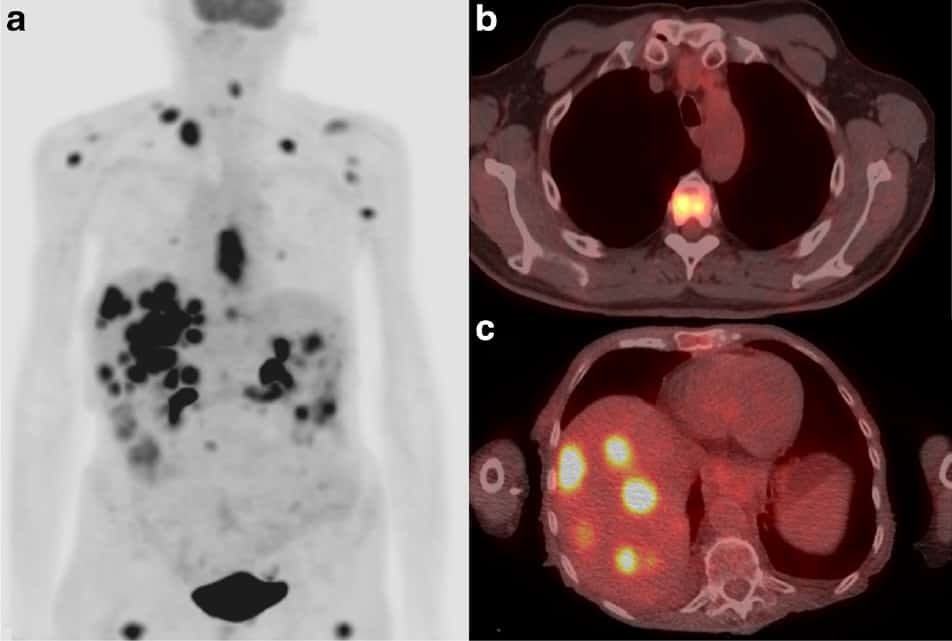
Examples of true positive metastatic lesions detected by 18F-FDG PET/CT restaging. (Courtesy: Eur. J. Nucl. Med. Mol. Imaging45 1742/CC BY 4.0)
Treatment debate
It is estimated that more than 450,000 people contract oesophageal cancer on an annual basis. In cases of non-metastasized oesophageal cancer, neoadjuvant chemoradiotherapy is the standard of care, while patients with inoperable locally advanced forms of the disease face definitive chemoradiotherapy.
“Currently, there is disagreement between guidelines as to whether all patients should be restaged after chemoradiotherapy,” the authors wrote. “At present, little is known about which patients are at risk of developing interval metastases.”
Thus the objective of this study was to assess FDG-PET/CT’s ability to detect and to diagnose interval metastasis and identify predictors of interval metastases in a large cohort of patients with oesophageal cancer.
Researchers from University Medical Center Utrecht and University of Texas MD Anderson Cancer Center in Houston, Texas, looked at a total of 783 consecutive patients (mean age, 62.5 years, ±10.6 years) between 2006 and 2015 who were diagnosed with oesophageal cancer. The most predominant tumour type was adenocarcinoma (86%), while the majority of patients (87%) were in clinical tumour stage III (Eur. J. Nucl. Med. Mol. Imaging 45 1742).
The subjects underwent an FDG-PET/CT scan (Discovery RX, ST, or STE; GE Healthcare) before and after completion of chemoradiotherapy. After fasting for six hours, patients received between 555 and 740 MBq of FDG.
The mean time between completion of chemoradiotherapy and FDG-PET/CT restaging was 41.3 days (± 10.7 days). After completion of chemoradiotherapy, 450 patients (57%) underwent oesophageal resection.
In reviewing the FDG-PET/CT results, Goense and colleagues observed 109 patients (14%) presented with new potential metastatic lesions during restaging. Of these patients, 65 cases were true-positive results (8.3%) confirmed through clinical follow-up (44 patients, 68%) or by histology (21 patients, 32%). By comparison, there were 44 false-positive (5.3%) results.
As the reference standard, the researchers used histological verification or clinical follow-up for diagnostic accuracy measures based on a per-patient basis, and calculated the sensitivity, specificity and other metrics for PET/CT.
Accuracy of FDG-PET/CT to detect interval metastasis of oesophageal cancer.
In addition, patients with no evidence of interval metastasis after initial restaging with FDG-PET/CT were still at risk of developing new metastatic lesions. The researchers discovered 22 such lesions (50%) among the 44 false-negative results within three months of follow-up.
Because there were no new lesions detected in 86% of patients during restaging after chemoradiotherapy, the authors indicated a “limited impact on patient management is anticipated in the majority of patients … Consequently, a more individualized application of FDG-PET/CT restaging could reduce the number of unbeneficial diagnostic tests.”
On a more sombre note, patients with interval metastases had a significantly shorter median overall survival of only six months (range, four to eight months), compared with patients without metastatic disease at restaging who had a mean survival time of with 59 months (47 to 70 months) (p = 0.001).
Predictive score
Goense and colleagues also noted the following independent risk factors for the development of interval metastases:
Clinical nodal involvement
Endoscopic ultrasound-based tumour length of 4 cm or more
Squamous cell tumour histology
Baseline maximum standard uptake values of 9.6 or greater
“Based on these findings, a prediction score was developed that may provide physicians a tool for objectively assessing the risk of interval metastasis in patients with [oesophageal] cancer,” the authors wrote. Based on the criteria, a prediction score with an “optimism adjusted C-index of 0.67 demonstrated accurate calibration.”
Patients with low predictive scores “have limited risk of interval metastases”, the authors wrote, and restaging of these patients based on FDG-PET/CT “may be safely omitted without subjecting the patient to the risks of further diagnostic tests”.
The prediction score also “may especially be of interest for hospitals/regions with limited resources that have not yet implemented FDG-PET/CT restaging in their routine clinical practice due to associated costs,” the authors advocated.
Because this study was conducted in one facility, Goense and colleagues cautioned that the results may not be applicable to other institutions. “Therefore, external validation of the developed risk prediction score is recommended to determine generalizability,” they concluded.
The China Electron Positron Collider (CEPC) is an ambitious project. What will it be used for?
The CEPC will be the world’s largest electron–positron collider with a circumference of 100 km. It will study the properties of the Higgs boson, which was discovered in 2012 at CERN’s Large Hadron Collider. We know that it has properties very similar to what the Standard Model of particle physics predicts. But the LHC and even its next upgrade – the High-Luminosity LHC – is only going to test the agreement between the Standard Model and the data with a precision of around 10%. The CEPC will get this precision down to 1% allowing us to probe new physics.
What is the current status of the collider?
We are working on the design. We have almost finished the conceptual design report, and we have also started a number of R&D projects for some of the key components of the machine. Things are moving forward and we hope that in the next three to five years we will be able to get a positive signal to go ahead with construction.
Where could the collider be built?
We don’t know yet. We need to get a more detailed investigation of the geological conditions for a couple of possible sites and also local support. We need to know what kind of support from the local government we will receive in terms of, for example, laboratories, living conditions, roads and power supply. We need time to finalize all the details.
How confident are you that central government will support the CEPC’s construction?
I cannot say if there will be support from the Chinese government. We will try our best to get it. From all the signals we have obtained so far, we know that there is enormous interest from many people and many funding agencies. But, in the end, we need a final decision from the central government, and that takes time.
How much international collaboration are you expecting for the CEPC?
We expect something like 20% to 30% of international contributions.
Given that the International Linear Collider (ILC) is also gathering momentum, does the world need two Higgs factories?
The world could accommodate two Higgs factories. The ILC can only host one detector at any given time. We think that the world needs at least two detectors. So, in principle, we could have two Higgs factories and a minimum of two detectors, maybe three. It very much depends on future support from the international community and the respective governments. By the end of this year the Japanese government is expected to decide about the ILC. I think it’s not too late for us to then decide afterwards to go ahead with the CEPC.
What other areas of research is the Institute of High Energy Physics involved in?
We aim to be a leader in high-energy physics but we also are building and operating many large-scale science facilities such as the synchrotron radiation facility and a spallation neutron source in Guangdong as well as astronomy facilities around China. So, we would like to be a centre for large-sciences facilities, as well as a research centre for multidisciplinary research.
Why is China attractive for scientific research?
China is a great place to do scientific work as the country is undergoing a very rapid investment in science. It is actually a very good place for new people to initiate new projects and new ideas.
What are the benefits of working in China?
At this moment China has probably the best opportunities for young talents because a lot of new funding, new positions and new ideas can be easily supported. So for people who are interested in starting new projects, China is a really good place to come. After all, if you come to China you could work on one of the best projects in the world for your discipline.
What are the challenges of living in China?
Salaries in China, in absolute terms, are still not comparable to those in western countries. But the cost of living in Beijing, and particularly in other places, such as Guangdong, is lower than most other western countries. Of course, housing in Beijing is very expensive, but in Guangdong, for example, the housing industry is in reasonably good shape. In Beijing, we are building a new campus in northern Beijing, and we are under negotiations with the city government to provide some sort of housing benefit for people who will live there.