Requiring just a drop of blood, American researchers have designed a microfluidic assay that can diagnose sepsis, a life-threatening condition responsible for 250,000 deaths annually in the US. By using a new microfluidic device to measure the motility of neutrophils, the most common type of white blood cells in humans, and applying a machine learning algorithm, they were able to diagnose sepsis with 97% sensitivity and 98% specificity (Nature Biomed. Eng.2 207).
Sepsis is an autoimmune reaction to infections that can eventually lead to inflammation and even organ failure. It affects one million patients each year in the US and about 30% of them are misdiagnosed due to poor sensitivity and specificity – the respective proportions of true-positive and true-negative test outcomes – of available tests.
Building on these findings, the researchers designed a microfluidic assay that allowed the analysis of neutrophils’ behaviour and the diagnosis of sepsis based on a machine learning algorithm. A drop of blood is first collected and filtered by the assay to extract only the white blood cells. About 96% of cells entering the assay are hence neutrophils, which then migrate through multiple channels to one of the eight mazes located at the periphery of the device. Throughout the process, the neutrophil motility velocity and their patterns are tracked and characterized following a scoring system derived by the machine learning algorithm.
The training set for this algorithm was composed of 72 blood samples collected in 23 patients, with and without sepsis, at different times during their stay in the intensive care unit of Massachusetts General Hospital. An initial set of 13 variables was monitored and the algorithm reduced it to five, all characterizing the motility behaviour of the neutrophils. A scoring system with a threshold sepsis score was then derived to discriminate patients with and without sepsis.
High specificity and sensitivity
The researchers then tested the device prospectively in a double-blind study including 19 patients, 10 of whom had sepsis. Following the same approach as with the training set, blood samples were collected at various stages of a patient’s stay in the intensive care unit. The device correctly characterized all but one of the 79 blood samples, yielding a 96.3% sensitivity and 100% specificity for the validation set.
Such accuracy highlights the fundamental role that neutrophils play during sepsis and raises hopes that soon a ready-to-use tool will allow clinicians to quickly diagnose sepsis, putting an end to the unnecessary prescription of antibiotics that makes viruses more resistant to treatments. But to be translated to clinical practice, the duration of the test will have to be significantly reduced from the 6.5 hours currently required to provide a result. This is all the more important as it is estimated that the risk of death from sepsis increases by 8% for every hour that diagnoses is delayed.
Today’s self-driving cars are hard to miss, thanks to the striking structures that emerge from their roofs. These structures – big backward fins, prominent domes or rotating turrets that resemble frozen yogurt containers – house an array of cameras and sensors that constantly look for hazards in all directions. One of the most important sensors in this array, but also currently one of the largest and most expensive, is known as light imaging detection and ranging, or lidar (when the light comes from a laser, it is sometimes called ladar). This range-finding method uses reflected light to measure the distance to faraway objects, much like a bat or a dolphin uses reflected sound, or a radar station uses radio waves. And despite the size and expense of lidar units, all but one of the nearly 20 companies currently pursuing self-driving cars – Tesla is the notable exception – include lidar somewhere in the array of gizmos sticking out of their vehicles.
Depth measurement is undoubtedly a very important capability for machine vision to have, especially on machines that are meant to avoid obstacles approaching at high speeds. But why is lidar so vital? There are, after all, other methods of measuring depth, and most of them are cheaper and less bulky than today’s lidar systems. The answer is that lidar is uniquely good at providing high-resolution 3D imaging at highway speeds. In fact, it is very well suited to machine vision in all kinds of fast-moving situations – not just self-driving cars, but also drones, spacecraft, factory automation and games. Hence, the availability of compact, low-cost lidar systems would produce a giant leap in the accuracy of machine vision.
Strengths and weaknesses
Most self-driving cars use a combination of methods to sense depth. Cameras, for example, can deduce depth with the help of image-processing algorithms, and they offer high-resolution sensing at a much lower cost than lidar. However, their measurements are subject to uncertainty. Is that open sky ahead or a reflection from a shiny obstacle? Is that a real bicycle or a mural? How about non-sequiturs such as emus or people in costumes? Humans mostly get along fine with vision alone, but machine vision has a long way to go before it can handle all of the ambiguities that people can. This is why a “ground-truth” depth measurement – rather than inferring depth from 2D images – is useful.
For bats, dolphins and submarines, the depth-sensing strategies of choice are sonar and ultrasound, which both rely on reflected sound waves. In self-driving cars, these methods are widely used for parking assistance and close-range obstacle avoidance. However, the slower speed of sound compared with light, and the fall-off of reflected signal intensity with distance, means that they don’t work well at driving speeds, or over distances of more than a few meters.
Radar, in contrast, is fast, inexpensive, and great for measuring speeds and detecting large obstacles like cars, ships and planes. It penetrates rain, snow and fog relatively well, and (unlike cameras) it works just as well without artificial illumination. However, the relatively long radio wavelength means that it doesn’t resolve fine detail well, and it usually only scans in 2D.
Lidar can resolve details fine enough to recognize obstacles, or even determine which way a pedestrian is facing. However, lidar is currently heavy and expensive
This is where lidar comes in. Like radar, lidar uses time of flight for high-speed distance measurement, but its operating wavelength in the near infrared gives it a higher spatial resolution. This means that lidar can resolve details fine enough to recognize obstacles, or even determine which way a pedestrian is facing. However, lidar is currently heavy and expensive; indeed, Tesla cites high cost as the chief factor behind its decision, alone among self-driving car developers, not to pursue it.
The main reason lidar systems are currently so large and expensive is that they need to capture a large field of view. Cameras can gather information about an entire scene at once using a pixelated sensor and the ambient illumination from sunlight, room lights or headlights. Lidar, however, must produce its own illumination – usually carefully timed pulses of near-infrared light – and this creates some challenges. It takes a lot of light to illuminate an entire scene at once (called flash lidar), especially if reflected light levels need to be strong enough to compete with ambient lighting. Filtering the collected light by wavelength can help get rid of some ambient background, but narrowband filters don’t work well at the higher incidence angles needed for wide-angle viewing. Increasing the illumination strength can help, but it makes systems consume a lot of power, and splashing lots of light around is undesirable in many situations. Another problem is the resolution: although high-resolution camera sensors are readily available, high-resolution lidar sensors are much more expensive. This means that flash lidar systems can only capture relatively narrow fields of view with high resolution.
The scanning solution
Scanning is a natural solution to the field-of-view difficulty. Even human vision, often thought of as a gold standard for high-resolution imaging, only has the resolution required for 20/20 vision in the central 1.5–2 degrees of its field of view. Constant eye movements – called microsaccades – scan this high-resolution area to collect information about a wide-field scene, and our brains fill in the details to give us a unified picture. Likewise, the lidar systems used in self-driving cars scan discrete illumination points to fill in a larger field of view. The spinning turret found on the top of many of these vehicles, for example, houses a 64-laser device from Velodyne that rotates several times a second, filling in a 360 × 27 degree field of view.
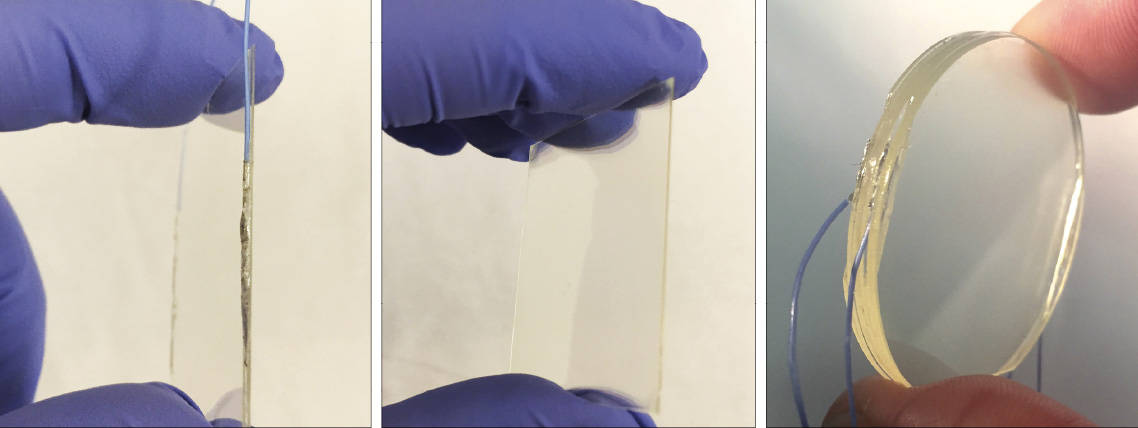
A quick scan: Liquid crystal polarization gratings are an inexpensive, lightweight and non-mechanical alternative to established lidar-scanning technologies. (Courtesy: Boulder Nonlinear Systems)
This device, however, weighs about 13 kg and costs around $80,000, and although a 16-laser version weighs less than 1 kg and costs around $4000, the resolution is correspondingly lower. These sizes and costs are prohibitive for mass deployment, and competing methods of mechanical lidar scanning also carry significant overheads in cost, weight and size. NASA’s DAWN (Doppler Aerosol WiNd lidar) mission, for example, carries a rotating wedge scanner that takes up 16 kg of the transceiver’s 34 kg payload. Mechanical lidar scanning is also sensitive to vibration, acceleration and impact; consumes a lot of power; and can transfer impulses to the device the scanner is mounted on. The last two problems are particularly significant for spacecraft and for small, light vehicles such as drones.
To lower the weight, and especially the cost, of lidar systems, a new class of lidar steering is emerging. Rather than using large mechanical motions to scan the lidar’s field of view, the so-called solid-state lidar methods use non-mechanical technologies. For example, several companies (including Luminar, Innoviz and Infineon, as well as Velodyne) are developing micromechanical systems (MEMS) for lidar steering. As their name implies, MEMS are not strictly non-mechanical, but the motion is performed by microscopic mirrors, which means that these systems can be small and light, consuming very little power. They are still somewhat sensitive to vibration and shock, but one of their major advantages is their low cost because MEMS devices have been produced in large quantities for cinema and consumer projectors.
A different steer
Another alternative is to use liquid crystal polarization gratings (LCPGs) to perform the beam-steering action. This is a relatively new method and it is truly non-mechanical because it relies on the ubiquitous liquid crystal (LC) technology found in a wide range of devices, from smartphone screens to car dashboards. LCPGs consist of a passive patterned LC grating, plus an active LC switch. When the switch changes the polarization handedness of light entering the grating, it will switch with >99.5% efficiency to the +1 or –1 diffraction order. Since each switch/grating stage can be <1 mm thin, these stages can be cascaded for discrete, highly repeatable steering in 2D over a >90 degree field of regard (the total area that a movable sensor can “see”). The LC response times range from tens of microseconds to a few milliseconds and, unlike with mechanical devices, there is no “ringing” while the device settles between movements.
One major advantage of LCPG steering is that these devices can be made with very large apertures – 15 cm or more. This means that more of the returning lidar signal can be collected because the illumination is scattered in all directions when it reflects from most targets. In addition, LCPGs steer the lidar unit’s excitation and collection optics at the same time, meaning that signal is only collected from the area that is being actively illuminated. This contrasts with MEMS systems, which steer a narrow illumination beam but collect from a fixed wide-aperture area – meaning that they not only collect more background light, but are also susceptible to collecting confusing multi-bounce signals from cars and other reflective objects. More efficient signal collection and background rejection mean that LCPG-based lidar can use lower-power sources, potentially lowering its cost and weight compared with MEMS-based systems.
Although LCPG technology is relatively new, at Boulder Nonlinear Systems we have already used these devices to steer flash lidar, synthetic aperture lidar and Doppler lidar – mostly for aerospace applications where large apertures not only increase signal, but crucially mean lidar excitation beams can be more highly collimated, increasing their accuracy and range. We are also using LCPGs to refocus microscope systems (LCPGs can be made in lens form too), where modern objectives are too large to work well with other remote focusing methods.
These initial applications in aerospace and microscopy are much more sensitive to aperture, weight and vibration than to cost. However, LCPGs have the same potential to be made cheaply in volume as regular LC devices, and therefore show promise for more cost-sensitive lidar applications such as self-driving cars. Their lifetimes and ability to withstand thermal cycling will have to be characterized and optimized. However, their true non-mechanical nature means they may be well suited to the rugged, high-vibration environments of future machine vision.
Light-induced processes at the interface between silicon-based structures and biological ones can be used to remotely control a wide range of biological activities – from single cell calcium signalling to brain activity – without any genetic engineering of the biological systems involved. The new finding could help in the development of “electroceuticals”, in which bioelectric signals could be modulated to treat disease. As well as biomedical applications, the toolkits employed could also be used to study fundamental biophysical processes.
Silicon-based materials are widely used in biological applications. Two examples include silicon nanowire-based transistors for electrically monitoring the signals in cardiomyocytes and bioelectronics implants for the heart. They are rarely found in remotely controlled and interconnect-free device set ups, however. This is because researchers do not fully understand the complex physicochemical processes at play at the interfaces between silicon and biological materials.
Remotely-controlled biointerfaces
A team of researchers led by Bozhi Tian of the University of Chicago in the US is now putting forward a biology-guided design principle to make silicon-based structures for remotely-controlled biointerfaces. “We all know that biological structures are hierarchical in nature and span multiple length scales, from nanometre-sized organelles and micron-level single cells to centimetre-scale organs,” says Tian. “To form intimate interfaces with various biological targets, silicon materials therefore need to have right geometries and mechanical properties to match those of biological systems. In our work, we created three types of materials: silicon nanowires that slide along cytoskeletal filaments; thin silicon membranes that adhere well to cultured cells or tissue slices; and gold-coated flexible silicon meshes that closely ‘wrap around’ the brain cortex.”
The researchers also studied the effect of other parameters, such as size, chemical doping and surface chemistry, on the properties of the silicon structures.
Photothermal effect
Glial cells, for example can selectively internalize the nanocrystalline silicon nanowires. “When we then illuminate these wires with light, they heat up and this heat produces surges of calcium ions inside the cells,” explains study lead author Yuanwen Jiang. Calcium ions are ubiquitous signalling molecules in all multicellular organisms and are involved in many aspects of intracellular and extracellular communication. In the brain, for instance, variations in intracellular calcium concentrations in either neurons or glial cells are linked to synaptic activity.
“As for the silicon membranes, we added diode junctions to them and placed them in close contact with neuronal cultures and brain slices (from mice),” says Jiang. “Again, they react to light and produce a strong capacitive current that can stimulate cells extracellularly towards either calcium signalling or to release neurotransmitters.”
Controlling animal behaviour with purely optical means
Finally, the researchers used the gold-coated silicon multi-layered meshes for in vivo studies. “Here photostimulation of the meshes wrapped around the brain cortex enhances synaptic activity. But, more importantly, we are also able to show that this stimulation can be used to move the forelimb of an anesthetized mouse. This is the first example of being able to control animal behaviour with purely optical means and without genetic modification,” Tian tells nanotechweb.org.
“Looking forward, our work is just one step towards remotely-controlled non-genetic biological modulation,” he adds. “Future systems should exploit a host of other external physical inputs (for example, optical, electrical, magnetic and ultrasonic) into output signals (electrical, thermal and mechanical) that biosystems will recognize. In combination with advanced imaging and recording techniques, this might lead to advanced integrated control systems.”
“Our ultimate goal is to create interactive human-machine interfaces in which devices and the body can wirelessly communicate in a closed-loop to augment human function, monitor health and treat disease.”
Researchers led by Patrick Smith of the University of Sheffield in the UK recently showed that they could print neuronal and other types of biological cells using a piezoelectric ink-jet printer. The neuronal cells printed with the breakthrough technique, originally reported in the IOP journal Biofabrication, have nearly 90% viability and also stimulate neural processes more efficiently and for longer periods than non-printed control samples (Biofabrication 8 015017).
The neural processes generated by the printed cells also proliferate as well as from the control samples, which means there is no discernible difference between these cells and those produced by conventional tissue engineering techniques. The results suggest the team’s precise printing technique could be exploited for lab-on-chip technologies and to fabricate neural networks for fundamental neuroscience studies and applications.
“Ink-jet printing can be used to produce finer neuronal networks than produced by other techniques since the printed cells produce longer neural processes,” Smith explains. “The work in our Biofabrication paper proves that a large number of cell types can be ink-jet printed without any induced side-effects that can denature the cells, and this at higher range of experimental voltages (from 70 V to 230 V) not investigated before.”
The benefits of ink-jet printing
Smith’s lab at Sheffield is interested in applied inkjet printing in many diverse fields – including both biological and non-biological applications, and across industrial and lab-scale science. “The main focus of our work is to find out whether we can use ink-jet printing as a general fabrication route, and if can we add value using ink-jet printing as a means of manufacture,” he told Physics World.
The team’s specializes in so-called reactive ink-jet printing, in which two reactants are deposited to form a product. “For in vitro tissue engineering, for example, we employ this approach to form alginate hydrogels,” Smith continues. “The work we reported in on in Biofabrication fits in well with this new direction of study.”
Smith believes that the technique could directly compete with conventional approaches to tissue engineering, which involve manually seeding cells onto scaffolds. Ink-jet printing offers the advantage that it can produce large numbers of cells quickly, and it also creates reproducibly sized droplets that can be positioned with precision anywhere on a substrate. The important benefit of this new approach is that it can produce undamaged cells that can then proliferate and differentiate after the printing process.
“Since the publication of this study, we have advanced in our research but still need to understand some of the behaviour we observed in printed neuronal cells,” continues Smith. “For example, why do these cells produce neural processes earlier and in greater number than control cells? And why are these neurites longer than those produced by control cells?”
In their study, Smith and colleagues printed neuronal cells from hybrid cells, which are widely used in in vitro studies instead of primary-cultured neurons. Applying their technique to other types of neuronal cells might help them answer these questions. “The next step in our tissue engineering work is to investigate a larger range of cell types and print co-cultures that interact to form biologically relevant constructs,” Smith continues.
The researchers hope that the interest generated in by their Biofabrication paper will help the team to form new collaborations in the future, both in the tissue engineering world and in other related areas such as controlled crystallization printing and even polymer printing. The team is also studying ink-drying behaviour, printed bioelectronics components, and additive manufacture.
Read our special collection “Frontiers in biofabrication” to learn more about the latest advances in tissue engineering. This article is one of a series of reports highlighting high-impact research published in the IOP Publishing journal Biofabrication.
The European Union is in the midst of resetting its longer-term targets for renewables, given the expectation that it will more or less meet its overall target of getting 20% of its total primary energy from renewables by 2020, with 11 countries already achieving or even exceeding the national targets set by the EU. For example, by 2016 Sweden had got to around 54%, 5% over its target, although some others have been doing less well: by 2016 the UK had only got to around 9%, against the actually quite low 15% national renewable energy target that had been agreed with the EU. But most of the laggards may just about reach their national targets by 2020 or soon after, hopefully even the UK. For the next stage, the European Commission initially proposed a somewhat unambitious overall EU target of 27% of primary energy by 2030, with individual national targets to be left to each country to decide.
A bit cynically, you might say that, with the UK out of the EU by then, the EU overall should then be able to do better than 27%. Certainly, the European Parliament has called for the overall EU 2030 target to be raised to 35%, with, in addition, EU energy consumption to be cut by 40%, against the ECs recommended 30%. They also wanted at least 12% of the energy consumed in the transport sector to come from renewables. We await an EC ruling.
Wind is still the largest of the new (non-hydro) renewables in the EU, with over 155GW installed by the end of 2017 and offshore wind now adding to the total. It has been claimed that 30% of EU power could be from wind by 2030.
However, PV solar is coming up fast behind, with over 100 GW installed by 2017, and 6 GW installed in 2017. Germany installed 1.75 GW of new PV, a 23% growth. But the UK’s 912 MW of PV additions represented a 54% fall in new capacity against 2016’s growth, as solar subsidy programmes were scaled back further. France and the Netherlands, both a bit late to the PV area, nevertheless installed 887 MW and 853 MW respectively and more is now expected. Former shining solar star Spain only installed 135 MW of new PV in 2017, but that is 145% up on the 55MW in 2016.
The early expansion of wind and solar in the EU was much aided by the use of guaranteed price feed-in tariffs, but these FiTs are now being phased out in preference for competitive project tendering/contract auction based systems: see my earlier post. Renewable energy projects like PV have also enjoyed “priority dispatch” to the grid and have been exempt from grid balancing responsibilities. But maybe not after 2020 – changes to that are also afoot.
The UK may soon be outside of all these arrangements, given Brexit, but it is actually adopting a similar approach. It has been cutting back its FiT support, which has impacted on small scale PV, and it has moved to a contract auction-based approach (the CfD system) for larger renewable projects- although on shore wind and large PV have of late been excluded from that. Nevertheless, on shore wind and PV have both continued to expand, if more slowly that before. National Grid (NG) says that “distributed” renewable energy, solar and wind power connected at the local distribution level, as opposed to the national transmission level of the electricity grid system, at present contribute around 7% of UK electricity supply on an annual basis. This includes around 5.7 GW of wind and 13 GW of solar, each supplying roughly the same amount of energy on an annual basis. NG had previously only reported on the capacity linked at transmission level, i.e. the larger projects, including the large offshore wind farms, the latter having reached 7.5 GW so far.
More offshore wind projects are planned, and, as UK renewable capacity builds up (it’s already passed 40 GW), grid balancing/curtailment issues will get tougher, in summer especially, when, NG notes, UK night time power demand may fall to around 17 GW. So it says: “We may need to take more actions to curtail generation and possibly instruct inflexible generators to reduce their output in order to balance the system.” Of course peak power demand, especially in winter evenings, will be much higher, maybe 42 GW. But renewables, big and small, will soon at times be able to supply most of that, with some of the 30 GW of flexible gas turbines that are in place helping to top up when renewables can’t deliver. So there’s no room for the 9 GW or so of existing nuclear. Though since that is inflexible, NG is considering more wind curtailment at times, to make room for it. Surely a bad move?
While renewables are doing quite well in the UK in power generation terms, supplying over 28% of UK electricity, that is not yet making much of an impression on heat and transport- much larger areas of energy use. Hence its low primary energy figure so far. The plan is, or at least was, to use non-fossil electricity (renewables and nuclear) for heating, via electric heat pumps, and for personal road transport, via electric vehicles. With batteries getting cheaper, EV take-up is improving, but there have been concerns about the viability of supplying enough power to meet this demand and also the demand for heating. For one thing, the grid system might not be able to cope with the resultant evening-time demand peak. So the use of gas for heating is likely to continue, although some of this could be green gas – biogas, and syngas made by electrolysis, using surplus renewable electricity. A better idea than curtailment. And possibly competitive with hydrogen made via steam reforming of fossil methane, if you include the cost of CCS to make the later route less carbon intense. Certainly, as green power prices fall, and electrolysers get cheaper and more efficient, the relative advantage of using electrolysis will improve.
On the demand side, the UK government has proposed a £6bn programme for domestic energy savings, re-focusing its flagship Energy Company Obligation (ECO) entirely on low-income homes and the vulnerable, “cutting bills for thousands more families until at least 2028”. It will also extend the Warm Home Discount, enabling over 2 million low income and vulnerable customers to receive £140 off their energy bills next winter. And it will back innovations that cut demand.
All good stuff as far as it goes, with the practical focus on insulation: it does put pressure on energy supply companies to deliver help. But will they? There have sometimes been a little reticent in the past and take-up has often been slow. It is also a longer term 10 year programme, with concerns emerging about the length of time it will take to have a real impact.
Perhaps more important for the medium to long term, and of wider relevance, is the governments support for green heating networks- seen as a more efficient form of heat delivery in some urban locations. In its ‘Clean Growth Strategy’ scenarios, heat networks were projected to meet 17% of heat demand in homes and up to 24% of heat demand in industrial and public-sector buildings by 2050 – they currently only supply around 1% of buildings’ heat demand. A £320m support programme has now been confirmed – small, but a start.
That, along with improved energy efficiency, may help compensate for the halt to the £1bn fossil CCS programme and the delay to the multi-billion-pound nuclear programme: there seems little chance of Hinkley starting up before 2027, if then, and the same goes for the other proposed, though even more uncertain, nuclear plants, e.g. Sizewell C’s start-up date has been put at 2031. By contrast, long before then, we should be seeing more offshore wind projects starting up, with costs falling. On-shore wind could also be making a bigger contribution, as could PV solar, if the government would relent on its planning and funding blocks to these increasingly economic options. But either way, leaving aside green (or nuclear) power, the green heat side clearly needs more backing.
The same sort of issues are also emerging elsewhere in the EU, as my next two columns will illustrate – starting with France.
NASA has launched a mission that will probe deep beneath the Martian surface to measure the seismology of Mars for the first time. The $800m Interior Exploration using Seismic Investigations, Geodesy and Heat Transport (InSight) mission took off on Saturday 5 May at 04.05 local time from Vandenberg Air force Base in California aboard an Atlas V rocket. Once InSight reaches Mars on 26 November, the probe is expected to land in a flat region of the planet called Elysium Planitia. It will then take a couple of months to deploy the craft’s instruments before it begins transmitting data for at least two years.
InSight’s main aim is to study the planet’s interior by measuring its heat output and listening for seismic events on the planet. By studying the early geological evolution of Mars it is hoped the mission will shed light on the processes that shaped other rocky planets of the inner solar system, including Earth.
To do so the mission will carry two cameras as well as three other instruments, all of which will be deployed by the craft’s robotic arm. These include a geodetic instrument built by NASA’s Jet Propulsion Laboratory (JPL) to determine the planet’s rotation axis as well as a device that can measure seismic waves travelling through the planet, made by a consortium led by France’s Paris-based National Centre for Space Studies. The third instrument, built by the German Aerospace Center in Cologne, will measure the flow of heat from the interior of the planet by burrowing a probe 5 m into the surface.
Testing communications
Launching alongside InSight is Mars Cube One. Built by JPL, this consists of two CubeSats – with dimensions of around 36 x 24 x 11 cm — that will test relaying communication signals from InSight to Earth. It is the first time that such small satellites have been sent to another planet.
InSight received the go-ahead in 2012 after beating off 27 other proposals, including a mission to Saturn’s moon Titan. The mission was initially set to launch in March 2016, but delayed for two years after a leak was discovered in a vacuum-sealed container that houses the seismometer in the device built by the French consortium.
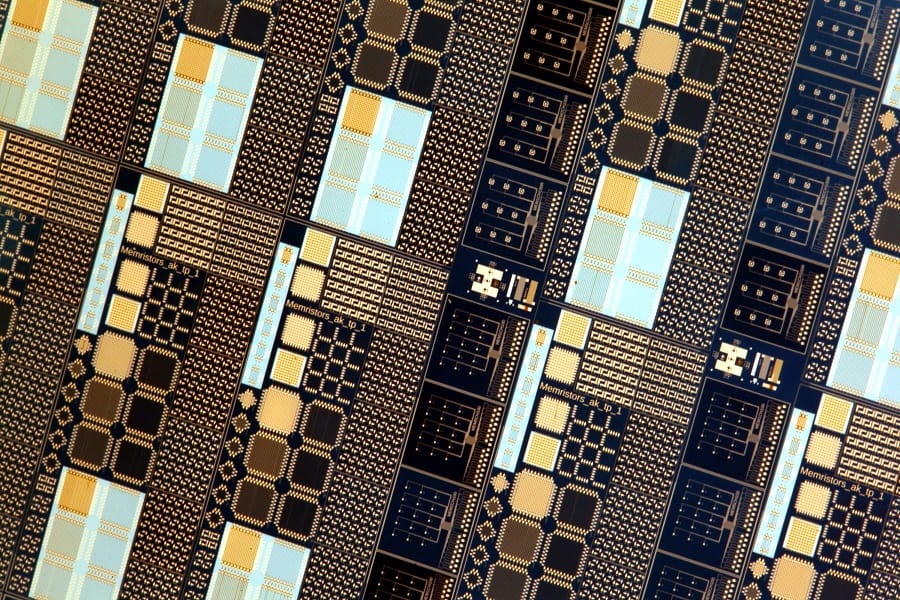
In just 10 years the memristor has developed from Leon Chua’s “lost circuit element” found by researchers led by Stanley Williams at HP Labs in 2008, to a commercially viable product in the data-storage range of commercial electronics giant Intel. And many believe there is more in store as memristors may provide the backbone for an alternative to traditional von Neumann computing architectures, saving time, space and energy. Recognizing this potential, the EPSRC – the UK’s main funding agency for engineering and physical sciences research – alongside several industry partners is investing £11 million in a five and a half year programme at Southampton, Imperial and Manchester universities in the UK to develop the technology.
Memristors have a resistance that is defined by the history of current through the device rather than taking a set value. This allows memory and processing functions within the same region of the device unlike traditional computing paradigms where data must be shifted around. The result is more efficient devices that might more closely mimic a brain. Conventional computing running on the power equivalent to 10,000 homes still struggles to match the processing power of even a rather modest human brain.
The £11m memristor programme has set milestones for the first few years for not just developing the technology for wider use but also defining design rules and models for memristor technology that the rest of the research community can share. “Imagine an electronic system as like a painting,” says Themis Prodromakis, professor of nanotechnology at the Zepler Institute and Nanofabrication Centre at Southampton University in the UK, and principal investigator for the programme. “So far we’ve only been able to paint in black and white because we can only work with traditional transistors that only process 0s and 1s. But now we can work with elements that can each deal with more than 100 memory states, it’s like introducing colour. And to work with colour we need new canvases, new brushes, and even new techniques for painting – that’s what we’re doing.”
Memristors could help mimic the brain.
The focus of the final two years is free for the researchers to follow in the most fruitful direction apparent at the time. “Programme grants are the highest level of investment,” says Prodromakis. “And they provide flexibility to innovate in this area, which is fantastic.”
Why memristors?
With so many other emerging alternative computing technologies, there would seem to be stiff competition for investment. Prodromakis tells nanotechweb.org that it is the plurality of performance that gives memristors the advantage.
While more than 50 leading technology companies and organizations have recently signed a billion-dollar deal to develop artificial intelligence, memristors could provide the hardware to enable it. Memristors function at room temperature, a convenient advantage over a lot of quantum computing technologies, and they are immune to radiation damage, an attribute that lends them to space travel where the behaviour of conventional electronics can drastically alter after a single encounter or long-term exposure to radiation. In addition, the metal oxide memristor technology developed at Southampton University is CMOS compatible so that the past seven decades invested in developing silicon-based electronics need not be wasted.
Why Southampton, Imperial and Manchester?
The three universities to win the grant are international leaders in memristive, analogue and digital technologies. They will work closely with a number of companies including ARM, IBM, NXP, ArC Instruments, Thales, Lloyd’s Register Group, AMS who are providing full silicon wafers to build memristive designs on, and Cadence who are developing design tools.
Each institution has its own focus within the programme. Research at Southampton focuses on the technology and fabrication, while Imperial College London focuses on analogue technology and Manchester on digital. Southampton already has impressive facilities for research in this field, which is what first attracted Prodromakis to work there. There is a clean room worth over £200m and fabrication facilities capable of producing 8 inch wafers, on a par with industry standards.
What this investment will bring to the mix is people. While some of the funding will be spent on maintaining facilities and access to them, research consumables and travel to meet within the collaboration and publicize fundings to the rest of the research community but Prodromakis emphasizes the importance of the human resources in the project. Leon Chua himself and David Scellern who established the first wifi chip set will act as advisers on the programme. As well as these technology giants there will be researchers at postdoc level and around 15 PhD students. Prodromakis shares his research via teaching one of the few advanced memory technology courses in the world, which can be a great source of enthusiastic new PhD students. As Prodromakis highlights, “You can have the best equipment in the world but you still need the minds.”
In the years since Hurricane Katrina, the city of New Orleans has faced profound questions about its relationship with water. What became clear in the aftermath of the storm was that existing defences are no match for the increasing flood risk from storm waters and intense rainfall. Authorities at all levels are fundamentally rethinking their approach to protecting citizens and the urban infrastructure. Testing the Waters explores a new project in the city’s Gentilly district that sees local residents help make their neighbourhood more resilient to flooding.
iSeeChange is a citizen science initiative where the inhabitants of Gentilly monitor the impacts of water in their neighbourhood. Volunteers take rain gauge measurements and photographs to identify local flooding hotspots. To encourage community engagement, the project also includes exhibitions and block parties. In this Physics World video shot in New Orleans, iSeeChange founder Julia Kumari Drapkin explains her vision, while residents reveal why they got involved.
One aim is to use residents’ experiences of flooding to inform policy decisions, as detailed by City of New Orleans planner Jared Genova. The iSeeChange project sits alongside the city’s Resilient New Orleans strategy, which integrates flood defence with environmental, societal and wider infrastructure issues. Historically, New Orleans has focussed on keeping water out of neighbourhoods using levees and pumps. The new vision is more nature-based, including plans to restore wetlands and to construct a water garden to store water temporarily and keep it from the streets of Gentilly.
Testing the Waters is the second in our series of films about environmental challenges and the solutions to creating more sustainable futures. The first film looked at how Mexico City’s unique geology makes it difficult to provide a reliable source of fresh water to citizens. Within the next few weeks, we’ll publish the third in the series, which will explore the impacts of offshore wind farms on North Sea porpoises.
If you fancy some soothing jazz over the weekend, why not check out Milky Way Blues by astronomer Mark Heyer from the University of Massachusetts Amherst, which is being featured all month on the Astronomy Sound of the Month website. The culmination of a 25-year idea for Heyer, it’s not any ordinary jazz composition, but is instead based on the motion of the gas between stars in the Milky Way, as measured by radio telescopes.
The frequency of every note in the music depends on the speed of the gas, with gas that’s moving toward us being the high notes (faster speeds being higher notes) and gas going away from us being the low notes (faster speeds now meaning lower notes). Heyer has in fact mapped the data onto a “pentatonic minor blues scale”, which has five notes in an octave instead of the usual seven, and in a minor key, apparently because when he heard the bass notes “it sounded jazzy and blue”.
Different instruments are used for each note depending on the phase of gas it originated from: wood blocks and piano for molecular gas, a saxophone for ionized gas and acoustic bass for atomic gas. Meanwhile, the intensity of the emission from the gas is proportional to the length of the note (strong emissions meaning long notes). In essence, you can now hear how gas in the Milky Way rotates around the centre of our galaxy. You can read the full story here.
Alien megastructures
A Dyson sphere is a hypothetical structure that would surround a star in order to deliver vast amounts of energy to an alien civilization. Named after the physicist Freeman Dyson, who pointed out in 1960 that the energy needs of an advanced civilization could become so large that they would encase a star within a sphere to capture most of the energy it emitted. Some energy would escape, and in “Dyson spheres, the ultimate alien megastructures, are missing from the galaxy“, Ethan Siegel explains how we could detect these colossal solar panels and asks why we have not seen any so far.
If you want to build a Dyson sphere, or a solar probe, you better make sure that it can withstand the blast of radiation that comes out of the Sun. Physicists working on NASA’s upcoming Parker Solar Probe have come up with a low-cost way of testing the robustness of the mission’s Faraday cup – which will catch charged particles. The have used bulbs from an IMAX projector to deliver a whopping 10 kW of light onto the Faraday cup. Find out more by watching the above video.
Alpha particles are a powerful cancer-killing tool, directly damaging tumour cell DNA regardless of the level of oxygenation or cell cycle stage. The downside of alpha particles is their extremely short range (40-90 µm) in tissue. Now, Israeli start-up company Alpha Tau Medical has created a method to overcome this range limit and showcased its technology at the recent ESTRO 37 congress in Barcelona.
The company’s Alpha DaRT (diffusing alpha-emitters radiation therapy), invented by Itzhak Kelson and Yona Keisari from Tel Aviv University, is based around a radioactive seed containing 224Ra atoms. The seed is injected into a solid tumour and as it decays, it continually releases short-lived daughter atoms (220Rn, 216Po, 212Bi and 212Po), which are also alpha emitters. These atoms diffuse into the tumour, where they emit high-energy alpha particles that destroy tumour tissue. This approach increases the treatment range to a radius of several millimetres.
“Instead of directly irradiating the tumour, 224Ra decays and pushes daughters into the tumour. These are alpha emitters, which start to diffuse and decay again,” explained Amnon Gat, chief operating officer at Alpha Tau. “This enables clinical use of alpha for tumour destruction.”
The 224Ra atoms are fixed onto the seed, so they don’t diffuse into tissue themselves. The daughter atoms diffuse well in the tumour but hardly in healthy tissue, making the treatment highly conformal with no systemic side effects. Alpha radiation also has a high relative biological effectiveness, so less dose is required to induce damage. Another advantage is that because alpha particles are not impacted by oxygen level, Alpha DaRT can treat hypoxic tumours that are resistant to other type of radiation.
Into the clinic
Preclinical trials demonstrated that Alpha DaRT is effective and safe for treating a range of solid tumours, including squamous cell, colon, prostate, brain, pancreatic and lung carcinomas. The therapy is now undergoing clinical trials in Israel and Italy, and has been used to treat 16 patients to date.
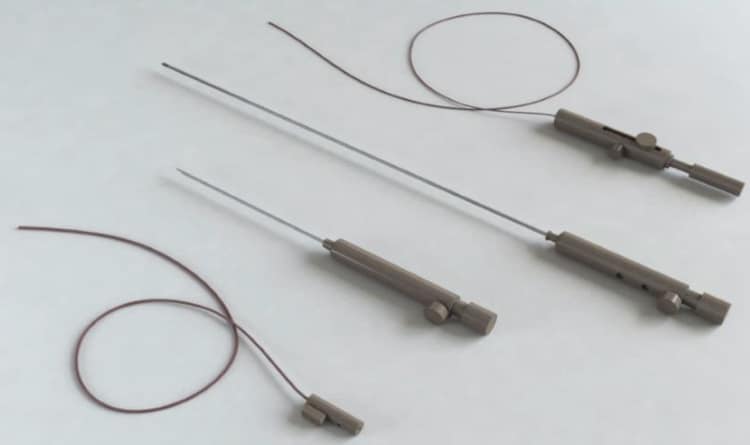
The Alpha DaRT seeds are inserted through easy-to-use, minimally invasive, disposable applicators that the company has developed for different anatomic locations.
The initial trial is examining superficial indications – squamous cell carcinoma of the skin and oral cavity. In such cases, the seeds are placed temporarily (under local anaesthesia) into the lesion using minimally invasive applicators and are removed after 15 days. Thanks to the short half-life of 224Ra (3.7 days), Alpha DaRT can be applied as a single-session treatment that achieves clinical outcome within a few days.
Early results from this feasibility study have demonstrated complete local control of about 80% and zero systemic toxicity. Gat notes that the company also has protocols in place for treatment of pancreatic and prostate cancers. For such deep-seated tumours, the biocompatible seeds are simply left in place.
“Alpha Tau Medical is now focused on starting clinical trials of 12 different protocols at 55 centres in 24 countries around the world,” stated Gat. “The company also plans to open production facilities in each of the key markets, to ensure the supply of the Alpha DaRT.”