After more than 15 years of conflicting results, two independent measurements appear to have settled the debate over the charge radius of the proton. The new measurements, which are the most precise to date and are based on protons in normal atoms, suggest that the radius is 0.8406 femtometres (10-15 m) – very close to the measured value that initiated the controversy back in 2010.
Charge radius is a measure of how far the electric charge of a particle extends into space. In protons, researchers have two main ways of measuring it. The first is by scattering electrons from hydrogen atoms, which consist of a single proton bound to an electron. The second is by analysing the Lamb shift, which slightly modifies the gap between energy levels of the hydrogen atom and arises from interactions between the electron and proton. According to the theory of quantum electrodynamics (QED), these interactions will be slightly different for electrons occupying different energy levels, so the resulting energy shift depends, in part, on the radius of the proton.
For many years, the accepted value of the proton radius – based on measurements by several groups around the world – was around 0.876 femtometres (fm). Then, in 2010, a team led by physicist Randolf Pohl at the Max Planck Institute of Quantum Optics (MPQ) in Garching, Germany performed a new measurement using muonic hydrogen. In this quasi-atomic system, the electron is replaced by its much heavier cousin, the muon. Muons are more tightly bound to the nucleus and therefore have a much higher probability of being very near – or indeed within – the proton. This makes their Lamb shift much more dependent on the proton’s radius.
Based on their measurement of the photon energy required to drive the 2S-2P transition in muonic hydrogen, Pohl and colleagues calculated that the proton’s radius was 0.8418 fm with an uncertainty of 0.0007 fm. This value disagreed substantially with previous measurements and was well outside the error bars of earlier results.
Physicists found this concerning because it implied that either QED theory had been misapplied or that the Standard Model of particle physics was somehow lacking. These concerns increased as subsequent measurements (on normal as well as muonic atoms) by various other groups produced some results that agreed with the 2010 finding, but also others that did not.
New measurements also yield a radius of about 0.84 fm
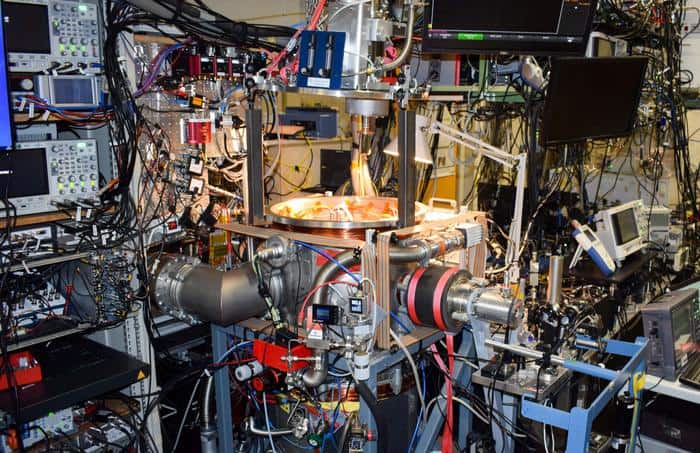
Both new studies involved placing hydrogen atoms in a vacuum and using laser light to control and measure transitions between different electron energy levels. In one of the studies, Thomas Udem and colleagues at MPQ measured the 2S-6P transition in atomic hydrogen with a precision 2.5 times higher than previous measurements, reaching the five sigma (5𝜎) threshold commonly used as a benchmark in the field. Thanks to this precision, they were able to test the Standard Model’s predictions to 0.7 parts per trillion (ppt) and the bound-state QED corrections to 0.5 parts per million (ppm).
The 2S-6P transition involves a single photon, which means it has fewer systematic corrections than the more commonly probed two-photon resonances. “Lower systematic corrections lower the possibility of making errors in those corrections,” notes MPQ team member Lothar Maisenbacher.
The downside is that the linewidth of the transition is very large compared to the precision the team needed to reach, but Maisenbacher says they were able to overcome this. “We succeeded in finding the centre of the resonance at 1 part in 15 000 of its width, which is (as far as we know) a world record for laser spectroscopy,” he tells Physics World.
The other work, by Dylan Yost and colleagues at the Colorado State University in the US, involved measuring three two-photon transitions (in 2S-ns, with n being between 8 and 10) that had not previously been studied for this purpose. Yost describes these transitions as “nice” because they are intrinsically narrow. “Generally speaking, narrower lines can be measured more precisely,” he explains. “This has us very excited that we may be able to really push our technique to higher precision with some modest additional technical improvements.”
The Colorado State researchers say that the three measurements they made were “very precise and agreed very well with each other”. By combining these results, they produced the most precise values for the proton radius to date based on two-photon spectroscopy, complementing the one-photon method used in the MPQ group’s 2S-6P measurement.
Solving the proton puzzle

“Our new measurement, together with the new result from the Garching group and the muonic hydrogen measurements, are now the most precise spectroscopic measurements of the proton radius and all show extremely good agreement,” says Yost. “Personally, I find it remarkable that the theorists working on the required bound-state QED calculations have been able to make such accurate and reliable predictions and that these predictions have now been tested and show agreement at the parts-per-trillion level.”
The most precise spectroscopic measurements of the proton radius
According to Meisenbacher, the 2010 muonic result has now been thoroughly tested, and the proton radius puzzle has been resolved in a way that suggests that both the Standard Model and QED theory remain valid. “Our result also confirms that muonic spectroscopy is a powerful tool for studying nuclear properties,” he says. “Indeed, the community is working on extending it to heavier atoms.”
Both groups now want to repeat their measurements in atomic deuterium, where the nucleus contains a neutron as well as a proton. A similar discrepancy exists in this nuclear charge radius and measuring it precisely could reveal a hitherto undetected interaction between the electron and the neutron that is not included in the Standard Model.