Qubits are delicate and often misbehave. A qubit’s advantage over an ordinary bit is that in addition to “0” or “1”, it can hold values of 0 and 1 at once, in a specific combination; that combination is what quantum algorithms actually run on. But any stray interaction with the surrounding world (a vibration, a stray field, a single errant photon) leaks out a bit of information about which state the qubit is in – and that’s enough to collapse the combination back into an ordinary, classical either/or state. Coupling to the environment leads to high decoherence, meaning high error rates, and is normally how we lose good quality qubits. As such, most of the engineering effort in quantum computing goes into avoiding this coupling.
Yet recently, a team at the Institute of Science and Technology Austria (ISTA), working with collaborators in Munich and Madrid, has defied this norm.
Writing in Physical Review X, Alejandro Andrés-Juanes, Johannes Fink and colleagues show that two superconducting transmon qubits, separated by a metre of coaxial cable, can settle into an entangled state by being exposed to the same quantum-correlated microwave field. Avoiding synchronized pulses, heralding, post-selection and feedback (techniques usually used to actively generate and verify entanglement, rather than to fix decoherence), the entanglement can be generated and maintained for as long as the field is on. In other words, the researchers have managed to exploit noise to generate entanglement, rather than losing their qubits to it.
This idea of entangling by using fields belongs to a family of techniques known as dissipation engineering. “The common understanding is that the environment is bad, and it will decohere your qubits,” Andrés-Juanes tells Physics World. “The main idea [here] is that one can engineer a specific interaction with the environment that is not detrimental but – like in this case – prepares your qubits in an interesting state without you having to actively apply any action on the system.”
This proposal dates back more than 20 years, to work performed by Barbara Kraus and Ignacio Cirac, but this is its first experimental realization.
The correlated environment comes from a superconducting device (a Josephson parametric converter) that splits each pump photon into a pair of photons at gigahertz frequencies. The two photons of this pair are entangled with one another and each is sent down its own coaxial cable to one of the qubits, half a metre away in either direction.
Because the noise reaching the two qubits is correlated, relaxing into it does not scramble them (specifically, it does not wash out the fixed phase relationship between them, as independent noise on each qubit would). They settle instead into a superposition, for which absorbing a photon from the field and emitting one into it interfere destructively: “the destructive interference between a photon emission event in the first waveguide and a photon absorption process at the location of the second qubit,” as the authors explain.
Once there, the qubits stop evolving and the field passes through unchanged: the entangled state is dark, invisible to the very field that created it. What the experiment does, in effect, is convert the continuous-variable (CV) entanglement carried by the two microwave beams into ordinary entanglement between two conventional transmon qubits – “we obtain qubit entanglement from CV entanglement,” Andrés-Juanes confirms – with roughly a tenth of it inherited.
Most entanglement-distribution schemes deliver entanglement as events: a pulse sequence runs, a detector clicks, a pair is announced, and the state then decays until the sequence runs again. The author’s autonomous version could enable the elimination of this machinery.
“It removes a lot of overhead on the pulse sequences you need to run to get the entanglement,” says Andrés-Juanes, an advantage that’s expected to matter most at scale, since one correlated photon source can drive many pairs at once. “Another differential feature of this protocol is that the entanglement is ‘always on’ for when you need to use it. In active protocols, you would have to reinitialize the entangled state because it would decohere after a while.”
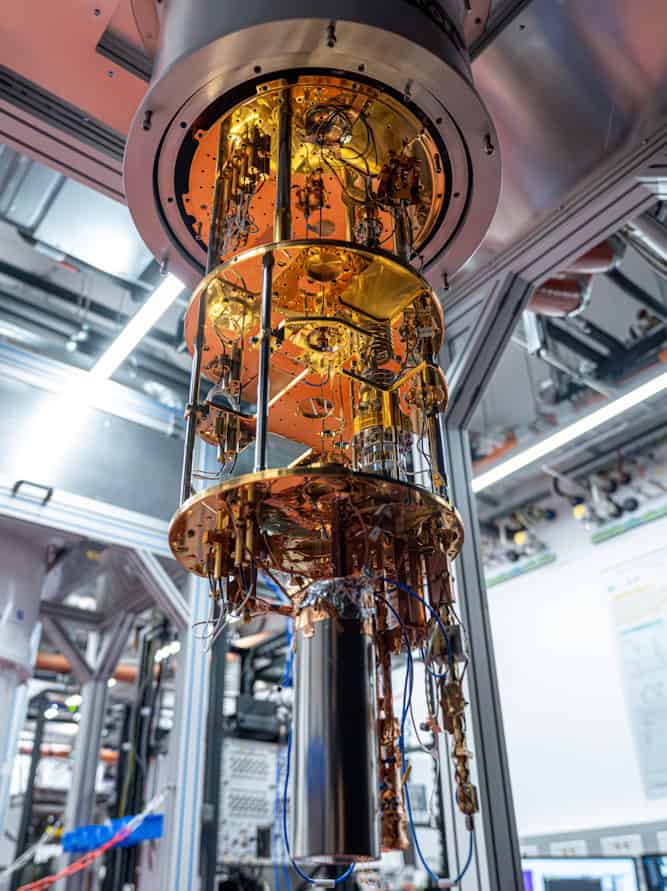
The practical limit of this setup is temperature: “We use microwave frequencies, which are only quantum at very low temperatures,” Andrés-Juanes explains. “The real limit in the separation is how big your dilution refrigerator is”, with the longest such link so far being 30 m, at ETH Zurich. He positions the work as an intermediate-distance technology rather than a long-distance one. At optical frequencies, the constraint would lift, though achieving the same strong qubit–waveguide coupling in an atomic system would be its own problem.
Quantum entanglement expands to city-sized networks

For now, the numbers are modest: two qubits, entangled with a concurrence of just 0.10 (on a scale where 1 is a perfect pair), inheriting only about a tenth of the entanglement carried by the microwave beams. The group is working on a module with more than one qubit per node.
But critically, the idea is no longer theoretical. The team has now realised an entangled link that is always “there”, bringing us one step closer to distributed quantum computing (linking separate processors into one machine via entanglement), networked sensing (detectors sharing entanglement to jointly see what none could alone) and quantum repeaters (relay stations for long-distance quantum links, needed because a quantum state can’t be copied and amplified like a classical signal).