

Nanoparticle sensors detect arsenic in drinking water
A low-cost sensor based on gold nanoparticles changes colour when exposed to arsenic-contaminated water
 Read article: Nanoparticle sensors detect arsenic in drinking water

A low-cost sensor based on gold nanoparticles changes colour when exposed to arsenic-contaminated water
Read article: Nanoparticle sensors detect arsenic in drinking water
Even once a new medical device is launched into clinical use, there’s still a great deal left to discover
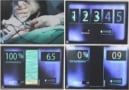 Read article: Translating technology into the clinic is a two-way process
LAP’s laser systems are a core enabling technology for accurate, repeatable patient positioning in the imaging suite and on the treatment couch
 Read article: Patient positioning: why lasers point the way to optimized workflows in radiation therapy
A cost-effective method for high-throughput production of spheroids could prove indispensable for tissue engineering applications
 Read article: Mass produced spheroids line up for tissue repair
Photonic crystal surface-emitting lasers emit high-quality beams with high output power and narrow divergence
 Read article: Photonic crystal lasers deliver optimal performance for lidar sensing and laser processing
The THALES 3D MR SCANNER from LAP has been developed specifically to support the commissioning and quality assurance of MR-guided radiotherapy machines
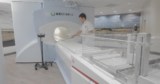 Read article: Motorized water phantom underpins ‘gold-standard’ QA for MR/RT systems
Detecting the prompt gamma photons emitted by many PET isotopes enables quantitative, high-resolution imaging of isotopes with large positron ranges
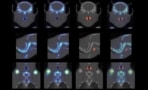 Read article: Prompt gammas enable sub-millimetre-resolution, multi-isotope PET
This year's Photonics West will use digital technology to engage attendees with live and on-demand presentations, as well as online networking events and a virtual industry marketplace
 Read article: Digital forum focuses on photonics
A de-noising model enables significant reduction of radiotracer dose in cardiac PET scans without lowering diagnostic accuracy
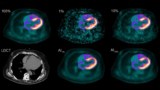 Read article: Deep learning enables safer heart scans with lower radiotracer dose
Perovskites 3D printed on graphene create a highly efficient X-ray detector that could considerably improve the performance of medical imaging devices
 Read article: 3D printing perovskites onto graphene creates ultrasensitive X-ray detector