A new wood-based material that conducts ions 10–100 times better than other polymers could find use in next-generation solid-state lithium-ion batteries. The material, which was fabricated by researchers at Brown University and the University of Maryland in the US, combines copper and cellulose nanofibrils and could be used as either a solid battery electrolyte or as an ion-conducting binder for the cathode of an all-solid-state battery.
Lithium-ion batteries are widely employed in applications ranging from mobile phones to electric vehicles. These devices have a high capacity and high energy density, which means they can store a lot of charge very quickly. During charging, lithium ions move from the cathode to the anode though an electrolyte, which is usually made from a lithium salt dissolved in a liquid organic solvent. While this type of electrolyte works well, at high currents, needle-like lithium-metal structures called dendrites form on the anode surface and flow into the electrolyte. These unwanted structures eventually pierce the barrier separating the anode and cathode, causing the battery to short or even, in some cases, to ignite.
Polymer ion conductor
To overcome this problem, researchers are looking to replace the liquid electrolyte in these devices with a solid-state one that is harder for the dendrites to grow through. Most solid electrolyte materials studied to date are based on ceramics, which make good ionic conductors but are also rigid and brittle. This makes it difficult to integrate them into electrodes, and they are also prone to cracking or breaking during repeated battery charging and discharging.
The new material made by Hu, Qi and colleagues is based on copper-containing cellulose nanofibrils, which are polymer tubes derived from wood. This combination allows the normally ion-insulating cellulose to rapidly transport lithium ions along the direction of the polymer chains thanks to the copper opening molecular channels in the polymer. According to the team’s modelling, these channels increase the spaces between the cellulose polymer chains, which normally exist in tightly packed bundles. The expanded spacing creates what amount to “ion superhighways” through which ions can zip by relatively unimpeded, they say.
As well as its high lithium-ion conductivity of 1.5 × 10⁻³ S/cm (a value comparable to that of ceramics), the new material is thin and flexible, and operates over a wide range of voltages of 0.2 to 4.5 V. The researchers say that their approach, which they detail in Nature, could be extended to other polymers and metal cations.
Digital flat-panel detectors are central to today’s clinical X-ray imaging systems. But flat detectors are ill-matched to the complex 3D shape of a human body. A better option could be to use curved detectors, which could minimize distortion around image edges and reduce vignetting compared with their planar counterparts. Efforts to produce flexible detectors, however, have so far been unsuccessful, due to the stiff and brittle nature of the underlying inorganic (mainly silicon-based) semiconductor technology.
A promising alternative for creating curved X-ray detectors is to use hybrid “inorganic-in-organic” semiconductors. One candidate architecture comprises X-ray attenuating bismuth oxide nanoparticles integrated into an organic bulk heterojunction (BHJ) consisting of the p-type polymer P3HT and the n-type PC70BM.
For such a material to function effectively as a curved detector, it must combine high bendability with optimized detection performance. To achieve this, a team headed up at the University of Surrey has examined the influence of P3HT molecular weight on the mechanical and electrical properties of these nanoparticle-incorporated BHJ (NP-BHJ) X-ray detectors.
Reporting their findings in Advanced Science, the researchers found that by tailoring the molecular weight of the organic semiconductor to lengthen the polymer chains, they could create robust, high-sensitivity curved X-ray detectors for medical applications.
“Our curved detector concept has shown exceptional mechanical robustness and enables bending radii as small as 1.3 mm,” says lead author Prabodhi Nanayakkara in a press statement. “The use of organic or ‘inorganic-in-organic’ semiconductors is also far more cost effective than conventional inorganic semiconductors made from silicon or germanium, which require expensive crystal growth methods.”
Performance parameters
To investigate the impact of P3HT molecular weight on detector performance, Nanayakkara and colleagues created rigid NP-BHJ detectors using four P3HT molecular weights – 25, 37, 46 and 55 kDa – as typically employed in P3HT-based optoelectronic devices. They fabricated the detectors on glass substrates and incorporated 55 µm-thick NP-BHJ films.
The team assessed a series of parameters, including dark current, photocurrent characteristics and charge transport characteristics. The detector dark current decreased with reducing polymer molecular weight. All devices, however, displayed low dark currents well within the industrial requirement of 10 pA/mm2 at an applied bias from −10 to −200 V. The device sensitivity was slightly higher for the lowest P3HT molecular weight, with a limit of detection (for a 70 kV X-ray source) of around 1.5 µGy/s – better than required for diagnostic imaging.
While performance parameters differed between the four devices, the researchers emphasize that all P3HT molecular weights evaluated provided excellent detector response characteristics, including ultralow dark current, high sensitivity and fast response time, highlighting the potential of NP-BHJ detectors for low-dose imaging and dosimetry.
Optimizing bendability
Next, the team assessed the mechanical properties of various detector constructions. X-ray detectors require a higher crystallinity to achieve satisfactory charge extraction. But with curved detectors, higher crystallinity can result in mechanical failure. To identify the most suitable P3HT molecular weight for a curved X-ray detector, the researchers performed grazing incidence wide angle X-ray scattering measurements on NP-BHJ films.
They found that crystallinity was lower for films fabricated from higher P3HT molecular weights, suggesting that such films have more amorphous regions that can bridge between the crystalline regions. These amorphous regions also increase intermolecular interactions and interchain entanglements, enabling greater deformation before mechanical failure.
The researchers also examined the impact of substrate thickness on the nanomechanical properties of various NP-BHJ films. They fabricated detectors on flexible polyimide substrates with thicknesses lower than (25 µm), equal to (50 µm) and higher than (75 µm) the 55 µm NP-BHJ layer. The mechanical behaviour was dependent on both P3HT molecular weight and substrate thickness. Lower molecular weight detectors were stiffer and extremely brittle, while those fabricated on thinner substrates curled excessively and delaminated easily from the substrates.
Based on the crystallinity and nano-mechanical analyses, the researchers predict that higher P3HT molecular weights and thicker flexible substrates are most suitable for fabricating curved X-ray detectors. With this in mind, they tested the responses of three detectors – 46 and 55 kDa P3HT on 75 µm substrates, and 55 kDa P3HT on a 50 µm substrate – to 40 kV X-ray irradiation under different bending radii.
All detectors displayed excellent resistance to bending, maintaining sensitivities of roughly 0.17 µC/Gy/cm2 and a dark current of less than 1 pA/mm2, even when curved to a radius as small as 1.3 mm. The team demonstrated the detectors’ mechanical robustness by performing cycles of dynamic bending down to a radius of 1.3 mm. After 100 cycles, the detectors exhibited less than 2.8% variation in sensitivity.
“The technology we’re demonstrating will help create a revolutionary new high sensitivity X-ray detector that is scalable, due to the design and materials adopted,” says senior author Ravi Silva. “This technology has huge potential in medical applications and other X-ray uses, so we’re working with a spinout company, SilverRay, and hope to turn this technology into the X-ray detector of choice for high-sensitivity, high-resolution, flexible large-area detectors.”
Much of quantum technology is linked to computing. It is easy to imagine how a better, more powerful computer, capable of solving complex problems, could be useful. But what is a computer, after all, if not a data-processing machine. Computers, quantum or otherwise, transform data into information, which is then used to steer scientific, medical, industrial processes. Their output is only as good as the data put in. And those data are collected by sensors.
New kinds of sensors and novel ways of obtaining information have, in fact, triggered many major technological and economic disruptions. “If we look back in history, Nobel prizes are aligned with sensors, such as Wilhelm Röntgen’s 1901 prize for X-rays,” says Kai Bongs, a quantum physicist at the University of Birmingham, UK. “No-one knew what these were, but nowadays every hospital, airport scanner, as well as a number of industrial quality-control machines have X-ray machines in them. They allow us to see something, to get data inside bodies that we hadn’t been able to get before.”
Indeed, the discovery of X-rays had a significant impact on medicine, security and industrial processes. In a similar vein, sensors and other devices that exploit quantum principles – especially the sensitivity of a quantum state as compared to its environment – may well be the first stage of a commercial quantum revolution.
Bongs is principal investigator of the UK Quantum Technology Hub Sensors and Timing. This hub, which is part of the National Quantum Technologies Programme, has more than 110 projects valued at around £120m. Its aim is to drive the innovation and commercialization of quantum clocks and sensors such as magnetic sensors for healthcare and gravity sensors. These technologies have applications across a diverse range of sectors, including climate, communications, energy, transport, healthcare and urban development.
“When we talk about quantum sensors we mean sensors that use some enhanced quantum effects, like superposition or possibly entanglement,” says Bongs. Superposition is the idea that quantum particles can be in two states at once or travelling along two trajectories at once. “The difference between those two trajectories can create essentially a quantum interference at the end when we bring them back together and that allows us to read out what ever caused the difference with very high precision,” he explains.
This quantum effect is being exploited by Bongs and his colleagues to create a quantum gravity meter, based on atom interferometry. In the device, atoms travel along two different trajectories at two different heights. This means that they are travelling through two slightly different gravitational fields and when they come back together the interference pattern can be used to reveal the gravity gradient.
Gauging gravity
Most gravity meters are based on a mass suspended on a spring, with changes in the position of the mass indicating change in the gravitational forces acting on it. Springs, however, stretch and bounce around if the ground vibrates. This means that these devices have to be recalibrated over time. They also have to be left in place for quite a long time to take a reading, to average out the background noise created by vibrations due to everything from passing trucks and trains to low-level seismic activity and more.
Spring-based gravity meters are already very sensitive, but the advantage of a quantum gravity meter is that when the ground vibrates for any reason, the whole unit moves as one, as there is no spring to bounce around. The container, the clouds of atoms, and the laser that measures how they fall, all shift together. “You overcome not necessarily the sensitivity barrier,” Bongs says, “but you overcome the barrier of ground vibrations, so that you can measure much faster due to suppression of noise.” You can then start to push the sensitivity, he adds.
In civil engineering, gravity sensors can be used to detect anything under the ground that creates a mass difference. They could help find buried infrastructure such as pipes, tunnels and old mine shafts. While there are other techniques for doing this, such as ground penetrating radar, most of them are active techniques. You have to put a signal into the ground, which places limits on how deep they can go. “The real advantage of gravity is that it is passive, so the ground doesn’t attenuate the signal because we are not putting a signal in, we are just passively measuring it on the surface,” explains Daniel Boddice, a civil engineer at Birmingham. As long as the object produces a big enough signal on the surface, it can be detected. In theory there is no fundamental limit on depth.
Bad vibrations
Despite their potential, Boddice says that gravity sensors are not used very often, even in geophysics. This is because they are currently too expensive due to the amount of time you have to leave them in position to gather enough information so that you can cancel out the vibrational noise. He adds that there is always vibrational noise, because the Earth is always shaking. Boddice’s colleague Nicole Metje, also a civil engineer at Birmingham, says that it is not just seismic vibrations that create the noisy signal. “When you are on a site even things like traffic, people moving, people drilling, that all causes vibration.” Boddice adds. “The real opportunity with a quantum sensor is going to be that we can use it in more places because we can take measurements quicker and more viably, and more accurately.”
Metje and Boddice have recently been using quantum gravity sensors to detect culverts – a pipe or structure that channels water – on railway tracks. They provide drainage but if they become blocked, the track bed becomes saturated with water and you get what are known as “wet beds”. This impacts the track’s stability and can create structural issues such as dips, which affect the speed at which trains can safely travel, causing delays.
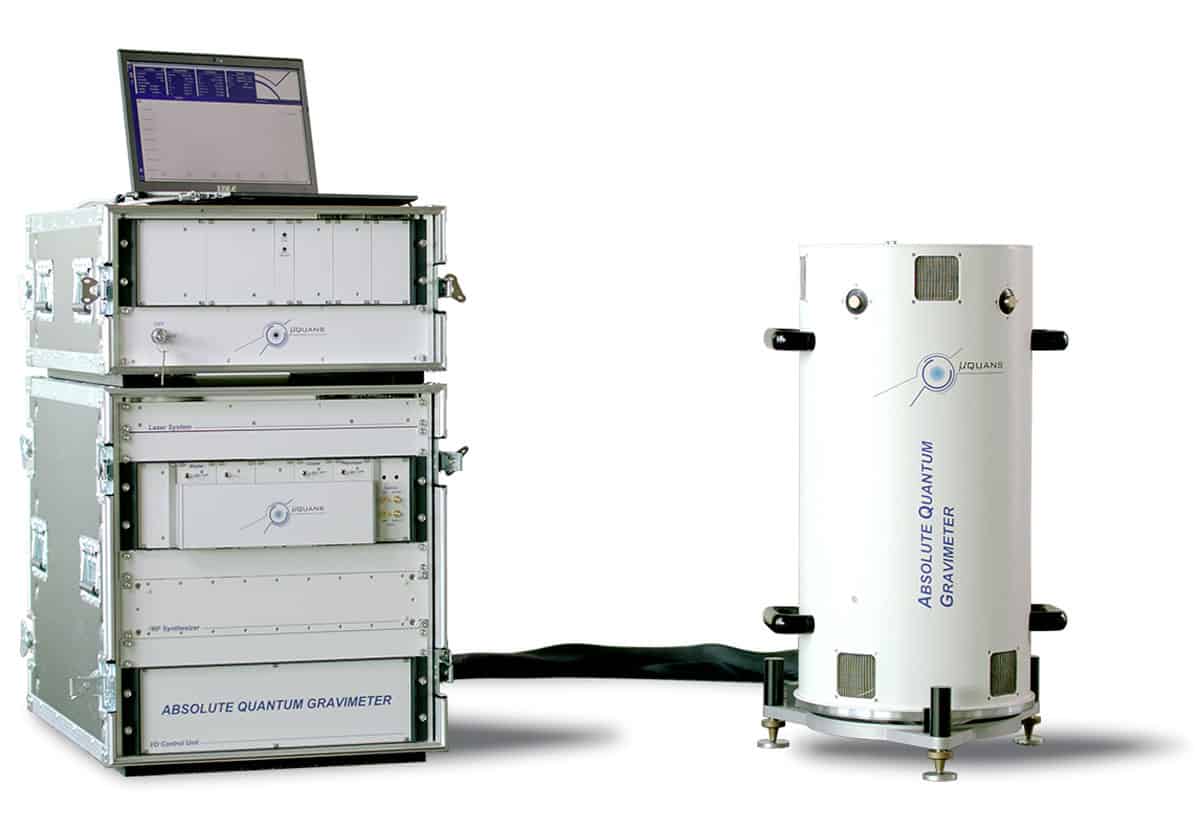
The Absolute Quantum Gravimeter from French company Muquans. (Courtesy: µQUANS)
These culverts can be buried deep under the track, which can make finding them and assessing their condition challenging. Ground penetrating radar often cannot infiltrate far enough. Measurements also have to be taken quickly as engineers usually only have a few hours on the track at night. Metje has shown that gravity sensors work better than any other technique for finding railway culverts.
Existing spring-based gravity sensors are, however, a last resort, Metje points out, because they are slow. But quantum gravity sensors could change this. Not only could they take measurements much faster due to the lack of noise from vibrations, they also don’t need to be stationary. Such quantum sensors could be placed on trains scanning the tracks as they go – indeed, the Birmingham team has been running trails on sections of train track in the UK. “We’ve done some investigations where we have looked at silted culverts, full culverts and empty culverts – so full with water, full with silt and empty,” Metje says. “You can’t detect [the differences] if you just do one measurement, but the idea is that we could have sensors on trains and if you get time lapse measurements you can then detect differences.”
Mitigating risk
George Tuckwell at the RSK Group – a UK-based environmental and engineering consultancy – has also been exploring how these quantum gravity sensors could be used for civil engineering applications. RSK helps its clients “de-risk” construction projects by accessing ground conditions at an early stage. They map the ground to identify variations in bedrock and groundwater, and other natural and artificial variations in the ground such as landfill and mine workings. This protects projects against unforeseen problems that can cost money and cause delays.
Tuckwell and his colleagues already perform gravity surveys, but these can be slow, time consuming, and therefore expensive. They also almost always require follow-up work, such as digging a hole or drilling a borehole, to identify the mass anomaly. Tuckwell hopes that quantum sensors could change this, as they should be more accurate, much faster and able to measure things that current devices cannot.
Together with the University of Birmingham and other industrial partners, Tuckwell has been working on combining quantum gravity sensors with artificial intelligence, past data and machine learning to create a system that can provide a model of the most probable ground conditions. The ultimate goal is to create a set-up that can scan a patch of land and provide an accurate map of the subsurface, with all the required information and no need for further investigations.
One of the advantages gravity has as a sensor is that it is impossible to shield a subsurface feature from its gravitational affect, so there is no way of hiding it. If there is something there that gravity could measure then gravity will measure it
George Tuckwell, RSK Group
“You can imagine an intermediate step where you would scan the ground, and the gravity sensor would say these are the three things that [the mass anomaly] is most likely to be and this is what you should do to confirm or otherwise to pin it down to one possibility – and lead you through what follow-up data to take,” Tuckwell says. “We have already developed an algorithm that as you are doing the survey it can suggest to you where you should measure the next point, to have the biggest impact on the certainty you’ll get of the model of the subsurface, and you can do that as you are going along.”
Although civil engineering is going to see the first commercial applications of gravity sensors, Tuckwell adds that there is also a lot of military interest. “For a defence and security application it might be a clandestine tunnel or some subsurface facility,” he explains. “And one of the advantages gravity has as a sensor is that it is impossible to shield a subsurface feature from its gravitational affect, so there is no way of hiding it. If there is something there that gravity could measure then gravity will measure it.”
From ships to volcanoes
Quantum gravity meters could also be used to create secure navigation systems. In recent years there has been increasing concern about GPS spoofing, particularly in marine navigation. This is when a ship’s navigation system is sent a false signal, so that it thinks it is in a different position to where it actually is. In the hands of rogue states or pirates this could potentially be used to hijack or wreck boats, or steer them into hostile territorial waters – a 21st-century version of the lanterns used by Cornish ship-wreckers.
If we could create accurate gravity maps, ships could have an onboard quantum gravity meter, and could then trace the gravity values and match them to the map, giving them their position. In theory, this gravity meter could be in an enclosed box entirely isolated from the outside world, making it unhackable. Even if somebody jammed the ship’s communications, satellite and radar navigation systems – all its links to the outside world – it would still be able to navigate. “The only way to interfere with [the gravity sensor] is to essentially change the gravitational signal, but that means moving masses on the order of mountains,” Bongs explains.
Unprecedented access The Absolute Quantum Gravimeter (see above) from French company Muquans has spent a year on Mount Etna collecting measurements. (Courtesy: iStock/marcocalandra89)
Measuring changes in gravity around a volcano is essential as it gives clues about changes in density of the underlying materials such as rock, gas and magma. An increase in gravity might suggest an influx of a denser material such as magma, while a drop in density (and so gravity) would point to a sinkhole. “The idea behind this instrument is really to exploit the gravity measurement at the surface of the volcano in order to obtain some information about the underground geophysical processes and get a better understanding of what is happening inside the volcano,” Desruelle explains. The main thing the device is measuring is changes in masses of magma inside the volcano, with the long-term goal of gathering enough data to predict volcanic eruptions. He adds that this is likely the first time that geophysicists have deployed a gravimeter so close to the top of a volcano, and that the researchers have already acquired some new information about the behaviour of Mount Etna, which will be published soon.
According to Desruelle, the way a quantum gravity meter works is both complicated and simple. Simple because it is basically a Newton experiment, where the test mass is dropped in a vacuum chamber and its vertical acceleration is measured, to give the value of gravitational acceleration, g, at any point on the Earth’s surface. Where is gets complicated is that instead of using an apple, this device uses a cloud of laser-cooled rubidium atoms. Every half a second, it captures a cloud of atoms, cools them to a temperature of a few kelvin and then lets them fall, using lasers to measure their acceleration (Sci. Rep.8 12300).
The quantum nature of the device comes from its reliance on wave–particle duality and using quantum interference to reveal differences in the gravitational field. The company did have to struggle with some challenges when it came to the mass, power consumption and size of the device. These factors were especially important for being able to successfully deploy the gravimeter in terrain such as that of Etna, making it robust enough to survive a year or more of changing temperatures.
As with many civil-engineering applications, the lack of noise from vibrations is a big advantage on a volcano. “As you may guess, the volcano is not a very friendly environment,” Desruelle says. “You have a very strong level of vibrations all the time and it is very challenging to acquire a very high resolution on the gravity measurement.” Another advantage is the lack of any springs in the quantum system, meaning that measurements can be taken for a very long time, with no need to recalibrate the system. Being able to collect data without any interruptions for months or years is very important for understanding complex geophysical systems – and is simply not possible with a mechanical gravity meter.
Beyond computing
Desruelle believes that while advances in building quantum computers are very interesting, “we are still talking about research activities and long-term perspectives”. Quantum gravity meters, however, are already operational and being used in the field. “I really believe that with quantum gravity meters, we have reached a very different level of technological maturity,” he says, pointing to concrete examples of their applications. Quantum gravity sensors can be used for any activity where “you really want to have an idea of the underground mass distribution”. This applies to hydrology and seismology, as well as civil engineering projects to detect voids, sink holes, tunnels and cavities. “Many people are interested in this instrument for geodesy,” he adds, “so they want to get a very good understanding of the geosphere and the gravity maps, so many institutes are assigned to provide gravity maps in many areas.”
A somewhat less practical, but equally interesting from a research point of view, application is that gravity meters can be used as dark-matter detectors. For civil engineering and geophysical applications, the two different paths the atom follows are just a few millimetres apart, but increasing the size of the device significantly increases its sensitivity, allowing it to be used to detect certain candidates for this mysterious invisible matter, which makes up almost 85% of matter in the universe.
As of January, UK Research and Innovation had already funded seven projects, with a £31m investment, that hope to show how quantum technologies could solve some of the greatest mysteries in fundamental physics. Three of the projects are looking at developing quantum-enhanced interferometry and sensors in the hunt for dark matter – to detect ultra-light candidates such as axions or to test our theories about the quantization of space–time. Often, a paradigm-shifting discovery in science comes on the back of melding together new technologies and established theories. We might still be at the very dawn of quantum sensors, but how remarkable it is that they can simultaneously help us build a better road and delve into the deepest mysteries of the universe.
A new, nanostructured version of a material known as a chalcogenide glass could find its way into a wide variety of optoelectronics applications thanks to its unusual transparency. Although chalcogenide glasses are already employed in detectors, lenses and optical fibres for near- and mid-infrared photonics applications, their use in the visible and ultraviolet parts of the electromagnetic spectrum has been limited because they strongly absorb light at these wavelengths. A team from Duke University in the US has now found a way to eliminate this undesirable effect, with possible future applications in underwater communications, environmental monitoring and biological imaging.
Chalcogenide glasses are amorphous materials that contain one or more chalcogens, which are chemical elements from the family that includes sulphur, selenium and tellurium. While they are ideal for use at infrared wavelengths, with applications ranging from optical switches and wavelength converters to molecular fingerprinting and astronomy, their lack of transparency in the ultraviolet is a drawback because many other applications, including underwater communications and biomedical imaging, require UV light sources.
Higher-order harmonic frequencies
Researchers led by Natalia Litchinitser recently predicted that nanostructured gallium arsenide (GaAs), a semiconductor widely employed in electronics, could react with high-intensity pulses of light in a way that differs from the behaviour seen in bulk or even thin-film versions of the material. This is because very thin wires of the GaAs lined up next to each other might vibrate at frequencies one or two octaves higher than the bulk or thin film material, creating higher-order harmonics with much shorter wavelengths.
The team set out to discover whether the same held true for chalcogenide glasses by depositing a 300 nm thick film of arsenic trisulphide (AsS3) onto a glass substrate. They then used electron beam lithography and reactive-ion etching to position the 430 nm wide AsS3 wires 625 nm apart from each other, creating a structure known as a metasurface.
Unexpected result
While bulk AsS3 completely absorbs light above frequencies of 600 THz (the blue-green or cyan colour range), Litchinitser and colleagues found that when they illuminated their metasurface with near-infrared (NIR) light, the nanowires transmitted faint signals at a wavelength of 846 nm, which is in the UV part of the spectrum. They attribute this faint signal to the material generating and transmitting both the NIR frequency and its third harmonic. This was very unexpected because the third harmonic falls into the range at which the material should be absorbing it, Litchinitser says.
The team attribute this result to the generation of nonlinear third harmonics and their phase locking with the original NIR frequency. “The initial pulse traps the third harmonic and sort of tricks the material into letting them both pass through without any absorption,” Litchinitser explains.
The researchers, who report their work in Nature Communications, now plan to engineer chalcogenide structures other than nanowires that can carry harmonic signals even better. One possibility would be pairs of long, thin, Lego-like blocks spaced at the right distance to produce stronger signals at the third and second harmonic frequencies. Stacking multiple layers of these metasurfaces atop each other might also enhance the effect, they predict.
One of the highlights in the Physics World calendar is the announcement of our Breakthrough of the Year, which will be made this year on Tuesday 14 December.
Today, we are revealing the 10 finalists for 2021, which serves as a shortlist from which we will pick the winner.
This year’s Top 10 Breakthroughs were selected by a crack team of five Physics World editors, who have sifted through hundreds of research updates published on the website this year. In addition to having been reported in Physics World in 2021, selections must meet the following criteria:
Significant advance in knowledge or understanding
Importance of work for scientific progress and/or development of real-world applications
Of general interest to Physics World readers
Here are the Physics World Top 10 Breakthroughs for 2021, in no particular order. Come back next week to find out which one has bagged the Breakthrough of the Year award!
Think before you speak: Clinical trial testing session with researcher David Moses. During the session, a neuroprosthesis recorded the participant’s cortical activity while he attempted to produce words and sentences. (Courtesy: Todd Dubnicoff, UCSF)
To Edward Chang, David Moses, Sean Metzger, Jessie Liu and colleagues at the University of California San Francisco for developing a speech neuroprosthesis that enabled a man with severe paralysis to communicate in sentences, by translating his brain signals directly into words on a screen. To achieve this, the team used a high-density electrode array implanted on the surface of the participant’s brain to record electrical activity in multiple cortical regions involved in speech formulation. Based on a 50-word vocabulary that the system could identify from patterns in recorded cortical activity, he was able to produce hundreds of short sentences. The technique showed a promising median decoding rate of 15.2 words per minute – around three times faster than the computer-based typing interface that he normally used for communication.
To Sebastian Klembt of the University of Würzburg, Germany, Mordechai Segev of the Technion-Israel Institute of Technology, and colleagues for creating an array of 30 vertical cavity surface emitting lasers (VCSELs) that behave as a single coherent light source, paving the way for large-scale, high-power applications. The team drew on principles of topological photonics to ensure that light from each laser in the array flows through all the others, forcing them to emit at the same frequency. The new design overcomes the power limitations of a previous device built by Segev and collaborators in 2018, and can in principle be scaled up to incorporate hundreds of individual lasers.
To Tai Hyun Yoon and Minhaeng Cho of the Institute for Basic Science, South Korea; Xiaofeng Qian of the Stevens Institute of Technology, US; and Girish Agarwal of Texas A&M University, US for experimental and theoretical work quantifying the “wave-ness” and “particle-ness” of a photon and demonstrating that both properties are related to the purity of the photon source. In their experiment, Yoon and Cho tightly controlled the quantum state of pairs of photons – a “signal” and an “idler” – emitted by two crystals of lithium niobate. By independently altering the chances that each crystal would emit photons, they showed that this so-called source purity is related to the visibility of interference fringes (a wave-like property) and path distinguishability (a particle-like property) by a simple mathematical expression first articulated by Qian and Agarwal in 2020. The result has applications in quantum information and puts a new twist on interpretations of complementarity – the idea, originating from the 20th-century quantum pioneer Niels Bohr, that quantum objects sometimes behave like waves, and sometimes like particles.
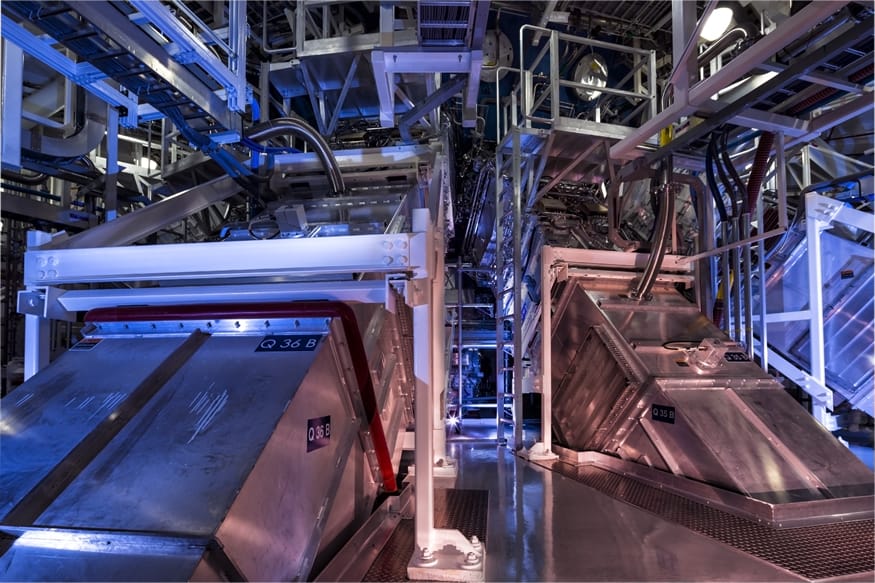
Burning question: Scientists at the $3.5bn National Ignition Facility are nearer to achieving ignition – the point at which fusion reactions generate at least as much energy delivered by the laser system (Courtesy: NIF)
To Omar Hurricane, Annie Kritcher, Alex Zylstra, Debbie Callahan and colleagues at the National Ignition Facility (NIF) in California, US, for taking a step closer to their ultimate goal of realizing “ignition”. Since NIF was turned on over a decade ago, its long-term goal has been to show it can achieve ignition – the point at which fusion reactions generate at least as much energy as its lasers put in. This involves self-sustaining reactions, in which the alpha particles that are also emitted during fusion emit heat to initiate further fusion. NIF, which is operated by the Lawrence Livermore National Laboratory, trains 192 pulsed laser beams on to the inner surface of a centimetre-long hollow metal cylinder known as a hohlraum. Inside is a fuel capsule, which is a roughly 2 mm-diameter hollow sphere containing a thin deuterium-tritium layer. Experiments between 2009 and 2012 fell well short of reaching ignition and so researchers went back to the drawing board to make improvements. That paid off spectacularly on 8 August when researchers achieved an energy yield of more than 1.3 MJ – about 70% of the energy that the laser pulse delivered to the sample. Although still short of break-even, the figure far exceeded previous markers of around 0.1 MJ and some experts have described the result as the most significant advance in inertial fusion since it began in 1972.
To researchers from the Antihydrogen Laser Physics Apparatus (ALPHA) and the Baryon Antibaryon Symmetry Experiment (BASE) collaborations at CERN, for two separate studies presenting new ways to cool particles and antiparticles. The techniques could pave the way for precision studies examining the matter–antimatter asymmetry in the universe. The ALPHA collaboration demonstrated laser-cooling of antihydrogen atoms for the first time. To achieve this, the physicists developed a new type of laser, which produces 121.6 nm laser pulses, to cool the antiatoms. They then measured a key electronic transition in antihydrogen with unprecedented precision, a breakthrough that could lead to improved tests of other key properties of antimatter. The BASE researchers, meanwhile, showed how to extract heat from a single proton via a superconducting circuit connected to a cloud of laser-cooled ions several centimetres away – a technique, they say, that could easily be applied to antiprotons.
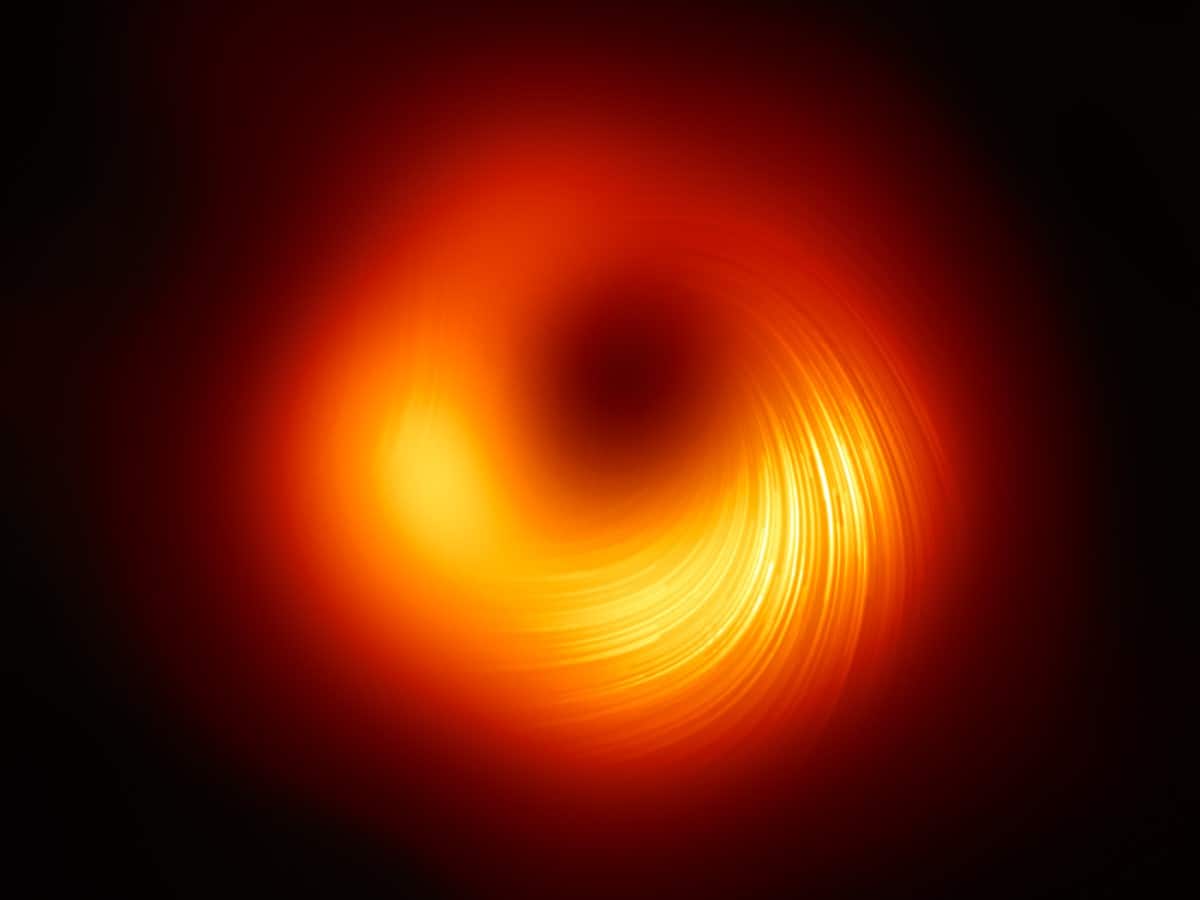
Magnetic swirl: A view of the M87* supermassive black hole in polarized light. The lines mark the orientation of the polarization, which is related to the magnetic field around the shadow of the black hole. (Courtesy: EHT Collaboration)
To the Event Horizon Telescope Collaboration (EHT) for creating the first image showing the polarization of light in the region surrounding a supermassive black hole. The polarization reveals the presence of strong magnetic fields in an area where matter is accelerating into M87*, a black hole more than six billion times the mass of the Sun. Further study of this polarization could provide important insights into how some black holes create huge jets that eject matter and radiation into surrounding space. In 2019 the EHT made history by capturing the first image of the shadow of a black hole, and the collaboration was awarded the Physics World 2019 Breakthrough of the Year for that work.
To Jörg Evers and colleagues at the Max Planck Institute for Nuclear Physics in Heidelberg and the Deutsches Elektronen-Synchrotron – both in Germany – and the European Synchrotron Radiation Facility in France, for being the first to achieve the coherent quantum control of nuclear excitations. The team used X-ray light from a synchrotron that was delivered to the nuclei in two ultrashort pulses. By adjusting the phase of the pulses, the team could toggle iron nuclei between coherent enhanced excitation and coherent enhanced emission. As well as providing a better understanding of quantum matter, the work could hasten the development of new technologies such as ultraprecise nuclear clocks and batteries that can store huge amounts of energy.
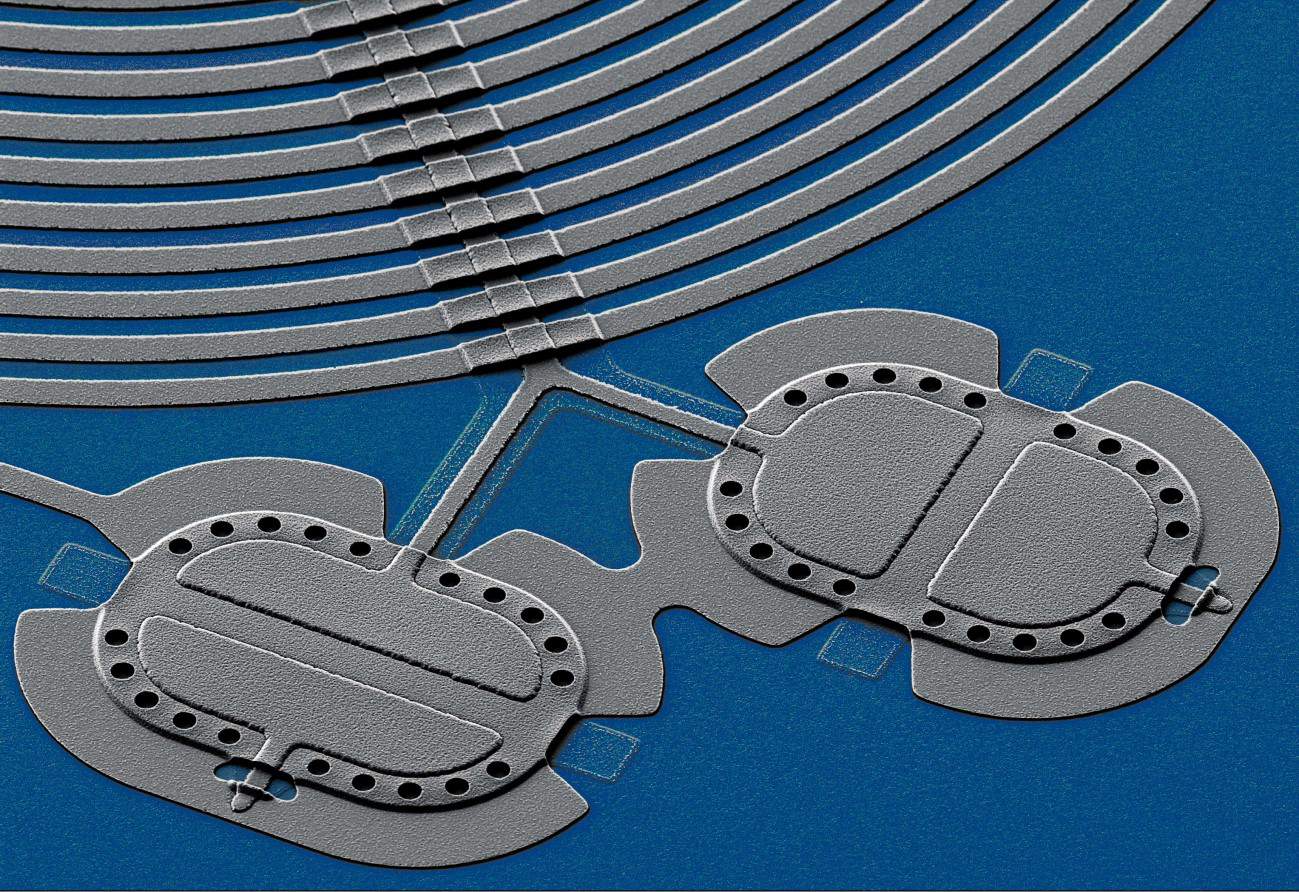
Bang the drums: This colourized electron microscope image shows the two aluminium drum heads used by the NIST researchers. (Courtesy: J Teufel/NIST)
To Mika Sillanpää and colleagues at Aalto University, Finland and the University of New South Wales, Australia, together with an independent team led by John Teufel and Shlomi Kotler of the US National Institute of Standards and Technology (NIST), for entangling two macroscopic vibrating drumheads, thereby advancing our understanding of the divide between quantum and classical systems. The two groups generated their entanglement in different ways. While the Aalto/Canberra team used a specially chosen resonant frequency to eliminate noise in the system that could have disturbed the entangled state, the NIST group’s entanglement resembled a two-qubit gate in which the form of the entangled state depends on the initial states of the drumheads. The entangled resonators could become the basis for quantum sensors or nodes in a quantum network.
To Christian Sanner and colleagues at JILA in the US; Amita Deb and Niels Kjærgaard at the University of Otago; and Wolfgang Ketterle and colleagues at the Massachusetts Institute of Technology in the US, for independently observing Pauli blocking in ultracold gases of fermionic atoms. Pauli blocking occurs in such gases because the constituent atoms fill nearly all available low-energy quantum states, which prevents atoms from making small transitions to neighbouring states. This affects how light scatters from atoms in the gas, and all three teams observed that Pauli blocking increased the transparency of their gases as they were cooled. The effect could someday be used to improve technologies based on ultracold atoms such as optical clocks and quantum repeaters.
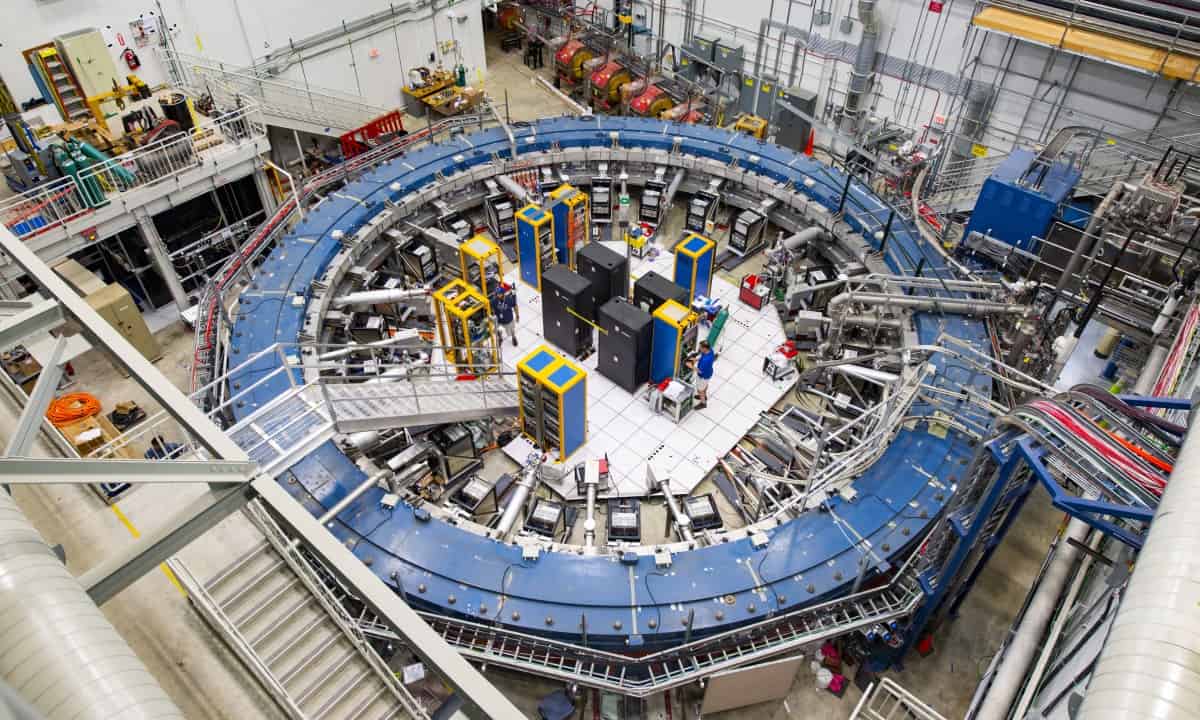
New home: The Muon g-2 ring sits in its detector hall at Fermilab, where it studies precession of muons. (Courtesy: Reidar Hahn/Fermilab)
To the Muon g–2 collaboration for providing further evidence that the measured value of the muon’s magnetic moment disagrees with theoretical predictions. The international team circulated a beam of magnetically-polarized muons in a storage ring at Fermilab in the US. The magnetic moments of the muons were rotated by a magnetic field and the rotation rate gave the size of the muon’s magnetic moment. The discrepancy between theory and experiment was first revealed two decades ago at Brookhaven National Laboratory. Now the combined Fermilab/Brookhaven results put the difference between experiment and theory at 4.2σ, which is less than the 5σ required for a discovery. If the discrepancy stands the test of future experiments, it could point to new physics beyond the Standard Model.
Additional reporting by Michael Banks, Tami Freeman and Margaret Harris. There is more about this year’s shortlist in the Physics World Weekly podcast where we have a lively discussion about all of the entries. This article was modified on 10/12/2021 to recognize additional leaders within the shortlisted teams.
Physics World‘s Breakthrough of the Year coverage is supported by Bluefors, a leading supplier of cryogen-free dilution refrigerator measurement systems with a strong focus on the quantum computing and information community. Our aim is to deliver the most reliable and easy to operate systems on the market which are of the highest possible quality.
Researchers at Queen’s University Belfast (QUB) have developed a novel tool that uses a combination of high-power lasers and selective ion acceleration to investigate the biology of potential future radiotherapy regimes.
The QUB team used lasers in the Gemini laser facility at Rutherford Appleton Laboratories, UK to focus an extremely intense, ultrashort 40 fs laser pulse onto ultrathin carbon foil targets – instantly ionizing and transforming them into a plasma of protons, carbon ions and electrons. At these extreme intensities, the laser pulse is able to push the plasma electrons forward by radiation pressure, which accelerates the carbon and protons.
The researchers demonstrated that by optimizing the thickness of the target, they could selectively accelerate carbon nuclei in the target material with respect to the lighter protons. A target thickness of 15 nm produced maximum carbon ion energies of 33 MeV/nucleon (approximately 400 MeV), as well as minimizing the acceleration of protons (18 MeV).
This preferential acceleration of heavier species over protons is atypical of acceleration mechanisms known to act on multispecies targets. To investigate the reason for this, the researchers performed further experiments and computer simulations of the acceleration process. They found that the two ion species are accelerated via different mechanisms, which arise due to the intensity profile of the Gemini laser pulse – in which the main pulse is preceded by a short pedestal and rising edge.
At the ideal target thickness, the very early part of the laser pulse reaching the target is intense enough to create the plasma and drive the protons out of it. When the main pulse arrives, it then accelerates the remaining carbon-dominated target. The team publish the results in Physical Review Letters.
Lead author Aodhan McIlvenny, a research fellow at QUB, explains that the team uses these unique radiation sources to investigate ultrahigh-dose-rate radiobiology – an extension to the “FLASH” regime – a technique that delivers radiation at far higher dose rates than existing treatments. According to McIlvenny, this has so far been explored with electrons and protons, but high-power laser–solid interactions also offer a source of ultrahigh-dose-rate higher-mass ions – such as carbon ions – that are able to deliver their energy at dose rates orders of magnitude higher than any conventional form.
“The FLASH regime is currently being explored as a means of delivering high doses for cancerous cell killing – but is also thought to reduce the damage to healthy tissue, which would lead to reduced side effects,” McIlvenny explains.
“This is what we explore with radiobiology studies – looking at cell models, exposing them to laser-driven radiation and comparing it to standard sources. Carbon is of particular interest as it is known to be better for the treatment of some cancers which are resistant to other forms of radiation,” he adds.
Simple cells
At this stage, the QUB team continues to work with relatively simple cell models, and McIlvenny is keen to stress that the new technique has not yet been used in a clinical setting and is definitely not suitable for use with any patients currently.
“So far, we have mostly shown that laser-driven protons have the same cell killing abilities as those from standard sources. The biology at these dose rates is yet to be fully explored and the mechanisms are yet to be understood, but we hope to test whether they are beneficial for reducing side effects in healthy tissue so that we can help develop more effective treatments in the future,” he says.
In a radiotherapy context, it is particularly important to reduce damage to healthy tissues surrounding a tumour deep in the body. Particle therapy, using protons and carbon ions, offers advantages when treating some cancers as these particles deposit the majority of their energy at a specific depth so the dose can be localized. X-rays, the main radiotherapy approach employed currently, will unavoidably deposit energy in healthy tissue as they propagate through the body, which can cause some unwanted damage. “So, we are investigating the use of ions, but with an ultrahigh dose rate to see if there are any additional benefits,” McIlvenny adds.
Although the QUB team already works with the highest power lasers currently available worldwide, McIlvenny also reports that “even higher power lasers are coming online across the US, Europe and Asia in the next few years” – and confirms that he and his colleagues hope to use these beams to produce more and higher-energy ions to extend their range of studies.
“In the meantime, we are planning to investigate methods to optimize this source and investigate new mechanisms while exploring the complex physics of high-power laser–matter interactions,” says McIlvenny.
A two-dimensional semiconductor crystal just three atomic layers thick has emitted laser-like light. Crucially, this emission happened at room temperature: a significant improvement over previous cryogenic experiments. Coherent light generation from these ultrathin crystals paves the way for creating novel nanolasers, as well as opening doors for an emerging field of two-dimensional materials called valleytronics.
Exciton–polaritons
Researchers from the University of Oldenburg obtained coherent light from hybrid light–matter particles known as exciton–polaritons. These are formed from the strong interaction between confined photons and electrons. The process begins by exciting electrons in the two-dimensional crystal, which give off a photon. By placing the crystal between two optical mirrors, the photon can be reabsorbed, forming another excited electron. This electron–photon re-excitation process is then repeated, yielding a hybrid exciton–polariton.
Above a critical threshold emission, the exciton–polaritons transit into a macroscopic bosonic quantum state that generates spatially and temporally coherent light. Unlike normal laser light, it does not rely on population inversion, therefore requiring much lower lasing thresholds.
A class of semiconductors consisting of a transition metal and either sulphur, selenium or tellurium is known to possess a strong interaction with light. In this case, the team used a single layer of tungsten diselenide (WSe2) crystal to strongly couple to light. Their previous experiments used a slightly different crystal (molybdenum diselenide) at cryogenic temperatures, but the researchers were now ready to make the step into warmer territory. They publish their latest findings in Nature Communications.
And then there was light
Electrons within the material were kicked into action with a green laser that was progressively increased in power to reach the lasing threshold. Exciton–polaritons were created in a trap (a few micron-sized WSe2 monolayer), and light was captured between two distributed Bragg reflectors (DBRs) that act as mirrors.
The team then tested the spatial coherence of the light using a Michelson interferometer and noticed a very small coherence length before the threshold value, followed by a significant increase after the threshold. Additionally, the emitted light showed high temporal coherence. Such high temporal and spatial coherence are key signatures of exciton–polariton lasing.
Magnets reveal the smoking gun
When placing the sample inside a magnetic field, the researchers observed a spectral Zeeman splitting: a phenomenon that occurs due to the electrons slightly changing orbits. The applied magnetic field induced the energy splitting of the polariton emission into two circularly polarized light components, which are linked to the local extrema in the electronic band structure in the semiconductor material, called valleys, in which the two-dimensional excitons are formed. Since photons do not respond to a magnetic field, this magnetic Zeeman splitting was another tell-tale sign of exciton–polariton emission.
Carlos Antón-Solanas and Christian Schneider, leaders of this research work, explain that spatial coherence had been associated with a “smoking gun criterium” years ago. “But our work is the first to report these central results,” Antón-Solanas adds. He explains that the step to room temperature was made possible by changing to WSe2: a material where the exciton photoluminescence can be reached at elevated temperatures, and exciton–polaritons present a sufficiently long lifetime enabling their formation before decay.
On future steps, Schneider says that the team will study the photon-number composition of the lasing polariton emission via second-order correlations experiments, as well as signatures of superfluidity and superconductivity. As for applications, Schneider thinks that the polariton lasing can be applied to micro- and nano-devices. The control over the polarization and energy structure of the polaritons also looks promising for applications in nanophotonic valleytronic devices: an emerging field in which the valleys inside semiconductor material are used to store, manipulate and read out bits of information.
Ritesh Agarwal from the University of Pennsylvania, who was not involved in this research, thinks that these studies are important as they show macroscopic coherence of matter at room temperature in relatively “unclean” materials that don’t require the highly advanced optical cavity designs seen in traditional optical materials.
Agarwal adds that their rather simple fabrication procedures will make these systems more accessible to many researchers, leading to many more discoveries of new and intriguing phenomena. “This study, which adds to a rapidly growing body of work, is in the right direction to fabricate novel polaritonic devices for photonics applications,” he concludes.
“Music has been very disrupted due to the pandemic.”
When Philippe Bourrianne spoke these words at the annual meeting of the American Physical Society’s Division of Fluid Dynamics in late November, I nodded vigorously at my laptop. Before the pandemic, I was a keen amateur singer, trotting along to rehearsals with the Bristol Choral Society every Wednesday after I finished work in Physics World’s office in Bristol, UK. Since the coronavirus arrived, though, a mixture of government regulations and a fear of getting caught in a super-spreader event like the one that struck Washington’s Skagit Valley Choir (61 singers at a March 2020 rehearsal, 52 confirmed or probable cases of COVID-19, two deaths) has kept me away. So when I read that Bourrianne, a fluid dynamics expert, would be presenting about the flow of exhaled air (and any airborne pathogens within it) in opera, I cleared my schedule to hear his talk.
In his presentation, Bourrianne described how he and colleagues in Howard Stone’s research group at Princeton University, US teamed up with musicians at New York’s Metropolitan Opera to investigate what happens to singers’ breath during a performance. Using an infrared camera, the Princeton researchers monitored the flow of warm, exhaled carbon dioxide from several Met artists, including soprano Angel Blue, as they performed fluid, vowel-rich arias and choppier, consonant-heavy recitatives with and without a surgical face mask. They also performed similar tests on orchestral musicians such as trombonists, trumpeters and oboists, with bell covers taking the place of face masks.
What Bourrianne and colleagues found is that wearing a mask (or playing an instrument with a bell cover) drastically reduces how far the musician’s breath can travel, from well over two metres down to just 10–30 cm. That’s perhaps not so surprising. Within this overall finding, however, they uncovered some interesting wrinkles.
Before they conducted their study, which is published in Physical Review Fluids, the researchers expected that opera singers would have a higher risk of spreading airborne viruses because they must sing loudly to project their voices across large performance spaces without a microphone. In fact, the team’s data showed that the velocity of Blue’s exhaled breath was lower when she was singing arias (such as “Casta Diva” from Vincenzo Bellini’s Norma) than when she was speaking. The team’s new hypothesis is that normal speech may actually carry a higher risk of spreading respiratory disease than this type of singing because it contains more spittle- and air-burst-generating consonants. A further unexpected finding is that because the oboe is played with a very low flow rate, it may be riskier than other instruments because musicians must quickly and forcefully expel their unused breath outside the instrument as they play, limiting the effectiveness of bell covers.
But what does it sound like?
One thing Bourrianne and colleagues didn’t study, though, was the sound singers produce while masked. For that, I tuned in to a different conference, this one organized by the Acoustical Society of America (ASA). Thomas Moore is a physicist at Rollins College in Florida, US, and one of his pandemic research projects has been to analyse the acoustic effects of different types of face mask. “When you sing or speak, there’s quite a bit of exhaled aerosol that comes out of your mouth – a miasma of particles and gases,” Moore told the audience at an ASA press briefing on 1 December. “The idea of putting a mask on is to stop that.”
The problem, he went on, is that “no-one would hire a soprano if she sounded like she does wearing a mask”. Basic cotton two-ply masks are especially bad for singing, as they excel at blocking frequencies above 1 kHz. Although this is much higher than the frequency of normal human speech (a soprano’s high C, for reference, clocks in at 1046.5 Hz), it’s the higher frequencies and harmonics that lend sound its rich, distinct quality.
The good news is that not all face masks perform as poorly as cotton ones. From an acoustical perspective, the best option is a so-called singer’s mask. These devices incorporate a frame that keeps the fabric away from the wearer’s mouth, and the bigger ones form a resonant cavity as well. “It’s just like singing into a small room,” Moore explained. “Although they look a little funny, they are the way you want to go.”
In the longer term, Moore suggested that other solutions might come to the fore. “The real way we probably need to deal with exhaled contagion is to redirect the flow in the room,” he said. If air were brought in from the floor and allowed to exit through the ceiling of concert venues and other public spaces, he added, “significant progress against the contagion” would result.
For the time being, though, it’s tempting to conclude that these oddly shaped masks might provide a safer route back to performing for choirs and audiences alike. As Moore put it, “It would be sad if the next time we had a pandemic, we had to stop all of our arts like we did this time.”
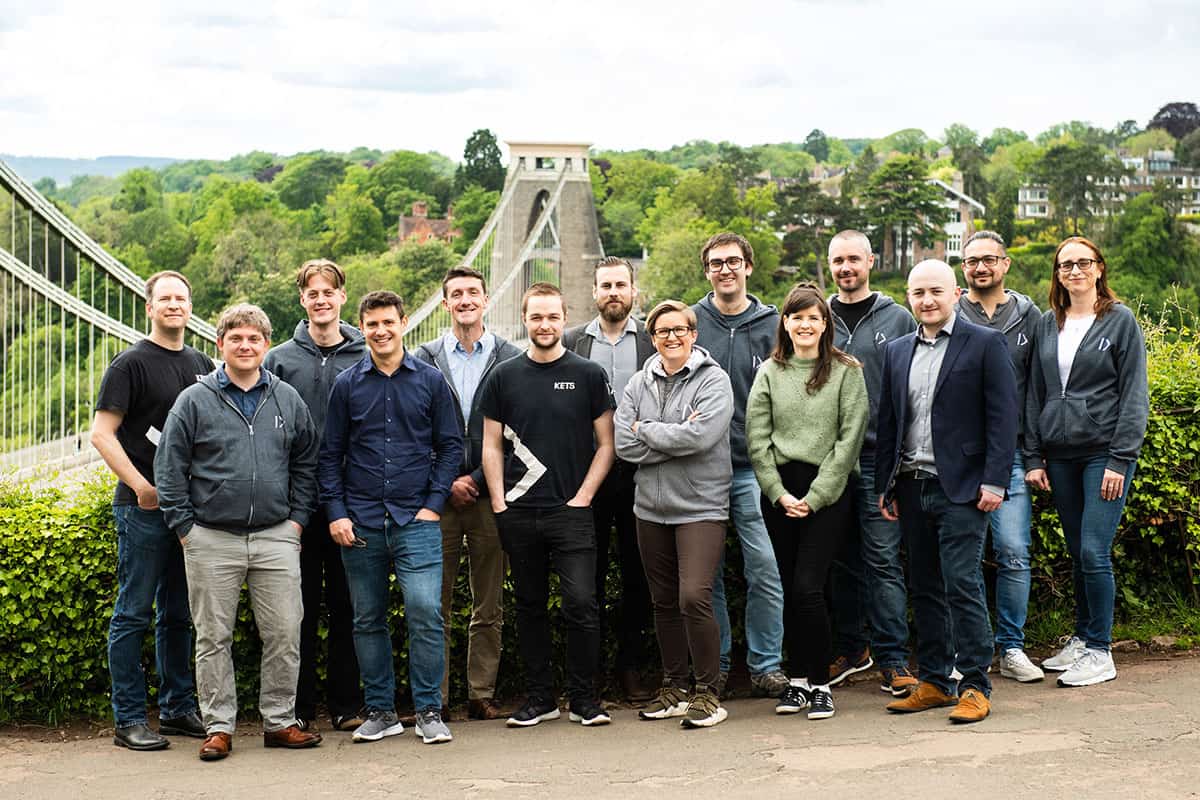
Commercializing quantum Chris Erven, chief executive and co-founder of KETS Quantum Security. (Courtesy: KETS Quantum Security)
Academics, governments and the technology industry are all involved in a global race to build the first usable and scalable quantum computer. And when that goal is achieved – most likely within the next five to 15 years – we will not only have unprecedented computing power at our disposal, but also the worrying issue of safety. That’s because such a device could easily be used to hack into our current public-key cryptography, which underlies almost all of our digital transactions and interactions today. With this in mind, KETS Quantum Security – a UK firm – has been working on securing communications in the “post-quantum” world, according to its chief executive Chris Erven.
The Bristol-based company has spent the last decade developing a fast and powerful chip-based quantum random number generator, as well as full quantum key distribution (QKD) devices. Erven – who was deputy director of the Quantum Technology Enterprise Centre at the University of Bristol – has long been interested in the commercial application of quantum encryption. Here he talks to Physics World about the real-world security issues that all organizations may soon face and explains how KETS is currently working with a number of blue-chip organizations in sectors that range from telecommunications and defence, to data and finance. Erven also reveals his vision of our quantum future.
What are the key challenges, focuses and aims of the quantum-cryptography industry today?
It is fair to say that the industry, which has been around for a while now, is maturing. No one would deny that China leapt ahead when it comes to QKD and really moved the field along. They launched the Micius satellite, which established an ultrasecure link between two ground stations separated by more than 1120 km. And as of this year they have built a QKD network spanning thousands of kilometres and linking four main metropolitan areas in the country. These advances made a number of other governments sit up and pay attention.
Outside of China, the next biggest project is the European Quantum Communication Infrastructure (EuroQCI) Initiative, which involves developing a quantum-safe communications network that spans all 27 member states of the European Union (EU), and aims to be fully operational by 2027. It’s an interesting beast as it has a centralized plan, as well as projects in individual countries – for example, we are working with the Paris QCI. Here in the UK, too, the government is talking about “preparing for quantum-safe cryptography”. And of course the US has a number of initiatives – in fact the US Department of Energy has put considerable emphasis and funding into this. So a lot has flowed from all this government interest – it has provided new opportunities for vendors to sell kit into test beds.
When it comes to the technology of quantum security, it’s early days still and we are only at the bulletin-board stage. Yes, we have the internet, but it’s a bit unreasonable to assume that we’re going to jump right to the quantum internet – although many people are starting to get their heads around that. At KETS today we are part of some ongoing test beds in Europe and Canada which serve multiple purposes – that way, an end-user doesn’t have to pay ridiculous sums to do it all in-house, they can join a test bed. And technology providers can see how users plan on using these systems and improve on them.
When it comes to the quantum-computing race, the final stages have really begun, and that is raising awareness. Quantum computing is coming up more and more in our feeds and people are realizing that there’s plenty of good things, but there’s also some stuff that you’ve got to think about the implications for, one of them being security. So that has changed the conversation from “We should keep an eye on that” to suddenly a lot of private and public institutions thinking seriously about their security, which is great for us.
What are some of your goals and targets at KETS in the next couple of years, technology-wise?
Our latest £3.1m pre-series A funding round was announced in June this year. We continue to enjoy incredible support from our bedrock investor, Quantonation, who has been with us since seed, and were really lucky to add two new, great investors in SpeedInvest and Mustard Seed MAZE. The pandemic has slowed everybody down, but our main aim is to get our two products – a quantum random number generator (QRNG) and a QKD system – ready for users. The QRNG has been built and is ready. The QKD system should be ready any day now, when one of our team finds that last line of code where the bug is! So we’re within a hair of the second one.
The new funding will be used to accelerate development, production and delivery of the first products. It will also allow KETS to expand key first trials of the technology in real-world applications and environments that are already in development. To deliver all of this, KETS will continue to build a world-leading team that is passionate about the company’s technology and values.
Perfectly random KETS’ quantum random number generator chip, capable of producing extremely high-quality randomness, at Gbps rates. (Courtesy: KETS Quantum Security)
The rest of our funding will be to build a few of them and trial the QRNG and the QKD system – we’ve talked to a number of people now in telecoms, in data centres and in defence and space; and will be testing some proof of concepts. So the next year is going to be testing as much as we can and bringing in users. We will be taking the early versions of our kits to people in a number of sectors, doing demos and then looking at the next steps to show off our technology. And then we want to start running as fast as possible, to go from there to 10 units to 10,000 units, and to make sure that we’re involved in key projects such as the EuroQCI.
Lastly, we have a few things in the pipeline that bring new capabilities that we would like to accelerate. This includes multi-transceiver devices, rather than just point-to-point, because that is looking closer to the internet and not the bulletin-board systems of the 1990s. So next year is all about demos and proof of concepts, and the year after that the plan is to build 10,000 of them and bring the next capabilities online.
Tell me a bit more about your QRNG and QKD systems, and who you think your key users will be
Our QRNG does exactly what it says on the tin – it produces random numbers according to the laws of physics. It sounds incredibly boring, but every past, present and future encryption algorithm needs good randomness. And then we have our QKD system that would let you and me exchange a symmetric key. So it’s a random sequence of zeros and ones, but only you and I know it, and distributing the key is now secure according to the laws of physics.
We call both of these our “development kits”. The cyber industry is an interesting one – as much as I try to show up to new customers and say, “Right, tell me all the ways you’re insecure so I can help,” they generally aren’t so forthcoming. It takes a while to build trust and get users to open up a little bit. Most of them just want to either get involved in a trial or to have us come and do a demo – some sort of three-month proof of concept, which ultimately helps build momentum at their end too.
This is also practical, as there are no established standards yet for quantum-security technologies or post-quantum algorithms – they’re still being written. There are some drafts in place, and it might meet some basic criteria, but in the sense of putting a sticker on the box saying “quantum safe” – it’s just not certified. So development kits in the hands of users will help us get there as they will contribute to writing the basic standards. With this in mind, we are focused on the telecommunications industry, as it’s a necessary first step. There’s definitely good sales there, both because they want to resell on these services, but they’re also a customer as they’re thinking about upgrading their own infrastructure to make it quantum-safe. A bank is not going to put in a fibre network between all of its locations, it’s going to turn around to BT and say, “I’d like to connect around the country.”
High-quality keys KETS’ quantum key distribution (QKD) transmitter chip (inside Alice), which includes an on-board laser (three prongs) and four high-speed modulators (lengths where two paths come together) to attenuate the light to the single photon level. (Courtesy: KETS Quantum Security)
So you start with the telecoms to get the basic infrastructure and then you begin hanging use-cases off it. And we think one of the first big ones is data centres, because that’s where a lot of high-value data is being stored, processed and accessed. We hope to start with making some of these high-value links secure because there’s still a high cost of the technology.
We have also always worked with the defence and space industries, who obviously want good security, and have done things like put our test kits on Airbus unmanned aerial vehicles and fly them around. And of course, there is banking, finance and critical infrastructure – anything from ferrying around “no fly” lists and passport information between home office and airports, to securing next-generation nuclear power plants. In recent times, we’ve seen a number of hacks on energy grids and the like, so all these areas must be made secure.
From your point of view, what kind of timeline are you planning for when it comes to having a functional quantum computer?
We have some materials that we tend to send to customers now, that have been written by third-party experts such as quantum scientist Michele Mosca, working with the Global Risk Institute, who surveyed the field. Their estimate is a one in seven chance within five years and a one in two chance within 10 years.
The other key factor is all the investment going into quantum computing, which has really taken off in the last couple years – so we’re trying to put our money where our mouth is. Quantum computers are such a key resource, and in many cases they are now being developed by state actors in the US, China and the EU. You probably won’t know when the first one’s turned on. So we’ll probably never actually know when “Q day” is, unless it’s 50 years later, like with the Enigma machine where we found out much later. It could already have happened! I don’t think that’s quite the case just yet, but I think it’s closer than we think. So we plan for five-ish years.
We have a small, internal project looking at how we would make KETS quantum-safe – because currently we don’t have the full infrastructure to, say, access our Google docs in a quantum-safe way, and we’re a company of 14 at the moment. But even in a small start-up, it’s a can of worms when you open it up and consider all the ways you communicate and all the places your data goes. I can only imagine what it’s like for a multinational company. So even if Q day is 10 to 15 years away, it’s probably a 20 to 25 year transition for large companies, so they really should be looking into it.
Tell me more about your quantum random number generator and why it’s such an important resource?
There are a number of QRNGs on the market – for example, ID Quantique has a chip focused on IoT [internet of things] smart devices and applications that perform at slower speeds. Ours focuses on high speed, as it is aimed towards data centres and telecommunications, who will gobble up as much randomness as you can give them. Today, our development kit is similar to a graphics-card chip, but we are going to continue to shrink it. It currently goes up to a gigabit per second; but natively it can do up to seven gigabits per second of randomness. We think we can push it to 25 without changing much, beyond some of the electronics.
The challenge has always been for anybody that doesn’t have quantum engineers on staff. They would ideally love to have a number in mind, so that they can say “this is 40 times better than my classical random number generator”, and an executive can then sign off on spending resources for that – but it’s just fundamentally different. So, early days this has been a challenge. Something that’s really helping that argument is developing a few more certification efforts or security assurance efforts. We are part of an Innovate UK project called AQuRand that has brought together a bunch of QRNG vendors and the National Physical Laboratory (NPL) is putting them through their paces. NPL is testing all the components and evaluating whether the model the company says this operates by actually holds true – and this will go a long way towards assuring users.
Harnessing quantum The Bristol-based quantum security firm was incorporated in 2016, and recently raised £3.1m through publicly funded projects and a seed equity round. (Courtesy: KETS Quantum Security)
Data centres are certainly a big user because I don’t know any server that won’t spin up a hundred or a thousand virtual machines on any given day, and all those get populated with current cryptographic keys. So not even thinking about the “post quantum” future – they need thousands of keys today and the best-quality randomness.
Looking ahead to post-quantum algorithms versus QKD, you will still need good randomness. KETS has partnered with French startup CryptoNext to carry out some demonstrations. We injected our randomness into their post-quantum algorithms and they injected that into a popular open-source library. We then did a quantum-safe digital document signing demo by the end of the day. So we’re really trying to show every possible application of our technology.
Where might you use a post-quantum algorithm over quantum security tech, and vice versa?
At KETS, we produce quantum-security hardware. But there’s also post-quantum cryptography algorithms, which are updates to the software algorithms we currently use for security. To the best of our knowledge, they are secure against a quantum computer – it’s never been proven but there is ample evidence. And so, it comes down to the use case – if it’s financial high-frequency trading, then you care for a millisecond that the algorithm is good enough. But if you care about your medical records or your genome being stored over a lifetime, with data being exchanged back and forth between sites, then you care for a much longer period of time, and a layered approach to security is necessary.
Where is quantum computing headed, in the near term?
The key challenges for quantum computing are the ability to scale-up our small quantum computers, and to perform quantum error corrections. Companies are looking at different ways to do this: they’re designing novel qubits and control hardware. Quantum software firms are building quantum operating systems, but also beginning to try and optimize errors and get rid of them with machine learning at more of a firmware level. No one has won yet in terms of which technology you should build your quantum computer from, but I don’t think we’re far away from some exciting breakthroughs! Before we know it, I’ll be playing quantum solitaire on my quantum computer thinking nothing of what’s under the hood, just like we no longer marvel at the smartphones in our pockets.
The emergence of a new variant of the coronavirus has put a constellation of researchers – virologists, immunologists and epidemiologists chief among them – in the hot seat as political leaders and public health experts seek answers to questions about how transmissible it is and whether it erodes pre-existing immunity. But while attention for the moment is on the life sciences, physicists also have a role to play in stopping the virus that causes COVID-19. Indeed, in the longer term, insights from physics could drastically reduce transmission of other respiratory pathogens, too.
Take social distancing. Signs asking people to keep 2 m (or 6 feet) away from others have become ubiquitous during the pandemic, and many shops have placed stickers on the floor at 2 m spacings to help safety-conscious consumers stay the requisite distance apart as they queue. But according to Varghese Mathai, a physicist at the University of Massachusetts Amherst in the US, these precautions are ineffective. In fact, they could even do more harm than good.
To evaluate the effects of 2m distancing in queues, Mathai, Ruixi Lou and Devin Kenney constructed a series of cylindrical dummies (a stand-in for queuing humans) spaced 6 feet apart, mounted it on a conveyor belt and placed it underwater (a stand-in for air, which is also a fluid). After filling an “infected” dummy with dye (representing virus-laden particles), they used a stepper motor to replicate the stop-start motion of people in a queue. The discomfiting result is that whenever the “queue” moved, each dummy ran straight into the cloud of dye emitted by the dummy in front of it, significantly reducing any benefit associated with distancing.
The Amherst team’s study did have some limitations. Notably, people’s breath tends to rise above their heads after they exhale, whereas the dye in the test tank did not. The conclusion, nevertheless, is that social distancing in queues is not an effective public health measure, even if the distance is doubled to 12 feet. “In both cases, you see that the released dye particles end up right in front of the person behind you,” Mathai told the audience at a press briefing held on 23 November, during the annual meeting of the American Physical Society’s Division of Fluid Dynamics (APS DFD). His verdict? “Waiting lines present a scenario where airborne transmission is possible.”
Masking up
If keeping your distance indoors isn’t an effective way of stopping the coronavirus, what is? The answer, in a word, is masks. On the same day as the briefing, Philippe Bourrianne of Princeton University and colleagues published a study in Physical Review Fluids on how masks change the airflow around a person as they exhale. The gist is that basic surgical facemasks tend to redirect the flow of exhalations upward, mitigating airborne disease transmission by keeping infectious particles out of the faces of other humans.
And breathe: False-colour images of typical airflows during four types of breathing without (top row) and with (bottom row) a surgical face mask. From left to right: soft respiration from the nose, mild respiration with an open mouth, heavy respiration, and blowing. (Courtesy: Adapted from P Bourrianne et al. 2021 Phys. Rev. Fluids6 110511)
If that isn’t enough to protect people – and if the room is heated or cooled via vents blowing air down from the ceiling, it likely isn’t – the good news is that physics may have a solution. At a separate APS DFD briefing on 24 November that focused on the future of face masks, biomedical fluids engineer Saikat Basu described how he and his team at South Dakota State University are developing a new type of mask inspired by the convoluted nasal passages of dogs and other animals that have an excellent sense of smell. Their goal is to create a filter that is as effective as the material in a standard N95 mask, but much more breathable. “We are looking at a future where these respiratory pathogens will be more common,” Basu explained. Comfortable, effective masks are part of the solution, he added, because people will be more inclined to wear them.
During the same briefing, fluid mechanics researcher Tanya Purwar zeroed in on another flaw in today’s face masks: the tremendous amount of non-recyclable, non-biodegradable waste they generate. She and her colleagues at Purdue University have developed a reusable filter made from multiple layers of material: a hydrophobic and lipophobic outer layer to repel the virus and droplets that carry it; a non-woven layer; a copper layer coated with diamond-like carbon to inactivate any virus that makes it through; and finally two more non-woven layers for filtration and comfort near the mouth. Purwar explained that the point of making a filter, rather than a complete mask, is that they want it to be as flexible as possible to suit different face shapes and sizes. “This could have several applications – not just in a mask, but in air filtration systems, too,” she added.
Staying safe
Scientifically-informed public health measures, better masks, and ventilation systems that don’t create “dead zones” of uncirculated air or blow infectious particles around a room (the subject of a presentation by atmospheric scientist Rao Kotamarthi of Argonne National Laboratory) will all play a role in protecting people. As Purwar put it, “We’ve all been trying to come up with more efficient ways of staying safe from the virus.” The big question, though, is how long it will take to implement these solutions, and on that subject, Alfredo Soldati, a fluid mechanics expert at Technische Universität Wien, Austria, sounded a note of caution. Too often in the pandemic, he warned, “measures have been put in place where we could, not where we should”. Public health officials have a lot on their plates, but if they can spare some time to listen to their physics-trained colleagues, it could make their jobs – and all of our lives – much, much easier.