Talking about talking

A good popular-science book starts a conversation. But Trevor Cox’s latest book is about conversation itself, exploring how the science of speech and hearing can help us to understand what it means to be human. Now You’re Talking: the Story of Human Conversation from the Neanderthals to Artificial Intelligence is a fly-by tour of human history guided by an acoustics engineer who steers smoothly through varied academic terrain.

The book follows on from Cox’s first popular-science book, Sonic Wonderland: a Scientific Odyssey of Sound, which was shortlisted for Physics World’s book of the year in 2014. In his debut, Cox deliberately didn’t focus on speech and music because he felt the “recognizable patterns” can distract from a full appreciation of natural sounds. This time round, however, Cox takes the plunge by embracing all the emotional and political baggage that comes with human communication.

Cox’s epic journey begins with the biomechanics of speaking and listening, alongside the competing theories of how and why human speech developed. Jumping to relatively recent history, Cox looks at how sound-recording transformed our relationship with our voices. He briefly ventures into the dark arts of political rhetoric where vocal charisma can trump the truth when it comes to persuasiveness. Finally, Cox examines some of the new technologies designed to simulate natural human communication. Although clearly impressed, Cox believes these AI systems still lack the “narrative intelligence” to tell a proper human story.

Given the breadth of material, the book could have been tricky to follow. But Cox keeps the tone accessible with pop-culture references throughout, revealing Cox’s taste in music and film. For instance, he observes how recording technologies enabled Amy Winehouse to sing in a far more personal way than if she had used early phonographs.

One final bit of advice – read the book in private, so you can enjoy the various demos. Observe, for instance, how your tongue, lips and soft palate perform gymnastics in switching between the vowel sounds. Or just do that in public, then at least you might start a conversation. And that’s what any good science book should do.

  • 2018 Bodley Head 312pp £20.00hb

Strange thinking

An exploration of some of the puzzles, paradoxes and mind-bending mathematical concepts that fill our universe – that’s what’s on offer from science writer David Darling, who has teamed up with his teenage, mathematical-genius student Agnijo Banerjee to write Weird Math: a Teenage Genius and His Teacher Reveal the Strange Connections Between Math and Everyday Life.

The book takes a fascinating look at some of the oddities of the mathematical universe. The authors explain the maths terms when they crop up, so there’s no need to be scared away, but some previous mathematical education will help. The first few chapters explore some concepts that you may have already come across in other popular-science books, such as Flatland. You may find yourself trying to bend your brain to see in 4D, but fair warning, this may cause a headache.

The book takes you through such peculiar concepts as the largest numbers. Chance, chaos and prime numbers all get explored and explained – you will even learn about how prime numbers help cicadas survive. The mathematics of music are discussed, with the duo describing the different series of scale bases, and how they differ all over the world.

The authors cover everything from astronomer Johannes Kepler’s apparent musings about harmonics, which led to important discovers in astrophysics; to thinking about what music out in the wider universe might be like, and whether we would still consider it music. Some cosmology is investigated via infinity, while knots, manifolds and topology also get a chapter. Knots, it turns out, can get even more complicated than the tangled mess your earphones always seem to end up in.

The final chapter is all about proof and the truth and purity of mathematics. As the authors show, mathematics is truly everywhere, and sometimes it’s very weird.

  • 2018 Basic Books 304pp £16.56hb

Nobel impact

I was recently talking to some friends about this year’s Nobel prize and why the award is so important for physics. These particular friends aren’t physicists and I quickly realized that they were wondering what I was on about. For them, the Nobel prize – even if they think about it at all – means literature or peace, which is not surprising given the huge media coverage given to recent recipients like Barack Obama, Malala Yousafzai and Bob Dylan.

My friends, who immediately started searching online, were surprised to find that there are in fact six Nobel prizes. Five have been awarded annually most years since 1901 – in physics, chemistry, literature, peace and physiology or medicine – as outlined in the will of the Swedish industrialist, inventor and arms manufacturer Alfred Nobel. The sixth prize, in economics, was added in 1968.

The Nobel Peace Prize has a controversial history, with winners including Mikhail Gorbachev, Shimon Peres, Menachem Begin, Yasser Arafat, Henry Kissinger and Aung San Suu Kyi – not all of whom have an entirely unblemished record. There have also been notable omissions, such as Mahatma Gandhi. Even Obama won the peace prize before he’d barely served a year as US president (though for me it was a fantastic move as it gave him credibility and a powerful mandate to live up to).

For physicists, of course, the Nobel prize is the ultimate accolade and a chance for them to join the elite. Just think of some of those who’ve won. Röntgen was the first in 1901 for discovering X-rays; others include Lorentz, Curie, Rayleigh, Michelson, Marconi, van der Waals, Bragg, Planck, Einstein, Bohr, Millikan, Hertz, de Broglie, Compton, Raman, Heisenberg, Dirac, Fermi, Bloch, Purcell, Shockley, Cherenkov, Feynman, Gabor, Higgs and Nakamura. I could go on, but the fact that I only used their surnames – and yet you all know who they are – underlines just how much impact Nobel laureates have had on physics.

Perhaps one reason my friends weren’t aware of the Nobel Prize for Physics is that it’s so rarely controversial. However, the prize has had far-reaching implications for society and business, especially when you think of the long-term impact of some of the early winners.

I am sure that when Marconi shared the 1909 prize with Karl Ferdinand Braun for developing wireless telegraphy, few could have envisaged the full commercial impact of the work. But these researchers transformed modern life, laying the foundations for everything from radio and TV to satellites and smart phones.

Of course all great inventions have a flip side – unintended consequences that reflect the darker side of human ingenuity. Some Nobel scholars even suggest – quite reasonably in my view – that Alfred Nobel’s decision to set up his prizes was his way of compensating for having developed dynamite. This substance may have revolutionized the mining industry as intended, but it had devastating effects when used inappropriately too.

On balance, though, I believe Nobel balanced the scales via his legacy of celebrating the more positive aspects of human ingenuity. After all, even if Nobel himself hadn’t invented dynamite, someone else would certainly have done so, given that all inventions build on the foundations of existing knowledge.

Recognizing success

The Institute of Physics (IOP), which publishes Physics World, has long had its own awards recognizing outstanding achievements in science, education and outreach. In recent years, it has also established prizes specifically honouring achievements in business. I think these IOP prizes are great, given that the impact of physics on society is so often overlooked and so hard to evaluate.

Just think about this year’s Nobel Prize for Physics: who knows how the discoveries will affect society in the future? One half of the prize went to Arthur Ashkin, who was born in 1922 and worked at Bell Laboratories and Lucent Technologies for much of his life. Ashkin began manipulating microparticles with laser light in the late 1960s – work that ultimately led him to invent “optical tweezers” in 1986.

This optical-trapping technique is now widely used to manipulate individual atoms, molecules, biological cells, bacteria and viruses. Indeed, optical tweezers, which are vital for medical science, are now standard equipment in many labs, where they are used to study DNA, individual proteins and other biological molecules as well as processes such as molecular motors in cells.

As for the other half of this year’s prize, it was jointly awarded to the French electrical and laser physicist Gérard Mourou and the Canadian optical physicist Donna Strickland for their technique of chirped pulse amplification (CPA). Mourou and Strickland found that stretching a laser pulse reduces its peak power, which could then be amplified and compressed to create ultrashort laser pulses.

CPA might sound interesting in abstract terms but it is immensely useful and commercially relevant. As the Canadian prime minister Justin Trudeau himself acknowledged, Mourou and Strickland’s “innovative work can be found in applications including corrective eye surgery, and is expected to have a significant impact on cancer therapy and other physics research in the future”. CPA can also be used to create a laser pulse that lasts for only one attosecond, or 10–18 s. At these timescales, it becomes possible to study not only chemical reactions, but also events inside individual atoms.

New businesses exploiting the discoveries have been set up and immense commercial value will be extracted from something that initially may have looked rather academic. The value of fundamental science and research is the foundation for the next generation of companies delivering huge commercial and societal benefits for – as Alfred Nobel put it – “the greatest benefit to mankind”.

I just wish I’d explained all this rather better to my friends.

A chilling read

Climate science is complicated and can cover everything from computer modelling to tracking animal migration patterns to materials technology, and so much more besides that it can be overwhelming trying to understand it all. By zeroing in on one small but key geographical area – the Arctic – climate scientist Mark C Serreze clearly explains the complicated interplay between sea ice, greenhouse gases, flora and fauna. His book Brave New Arctic: the Untold Story of the Melting North maps the rise of Arctic climate science over the past 30 or so years (with a few dips into the longer past).

The crux of the tale is the switch in scientific consensus from “human effects on the climate will cause global warming at some point in the future” to “it’s happening now, and it’s happening fast” – and the gathering of evidence that led to that change. Serreze is knowledgeable and interesting, writing from personal fascination as well as a sense of political urgency. He opens with his own early research trips to the Arctic, which adds a nice touch of colour, but veers a little too far into a “chatting down the pub” vibe that jars with the otherwise serious text.

It is a little unclear who the intended audience of this book is, as Serreze does a great job of explaining the science, from the complex to the most basic concepts – such as a whole page on how peer review works – but also includes lots of the graphs and measurements and other details that might put off the lay reader.

He acknowledges that even with our vastly improved understanding, there are still lots of unknowns. And that there are paradoxically some potential advantages to a warmer Arctic – certain animal species will have more food available as more sea life moves further north – as well as unforeseen challenges such as managing the increase in shipping in the region.

I finished the book sharing Serreze’s fascination with the topic, if a little tired of trying to follow all the details of pressure gradients and ice thickness.

  • 2018 Princeton University Press 264pp £19.95hb

2018 Breakthrough of the Year: Tami Freeman’s shortlist

One of the highlights in the Physics World calendar is the annual announcement of our Breakthrough of the Year. It’s always a tricky task to choose a winner, and it’s even harder this year as we have so many more articles to choose from. That’s because myself and two other new editors joined the Physics World team earlier this year, expanding the site’s coverage in three key research fields: medical physics and the biosciences; environment and energy; and materials science and technology.

To reflect this expanded scope in the 2018 award, each us will select our own top five shortlists from the research we have covered in 2018, based on three criteria:

  • Significant advance in knowledge or understanding
  • Importance of work for scientific progress and/or development of real-world applications
  • Of general interest to Physics World readers

After all the shortlists have been published, we will get together to decide which of the breakthroughs will make it into the Top 10 – and which will be the overall winner. The final announcement of the Physics World 2018 Breakthrough of the Year will be made on Thursday 13 December.

In no particular order, here is my top five shortlist from the medical physics and biosciences sections:

EXPLORER PET/CT produces first total-body scans

The EXPLORER PET/CT scanner – the world’s first medical imaging system that can capture a 3D image of the entire human body simultaneously – has produced its first human images. Developed by UC Davis scientists and a multi-institutional consortium, EXPLORER can scan up to 40 times faster, or use up to 40 times less radiation dose, than current PET systems, making it possible to conduct repeated studies in an individual, or dramatically reduce dose in paediatric studies. The high-sensitivity scanner can also create movies that track radiolabelled drugs as they move around the body.

Artificial intelligence predicts cancer evolution

The ever-changing nature of tumours is a major challenge when treating cancer. If doctors could predict how a tumour will evolve, however, they could alter the treatment before the tumour has a chance to adapt and develop resistance. A team led by scientists at the Institute of Cancer Research and the University of Edinburgh has used artificial intelligence to predict how cancers will progress and evolve. They developed a technique called REVOLVER (repeated evolution of cancer), which picks out patterns in DNA mutation within cancers and uses this information to forecast future genetic changes.

Compensator expands global access to advanced radiotherapy

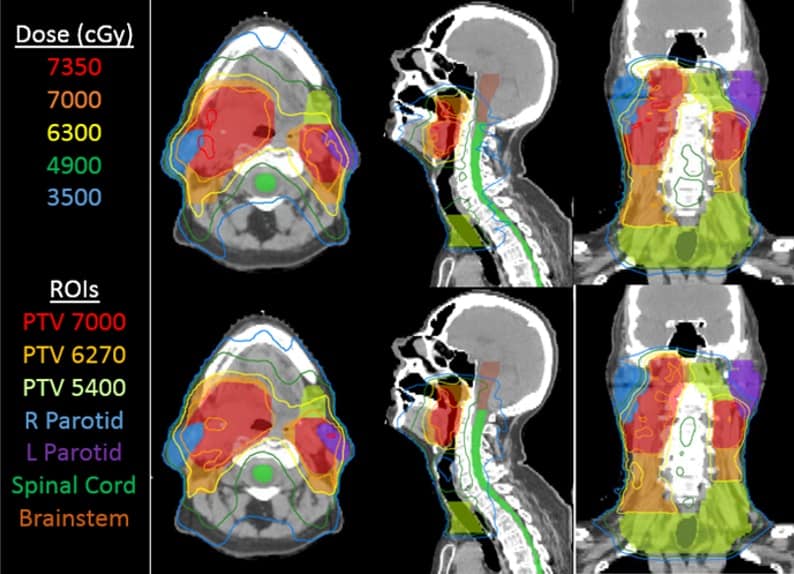
Intensity-modulated radiotherapy (IMRT) is a precision treatment technique that uses complex multileaf collimators (MLCs) to shape the photon beam and spare more healthy tissue. But while IMRT is available in essentially all radiotherapy clinics in high-income countries, it is largely absent in vast regions of low- and middle-income countries. To address this shortfall, a team headed up at the University of Washington Medical Center developed a cost-effective alternative to the MLC, replacing it with a ring of compensators made from lightweight plastic moulds filled with attenuating beads such as tungsten beads. The proposed device can be retrofitted to existing linac and cobalt teletherapy units – allowing clinics to add IMRT without having to purchase a new treatment system.

Treatment plans

Precise proton range detector gets ready for the clinic

The accuracy of proton therapy is limited by uncertainty in the beam range and, currently, a margin around the tumour is irradiated to ensure tumour coverage. To reduce the need for this margin, a team at MGH and Harvard Medical School is developing a proton range detector based on real-time detection of the prompt gamma rays produced when protons interact with tissue in the patient. Tests on phantoms showed the detector could predict each proton pencil-beam spot with a mean precision of 1.1 mm. The team is now working to integrate their detector into the clinical workflow, with a long-term goal of providing real-time feedback during proton therapy.

Activating retinal stem cells restores vision in mice

An international research collaboration has successfully restored vision in mice by activating retinal stem cells, a feat that has never been achieved before. The approach could one day transform treatment for patients with retinal degenerative diseases, which currently have no cure. To achieve this, the team performed a two-step gene transfer to reprogramme Müller glia cells in blind mice. Between four and six weeks after the reprogramming, the blind mice could sense light and regained their vision. The researchers note that further tests are needed to determine the degree of sight improvement.

Collaborative vision takes photonics into the future

Hugo interview

Photonics research in Europe is thriving, with numerous groups across different countries connecting together and each contributing a unique strand of expertise that advances knowledge and understanding across the field. But it has not always been this way, and Hugo Thienpont, director of photonics research at Vrije Universiteit Brussel, worries that fresh challenges may yet threaten this golden age of collaboration and progress.

Like now, back in 2003, photonics research in Europe was a competitive business. Such competition can spur on research groups to achieve more than their rivals, but it does not always foster a working environment that maximizes the potential of the whole field. Groups vie with each other to be the first to publish, potentially wasting valuable money and energy in the process.

Thienpont proposed a bold plan to establish a network that would help photonics researchers to work together – sharing best practices and expensive equipment while making sure that each group focuses on what they do best, something that has become known as “smart specialization”. But restructuring the research landscape across a continent was no modest undertaking, particularly for a young professor. “It was very, very bold to make that move,” says Thienpont. “I had a vision and an approach that I think a lot of people liked, so they gave me the opportunity to collaborate with them to make it happen.”

The result was the Network of Excellence on Micro-optics (NEMO), which received €6.4m from the European Commission, and ran from 2004 to 2010 with 30 member groups from 13 countries. More recently, Thienpont has become co-ordinator of ACTPHAST 4.0 – the one-stop-shop incubator for photonics innovation focusing on the needs of SMEs.

Teamwork makes the dream work

The same love and aptitude for working with people has helped Thienpont to build the small research group he set up in 1990 once he had finished his PhD into a globally acclaimed photonics centre with around 60 researchers and staff. Crucial to his success has been a strong strategic vision, along with plenty of perseverance and passion, but he clearly values working with his team. “What really matters I think is the joy of working with people on a daily basis,” he says. “You improve your own skills and those of others by collaborating.”

Photonics research at the Vrije Universiteit Brussel focuses on microlasers; graphene as a nonlinear optical material; optical devices for medical applications; optical fibre sensors for measuring temperature, pressure and strain; and free-form optics – a lens technology that abandons the traditional spherical shape to avoid optical aberrations. Despite significant metrology and fabrication challenges, Thienpont describes free-form optics as “the next revolution in optical lenses”.

The real challenge lies in the interdisciplinary aspects for photonics

Hugo Thienpont

He also has quite clear ideas about what is needed to revolutionize the photonics sector as a whole. “The real challenge lies in the interdisciplinary aspects for photonics,” he says. He refers to the so-called “key enabling technologies” (KETs) that have been identified by the European Commission as drivers of society and economy, along with the “cross-KETs” where these technologies work together, and where he believes photonics can play a crucial role. “We need to revolutionize photonics not only as a key enabling technology, but also to link it up to all the other key enabling technologies like advanced manufacturing, biotechnology, nanotechnology, nanoelectronics and new materials to create biophotonics, nanophotonics, lasers in manufacturing and optical materials.”

This faith in the potential impact of interdisciplinary photonics research persuaded Thienpont to accept the role of editor-in-chief of IOP Publishing’s recently launched Journal of Physics: Photonics. “When asked about this new journal for photonics, I said I will accept this with great pleasure but on one condition – that we make it the first truly interdisciplinary journal for photonics. Because that’s the future.”

Thienpont concedes that truly interdisciplinary work is not easy – not least because different disciplines use their own scientific language, but also because students are generally not educated to think beyond their own subject. In many ways the more specialized a field becomes, the greater the challenge for work that crosses more than one area of expertise. “It’s so easy to fall back on what you know best and not open your mind to what others know best to see whether we can do things together,” he says. “So we’re going to really work hard in making interdisciplinarity the key feature of the Journal of Physics: Photonics.”

To live long and prosper with photonics

Thienpont speaks about photonics with tangible passion and zeal, an excitement that was first kindled by a childhood obsession with science fiction, in particular Star Trek. “In those days, lasers were gimmicks – fascinating, but only used in science fiction,” he says. “I wanted to turn that science fiction into reality.”

He lists many different technologies that appeared in Star Trek 40 years ago that have since become a reality, such as tractor beams, laser cutters, and special flat-panel displays. He is also quick to point out how many of the researchers he speaks to at conferences were “Trekkies” too, so perhaps it’s no coincidence that Star Trek has proved such an accurate forecast for new technologies.

But Thienpont has real concerns that the next generation of photonics researchers are not fired with the same enthusiasm. “Think about exoplanets, everything that happens with elementary particles, all the fantastic things that optics and photonics can do in the medical world, all the breakthroughs that are bettering cancer research – it’s just so disruptive, so positively engaging,” he says. “But I don’t think that the majority of young people are impressed. We’re currently creating a society that is built on knowledge and innovation, but I think that we are not going to have the workforce to sustain it in the near future.”

These concerns have made Thienpont committed to nurturing the talents of young scientists, and together with his colleagues he has put in place an internationally recognized Master’s programme in photonics at Vrije Universiteit and Ghent University in Brussels. As vice-rector of the Vrije Universiteit, he has also been tasked with boosting collaboration with industry. He considers promoting the economic and societal value of research as key to this role, and has worked closely with big industry players including Barco, Agfa-Gevaert, Commscope, Punch Graphix and Umicore, accruing 21 patents to his name.

Thienpont clearly has plenty to fill his time. While no two days are the same, he can often be found giving keynote talks, working on panels to restructure the research and innovation ecosystem of Europe, or working on new finance and support mechanisms. His advice for the photonics trailblazers of the future is to pursue their career with passion, perseverance and patience, but above all to embrace opportunities to work with other people. “I think every day is worth living, and living for research means teaming up with others,” says Thienpont. “For me research comes second – the first thing is working together with people.”

Einstein and Feynman objects fetch millions, Manne Siegbahn’s Nobel medal is on the auction block

Is it just me, or is lots of physics memorabilia being bought and sold these days?

Last week, items associated with Richard Feynman fetched nearly $5m at  Sotheby's in New York. His Nobel prize medal alone sold for almost $1m.

On Tuesday, a handwritten letter by Albert Einstein calling the Bible “a collection of primitive legends,” sold for nearly $3m at Christie’s in New York. Sent in 1954 to the philosopher Eric Gutkind, the 1.5-page “God letter” is written in German and contains a number of ruminations on religion.

Next up is the Nobel prize medal and citation won in 1924 by Manne Siegbahn for his work on X-ray spectroscopy, which will be auctioned in Boston on 13 December. The sale will be conducted by RR Auction and is expected to garner $150,000. As you can see in the above image, it is a beautiful collection of objects.

Helium jet focuses extreme-ultraviolet light

A lens for extreme-ultraviolet (XUV) light has been created by physicists in Germany. Using a jet of gaseous helium, Bernd Schütte and colleagues at the Max Born Institute could focus XUV beams and separate the light into its constituent wavelengths. The device overcomes a key challenge facing those trying to develop XUV lenses, which is that most materials are highly absorptive of XUV light.

Lenses and prisms direct and focus light using refraction – whereby light bends as passes between two different media (such as air and glass). Devices that can focus XUV beams, however, have been notoriously difficult to develop because solids, liquids and even gases tend to be opaque to XUV light. Indeed, XUV beams tend to be created in vacuum to avoid absorption by air.

There are a growing number of XUV sources worldwide and beams are becoming increasingly useful for semiconductor lithography and fundamental research into the structure of matter. As a result, there is a real need for practical XUV lenses.

Density gradient

Instead of using highly-absorbing solid or liquid lenses, Schütte’s made their device from a jet of hydrogen gas that is fired across a beam of UV light. The density of the gas is varied in the direction that is perpendicular to both the jet and the light beam.

The helium atoms have a resonant frequency close to that of XUV light. This means that most of the beam is deflected away from the jet, resulting in low absorption. By fine-tuning the density gradient of the jet, the team can adjust the focal length of their lens, allowing it to focus XUV beams down to spot sizes of nanometres.

Since the atoms in the lens are continually replenished, any damage caused by XUV exposure is essentially repaired immediately -- an advantage that is not possible in XUV mirrors. In addition, the angle at which XUV light is deflected from helium is highly dependent on the wavelength of the light. This means that the jet can be used as a prism; separating XUV light into its constituent wavelengths.

The team’s gaseous lens could have a range of practical applications including microscopes that can monitor changes in the structures of biomolecules over short timescales. The lens could also be used to create semiconductor devices with smaller and more intricate features than possible today.

Schütte and colleagues are now working on implementing a range of refractive optics techniques using gas jets. They also point-out that the technique could be adapted for shorter-wavelength light by replacing the gaseous jet with a plasma of highly-charged ions and electrons.

The research is described in Nature.

Complex-systems theory could explain why some democracies become unstable

What a week it has been on both sides of the English Channel. The rancour over Brexit  has hit fever pitch here in the UK and groups of very angry people in yellow vests have taken over streets throughout France. An observer would be forgiven for thinking that both of these stable western democracies are heading for crises.

The various Brexit scenarios and the motivations of the gilets jaunes are both very complex and therefore it can be very difficult to understand how these crises arrived and where they are going.

In “Complex systems help explain how democracy is destabilised”, my colleague at IOP Publishing, Simon Davies looks for answers in research led by Karoline Wiesner at the University of Bristol. Wiesner is a mathematician and she worked with an international and multidisciplinary team to use complex systems theory to analyse the stability of social institutions such as democracy.

Targeted messages

Wienser tells Davies that very little work has been done on understanding the circumstances that can cause a democracy to become unstable. In conversation with Wienser and several of her collaborators, Davies looks at the roles of radicalization, polarization and social media. In particular, the researchers explore the consequences of targeted messaging in social media when the recipients do not know the true identity or motivation of the sender.

“These impacts of social media on public discourse show how democracies can be vulnerable in ways against which institutional structures and historical traditions offer little protection,” says Wienser. “Complex systems science offers a unique entry point to study such phenomena.”

A paper written by Wiesner and colleagues is published in the European Journal of Physics.

Machine learning without understanding improves femtosecond laser patterning

Schematic for using a trained convolutional neural network for the identification of laser machining parameters. Credit: Journal of Physics: Photonics

From additive 3D printing to subtractive ablative eye surgery, laser patterning is a versatile and widely used tool. Using laser pulses just femtoseconds long can increase the precision but this also leads to nonlinear processes that are little understood dominating the patterning mechanism. As a result, it can be difficult to optimize the parameters. To make things harder still, nonlinear processes can mean small changes in the patterning parameters have a large effect on the final structure. Now Ben Mills and colleagues at the University of Southampton in the UK have found a way round tackling the nonlinear physics by training a convolutional neural network (CNN).

“It is important to realise that here the CNN identifies the experimental parameters purely via pattern recognition of images of the laser-machined surfaces, without requiring any understanding of the underlying physics,“ they report. Having demonstrated the accuracy of the CNNs for identifying parameters from images of patterned substrates, the researchers suggest the CNN could be used in a feedback loop to identify and adjust the parameters needed to produce a desired structure with greater precision.

Learning not understanding

Neural networks consist of layers of artificial “neurons” – data processing elements - with an input layer, several hidden processing layers and an output layer. As Mills and colleagues explain in their report, each neuron receives a set of weighted inputs from the previous layer, which it processes before passing the result to the next layer of neurons.

Mills and his team worked with a CNN over other types of neural network because they are particularly adept for pattern recognition, having already found use in language analysis and medical imaging and diagnosis. They trained and tested their CNN on 1800 images from 19 categories defined by substrate material, the number of pulses and the fluence. The substrate could be either silica or nickel, the number of pulses ranged between one and three, and the fluence was taken from a range of over 10 discrete values. They then used images of patterned structures as input and looked at how the accuracy of their CNN for identifying the patterning parameters compared with a random number generator.

As expected for just two possible substrates, the number generator was 50% accurate at getting the right material, but the accuracy plummeted for parameters with wider ranging variables leaving just a 5% accuracy for getting all 3 parameters correct. In comparison the CNN correctly identified whether the material was silica or nickel, the fluence, and the number of pulses with accuracies of 98%, 87%, and 94%, and correctly identified all 3 parameters with an accuracy of 82%.

“This approach could be a central component of a visual-based real-time closed loop feedback system for laser machining,” conclude the researchers. “With suitable training data, we anticipate that this approach could also be adapted to ensure the correct fabrication of a specific pattern or structure, where the desired pattern or structure is used as an input to the process.”

Full details are reported in the first issue of Journal of Physics: Photonics.

Copyright © 2026 by IOP Publishing Ltd and individual contributors