2018 Breakthrough of the Year: Anna Demming’s shortlist

Readers waiting with bated breath each year to read the Physics World 10 breakthroughs are in for a treat. With the new and improved website accruing additional section editors on its relaunch we have decided that in the lead up to the announcement of the Physics World top 10 breakthroughs, each section editor will shortlist their top 5 breakthroughs in their field. The selections will be based on three criteria:

  • Significant advance in knowledge or understanding
  • Importance of work for scientific progress and/or development of real-world applications
  • Of general interest to Physics World readers

After all the shortlists have been published, the editors will retreat together to deliberate, discuss, and contest which of the breakthroughs will make it into the Top 10 – and which one will be the overall winner. The final announcement of the Physics World 2018 Breakthrough of the Year will be made on Thursday 13 December.

Today I am announcing in no particular order the top five contenders from the materials section.

Engineers reinvent the inductor after two centuries

After 200 years of dominating electronics, magnetic-based inductors have a rival that may allow smaller and denser device architectures. Researchers in the US, Japan and China led by Kaustav Banerjee have made the first high-performance inductors from intercalated graphene that work in the 10-50 GHz range, thanks to the mechanism of kinetic inductance.
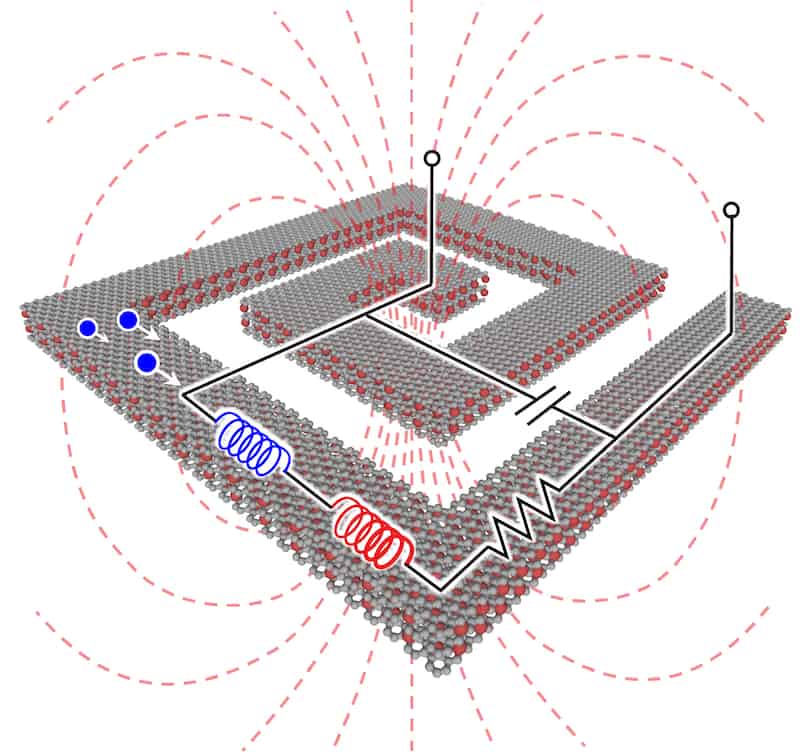
A spiral inductor and its simplified equivalent circuit. Courtesy: K Banerjee

While magnetic inductance relies on device geometry, kinetic inductance is purely a material property that makes higher inductance densities possible. As well as applications in sensors and energy transfer, inductors are key to the RFICs and RFIDs used in the Internet of Things – which promises to connect us with 50 billion objects by 2020, with a potential impact of $2.7 to 6.2 trillion per year by 2025.

‘Magic-angle graphene’ behaves like a high-temperature superconductor

Magic angle graphene superlattice. Courtesy: P Jarillo-Herrero

This first observation that the electronic properties of graphene can be altered by rotating adjacent layers of the material triggered several follow-up revelations within months, in a new development that has been tagged “twistronics” . It started when a team of researchers led by Pablo Jarillo-Herrero of the Massachusetts Institute of Technology (MIT) in the US demonstrated Mott insulator behaviour and high-temperature superconductivity in pristine bilayer graphene when the layers were twisted by a so-called “magic angle”. Later reports include a device that can control the electronic properties of 2D materials by fine-tuning the angle between adjacent layers, rather than applying a field. Doing the twist has also helped to reduce Umklapp scattering, which degrades high-temperature carrier mobility.

Black hole hologram appears in a graphene flake

Much research on black holes is theoretical since it is difficult to make actual measurements on real black holes. Such experiments also need to be undertaken over decades or longer. Physicists are therefore keen to create laboratory systems that are analogous to these cosmic entities. New theoretical calculations by a team in Canada, the US, UK and Israel, led by Marcel Franz of the University of British Columbia, have now revealed that a material as simple as a graphene flake with an irregular boundary subjected to an intense external magnetic field can be used to create a quantum hologram that faithfully reproduces some of the signature characteristics of a black hole.
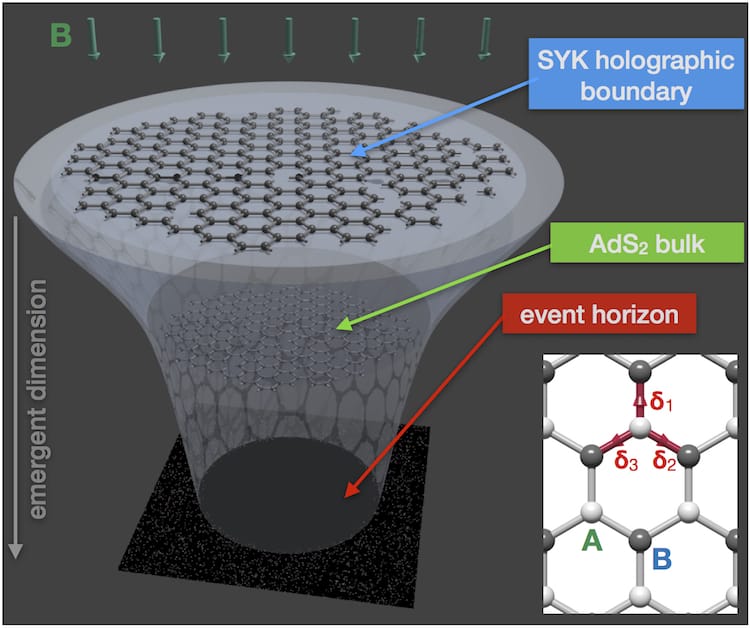
Holographic duality between a graphene flake and a black hole. Courtesy: M Franz, University of British Columbia

The electrons in the carbon material behave according to the Sachdev-Ye-Kitaev model, an illustration of a type of ‘holographic duality’ in which a lower-dimensional system can be represented by a higher dimensional one. Franz and colleagues show through their calculations that the graphene electrons in (0+1) dimensions can model the dilation gravity of a black hole in (1+1) dimensional anti-de Sitter (AdS2) space.

Multifunctional carbon fibres enable massless energy storage

Despite progress in energy storage technology, batteries still make up a significant part of the weight for devices such as laptops and even cars. Rather than focusing solely on optimized battery materials to tackle lightweight demands, Leif Asp at Chalmers University of Technology, along with a team of researchers in Sweden, Italy and France, reported in Multifunctional Materials that exploiting the electrochemical properties of carbon fibres could drop device masses by as much as 50%.
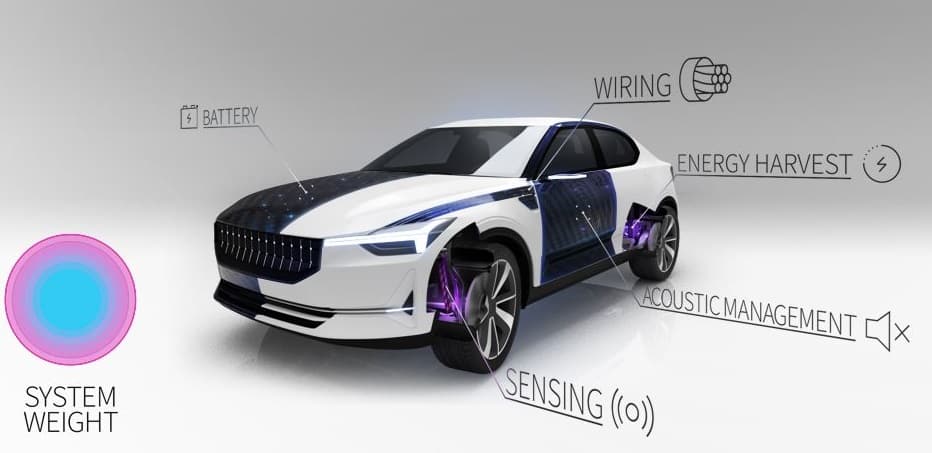
Multifunctional materials for future zero-emission transport solutions. Credit: Chalmers University of Technology

The researchers knew that optimum mechanical strength favours highly ordered carbon fibres, while electrochemical activity requires amorphosity, but the tolerance of the properties had not been tested. In the first studies comparing the mechanical and electrochemical properties of different grades of carbon fibre, Asp and his team reveal that the trade-off in mechanical strength for less-ordered structures is not as significant as expected, which means that the same fibres that provide structural functions could double up as effectively massless batteries.

Light-induced corneal cross-linking corrects vision

Myopia, or short-sightedness, is almost twice as common in the US and Europe today than it was 50 years ago. It has also become an important problem in some Eastern Asian countries where it affects as much as 70–90% of the population. Although glasses and contact lenses are the first choice for many people, permanent vision correction by refractive surgery is becoming more popular, even though the procedure is not without risk. A team of researchers at Columbia University in New York led by Sinisa Vukelic has now developed a new, safe and non-invasive technique that makes use of a femtosecond laser to produce a low-density plasma in the cornea.

The plasma generates reactive oxygen species that then react with collagenous tissue in the treated area to form cross-links. As the molecular bonding changes, the altered material properties affect the shape of the cornea to correct the refractive power of the eye.

  • Check back tomorrow for Tami Freeman‘s top 5 breakthroughs in medical physics, biophysics and bioengineering.

The first step

Over the past few years, virtual reality and immersive technologies have made such giant leaps that you can now wander on the surface of the Moon, not to mention other worlds, in high definition. But imagine if you could literally step into the moon-dust-covered boots of NASA astronaut Neil Armstrong, as he became the first person to set foot on the Moon on 20 July 1969. This is what viewers will experience in First Man, the latest film from Whiplash and La La Land director Damien Chazelle. Armstrong is played by Hollywood star Ryan Gosling, while British actress Claire Foy, who starred in The Crown, plays his wife Janet, both of whom do a superb job.

An adaption of James R Hansen’s 2005 book by the same name, this stunning film is an in-depth look at the eight years in the life of Armstrong in the lead up to the legendary Apollo 11 mission that took humankind further than ever before. But viewer beware – this is no traditional biopic, following the lead character’s story from birth to death. Nor is this some glossy CGI star-scape with sweeping space vistas, à la Gravity, or even a straightforward telling of the Apollo 11 story. First Man is an intimate look at some of the most pivotal years in Armstrong’s life, as he sets out on a journey that will see his name go down in history.

While the film covers the extreme highs of Armstrong’s life – the Moon landing, of course, but also the somewhat complicated success of the other missions leading up to it, such as Gemini 8 – it definitely does not shy away from the lows. There’s the death of his two-and-a-half year old daughter Karen, as well as the loss of his fellow astronauts Elliott See and Charles Bassett, who were killed in a T-38 crash. There’s also the Apollo 1 fire that led to the deaths of Virgil “Gus” Grissom, Ed White and Roger Chaffee.

The film opens in 1961, the year before Armstrong applies for Project Gemini and is accepted to NASA Astronaut Group 2, or the Next Nine. It is a grief-stricken Armstrong who applies to Gemini, as he attempts to help himself and his family move on after the loss of Karen, and while the family does seem happier following the move to Houston, Armstrong carries the loss and the memory of his daughter all the way to the Moon and back (a bracelet of hers is a particular talisman for him).

The Moon itself is arguably a character in the film, a sort of leitmotif for Armstrong, and there are numerous scenes of him looking at it from his backyard, while the viewer is left to ponder his thoughts. Director Chazelle said in an interview with IMDb that they wanted the Moon “to be sort of looming over all the on-the-ground interactions, and to really get at the messy reality of what going to the Moon actually took”.

First Man film

Indeed, the film honestly portrays the true brutality and difficulty of winning the so-called space race and getting someone on the Moon as quickly as the Americans did. In many other space-related films there is a certain sterility to the whole process of space flight, and the viewer is convinced that NASA, with its rows of computer screens, mostly has everything under control.

First Man clearly shows how much of the time, the success of a mission was determined by the fast-thinking astronauts taking a chance and making a snap decision that paid off, as they hurtled into the horizon in their ramshackle crafts. I am not sure how many viewers were aware that after Armstrong and pilot Buzz Aldrin (perfectly portrayed by Corey Stoll) had begun their descent to the lunar surface in the Lunar Module, Armstrong was forced to take manual control of the spacecraft as Aldrin realized the planned landing site was covered in massive boulders. Armstrong manages to successfully land the module, of course, but with minimal fuel remaining and the nail-biting scene was one of my favourites in the film. Although I knew precisely which of the many missions from Apollo 1 to 11 would succeed and fail, I nevertheless found myself at the edge of my seat, hoping that all would go well.

In large part, this was thanks to the filming style. Unlike most films of this genre, First Man mostly looks like a documentary, with all of the scenes on Earth and at the Armstrongs’ home filmed in 16 mm or 35 mm, with a hand-held camera, which zooms in for occasionally disorienting close-ups. This is even the case in many of the mission shots, filmed within the spacecraft, giving viewers a true appreciation of just how crammed and claustrophobia-inducing those spaces are. It is only once Armstrong and Aldrin get to the Moon’s surface that there is a sudden huge jump in perspective – the hatch of the lunar module swings open and, in an unforgettable shot, the sweeping lunar surface comes into view with crisp high-definition as the film changes to IMAX, and the Moon engulfs the entire screen.

Equally important to the film is its impressive and powerful score, composed by Justin Hurwitz and played by a 94-piece orchestra. If you hear a strange, hypnotic electric sound, that is the electronic theremin – an instrument that Armstrong was especially fond of, which led Hurwitz to add it to the score.

While First Man does an excellent job of depicting the huge advances in science and technology that it took to get humankind to the Moon, this film is ultimately about people; and each of the actors plays their part to perfection. As we approach the 50th anniversary of the Moon landing next year, First Man is a poignant retelling of Armstrong’s legacy, but in a more honest and intimate way than ever before.

  • 2018 Universal Pictures

Multiferroics and topological materials for the post-CMOS world

Researchers at Intel Corp. and the University of California at Berkeley have invented a new kind of computing device based on magnetoelectric spin-orbit logic (MESO). The device, which works at room temperature, is made from multiferroic and topological materials and it could be 10 to 100 times more energy efficient than future microprocessors that are based on conventional CMOS (complementary metal-oxide-semiconductors). It is also able to host five times more logic operations than a CMOS chip of the same size.

Transistor technology was invented 70 years ago and is ubiquitous in our modern world. Since the early 1980s, most electronic devices have relied on CMOS-based transistors – in which the resistance of a semiconductor is modulated by applying a voltage across an insulating gate. This switching technology continues to be the mainstay in electronics even though transistors have become ever smaller over the decades and can now be just 10 nm in size.

This successful size scaling has come with a price, however, and voltage and frequency scaling has slowed. Further decreases in operating voltages are not possible because of the so-called Boltzmann limit of current control (which is 60 mV for every change in current by a factor of 10 at room temperature). Researchers are thus looking for alternative technologies.

Collective switching devices

“Finding the next room-temperature general purpose switch that allows for computational scaling is a holy grail for computing,” says team member Sasikanth Manipatruni, who is responsible for hardware development for the MESO project at Intel in Hillsboro, Oregon, and who designed the first ever MESO device. “So-called collective state switching devices are potential candidates for replacing or enhancing CMOS-based transistors. A collective state switch is one that operates by reversing a material’s ferromagnetism, ferroelectricity or ferrotorodicity, for example. Such devices could be made smaller than 10 nm and overcome the ‘Boltzmann tyranny’.”

Multiferroics show promise in this context since they contain atoms that have more than one collective state. Positive and negative charges are offset in these materials and create electric dipoles that align throughout the sample, so producing a permanent electric moment.

The MESO device made by Manipatruni and colleagues comprises a multiferroic consisting of bismuth, iron and oxygen (BiFeO3) that is both anti-ferromagnetic and ferroelectric. “These two states – anti-ferromagnetic and ferroelectric – are linked so that changing one affects the other,” explains Ramamoorthy Ramesh of UC Berkeley, who made the first multiferroic material back in 2001. “By manipulating the electric field, you can change the magnetic states, which is critical to MESO.”

Spin-orbit coupling for readout

In MESO devices, the electric field flips the electrical field throughout the material, which in turn flips the electron spins that generate the magnetic field. This capability comes from spin-orbit coupling, a quantum effect that produces a current dependent on the direction of the electron spin.

The researchers are able to read out this direction, and thus the state of their multiferroic, using topological or high-spin–orbit-coupling (SOC) materials with a spin-orbit effect. Such materials include topological oxides.

“We do this by injecting a supply current into the device, which causes spin-polarized electrons to flow from the ferromagnet into the SOC material,” explains Manipatruni. “Thanks to SOC spin-to-charge transduction, a charge current is generated at the output. The input charge state (positive voltage and current) is thus inverted by the MESO logic gate at the output.”

“Many good properties”

Our MESO has many good properties, he says. “First, it is the first scalable spintronic logic device than can meet the demands of integrated circuits for computing, in the sense that the operating principles allow the energy requirement to improve as the device becomes smaller. Indeed, the device’s energy reduces by eight times for every two-fold reduction in size.”

And that is not all: the device can operate at 100 mV, and potentially even lower voltages, he adds. “This switching voltage is five times lower than CMOS with a concurrent energy reduction of 10 to 30-fold. Finally, logic density is also much higher since the device is essentially a single multiferroic and ferromagnet node. In fact, the logic density increases by five times compared to that possible in future CMOS-based devices.”

This class of logic produces a leap in computational efficiency beyond the limits imposed by the physics of CMOS, he tells Physics World. “Our calculations show that it is capable of more than 200 TIOPS/W (trillion integer operations/watt), which means that there could be a 10-100 times efficiency boost across computer platforms. This increase could come in very useful for emerging applications such as self-driving vehicles and drones, machine learning, artificial intelligence and the Internet of Things.”

“We are looking for revolutionary and evolutionary approaches to computing,” adds Intel senior fellow Ian Young, “and are excited to see the path to 100 mV operation for our logic.”

The researchers, who report their work in two papers, one published this week in Nature 10.1038/s41586-018-0770-2, and one last month in Science Advances 10.1126/sciadv.aat4229, say they will now be focusing on improving their technology. “We will continue to work with our internal and external partners at UC Berkeley (Ramesh Ramamoorthy) and Cornell (Darrel Schlom), as well as Felix Casanova’s team at Nanogune, Manuel Bibes and Albert Fert at CNRS/Thales, and other academics that we are trying to involve further. Our hope is to trigger a wave of innovation across industry and academia targeting beyond-CMOS with room temperature quantum materials,” says Manipatruni.

Computational model sheds light on how multicellular organisms evolve

The authors

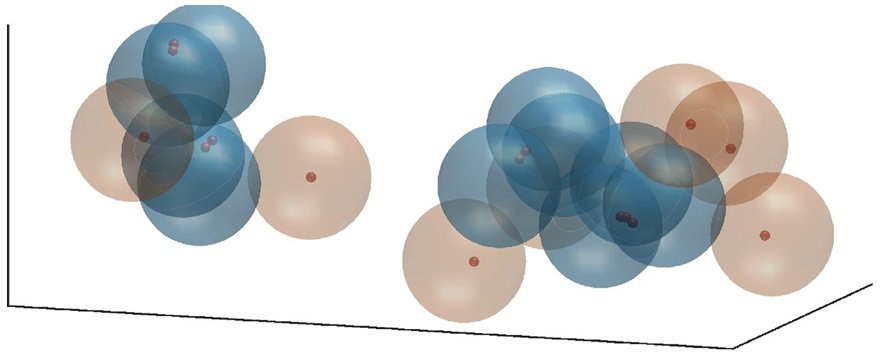
A computational model developed by scientists and engineers in the US describes different ways in which gene products are capable of performing specific biological functions. Their results also help explain how certain ways of performing specific functions may have enabled complex multicellular organisms to evolve more readily (PNAS 10.1073/pnas.1815912115).

Upon receipt of particular signals as inputs, biological systems respond by performing particular functions. Two main mechanisms mediate functional specificity in biology: “lock-key” interactions, as for example when an enzyme is the lock and its substrate is the key; and weak cooperative interactions (WCI). In the first class, the substrate can fit into the lock (the enzyme’s active site) only if it is perfectly right in term of size and other properties.

Increasing evidence suggests that the second class, WCI, is more prevalent in higher organisms. For example, exciting recent insights suggest a quarter of human genes encode proteins that can functionally interact through WCI in executing critical tasks.  In the context of immunology, WCIs are important for how the immune system can differentiate different antigens (specificity). Functional specificity mediated by WCI can lead to some cross-reactivity, such as when the same immune cell can “recognize” different antigens. However, the factors that drove the evolution and selection of WCI for mediating functional specificity in multicellular organisms is yet to be understood.

Therefore, researchers are motivated to learn more about how WCI underlies functional specificity, not only because of its far-reaching implications for biology but also due to its potential contributions to dangerous pathologies when cross-reactivity is misregulated.

 In silico simulation of evolution

To gain insights into the driving forces that mediate biological specificity in complex organisms, researchers from Massachusetts Institute of Technology and the Ragon Institute of MGH, MIT and Harvard, led by Arup Chakraborty and Phillip Sharp, developed a model where a population of organisms evolves as the number of tasks that must be carried out with functional specificity increases. In other words, their model is based on interactions between the organisms’ gene products and the tasks that they must perform. Indeed, their model is inspired by the interactions that lead to protein–protein recognition.

In silico simulation

Briefly, the model represents a space composed of gene products of organisms and the tasks that need to be performed with specificity for the organisms to function properly. Gene products and their tasks are defined as positions in a characteristic space, with axes that define different properties of the tasks and the gene products. Well-matched gene products and tasks are closer to each other in characteristic space, and if they are close enough, the task is considered to be performed specifically by the corresponding gene product. Similarly, well matched gene products that can perform a task by their cooperative action are close to each other in characteristic space.

 Mapping evolutionary dynamics

The researchers found that when there are very few tasks that must be performed specifically for organisms to function properly, the lock-key mechanism is dominant. As the number of tasks that had to be performed with functional specificity increased, WCI naturally evolved as a mechanism for mediating functional specificity and became increasingly prevalent. This result led the researchers to wonder whether there is a link between the emergence of WCI and becoming more evolvable – i.e., the evolvability of multicellular organisms.

Mutations, gene loss and gene duplication underlie evolution. It is thought that more evolvable systems require fewer number of mutations to create new phenotypes in a shorter time period. Therefore, to explore the relationship between WCI and evolvability, the researchers compared simulations where emergence of WCI was not allowed to those where WCI was allowed.

They found that the model allowing the evolution of WCI exhibited shorter response times and required fewer mutations to respond to new tasks. This enables higher-order organisms to efficiently perform new tasks in addition to maintenance of old tasks. Thus, the authors suggest that WCI has been repeatedly positively selected in increasingly more complex multicellular organisms.

These findings may have implications beyond protein–protein or specific enzyme–substrate interactions and immunology. One example is the nervous system. “It may also be a characteristic of how computational machine learning algorithms trained on large datasets to predict specific outcomes could be adapted to predict new outcomes,” the authors speculate.

More states opt to phase out oil production

A growing number of governments are choosing to phase out oil production, reasoning that cutting the availability of fossil fuels can help to cut the demand for them.

The world needs to reduce greenhouse gas emissions as fast as possible, yes? And one of the main causes of the emissions is the burning of fuels such as oil, gas and coal? Right again. So the simple and obvious answer, these governments are deciding, is to stop the drilling and mining which extract fossil fuels.

That’s the argument examined in a report by researchers from the Stockholm Environment Institute (SEI). There’s already a growing movement to leave fossil fuels in the ground. But their study concentrates specifically on governments.

They say phasing out oil production could be the next big step in climate policy, thanks to an initial group of first-movers who’ve already taken the plunge.

One is Spain, which announced this month that it plans to completely decarbonise its electricity system by mid-century, a move which includes a total ban on all oil and gas exploration.

The SEI team outlines its findings in the journal Nature Climate Change. The authors presented their results in greater detail in the Polish city of Katowice on 5 December at this year’s UN global climate summit, COP24.

They focus on California as the possible next addition to this growing list of governments choosing to forego oil extraction. The study finds numerous benefits to restricting production, including not only reducing global emissions but also helping to revoke the “social licence” of fossil fuel producers – the public acceptance of their activities.

“Countries like France, New Zealand, Costa Rica, Belize and – just last week – Spain are sending a clear signal by phasing out oil production,” said Georgia Piggot, an SEI sociologist and co-author of the study. “The fossil fuel era needs to end soon, and governments need to have clear plans in place to ensure an orderly and fair transition.”

With California as a case study, the SEI report points to a resolution by the state’s Air Resources Board to “evaluate and explore” reducing the production of petroleum.

Boosting environmental justice

It finds that phasing out oil in California would reduce global greenhouse gas emissions by roughly the same amount as many of the other climate policies currently planned by the state. And, because most oil drilling there happens in the most pollution-vulnerable communities, phasing it out would have important environmental justice benefits as well.

“Gradually phasing down oil production is a reasonable approach to reducing greenhouse gas emissions,” said SEI senior scientist Peter Erickson, the study’s lead author.

“California is one of the top oil-producing states in the US, but it is also a climate leader. Restricting oil production would complement the state’s flagship policies, such as strengthened standards for clean power or energy efficiency.”

The study’s lessons apply to other states too. It concludes that governments that aim to demonstrate leadership and meet the Paris Agreement goals have “a number of policy options that can limit future production of oil and other fossil fuels, while delivering important global emissions and local environmental benefits.”

Limiting temperature rise

The Paris Agreement settled on a target that global temperatures should increase by no more than 2 °C above their pre-industrial levels, with governments striving to keep the rise to just 1.5 °C.

Peter Erickson told the Climate News Network that the scenarios published by the Intergovernmental Panel on Climate Change (IPCC) with its recent report Global Warming of 1.5 °C provided guideposts to the SEI’s work.

He said: “The median results of those scenarios suggest that global oil production (and consumption) needs to decline more than 40% between 2020 and 2030 to meet a 1.5 °C target, global coal production (and consumption) more than 80%, and global gas production (and consumption) by more than 40% (the declines are rather less for meeting a 2 °C goal).

“These declines could be accomplished most effectively with both demand and supply-side measures. That is our central point – that limiting fossil fuel production is an important complement to limiting demand.”

Physics in the built environment and Mary Archer discusses her diverse career

In the latest episode of Physics World Weekly, James Dacey discusses some of the key talking points from a recent Institute of Physics event on the physics of the built environment. Meanwhile, Hamish Johnston is in conversation with Mary Archer, the chairperson of the board of trustees of the Science Museum Group, about her career in science, which included pioneering contributions to solar cell research in the UK.

There is also a round-up of what is new on Physics World this week.

If you enjoy what you hear, then you can subscribe via the Apple podcast app or your chosen podcast host.

Physics World’s shortlist for Book of the Year 2018

It’s that most wonderful time of the year once again, when we reveal our shortlist for the Physics World Book of the Year. We’ve based our choice on the 37 books we’ve reviewed over the last 12 months in Physics World, picking our favourite 10 using the same three criteria that have been in place since we launched our book of the year award in 2009. These are that the books must be well written, novel and scientifically interesting to physicists.

Quantum mechanics – from the fundamentals to the science to the history and philosophy – was  rather a hot trend in pop-sci writing this year, and three books with a quantum spin have made our shortlist. Another growing theme is that of illustrated books, in a graphic novel format, and you will spot two of those on the list too.

As is the case every year, picking one winner from 10 such interesting and varied books is a tough task, but keep your eyes peeled on 17 December, when we will reveal this year’s award-winning book, via the monthly Physics World podcast. This year will mark our 10th winner, so the podcast will also feature some familiar voices of previous winners as we look back on a decade of awarding our Book of the Year. In the meanwhile, if you’d like to remind yourself of some past winners, here are a few of the previous years’ shortlists: 2017, 20162015201420132012.

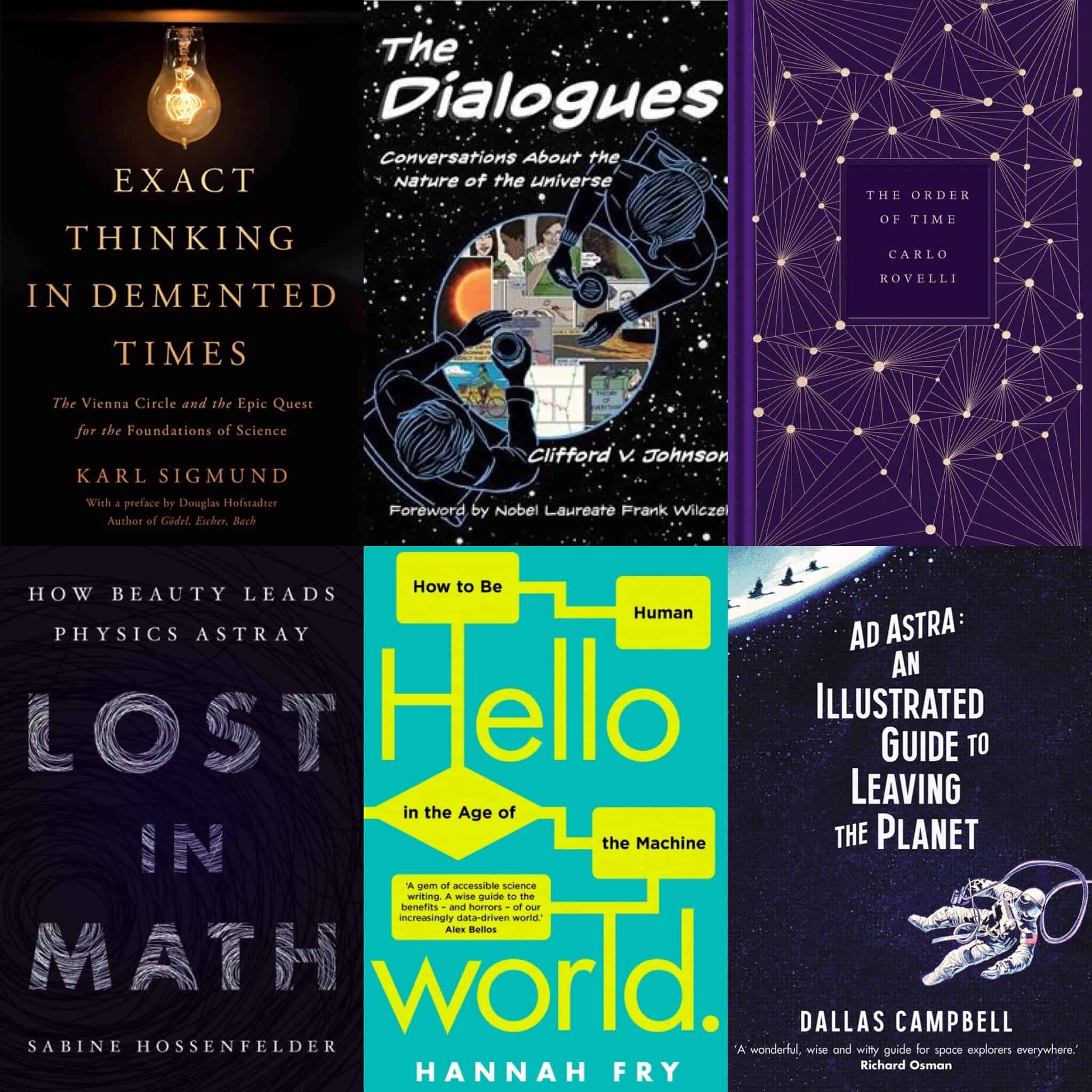
books on our 2018 shortlist


The shortlist for Physics World’s 2018 Book of the Year

Treknology: the Science of Star Trek from Tricorders to Warp Drives by Ethan Siegel

The fictional universe of Star Trek has always been applauded for its scientific touches, and has inspired countless of today’s scientists and astronauts from a young age. In Treknology, astrophysicist and science writer Ethan Siegel delves into the fact, fiction and everything in between of the physics, biology, chemistry, engineering and advanced technology depicted in the futuristic world of Star Trek. With its large format, glossy images and illustrations, and lucid writing, this book is an excellent guide to science at the final frontier.

Ad Astra: an Illustrated Guide to Leaving the Planet by Dallas Campbell

Next year will mark the 50th anniversary of the Apollo 11 mission, which saw humankind land on the Moon for the first time. It’s no surprise then, that we have spaceflight on the brain. Broadcaster and author Dallas Campbell’s Ad Astra is our go-to reference guide to a detailed but simplified history of human spaceflight. Charming, witty and humorous, Campbell’s book is not just a historic view – it will hopefully remind all readers that the future of space exploration is bright.

Exact Thinking in Demented Times: the Vienna Circle and the Epic Quest for the Foundations of Science by Karl Sigmund

The Vienna Circle was an “assemblage of some of the most impressive human beings who have ever walked the planet”, according to author and professor of mathematics at the University of Vienna Karl Sigmund. In Exact Thinking in Demented Times, Sigmund tells the tales of these giants of science and philosophy, getting into their world views and ideas. This lively and somewhat idiosyncratic book mirrors the intellectual, personal and political conflicts it describes and analyses.

Beyond Weird: Why Everything You Thought You Knew About Quantum Physics is Different by Philip Ball

Spooky, strange and somewhat impenetrable, quantum mechanics is often thought of as impossible to fully understand, and very difficult to explain to a general audience, especially without falling into the trap of analogies that never quite work. In his latest book, veteran science write Philip Ball tackles the “weird” label, pointing out that quantum theory simply reveals how nature truly works, absurd though it may seem to us at times. Indeed, he says, the inherent “weirdness” is in our understanding, not in nature. Beyond Weird tackles the varied interpretations of quantum mechanics – a bold and much need addition to physics literature.

The Order of Time by Carlo Rovelli

Albert Einstein once said that “time is an illusion”. In opening chapter in his new book, The Order of Time, Italian-born physicist and bestselling author Carlo Rovelli writes that “perhaps time is the greatest mystery”. Despite this, Rovelli attempts to tease meaning from humanity’s centuries-long quest for a deeper understanding of time, as he condenses complex ideas into beautifully written prose. Along with some solid science, anecdotes, history, art, philosophy and culture are what make this tiny tome yet another formidable addition to popular-physics literature from this science poet.

Lost in Math: How Beauty Leads Physics Astray by Sabine Hossenfelder

Theoretical physics is dead – long live theoretical physics. That is the bold rallying cry from veteran blogger, first-time book author and theoretical physicist Sabine Hossenfelder in Lost in Math. Dissatisfied and ill at ease with many of the “big ideas” that rule the roost in fundamental physics today, including supersymmetry, string theory, branes, M-theory and extra dimensions, Hossenfelder takes her fellow physicists’ search for “beauty” in science to task. “The more I try to understand my colleagues’ reliance on beauty, the less sense it makes to me,” she writes, as she confronts physicists on why their ideas aren’t working.

The Dialogues: Conversations About the Nature of the Universe by Clifford V Johnson

This non-fiction graphic novel uses the teacher–pupil relationship as a format of discourse on complex topics in physics, ranging from inflation and relativity to the philosophy of science and discussions of experimentation and geometry. The artist and author is physicist Clifford Johnson and his book is The Dialogues. Over the course of 11 conversations, each intricately drawn and written by Johnson (who is a self-taught artist), you will meet a host of characters in a variety of locations, all of whom are attempting to better fathom the fundamental laws of our universe.

When the Uncertainty Principle Goes to 11: Or How to Explain Quantum Physics with Heavy Metal by Philip Moriarty

It is probably fair to say that the general overlap between heavy-metal music fans and quantum science enthusiast is small, perhaps even niche. But that isn’t to say that fans of one can’t be converted to the other – at least that is what physicist and metalhead Philip Moriarty hopes to do with his first book When the Uncertainty Principle Goes to 11. From notes on guitar-shredding and mosh pits to Fourier transforms and nanoscience, tune in for a wild ride through physics… and turn up the volume.

What is Real: the Unfinished Quest for the Meaning of Quantum Physics by Adam Becker

The birth of quantum mechanics proved to be a big paradigm shift for modern physics at the start of 20th century, so it is no surprise that many a book has told the tale of its key players  such as Niels Bohr, Werner Heisenberg and Erwin Schrödinger. But every good story has interesting characters lurking in the background, and telling their tale can provide an interesting shift in perspective. In What is Real? science write Adam Becker does precisely that, as he provides a wide-ranging and character-driven history of the struggle for a coherent interpretation of quantum mechanics, going into why Bohr and co’s so-called “Copenhagen interpretation” emerged victorious over, say, the “many worlds” of Hugh Everett or the pilot-wave theory of David Bohm. “The history behind the physics can guide us in our pursuits…The path that led us here can give hints about the way forward,” writes Becker, perfectly summing up why he wrote this bold book.

Hello World: How to be Human in the Age of the Machine by Hannah Fry

If you have been to a physics conference in the past year or two, there is a distinct possibility that the sessions on artificial intelligence and machine learning (no matter what physics topic the conference was focused on) were some of the most popular. With this hot trend making its way into laboratories across the world, now is the perfect time to get to grips with the language of machines. Author Hannah Fry’s latest book Hello World will help you do just that, with her anthology of algorithm-related anecdotes. Equal parts praise and condemnation, Fry makes a compelling case for how much algorithms are already an integral part of modern life.

2018 Breakthrough of the Year: Hamish Johnston’s shortlist

One of the highlights in the Physics World calendar is the annual announcement of our Breakthrough of the Year, which in recent years has been awarded to such landmark achievements as the first multimessenger observation of a neutron star merger, the detection of gravitational waves by the LIGO scientific collaboration, and the simultaneous quantum teleportation of two fundamental properties of the photon.

It’s always hard to choose a single winner, and even to pick out the nine other scientific breakthroughs that make it into our Top 10, but this year we realized that we truly have an embarrassment of riches. That’s because three new expert editors have joined the Physics World team to expand our coverage of research fields that benefit from an interdisciplinary approach – medical physics and the biosciences; environment and energy; and materials science and technology – and we wanted to reflect that expanded scope in the 2018 award.

So, over the next few days, each of our online editors will select their own top five shortlists from the research they have covered in 2018. Their selections will be based on three criteria:

  • Significant advance in knowledge or understanding
  • Importance of work for scientific progress and/or development of real-world applications
  • Of general interest to Physics World readers

After all the shortlists have been published, the editors will huddle together in a locked room to debate and decide which of the breakthroughs will make it into the Top 10 – and which one will be the overall winner. The final announcement of the Physics World 2018 Breakthrough of the Year will be made on Thursday 13 December.

First up are my five picks, which cover core physics topics ranging from cosmology and ultracold atoms through to quantum optics, superconductivity and particle physics.

Ultracold atoms quench a thirst for universality far from equilibrium

Physicists are pretty good at describing matter at or near equilibrium, but nature can be violent, and many important physical processes involve rapid changes far from equilibrium. One way of making sense of far-from-equilibrium processes is to look for universality, whereby very different systems behave in very similar ways. Studying universality far from equilibrium had proven very difficult, but now three independent groups of researchers have done so using ultracold atoms.

Pencil trap

In all three experiments atomic gases were subjected to violent changes. In one experiment, interactions between the atoms were suddenly switched on; in another, a 3D gas was suddenly confined to 1D; and in the third experiment, the spin states of the atoms were suddenly allowed to fluctuate. Thanks to this pioneering work, ultracold atoms could soon be used to simulate a wide range of far-from-equilibrium phenomenon from galaxy formation to colliding nuclei. The work was done by Christoph EigenZoran Hadzibabic and colleagues at the University of Cambridge and University of Colorado; Jörg Schmiedmayer and colleagues at the Technical University of Vienna and the University of Heidelberg; and Maximilian Prüfer and colleagues at the University of Heidelberg.

Quantum mechanics defies causal order, experiment confirms

In classical physics – and everyday life – there is a strict causal relationship between consecutive events. If a second event (B) happens after a first event (A), for example, then B cannot affect the outcome of A. But now, Jacqui RomeroFabio Costa and colleagues at the University of Queensland in Australia have done an experiment that shows that quantum mechanics can allow events to occur with no definite causal order. They created a “quantum switch”, in which a photon can take two paths. One path involves the photon being subjected to operation A before operation B, while in the other path B occurs before A. If the operations are performed close together in time, then it becomes impossible to tell which was done first. This “indefinite causality” was first predicted in 2012 and the effect – along with team’s quantum switch – could prove useful for processing quantum information.

Proton pressure

Internal pressure of proton is measured for the first time

It is a pressure cooker inside the proton, with crushing forces exceeding those found in a neutron star. That is the conclusion of Volker Burkert and colleagues at Jefferson Lab in Virginia, US who have studied how electrons scatter from protons. They calculated that the quarks inside a proton are subjected to a pressure of about 1035 Pa – about ten times greater than the pressure at the centre of a neutron star — and showed how the pressure varies from the centre to the edge of the particle. As well as providing important information about the strong force, which binds the quarks together, the new technique could lead to a better understanding of the mechanical properties of protons and other hadrons.

Superconductivity spotted in a quasicrystal

Conventional superconductivity arises when pairs of electrons form via an interaction with phonons, which are particle-like deformations that propagate through crystalline lattices. Quasicrystals do not have translational symmetry and therefore do not have crystalline lattices – and should therefore not be conventional superconductors. Since the first quasicrystals were discovered in 1984, some physicists have suggested that superconductivity could occur in quasicrystals and now Keisuke Kamiya and Noriaki Sato at Nagoya University in Japan and colleagues have shown that a metal-alloy quasicrystal is a superconductor a temperatures lower than 0.05 K. Their discovery could lead to the creation of new materials that display fractal superconductivity.

Ancient hydrogen reveals clues to dark matter’s identity

One of the most important unsolved mysteries of physics is the nature of dark matter – the invisible stuff that makes up 26.8% of the total mass and energy in the universe and has a profound effect on the large-scale structure of the universe. Now a potentially huge breakthrough in the study of dark matter has come from an unlikely source: radio emissions detected from hydrogen gas that existed just 180 million years after the Big Bang.

Illustration of the early universe

Using data from the EDGES all-sky radio antenna in western Australia, a team led by Judd Bowman of Arizona State University have argued that the ancient hydrogen is significantly colder than had been expected. Picking up on their work, Rennan Barkana, of Tel Aviv University, has suggested that dark matter is responsible for the hydrogen’s low temperature. If Barkana is right, this is the first direct observation of a non-gravitational interaction between dark matter and conventional matter and could point to a new way of studying the black stuff.

  • Check back tomorrow for Anna Demming‘s top 5 breakthroughs in materials science and technology.

The spirit of science

History teaches us that fundamental science is critical to the development of revolutionary technologies. In the early 1600s, Galileo improved the design of telescopes to advance astronomical observations, but those same devices also paved the way for ocean voyage. In the early 20th century, Einstein’s curiosity in space–time, energy and matter triggered his general theory of relativity that in turn led to satellite navigation. Galileo and Einstein were both primarily motivated by fundamental science, but their achievements also directly led to important technologies that have had far-reaching consequences in everyday life.

Fundamental science is critical when it comes to developing new technologies – not only because fundamental science may directly lead to great inventions but also because it has a deeper influence in shaping thinking. It makes one ask probing questions, forces one to critically check the most basic principles, and pushes one to think in the most creative and revolutionary way.

Besides leading to new technologies, fundamental science also exhibits an intrinsic beauty. Human beings have always been fascinated by fundamental questions such as how the universe was born, how matter forms, what kinds of matter exist and how consciousness emerges.

Although most of these questions remain mysterious, progress has been made in understanding them. Indeed, such understanding often exhibits great elegance. James Clerk Maxwell, for example, unified the phenomena of electricity and magnetism into a set of simple equations. Despite their simplicity, these equations display rather neat structures, highlighting the symmetry between the two.

Beauty and applications

Theoretical condensed-matter physics is one of the areas of fundamental science that has intrinsic beauty and the potential for applications. This area focuses on possible forms of macroscopic systems and how different forms convert into each other. For example, one gram of water molecules can be viewed as a macroscopic system and it can take up various forms: ice, water or vapour. These different forms are also called the different phases of water and the process for the water to go from one phase into another is called a phase transition.

Condensed-matter physics is the subject that investigates phases and phase transitions. More concretely, it looks at the rationalization, detection, realization, exploration, characterization and classification of phases as well as transitions among them. As one central goal of science is to explain observed phenomena, a major effort in condensed-matter physics is devoted to the rationalization of experiments on various materials. Typical questions in this direction include – but are not limited to – why certain materials are insulating whereas others appear to be metallic.

In many cases, condensed-matter theorists also need to propose methods to realize and detect various phases. A related field under intense study is how to realize and detect Majorana fermions in solid-state materials. These particles are their own antiparticles and possess potential applications in quantum computing.

The exploration of new phases of matter is particularly exciting and such breakthroughs can often significantly boost the field. For example, researchers used to think all systems will equilibrate thermally, but recently, phases that never fall into -thermal equilibrium have been found. These so-called many-body localized phases are now being widely studied.

When a new concept is first proposed, scientists may not know how to characterize it, so it is sometimes important to propose new ways to do so. Historically, researchers used symmetries to characterize phases, but it is now better appreciated that quantum entanglement needs to be incorporated into the characterization too. Finally, after collecting and understanding the plethora of phases, it will be important to classify all of them according to some principle. Such classifications yield a unified understanding of the “zoo” of possible phases.

One example I have worked on is quantum spin liquids – a phase that displays an intricate interplay between quantum entanglement and symmetry. This work is one of the first systematic studies of 3D symmetry-enriched long-range entangled phases. Based on this work, I proposed a new way to characterize topological crystalline insulators, which are phases that have non-trivial topological properties in the presence of symmetries. The new characterization is more general than the conventional method, and, interestingly, it is also simpler. More recently, my colleagues and I have proposed explanations for the remarkable experimental discoveries of unconventional insulating and superconducting behaviours in twisted bi-layer graphene.

Long-term vision

The importance of fundamental science is recognized by many countries. Yet due to basic science’s lack of immediate applications, it has largely been overlooked in traditional Chinese culture. The general public in China often cares more about issues that tackle questions about everyday life than fundamental questions. But the country needs to devote more resources to fundamental research.

It may be impossible for everyone in a country to be a researcher in fundamental science, but a good environment for fundamental science helps the country shape its spirit. When the entire country possesses a scientific spirit, it will be hard to stop the creation of original technologies. I hope more Chinese scientists will become interested in fundamental research and together we can make great discoveries. In the long run, I hope the fundamental sciences we study will yield powerful technology. More importantly, through all our efforts, I hope we can contribute to the spirit of China in a positive way, however minor it may appear in the short term.

Harvard physicist Liujun Zou wins inaugural Physics World science-communication award

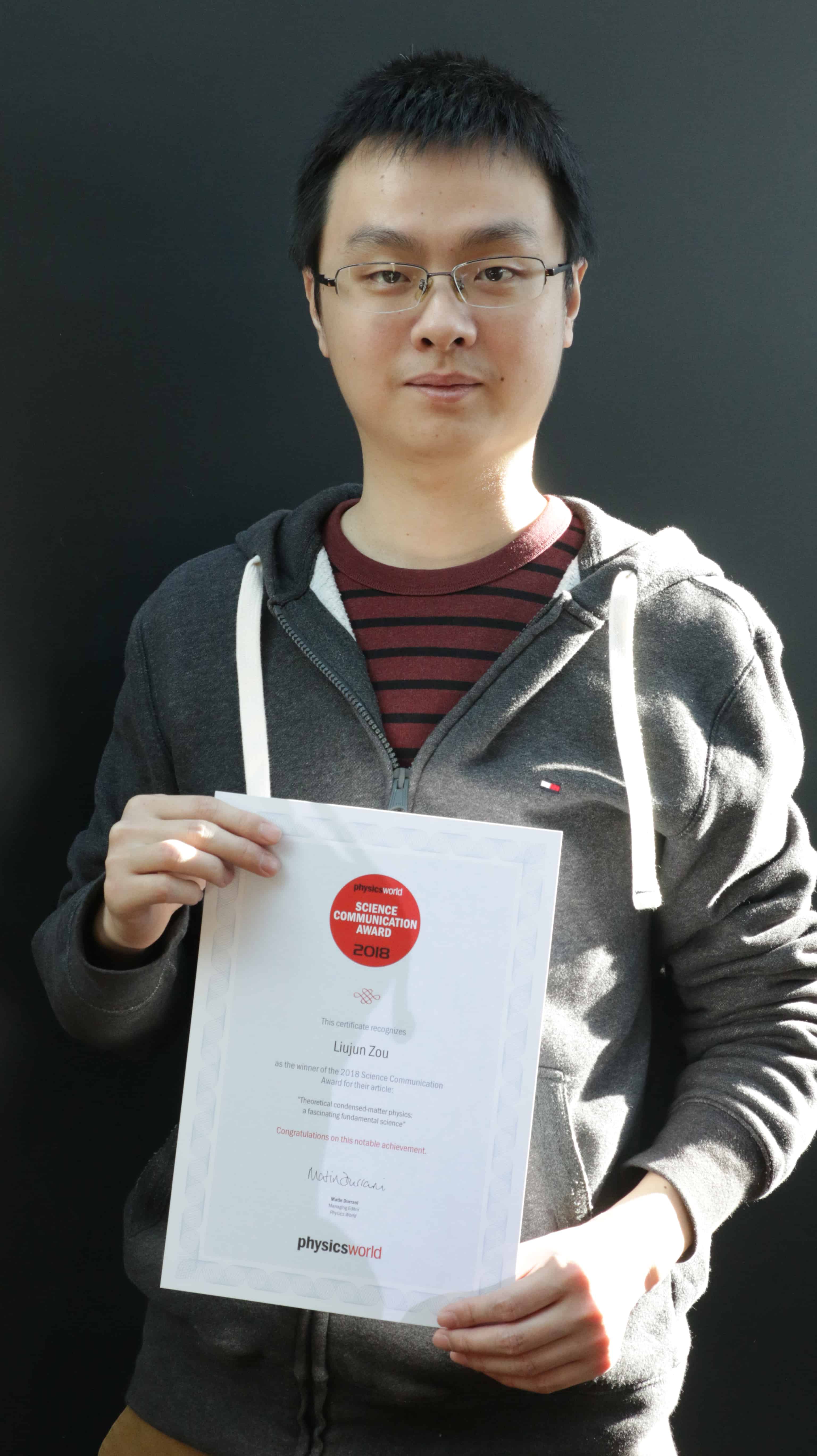
Photo of Liujun Zou from Harvard University with a certificate as the winner of the inaugural Physics World science-communication award

Physics World is pleased to announce that Liujun Zou from Harvard University in the US has won the magazine’s inaugural science-communication award, which was set up “to celebrate the huge advances that China is making in science, engineering and medicine”.

Entrants to the competition were asked to answer the question: “How is your research contributing to China’s rise as a leading science nation?”

Zou, who is doing a PhD in condensed-matter physics at Harvard, picked up the prize, which comes with a $2000 travel grant, for his essay entitled “The spirit of science”.

In the article, Zou says that while basic science is recognized by many countries, it has largely been overlooked in traditional Chinese culture because it is seen to lack immediate applications.

China, however, needs to devote more resources to fundamental research, Zou writes. That’s because basic science not only leads to “great discoveries” that are important in their own right, but is also vital to develop technologies of the future.

“Through all our efforts, I hope we can contribute to the spirit of China in a positive way, however minor it may appear in the short term,” Zou concludes.

Zou’s article, which will also appear in the January 2019 issue of Physics World magazine, responded brilliantly to the challenge of the competition, by showing how seemingly abstract theoretical physics can have a huge long-term impact on society. Zou, who is originally from China, has been based at Harvard for more than five years.

The photo shows him picking up the award at Harvard on 30 November, which was presented to him by Physics World reviews and careers editor Tushna Commissariat.

Entries to the competition were judged by a panel of senior Chinese scientists and science communication specialists, with the winning entry best meeting the guidelines, which were to convey complex ideas with clarity and flair, have a persuasive and creative line of thinking, be technically accurate, and have an enjoyable and accessible writing style.

The panel was chaired by Matin Durrani, the managing editor of Physics World magazine. The rest of the panel consisted of: Shi Yu (Department of Physics, Fudan University); Xiaoxue Chen (science journalist at The Intellectual); Yi Rao (School of Life Science, Peking University); Zhihong Xia (Department of Mathematics, South China University of Technology); Lv Li (Institute of Physics, Chinese Academy of Sciences); Yang Ji (Institute of Semiconductors, Chinese Academy of Sciences); Feng Pan (Deptartment of Material Science, Tsinghua University); Jingkang Deng (Director, Tsinghua University Library); Long Xiao (Deputy Director, Peking University Library); and Zexian Cao (Institute of Physics, Chinese Academy of Sciences).

For more about Physics World’s coverage of physics in China, check out the latest Physics World China special report.

Copyright © 2026 by IOP Publishing Ltd and individual contributors