Iron in Earth’s core might be cubic, not hexagonal

A long-standing debate about the structure of solid iron at the centre of the Earth looks set to be reignited following new laboratory tests carried out by scientists in the US. The researchers say their results imply that iron crystals in the Earth’s inner core have a body-centred cubic (BCC) arrangement – in contrast to the hexagonal-close-packed (HCP) structure pointed to by many previous results.

Scientists have good evidence that the exceptionally high pressures that exist in Earth’s inner core dictate that the iron there is solid – in contrast to the molten iron present in the outer core. That evidence comes in the form of data from earthquakes. By plotting the paths of seismic waves through the Earth, seismologists have concluded that shear waves – which cannot propagate in liquids – do not travel through the outer core but do travel through the inner one.

However, for several decades debate has raged about how the atoms in that solid iron are arranged. At room temperature and pressure, iron has a bcc lattice, which means that every atom is surrounded by eight others – four in each of the layers immediately above and below it. But at higher pressures, iron atoms form the slightly tighter hcp structure, such that each atom has 12 neighbours – six in its own layer and three in those above and below it.

Diamond anvils

The situation at very high temperatures and pressures, however, is not well understood. Several experiments using iron heated inside high-pressure diamond anvil cells have shown that here too the structure is hcp. These experiments involve squeezing tiny samples of iron between the tips of diamonds, heating them with a laser beam and at the same time illuminating them with X-rays from a synchrotron source to determine the crystal structure from the X-ray diffraction pattern.

In fact, according to Guoyin Shen of the Carnegie Institution of Washington, most Earth scientists are persuaded that the iron in the inner core does in fact have a hexagonal-shaped lattice. “Within the community,” he says, “many think that it is a done deal – that the structure of iron seems to be hcp.”

Seismic anisotropy

There is a problem, however. Seismologists have established that shock waves from earthquakes travel more quickly through the Earth when they go from pole to pole than when they go along the equator. This “anisotropy” ought to be reflected in the structure of the iron, such that it is significantly more elastic at right angles to its atomic layers than it is parallel to them. In other words, that the spacing, and hence the give, between adjacent layers should be significantly greater than that between neighbouring atoms within the same layer. But theorists have calculated that very high temperatures should flatten hcp iron – making the difference in spacing too small to account for the seismic anisotropy.

In the latest research, Shen and his Carnegie colleagues Ross Hrubiak and Yue Meng show experimentally that the inner core iron might in fact have a bcc structure. They did so after realizing that the diamond cell experiments could be giving misleading results. These “in-situ” measurements provide X-ray diffraction patterns of the iron during the brief period that it is heated by the laser. But because the X-ray beam is not much narrower than the hot spot created by the laser there is a chance, says Shen, that the high-temperature data become “contaminated” by data from regions at lower temperatures.

To try and get round this problem, Shen and co-workers have developed an alternative technique in which they compress samples of iron in a diamond anvil cell but this time take X-ray diffraction images before, during and after each heating pulse. Using the HPCAT beamline at the Argonne National Laboratory’s Advanced Photon Source, they find that at relatively low pressures and temperatures the diffraction patterns are as would be expected from hcp-iron grains.

Two distinct axes

However, once the group raised the pressure above about 10atm and the temperature well above 4000 K it discovered that the crystal grains became oriented along two distinct axes. Because the grains’ orientation might be preserved across phase transitions, the researchers say that this “bi-axially aligned microstructure” is evidence that the iron adopts a bcc structure at high temperatures and then transforms back into hcp when it cools down.

Buoyed by these results, Shen and colleagues then carried out fresh measurements at inner-core like conditions. They realized that, as they and other groups had found previously, many of the spots in the diffraction pattern would be due to hcp-iron. But they predicted that they should also see one spot due to bcc-iron in a particular orientation – and say that they have observed it. “In earlier experiments we considered that diffraction spot as noise,” says Shen, “but now it becomes evidence that supports our view.”

Shen acknowledges that others in the field are likely to be sceptical, given potential doubts about his group’s interpretation of the microstructure data and the fact that it has so far only seen one family of diffraction planes that it can attribute to bcc-iron. He says that he and his colleagues are now focused on trying to improve the in-situ measurements, either by reducing the X-ray spot size or increasing the X-ray energy to boost chances of finding more diffraction information.

The research is reported on the arXiv server.
Learning from the ozone solution

In the May episode of our Physics World Stories podcast, Andrew Glester is in conversation with the Nobel laureate Mario Molina. The Mexican researcher shared the 1995 Nobel Prize in Chemistry for his work on understanding formation and decomposition of ozone in the Earth’s atmosphere. He talks about how winning the award transformed his status as a scientist, giving him a unique platform to influence politicians.

The banning of substances (mainly CFC chemicals) that deplete the ozone under the 1987 Montreal Protocol is hailed as a shining example of coordinated global action in tackling an environmental issue. Molina talks about how industries in the 1980s paid attention to the scientists at a relatively early stage, and sought alternative products and processes to CFCs. He engages with the reasons why it is harder today when dealing with the more multifaceted issue of climate change.

Later in the podcast, Glester picks up the story with Lorraine Whitmarsh, a social scientist at the Tyndall Centre – a network of universities seeking sustainable responses to climate change. Whitmarsh is interested in why the general public responds to the science of climate change in particular ways. She is also interested in practical solutions for shifting to a lower carbon lifestyles and offers her top tips for reducing your carbon impact.

If you enjoyed this podcast then you can subscribe via iTunes or your podcast provider. Also check out Physics World Weekly – our news-focused podcast presented by the Physics World editorial team.

Modified Sierpinski triangle makes a good mid-infrared sensor

Fractals are becoming popular for when it comes to designing microwave and radio-frequency antennas thanks to their “self-similarity” that allows the antenna to better collect and focus broadband, multi-frequency light. Researchers at the National University of Singapore have now made a molecule sensor from a modified Sierpinski triangle that works in the mid-infrared range. The device could be used to profile the fingerprints of various biological elements, such as cells and protein monolayers.

Researchers have recently begun to make use of fractal patterns to manipulate surface plasmons, which are quantized collective oscillations of conduction electrons on the surface of metallic nanostructures that interact strongly with light. Such strong interactions allow the plasmons to concentrate light into subwavelength volumes, well below the diffraction limit of light. The applications are many: sub-diffraction focusing, transparent metallic electrodes, improving photovoltaic efficiency, and enhancing molecular fluorescence, to name but a few.

 Modified Sierpinski fractal model

In their work, researchers Chengkuo Lee and Dihan Hasan in the Department of Electrical and Computer Engineering and the Center for Intelligent Sensors and MEMS at the NUS studied a Sierpinski fractal model made of gold and chromium.

“Our original goal was to investigate the properties of this fractal structure once we had tailored its dimensions for mid-infrared sensing,” explains Hasan. “We then came up with the idea of modifying the model slightly to drastically improve its sensing properties in this spectral range.”

The Sierpinski fractal is an equilateral-triangle-shaped fractal with intrinsic “self-similarity” – that is, its constituent triangles are repeated at smaller scales (or “orders”). Self-similarity in electromagnetic structures is important for miniaturizing the size of a device so that it can focus light at a particular frequency. In our work, we slightly modify the existing fractal model without destroying its self-similarity,” says Hasan.

Bow-tie nanostructures

The Sierpinski fractal is particularly suitable for merging with bow-tie nanostructures, he adds. These structures are among the best at manipulating localized surface plasmon resonances and enhancing light fields the most thanks to a “lightning rod” effect at their sharp tips that allow them to act as nanoantennas. These antennas possess “plasmonic modes” that can be tuned to resonate with the optical transitions in molecules nearby. It is these plasmonic modes that increase the coupling between light emitted by neighbouring molecules and the antenna, and means that they can be used as sensors.

Sierpinski fractals have already been used a key element in many high-performance plasmonics applications, such as nanolithography, ultralow power optical trapping, and plasmonic photography film for high density data storage. The problem is that it is difficult to make a pure Sierpinski fractal because of geometric differences at the junctions of the fractal components. What is more, previously-fabricated fractals did not fully exploit the lightning rod effect of nano-bow-ties.

No need for molecule functionalization

Lee and Hasan have now used advanced electron beam lithography to precisely tune the geometric structure of these fractals. By improving their architecture, the researchers have found that the structures can enhance light fields in the mid-infrared range (3000 to 8000 nm). The way the components are arranged also maximizes the lighting rod effect of the nano-bowtie/fractal patterns.

“Conventional resonant sensing focuses mostly on the visible part of the spectrum,” explains Hasan. “Here, we investigate sensing in the mid-infrared spectral range, which is the range in which many biological molecules absorb light.”

Probing these molecular absorptions does away with the need for functionalizing the biological molecules so that they can be picked up the sensor.

Towards on-chip molecule sensors

“Sensing in the infrared will also allow us to more reliably discriminate sequential events occurring in a biological system,” he adds. “And the multispectral fractal platform we describe will ultimately allow for high-throughput multiplexed detection of various molecules on a single platform. This should improve the signal-to-noise ratio of such imaging at multiple wavelengths of interest.”

The broadband and enhanced light absorption made possible by the modified fractalization is promising for sensing biological molecules at mid-infrared wavelengths, he tells Physics World. “But that is not all: the enhanced light-matter interactions that come about thanks to the increased number of light-absorbing ‘hotspots’ also makes the device more sensitive in the optical range. Here, light could be efficiently converted into heat for on-chip electronic readout, something that will help overcome one of the major limitations of mid-infrared sensors – their bulky size.”

The team, which reports its work in the IOP journal Nano Futures 2 025005, says that is now busy working on integrating the platform with 2D materials to make on-chip molecule sensors. “We are actively studying the thermoelectric properties of various 2D materials to this end,” adds Hasan.

Summit examines challenges of developing AI for cancer care

Over 100 radiologists, clinical oncologists, computer scientists, industry experts and funders came together last week for a pioneering stakeholder summit to discuss the challenges of developing artificial intelligence (AI) in imaging and cancer treatment.

The event, “Grand challenges in artificial intelligence in clinical radiology and clinical oncology”, took place at The Wellcome Collection in London on 16 May. The brainchild of Nicola Strickland, President of The Royal College of Radiologists, the summit was organised in partnership with The Alan Turing Institute, Health Data Research UK (HDR UK) and the Engineering and Physical Sciences Research Council.

The packed programme featured a keynote speech from renowned surgeon Lord Ara Darzi, who called on delegates to urgently collaborate to progress AI in clinical practice, both for the benefit of patients and to maintain the UK as a world leader in innovation after leaving the EU.

HDR UK’s Andrew Morris outlined the potential for national data sharing to realise benefits for patients and improve AI training, stressing the timeliness of the meeting given the UK government’s preparations to fund AI initiatives into general diagnostics and cancer detection.

Recurring themes revolved around how academics, funders and technology companies could and should collaborate to accelerate AI, as well as the ongoing challenge of sourcing large, robust sets of data to train algorithms and machine learning programmes.

Delegates were also introduced to an array of developing projects from universities and industry, including AI algorithms and machine learning that detects lung cancer nodules, models pulmonary hypertension and helps oncologists outline tumours ahead of radiotherapy.

“Our key stakeholder meeting demonstrated that the UK has a real opportunity to take the lead on artificial intelligence programmes in healthcare, if clinicians and researchers are brave enough to embrace its potential and work with industry to shape the application of machine learning in practice,” said Strickland.

“For clinical radiologists and oncologists to survive and thrive in the swelling digital revolution, it is vital these medical specialities work in collaboration with funders, AI experts and industry to develop AI that is robustly tested and regulated so it can be confidently put into practice to augment the work of clinicians and bring greater benefit to patients.”

World Metrology Day: Celebrating an underappreciated science

In an ever-changing world the few constants we can rely on become ever more important. The distance to the nearest high street bank may increase, hem lines may rise and fall, but the metre will always measure the same length. Or will it? With several SI units facing redefinition in 2019, the National Physical Laboratory (NPL), the UK’s national measurement standards laboratory, opened its doors to around 5000 visitors for its biennial open house to shed light on what we mean when we refer to everyday units and the work that goes into defining them.

“Measurement is what makes science science,” said NPL researcher Michael de Podesta, when I asked why metrology matters. No surprise then that scientists have discussed ways of defining internationally recognised units of measurements for centuries. However it was not until 1960 that the International Bureau of Weights and Measures first established the International System of Quantities (SI) formerly the International System of Units: the candela, kilogram, metre, second, Ampere, Kelvin, and the mole. This concise list in fact caters for the wide range of measurands across the physical sciences, as other units in current use can be defined in terms of these seven. For example, an Ohm can be defined as kg m2/s3 A2 from the definition of resistance as power / current2.

There are logical explanations for the original definitions of these units: the metre was 1 ten millionth of the distance between the North Pole and the Equator to the best estimates available at its invention in 1799; the second was 1/60th of 1/60th of 1/24th of a day on account of clock conventions. However these definitions have drifted from their original explanations as technological progress has demanded ever greater precision. “A lot of the SI units have been superceded technologically,” said de Podesta. “As technology advances measurements of the fundamental constants keep changing, which is bonkers, so we want to define the units in terms of these constants.”

Constant units

In 1983 the General Conference on Weights and Measures (CGPM) redefined the fundamental reference for the length of a metre – once set by a metre rule in Sevre just outside of Paris. It is now defined as the distance light will travel in a vacuum in 1/299792458 of a second, and that as far as we know is a fundamental constant. As well as the metre, the second has also been redefined in terms of the universal constant of the speed of light in a vacuum. However, there is a noticeable lag between the fundamental reference for other SI units and the technological capabilities of the present day. As Ian Robinson told attendees at NPL’s Open House, the fundamental reference for the kilogram remains a lump of platinum in Sevre, which is taken out every 50 years, weighed, cleaned and then locked away. As Robinson put it, “Not the best way to define mass in these modern times.”

On 16th November 2018 the CGPM will vote to adopt a series of new definitions for the kilogram, Kelvin,  mole and Ampere. Why has it taken a further 35 years to bring the remaining definitions in line with the metre and the second? In fact the technology to define units in terms of fundamental constants is far from trivial.

Robinson, who joined NPL in 1976, worked with Bryan Kibble shortly after the 1975 invention of the Kibble balance, which will redefine the kilogram. The Kibble balance works by putting a current through a coil and measuring the induced force balanced against the gravitational pull on a kilogram. Kibble’s invention removed some of the inaccuracies of its predecessor the Ampere balance, but as Robinson said it is still “like measuring a bag of sugar in a hurricane”.

De Podesta’s work at NPL focuses on different ways of measuring temperature, and has been integral for redefining the Kelvin. “We use electromagnetics, acoustics, precision weighing – it’s a tour de force that brought together teams across NPL,” he says. Their approach uses an acoustic thermometer. As de Podesta explains, the speed of sound in a gas is exactly related to the temperature of the molecules, so he and his colleagues are actually measuring the speed of sound carried by the molecules of the gas with ultraprecision. However having finally achieved this super accurate thermometer, using it in lab proved a struggle. “It was totally humiliating – you say you’ve made the most accurate temperature and then you can’t take the temperature of something in the lab,” says Podesta. “It turned out that it was all the other thermometers that were wrong.” The corrections are small – 0.004 °C at 30 °C – however there are experiments for length measurements for example, where that level of temperature precision matters.

Quantum metrology

Shrinking device sizes also place new demands on measurement science. At NPL’s single electron device lab they are working on an alternative definition for the Ampere. Their GaAs two-dimensional electron gas experiments pump electrons into a sink that holds just one electron at a time. From there electrons hop across into a transistor device in single file, defining the smallest current possible. For larger currents the Ampere can be defined macroscopically in terms of the voltage in a superconducting Josephson junction and the resistance of the quantum Hall effect. However, as devices shrink ever smaller a definition in terms of a single electron device becomes more and more important.

At this scale terms like temperature take on new ambiguities, as their statistical definitions no longer have meaning. “You can describe the temperature in terms of the probability of an electron occupying a particular energy level,” says Masaya Kataoka. “But if this is set then it has no temperature.” In addition, although these devices are devised to define current, at this scale where discrete charges move one by one continuous classical analogue current does not really exist.

Sunday 20th May was World Metrology Day 2018, a celebration of a science de Podesta feels is underappreciated. “When you see physics on the telly there’s a lot of emphasis on boffins and geniuses and maths – some people think physics is maths and that’s completely wrong.” He adds, “Maths is telling a story but what makes physics a science is when you compare with what actually happens.” The measurements for new standard definitions at NPL are checked across the world, with the National Institute of Science and Technology (NIST) in the US also playing a key role. It is reassuring that whatever may be going on in the rest of life, the international Standard of Quantities is something we can all agree on.

Biodegradable pressure sensor eliminates the need for second surgery

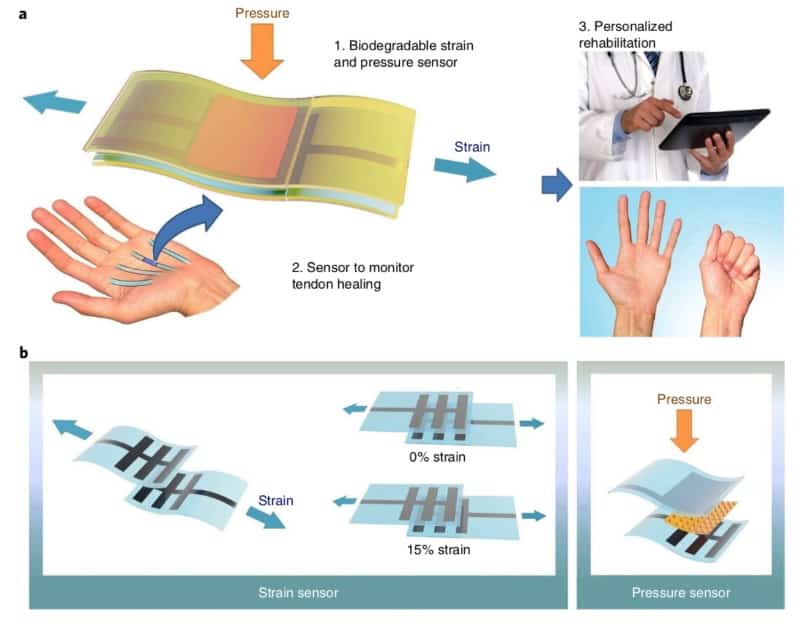
Every year in the USA alone, around 14 million people suffer from tendon, ligament and joint injuries. Many of these injuries require surgery, followed by a rehabilitation period to restore the repair site to its pre-injury function. A diagnostic sensor capable of measuring biomechanical characteristics of the affected tissue in real time would represent a significant step towards improved assessment of a patient’s recovery.

The sensor should, for example, be able to measure typical tendon strains (of less than 10%) after the surgery. However, existing implantable sensors either suffer from inadequate sensing capability or use materials with unreliable biocompatibility. Use of biodegradable materials would avoid the need for second surgery to remove the sensor. With that in mind, researchers from Stanford University devised a biodegradable sensor compatible with living organisms that can satisfy tissue recovery requirements by discriminating strain and pressure stimuli (Nature Electronics 1 314).

The sensor

The device consists of two stacked sensors that can accurately measure strain and pressure independently. For material design, the researchers used two biodegradable elastomers: poly-glycerol sebacate (PGS) and poly-octamethylene maleate citrate (POMaC). Two thin-film comb electrodes are sandwiched between two stretchable elastomer layers and when strain is applied, a change in capacitance is observed as the two electrodes slide relative to each other.

Biodegradable sensor

The pressure signal is monitored with a flexible and highly sensitivity capacitor supported by a thin elastic dielectric layer on both sides. This design allows the pressure sensor to work independently, without inducing any strain signal. The sensor responds in the millisecond range and can discriminate strains as small as 0.4% and pressures as small as 12 Pa (the amount of pressure exerted by a grain of salt).

Biocompatibility study

The team performed an in vivo study, which suggested that the device is compatible with a rat’s body. They tested the sensors by subcutaneously implanting them on the backs of rats. The rats were subjected to strain and pressure stimuli, and afterwards strain signal on tendon was measured. The sensor was observed to be stable for two to three weeks, when compared with a reference non-biodegradable sensor. Testing the sensor in vivo revealed that it was operational inside the body without any side effects and was functional for more than two weeks.

The researchers believe that this sensor – with high-sensitivity, faster response time and biodegradability – can play a valuable role in biomedical applications such as monitoring cardiovascular patches and reconstructive surgery. Sensors transmitting real-time information in vivo will open avenues for refined and personalized medicine where mechanical deformations and pressures can be easily monitored. The research team now plans to develop a biodegradable circuit capable of wirelessly transmitting measured signals through the skin.

Kelp forests under threat from acid seas

The kelp forests – those towering submarine tangles of brown seaweeds – may not survive the steady change of ocean chemistry.

Australian scientists have identified a risk to the kelp forests of the oceans, a new way in which carbon dioxide can change the world. Ever more acidic oceans could encourage weedy submarine grasslands to replace the rich habitats of the coastal kelp forests.

Although most climate change forecasts are based on computer simulation, this one has been tested in the real world. The scientists used natural volcanic seeps rich in carbon dioxide to observe the changes to sea floor ecosystems as water chemistry changes with greater levels of dissolved carbon dioxide.

“Carbon emissions might boost plant life in the oceans, but not all plant life will benefit equally,” said Sean Connell, of the Environment Institute at the University of Adelaide.

“Weedy species are quicker to capitalise on nutrients, such as carbon, and can grow faster than their natural predators can consume them.

Weedy turf wins

“Unfortunately, the carbon dioxide that humans are pumping into the atmosphere by burning fossil fuels gets absorbed by the ocean and favours weedy turfs, which replace kelp forests that support higher coastal productivity and biodiversity.”

He and colleagues from Australia, the US, New Zealand, Italy and Hong Kong report in the journal Ecology that they made a series of samples of submarine plant growth at natural volcanic vents in New Zealand’s Bay of Plenty: they looked at rocky reefs on which grew a mosaic of kelp and turf algae, along barren stretches grazed by sea urchins and a native New Zealand mollusc.

They chose the sites because the levels of carbon dioxide – and therefore the measures of acidity – in the water were roughly what climate scientists would predict for the end of this century, if humans go on releasing greenhouse gases.

They found that ecosystems changed with shifts in water chemistry. “While elevated carbon dioxide caused some weeds to be eaten in greater amounts, the dominant sea urchin predator ate these weeds at reduced amounts. This enabled the weeds to escape their natural controls and expand across coasts near the elevated carbon dioxide,” Connell said.

The slow but inexorable changes in ocean acidity will have inevitable consequences for coastal protection offered by natural ecosystems. Kelp forests provide habitat or nourishment for seals, sea otters, sea lions, whales, cormorants, gulls, terns and shore birds as well as fish. There is evidence that warming has already damaged some of Australia’s kelp forests.

Researchers have been issuing such warnings for years: among them Professor Connell and his co-author from Adelaide, Ivan Nagelkerken, who, three years ago, surveyed 632 scientific studies of a huge range of marine habitats to conclude that the overall effect of acidification was to impoverish ocean life.

“Under the level of acidification we will find in the oceans in a few decades, marine life is likely to be dominated by fast-growing and opportunistic species at the expense of longer-lived species with specialist lifestyles, unless we set some change in place,” said Nagelkerken.

“We need to consider how natural enemies might be managed so that those weedy species are kept under control.”

Physics World just got bigger

We are delighted to welcome three new expert editors to the Physics World team, each of whom will be working to expand our coverage of a specific research field that benefits from an interdisciplinary approach. Tami Freeman will focus on medical physics and the biosciences, Liz Kalaugher will specialize in environment and energy, and Anna Demming will be covering materials science and technology, particularly at the nanoscale.

Photos of Liz Kalaugher, Tami Freeman and Anna Demming

Tami, Liz and Anna have been writing about their specialist fields for many years, and you can explore their content in detail through our topic pages for medical physics, biophysics and bioengineering, environment and energy, and materials. We are also introducing specialist e-mail newsletters in each of these areas, and we’ll be in touch to let you know how you can sign up to receive these weekly e-mail updates.

In a particularly exciting initiative, our three new editors have also been working with groups of PhD students who have shown a real talent for science communication. Tami, Liz and Anna have provided training and mentorship to more than 50 student contributors over the last year or so, and these students have together have written more than 150 news articles about scientific advances that have piqued their interest.

This initiative has been so successful that we now plan to expand our student network into other fields covered by Physics World. If you are a PhD student who would relish the chance to work alongside our professional science journalists, or you know a student who is a great communicator, find out how to join our network of student contributors.

As ever, we’re keen to know what you think about the Physics World site and our newly expanded content programme. Please contact us at pwld@iop.org to let us know your views.

Doodling around mental health, the physics of Gulliver’s Travels, one excited astronomer

It is Mental Health Awareness Week, so a good time to pause and think about how things like stress and anxiety affect you, your friends and colleagues. In “Recognizing mental health in the research environment” Jenni Dyer –  head of diversity at the Institute of Physics – blogs about her experience at a one-day workshop exploring mental-health issues in the science, engineering, technology and mathematics.

Inspired by Dyer’s blog, physicist Jess Wade of Imperial College has sent us a doodle (see figure) in which she reflects on the myriad pressures bearing down on academics.

And if you missed “My invisible battle” about one physicist’s experience with mental health issues, I highly recommend it.

Scale plays a crucial role physics, and biophysics is no exception. It explains why the world isn’t populated by spiders several metres tall and why an ant can easily carry multiple times its own weight. In his series of Christmas Lectures given in 1968, the physicist Philip Morrison uses Gulliver’s Travels as an embarkation point for exploring the physics of the very small and the very big. The lectures are a tradition of the Royal Institution since 1825, and there are now lectures by 21 speakers and spanning the past 50 years available for your viewing  pleasure.

“I was excited enough that the signal appeared in my dreams and I had difficulty sleeping that night.” That is how Japanese astronomer Takuya Hashimoto reacted to the observation of oxygen in a galaxy 13.28 billion light-years away. It’s nice when a scientist gets such joy from their work.

Light-induced corneal cross-linking corrects vision

Lecturer at Columbia University, NY

Myopia, or short-sightedness, is almost twice as common in the US and Europe today than it was 50 years ago. It has also become an important problem in some Eastern Asian countries where it affects as much as 70 to 90% of the population. Although glasses and contact lenses are the first choice for many people, permanent vision correction by refractive surgery is becoming more popular, even though the procedure is not without risk. A team of researchers at Columbia University in New York has now developed a new, safe and non-invasive technique that makes use of a femtosecond laser to produce a low-density plasma in the cornea. The plasma generates reactive oxygen species that then react with collagenous tissue in the treated area to form cross-links and alter the refractive power of the eye.

In myopia, incoming light focuses in front of, rather than on the retina. Permanent corrective surgery techniques such as laser-assistedin situ keratomileusis (LASIK) and photorefractive keratectomy (PRK) work by reshaping the curvature of the cornea by laser ablating a portion of corneal tissue. Although they work well, these procedures can weaken the cornea and even lead to post-surgical complications. They are not suitable for patients with a weak cornea either.

New non-invasive approach

Researchers led by Sinisa Vukelic have now developed a new, safer approach in which a low-density plasma produced by a low-power ultrafast laser generates an ionization field within biological issue. Although the laser is powerful enough to produce the plasma inside the set focal volume, it does not have enough energy to damage biological tissue, explains Vukelic.

When applied to collagenous tissue (which is present in the cornea), this plasma ionizes water molecules in the region of interest. This ionization produces reactive oxygen species that then interact with collagen fibrils to form chemical bonds, or cross-links. These change the mechanical properties of the treated tissue, so changing the overall macrostructure (or curvature) of the cornea.

Changing the refractive power of the eye

“If we carefully tailor these changes, we can adjust the corneal curvature and thus change the refractive power of the eye,” Vukelic tells Physics World. “And since the process is photochemical, the induced changes remain stable.”

The researchers tested out their technique on pig eyes in the lab and rabbit eyes in vivo. Pig eyes are frequently used in ophthalmic ex vivo research, explains Vukelic, and rabbits as a model for correcting refractive errors.

The technique could not only be used to treat myopia but also conditions like hyperopia, astigmatism and keratoconus, he adds. “This non-surgical alternative to refractive surgery has fewer side effects and might also be suitable for patients with thin corneas, topographical abnormalities and dry eyes, since it would not disrupt the cornea or cause nerve damage.”

The team, reporting its work in Nature Photonics, says that it is now busy trying to understand how laser-induced cross-links deform the cornea. “We are also looking to bring the technique to the patient and start clinical trials in the near future,” says Vukelic.


Copyright © 2026 by IOP Publishing Ltd and individual contributors