Renewables in the EU and UK – the state of play

The European Union is in the midst of resetting its longer-term targets for renewables, given the expectation that it will more or less meet its overall target of getting 20% of its total primary energy from renewables by 2020, with 11 countries already achieving or even exceeding the national targets set by the EU. For example, by 2016 Sweden had got to around 54%, 5% over its target, although some others have been doing less well: by 2016 the UK had only got to around 9%, against the actually quite low 15% national renewable energy target that had been agreed with the EU. But most of the laggards may just about reach their national targets by 2020 or soon after, hopefully even the UK. For the next stage, the European Commission initially proposed a somewhat unambitious overall EU target of 27% of primary energy by 2030, with individual national targets to be left to each country to decide.

A bit cynically, you might say that, with the UK out of the EU by then, the EU overall should then be able to do better than 27%. Certainly, the European Parliament has called for the overall EU 2030 target to be raised to 35%, with, in addition, EU energy consumption to be cut by 40%, against the ECs recommended 30%. They also wanted at least 12% of the energy consumed in the transport sector to come from renewables. We await an EC ruling.

Wind is still the largest of the new (non-hydro) renewables in the EU, with over 155GW installed by the end of 2017 and offshore wind now adding to the total. It has been claimed that 30% of EU power could be from wind by 2030.

However, PV solar is coming up fast behind, with over 100 GW installed by 2017, and 6 GW installed in 2017. Germany installed 1.75 GW of new PV, a 23% growth. But the UK’s 912 MW of PV additions represented a 54% fall in new capacity against 2016’s growth, as solar subsidy programmes were scaled back further. France and the Netherlands, both a bit late to the PV area, nevertheless installed 887 MW and 853 MW respectively and more is now expected. Former shining solar star Spain only installed 135 MW of new PV in 2017, but that is 145% up on the 55MW in 2016.

The early expansion of wind and solar in the EU was much aided by the use of guaranteed price feed-in tariffs, but these FiTs are now being phased out in preference for competitive project tendering/contract auction based systems: see my earlier post. Renewable energy projects like PV have also enjoyed “priority dispatch” to the grid and have been exempt from grid balancing responsibilities. But maybe not after 2020 – changes to that are also afoot.

The UK may soon be outside of all these arrangements, given Brexit, but it is actually adopting a similar approach. It has been cutting back its FiT support, which has impacted on small scale PV, and it has moved to a contract auction-based approach (the CfD system) for larger renewable projects- although on shore wind and large PV have of late been excluded from that. Nevertheless, on shore wind and PV have both continued to expand, if more slowly that before. National Grid (NG) says that “distributed” renewable energy, solar and wind power connected at the local distribution level, as opposed to the national transmission level of the electricity grid system, at present contribute around 7% of UK electricity supply on an annual basis. This includes around 5.7 GW of wind and 13 GW of solar, each supplying roughly the same amount of energy on an annual basis. NG had previously only reported on the capacity linked at transmission level, i.e. the larger projects, including the large offshore wind farms, the latter having reached 7.5 GW so far.

More offshore wind projects are planned, and, as UK renewable capacity builds up (it’s already passed 40 GW), grid balancing/curtailment issues will get tougher, in summer especially, when, NG notes, UK night time power demand may fall to around 17 GW.  So it says: “We may need to take more actions to curtail generation and possibly instruct inflexible generators to reduce their output in order to balance the system.” Of course peak power demand, especially in winter evenings, will be much higher, maybe 42 GW. But renewables, big and small, will soon at times be able to supply most of that, with some of the 30 GW of flexible gas turbines that are in place helping to top up when renewables can’t deliver. So there’s no room for the 9 GW or so of existing nuclear. Though since that is inflexible, NG is considering more wind curtailment at times, to make room for it. Surely a bad move?

While renewables are doing quite well in the UK in power generation terms, supplying over 28% of UK electricity, that is not yet making much of an impression on heat and transport- much larger areas of energy use. Hence its low primary energy figure so far. The plan is, or at least was, to use non-fossil electricity (renewables and nuclear) for heating, via electric heat pumps, and for personal road transport, via electric vehicles. With batteries getting cheaper, EV take-up is improving, but there have been concerns about the viability of supplying enough power to meet this demand and also the demand for heating. For one thing, the grid system might not be able to cope with the resultant evening-time demand peak.  So the use of gas for heating is likely to continue, although some of this could be green gas – biogas, and syngas made by electrolysis, using surplus renewable electricity. A better idea than curtailment. And possibly competitive with hydrogen made via steam reforming of fossil methane, if you include the cost of CCS to make the later route less carbon intense. Certainly, as green power prices fall, and electrolysers get cheaper and more efficient, the relative advantage of using electrolysis will improve.

On the demand side, the UK government has proposed a £6bn programme for domestic energy savings, re-focusing its flagship Energy Company Obligation (ECO) entirely on low-income homes and the vulnerable, “cutting bills for thousands more families until at least 2028”. It will also extend the Warm Home Discount, enabling over 2 million low income and vulnerable customers to receive £140 off their energy bills next winter. And it will back innovations that cut demand.

All good stuff as far as it goes, with the practical focus on insulation: it does put pressure on energy supply companies to deliver help. But will they? There have sometimes been a little reticent in the past and take-up has often been slow. It is also a longer term 10 year programme, with concerns emerging about the length of time it will take to have a real impact.

Perhaps more important for the medium to long term, and of wider relevance, is the governments support for green heating networks- seen as a more efficient form of heat delivery in some urban locations. In its ‘Clean Growth Strategy’ scenarios, heat networks were projected to meet 17% of heat demand in homes and up to 24% of heat demand in industrial and public-sector buildings by 2050 – they currently only supply around 1% of buildings’ heat demandA £320m support programme has now been confirmed – small, but a start.

That, along with improved energy efficiency, may help compensate for the halt to the £1bn fossil CCS programme and the delay to the multi-billion-pound nuclear programme: there seems little chance of Hinkley starting up before 2027, if then, and the same goes for the other proposed, though even more uncertain, nuclear plants, e.g. Sizewell C’s start-up date has been put at 2031. By contrast, long before then, we should be seeing more offshore wind projects starting up, with costs falling. On-shore wind could also be making a bigger contribution, as could PV solar, if the government would relent on its planning and funding blocks to these increasingly economic options.  But either way, leaving aside green (or nuclear) power, the green heat side clearly needs more backing.

The same sort of issues are also emerging elsewhere in the EU, as my next two columns will illustrate – starting with France.

NASA launches Mars Insight mission

NASA has launched a mission that will probe deep beneath the Martian surface to measure the seismology of Mars for the first time. The $800m Interior Exploration using Seismic Investigations, Geodesy and Heat Transport (InSight) mission took off on Saturday 5 May at 04.05 local time from Vandenberg Air force Base in California aboard an Atlas V rocket. Once InSight reaches Mars on 26 November, the probe is expected to land in a flat region of the planet called Elysium Planitia. It will then take a couple of months to deploy the craft’s instruments before it begins transmitting data for at least two years.

InSight’s main aim is to  study the planet’s interior by measuring its heat output and listening for seismic events on the planet. By studying the early geological evolution of Mars it is hoped the mission will shed light on the processes that shaped other rocky planets of the inner solar system, including Earth.

To do so the mission will carry two cameras as well as three other instruments, all of which will be deployed by the craft’s robotic arm. These include a geodetic instrument built by NASA’s Jet Propulsion Laboratory (JPL) to determine the planet’s rotation axis as well as a device that can measure seismic waves travelling through the planet, made by a consortium led by France’s Paris-based National Centre for Space Studies. The third instrument, built by the German Aerospace Center in Cologne, will measure the flow of heat from the interior of the planet by burrowing a probe 5 m into the surface.

Testing communications 

Launching alongside InSight is Mars Cube One. Built by JPL, this consists of two CubeSats – with dimensions of around 36 x 24 x 11 cm — that will test relaying communication signals from InSight to Earth. It is the first time that such small satellites have been sent to another planet.

InSight received the go-ahead in 2012 after beating off 27 other proposals, including a mission to Saturn’s moon Titan. The mission was initially set to launch in March 2016, but delayed for two years after a leak was discovered in a vacuum-sealed container that houses the seismometer in the device built by the French consortium.

Memristor technology programme wins £11 million

In just 10 years the memristor has developed from Leon Chua’s “lost circuit element” found by researchers led by Stanley Williams at HP Labs in 2008, to a commercially viable product in the data-storage range of commercial electronics giant Intel. And many believe there is more in store as memristors may provide the backbone for an alternative to traditional von Neumann computing architectures, saving time, space and energy. Recognizing this potential, the EPSRC – the UK’s main funding agency for engineering and physical sciences research – alongside several industry partners is investing £11 million in a five and a half year programme at Southampton, Imperial and Manchester universities in the UK to develop the technology.

Memristors have a resistance that is defined by the history of current through the device rather than taking a set value. This allows memory and processing functions within the same region of the device unlike traditional computing paradigms where data must be shifted around. The result is more efficient devices that might more closely mimic a brain. Conventional computing running on the power equivalent to 10,000 homes still struggles to match the processing power of even a rather modest human brain.

The £11m memristor programme has set milestones for the first few years for not just developing the technology for wider use but also defining design rules and models for memristor technology that the rest of the research community can share. “Imagine an electronic system as like a painting,” says Themis Prodromakis, professor of nanotechnology at the Zepler Institute and Nanofabrication Centre at Southampton University in the UK, and principal investigator for the programme. “So far we’ve only been able to paint in black and white because we can only work with traditional transistors that only process 0s and 1s. But now we can work with elements that can each deal with more than 100 memory states, it’s like introducing colour. And to work with colour we need new canvases, new brushes, and even new techniques for painting – that’s what we’re doing.”

memristor

The focus of the final two years is free for the researchers to follow in the most fruitful direction apparent at the time. “Programme grants are the highest level of investment,” says Prodromakis. “And they provide flexibility to innovate in this area, which is fantastic.”

Why memristors?

With so many other emerging alternative computing technologies, there would seem to be stiff competition for investment. Prodromakis tells nanotechweb.org that it is the plurality of performance that gives memristors the advantage.

While more than 50 leading technology companies and organizations have recently signed a billion-dollar deal to develop artificial intelligence, memristors could provide the hardware to enable it. Memristors function at room temperature, a convenient advantage over a lot of quantum computing technologies, and they are immune to radiation damage, an attribute that lends them to space travel where the behaviour of conventional electronics can drastically alter after a single encounter or long-term exposure to radiation. In addition, the metal oxide memristor technology developed at Southampton University is CMOS compatible so that the past seven decades invested in developing silicon-based electronics need not be wasted.

Why Southampton, Imperial and Manchester?

The three universities to win the grant are international leaders in memristive, analogue and digital technologies. They will work closely with a number of companies including ARM, IBM, NXP, ArC Instruments, Thales, Lloyd’s Register Group, AMS who are providing full silicon wafers to build memristive designs on, and Cadence who are developing design tools.

Each institution has its own focus within the programme. Research at Southampton focuses on the technology and fabrication, while Imperial College London focuses on analogue technology and Manchester on digital. Southampton already has impressive facilities for research in this field, which is what first attracted Prodromakis to work there. There is a clean room worth over £200m and fabrication facilities capable of producing 8 inch wafers, on a par with industry standards.

What this investment will bring to the mix is people. While some of the funding will be spent on maintaining facilities and access to them, research consumables and travel to meet within the collaboration and publicize fundings to the rest of the research community but Prodromakis emphasizes the importance of the human resources in the project. Leon Chua himself and David Scellern who established the first wifi chip set will act as advisers on the programme. As well as these technology giants there will be researchers at postdoc level and around 15 PhD students. Prodromakis shares his research via teaching one of the few advanced memory technology courses in the world, which can be a great source of enthusiastic new PhD students. As Prodromakis highlights, “You can have the best equipment in the world but you still need the minds.”

Testing the waters in New Orleans

In the years since Hurricane Katrina, the city of New Orleans has faced profound questions about its relationship with water. What became clear in the aftermath of the storm was that existing defences are no match for the increasing flood risk from storm waters and intense rainfall. Authorities at all levels are fundamentally rethinking their approach to protecting citizens and the urban infrastructure. Testing the Waters explores a new project in the city’s Gentilly district that sees local residents help make their neighbourhood more resilient to flooding.

iSeeChange is a citizen science initiative where the inhabitants of Gentilly monitor the impacts of water in their neighbourhood. Volunteers take rain gauge measurements and photographs to identify local flooding hotspots. To encourage community engagement, the project also includes exhibitions and block parties. In this Physics World video shot in New Orleans, iSeeChange founder Julia Kumari Drapkin explains her vision, while residents reveal why they got involved.

One aim is to use residents’ experiences of flooding to inform policy decisions, as detailed by City of New Orleans planner Jared Genova. The iSeeChange project sits alongside the city’s Resilient New Orleans strategy, which integrates flood defence with environmental, societal and wider infrastructure issues. Historically, New Orleans has focussed on keeping water out of neighbourhoods using levees and pumps. The new vision is more nature-based, including plans to restore wetlands and to construct a water garden to store water temporarily and keep it from the streets of Gentilly.

Testing the Waters is the second in our series of films about environmental challenges and the solutions to creating more sustainable futures. The first film looked at how Mexico City’s unique geology makes it difficult to provide a reliable source of fresh water to citizens. Within the next few weeks, we’ll publish the third in the series, which will explore the impacts of offshore wind farms on North Sea porpoises.

Milky Way blues, detecting alien megastructures, solar mission goes to the movies

If you fancy some soothing jazz over the weekend, why not check out Milky Way Blues by astronomer Mark Heyer from the University of Massachusetts Amherst, which is being featured all month on the Astronomy Sound of the Month website. The culmination of a 25-year idea for Heyer, it’s not any ordinary jazz composition, but is instead based on the motion of the gas between stars in the Milky Way, as measured by radio telescopes.

The frequency of every note in the music depends on the speed of the gas, with gas that’s moving toward us being the high notes (faster speeds being higher notes) and gas going away from us being the low notes (faster speeds now meaning lower notes). Heyer has in fact mapped the data onto a “pentatonic minor blues scale”, which has five notes in an octave instead of the usual seven, and in a minor key, apparently because when he heard the bass notes “it sounded jazzy and blue”.

Different instruments are used for each note depending on the phase of gas it originated from: wood blocks and piano for molecular gas, a saxophone for ionized gas and acoustic bass for atomic gas. Meanwhile, the intensity of the emission from the gas is proportional to the length of the note (strong emissions meaning long notes). In essence, you can now hear how gas in the Milky Way rotates around the centre of our galaxy. You can read the full story here.

Alien megastructures

A Dyson sphere is a hypothetical structure that would surround a star in order to deliver vast amounts of energy to an alien civilization. Named after the physicist Freeman Dyson, who pointed out in 1960 that the energy needs of an advanced civilization could become so large that they would encase a star within a sphere to capture most of the energy it emitted. Some energy would escape, and in “Dyson spheres, the ultimate alien megastructures, are missing from the galaxy“, Ethan Siegel explains how we could detect these colossal solar panels and asks why we have not seen any so far.

If you want  to build a Dyson sphere, or a solar probe, you better make sure that it can withstand the blast of radiation that comes out of the Sun. Physicists working on NASA’s upcoming Parker Solar Probe have come up with a low-cost way of testing the robustness of the mission’s Faraday cup – which will catch charged particles. The have used bulbs from an IMAX projector to deliver a whopping 10 kW of light onto the Faraday cup. Find out more by watching the above video.

Alpha particles treat deeper into solid tumours

Alpha particles are a powerful cancer-killing tool, directly damaging tumour cell DNA regardless of the level of oxygenation or cell cycle stage. The downside of alpha particles is their extremely short range (40-90 µm) in tissue. Now, Israeli start-up company Alpha Tau Medical has created a method to overcome this range limit and showcased its technology at the recent ESTRO 37 congress in Barcelona.

The company’s Alpha DaRT (diffusing alpha-emitters radiation therapy), invented by Itzhak Kelson and Yona Keisari from Tel Aviv University, is based around a radioactive seed containing 224Ra atoms. The seed is injected into a solid tumour and as it decays, it continually releases short-lived daughter atoms (220Rn, 216Po, 212Bi and 212Po), which are also alpha emitters. These atoms diffuse into the tumour, where they emit high-energy alpha particles that destroy tumour tissue. This approach increases the treatment range to a radius of several millimetres.

“Instead of directly irradiating the tumour, 224Ra decays and pushes daughters into the tumour. These are alpha emitters, which start to diffuse and decay again,” explained Amnon Gat, chief operating officer at Alpha Tau. “This enables clinical use of alpha for tumour destruction.”

The 224Ra atoms are fixed onto the seed, so they don’t diffuse into tissue themselves. The daughter atoms diffuse well in the tumour but hardly in healthy tissue, making the treatment highly conformal with no systemic side effects. Alpha radiation also has a high relative biological effectiveness, so less dose is required to induce damage. Another advantage is that because alpha particles are not impacted by oxygen level, Alpha DaRT can treat hypoxic tumours that are resistant to other type of radiation.

Into the clinic
Preclinical trials demonstrated that Alpha DaRT is effective and safe for treating a range of solid tumours, including squamous cell, colon, prostate, brain, pancreatic and lung carcinomas. The therapy is now undergoing clinical trials in Israel and Italy, and has been used to treat 16 patients to date.

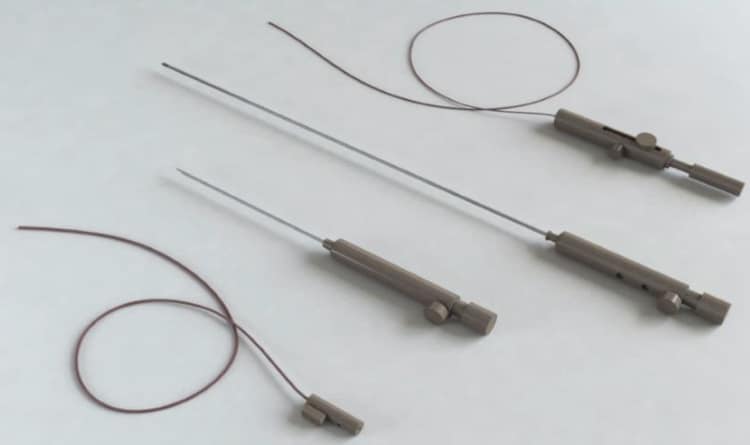
Minimally invasive applicators for the Alpha DaRT seeds

The initial trial is examining superficial indications – squamous cell carcinoma of the skin and oral cavity. In such cases, the seeds are placed temporarily (under local anaesthesia) into the lesion using minimally invasive applicators and are removed after 15 days. Thanks to the short half-life of 224Ra (3.7 days), Alpha DaRT can be applied as a single-session treatment that achieves clinical outcome within a few days.

Early results from this feasibility study have demonstrated complete local control of about 80% and zero systemic toxicity. Gat notes that the company also has protocols in place for treatment of pancreatic and prostate cancers. For such deep-seated tumours, the biocompatible seeds are simply left in place.

“Alpha Tau Medical is now focused on starting clinical trials of 12 different protocols at 55 centres in 24 countries around the world,” stated Gat. “The company also plans to open production facilities in each of the key markets, to ensure the supply of the Alpha DaRT.”

How vortexes cool earthquake faults

Geological faults could be cooled during earthquakes by the formation of granular vortexes – according to a new study by researchers in Australia and France. The finding could explain why there is little evidence for frictional melting along geological faults and could boost our understanding of how temperature-related phenomena affect active fault systems.

Rising temperatures within fault systems could play a vital role in the motions associated with earthquakes. This is because heat can activate various processes that make fault slippage more likely – including melting, pore fluid pressurization and silica gel lubrication. While fault temperatures have been predicted to rise significantly during earthquakes, evidence of frictional melting along exposed fault gouges is rare. This presents a conundrum: where is the extra heat going?

Now, Itai Einav and colleagues University of Sydney and Laboratoire Navier say they have come up with an answer. They say that the previously-overlooked phenomenon of transient granular vortexes could be cooling faults during earthquakes. These vortexes are known to form in granular materials that are subjected to a shear force. The size of the vortexes is related to grain size, density, stress and strain rate – and the vortexes last for between a fifth and a tenth of an earthquake’s shear time.

Along for the ride

The researchers propose that these vortexes enable convection-based heat transfer in geological faults through the mixing of solid particles. Previously, it was assumed that heat generated at faults during earthquakes could only diffuse away by conduction. “It is simply more effective for heat to move in space as the passenger of grain motions than to molecularly diffuse through grains and contacts,” the team writes in in Geophysical Research Letters.

While it is not possible to observe granular vortexes as they occur in real time in fault slips, evidence can be found in the geology of fault planes that connect different rock types. “The effect of the vortexes will be seen through the mixing of the various minerals,” Einav tells Physics World. He points out that an example of this mixing across a fault plane can be seen on the Glarus Fault in the Alps of eastern Switzerland.

To test their hypothesis, Einav and colleagues created their own granular vortexes in the laboratory by using a stadium shear device. This is a belt system that applies shear to a series of granular discs set on a glass plate. By tracking disc motion and larger-scale eddy evolution, the team could model the impact vortexes would have on the thermal evolution of faults during slip events. The researchers then applied their model to a case study by looking at California’s active San Andreas fault system.

1000-fold boost

“Transient granular vortexes can boost the effective thermal diffusivity of earthquake faults by a factor of up to 1000 times,” says Einav. As a result of this, he adds, “crustal faults such as those in the San Andreas system may experience a maximum temperature rise 5-10 times smaller than previously thought.”

Reduced temperatures could delay the thermal activation of fault weakening mechanisms, leading to faults that are stronger – at least temporarily. Future investigations into earthquakes, Einav says, will need to reassess the role of the different fault-weakening mechanisms in light of the impact of granular vortexes.

Game changer

“This is a game changer in the mechanics of earthquakes,” says Christopher Scholz, a geophysicist at Columbia University in the US. He adds, “This mechanism for convective heat transport within the cataclastic core of faults during seismic slip readily explains a host of previously enigmatic problems: the scarcity of friction melt in faults, the lack of a conductive heat flow anomaly over the San Andreas fault, and the lack of evidence for thermal weakening in earthquakes.”

With their initial study complete, Einav and colleagues are planning further experiments with more realistic test materials. They are also evaluating how the presence of granular vortexes would impact the various fault weakening mechanisms and larger-scale earthquake dynamics.

Plastic particles now infest the Arctic

Plastic particles have colonized one of the last once-pristine oceans. German scientists sampled sea ice from five locations within the Arctic Circle and counted up to 12,000 microscopic particles per litre of ice.

They have even been able to identify the sources and piece together the journey to the icy fastness. Some tiny lumps of plastic detritus have made their way north from what has become known as the Great Pacific Garbage Patch, a swirling assembly of an estimated 80,000 tonnes of plastic floating in the ocean across a stretch of water bigger than France.

Other fragments, that began as paint and nylon, date from the invasion of increasingly ice-free Arctic summer waters by more freight ships, and more fishing vessels, the scientists report in the journal Nature Communications.

“During our work, we realised that more than half of the microplastic particles trapped in the ice were less than a twentieth of a millimetre wide, which means they could easily be ingested by Arctic micro-organisms like ciliates, but also by copepods,” said Ilka Peeken, a biologist with the Alfred Wegener Institute.

“No one can say for certain how harmful these tiny plastic particles are for marine life, or ultimately also for human beings.”

The researchers gathered their samples during three expeditions to the Arctic aboard the icebreaker Polarstern in the spring of 2014 and the summer of 2015, following an ice movement called the Transpolar Drift from Siberia as far as the Fram Strait where warm Atlantic water enters the polar ocean. The Transpolar Drift was first identified by the Norwegian explorer Fridtjof Nansen aboard the Fram, late in the 19th century.

Microplastic particles are defined as 5 mm or smaller, and many are measured in millionths of a metre. These are formed by the deterioration of larger pieces of plastic dumped into landfills in billions of tonnes, or released into the waterways and thus into the ocean.

Man-made synthetic polymers are effectively indestructible, and now represent a major source of marine pollution and a constant hazard to wildlife.

More than two-thirds of the particles measured 50 millionths of a metre or smaller. Some were as small as 11 micrometres – one sixth of the diameter of a human hair.

Multiple sources

The researchers identified 17 different types of plastic in the sea ice: from paints, nylon, polyester, cellulose acetate – used in cigarette filters – and the packaging materials polyethylene and polypropylene.

The guess is that the plastics endure in the sea ice for between two and 11 years before melting from their icy packaging in the Fram Strait, to begin sinking in deeper waters. One study recently found 6,500 bits of microplastic per kilogram sampled from the sea floor.

“This is an important finding because it means that they were always present in the water under the ice as it was growing, and drifting, within the Arctic Ocean,” said Jeremy Wilkinson, a sea ice physicist with the British Antarctic Survey, commenting on the study.

“Sea ice grows from the freezing of seawater directly onto the bottom of the ice (i.e. it grows vertically downwards), thus it was incorporating microplastic particles as it grew. It suggests that microplastics are now ubiquitous within the surface waters of the world’s oceans. Nowhere is immune.”– Climate News Network

Amazon set to dry as trees narrow stomata

As carbon dioxide concentrations rise, the Amazon rainforest is likely to become drier whilst woodlands in Africa and Indonesia become wetter. That’s at least partly due to the direct response of vegetation to higher levels of the gas, according to a new study.

James Randerson

“People tend to think that most of the disruption will come from heat going into the oceans, which, in turn, will alter wind patterns,” said James Randerson of the University of California, Irvine, US. “We have found that large-scale changes in rainfall can, in part, be attributed to the way tropical forests respond to the overabundance of carbon dioxide humans are emitting into the atmosphere, particularly over dense forests in the Amazon and across Asia.”

Small pores known as stomata on the underside of tree leaves open to take in carbon dioxide for photosynthesis and emit water vapour in a process known as transpiration. If there’s more carbon dioxide in the atmosphere, the stomata open less widely, reducing the amount of water evaporated into the air. When multiplied across the rainforest, this process can affect winds and the flow of moisture from the ocean.

“In many tropical forest regions, the moisture supplied by transpiration, which connects water underground at the root level directly to the atmosphere as it is pulled up to the leaves, can contribute as much as moisture evaporated from the ocean that rains back down at a given location – which is normal rainforest recycling,” said Gabriel Kooperman, who’s now at the University of Georgia, US.

With higher carbon dioxide concentrations, however, forests evaporate less moisture into the air and fewer clouds are likely to form above the Amazon. “Rather than [joining with the usually abundant clouds and] raining over the forest, water vapour from the Atlantic Ocean blows across the South American continent to the Andes mountain range, where it comes down as rain on the mountain slopes, with limited benefit to the rainforest in the Amazon basin,” Kooperman said.

The forests in Central Africa and the Maritime Continent, an area between the Pacific and Indian oceans that includes Malaysia, Papua New Guinea and the Indonesian archipelago, are predicted increased rainfall, on the other hand.

On islands such as Borneo, Java and Sumatra, which are surrounded by humid air above warm ocean surfaces, the reduction in evaporation is projected to lead to warming over the forests.

“You’ll get a stronger contrast in heating over the islands compared to the nearby ocean, and so it will enhance a natural ocean-land breeze, pulling in more moisture from these neighbouring ocean systems to increase rainfall over the forests,” said Randerson.

The team’s results, published in Nature Climate Change, indicate that the response of tropical vegetation to higher carbon dioxide can be an important driver of climate change in the tropics.

According to Kooperman, the resulting droughts and forest mortality in the Amazon and a potential increase in flooding in other rainforests may have an impact on biodiversity, freshwater availability and food supplies for economically vulnerable populations.

Distorted neutron stars give up secrets of dense nuclear matter

New insights into the properties of neutron stars have come from two independent analyses of gravitational waves from the GW170817 neutron-star merger. The work was done by teams led by Farrukh Fattoyev at Indiana University Bloomington and Eemeli Annala at the University of Helsinki. The teams used different methods to calculate the relationship between the radius and mass of neutron stars and came up with the same result.

In October 2017 the LIGO and Virgo detectors made the first-ever observation of gravitational waves from two neutron stars as they spiralled into each other and then merged to form a black hole. The observation is also notable as the first time that electromagnetic radiation was detected from a gravitational-wave event.

GW170817 offers astrophysicists new and exciting information about the equation of state (EOS) of neutron stars. The EOS describes the complex behaviour of the dense nuclear matter that makes up neutron stars. Little is currently known about the EOS because it is difficult to glean information from conventional astronomical observations and because theoretical calculations of dense nuclear matter are extremely difficult to do. Before GW170817, the most important piece of information about the EOS came from observations published in 2010 and 2013, which showed that neutron stars can have masses at least as large as two solar masses.

Tidal distortions

Just before the GW170817 neutron stars merged, the shapes of both stars are distorted by their mutual gravitational attraction – with the nature of the distortion being defined by the EOS. This tidal distortion affects the gravitational waves emitted by the pair, which means that careful analysis of LIGO-Virgo data should provide valuable information about the EOS.

LIGO Scientific Collaboration member Francesco Pannarale from Cardiff University explains: “The EOS determines the radius of a neutron star, and how easily it can be distorted as it experiences the tidal forces generated of another object, including another neutron star”.  “This distortion is quantified in the tidal deformability, which was constrained by the analysis of GW170817.”

Fattoyev’s team used this constraint to assess experimental data from nuclear physics experiments that measure properties of protons and neutrons in atomic nuclei. “The researchers used the constraint on tidal deformability to determine a constraint on the neutron skin thickness – the difference between the radius of a neutron and a proton,” Pannarale says. “They then contrast the prediction to experimental skin thickness measurements. Right now the two values are compatible, but future experiments will provide a more accurate measurement of the neutron skin thickness.”

Thicker or thinner skins

Indeed, future experiments could lead to new discoveries about the elusive properties of matter at extremely high densities. “If the skin thickness value measured on Earth became no longer compatible with the value derived from gravitational-wave observations, it would mean that matter suddenly behaves differently from some density onward,” Pannarale explains. “Matter would undergo a phase transition, indicating that the way in which terrestrial and astronomical results are connected must break down.”

Taking a different approach, Annala’s team used the tidal deformability value to narrow the range of possible EOS models of neutron stars. “The researchers tried many possible EOS models where the GW170817 constraint on tidal deformability is obeyed, two-solar-mass neutron stars are allowed, and theoretical results at low and high density are respected,” says Pannarale. “Once they narrowed down the possibilities, they ended up with around 100,000 EOSs, allowing them to make predictions about neutron star properties.”

Using their results, both groups separately calculated a relationship between the mass and radius of neutron stars. “Both teams determined that the maximum radius of a 1.4 solar-mass neutron star is 13.6 km,” Pannarale explains. “While the two values are in very good agreement, they stem from very different approaches, indicating that the conclusions of the two teams are solid.” The remarkable result is promising for future studies of neutron star properties, and could soon be improved further through forthcoming observations of merging neutron stars.

Papers by Annala’s team and Fattoyev’s team appear in Physical Review Letters.

Copyright © 2026 by IOP Publishing Ltd and individual contributors