Neutron-science pioneer John Enderby dies aged 90

The British physicist John Enderby has died aged 90. He is best known scientifically for his development of new techniques using neutrons to study the structure of liquids. Knighted for his services to science and technology in 2004, Enderby had a long association with IOP Publishing in Bristol, where he served for many years as scientific adviser. He was also president of the Institute of Physics (IOP).

Enderby was born in Lincolnshire on 16 January 1931. After doing his national service in the Middle East, he earned a first-class honours degree in physics from Birkbeck College, University of London in 1957. He remained at Birkbeck to do a PhD on the properties of liquid metals under the supervision of Norman Cusack.

He then embarked on an academic career, working at the universities of Huddersfield, Sheffield and Leicester, before accepting a chair at the University of Bristol in 1976, where he was head of department for more than a decade. In 1985–1988 Enderby took leave from Bristol to serve as the British directeur-adjoint of the Institut Laue-Langevin in Grenoble, France – which is a leading international centre for neutron science. He was elected a fellow of the Royal Society in 1985 and was an honorary fellow of the IOP.

Alan Soper, who did a PhD with Enderby at Leicester, described him as a “constant source of inspiration and support”. Soper first encountered his future supervisor as an undergraduate. “I was intrigued by his classes,” recalls Soper, “He mostly taught from memory, with little reference to notes, and his lectures usually ended with a question – making it clear that what we had been told up to that point was incomplete and that there was still more to be learned.”

Significant achievement in liquid-state physics

Soper highlights Enderby’s collaboration in the 1960s with Peter Egelstaff, then at AERE Harwell, that used innovative neutron-scattering techniques to demonstrate the validity of the Faber–Ziman theory of liquid binary alloys. He describes this work as “one of the most significant achievements in liquid-state physics that occurred in the 20th century”.

Enderby also had a deep commitment to the UK physics community. “John Enderby has been involved with the IOP, IOP Publishing and the original Physical Society for nearly 60 years,” says Antonia Seymour, chief executive of IOP Publishing. “His first paper was submitted to the Proceedings of the Physical Society in 1959 and he went on to become hugely interested in scholarly publishing, working closely with IOP Publishing staff as a reviewer, an editor and more recently in a scientific advisory capacity. He has been a great friend to IOP Publishing: always supportive and encouraging, with a plethora of ideas for how we might expand our books and journals portfolio.”

Seymour adds, “He will be hugely missed, and IOP Publishing owes Sir John a debt of gratitude for his prodigious contributions to our publishing success over many years.”

He is survived by his wife Susan and four children.
Towards Auger therapy with iodine-infused nanoparticles

Researchers at Kyoto University, the National Institutes for Quantum and Radiological Science and Technology (QST) and the University of California Irvine observed that tumour masses containing iodine-infused nanoparticles shrank when they were hit with single-energy X-rays. Their in vitro laboratory studies are described in Scientific Reports.

Cancer cells and the photoelectric effect

“Cancer radiation therapy is rapidly changing. Utilization of high-Z [high atomic number] elements [such as iodine] that can release electrons upon X-ray irradiation can bring further advances in radiation therapy,” says senior author Fuyuhiko Tamanoi from Kyoto University.

Tamanoi’s team designed and produced silica-based nanoparticles containing iodine and introduced the nanoparticles to one-millimetre in vitro masses of human ovarian cancer cells, human head-and-neck cancer cells and human brain cancer cells. The nanoparticles accumulated in the cancer cells. Tumour masses containing the nanoparticles shrank when bombarded by 33.2 keV X-rays for 30 minutes.

The researchers believe that the reduction in tumour size can be traced back to the photoelectric effect, in which electrons including Auger electrons are released when X-rays hit iodine atoms. They also hypothesize that these Auger electrons interact with the DNA in the nuclei of cancer cells, resulting in double-strand breaks in the DNA that trigger apoptosis, or programmed cell death.

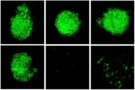
The researchers studied how the nanoparticles accumulate in cancer cells by tagging some nanoparticles with red fluorescent markers and observing their uptake with confocal microscopy. They also confirmed that cells were dying by programmed cell death rather than other mechanisms using a laboratory test that detects DNA damage at late stages of apoptosis.

The future of radiation therapy?

While the iodine-infused nanoparticles can also be taken up by healthy cells, the researchers believe that their accumulation in tumours in animal models confirms preferential uptake in cancer cells. They hypothesized that this happens because tumours are highly vascularized and have porous blood vessel walls, so the nanoparticles leak out of blood vessels and could accumulate in tumours.

The research team also observed that irradiating the tumour masses with 33.2 keV X-rays shrank the masses the most.

“While a sharp peak at 33.2 keV [compared with other energies] can be explained by the absorption of energy by K-shell electrons, it was surprising to observe the relatively sharp decrease in tumour destruction effect beyond 33.2 keV,” says Tamanoi. “We speculate that this was due to multiple electron release events taking place after X-ray irradiation.”

The researchers are continuing their investigations to learn more about the photoelectric effect, how their nanoparticles behave inside cancer cells and in simulation studies, and the implications of both for the development of Auger therapy.

New semiconductor cools computer chips

A novel semiconducting material with high thermal conductivity can be integrated into high-power computer chips to cool them down and so improve their performance. The material, boron arsenide, is better at removing heat than the best thermal-management devices available today, according to the US-based researchers who developed it.

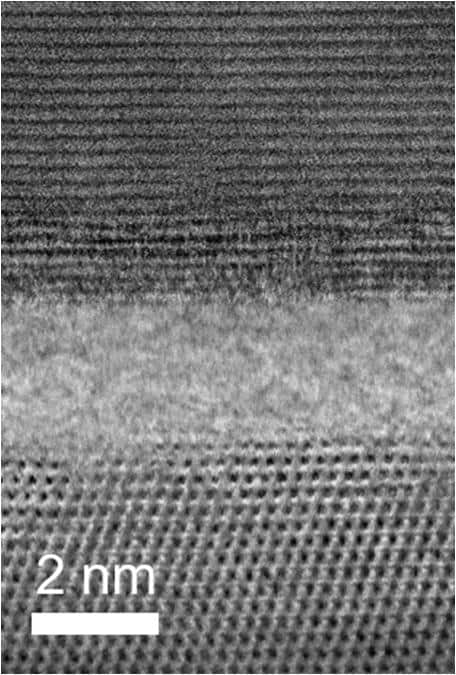
gallium nitride-boron arsenide heterostructure interface

The size of computer chips has been shrinking over the years and has now reached the nanoscale, meaning that billions of transistors can be squeezed onto a single computer chip. This increased density of chips has enabled faster, more powerful computers, but it also generates localized hot spots on the chips. If this extra heat is not dealt with properly during operation, computer processors begin to overheat. This slows them down and makes them inefficient.

Defect-free boron arsenide

Researchers led by Yongjie Hu at the University of California, Los Angeles, recently developed a new thermal-management material that is much more efficient at drawing out and dissipating heat than other known metals or semiconducting materials such as diamond and silicon carbide. This new material is known as defect-free boron arsenide (BAs), and Hu and colleagues have now succeeded in interfacing it with computer chips containing wide-bandgap high-electron-mobility gallium nitride (GaN) transistors for the first time.

Using thermal transport measurements, the researchers found that processors interfaced with BAs and running at near maximum capacity had much lower hot-spot temperatures than other heat-management materials at the same transistor power density. During the experiment, the temperature of the BAs-containing devices increased from room temperature to roughly 360 K, compared to around 410 K and 440 K, respectively, for diamond and silicon carbide.

A new benchmark performance

“We have shown that we can process these BAs heterostructures and integrate them into a high electron mobility transistor chip design,” Hu tells Physics World. “The benchmark performance we have demonstrated shows much promise for applications in high-power electronics and future electronics packaging.”

As well as boasting a high thermal conductivity, Hu adds that BAs is ideal for managing heat for another reason too: it has a low thermal boundary resistance. This means that heat passing through it and then into an interfaced material does not slow down as much compared with other heat spreaders. “This is sort of like if the heat just needs to step over a curb when getting into an adjacent material, versus jumping a hurdle,” he explains.

Unique phonon band structure

The low thermal boundary resistance of boron arsenide stems from its unique phonon band structure. For two interfaced semiconducting materials, this resistance typically depends on the mismatch between the vibrational spectra of phonons (vibrations of the crystal lattices) of both. This mismatch is usually calculated by comparing the temperature at which phonons oscillate with the highest frequencies in each. A small difference in this so-called Debye temperature should result in a lower thermal boundary resistance. Conversely, a big difference implies a higher thermal boundary resistance.

Most semiconductors (including silicon, germanium, gallium arsenide and gallium nitride) and metals have Debye temperatures below 700 K, the researchers explain. Prototype high thermal conductivity materials such as diamond and cubic boron nitride (BN), on the other hand, have much higher Debye temperatures (over 2000 K) because of their large phonon velocities. The thermal boundary resistance for diamond and BN interfaces (once integrated with typical semiconductors) should therefore be high, which somewhat limits their potential applications in thermal management despite their high thermal conductivities. For example, the interface between diamond and GaN has aDebye temperature mismatch of over 1500 K, resulting in a thermal boundary resistance of ~30 m2 K GW−1. BAs, in contrast, has a much lower Debye temperature value (of ~700 K), so it should have a lower thermal boundary resistance after integration.

Spurred on by their findings, Hu and colleagues now plan to integrate the material they have developed into various device architectures and radio-frequency (RF) circuits.  Indeed, they have already succeeded in self-assembling the material to develop high-performance flexible thermal interfaces for wearable electronics and soft robotics.

The researchers report their work in Nature Electronics.

Physics-themed holidays, meet the next director of the European Spallation Source

It is summer holiday season, at least here in the northern hemisphere, and hardworking physicists deserve a break. In this episode of the Physics World Weekly podcast, editors chat about holiday hotspots for physicists including Isaac Newton’s home and dark skies parks for stargazing.

This year marks 50 years of operation of the Institut Laue Langevin (ILL) in France, which is an international centre for neutron science. Helmut Schober is the facility’s outgoing director general, and he talks about how researchers at ILL have joined the scientific battled against COVID-19. He also chats about his hopes for the European Spallation Source neutron facility, which is currently being built in Sweden and will soon count Schober as its director general.

For many physicists, 2021 will be the second consecutive year that they are unable to attend their favourite conferences in person. Fortunately, technology has come to the rescue and virtual meetings are getting much better at filling the gap. We chat about the recent American Association of Physicists in Medicine virtual meeting and find out how access to radiotherapy can be improved in low- and middle-income countries.

Think before you ‘speak’: brain–computer interface restores speech in paralysed man

“Hello, World!” is a simple and commonly used code to introduce people to a programming language. Pronouncing “Hello, World!” out loud, however, while instinctive for most adults, involves a complex series of respiratory, phonetic and resonance tasks to produce sound and articulate the correct words.

Speech originates in the brain, with neural signals fired from the brain cortex effortlessly coordinating vocal tract muscles to communicate. However, for paralysed patients who have lost the ability to articulate speech (a condition called anarthria) due to a brain injury or neurological disorder, verbal communication is especially challenging. This can restrict their autonomy and impact quality-of-life, despite retaining intact cognitive function.

A team of neuroscientists and engineers at the University of California San Francisco (UCSF) used deep-learning and natural-language models to decode the brain waves of a clinical trial participant with severe paralysis and anarthria as he attempted to produce words and sentences. The study, published in the New England Journal of Medicine, showed a promising median decoding rate of 15.2 words per minute (with a median word error rate of 25.6%). This is approximately three times faster than the computer-based typing interface that the participant normally relies on for communication.

“We think that an ideal speech neuroprosthesis would allow a paralysed user to voluntarily and autonomously engage the system to communicate and interact with their personal devices,” explains David Moses, a postdoctoral fellow at UCSF and one of the lead authors in the study.

Recording the brain – restoring the speech link

To capture the cortical signals associated with speech in real time, the team used a high-density rectangular electrode array (67 × 35 × 0.51 mm) implanted on the surface of the brain to record electrical activity in multiple cortical brain regions involved in speech formulation.

Electrode placement

During speech tasks, a percutaneous connector secured to the participant’s cranium transmits the analogue brain signals – using a detachable link and cable – from the electrode array to a computer for signal processing and filtering.

Translating the speech-correlated filtered cortical brain signals into words restored the participant’s ability to communicate in real-time. Throughout the 81-week study period, the neural implant provided highly stable cortical signals without the need for frequent recalibration, which is desirable for long-term neuroprosthetic applications.

Decoding speech – words library

The researchers employed a set of 50 common English words as the baseline to form grammatically and semantically correct sentences. The participant attempted to produce individual words that appeared on a monitor and, on a subsequent task, create sequences to form sentences such as “hello how are you”, “I like my nurse” and “bring my glasses please”.

A variation of the speech tasks required the participant to formulate a unique response to prompts displayed in the monitor to actively engage him in a conversation.

The neural signals recorded throughout the isolated-word task were used to train word detection and classification models using deep learning. During sentence decoding, the word error rate using only the deep-learning models was 60.5%. When accounting for the next-word probabilities using a natural-language model, the word error rate dropped below 30%, making the neuroprosthetic suitable for real-time speech decoding.

The next step for this technology involves validation with other clinical trial participants. “We need to show that this method of decoding attempted speech from brain activity works with more than just one person and ideally with individuals who have other severe conditions, such as locked-in syndrome,”  Moses tells Physics World.

Summer internships: Maria Violaris – ‘I developed general research skills, which are useful in both industry and academia’

For Maria Violaris, who graduated with a degree in physics from the University of Oxford in 2020, the main motivation to do a summer internship was to find out what it’s like to work in industry. She went to a careers fair hosted by her university, where she met employees of Innovia Technology – a Cambridge-based science innovation consultancy that helps its client companies improve products – and found out about its internship programme.

Although Violaris didn’t know before the event that science consultancies even existed, she thought that Innovia sounded like a fun place to work because of the variety of projects it does, which meant she could learn about lots of different areas of physics. She applied with a CV and cover letter, followed by a video call in which she was asked physics-related technical questions. Violaris was then invited to an in-person interview where she had to look at a case study and come up with ideas of how to approach it. While this may sound daunting, it is an excellent opportunity to practise for post-university job applications and interviews, many of which follow a similar process.

After finding out she had been successful, Violaris moved to Cambridge for the summer of 2019, where she worked in multidisciplinary teams on several projects, including one looking at a cosmetic product made by one of Innovia’s clients. “We were trying to improve the texture of the product, so I was looking at the physics of how the fluid stretches, and the difference in how it behaves when tapped or rubbed onto skin. I worked with behavioural scientists who were investigating how people typically use the product, and with chemists who were looking at its chemical composition.” Over the course of the internship, Violaris also got involved in a project to improve surgical hammers to reduce their risk of being fractured, and a project to enhance the taste of a product for a food company.

Innovia encourages its interns to maintain a good work–life balance, which meant that Violaris had plenty of time for social activities, playing ultimate frisbee with her colleagues once a week and going to the pub together on Friday evenings. She even joined a yoga group at the company.

Having enjoyed her time at Innovia, Violaris sought out another internship for the summer of 2020. At this point she knew she was most excited by quantum physics. By searching online for quantum computing companies, she found the website of quantum software start-up Riverlane, also based in Cambridge, and discovered that it runs an internship programme, which she applied to successfully. “My project involved lots of coding. I put together some Raspberry Pis and circuit boards, and ran Riverlane’s quantum operating system on the circuit boards to create a model quantum computing lab,” says Violaris. “I used this model to create science-communication materials, including a video explaining how the system worked.”

At the time of Violaris’ internships, Riverlane was a start-up with around 30 employees, while Innovia was 20 years old and had 80 employees, so Violaris experienced working for both a new and a more established company. “The systems of work at Innovia were more established,” she says. “At Riverlane, there were more unknowns about how the company would develop, and there was more flexibility around how it collaborated with other companies.” However, both internships gave Violaris a positive experience of working in industry, and a useful insight for her future career. “I decided to do a PhD after graduating, because I really wanted to do research on quantum physics,” she says, “but I’m considering going into either research or industry afterwards. It was great to see a quantum computing company from inside, as that’s an area that I am keen to explore in the future.”

I developed general research skills and learnt how to find out about a topic quickly, which is useful in both industry and academia

Maria Violaris

Additionally, she gained some valuable skills that she has already been able to draw on during her PhD at Oxford, which she started in October 2020. “I developed general research skills and learnt how to find out about a topic quickly, which is useful in both industry and academia,” she says. “It was also interesting to see the companies’ productivity systems and how they manage teams of people.” In fact, during her final year as an undergraduate, Violaris started a quantum-information student society, where she used her experience to manage group projects.

As for making the most out of an internship, Violaris’ advice is “Ask a lot of questions, especially at the start, because this will help you get going quickly. And don’t be afraid to contribute your ideas. You may think you don’t have enough experience in the area to have useful ideas, but actually the opposite is true. You have a fresh perspective, and in my experience companies value that.”

New location technique shatters the diffraction limit

The diffraction limit has been beaten by a factor of 38 by a new technique that uses microwaves to locate objects. Developed by physicists in France and Germany, the technique is inspired by the coded aperture method and works by allowing light or sound waves to echo and randomly scatter within an enclosed space.

Developed by the trio of Michael del Hougne at the University of Würzburg, Sylvain Gigan of the Laboratoire Kastler Brossel and Philipp del Hougne at the University of Rennes, the technique has been used to determine position of a small cube to within 1/76th of the microwave wavelength used.

The diffraction limit places a stringent lower bound on the resolution of imaging and location techniques that use light, sound or other waves. The limit makes it impossible to use conventional methods to distinguish features that are slightly smaller than 1/2 the wavelength of the waves being used. This is a problem for some popular imaging and location techniques that use ultrasound, microwaves and radio waves – where wavelengths range from hundreds of microns to metres.

There are ways of overcoming the diffraction limit – such as placing a detector less than half a wavelength away from an object and detecting short-lived evanescent waves – but these techniques are often difficult or impractical to implement.

Irregularly shaped cavity

The trio took an alternative approach based on the coded aperture concept, which is used in specialized imaging applications. Here, a scattering structure such as an irregularly shaped cavity is placed between the illuminated object and a single-pixel detector. The scattering structure is altered using coded masks that block certain patterns of waves from reaching the detector. Multiple measurements are made, and the results are used to create a mathematical reconstruction of the object.

Building on this approach, the trio have found a way to make the technique more sensitive to sub-wavelength details. This involves placing both the object and the illumination source inside a cavity where waves can scatter off the walls (see figure). A key feature of the technique is that the waves encounter the object multiple times before arriving at the detector, which is inside the cavity. Also inside the cavity are programmable reflective metasurfaces, which alter the properties of the scattering structure.

Neural network

To test their technique, the trio placed a 4.5 cm metal cube within a metre-wide cavity. The cube was illuminated with 12 cm wavelength microwaves and the detector signals were processed using an artificial neural network.

When the cube was moved to different random locations within the box, the team was able to determine it position to within just 0.16 cm. At about 1/76 of the microwave wavelength, this is well below the diffraction limit. This spatial accuracy improved when the waves were left to echo for longer.

Although the concept is still some way from real-world application, the team believes it could be further developed to non-invasively locate small objects within large rooms, using the echoes of radio or acoustic waves.

The research is described in Physical Review Letters.

Introducing the non-radiating antenna

An international team of physicists has created what might seem like a contradiction in terms: a non-radiating source of electromagnetism. By placing antennas inside a hollow dielectric disc, the researchers exploited interference phenomena to create a non-radiative “meta-atom” that could have applications in several areas, including sensing and wireless power transfer.

Maxwell’s equations tell us that accelerating charges radiate energy in the form of electromagnetic waves. This idea has led to the development of much modern technology, most notably radio communications in all its various guises. But it also posed a challenge to early 20th century physicists seeking to explain the stability of atoms, given that electrons were thought to follow (curved) orbits around atomic nuclei and therefore continuously lose electromagnetic energy.

The response to that problem was Niels Bohr’s atom and the development of quantum mechanics – in particular, the idea that electrons can only occupy certain discrete energy levels. Beyond the quantum world, however, some physicists wondered whether it might be possible to create classical “meta-atoms”: macroscopic objects containing alternating currents that confine the electromagnetic energy they generate and so prevent emission to the far-field.

Electric moments without any poles

This idea received a boost in 1957 when the theoretical physicist Yakov Zel’dovich predicted that the effects of parity violation on electric charges would yield electric moments without any poles. These so-called anapole states were discovered in the late 1990s when researchers at the JILA centre in the US made measurements of parity non-conservation in caesium atoms. Since then, other physicists have suggested that these anapole states could help explain how dark matter remains hidden electromagnetically.

In practical electrodynamic terms, anapoles can be generated by precisely tailoring charge distributions in time and space. These distributions are represented as a series of point-like electric and magnetic multipoles, the emissions from which interfere destructively in the far-field, leaving electromagnetic energy confined within a small space around the sources.

The simplest way to generate anapoles is to superimpose the fields from an electric dipole and a toroidal dipole – the latter can be imagined as electric currents flowing around the cross section of a torus. This has been demonstrated experimentally several times over the last few years, with various research groups exploiting nanofabrication techniques and metamaterials to observe anapole states at different frequencies – from microwaves to the visible range.

Anapole observations

In the new work, Esmaeel Zanganeh and Polina Kapitanova at ITMO University in Saint Petersburg, together with colleagues in Russia, Germany, Australia and China, have put together a relatively simple system to observe both electrical and magnetic anapole states – something not achieved before. The set-up consists of a radiating antenna placed inside a thick, hollow disc shaped like a roll of sticky tape. The disc is made from a dielectric with extremely high permittivity, which allows the disc to be smaller than the wavelength of the radiation it emits. The idea is that the electromagnetic waves from the antenna interfere destructively with secondary waves produced by electric current induced in the dielectric – thereby yielding a non-radiating source.

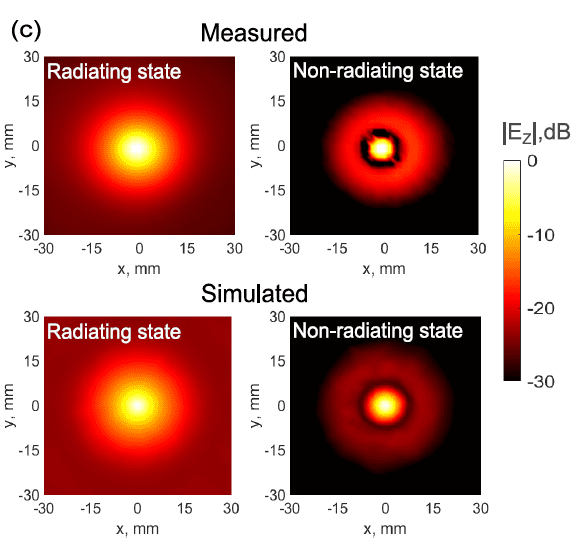
Electric field of radiating and non-radiating states

The researchers first modelled their system numerically, assuming a 25 mm-long copper electric dipole antenna emitting radio waves and placed along the thickness of a 20 mm-diameter dielectric disc. Varying the frequency of the antenna, they compared the output of this source with that of the same antenna operating in free space. They found that at the disc’s resonant frequency (375 MHz), the system radiated slightly more power than the antenna alone, but that at a slightly higher frequency (411 MHz) the system’s radiated power dropped to seven orders of magnitude below that of the naked antenna.

Backing their modelling up with analytical calculations, the researchers showed that the sharp drop in power resulted from the antenna and disc generating equal and opposite radiation fields at 411 MHz, leaving just the confined electromagnetic field inside the source. They also did similar calculations involving a magnetic loop antenna – one that intercepts the magnetic field of electromagnetic waves – in place of the electric dipole device. Here, too, they found that by tuning the antenna away from its resonant frequency they could reduce the radiated (magnetic) power to near zero, and about three orders of magnitude lower than that of the antenna alone.

Finally, Zanganeh and colleagues tested their system experimentally, albeit at microwave rather than radio frequencies due to difficulties with materials and testing facilities. By placing a 6.4 mm-diameter disc containing an 18 mm long antenna in an anechoic chamber and using a horn antenna to pick up its far-field emissions, they measured a radiation pattern that closely matched their simulations.

The researchers believe that their new “meta-atoms” could have several practical applications. In particular, the very small radiative output of such devices, coupled with a larger concentration of electromagnetic energy in their immediate vicinity, could see them used for sensing, radiofrequency identification or near-field wireless power transfer, they say.

The research is published in Physical Review Letters.

Protons combine with photons to optimize cancer treatments

Proton-photon combination

Proton therapy offers precision tumour targeting with low integral dose to normal tissue. But for certain situations, photon-based radiotherapy may hold the advantage. In some cases, the penumbra of a photon beam may be sharper, for example, while proton treatments of lung or breast cancer can suffer from robustness problems.

Proton therapy is also a limited resource, with roughly 100 proton therapy centres worldwide compared with more than 10,000 conventional linear accelerators (linacs). In addition, some facilities only have a fixed proton beamline with limited beam angles, making proton treatments suboptimal. The answer to all of these problems, according to Jan Unkelbach from the University of Zurich, may lie in combined proton–photon radiotherapy. Speaking at the recent AAPM Annual Meeting, he explained the rationale.

The size and expense of proton gantries have hindered the widespread implantation of proton therapy systems. But with the introduction of compact accelerators that can fit into a bunker designed for a standard linac, it becomes possible to install fixed proton beamlines into existing radiotherapy departments more easily and at much lower costs.

“The idea is that we have a treatment room with a robotic couch and a standard linac, and we now add a fixed proton beamline equipped with pencil-beam scanning to that treatment room,” Unkelbach explained. This set-up could deliver both proton and photon beams in the same room, during the same treatment fraction and using the same patient immobilization devices.

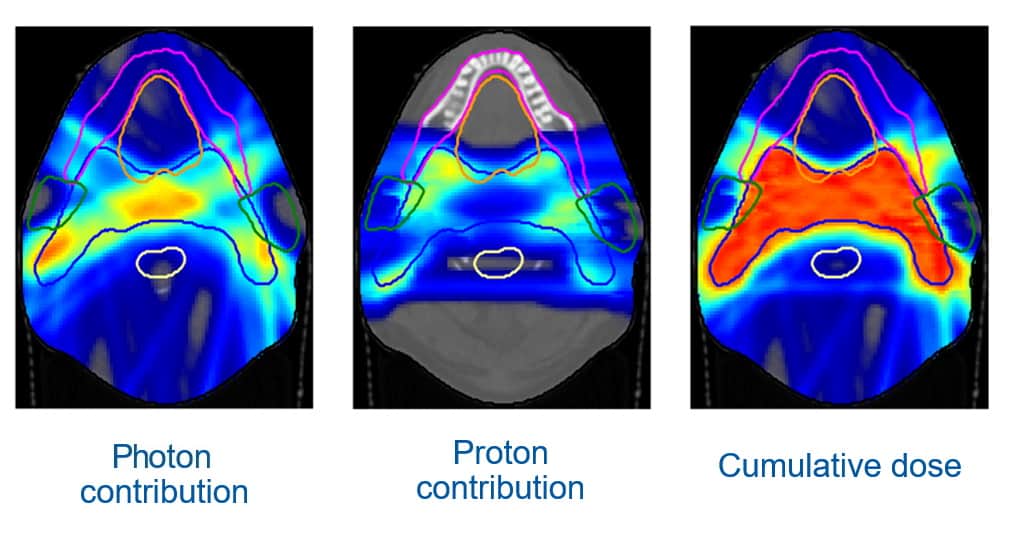
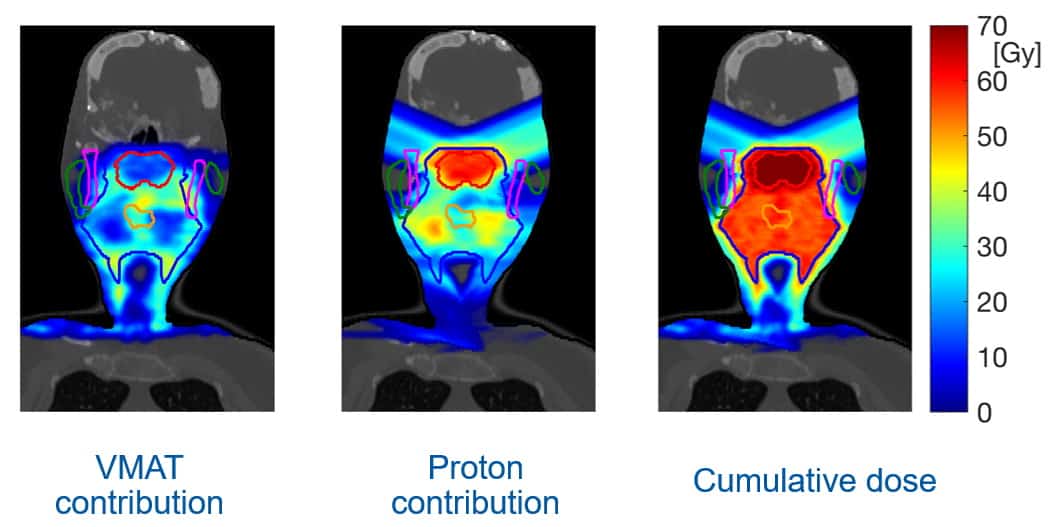
Unkelbach described an example of a head-and-neck cancer treatment. With a fixed horizonal proton beamline and the treated patient lying on a couch, the proton beams can only be delivered in the coronal plane, which is not ideal for head-and-neck cancer. “If you can only irradiate from left and right, you have to irradiate through the parotid gland to treat the target volume,” he explained.

Using volumetric modulated arc therapy (VMAT) to deliver photons will better spare the parotid, but delivers a dose bath to surrounding normal tissue. “So we would like to combine protons and photons in an optimal way, and we can do this by simultaneously optimizing intensity-modulated photon and proton plans,” Unkelbach explained. “Indeed, both modalities combined gave the desired dose distribution in the target.”

Coronal dose

He presented a similar example for a breast cancer case. Here, the optimal treatment combined tangential photon beams to treat the majority of the target with proton beams to deliver dose to lymph nodes and the target periphery. The team is also evaluating the potential of this approach for many other treatment sites.

Optimizing resources

Photons could also play an important role within existing proton therapy facilities, via combined treatments in which some fractions are delivered using protons and the rest using photons. As well as potentially improving treatment plans (for some patients), the approach could help address limited resources. Ultimately, by distributing proton resources over a larger number of cancer patients it may be possible to increase the benefit of proton therapy for the entire patient population.

In the Netherlands, Unkelbach explained, the decision whether to treat with proton or photon therapy is based on the calculated difference in normal tissue complication probability (NTCP) between a proton plan and a photon plan. “But rather than asking who should receive protons and who should not, could we ask how many proton fractions should each patient receive?” he suggested.

He noted that proton fractions have a diminishing return on the NTCP, with the first proton fraction giving a relatively large benefit, and the last few proton fractions having a smaller impact. There’s also a trade-off between making sure all proton therapy slots are used, while not blocking slots with patients who would only gain a mediocre benefit.

Unkelbach presented the example of a clinic with a single proton therapy system that has capacity for three head-and-neck treatments each day. The clinic treats around 100 head-and-neck cancer patients per year with 30 fractions each, giving an average of 12 patient treatments each day. But with only three proton slots available per day, the goal is to use these proton fractions optimally to minimize the total number of complications seen across all of the patients.

To achieve this, the clinic can perform daily proton slot re-assignment, in which the incremental NTCP reduction is calculated for each patient requiring treatment that day, and proton therapy is delivered to those who would benefit the most from an additional proton fraction. To test this scheme, Unkelbach and colleagues simulated the mean doses to relevant organs-at-risk from intensity-modulated radiotherapy and proton therapy, calculating the NTCP for each.

A simulation of 100 cases resulted in some patients receiving only photons, a few receiving protons only and many receiving combined treatments. Switching all patients from photons to protons reduced the average NTCP by about 15%. But even with only three proton slots available, combined treatments with daily slot re-assignment realised about 5% NTCP reduction – roughly 1% more than the existing patient-based selection scheme.

“Combined proton–photon radiotherapy may enable the development of cost-effective forms of proton therapy , which may allow for more widespread implementation of protons,” Unkelbach concluded. “Secondly, combined treatments with some fractions delivered with protons and others with photons may play a role in optimally using proton resources for the entire population of cancer patients.”

Spending your summer wisely: internships special

When you’re a student, the summer holiday is a chance to recharge and recover from all your hard work during term time, but it is also an opportunity to gain some valuable experience for your post-university career. Through doing a summer internship, you can develop skills to boost your employability, while earning money and getting an insight into the type of work you enjoy. On top of that, internships can be a lot of fun too.

Below you will find three short case studies of former interns and their experiences, as well as a box of links to four longer case studies that we’re publishing throughout August.

As the varied experiences of these former interns show, placements come in all shapes and sizes, and there are plenty of them out there if you know where to look. Go to your university’s next careers fair, ask a careers adviser, or simply search online. Don’t be afraid to apply for things and try them out, even if you’re not sure they’re right for you in the long run. An internship is only three months, but you never know what you might learn or where it might lead you.

Jacob Austin Marks

Jacob Austin Marks

Internship at: CERN

Found it through: Yale University programme

The project: fine-tuning neural network algorithms to distinguish between bottom and charm quarks more reliably

Outside work: explored Switzerland and France with other CERN interns

Top tip: “Go in with an open mind and try to have as many different experiences as possible. That will help to shape your perspective on physics, research and life in general, and will help you to find out what you’re most interested in.”

Lisa Tse

Lisa Tse

Internship at: Imperial College London

Found it through: Imperial website

The project: coding to try and degrade the performance of algorithms, to understand their weaknesses

Outside work: still based in London, where she studied, so she could meet up with friends

Top tip: “Try to find out beforehand who you’ll be working with and what their expertise is. No-one I was working with was familiar with the specific Python package I was using during my internship, so I couldn’t ask others for help if I had difficulties with the package. That wasn’t a problem for me, but it’s useful to know these things in advance, so you know what you’re getting yourself into.”

Jack Foster

Jack Foster

Internship at: Crossfield Fusion, Harwell, Oxfordshire, UK

Found it through: SEPnet

The project: using two different types of software to model fusion reactions in different reactor designs

Outside work: internship was during 2020, so activities were restricted by COVID

Top tip: “Make sure that you read up on the company and any information that they provide you with, because it will really help you to hit the ground running.”

Summer internship case studies

For the lowdown on summer internships and more advice from people who took part in them, check out these longer case studies from the August 2021 issue of Physics World that we’re publishing throughout this month.

Maria Violaris “I developed general research skills, which are useful in both industry and academia”

Constantine Pelesis “I built up my network and got an understanding of how a whole company works together”

Marion Cromb “I learnt good coding practice, and the code was actually sold to customers at the end”

Claire Houghton “I got to see real scientific experiments, where no-one knows exactly what’s going to happen”

Copyright © 2026 by IOP Publishing Ltd and individual contributors