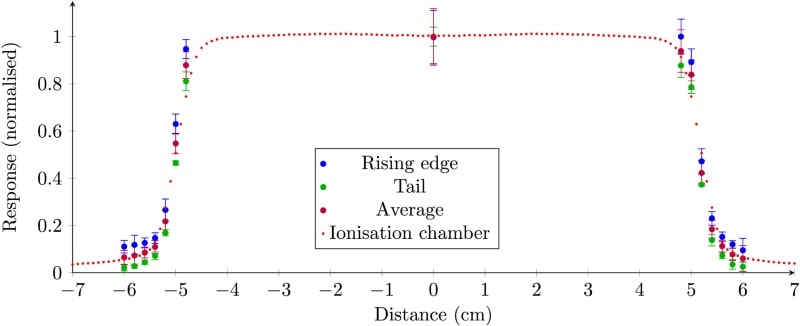
Scintillator dosimetry using three signal analysis methods to determine the beam profile.
Scintillator dosimeters monitor radiation therapy using a scintillating material that generates light in response to irradiation; this signal is then guided via optical fibre to a photodetector. One major advantage of such a device is that it measures the delivered radiation dose over a very small volume.
“A scintillator dosimeter doesn’t affect how the dose is delivered to the target because the components used interact with the radiation the same way that water or tissue does,” explains James Archer from the University of Wollongong.
Alongside the signal-of-interest, however, Cherenkov light is generated in both the scintillator and the fibre, which can compromise the dosimeter’s spatial resolution and accuracy. The simplest way to remove this unwanted signal is to use a parallel fibre without a scintillator to measure only the Cherenkov signal and subtract it from the dosimeter signal. This approach, however, is not optimal in beams with a high dose gradient, and increases the bulk of equipment.
Instead, Archer and colleagues propose using a single probe with a signal analysis algorithm to temporally separate the Cherenkov radiation from the signal of a pulsed radiation beam (Biomed. Phys. Eng. Express 4 044003).
Analysing the tail
In a previous study, the team separated the fast rising edge of the detected signal – the Cherenkov signal – from the slow rising edge – the scintillation signal. This approach removed 74% of the Cherenkov light at the expense of only 1.5% of the scintillation signal. The main limitation here is that varying beam intensity during the pulse reduces the accuracy of determining the Cherenkov contribution.
In this latest work, Archer and colleagues investigated whether using the tail of the signal can improve the accuracy. After the radiation beam pulse has stopped, the Cherenkov signal drops off rapidly while the scintillator signal decays more slowly, enabling separation of a pure scintillation signal.
To study this premise, the researchers used a 500 µm-thick plastic scintillator optically coupled to a 10 m plastic optical fibre and read out by a photomultiplier tube. They irradiated a water tank with a 6 MV linac beam and placed the dosimeter inside to measure the delivered dose at various positions.
Beam profile measurements revealed that the rising edge analysis overestimated dose compared with ionization chamber measurements, while the tail-based analysis underestimated the dose. The average of the two, however, agreed well with ionization chamber results.
To quantify the differences between scintillator and ionization chamber measurements, the researchers calculated S values (the average sum of relative squared difference percentages) for a lateral beam scan at 15 mm depth, and a depth dose scan from surface to 200 mm. Using the averaged data improved the accuracy of beam profile results by 87% (to an S value of 2.20%) and depth dose results by 90% (to an S value of 0.050%).
Depth dose results for the three signal analysis methods.
The researchers also calculated the uncertainties in the beam profiles and depth dose results. In all cases, the tail method produced lower variations between individual measurements than the rising edge method. While the larger uncertainties in the rising edge data served to increase uncertainty in the averaged results, the authors note that there is still an advantage in combining both data sets.
“The tail of the radiation pulse provides an accurate measurement of relative dose,” explains Archer. “The rising edge analysis is slightly less accurate, but uses data from the whole pulse to determine the relative dose, and so will be proportional to the pulse duration. With these together, relative dosimetry can be done between differing pulse durations without having to measure the durations directly.”
The study demonstrated that it is possible and practical to perform single-probe temporal Cherenkov removal techniques. The team is now working on using experimental data to construct beam intensity functions that can fit to the data to the entire shape of the pulse waveform. “This provides a more accurate and more robust method to determine the exact Cherenkov contribution to the signal,” says Archer. “We have also begun working on using machine learning algorithms to learn which parts of the signal we want and don’t want.”
There’s no point in denying that the appeal of an idea in science can depend on finding a catchy name for it. Just think of the Big Bang, black holes or dark matter. None of those, however, comes close to the Doctor Who-style resonance of the phrase “time crystals”. But this concept, first proposed in 2012 by the Nobel-prize-winning physicist Frank Wilczek (Phys. Rev. Lett.109 160401), is more than a case of canny packaging. It toys with some deep themes in physics – the symmetry of time, quantum mechanics and the role of disorder – to come up with a counterintuitive new proposal for how matter can behave.
Ordinary crystals consist of atoms or molecules arranged regularly in space. But rather than having a periodicity in space, time crystals exhibit a periodicity in time. They display a dynamical, ever-changing mode of behaviour that repeats regularly. Although Wilczek’s original concept of time crystals as materials that show spontaneous temporal periodicity has been invalidated, it’s possible to produce a variant of what he had in mind by driving a system out of equilibrium. Last year time crystals of this other kind were demonstrated for the first time in the lab. And very recently two more varieties have been spotted, raising the possibility that time-crystal behaviour might be a rather common property of materials.
That’s all very well, but are time crystals actually of any use? Some researchers think they could be used to make highly sensitive magnetic-field detectors or possibly even components of quantum computers. Their real value, however, could be to furnish a broader picture of how condensed states of matter can behave. For theorists exploring that question, says Norman Yao of the University of California at Berkeley, “all of a sudden we have a new playground”.
Time for a break
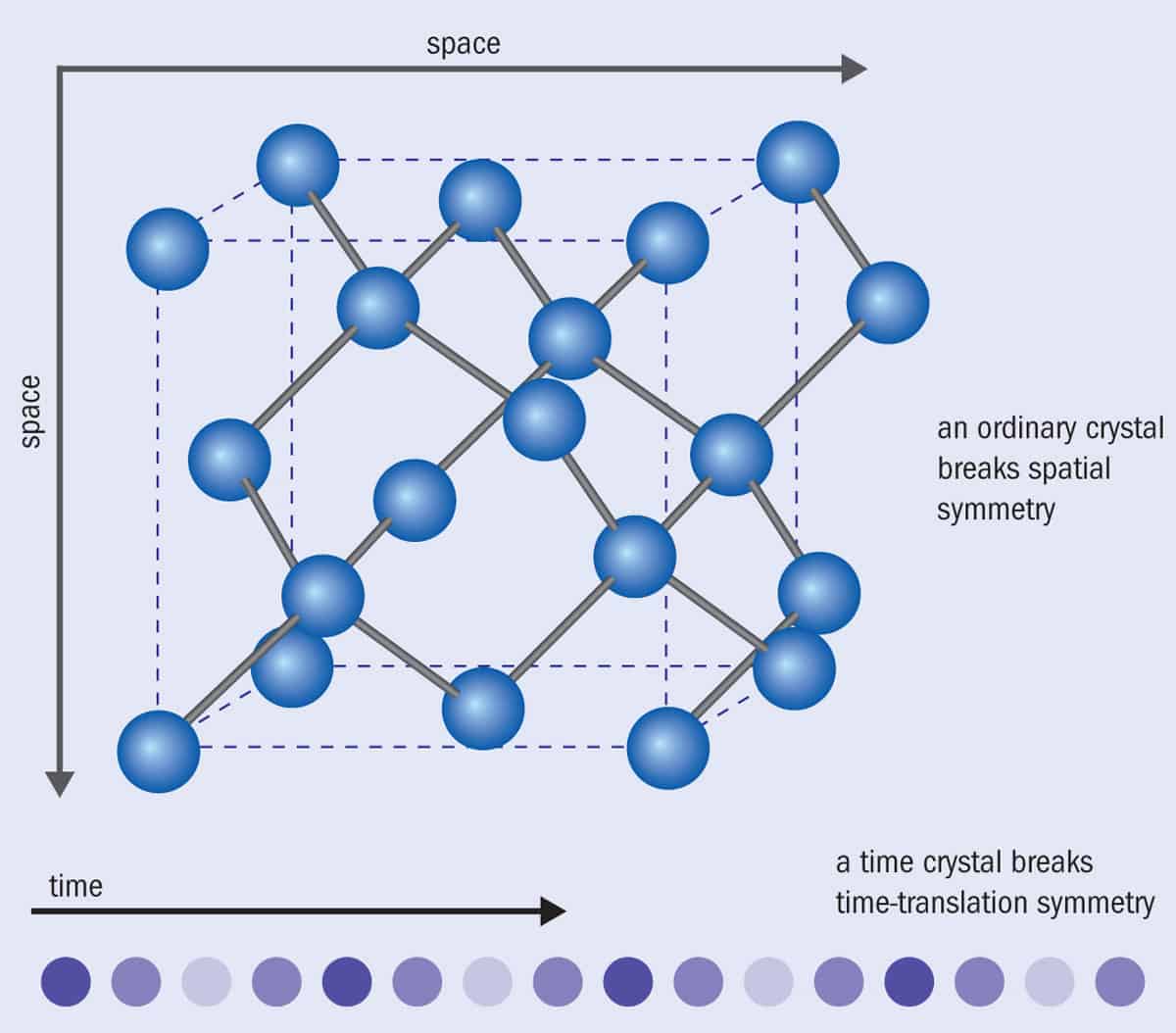
To understand time crystals, let’s remind ourselves about ordinary crystals. Diamond, say, breaks spatial symmetry because not every location is equivalent. Some locations have carbons atoms; others don’t. If you shift, or “translate”, the diamond lattice by some arbitrary amount, it won’t superimpose on the original lattice; the crystal structure has broken the translational symmetry of uniform space. But if you shift the lattice by some integer multiple of the spacing between atoms, it does superimpose, which means that the broken translational symmetry is periodic.
1 A break in time
But what if a material could break “time-translation” symmetry – the symmetry that makes the system unchanged if you shift it forward by an arbitrary amount of time? In his original 2012 proposal, Wilczek considered a ring of quantum particles – the simplest 1D system without edges. He asked if there might be circumstances in which the lowest-energy state of this ring breaks time-translational symmetry such that it changes in time, but returns to the original state at periodic intervals (figure 1).
If a system could indeed break time symmetry, Wilczek reasoned, that periodic change might not necessarily entail the motion of the atoms themselves. Instead, it could perhaps be a periodic cycling of some other property, such as the orientation of their spins. Just as moving through space in an ordinary crystal seems to take you away from and then back to where you started – you come to another atom identical to the one you began at – so moving through time at some location in a time crystal will trigger a periodic departure from and return to your initial state.
Such spontaneous, continual change sounds “perilously close to fitting the definition of a perpetual motion machine”, Wilczek admitted in his 2012 paper. But it needn’t actually be that. After all, we already know of one type of quantum-mechanical ground state that supports a kind of motion indefinitely: a current circulating forever around a ring of superconducting material. But that’s uniform motion. In a time crystal, the motion would oscillate – like, say, a Mexican wave of flipped spins circulating around Wilczek’s ring of spins forever.
Question time
So far so good for time crystals, but in 2015 physicists Haruki Watanabe from the University of California, Berkeley, and Masaki Oshikawa from the University of Tokyo argued that the idea won’t stack up. They showed that no physical system in its lowest-energy state can form a time crystal of the kind envisaged by Wilczek (Phys. Rev. Lett.114 251603). A similar objection had been previously stated more briefly by Patrick Bruno of the European Synchrotron Radiation Facility in Grenoble, France (Phys. Rev. Lett. 110 118901).
The argument against time crystals is that there is no way to prevent such an oscillating system from dissipating energy, meaning that the oscillating state must gradually decay – it’s not in equilibrium. Systems in thermal equilibrium cannot therefore have any interesting time dependencies – there will be nothing interesting that changes with time. So were time crystals just the futile fantasy of a Nobel-prize-winning theorist?
Not quite. Watanabe and Oshikawa admitted that there is a loophole in their argument against the existence of time crystals. Periodic “time-crystal” behaviour could exist, they said, in a system that is pushed out of equilibrium by some driving force. In effect, says David Huse of Princeton University, Watanabe and Oshikawa showed that to break time symmetry (and so get time-crystal behaviour) you’d also have to break some other symmetry too, as with a periodic driving force.
The fact that you could get time-periodic behaviour out of equilibrium might not seem that surprising. After all, oscillatory non-equilibrium states are well known already, as Watanabe and Oshikawa pointed out. Such states occur, for example, in the population cycles of ecosystems and in oscillating chemical reactions such as the well-known “clock reaction”, which can keep switching states (and colours) indefinitely if continuously supplied with fresh reagents.
Given that such states exist, they shouldn’t be awarded this fancy new label of time crystals “without a further justification”, the two physicists warned. And in fact, quantum systems subject to some periodic driving force had been thought about long before Wilczek came to the idea of time crystals. They belong to a broader class known as “Floquet systems”, named after the 19th-century French mathematician Gaston Floquet who worked out the maths needed to analyse them.
A discrete business
In one of those delightful “something in the air” convergences that science occasionally produces, the states that Floquet systems can adopt were being clarified at just the same time as, but independently of, the notion that such non-equilibrium time crystals can exist. In 2016 a team at Princeton and at the Max Planck Institute for the Physics of Complex Systems in Dresden, Germany, showed that Floquet systems containing disorder can, paradoxically, give rise to phases that are periodically ordered in time (Phys. Rev. Lett.116 250401).
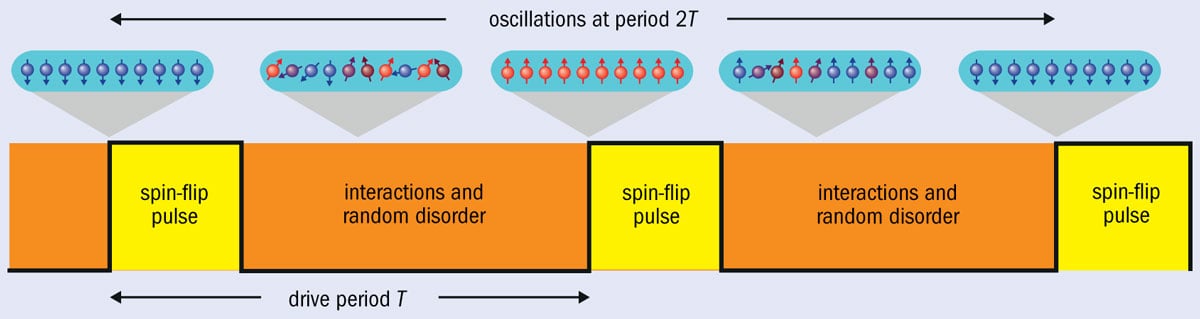
2 First signs
Those researchers considered chains of spins, rather like opened-out versions of Wilczek’s ring of interacting quantum particles. “The authors didn’t notice the connection to Wilczek’s time-crystal discussion,” says Huse, but that was soon pointed out by others – specifically by Chetan Nayak of Microsoft Research in Santa Barbara and co-workers (Phys. Rev. Lett.117 090402), who also proposed how they might be created (figure 2). Yao and colleagues subsequently dubbed these non-equilibrium states “discrete time crystals”, or DTCs (Phys. Rev. Lett.118 030401). The “discrete” comes from the fact that their periodicity is a discrete, integer multiple of the driving period.
Discrete time crystals are very subtle. These systems look like they’re in equilibrium, but they’re not really
Chris Monroe, University of Maryland
Despite the reservations of Watanabe and Oshikawa, there is something odd about DTCs in Floquet systems that makes them different from chemical waves or other periodic non-equilibrium states. Although they are being energetically driven, they don’t actually absorb and dissipate any of that energy. “It’s a very subtle concept,” says physicist Chris Monroe of the University of Maryland. “These systems look like they’re in equilibrium, but they’re not really.”
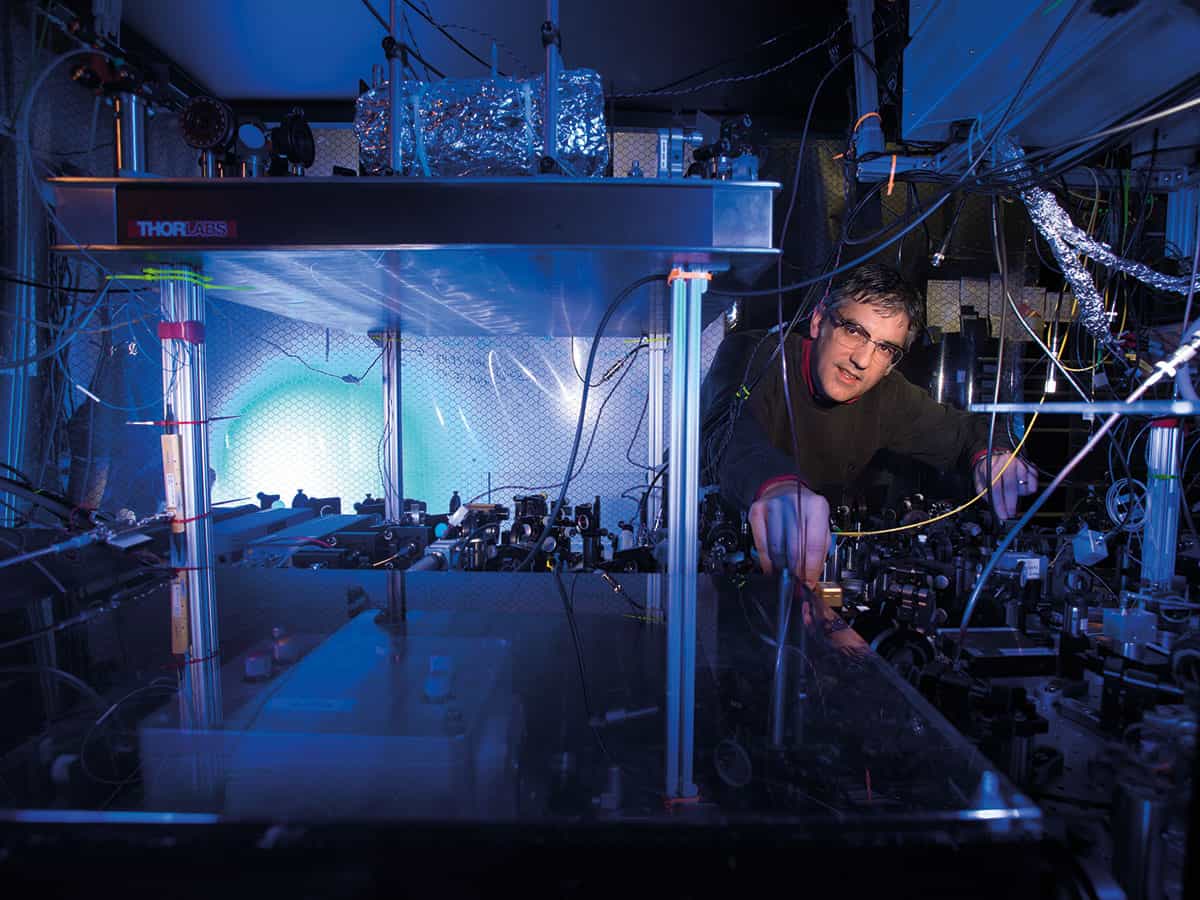
Time in his hands: Chris Monroe at the University of Maryland. (Courtesy: John T Consoli/University)
A local affair
This ability to be driven without absorbing energy arises because the disorder in the system makes the energy states isolated from one another. Unable to exchange energy, the system cannot therefore equilibrate. Instead, it gets trapped or “localized” in a particular non-equilibrium state (Ann. Rev. Cond. Matt. Phys. 6 15). This strange situation, dubbed “many-body localization”, goes back to work on disordered systems in the late 1950s by Philip Anderson, who would later go on to win a physics Nobel prize.
Many-body localization, says Huse, arises because of the quantized nature of the energy levels. “If you drive it at a particular frequency, this drive will not be exactly resonant with any energy differences and the system may remain localized and fail to steadily absorb energy from the drive,” he says. That’s crucial, says Yao, because if the system absorbs energy then it slowly heats up until eventually it’s so hot that any possibility of well-ordered phases vanishes.
Such behaviour seemed to require two key ingredients: some disorder among the components, and strong interactions linking their behaviour. That made Monroe think about the kinds of systems in which he specializes: ions held in electromagnetic traps. He and others have manipulated such ions as quantum bits (qubits) for quantum computing, with binary information encoded in their energy levels.
Actually, such systems are rather too perfect, says Monroe: to get DTC behaviour, they needed to inject some disorder in their ion arrays, “making each ion qubit a little different from the others”. It’s precisely because they could introduce this in a controlled way that the trapped ions seemed such an ideal test-bed for comparing with other disordered Floquet systems in which there is more messy, uncontrolled disorder.
Time crystals in the lab
Last year Monroe and his coworkers reported the characteristic signature of a DTC in an array of 10 ytterbium ions held in a trap, where their spins interact with one another (Nature543 217). When they drove the system with laser pulses to excite transitions between the spin states of the ions, the spin orientation of each atom in the chain started oscillating with a period that was an integer multiple of the driving period. And, crucially, this response frequency is robust. These are the signs of a DTC, says Monroe. “You drive the system in time in a way that’s a bit wobbly, not clean, but it always responds in the same way.”
At the same time, a team at Harvard University led by Mikhail Lukin saw another way to create a quantum system with the requisite disorder: it could come from impurities distributed randomly in a diamond crystal lattice. Lukin and colleagues described a DTC made from coupled electron spins present in defects composed of a nitrogen atom next to a vacant lattice site in diamond at room temperature (Nature 543 221). They used microwaves to manipulate and drive the spin states – basically the procedure used for electron spin resonance (ESR) spectroscopy – in a 300 nm-diameter region of a microscopic beam made of diamond. “It was not fully clear if the DTC phase could even exist in our system,” says Lukin. “But we discovered experimentally that this phase not only exists, but is also remarkably robust.”
We discovered experimentally that discrete time crystals not only exist, but that this phase is also remarkably robust
Mikhail Lukin, Harvard University
The class of materials that act as DTCs has been recently broadened. Earlier this year Ganesh Sreejith and colleagues from the Indian Institute of Science Education and Research in Pune reported it in the interacting nuclear spins of hydrogen, carbon and silicon atoms in three star-shaped organic molecules in solution, probed by nuclear magnetic resonance (NMR) spectroscopy (Phys. Rev. Lett.120 180602). Given the previous work on spin resonance in diamond defects, says Sreejith, “NMR systems were in some sense a natural place to look for the same physics”.
They saw the tell-tale signature of a DTC phase in the way that the oscillation period of the spins is twice that of the driving pulses. And again, says Sreejith, “the oscillation time period is stable against changes in the pulse properties and other perturbations”. These results, he concludes, “indicate that the phenomena can be observed in simpler systems than what has been studied previously”.
Crystal catchers: Sean Barrett and colleagues at Yale University. (Courtesy: Michael Marsland/Yale University)
Sean Barrett at Yale University and his colleagues had much the same idea of using NMR, in their case to look at crystals of the salt ammonium dihydrogen phosphate (ADP). When they heard about the earlier experiments last year, Barrett explains, “just by chance we had a nice crystal of ADP already under study in our NMR spectrometer for a completely different purpose, to do with magnetic-resonance imaging of bones”. They have seen DTC behaviour by driving transitions in the phosphorus spins using a sequence of radio-frequency pulses (Phys. Rev. Lett. 120 180603 and Phys. Rev. B97 184301).
Yao says it’s possible that these NMR systems might prove to be only transient time crystals, since they are expected to eventually relax to thermal equilibrium over long timescales – a process still to be understood. Importantly, however, neither the ADP crystals nor the star-shaped molecules studied by the Pune group have much disorder. “So either many-body localization is a broader phenomenon than previously thought, or it is not required for DTC signatures to be seen,” says Barrett. “I think theorists are working hard to understand what this means.”
This notion of DTCs that don’t depend on disorder is already out there, says Monroe. What you need is merely enough complexity in the interactions. Under certain conditions such a system can never relax to an equilibrium state: a phenomenon called pre-thermalization. Monroe is now seeing if it can be realized with his trapped-ion qubits.
Practical applications
The ability to get such a regular and robust time response out of a disordered system could ultimately point to applications. “In these very messy natural systems with disorder, to have a property emerge that is very stable could point the way to some kind of clock, for example,” Monroe says. Barrett seconds that idea. “The DTC oscillations that all four experiments see is a case where regularly applied pulses make densely packed atoms or spins seem to behave as a synchronized unit,” he says. “If we can understand this behaviour better, then it might be used to improve quantum technologies like atomic clocks.”
If we can understand this behaviour better, then it might be used to improve quantum technologies like atomic clocks
Sean Barrett, Yale University
It would be poetically satisfying if time crystals were to let us measure time more reliably. But Lukin thinks that DTCs might instead be put to a different use, which is that the quantum states between the coupled particles in these systems are so robustly entangled. That means they not only resist the “decoherence” that usually breaks down such states but are also highly sensitive to perturbations such as magnetic fields. They could therefore be used to make tiny magnetic sensors: the more particles there are in the entangled group, the better the sensitivity. Indeed, Lukin, Yao and their collaborator Soonwon Choi reckon that sensors like this could be made either from nitrogen-vacancy defects in diamond or other defects (such as carbon-13 atoms) in layered materials such as graphene (arXiv:1801.00042).
Yao sees another enticing possible application too. Researchers at Microsoft and elsewhere are currently trying to make qubits for quantum computing from quantum states that are rendered stable by “topological protection”: fundamental geometric constraints on the many-body states that would give rise to robust topological qubits. So far, though, making them demands extremely low temperatures, of the order of millikelvins. But Yao says that Floquet phases of DTCs could offer the same benefits at higher temperatures.
In fact, he has an even bolder notion: to make DTCs that aren’t quantum mechanical at all, but are governed by classical physics (arXiv:1801.02628). Yao and his coworkers have shown that even in that case, a combination of noise-induced disorder and strong interactions between the components can be enough to induce time-periodic behaviour characteristic of a DTC in a chain of classical particles – balls coupled by springs, say – subject to an oscillatory driving force. Looked at this way, time crystals could have been discovered with the mechanics of the 18th century.
And that’s what’s really exciting about time crystals, Yao says. They show things are possible that you might never have imagined could be. There have even been suggestions of more exotic structures too, such as time quasicrystals and superfluid time crystals (Phys. Rev. Lett.120 215301). Given the wealth of such paradoxical and surprising substances, time crystals are surely entirely worthy of their Doctor Who style name.
Business thrives on healthy competition, so when different suppliers offer apparently similar but incommensurable products it is not hard to imagine this having a negative impact on companies trying to work with the products and the industry as a whole. Such has been the case for graphene, until now. On Monday afternoon 16th July 2018, representatives from academia, industry and business gathered at the House of Commons in Westminster in the UK for the launch of the world’s first graphene characterization service, an initiative led by the National Physical Laboratory (NPL) in Teddington and the National Graphene Institute (NGI) at the University of Manchester in the UK.
“This service will provide the missing link between academia and industry and will revolutionize how graphene is commercialized in years to come,” Graham Stuart, Minister for Investment told attendees, many of whom have had firsthand experience of the difficulties the lack of standardization in the industry causes and can see the service making a major step to commercially exploiting a material with properties so extraordinary, as Stuart put it “it sounds like something out of a Marvel comic”.
Reliably reproducing wonder properties
In fact as Ray Gibbs, CEO of Haydale pointed out, since 2010 when the Nobel Prize was awarded for the discovery of graphene, industry started to evolve its own standards and definitions because there weren’t any. Set up in 2010 Haydale functionalizes commercial graphene for different dispersions and formats to serve a range of applications.
“We were shocked by the number of measurements that were variable and different because people were using very expensive equipment,” said Gibbs, as he explained that often the problem lay in lack of training for the people using the equipment. “Repeatability is crucial – if you can’t repeat it again no-one will make big ticket investment.”
Filling this gap, both NPL and the NGI share a wealth of expertise in the techniques needed to provide a reliable characterization and measurement service, an idea that has been five years in the making. NPL, a global pioneer in measurement technology will be able to offer robust measurements of the properties of commercially supplied graphene while the NGI can draw on their specialist research excellence in graphene to comment on how the measured properties match up for specific applications.
“The key thing is if you want to purchase a material you look at the data sheet and see what you want but for graphene the data sheets are all different so if you want to compare different suppliers you can’t,” Martin Kemp, consultant for graphene producer Versarien plc told Physics World. “So we’re saying we don’t care what you call your black powder for instance – just tell us what’s in it.” Kemp has also worked with the British Standards Institute on the British standardization of graphene to be launched next month, a brief 20 page document by and for industry that follows the more detailed International Standardization of graphene released in the autumn of 2017.
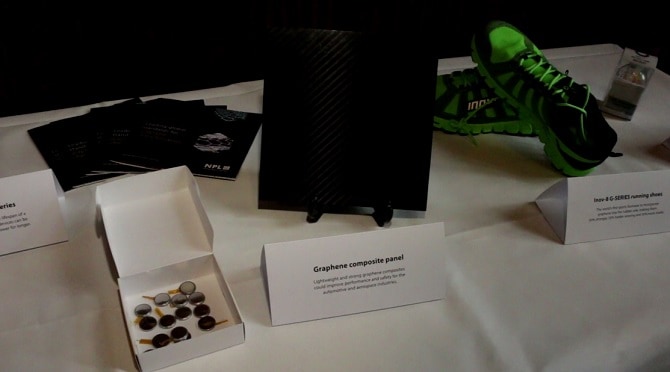
Products on display at the Graphene Service launch at the House of Commons, including high-performance trainers and a lightbulb
Hitting the market
Graphene has been used in commercial items before now but for a long time its inclusion has been more of a marketing exercise to attract attention rather than making use of its manifold fascinating properties. This is now starting to change making the service launch particularly timely. Examples of products on display at the launch that are making genuine use of graphene’s properties included trainers using graphene for mechanical and thermal management enhancement to improve their durability, as well as a lightbulb with a filament coated in graphene, again exploiting the material’s thermal conduction properties to give the filament greater efficiency and longevity.
Will it end with graphene? Quite likely no, as James Baker – CEO of Graphene@Manchester at the University of Manchester, which includes the NGI and the new Graphene Engineering and Innovation Centre (GEIC) – points out, “We Launched the service for graphene but graphene is shorthand not just for graphene but a whole load of other materials.”
The UK’s first “spaceport” for the “vertical” launch of spacecraft will be built on the A’Mhoine peninsula in Sutherland on the north coast of Scotland. The Highlands and Islands Enterprise (HIE) of Scotland will pay £9.8m towards the initial development of the facility, which could be operational in the early 2020s. A further £5m for the project is expected to come from industry and an additional £2.5m will be stumped-up by the UK Space Agency from an existing £50m fund. Money from that same fund will also be available to airports vying to become the country’s first “horizontal” launch facility.
Despite having a thriving satellite manufacturing industry, the UK currently has no launch facilities for spacecraft. A vertical launch involves a rocket blasting off from a launchpad, with the UK Space Agency saying that northern Scotland is the best place in the UK to reach popular satellite orbits using vertically launched rockets.
“Fantastic opportunity”
Covering much of northern and western Scotland, HIE is an agency of the Scottish government that aims to create and grow business opportunities in what is a remote and sparsely populated part of the UK. “The decision to support the UK’s first spaceport in Sutherland is tremendous news for our region and for Scotland as a whole,” says HIE chief executive Charlotte Wright. “The international space sector is growing and we want to ensure the region is ready to reap the economic benefits that will be generated from this fantastic opportunity.”
The UK Space Agency has also announced a £2m fund for the further investigation of building a horizontal launch facility – essentially an airport for jet aircraft that carry rockets aloft, where they are then fired into space. There are currently several locations in the UK vying to host a horizontal facility including Cornwall Airport Newquay, Glasgow Prestwick Airport and Llanbedr Airport in Wales.
Cornwall Airport Newquay got a boost yesterday when the horizontal launch company Virgin Orbit announced that it will run missions from the airport by 2021. The launches will use a modified Boening 747-400 aircraft, which will deploy Virgin’s LauncherOne rocket at an altitude of about 10 km.
Lack of facilities
In November 2017 the UK Space Agency addressed the nation’s lack of launch facilities by promising to spend £50m on what is now called the UK Spaceflight Programme.
According to the agency’s chief executive Graham Turnock, the satellite industry faces “significant barriers to growth”. “The global shortage of dedicated small satellite launches is one such barrier that the UK is in a strong position to translate into an opportunity.” Indeed, the agency estimates that launching commercial satellites could garner £3.8bn for UK spaceports in the decade 2021-30.
Read more about industrial opportunities in space in our special collection “The business of space“.
Topological insulators have shot to fame in recent years following observations of exotic phenomena like the quantum spin Hall (QSH) effect in quantum wells made from mercury telluride (HgTe). However, research on these materials, which are electrical insulators in the bulk, but which can conduct electricity on their surface (via special surface electronic states), is being held back for lack of high quality samples. Researchers in Germany and France have now developed a new wet-etch technique to make micron-sized (Cd,Hg)Te/HgTe structures that does not damage the samples and leaves the crystalline structure of the material intact.
The (Cd,Hg)Te/HgTe could be used for fundamental research on the QSH effect, in which spin-polarized electrons at the edges of an insulator are able to conduct. The QSH effect is interesting because it could be useful for making spintronic devices, which exploit both the spin and charge of the electron. As well as finding applications in such devices, the material might also be used as robust topological quantum bits (qubits) for quantum computers.
New fabrication scheme does not damage microstructure of topological materials
“Dry-etching processing techniques (such as ion milling) typically used to make topological insulators damage the sides of the samples,” says Laurens Molenkamp of the University of Würzburg, who led this research effort. “This is problematic when the quantum states you want to study are located exactly at these edges.” Ion milling can also lead to doping in these materials making them conducting in the bulk. “This is less of a problem in HgTe-based samples, however, which are better than most other topological materials in this respect – if processed properly, bulk doping in HgTe is very low.”
Molenkamp together with colleagues at the Ecole Normale Supérieure, PSL Research University in Paris, have put forward a new fabrication scheme that does not damage the microstructure of topological materials. Their chemical wet-etch process, which makes use of a solution of KI/I2/HBr to oxidize telluride (Te2-), leaves the crystalline structure of the material intact, producing samples of (Cd,Hg)Te/HgTe with a high carrier mobilities of 400 x 103cm2/(V s). The researchers calculated the mobilities by measuring how thin flakes of the material conducted electricity and found that the conductance of the different samples was almost independent of their thicknesses. This result is consistent with the picture that bulk (Cd,Hg)Te/HgTe is only conducting at its surface.
Higher mobility and QSH quantization over longer distances than ever before
“Wet etching techniques leave much cleaner edges, but because all known wet etchants for II-VI semiconductors are diffusion-limited, it is very difficult to make small samples using these etchants,” explains Molenkamp.
“What we have done now is carefully optimize a wet-etching recipe that does allow us to make micron-sized samples – with nice well-preserved edges. This shows up in the higher mobility of these small samples and quantum spin Hall quantization over much longer distances (over 10 μm along the sample edges) than possible previously,” he tells Physics World.
The researchers, reporting their work in Nano Letters 10.1021/acs.nanolett.8b01405, also used their samples to make high-quality Josephson junctions, which will allow for fundamental topological superconductivity studies in the future, they say.
Researchers in Canada have used a D-Wave quantum processing unit to solve a computationally challenging problem in condensed matter physics. While the speed of the calculation does not surpass that of the best conventional computers, the work could be a major step towards the use of quantum processors to enhance physicists’ understanding of systems that are currently difficult to compute. Some experts, however, say that the technique has significant limitations.
The team focussed on the transverse field Ising model, which is a stalwart of condensed-matter theory. It is used, for example, to describe magnetic materials by assuming that spin magnetic moments are fixed on a regular lattice and interact with their nearest neighbours in the presence of an applied magnetic field.
Other systems outside condensed matter physics can also be described by the same equations. Quantum computing expert Helmut Katzgraber of Texas A&M University in the US offers an example: “Suppose you have a very large museum such as the Louvre in Paris and you want to place guards in the museum. You want to find the smallest number of guards that you can distribute across the museum such that every single room is watched.”
In 1D, the model’s equations can be solved analytically. In two or more dimensions, however, numerical solutions are required. On a conventional computer, a lot of computing power is needed to run the necessary algorithms: “The workhorse for studying that system is something referred to as quantum Monte Carlo,” explains condensed matter physicist Richard Harris of D-Wave Systems. “People use very large servers to study that particular system using that technique.”
Quantum annealing
To try to devise a more effective simulation, Harris and colleagues at D-Wave, Simon Fraser University and the University of British Columbia used a commercial D-Wave processor. This is a cryogenic chip containing several thousand interacting superconducting loops, with each loop acting as a quantum bit (qubit). The researchers programmed the qubits to simulate a cubic lattice of 8x8x8 individual spins. In a process known as quantum annealing, the system evolves by quantum tunnelling from a superposition of all possible states into the lowest energy state. The researchers looked at the effect of flipping or removing individual spins on the other spins in the lattice to calculate values for some important magnetic properties. These results were in good agreement with those found in literature.
The team went on to find magnetic phase transitions in the lattice. The transverse field Ising model can produce various magnetic configurations. In the paramagnetic state, the spins are aligned. In the antiferromagnetic state, neighbouring spins point in opposite directions. In the spin glass state, the spins adopt a seemingly random orientation. Which state the system adopts depends on the values of temperature, applied field and the amount of disorder in the lattice (caused, for example, by impurities).
Choose your sequence of programs, put them in overnight and your results are there in the morning
Richard Harris
“If you were a condensed matter physicist doing these sorts of experiments, you’d have to produce an entire series of crystals where you’d very carefully changed the concentration of impurity or disorder and take measurements on each individual crystal.” explains Harris. “We’re showing here that you can move along all three axes on our processor by programming: choose your sequence of programs, put them in overnight and your results are there in the morning.”
Harris admits that the results from their D-Wave simulations are not yet competitive with state-of-the-art conventional computers: “We are working at the level of an early- to mid-1990s, high-horsepower computer, not a modern mainframe computer,” he explains. “Nevertheless, we’re actually starting to see a place where you can push the limits of modern digital computing.”
Very significant
Katzgraber, who was not involved in the research, is more cautious. “The approach that they have used, while it works very well for a magnetic system, will not be extended easily to many other problems. ” Nevertheless, he describes the paper as “very significant” for its fulfilment of Richard Feynman’s dream of a machine that could use a quantum approach to simulate the physics of a material successfully.
Quantum computing expert Barry Sanders of University of Calgary in Canada agrees with Katzgraber on the significance of the work. He is sceptical, however, of Harris’ claim that the D-Wave offers any potential to overtake classical computing: “If you use a multi-core processor with enough cores, you can do the same thing with quantum Monte Carlo on a classical computer as with D-Wave,” he explains. “As the problem gets bigger, you need a bigger D-Wave computer – and the scaling factor is the same with the classical computer as with D-Wave.”
What was your background before you started Zenotech?
I did a PhD in applied mathematics in Adelaide, South Australia, and from there I spent two years as a postdoc in the NASA microgravity programme at the University of Delaware, solving dynamic equations for thin films – particularly the “contact line” problem, which concerns whether a liquid will wet a solid. After that, I joined the fluid dynamics group at BAE Systems, working at their technology centre in Bristol, UK. It was an interesting time to be involved in fluid dynamics because the aerospace industry was just starting to adopt codes for viscous computational fluid dynamics (CFD), going beyond the Euler equations for non-viscous flow. As I became more senior though, my job took me away from my natural inclinations. That’s part of why I left to co-found Zenotech: I wanted to return to the area I was passionate about, which was performing large Navier-Stokes fluid simulations on big computers.
What other factors spurred you to leave?
My co-founder Jamil Appa and I had talked about forming our own company roughly every three years since I started at BAE, but each time one of us would get promoted or something else exciting would come along. Then, a little over six years ago, BAE went through a round of redundancies, and we also both turned 40. That was a critical element in making us think “Well, it’s now or never.” It was a big step to leave that corporate environment. On day one, your inbox is empty. You have no contracts, no customers, no actual work to do. My wife told me to go outside and get a coffee, which was good advice because two months later, our inboxes were back to being full again, we were desperately trying to track down contracts from customers and the work was starting to pile up.
Who did you bring in to help you?
One of the first, and smartest, things we did was to join a local business incubator called SETSquared. It is very good at giving advice on how to go from doing technical work to running your own company, and becoming part of the incubator gave us a lot of contacts. We also buy in services such as accountants, lawyers, public relations specialists and designers when we need them. Design is especially important. In fact, it’s becoming the discriminating feature for a company offering any kind of online service. People’s expectations have been raised by the Internet and the various services they consume on it, and the user experience is critical. You cannot afford to have an out-of-date-looking website or an interface that’s difficult to use.
How did you get funding?
Zenotech has been “organically grown” – a sometimes pejorative term meaning that we are self-funded as opposed to taking venture capital money. We were offered money early on, but we were advised – I think quite wisely – not to take it at that stage. Instead, we have funded product development ourselves via consultancy work and collaborations with end-users in the aerospace, automotive and renewable-energy sectors. One of our products, for example, is a CFD code that is perfectly suited to doing aerodynamic design analysis on things like turbines and the airflow around buildings or over terrain. Wind-turbine manufacturers care a lot about how the wakes from one turbine impact on the performance of the ones behind it; similarly, the automotive sector wants to know where the vortices go if they’re designing a new car. We’ve developed that code over a number of projects, and a key feature is that it will run very efficiently on different types of hardware – central processing units (CPUs), graphics processing units (GPUs), all kinds of architectures.
You’re involved in cloud-based computing. How did that happen?
We offer a service called Elastic Private Interactive Cloud, or EPIC, and it started as a way of helping organizations use our CFD code without having to operate a supercomputer themselves or go directly to major cloud-computing vendors such as Amazon. The classic use case is a consultancy firm that has landed a big project that requires them to spin up hundreds, maybe thousands, of cores in a computing cluster over a short period – but then for the rest of the year they don’t need any computing power at all. It doesn’t make sense for a firm like that to go out and buy their own supercomputer, and they may also lack specialist IT people who know how to configure and run big computers in the cloud or solve the inevitable problems that arise. So we do that work for them, and then we help identify the cheapest available machine that will get their job done. You can do post-processing of the results in the cloud as well, and obtain the kind of “eye candy” images and videos that CFD simulations love to produce, without having to download tens or hundreds of gigabytes of raw data.
Turbulence: CFD simulation of wakes behind wind turbines at Whitelee Farm in Scotland. (Courtesy: Zenotech)
The development of cloud computing has also been interesting in a more general sense. Four or five years ago, when you talked to people about moving their computational engineering or high-performance computing applications into the cloud, security was the number one stumbling-block – it was used as a blanket excuse, really, for not doing it. There was this idea that because your data was being processed or your code was run off-site, it was somehow less secure, and that was a very difficult thing for cloud service providers to address. Now, though, the security argument has matured and people are far more cognizant about what they mean by a “security risk”. The relative merits of having an off-site, on-demand system where every access is logged, backed up, traceable and auditable, versus using a computer on your own premises with an open USB portal on the front and a regular traffic of visitors and students, have become clearer.
What have been your biggest challenges in developing Zenotech?
One challenge, especially if you don’t take investment money to start with, is that your salary suddenly depends on how much money the company has that month. Technically speaking, though, the challenges are the same as the opportunities. We started with a blank sheet – literally all our code has been developed from scratch within the company – and that means we probably made a few false starts before settling on a product line that works. Our initial idea was that we were just going to write a CFD code that runs on GPUs, but that rapidly turned into two product lines, and frankly it’s our cloud service that has been more widely applicable.
I also think we’re at a crucial point where both products are mature enough that I’d be willing to grow them significantly. That will take investment. The “organic growth” phase of the company is, I think, probably coming to an end. To work with larger businesses, it seems that a critical mass is needed, and that would involve growing the Zenotech team.
What do you know now that you wish you’d known when you started?
If I could go back and tell myself what to do, I’d have said to incorporate as soon as you can. Get a bank account running as soon as you can. In fact, get all that machinery in place because by the time you need, say, an accounting system, you’re probably already doing too much of that work manually. It’s far better to get processes in place and use a cloud-based system that costs you a little bit every month so that when the number of transactions does ramp up, you’ll be processing them efficiently.
The other thing I’d mention is that, coming from a large corporation, I always looked on the business world as being a wild and slightly scary place. There are a lot of unflattering images in the media of what business is like – shows like The Apprentice give you the idea that it is all about being nasty, ruthless and conniving – but in my experience people have been extremely supportive. There is a whole community who will bend over backwards to help and to give you advice if they can.
That segues nicely into my last question. What advice do you have for someone thinking of starting a company in this field?
There’s absolutely no substitute for giving it a go, but anyone looking to set up a technology business needs to assess their willingness to take risks. I had three kids under the age of 10 when I started Zenotech, and you need to be sure you’re not exposing yourself to a risk you’re not able to bear. Even with the best will in the world and the best product idea in the world, you have no idea what your competitors are doing or which way the wind is going to turn. Maybe your company is predicated on doing business with a firm that will cease to exist or a country that you won’t be able to trade with for some reason. Alternatively, sometimes the wind will blow in your favour.
A lot of people in the corporate world say things like, “You know, I’ve been at company XYZ for nearly 38 years now; maybe I should try starting one myself.” My response is, yes, you should – but only if you really want to. Don’t do it for any other reason, because you’ll find it’s quite hard at times. It turns up the volume on life when you’re running your own company. The highs are higher, but the lows (regardless of origin) are all yours.
“Looking ahead, our model simulations show that grasslands store more carbon than forests because they are impacted less by droughts and wildfires,” says Pawlok Dass of the University of California Davis, US. “This doesn’t even include the potential benefits of good land management to help boost soil health and increase carbon stocks in rangelands.”
Whilst forests mostly store carbon in woody biomass and leaves, grasslands sequester most of their carbon underground in roots and soil, where it largely remains even after a fire.
Since 2010, about 130 million trees have died in Californian forests due to high tree densities combined with climate change, drought and bark beetle infestation, according to the US Forest Service. Eight of the state’s 20 most destructive fires occurred in the past four years, with the five largest fire seasons all taking place since 2006.
“In a stable climate, trees store more carbon than grasslands,” says Benjamin Houlton, also of the University of California Davis. “But in a vulnerable, warming, drought-likely future, we could lose some of the most productive carbon sinks on the planet. California is on the frontlines of the extreme weather changes that are beginning to occur all over the world. We really need to start thinking about the vulnerability of ecosystem carbon, and use this information to de-risk our carbon investment and conservation strategies in the 21st century.”
California’s cap-and-trade market is designed to reduce the state’s greenhouse gas emissions to 40% below 1990 levels by 2030. The study indicates that grasslands should be given opportunities in the market, according to a UC Davis press release.
The findings could inform similar carbon offset efforts around the globe, particularly those in semi-arid environments, which cover roughly 40% of the planet.
Dass, Houlton and colleagues modelled four scenarios: a substantial decline in carbon emissions, with up to 1.7°C of temperature rise by 2100; business as usual, resulting in up to 4.8°C of warming; periodic drought; and megadrought, lasting for a century or more.
California’s grasslands were more reliable carbon sinks than trees in all but the first scenario. Grasslands continued to store some carbon even during the team’s simulations of extreme drought.
“Trees and forests in California are a national treasure and an ecological necessity,” says Houlton. “But when you put them in assuming they’re carbon sinks and trading them for pollution credits while they’re not behaving as carbon sinks, emissions may not decrease as much as we hope.”
As long as trees are part of the cap-and-trade portfolio, the researchers note, protecting that investment through strategies that would reduce severe wildfire and encourage drought-resistant trees, such as prescribed burns, strategic thinning and replanting, would likely reduce carbon losses.
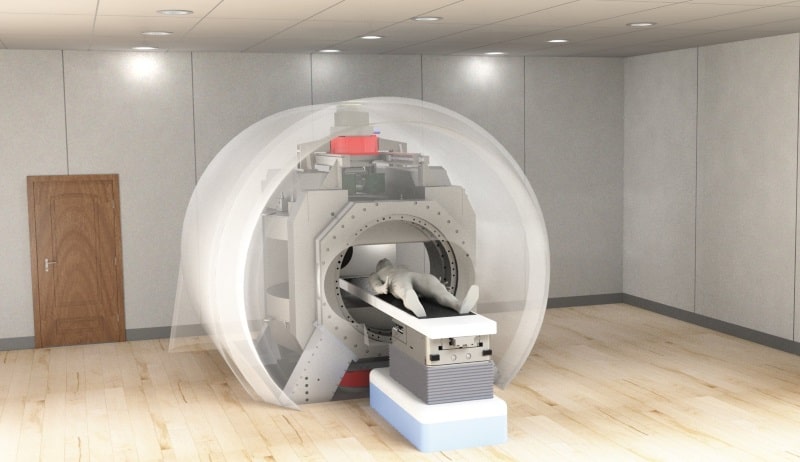
B. Gino Fallone, Keith Wachowicz and Brad Murray from the University of Alberta.
Image guided radiotherapy (IGRT) is the state-of-the-art in radiation treatment, and the recent introduction of integrated MRI-linac systems adds potential for real-time tumour tracking during beam delivery. But achieving this requires the ability to quickly and accurately determine the position of the target volume and critical structures from the MR images.
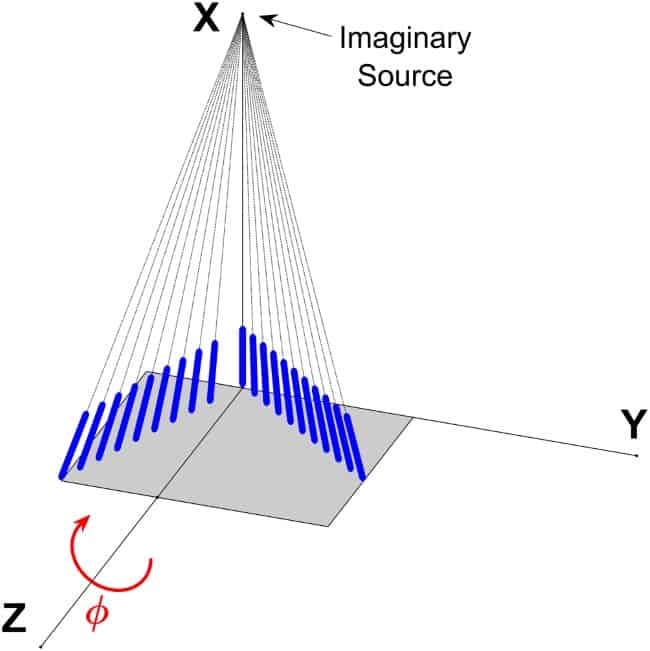
Because radiotherapy uses a divergent beam emanating from a single point, conventional pre-treatment simulation using CT requires the creation of “ray-traced” digital reconstruction radiographs to generate a beam’s-eye-view (BEV) image that represents the path of the treatment beam. Conventional MR image slices, however, have pixels that represent volume elements arranged parallel to each other.
When MRI is used to track structures for real-time radiotherapy guidance, these two coordinate geometries do not match and tracking errors can result, especially for thick image slices. Divergent ray-tracing of MR images is technically possible, but not suitable for real-time guidance due to lengthy 3D acquisition and ray-tracing reconstruction times.
“The BEV encoding gradients proposed in this work would allow direct acquisition of tracking images in the same geometry as the treatment beam, avoiding any potential for tracking errors due to the geometry mismatch,” explains first author Wachowicz.
Warping fields
To use MRI to track anatomy in real time, the researchers propose the use of non-conventional gradient field patterns, implemented through hardware additions to a standard scanner architecture. They developed nonlinear encoding gradient fields that allow MR images to be generated in a divergent beam geometry. For MRI-linac systems where the radiation source is fixed relative to the magnet, adding two warping coils to the linear X and Y coils can produce these encoding fields.
For MRI-linac architectures in which the beam source is not fixed to the imaging magnet, the identified warping field pattern will only be appropriate for one source position. In such cases, the researchers showed that a basis set of second-order spherical harmonic functions, together with linear gradients, provides a good approximation of the BEV gradient patterns at any angle.
They propose the use of a set of second-order warping coils fixed to the magnet, employed in various combinations to generate the conditions for divergent imaging as the source rotates. This would require four additional warping coils.
Proof of principle
To test their proposed theory, the researchers used a 3T scanner to image a phantom with nonlinear encoding-gradient field patterns. The phantom comprised gel-filled rods oriented to converge at a single point 100 cm away.
Arrangement of gel rods in the magnet.
As the derived encoding gradients are not readily available, they approximated the ideal warping field to a second-order field gradient and created this using second-order shim coils. Such coils, however, are not currently designed for rapid switching in tandem with the linear encoding gradients.
“To test the feasibility of this approach in an environment without rapid-switching capability, we had to first find a sequence that maintained as much as possible a constant encoding gradient amplitude during image encoding. The closest match we could find was a short-echo radial acquisition,” Wachowicz explains. “Secondly, we had to manually alter the shim coil currents according to our calculations for each of the 102 radial spokes that we acquired.”
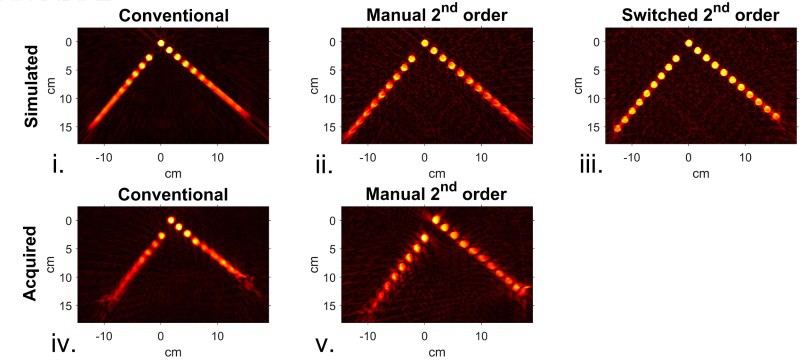
To circumvent hardware limitations, the researchers also created a corresponding virtual phantom. They simulated three images, using: conventional linear gradients; switched linear-encoding gradients and unswitched warping fields (to mimic the experiment); and linear-encoding gradients and warping fields switched in tandem (representing an ideal implementation).
Simulated and physically acquired images with and without BEV companion fields on a phantom with divergent geometry.
Images of the phantom generated with traditional parallel geometry over its full 12 cm thickness exhibited blurring, as expected. When images were acquired with (unswitched) warping field patterns, much of this blurring was absent. However, the tubes still appeared distorted, particularly those farthest from the isocentre.
The authors believed that a switched set of warping fields – as would be present in any physical implementation of this technique – would remove the bulk of this residual distortion. Simulations with companion fields switched in tandem with the read gradients produced images with all of the tubes clearly discernible, successfully validating their technique.
The Aurora RT hybrid linac-MR system developed at the Cross Cancer Institute in Edmonton, Alberta.
The team is now planning to move this approach towards clinical application. “We expect to include a set of BEV coils within the Alberta (Edmonton) biplanar linac-MR hybrid design,” says Fallone.
The most precise experimental value for the dissociation energy of molecular hydrogen has been measured by an international team led by Wim Ubachs at VU Amsterdam and Frédéric Merkt at the Swiss Federal Institute of Technology (ETH Zurich). The measurement delivers an order of magnitude improvement over the previous best and is a significant deviation from the most recent theoretical calculations. Resolving this discrepancy could lead to improvements in molecular quantum theory and could result in a better measured value for the proton radius.
The hydrogen dissociation energy is the amount of energy required to separate the two atoms in a hydrogen molecule. To measure the value, physicists have previously broken down the process into a thermodynamic cycle of intermediate transitions where the molecule is first ionized, and then split into a proton and a hydrogen atom. An electron is then added to the proton, forming two neutral hydrogen atoms. Physicists then calculate the molecular dissociation energy by summing the excitation energies for each of these transitions.
The dissociation energy can also be calculated theoretically; accounting for relativistic and quantum-electrodynamic effects. Comparing the theoretical result with experimental values has previously allowed for stringent tests of quantum theory. Experiment and theory have agreed with each other in previous studies, even as the accuracy of experiments improved.
New transition sequence
To improve accuracy further, Ubachs, Merkt and colleagues obtained a more precise value for the ionization energy – which is the stage of the dissociation process with the largest experimental uncertainty. They achieved this using a new sequence of transitions, which involved measuring a high-energy transition with vacuum-ultraviolet light at VU, then a lower-energy transition with an ultraprecise continuous-wave near-infrared laser spectroscopy at ETH. Combining the results, the researchers calculated a dissociation energy with a relative uncertainty of under 10⁻⁹.
The result is in line with previous experimental results, yet it appears to deviate from the most recent theoretical calculations by more than three times the experimental uncertainty. Writing in Physical Review Letters, the physicists note that adjustments may be needed to how relativistic electron motion and quantum vacuum fluctuations are treated in calculations. Alternatively, the mismatch could point a more fundamental problem in molecular quantum theory.
Resolving the discrepancy could offer a new way to determine the radius of a proton and could also lead to better measurements of the proton-to-electron mass ratio. Precise measurements of these quantities have the potential to reveal news physics.