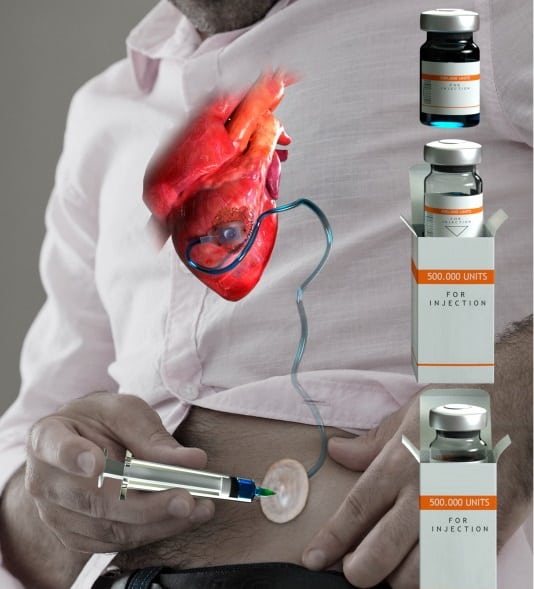
Therepi’s reservoir can be connected to a port or pump via a tube when it needs to be refilled. (Courtesy: Second Bay Studios/Harvard SEAS)
After a patient has a heart attack, residual scarring can lead to heart failure. Current therapies, such as drugs, proteins and stem cells, could treat scarring – but these treatments are often delivered systemically, rather than directly to the site of the damage, and can require multiple doses to work.
Hoping to halt the progression from heart attack to heart failure, researchers from the USA and Ireland have developed an implantable device that sits directly on the heart and delivers drugs and other therapies directly to damaged heart tissue (Nature Biomed. Eng.2 416).
The device, dubbed Therepi, is a small patch that is sutured onto the heart. The patch contains a sponge-like biomaterial that acts as a reservoir, holding and releasing therapies through a semi-permeable membrane. The biomaterial is connected to a port or pump outside the body, where therapies can be injected by the patient or a healthcare professional.
The reservoir also provides a unique opportunity for administering stem cell therapies. Rather than pass through the membrane into the heart, the cells stay within the reservoir where they produce paracrine factors that promote healing in the damaged heart tissue.
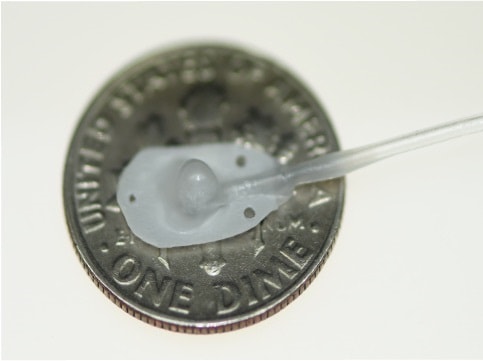
Therepi’s reservoir, which would attach directly to damaged heart tissue, placed on a dime for size reference. (Courtesy: Nature Biomedical Engineering, Whyte et al)
“The material we used to construct the reservoir was crucial. We needed it to act like a sponge so it could retain the therapy exactly where you need it,” says co-first author William Whyte, a PhD candidate at Trinity College Dublin and AMBER. “That is difficult to accomplish since the heart is constantly squeezing and moving.”
The team performed a pre-clinical study in a rat model, using the device to administer multiple doses of stem cells to a damaged heart over a four-week period. Hearts that received multiple dosages of cells via Therepi had more cardiac function than those who received only a single injection or no treatment at all.
“After a heart attack we could use this device to deliver therapy to prevent a patient from getting heart failure,” explains co-first author Ellen Roche from MIT. “If the patient already has some degree of heart failure, we can use the device to attenuate the progression.”
Therepi addresses the problems with current drug delivery methods by administering localized, non-invasive therapies as many times as needed. The device’s reservoir can be implanted on the heart in just one surgical procedure. By optimizing the design and adjusting the materials used to construct the reservoir, Therepi could also be used to treat diseases and health problems in other parts of the body.
At a Royal Air Force (RAF) base in northern Scotland, it has just turned 0200 GMT on a blizzardy winter morning. A bleary-eyed maritime patrol crew make final aircraft and mission system checks before air traffic control clears 1JF to line up on runway 08. As the plane positions itself for departure, a final brake check is conducted just as take-off clearance is issued. Auto-throttle is engaged and the two throttles advance to full power. The engines spool up with a howl, and the cold silence of the night is shattered as this hunter powers down the runway. At the call of “rotate”, the pilot pulls back on the controls propelling 1JF into a pitch-black moonless sky and en route to a long night over the north Atlantic. The hunt for submarines is on.
Hide and seek: Planes and helicopters are used as maritime patrol aircraft. (Courtesy: REX/Shutterstock)
A very short underwater history
While submarines are now relatively commonplace in the world’s oceans, it has taken mankind thousands of years to get there. Underwater military operations can be traced back to the Peloponnesian War from 431 to 404 BC, which was fought between the Delian League led by Athens and the Peloponnesian League led by Sparta. Thucydides (a main source from that era) records the Athenians using “divers” – probably men just holding their breath – during the Siege of Syracuse in Sicily. The divers cleared stakes that had been driven into the harbour floor by the Syracusans to defend against and damage Athenian ships.
Skipping forward to the early 1500s, Leonardo Da Vinci made some sketches of potential underwater vehicles, and the first prototype submersible was designed in 1578. However, it took another 42 years for the first successful submarine to be built. It was made by Cornelius Jacobszoon Drebbel, a Dutch engineer in the service of King James I of England. Propelled by oars and supplied with air from floating tubes, it was a simple vehicle and probably was not able to travel much below the surface.
Underwater acorn: the Turtle was one of the first military submarines. (Farnham Bishop 1916)
One of the next major advances occurred in 1775 when the Turtle – among the first military submarines to be constructed – was built by the US. Its purpose was to attack British warships by attaching explosives to the enemy hulls. Although it looked more like an acorn than any well-evolved sea creature, its design pioneered underwater propulsion by using hand-screws to turn a propeller.
As technology advanced and various engineering challenges were solved, submarine propulsion and power evolved from human to mechanical, electrical, diesel and nuclear. Some modern vessels even power themselves with radical technologies that don’t rely on nuclear motors or access to atmospheric oxygen either. Indeed, the ability to remain submerged without surfacing for air is a critical advantage so the submarine can avoid poking bits of the vessel above the water’s surface, which could lead to a “detection opportunity” for a hunter’s sensors.
The first submarines were designed to sink surface ships, but today’s military vessels have many different roles: they can carry and launch cruise or ballistic nuclear-tipped missiles to hit far away land targets (deterrence and/or attack), deploy special forces for midnight raids, conduct surveillance, or simply deter an enemy by their assumed presence in a critical sea lane.
Many world powers possess and invest in an undersea military capability including the UK, US, Russia, China and North Korea, while the technology has also been exploited to a lesser extent by drug cartels, the tourist industry, adventurers and even the Beatles. Consequently, the cat-and-mouse game you might recall from Hollywood movies such as The Hunt for Red October is alive and well, with surface warships, aircraft and other submarines all used to detect and deter these (almost) silent vessels.
Submarine spotting in the First World War
Peeking above. (Courtesy: iStock/iLexx)
In response to the big threat posed by enemy submarines in the First World War, which saw more than 5000 ships destroyed and 15,000 sailors lose their lives, the British Board of Invention and Research (BIR) came up with multiple counter-strategies. Working “to initiate, investigate and advise generally upon proposals in respect to the application of science and engineering to naval warfare”, the BIR included top physicists such as William Bragg and Ernest Rutherford. Switching his focus during the war from radioactivity and atomic structure to underwater acoustics, Rutherford made significant contributions to improving the underwater detection of sound from submarines.
There were, however, some rather odd solutions too for detecting submarines. One of the more unusual ideas proposed by the BIR involved dragging a dummy periscope behind a ship while food was discharged nearby. The aim was to attract a flock of seagulls to the periscope and, following repeated runs, condition the birds to associate periscopes with a good meal. Ergo, anytime a periscope popped above the surface, a flock of seagulls would beeline towards it giving the game away. Sadly, this idea didn’t work and the seagulls were left in peace to harass small children with ice creams.
Enter the maritime patrol aircraft
As with all new military technologies, the construction of submarines soon led to the development of techniques to spot enemy vessels. Some of these, dreamt up during the First World War, were rather odd (see box, above). That conflict also saw the introduction of aerial anti-submarine warfare (ASW) patrols. Blimps and early land-based planes became the first marine patrol aircraft (MPAs) and, by the Second World War, converted bombers and airliners were used in addition to purpose-built aircraft. Since then, most MPAs have derived from civilian airliners as they can fly long distances, stay airborne for a long time and have lots of interior space for the crew and mission equipment.
Two early examples of converted-airliner MPAs were the RAF’s Nimrod (originally the de Havilland Comet), which was retired in 2010, and the US Navy’s still-active P-3 (originally the Lockheed Electra). The most recently developed MPA, the Boeing P-8A Poseidon, is based on the Boeing 737, and is set to enter service with the RAF in the near future. Related to the MPA is the shipborne maritime ASW helicopter. It cannot fly as far or for as long as the planes but operates closer to the threat as the landing pad is at sea – something that keeps the crew highly motivated to hunt submarines so their own base doesn’t get sunk.
Submarine search science
All these aircraft are designed to exploit the fact that submarines can be found using physics. During an ASW mission, an aircraft crew use an array of hi-tech sensors to find any tell-tale trace left by a submarine as it glides under the water. Broadly speaking, these sensors can be classified as acoustic or electromagnetic, and active or passive.
Acoustic sensors look for sound pressure waves under the water, while electromagnetic sensors identify various parts of the electromagnetic spectrum. As for active sensors, they emit a shaped pulse of energy, or a ping, and collect any returning signal that has reflected off part of the submarine. Passive sensors, meanwhile “listen” to and collect any noise in the environment, which hopefully includes an emission from the target.
Perhaps the most familiar sensor is radar (which stands for radio detection and ranging). Radars send out a pulse of a radio frequency and then wait for a return pulse as it bounces off a target. Knowing the speed of light and the time it takes to get a return, you can calculate the distance to the target. This active method has been around since the late 1930s and while its original purpose was military, it is now used in a wide variety of commercial applications including weather tracking and crop surveillance.
The two most common passive sensors for the electromagnetic spectrum are electronic support measures (ESM) and optical devices. Optical sensors are possibly the oldest method of detecting submarines, dating back to the venerable but still useful, “Mk 1 eyeball” – the military nickname for the human eye. Modern variants are sophisticated electro-optical digital devices that extend beyond the visual spectrum and into the infrared, and include a high-power zoom function to see at extended ranges. Meanwhile, ESM listens to a broad range of radio frequencies, hoping to pick up the submarine’s emissions, such as its radar.
Both of these sensor types can, however, only be used when the submarine is at the surface or lies at “periscope-depth” – the depth at which their periscope and mast-mounted sensors can break the surface. Given that this is when a submarine is at its most vulnerable, it’s not surprising that submarine commanders prefer to keep their vessels fully underwater, leaving only the acoustic domain as the main detection medium for an MPA crew to exploit during their hunt.
There is, however, one exception – the magnetic anomaly detector (MAD). This is an extremely sensitive magnet usually housed in a pod at the back of an aircraft to isolate it from electromagnetic noise generated by the aircraft. This sensor measures the Earth’s magnetic field and senses any anomalies, alerting the crew to the potential presence of a submarine (or other large metal object) under the water.
Sounds like trouble
One of the issues with using underwater acoustics as a submarine detection device is that it is unfeasible to get an aircraft down into the water to listen and ping for the submarine. This is why the disposable sonobuoy was developed during the Second World War. Sonobuoys are cylindrical canisters dropped by parachute from an aircraft. They contain a hydrophone (special microphone) tuned to the water and a radio transceiver to send the information back to the aircraft. When it hits the water, the sonobuoy immediately deploys the hydrophone to a preset depth and erects a small floating antenna for a simple on-board radio to transmit the signal back to the aircraft. The range of sonobuoys and where they should be placed depends on the target and the local environment and is one of the most highly classified areas in ASW operations.
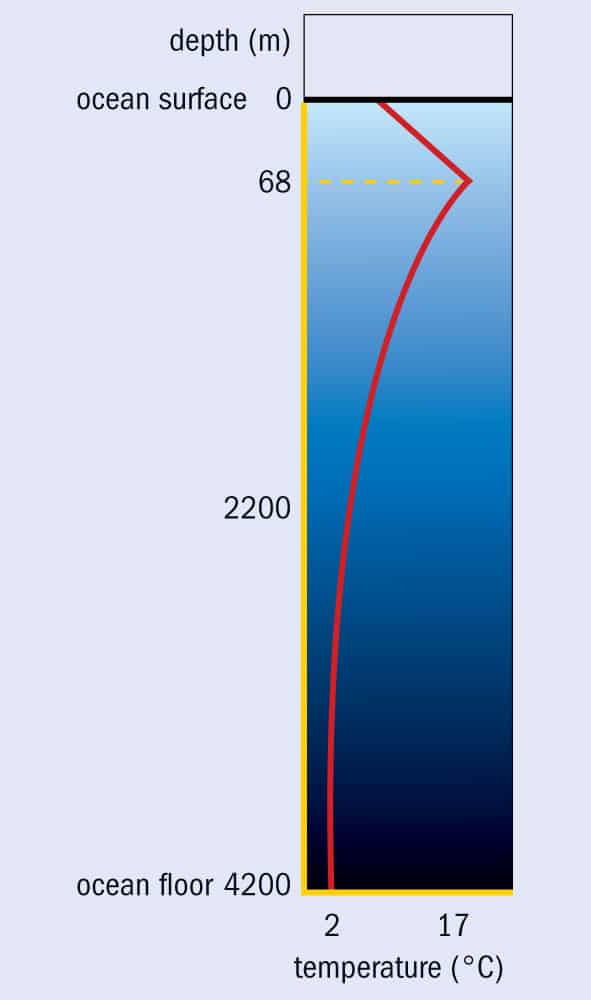
Figure 1: The temperature of ocean waters varies with depth.
Sonobuoys come in two basic varieties: active and passive. The passive sonobuoy is a fairly simple, inexpensive hydrophone; its sole job is to gather all the acoustic energy in the water and convert it to a radio signal, which is transmitted back to a computer processor on the aircraft. The active sonobuoy (sonar), on the other hand, works like an underwater radar, but instead of radio waves, it transmits high-frequency sound waves (the pings) that can be remotely controlled by the crew. Any wave that leaves the sonobuoy and hits a solid surface in the water reflects back towards the transmitter, where a hydrophone collects the acoustic energy and transmits it back to the aircraft via its radio. Once received on the aircraft, the passive and active signals are digitally processed and converted into a visual format for the crew to analyse. This allows them to establish whether they’ve found an acoustic contact of interest and, more importantly, determine if it is a submarine. The crew can then calculate its course and speed using a variety of techniques including Doppler analysis.
There are several difficulties with finding submarines using sound. The biggest of these is other sources of sound in the water. The oceans are a noisy place and they are getting noisier all the time. Everything from ships to oil rigs creates noise but there are also geophysical movements and marine animals that inject their signals into the water.
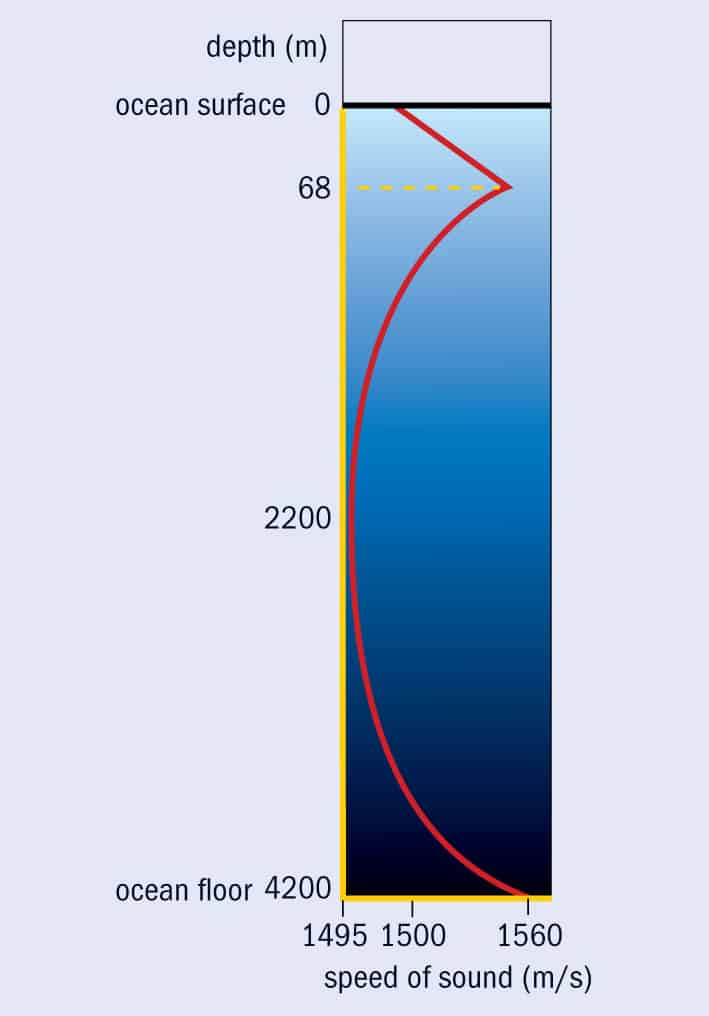
Figure 2: The speed of sound in the ocean is initially dominated by water temperature, but past 900 m it becomes strongly influenced by depth and pressure.
Another problem is that underwater sound doesn’t travel in a straight line. Much like light refracting through lenses, sound waves are subject to Snell’s law of refraction and bend in fluid because of changes to the speed of sound in the propagation medium. In the case of the ocean, the principal factors affecting the speed of sound in water are: temperature, depth, salinity and amount of suspended particulate.
In the first 900 m of the ocean, temperature is the most important factor in determining the speed of sound (figure 1), while below that depth, the dominant factor is how far you are below the surface (figure 2). A sub hunter can measure or calculate most of these and as a result, vertical and horizontal profiles of the sound speed can be determined.
The most common way to measure the vertical speed component is to drop a disposable bathythermograph (a temperature and depth sensor) sonobuoy into the water, which gives a temperature profile similar to that in figure 1. If you know the temperature as a function of depth, you can now fairly accurately calculate the sound speed.
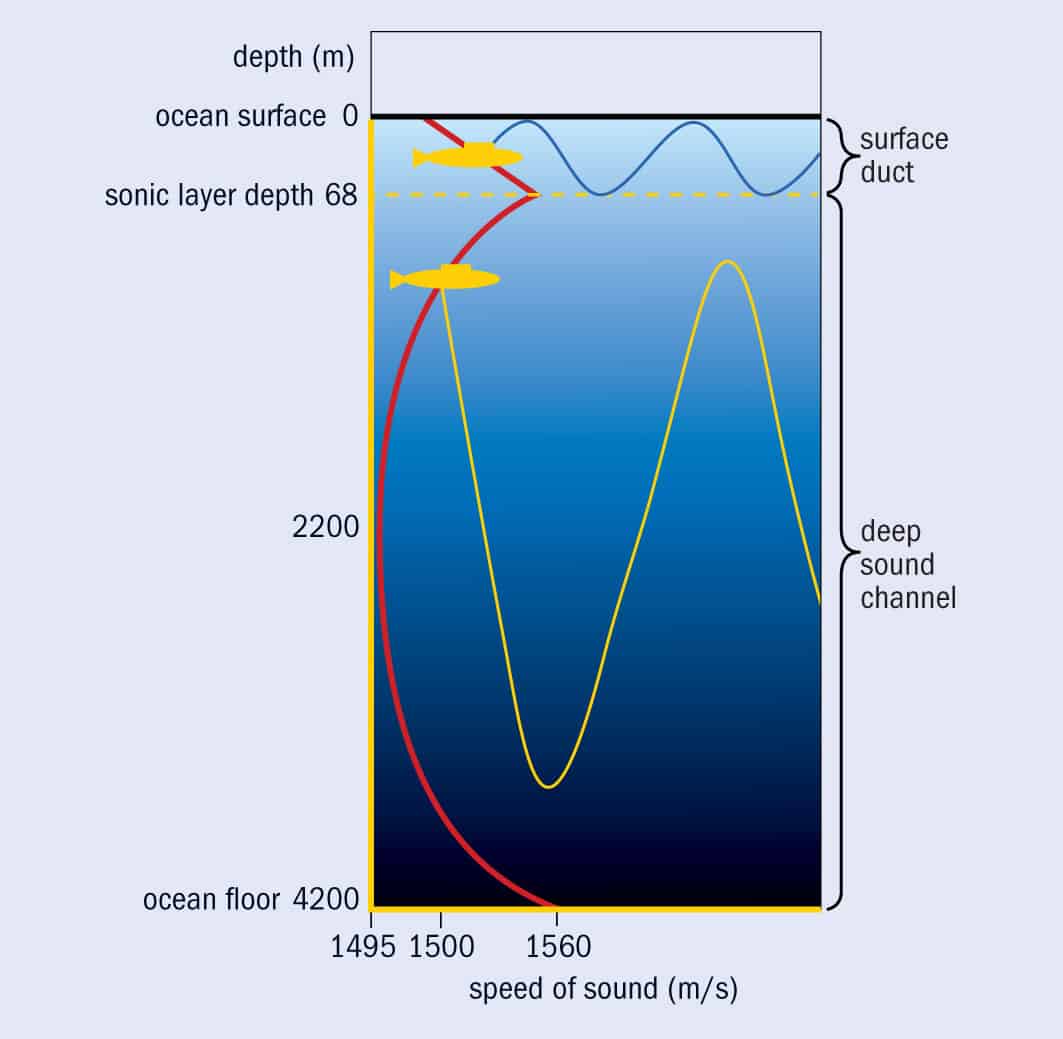
Figure 3: The variations in the speed of sound with depth creates zones – the surface duct and the deep sound channel – where sound waves are confined.
In the arbitrary example of figure 1, you will notice that from the surface to about 68 m, the temperature of the water increases before it suddenly decreases; this inflection in the graph is called the sonic layer depth (SLD) and is typical of a North Atlantic water mass early in the morning. The residual heat from the previous day is still latent in the lower levels of the SLD, but the higher levels have cooled off overnight. The consequence is that the speed of sound increases with depth in this shallow region as shown in figure 2, resulting in what is called a “surface duct” (figure 3). Sound waves from here heading towards the bottom of the ocean will be refracted back up to the surface. As for sound waves heading from this region towards the surface, they will bounce off the air–water interface and then refract off the lower layer much like light in a fibre-optic channel. Any sound source emanating in this region will therefore get trapped. Both active and passive sonobuoys in the surface duct will detect noise at extended ranges; however, all moving surface vessels inject noise into this duct, making it a very noisy region, allowing a submarine to blend into the background.
Below the SLD, as mentioned, the ocean water cools with depth, until the temperature eventually levels out. From this point the sound speed then increases dramatically due to the effects of water pressure. This increase creates a different, deeper sound duct. Known as the deep sound channel (DSC), it exists all over the world. Lacking all the noise of the surface duct, it tends to be quieter and, because it is physically larger, it favours lower frequencies, which attenuate less as a function of distance. These two types of propagation paths (surface and deep) are jointly referred to as direct-path propagation.
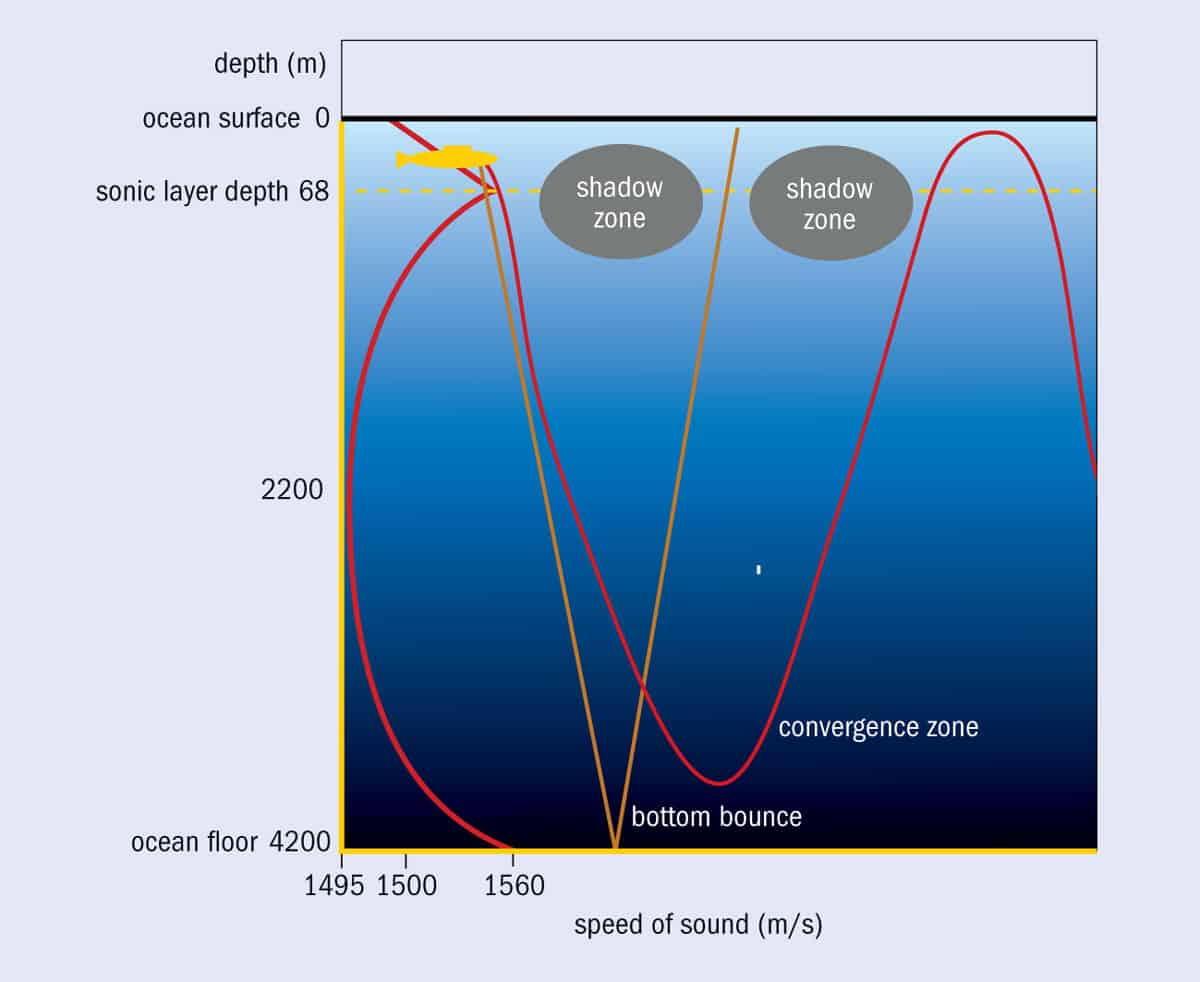
Figure 4: The convergence zone and bottom bounce are two other types of sound propagation that influence the search for submarines.
Two other types of sound propagation that bear mentioning are bottom bounce and convergence zone (CZ). Bottom bounce occurs when the sound waves reflect off the ocean floor and return back to a receiver. These are the most downward-oriented rays of sound that emanate from the source, overcoming the refracting effects of the layers to strike the ocean bottom and reflect back up to the receiver.
CZ occurs in very deep water, where there is space between the ocean floor and the bottom of the sound channel. High-volume sounds emanating from the near-surface area, like bottom bounce, penetrate the layers and then return back to the surface at a distance of 40–50 km away from the source. Because the sound waves are travelling at extreme depths, there is a blank region where there is no signal. This forms a doughnut-shaped annulus around the submarine making it vulnerable to detection in a specific area, but also creating areas called shadow zones where the submarine can hide. Plotting these other types of propagation paths on a diagram for a typical submarine, you get something that looks like figure 4.
Mission planning
Given all these factors, an MPA crew will spend a lot of time calculating the optimal placement of the sonobuoys and their depth settings before taking to the air. A variety of mathematical models have been developed that take into consideration all these factors so the crews can maximize their detection chances. Satellite images, weather buoys and underwater topographical charts all contribute to building an environmental picture so the crew has an idea of how to best configure the sensors. If the surface duct is weak, will the submarine hide in the noisy shallows or will it descend below the layer to hide? What is the time of day of the search? If it is late afternoon, then diurnal heating will increase the surface temperature and the water immediately below, erasing the effect of the surface duct so only the DSC exists. All these factors need to be taken into consideration by the crew. Of course, the submarine’s mission needs to be factored into the planning as the submarine captain will use tactics that best exploit the observed conditions to achieve mission success.
Now, this is just how sound works in the deep ocean. Once you get closer to shore, sea-bottom topography plays a larger part in the propagation of sound, adding to the already formidable list of factors that make it difficult to find an underwater target.
Springing the trap
Back in the North Atlantic and five hours into the patrol, the bleary-eyed crew of 1JF wait for the curry in the oven to heat up, while staring at their screens looking for a faint whisper to indicate the presence of their prey. Suddenly, the acoustic sensor operator cries out “Contact!” over the intercom, jolting the crew into action. The tactical co-ordinator sends a new waypoint to the pilot; the plane banks and the chase is on. With careful co-ordination between pilots and tactical crew, sonobuoys are surgically deployed to capitalize on the weak signal and soon the presence of the submarine is confirmed as it is trapped in a carefully laid pattern of submerged “trip-wires”. Now the crew must maintain acoustic contact until it can be handed over to another aircraft, helicopter, ship or possibly even a friendly submarine. Of course, in wartime, the crew will be waiting for another call over the radio; one that authorizes an attack.
Physicists in the US have used machine learning to determine the phase diagram of a system of 12 idealized quantum particles to a higher precision than ever before. The work was done by Eun-Ah Kim of Cornell University and colleagues who say that they are probably the first to use machine learning algorithms to uncover “information beyond conventional knowledge” of condensed matter physics.
This is an example of machines beating prior work by humans
Roger Melko
So far, machine learning has only been used to confirm established condensed matter results in proof-of-principle demonstrations, says Roger Melko of the University of Waterloo in Canada, who was not involved in the work. For example, Melko has used machine learning to sort various magnetic states of matter that had already been previously classified. Instead, Kim and colleagues have made new predictions about their system’s phases that are unattainable with other methods. “This is an example of machines beating prior work by humans,” says Melko.
Kim’s group studied the physics of 12 idealized electrons interacting according to the Ising model – which describes the interaction between the spins of neighbouring particles. Although their 12-particle model is simplistic compared to real-life materials, this system can just barely be simulated by supercomputers. This is because the complexity of quantum simulations grows exponentially with every additional particle.
The team was particularly interested in understanding the many body localization (MBL) phases that can arise in quantum systems. These phases occur when particles are out of equilibrium and do not behave as a collection of non-interacting particles nor as an ensemble. Physicists struggle to describe MBL phases because statistical concepts like temperature and pressure are ill-defined. “They challenge our understanding of quantum statistical mechanics and quantum chaos,” says Kim.
90% classification accuracy
The team taught the machine learning algorithm to draw a phase diagram that includes two different MBL phases and one conventional phase. To do this, they first generated simulated data of different configurations of the 12 quantum particles that correspond to known phases. They fed each configuration to a neural network, which classified the data as a particular phase. At this point in the machine-learning process the researchers told the neural network whether its classification was correct. Given that feedback, the neural network iteratively developed an algorithm based on matrix multiplication that could distinguish among phases. The neural network could achieve 90% classification accuracy after being trained with 1000 different particle configurations.
The next step involved using the neural network to classify particle configurations of unknown phase. By sorting these configurations, they could fill a phase diagram with boundaries that were more distinct compared to prior diagrams made from other techniques.
How do they learn?
One important downside of using neural networks to predict new physics is that we do not have a clear understanding of how the systems learn. This is a broad area of current research known as the interpretability problem. Fortunately, Kim’s neural network is relatively simple. Many neural networks, such as those that power speech and image recognition algorithms, involve feeding input data through multiple iterations of matrix multiplication called “hidden layers” before they produce an output. These hidden layers are the most opaque parts of the learning process, and Kim’s neural network only has one hidden layer. Her group is now trying to pick apart what exactly that hidden layer is doing. “It’s possible to look inside a simple, custom-built neural network and figure out how it’s making its decisions,” says Kim.
In addition, Kim wants to see if the team can apply a more sophisticated type of machine learning, known as unsupervised learning, to condensed matter problems. Unlike supervised learning, where the algorithm is given the correct answer as feedback, an unsupervised learning algorithm does not receive such feedback.
Condensed matter problems are particularly well-suited for machine learning because they involve many interacting particles, and therefore lots of data, says Melko. The field is moving fast, he says. “Just like you pick up your phone and take for granted that Siri works, in a few years I think everyone’s going to take for granted that there’s some integration of AI technology in these very complex quantum experiments,” he says.
A paper describing the research has been accepted for publication in Physical Review Letters and a preprint is available on arXiv.
By combining the best optical properties of inorganic and organic waveguides in a hybrid chip, researchers at the Chalmers University of Technology in Sweden demonstrate evanescent-wave microscopy using just a conventional microscope. The development allows low-cost and low-energy fabrication of a waveguide that can make imaging of biomaterials more accessible.
Traditionally, evanescent-wave microscopy is carried out using a total internal reflection fluorescence (TIR) microscope. In such a microscope, scientists produce a thin slither of “non-propagating” evanescent light that hovers just above the sample surface and allows observation of surface-bound fluorophores, which is useful in the study of molecular interactions such as cell adhesion, protein binding, and hormone binding. Using evanescent light for these observations limits the amount of background signal compared with what scientists typically observe in conventional fluorescence microscopy. Still, however, the area of illumination is small, the penetration depth of the light is limited to around 200 nm, and the method is totally reliant on the use of fluorescent material for signal generation.
The waveguide developed by the researchers at Chalmers eliminates the need for costly TIR microscopes and allows for nanoscopic objects to be detected without the use of fluorescent labels. The waveguide only requires the use of a conventional light microscope combined with a fibre-coupled laser and generates an evanescent wave with an improved penetration depth of below 100 nm. The penetration depth can also be varied by tailoring the thickness and refractive index of the core-layer of the slab.
“The design and fabrication is rather simple and straightforward compared to most nano-devices out there,” said co-author Bjorn Agnarsson, a post-doctoral fellow in the Department of Physics. The biggest challenge in development was keeping the surface of the waveguide’s core layer flat and free of contaminates to ensure the structural integrity of the fabricated chip. Now, however, using the fabrication technique detailed in the paper published in Nano Futures, the team can easily fabricate 100 chips within a few days.
Tailoring to task
According to co-author Mattias Sjöberg, a PhD student in the Department of Physics, the device can be tuned to different applications simply by changing the material of the device’s cladding layer. Since their team is interested in biological applications where molecules are in aqueous environments, they chose cyclized transparent optical polymer (CYTOP), a polymer that has the same refractive index as water.
“CYTOP allows for reduction of stray light, which is an advantage that other devices don’t have,” said Sjöberg. “Plus, we significantly reduce costs since we don’t need to use specially designed TIR microscopes and objectives.”
With their device optimized, next the team plans to look at using it for label-free studies of the interactions between proteins and biological nanoparticles such as vesicles.
A new experiment has revealed how sheared granular materials emit sound waves that evolve in characteristic patterns as grains suddenly slip and rearrange themselves. The research, carried out by Ted Brzinski and Karen Daniels at North Carolina State University, could improve our ability to forecast natural disasters by monitoring the sounds emitted by granular materials in nature.
When granular materials experience shear forces – such as when tectonic plates rub against each other, or as the weight of snow on a steep slope acts against friction – the microscopically-vibrating grains will initially stick to the interface as stress builds in the material. When the stress becomes too high for the overall system to cope, many grains will slip at once; suddenly rearranging themselves into different patterns. During this stick-slip transition, grains develop low-frequency vibrational modes as stress is suddenly dissipated. The presence of these modes can be detected in the form of sound waves that are emitted at the material interface.
In a recent experiment, Daniels studied this effect by firing sound waves into granular materials and measuring how they changed as the sound had passed through. The study successfully documented how acoustic waves evolve in a characteristic pattern shortly before grains underwent stick-slip transitions. However, Daniels realized that manipulating the material directly made the technique somewhat invasive.
Rotating wall
In this latest study, she and Brzinski devised a way to observe the signals passively. To do this, the researchers created an annular chamber, with an inner wall that rotated once per hour, and a static outer wall. The space in between was filled with a single layer of 8000 small plastic disks, packed together as closely as possible to replicate a granular material. The disks resisted the rotation of the inner wall, which generated shear forces in the overall system. When stick-slip transitions eventually occurred, the disks rearranged themselves rapidly in about 0.5 s in a process that repeated roughly once every minute. The sounds produced by the events were then picked up by sensors embedded in the outer wall.
As stress built up in the system, the sensor data revealed that individual disks vibrated in a narrow range of modes. This resulted in the generation of a spectrum of sound waves with similar frequencies, which did not evolve significantly over time. However, in the moments shortly before each slip, the frequency distribution of the disks’ vibrational modes began to broaden, while the average frequency increased gradually. After each slip, this average frequency dropped rapidly, and the distribution narrowed once again.
The researchers believe that the evolution they observed in the frequency distribution is characteristic enough to be useful for predicting slips in natural materials. Using sensors to measure changes in the sounds emitted at sites of potential avalanches, landslides or volcanic eruptions, it could become easier to predict when natural disasters are more likely to occur. Systems for predicting earthquakes would be a particularly useful application, although the researchers realise that they could still be a long way off. In the future, Brzinski and Daniels aim to collaborate with seismologists, which could allow them to develop some of the most sophisticated detection technology yet produced.
Magnetic detection and manipulation of cells is attractive for numerous biomedical applications, and so scientists have been eager to discover how many types of fish, amphibians, mammals and birds can sense changes in the earth’s magnetic field. Some theories claim that this “magnetoreception” is driven by biomagnetic structures – but these have yet to be found. Taking a complementary approach, a team of researchers led by Gil Westmeyer at the Technical University of Munich and Helmholtz Zentrum München have bioengineered a magnetoresponsive system using bacterial components (Nature Comm.9 1990).
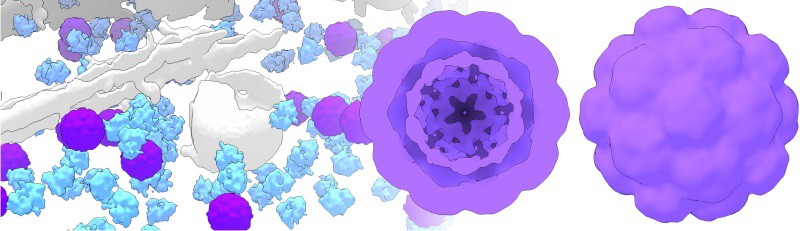
The researchers expressed bacterial shell proteins called encapsulins within mammalian cells and showed that they self-assemble into enclosed nanospheres that can accumulate substantial amounts of iron in their interior. The researchers were thus able to magnetically sort and separate the cells containing iron-rich nanospheres from non-magnetic cells, and use them to generate contrast in MRI and act as a genetic marker for electron microscopy.
In addition to applications with iron-accumulating nanocapsules, Westmeyer’s team explored the encapsulation of different types of cargo, such as enzymes, turning the nanospheres into mini bioengineering “workshops” within eukaryotic cells. “This method to genetically control compartmentalization of multi-component processes will be quite useful as a general tool for mammalian cell engineering,” says Westmeyer.
Building an iron accumulation chamber
Firstly, the researchers modified encapsulin genes from the bacterium Myxococcus xanthus and added them into a mammalian cell line, forcing expression of the nanospheres. A variety of identifying tags were added to the encapsulin shell protein (EncA) and its native cargo proteins so that the expression, self-assembly and cargo loading could be verified in in vitro assays. They also employed cell viability assays and showed encapsulins to be non-toxic.
Next, the researchers moved encapsulins in vivo, encoding them in adeno-associated viruses that they intracranially injected into mice. The nanospheres were robustly expressed and assembled in neurons, and again showed no toxic effects.
Native encapsulin cargo proteins EncB and C have iron storage capabilities, and when expressed with EncA, were able to accumulate and shield iron within the nanospheres from the metabolic processes occurring within the cytosol of a mammalian cell.
Magnetic genetics
By creating these iron accumulation chambers within mammalian cells, the researchers were able to significantly enhance the MRI contrast of cells, and Westmeyer hopes that, in the future, iron loaded encapsulins could possibly be used for deep-tissue molecular imaging and manipulation. For instance, optogenetics is a technique that uses light to control molecular processes in living animals; the drawback is that light does not travel well through tissue. Magnetic fields, on the other hand, could be used for molecular manipulation deeper in tissue. “With encapsulins we have started to obtain sufficiently magnetic handles that are genetically controlled,” Westmeyer explains.
The researchers also demonstrated that encapsulins could be used as a genetic marker in electron microscopy. Chemical reagents are often used to obtain contrast from molecular signals in electron microscopy, but the process of delivering these reagents can disrupt intracellular structures and complicates more high-throughput applications.
Artistic modification of cryo-electron microscopy data. (Courtesy: Philipp Erdmann)
“Encapsulins possess a well-defined structure that is clearly discernible in cryo-electron microscopy, and when they accumulate iron they exhibit additional contrast without extra preparative steps involving synthetic compounds,” says Westmeyer. As a direct, fully genetically encoded reporter, Westmeyer hopes encapsulins could generate similar value for electron microscopy as green fluorescent protein and its powerful variants delivered for fluorescent microscopy.
A workshop for bioengineering
In this study, the researchers also showcased the encapsulation of other, non-native proteins into the nanospheres. By simply adding an eight amino acid targeting tag, they were able to isolate specific enzyme reactions within the nanospheres, recruiting small reactants through pores in the shell but shielding enzymes and products from the cell’s complex metabolic processes.
Mammalian cell engineering is often confounded by the complexity of molecular processes, but Westmeyer thinks that the capability to contain reactions within encapsulins and prevent interference from other cellular processes will help the field to advance.
“The 32 nm nanospheres are tiny workshops, subspaces where we control which molecular players act on the inside… and things can be quite different from the office next door (the cytosol),” says Westmeyer. “Our next steps will be to exploit the modularity of these genetically controlled compartments to install more interesting functionalities into mammalian cells.”
Climate change is expected to displace millions of people through impacts like sea level rise, crop failures, and more frequent extreme weather. Yet scientists still cannot predict where these expected climate-induced migrants are likely to go in the coming decades.
A new study, published today in Environmental Research Letters, seeks to address this need by incorporating climate impacts into a universal model of human mobility.
To demonstrate the efficacy of the new approach, the study focused on the case of sea level rise (SLR) and human migration in Bangladesh, where the authors estimate that more than two million Bangladeshis may be displaced from their homes by 2100 because of rising sea levels alone.
The study, led by Columbia University, New York, used a probabilistic model combined with population, geographic, and climatic data to predict the sources, destinations, and flux of potential migrants caused by sea level rise.
Lead author Dr Kyle Davis, from Columbia University, explained: “More than 40 per cent of Bangladesh’s population is especially vulnerable to future sea level rise, as they live in low-lying areas that are often exposed to extreme natural events.
“However, SLR is a very different type of migration driver from short-lived natural hazards, in that it will make certain areas permanently uninhabitable.”
The team’s results using Representative Concentration Pathway (RCP) scenarios showed that mean SLR will cause population displacements in 33 per cent of Bangladesh’s districts, and 53 per cent under more intensive conditions. By mid-century, they estimated nearly 900,000 people are likely to migrate because of direct inundation from mean SLR alone.
Under the most extreme scenario, of up to 2 metre mean SLR, the number of migrants driven by direct inundation could rise to as many as 2.1 million people by the year 2100. For all RCP scenarios, five districts – Barisal, Chandpur, Munshiganj, Narayanganj, and Shariatpur – are the source for 59 per cent of all migrants.
Their analysis considered mean SLR without normal high tides, so the results – both in terms of inundated area and displaced population – are conservative.
The researchers also estimated the extra jobs, housing and food needed to accommodate these migrants at their destinations. They found that to cope with the numbers likely to be displaced by 2050, 600,000 additional jobs, 200,000 residences and 784 billion food calories will be needed.
These results have clear implications for the places that are likely to receive incoming migrants.
Davis said: “SLR migrants are unlikely to search far for an attractive place to move to, and the destination will generally be a trade-off between employment opportunities, its distance from the migrants’ origin, and how vulnerable it is to SLR itself.
“We found that the city of Dhaka was consistently favoured, coming out as the top destination in all scenarios. This means the city will need to prepare for the largest number of migrants, which may compound the area’s already rapid urban growth.”
The study also identified other risks from SLR, most notably on livelihoods and food security.
Davis explained: “Inundation by the sea, and the out-migration it causes, will have significant effects on agriculture and aquaculture. For instance, 1000 km2 of Bangladesh’s cultivated land could be underwater by the end of the century, with an even larger area made unusable by saltwater intrusion. Given that 48 per cent of the labour force works in agriculture, the impact of this would be keenly felt in terms of jobs and food security.
“Similarly, a great deal of the country’s coastal aquaculture is vulnerable to climate change impacts, and this will probably have important nutritional and economic consequences, given that 58 per cent of animal protein in the Bangladeshi diet comes from seafood, and the country is the world’s fifth largest aquaculture producer.
“Ultimately, we hope that the modelling tool we have developed can be used by researchers and planners to accurately predict the relocation of climate-induced migrants, and to enable the development of political and economic strategies to face the challenge.”
To say that I eagerly anticipated the arrival of my review copy of Jean Bricmont’s latest book would be an understatement approaching “we physicists have maybe got one or two loose ends to tie up when it comes to interpreting quantum mechanics” proportions. Bricmont – theoretical physicist, philosopher and emeritus professor at the Université catholique de Louvain – became, along with his co-author Alan Sokal, the scourge of postmodernists far and wide following the publication of Fashionable Nonsense: Postmodern Intellectuals’ Abuse of Science back in the 1990s. I thoroughly enjoyed Fashionable Nonsense, and with Bricmont’s latest book – titled Quantum Sense and Nonsense – was looking forward to a characteristically clear-headed analysis of the myriad interpretations of quantum mechanics that are now used and abused by physicists and non-physicists alike.
As a veteran of the so-called “science wars” that formed the backdrop to Fashionable Nonsense, where scientific realists were pitted against those who dismissed science’s claims to objective “truth” (however that might be defined), Bricmont is better equipped than most to expose the signature excesses of the worst of the “woo” surrounding quantum physics out there. And for those of you not aware of just how bad it can get, here’s Deepak Chopra – author, public speaker, widely lauded New Age guru (3.34 million Twitter followers and counting) and proponent of, um, quantum healing – on what quantum physics can do for you: “Viewing your body from the perspective of quantum physics opens up new modes of understanding and experiencing the body and its ageing. The practical essence of this new understanding is that human beings can reverse their ageing.” Or how about this gem? “Quantum healing involves a shift in the fields of energy information, so as to bring about a correction in an idea that has gone wrong.”
As I like to put it during the Skeptics in the Pub and Café Scientifique talks where I “critique” Chopra’s clueless take on the subject, his writings remind me of that classic 1970s Morecambe and Wise sketch with André Previn – “All the right words, just not necessarily in the right order.” To be fair to Chopra, at least he hasn’t quite plumbed the depths of claiming that lobsters hold the secret to life, the universe and everything. We can instead thank the latest kid on the self-help guru block, University of Toronto psychologist and author of 12 Rules For Life, Jordan B Peterson, for this insight into our crustacean kin. Peterson has also had very Chopra-esque things to say about quantum mechanics, but that’s a whole other story. As is the expanding “quantum life coaching” industry. Yes, you read that right.
If, like me, you were expecting Quantum Sense and Nonsense to be a take on quantum woo that echoes the style and approach of Fashionable Nonsense, then you may be slightly disappointed with Bricmont’s new book. That’s not to say that it isn’t an important, informative and at times engaging read. But it’s a book that falls between two camps. Indeed, one might even suggest that it exists in a superposition of states. It opens by stating, laudably, that “although this book belongs to the ‘popular physics’ category, its main purpose is cultural rather than scientific. We shall try to explain to the lay reader the basic principles of quantum theory”. But Bricmont also simultaneously wants to do justice to the many complexities and intricacies of the subject with the type of diligence we’d expect of a theoretical physicist of his standing. This leads to a rather disjointed and difficult read at times – a lot is asked of a reader who’s familiar with the subject matter, let alone a lay audience.
I agree with Bricmont that we physicists must shoulder a portion of the blame for fuelling the rise of woo
Moreover, while I agree entirely with Bricmont that we physicists must shoulder a fair portion of the blame for fuelling the rise of woo by making excitable and ill-advised pronouncements over the years about the nature of quantum mechanics (particularly with regard to the role of consciousness, the observer and that confounded cat), I would have preferred a slightly more up-front rebuttal of the more egregious pop-sci claims out there. As it is, chapter 11, titled “The cultural impact of quantum mechanics”, feels somewhat tacked on, piecemeal, and not as integrated as one might expect given the opening statements regarding the rationale for the book.
In this context, it was also rather surprising that the exceptionally important topic of decoherence – the suppression of the interference effects that are the very essence of quantum “weirdness” – is relegated to a throwaway footnote buried in the middle of the book. The scrambling of phase coherence due to interactions with the environment is now seen by most physicists as key to explaining how the big, bad classical world (and all its attendant myths, mysticism and misinformed gurus) emerges from the quantum. Decoherence thus plays a central role in disentangling quantum sense from nonsense, and Bricmont’s book would have benefitted from a brief review of the topic at the very least.
On the spectre of quantum weirdness, I should admit that I read this book and Philip Ball’s most recent, Beyond Weird: Why Everything You Knew About Quantum Physics is Different, in short succession. Brian Clegg’s review of the latter in April’s Physics World is spot on: Ball is an exceptionally talented writer who manages to combine accessibility and thoroughness in razor-sharp prose. This sets a very high bar for Bricmont’s book, and I came away from it with the distinct sense of a certain lack of coherence by comparison.
But when Bricmont is good, he’s very, very good. His insights into thorny (meta)physical and philosophical issues such as determinism, non-locality, hidden variables and Bell’s inequalities, and the ontological-versus-epistemological nature of the wavefunction are sharp and deserve to be widely read. I also especially enjoyed his sure-to-be-contentious critique of the Many Worlds Interpretation. (But then, as a dyed-in-the-wool experimentalist for whom empiricism is everything, I would say that. I’ll remain agnostic about all interpretations of quantum physics until experimental evidence gives one or other the edge. That, after all, is how science works.)
Similarly, Bricmont’s revised history of quantum mechanics is a fascinating read, in which the development of the field is considered against the socio-political backdrop of the time. David Bohm’s career, and the associated (lack of) influence of the “de Broglie–Bohm pilot-wave theory”, were particularly affected by those political underpinnings. But whether this theory deserves its centrepiece status in the book is questionable. The reader does get a heads up very early on that Bricmont is a proponent of de Broglie–Bohm (and that it’s hardly a universally accepted theory). But while it’s true that the pilot-wave idea perhaps deserves rather more attention than it has garnered (if only as an ingredient worth keeping in the conceptual mix), it’s certainly not a silver-bullet solution to the interpretational difficulties of quantum mechanics.
I think it’s unlikely that Quantum Sense and Nonsense would ever top my list of recommended quantum-physics books for the non-physicist. There are more readable “lay” introductions out there; in particular, Beyond Weird. Where Bricmont’s book comes into its own, however, is in providing a thorough overview and analysis for a Physics World audience – a readership that is already likely to have an appreciation of the foundational principles and the deep interpretational issues that continue to plague quantum physics. Undergraduate and postgraduate students, and their lecturers and tutors alike, will all benefit from Bricmont’s far-from-traditional take, including his well-placed closing plea for rather less hubris when it comes to waxing lyrical about what quantum mechanics tells us about our place in the universe (or multiverse, if you’re so inclined). After all, if there’s one field of physics in which we should admit to uncertainty about our interpretations, it’s quantum mechanics.
2017 Springer International Publishing 286pp £24.99pb
MILabs, a Dutch developer of molecular imaging systems, has launched the E-Class line of preclinical tomographic imaging products. The high-performance, economical PET, SPECT, optical and CT systems are designed for researchers with a limited budget who wish to get started on their research now, with the option to easily upgrade their system in the future.
“We have an exciting new range of E-class products in our portfolio, and these modular, standalone and integrated imagers are economical, exceptional and field-expandable,” says Frederik Beekman, CEO of MILabs. “We are enabling the cost-saving aspects by these entry level imaging systems, and we are confident that our global prospects will be enthusiastic that the E-Class PET, SPECT and CT systems are available today and can be upgraded later. With these new products, we are continuing our brand promise of ‘making molecular imaging clear’ for all preclinical researchers.”
The E-Class systems were developed using the same advanced imaging technologies as MILabs’ VECTor system, but refined for lower cost and easy scalability. They offer the same high-end specifications as existing MILabs systems: SPECT at sub-half-mm resolution, PET at sub-mm resolution, 2D and 3D bioluminescence and fluorescence, and ultrafast X-ray CT at low dose levels.
“The E-Class systems were built for the future needs of researchers, so they can start small, think big and scale fast,” adds Beekman.
“I’ll make a prediction right now. The first trillionaire will be made in space.”
So said Texas senator Ted Cruz, shortly after a bill was signed to increase NASA’s budget for 2018. To untrained ears, his claim would have sounded extraordinary. It might even have stretched credulity for those familiar with the challenges of space. But on closer inspection, Cruz was not being that revolutionary. Peter Diamandis – founder of the X Prize competition to encourage tech developments – made the same prediction back in 2008 and expanded on the theme in his 2015 book Bold. As for how those trillionaires will make their riches from space, both he and Neil DeGrasse Tyson – the US astrophysicist and TV host – reckon it will be done by mining asteroids.
Progress is already under way. The first asteroid company, Planetary Resources, was founded in 2012 by Diamandis, Chris Lewicki and others in Washington. Within a year the US company Deep Space Industries was set up by Rick Tumlinson, Stephen Cover and a host of others. A handful more firms have since been established, and while some are admittedly are less serious than others, the race to the riches of space is on.
Fake space rocks: A prototype of the Asteroid Redirect Mission’s robotic capture module system. (Courtesy: NASA)
Despite the existence of such firms and Cruz’s declaration, however, Donald Trump’s 2018 NASA budget cancelled the Asteroid Redirect Mission (ARM), which planned to bring an asteroid into an orbit around Earth where it could be studied and mined a lot more easily than one in the asteroid belt. A NASA spokesperson told me the ARM team is ensuring that the key knowledge from the mission so far is not lost, but NASA pulling out has left the asteroid-mining community without a valuable learning tool and places asteroid mining firmly in the realm of the private space sector.
Nevertheless, the investment bank Goldman Sachs has reassured its clients about the financial benefits of investing in asteroid-mining companies. “The psychological barrier to mining asteroids is high, the actual financial and technological barriers are far lower,” it said in a report published last year. A Caltech study put the cost of an asteroid-mining mission at $2.6bn – perhaps not surprisingly the same estimated cost of NASA’s erstwhile ARM. It might sound a lot, but a rare-earth-metal mine has comparable set-up costs of up to $1bn and a football-field-sized asteroid could contain as much as $50bn of platinum.
There are, however, potentially major challenges for anyone wanting to mine such an asteroid. How do you get it back to Earth through the atmosphere and land it without destroying the planet? Who do you sell it to in space if you can’t get it back to Earth? And even if you can bring it to Earth, all of a sudden platinum is no longer rare. Given that common metals aren’t as expensive as rare metals, will mining an asteroid really be worth it?
Metals and water
Scientists have studied asteroids using ground-based telescopes and space missions – such as NASA’s Galileo and Dawn crafts – which together have gathered close-up imagery and data. Perhaps the most important data came from Japan’s Hayabusa, which in 2010 became the first spacecraft to have landed on an asteroid and successfully returned home with samples. These studies have revealed that there are two types of asteroids of interest to the mining community.
The first are achondrites, which are rich in platinum group metals (ruthenium, rhodium, palladium, osmium, iridium and platinum). These precious metals gravitate to the cores of planets as they form, meaning that they are very deep down on Earth. In the turbulent early solar system, however, some burgeoning planets were smashed to pieces in collisions and became some of the achondrite asteroids that may provide a treasure trove for today’s space miners.
The other asteroids of interest are chondrites. They are perhaps the more immediately valuable, being rich in water. Astronauts need this vital resource not only as a drink and to hydrate food, but also because it is a very efficient radiation shield. Water will be precious for the Moon bases and hotels promised by today’s space entrepreneurs such as Elon Musk (founder of SpaceX) and Jeff Bezos (founder of Blue Origin).
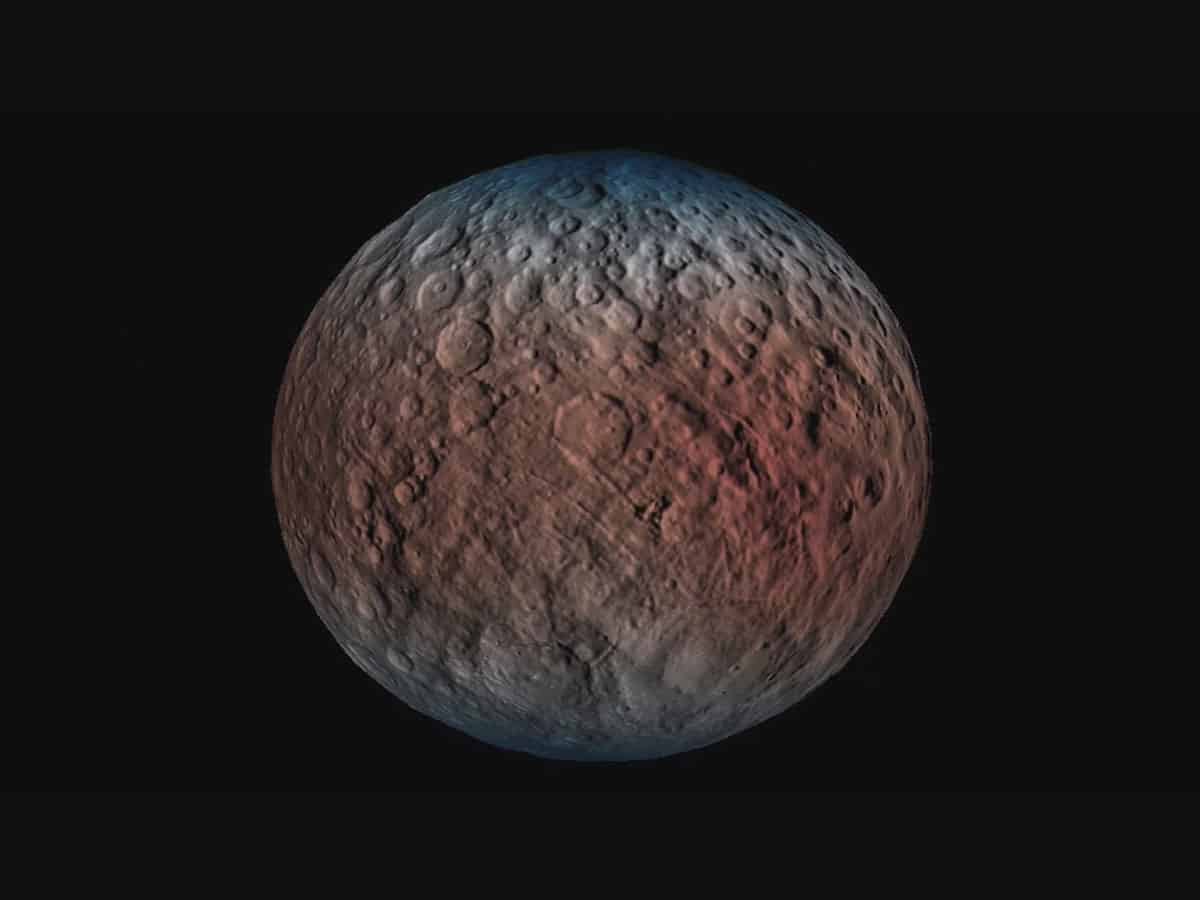
Watery wonder: The asteroid Ceres, showing the concentration of hydrogen measured by NASA’s Dawn spacecraft. (Courtesy: NASA/JPL-Caltech/UCLA/MPS/DLR/IDA/PSI)
But water is heavy and therefore expensive to launch out of the Earth’s atmosphere. Indeed, it costs between $9000 and $43,000 to send a water bottle into space – which is why it is all recycled on the International Space Station. However, Hubble images of the largest known asteroid, Ceres, suggest that it could hold more water than our planet. Smaller asteroids hold lots too and a technique known as optical mining would use the heat from the Sun to bake the water out of the rock.
The elements of water can also be used for rocket fuel. Asteroid miners are already planning to split the water from chondrites into hydrogen and oxygen, which would serve as fuel and oxidizer respectively. They are hoping to set up fuel stations in low-Earth orbit and the asteroid belt so that spacecraft can fill up on their way to the outer planets of the solar system. Currently, around 90% of the weight of modern rockets is taken up with fuel, so if you can carry less fuel on take-off because you can fill up off-Earth, space flight becomes much cheaper.
Within our reach
But how many asteroids are potential mining hotspots? Martin Elvis, a Harvard University astrophysicist with an interest in asteroid mining, developed an equation in 2013 to estimate the number of asteroids that might be potential mining candidates with our current technology. The equation accounts for the number of asteroids within reach of today’s rocket ships, the likelihood of them being worth mining, whether it is practically feasible to mine them, and whether they would yield a profit. When he first ran the numbers back in 2013, Elvis estimated that around 10 potentially metal-rich asteroids, and 18 sufficiently water-rich, lie within our grasp.
SpaceX’s development of increasingly powerful rockets has bolstered the hopes of asteroid miners because it means we can travel further into space. But Elvis told me that recent press reports claiming he thought the successful Falcon Heavylaunch on 6 February had burst open the sky to potential asteroids were wide of the mark. “I made the remark at a conference in Texas recently and the press missed off the word ‘might’, but the truth is that I haven’t run the numbers yet. We need more data before I can run the numbers again, but a wild guess might be that this new fleet of heavy rockets could increase the numbers by a factor of 10.”
Elvis was not just referring to Falcon Heavy either. Blue Origin’s New Glen rocket and, in the longer term, the New Armstrong rocket can all be added to the mix when Elvis next runs his equation. Yet even though the SpaceX rockets are boosting the hopes of asteroid miners who could one day provide his explorers with fuel and raw materials, Musk does not seem convinced. In fact, in 2003 he called asteroid mining “bogus” and, at least publicly, has not updated that view.
Amara Graps, an astrophysicist who organizes the bi-annual Asteroid Science Intersections with In-Space Mine Engineering Conference (ASIME) and founded the Latvian initiative Baltics in Space, is more optimistic. “Elon will come around. He’s a clever guy and he’s surrounded by clever people. He’ll get there but I don’t know how to reach him to sell it to him.” Half the delegates at the most recent ASIME conference, which took place in Luxembourg in April, came from asteroid-mining companies, with the rest being asteroid scientists. Indeed, Graps believes the interface between scientists and business people is essential. The asteroid scientists’ role is to provide scientific support to the companies; addressing some of the companies’ largest asteroid science questions.
Need riches to get rich
Asteroid companies have one major cash-flow issue: if there are riches in space, the miners are reliant on faithful funders to get them there in the first place. That’s why Graps believes communication is key. “Everyone is struggling in their own way,” she says. “So it helps if we can talk to each other. And share. And use our own resources more efficiently.”
Before any company reaches an asteroid, they’ll have to fill that gap in their finances with other revenue streams. The business model for asteroid-mining companies is therefore currently much more Earth-bound. Planetary Resources, for example, which uses its expertise for mining here on Earth, is still reliant on wealthy bankers. Indeed, after missing a funding milestone last year, the company laid off many of its 70 employees. Asteroid-mining companies need to convince potential funders that the claims of untold riches in space are believable and achievable.
But rather than just targeting wealthy investors, Mitch Hunter-Scullion, chief executive of the UK-based Asteroid Mining Corporation, has taken a different tack. He’s turned to crowdfunding for his first asteroid-prospecting mission, which he hopes to fire into space in 2020. “We’re launching APS-1 [Asteroid Prospecting Satellite 1] from India, because it is orders of magnitude cheaper than elsewhere,” he says. “We’re aiming to raise £2.6m through crowdfunding, which, in space terms, is not too overwhelming.” That may be true, but £2.6m will still require a lot of backing from the public for what, to many people, seems like a distant dream. If they do manage to raise the funds, he then plans to sell the data they own to raise more revenue.
A boost for public interest might not be too far away. Although NASA’s Asteroid Redirect Mission has been cancelled, its OSIRIS-Rex sample-return mission to asteroid 101955 Bennu left Earth in September 2016, before Trump took office. It will reach Bennu in December this year and then return a sample to Earth in 2023. Asteroid miners will be watching closely, just as they did when Rosetta landed on 67P/Churyumov–Gerasimenko…and then bounced along its surface.
“We knew a lot about the composition of the comet but that was still a surprise,” Graps tells me. “We need more science before we land on an asteroid to mine it. You don’t want to be bouncing off.”
Graps believes that the asteroid-mining community was distracted by the wrong thing to begin with. “I think [they] wasted time focusing on the metal-rich asteroids,” she says. Her view is shared by Planetary Resources, which puts the platinum-rich asteroids in its second wave of targets. They believe you’re better off targeting chondrites as they have water, which will be your revenue stream in the near future. You mine the water, you own the rocket fuel stations in low-Earth orbit, on the Moon and on the way to deep space. Whether it will make anyone a trillionaire is another question, however. You can use the heat of the Sun to bake the water out of the asteroid but you then need to stop it sublimating off into space. None of this is particularly cheap and you need the spacecraft to come along relatively frequently to keep your revenue streams buoyant. As Elvis says, “In space, no-one can hear you sell.”
How to be a trillionaire
Legally, nobody can own an asteroid, but the US Space Act of 2015 allows companies to own the materials they mine from bodies in space. Luxembourg passed similar laws last year and Hunter-Scullion tells me he is lobbying the UK government to follow suit. Graps is hopeful Latvia will join the party too. In fact, the country that gets the laws right might just win the most lucrative business in space. After all, if your space-mining company is making billions of pounds in space, the money will, for the foreseeable future, be spent on Earth.
There are fabulously wealthy and intelligent people who claim that they will become trillionaires from asteroid mining. Personally, I find it easier to imagine the tidal wave as their asteroid splashes down into the ocean, and the price of platinum dropping through the floor as it becomes suddenly and abundantly available. A future where the metals, rock and water that we mine in space are used in space feels more achievable. Whether that happens soon enough to make the investors of today rich is, I imagine, their big gamble. Elvis for one is convinced that asteroid mining will take place in our lifetime and gave me a top tip on how to become a space millionaire. “It’s relatively easy,” he says. “You just start with a billion.”