
Primordial black holes formed in the early universe might experience an extra dimension of space; a recent study suggests new ways to search for these mysterious objects
Andrew Glester talks to Graham Farmelo, author of a new authorized biography of Stephen Hawking
Whether you’re still working out your career pathway or have a specific role in mind, we’re here to help. Bringing a diverse range of opportunities for jobseekers at all career stages, we’ll help you take the next step in your career and find your perfect job.
The Milky Way’s massive black hole is rapidly rotating, and a star in an unprecedentedly close orbit could help measure its spin
A mysterious signal from a powerful gamma-ray burst may reveal how exotic particles and altered physics could let extreme radiation cross the universe
The theory of general relativity still holds, according to new space-based and laboratory experiments
CERN’s ATLAS experiment probes the extreme universe
Crewed missions to the lunar polar regions must limit the unintended transfer of Earth life forms, say scientists
Gravity from entropy theory offer hints of why low-entropy regions persist in the universe
Graham Farmelo's biography examines the brilliance and the imperfections of one of the world’s most famous scientists
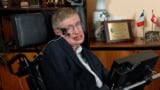 Read article: Hawking, warts and all: a new biography of a scientific icon
Emma Chapman reviews Ripples on the Cosmic Ocean: How the Solar System Shaped Human History – And May Help Save Our Planet by Dagomar Degroot
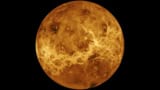 Read article: Cosmic chronicles: the impact of celestial instabilities on human history
Neutrino expert Kirsty Duffy is our podcast guest
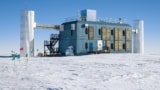 Read article: Francis Halzen and IceCube: why neutrinos keep attracting Nobel prizes
It would have been the earliest example of space weather impacting human technology, but an international team of researchers found a slight problem
 Read article: Did space weather delay a train in 1841?
Richard de Grijs looks at how the Roman Space Telescope will change astronomy forever
 Read article: How the Nancy Grace Roman Space Telescope will turn the sky into a dataset
The picture – The Quiet Predator– was taken by Kuwaiti photographer Ali Alobaidly
 Read article: Spectacular image of the Shark Nebula wins Royal Observatory Greenwich prize
Can you reconstruct the astrophysics illustration in our interactive slide puzzle?
 Read article: Uncertainty and the random universe: a slide puzzle
While energy usage could be met, water would cause some issues
 Read article: Moon’s water reserves insufficient to sustain a lunar city, astronomers find
New analyses of MESSENGER data find that present-day magnetic field can explain most of its crustal magnetism
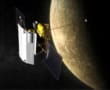 Read article: Mercury may not need an ancient dynamo to explain its magnetic crust
Study of inclusions in a primordial meteorite suggests that magnetism must be considered in simulations of planet formation, and may even be the dominant factor
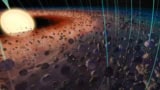 Read article: Magnetism likely played a key role in early solar system formation
Astronomers estimate the decagon-shaped wave may still be evolving
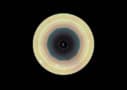 Read article: Astronomers discover unusual 10-sided atmospheric wave on Saturn
Heat and fire may have caused the mass extinction of Cretaceous creatures
 Read article: ‘Lid’ of asteroid dust smothered and burned the dinosaurs, say scientists
The observatory will also study exoplanets, black holes and map billions of galaxies
 Read article: NASA launches Nancy Grace Roman Space Telescope to shed light on the dark universe
Exploring the fallout from STFC funding cuts that have left one of the UK’s most iconic scientific facilities facing an uncertain future
 Read article: With e-MERLIN facing the axe, what next for Jodrell Bank and UK astronomy?
Sean G Ryan snaps an astronomical spectacle that captured the public imagination
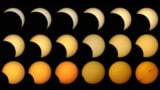 Read article: The 12 August 2026 partial solar eclipse as seen from the Isle of Wight
A new personal radiation shielding vest tested during the Artemis I flight could significantly reduce the radiation dose that future astronauts might receive
 Read article: Radiation shielding vest could reduce cancer risk for astronauts on deep space missions
Orion constellation's red supergiant has a companion star, say astronomers
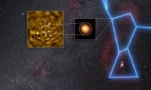 Read article: Betelgeuse is not alone
Did cocoons of dense gas shine brightly in the early universe?
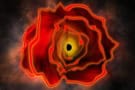 Read article: ‘Little red dots’ could herald the birth of supermassive black holes